Rest of the answer
Tell us more about how you evaluated the indirect consequences of climate-related regulation and business trends and how you concluded they are not material, providing support for your determinations.
According to your response, you (i) believe customers purchase your products and services for a wide variety of reasons, (ii) do not believe you have experienced decreased demand for products or services that produce significant greenhouse gas emissions or are related to carbon-based energy sources,
(iii) have not identified emissions as a driver of demand, (iv) are not aware of energy efficiency being a primary consideration, and (v) are not able to isolate the extent to which any single factor affects customers’ decisions. Tell us more about your actual experience regarding climate-related changes in demand and competition, including how you have identified or become aware of them. Explain the difficulty you have experienced in isolating climate-related factors from the other factors noted in your response, and tell us how you considered disclosing the related uncertainties in evaluating climate-related business trends.
Your response indicates that you believe your offerings could support customers’ achievement of environmental sustainability goals, both through transition to the cloud and through various cloud solutions. We also note disclosure on page 5 of your Form 10-K indicating that cloud service revenues represented 32%, 25%, and 22% of total revenues in fiscal 2023, 2022, and 2021. Tell us how you evaluated the materiality of these potential opportunities for purposes of disclosure.
Your response indicates that your cloud services used 81% renewable energy in 2023, with the goal of reaching 100% renewable energy across your commercial portfolio by the end of 2025. Provide us with additional information regarding the steps you have taken and expect to take in connection with your renewable energy goal. Include quantification of the costs incurred during the periods covered by your Form 10-K and expected to be incurred in future periods, and tell us how you assessed materiality.
Response
Set forth below are the Company’s detailed responses to each of the items referenced in the Staff’s comment.
Your response that you have not seen or identified any material indirect consequences of climate-related regulation or business trends appears conclusory in nature. In this regard, we note disclosure in your Form 10-K cited in response to prior comment 1, including that
“Regulatory, market, and competitive pressures regarding the greenhouse gas emissions and energy mix for our data center operations may also grow,” and on page 4 regarding increased customer demand for
Oracle Cloud Services. Tell us more about how you evaluated the indirect consequences of climate-related regulation and business trends and how you concluded they are not material, providing support for your determinations.
The Company has implemented a robust process to proactively identify, assess and manage environmental and climate-related risks, including through the use of risk management software and risk modeling tools and the performance of quantitative and qualitative scenario analyses. Assessments of environmental and climate-related risks are reviewed and discussed during quarterly meetings of the ESC and are also considered in connection with the Company’s Disclosure Reviews.
In connection with this process, the Company has assessed the reasonably foreseeable direct and indirect consequences of a variety of climate-related risks, including with respect to current and emerging regulation, technology, legal and compliance, market, reputational, acute physical and chronic physical risks. For example, as part of its assessment and management of climate-related regulatory risks, the Company closely monitors potential laws around energy efficiency and the circular economy and has sought to proactively mitigate the potential impact of such laws by participating in voluntary energy efficiency programs such as ENERGY STAR and LEED certifications. Informed by these risk assessment and risk management exercises, the
Company expects its exposure to risks related to existing climate-related regulation to increase gradually over time but does not expect that such risks will represent exposures of more than 1% of its annual revenues.
Similarly, the Company has not identified any material indirect consequences of climate-related business trends. In connection with the
Company’s risk management processes and Disclosure Reviews, the Company monitors market trends, including potential shifts in customer preferences toward low-carbon products, to inform product strategy.
For example, in order to ensure that the Company’s products align to customers’ emissions reduction goals, the Company has implemented trainings for its hardware engineers in circular economy design principles. In addition, the Company believes that its Social Impact Report and other proactive and voluntary stakeholder communications have helped to communicate its alignment with climate-related business trends, aiding the Company’s ability to effectively mitigate potential demand and reputational risks relating to climate-related business trends.
As a result of these risk assessment and management processes, the Company believes its exposure to risks relating to the indirect consequences of climate-related regulation or business trends is limited and has been further mitigated by the Company’s proactive steps to address those risks. For these reasons, the Company determined that no additional disclosure regarding the potential indirect consequences of climate-related regulation or business trends beyond that included on page 28 of the 2023 Form
10-K, which states that regulatory, market and competitive pressures regarding the greenhouse gas emissions and energy mix for its data center operations may grow, was required under the Applicable Disclosure
Requirements or would otherwise constitute material information necessary in order to make the statements in the 2023 Form 10-K, in light of the circumstances under which they were made, not misleading.
According to your response, you (i) believe customers purchase your products and services for a wide variety of reasons, (ii) do not believe you have experienced decreased demand for products or services that produce significant greenhouse gas emissions or are related to carbon-based energy sources, (iii) have not identified emissions as a driver of demand, (iv) are not aware of energy efficiency being a primary consideration, and (v) are not able to isolate the extent to which any single factor affects customers’ decisions. Tell us more about your actual experience regarding climate-related changes in demand and competition, including how you have identified or become aware of them. Explain the difficulty you have experienced in isolating climate-related factors from the other factors noted in your response, and tell us how you considered disclosing the related uncertainties in evaluating climate-related business trends.
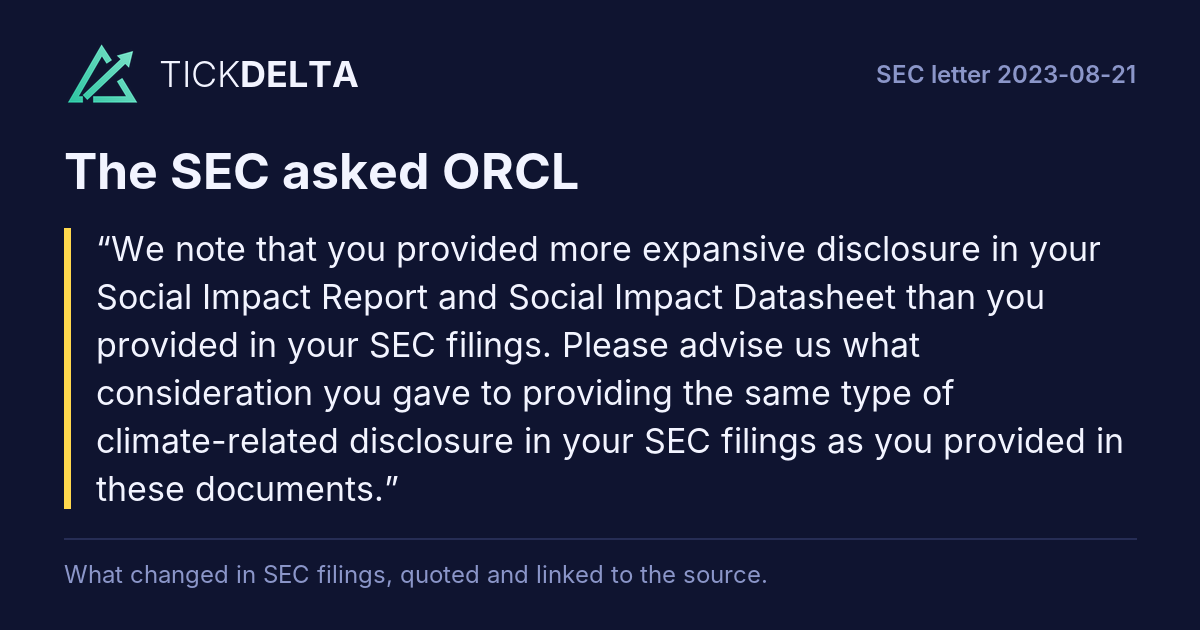
As noted above, market risks, such as potential shifts in customer preferences toward low-carbon products, are included in the Company’s climate-related risk assessments, and the Company monitors market trends, including potential shifts in customer preferences toward low-carbon products, to inform product strategy. For example, in order to ensure that the Company’s products align to customers’ emissions reduction goals, the Company has implemented trainings for its hardware engineers in circular economy design principles. In addition, the Company believes that its Social Impact Report and other proactive and voluntary disclosures about its environmental initiatives and footprint, including with respect to building and energy efficiency, renewable energy and emissions reduction, have helped to communicate its alignment with customers’ potential emissions reduction goals, aiding the Company’s management of demand and reputational risks relating to climate-related business trends.
The Company believes that these efforts to identify and respond to climate-related market trends, coupled with its proactive disclosures regarding such matters, have effectively addressed and mitigated the potential for customer considerations related to energy efficiency, greenhouse gas emissions, use of carbon-based energy sources and other potential climate-related considerations to adversely affect demand for the Company’s offerings. Although the Company believes that greenhouse gas emissions, use of carbon-based energy sources and energy efficiency may be among the factors considered by some of its customers, it is difficult to isolate the extent to which such factors affect customers’ decisions, if at all, as to whether or not to utilize its offerings. Further, as disclosed in the Initial Response Letter and on page 15 of the 2023 Form 10-K, the Company believes that numerous other factors, including cost, performance, scalability, reliability, security, functionality, efficiency, ease of use, speed to production and quality of technical support, are the key factors on which the Company competes in its cloud services and other businesses. Because the Company does not consider climate-related considerations to be a key factor upon which it competes, the Company believes a discussion of uncertainties in evaluating climate-related business trends was not material under the Applicable Disclosure Requirements and was appropriately omitted from the 2023 Form
10-K.
Your response indicates that you believe your offerings could support customers’ achievement of environmental sustainability goals, both through transition to the cloud and through various cloud solutions. We also note disclosure on page 5 of your Form 10-K indicating that cloud service revenues represented 32%, 25%, and 22% of total revenues in fiscal 2023, 2022, and 2021. Tell us how you evaluated the materiality of these potential opportunities for purposes of disclosure.
As noted above, the Company monitors market trends, including potential shifts in customer preferences toward low-carbon products, to inform product strategy, and believes that climate-related factors may be among the factors considered by some customers in deciding whether or not to utilize the Company’s offerings. For example, transitioning from on-premises infrastructure to a more efficient and sustainably powered cloud can help customers reduce their greenhouse gas emissions. However, as discussed above, the Company believes that numerous other factors, including cost, performance, scalability, reliability, security, functionality, efficiency, ease of use, speed to production and quality of technical support, are the key factors on which the Company competes in its cloud services and other businesses. Because the Company does not believe the potential to support customers’ achievement of sustainability goals is a key factor upon which it competes, it believes a discussion of such potential opportunities was not material under the Applicable Disclosure Requirements and was appropriately omitted from the 2023 Form 10-K.
Your response indicates that your cloud services used 81% renewable energy in 2023, with the goal of reaching 100% renewable energy across your commercial portfolio by the end of 2025. Provide us with additional information regarding the steps you have taken and expect to take in connection with your renewable energy goal. Include quantification of the costs incurred during the periods covered by your Form 10-K and expected to be incurred in future periods, and tell us how you assessed materiality.
The Company has taken various steps in pursuit of its renewable energy goal, including purchasing renewable energy and making strategic investments in renewable energy projects. The Company estimates that incremental costs from purchases of renewable energy and investments in renewable energy projects amounted to less than approximately 0.65% of its total cost of power in each of the periods covered by the 2023 Form 10-K. The Company’s total cost of power was less than approximately 1.15% of total operating expenses in each of such period, and disclosure of such amounts was therefore determined to be immaterial under the Applicable Disclosure Requirements and appropriately omitted from the 2023 Form 10-K.
The Company’s future energy costs, including incremental expenses associated with the Company’s renewable energy goal, will depend on many variables including energy price fluctuations and fluctuations in energy demand, driven by both demand for the Company’s cloud services and the energy efficiency of the Company’s commercial real estate portfolio and systems. For these reasons, although the Company expects its future energy costs will increase as its cloud business grows, such costs (and any incremental costs related to the Company’s renewable energy goal) cannot be predicted with precision or certainty and are not expected to change significantly as a proportion of total operating expenses. The Company is taking active steps to control and monitor future energy costs. If such energy costs become material to the Company’s business, financial condition or results of operations under the Applicable Disclosure Requirements, the Company will disclose them in future filings.