Form 10-K
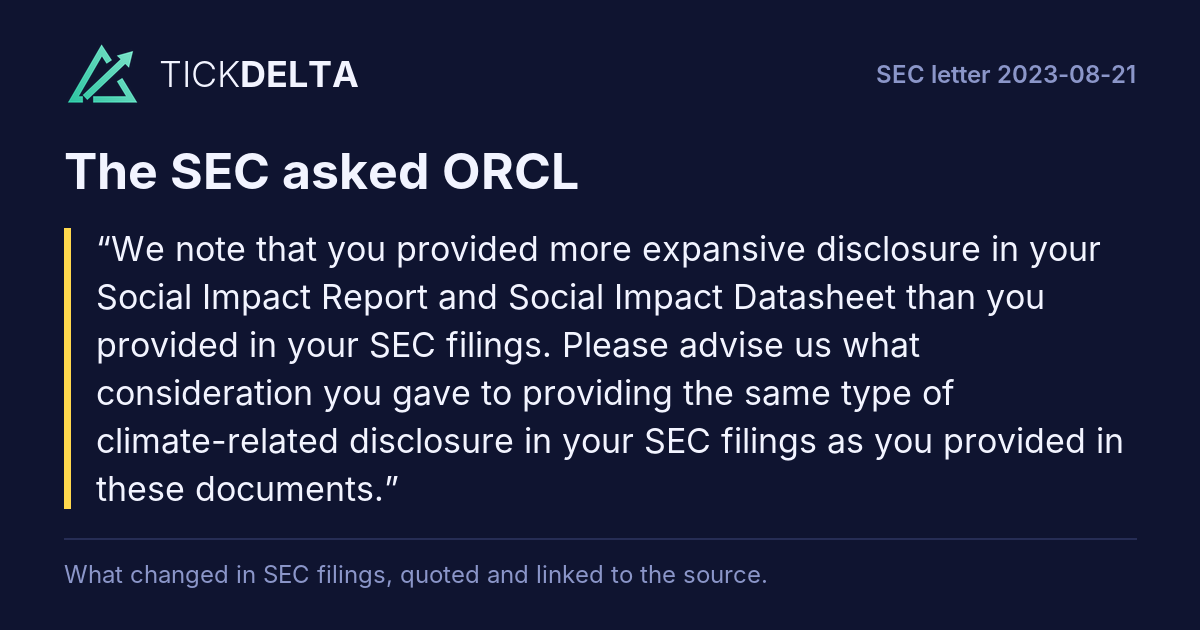
We note that you provided more expansive disclosure in your Social Impact Report and Social Impact Datasheet than you provided in your SEC filings. Please advise us what consideration you gave to providing the same type of climate-related disclosure in your SEC filings as you provided in these documents.
The Company acknowledges the Staff’s comment and respectfully advises the Staff that its Social Impact Report and Social Impact Datasheet (together, the
“Social Impact Disclosures”) address sustainability reporting practices, speak to a wide range of stakeholder interests and provide disclosures beyond those that the Company, in consultation with SEC rules and regulations and other applicable law, considers material for investors in the context of an Annual Report on Form 10-K.Read in the reply ↗Rest of the answer
The Social Impact Disclosures provide a convenient means of communicating social impact-related information, including climate-related disclosure, that may be of interest to a wide range of stakeholders, including customers, employees, suppliers, business partners and members of the communities in which the Company operates. The Company takes sustainability and climate change-related matters seriously and has voluntarily provided this information to its stakeholders.
Page
However, the information included in the Social Impact Disclosures is substantially more detailed than the information required to be disclosed under existing SEC rules and regulations, and the
Company believes such information is not material under the standards applicable to its filings with the SEC.
The Company carefully considers the requirements applicable to each filing under the Securities Exchange Act of 1934, as amended (the “Exchange Act”), the rules and regulations promulgated thereunder (the “Applicable Disclosure
Requirements”), as well as SEC guidance regarding those requirements, including the SEC’s Guidance Regarding Disclosure Related to Climate Change (SEC Rel. 33-9106, Feb. 2, 2010). In connection with the preparation of the Company’s Annual Reports on Form 10-K, including the 2023 Form 10-K, Quarterly Reports on Form
10-Q and annual proxy statements, including the 2022 Definitive Proxy Statement on Schedule 14A (the “2022 Proxy Statement”) and in consideration of the Applicable Disclosure
Requirements, the Company engages in a number of processes to surface potentially material developments, events, trends and risks for consideration for disclosure (collectively, the “Disclosure Reviews”). Among other things, members of the Company’s legal, finance, regulatory, compliance, investor relations, tax, treasury and sustainability teams review portions of the Company’s prior disclosures; propose potential new disclosures as appropriate; meet with each other and with other key business leaders to discuss potentially material developments, events, trends and risks; and seek input from other areas of the business as necessary. In addition, the Company maintains a standing Disclosure Committee, which includes the Company’s Chief Accounting Officer, Chief Legal Officer and other senior business leaders. The Disclosure Committee generally meets on a quarterly basis to review previous and proposed new disclosures and to discuss any changes that may be appropriate as a result of potentially material events, trends and risks identified during the Disclosure Review process. In determining the materiality of information to be included in its disclosures, the Company refers to the standard of materiality set forth in Basic v. Levinson, 485 U.S. 224 (1988).
In connection with its Disclosure Reviews, the Company regularly considers climate-related matters for inclusion in its filings, including in consideration of the requirements of Items 101, 105 and 303 of Regulation S-K. During the Disclosure Review process in connection with the preparation of the 2023 Form 10-K and the 2022 Proxy Statement, the Company considered whether it was required under the Applicable Disclosure Requirements to provide any of the extensive climate-related information that it has included in previous iterations of the Social Impact Disclosures. The Company determined that such information was not required to be included in the 2023 Form 10-K under the Applicable Disclosure Requirements or otherwise material information necessary in order to make the statements in the 2023 Form 10-K or the 2022 Proxy Statement, in light of the circumstances under which they were made, not misleading.
On page 28 of the Company’s 2023 Form 10-K, the Company included disclosure regarding environmental and related laws and regulations that could result in significant liabilities and costs. The Company disclosed that it has an Environmental Steering Committee comprised of senior management that oversees sustainability strategy, including climate risk mitigation, and provided additional information about the committee. The Company also disclosed that failure to implement and oversee controls to comply with mandatory environmental, social and governance-related disclosures may result in liability or harm to the Company’s reputation.
The Company has also evaluated the potential impact of failing to meet the standards and goals that are voluntarily set forth in its Social Impact Report. The Company determined that stockholders could potentially find such failure to be material and has timely disclosed this risk on page 28 of the 2023
Form 10-K, which states that the Company’s failure to meet these standards and goals may “potentially harm [the Company’s] reputation and brand.”
The Company therefore respectfully submits that the type of detailed climate-related disclosure in the Social Impact Disclosures was not required under the
Applicable Disclosure Requirements to be included in the 2023 Form 10-K or any other required SEC filings. With respect to future filings, the Company will continue to monitor and evaluate whether inclusion of any specific pending or existing climate-related matters may be warranted in response to the Applicable Disclosure Requirements in accordance with the processes described above.
To the extent material, discuss the indirect consequences of climate-related regulation or business trends, such as the following: • decreased demand for products or services that produce significant greenhouse gas emissions or are related to carbon-based energy sources; • increased demand for products or services that result in lower emissions than competing products; • increased competition to develop innovativeRest of the question
new products that result in lower emissions; • increased demand for generation and transmission of energy from alternative energy sources; and • any anticipated reputational risks resulting from operations or products that produce material greenhouse gas emissions.
The Company acknowledges the Staff’s comment and respectfully advises the Staff that it has not identified any material indirect consequences of climate-related regulation or business trends that would be required to be disclosed under the Applicable Disclosure Requirements or would otherwise constitute material information necessary in order to make the statements in the 2023 Form 10-K, in light of the circumstances under which they were made, not misleading.Read in the reply ↗Rest of the answer
As an initial matter, the Company notes that it is in the business of providing products and services that address enterprise information technology (“IT”) environments. In 2023, the Company generated 83% of its revenue from its cloud and license offerings, 6% from its enterprise hardware products and hardware-related software products and
11% from its consulting services and advanced customer services. The Company’s thousands of global customers vary widely by size and geography, and the trends and factors affecting demand for its offerings vary by region and customer.
The Company’s products and services do not directly produce greenhouse gases and only indirectly contribute to greenhouse gas emissions through the energy used to power data centers to deliver the Company’s cloud and license offerings, to manufacture and distribute the Company’ hardware products and to power offices for the Company’s staff. Although the Company has not seen, to date, any material indirect consequences of climate-related regulation or business trends, the Company is nevertheless committed to reducing the environmental footprint of its operations, including through the use of renewable energy sources and circular economy hardware design principles. For example, in calendar year 2022 the Company’s cloud services used 81% renewable energy, and the Company has a goal to reach 100% renewable energy across its commercial portfolio by the end of calendar year 2025. The Company believes its offerings could also support its customers’ achievement of environmental sustainability goals, both through the transition from on-premises infrastructure to the cloud, which is more efficient and can help reduce greenhouse gas emissions, and through various cloud solutions which allow customers to design environmentally friendly products, source materials responsibly, transport goods in more sustainable ways, manage risks and analyze and report on environmental impacts of their business operations.
Set forth below are the Company’s detailed responses to each of the items referenced in the Staff’s comment.
carbon-based energy sources
As described above, the Company’s products and services do not directly produce greenhouse gases and only indirectly contribute to greenhouse gas emissions through the energy used to power data centers to deliver the Company’s cloud and license offerings, to manufacture and distribute the Company’s hardware products and to power offices for the Company’s staff. In each of its businesses, the Company believes that its customers make purchasing decisions based on a variety of reasons, including, among others, cost, performance, scalability, reliability, security, functionality, efficiency, ease of use, speed to production and quality of technical support. To date, the Company does not believe that it has experienced decreased demand for products or services that produce significant greenhouse gas emissions or are related to carbon-based energy sources, and the Company has not identified such emissions in relation to carbon-based energy sources as a driver of demand for its products or services. The Company is not aware of energy efficiency being a primary consideration for its customers, although it may be a related consideration in some cases, and the Company is not able to isolate the extent to which this or any other single factor affects customers’ decisions as to whether or not to utilize those offerings.
As noted above, the Company believes that its customers purchase its products and services for a wide variety of reasons. Although the energy efficiency of the Company’s cloud services is one factor that customers may consider when determining to utilize the Company’s cloud and license offerings, the Company is not able to isolate the extent to which this or any other single factor affects customers’ decisions as to whether or not to utilize those offerings.
increased competition to develop innovative new products that result in lower emissions
The Company is not aware of any increased competition to develop new products that result in lower emissions. As noted above, the
Company believes that its customers purchase its products and services for a wide variety of reasons. The Company is not aware of lower emissions being a primary consideration for its customers, although it may be a related consideration in some cases. Improvements in energy efficiency and cost to operate, which are factors on which the Company does believe it competes for customers, may have the added benefit of resulting in lower emissions, but the Company does not believe that climate change-related regulations or business trends drive such competition.
increased demand for generation and transmission of energy from alternative energy sources
The Company is not aware of any increased demand for generation and transmission of energy from alternative energy sources as it relates to the Company’s products or services. However, as noted above, the Company’s cloud offerings used 81% renewable energy in calendar year 2022, and the Company has a goal to reach 100% renewable energy across its commercial portfolio by the end of calendar year 2025. Consequently, the Company does not expect to experience any material impacts from increased demand for generation and transmission of energy from alternative energy sources with respect to its operations.
As noted above, the Company does not believe its products or services directly produce significant greenhouse gas emissions, and it has taken steps to generally reduce its overall environmental footprint, which it believes have yielded reputational benefits. Consequently, the Company does not anticipate any material reputational risks resulting from its operations or products that produce greenhouse gas emissions.
For the reasons discussed above, the Company has not identified any material indirect consequences of climate-related regulation or business trends. Therefore, the Company does not believe any related disclosure is required under the Applicable Disclosure Standards or is otherwise necessary in order to make the statements in the 2023
Form 10-K, in light of the circumstances under which they were made, not misleading. The Company will continue to consider the material indirect consequences of climate-related regulation or business trends in connection with future Disclosure Reviews, and if they are considered reasonably likely to have a material effect on its business, financial condition, liquidity or results of operations, the Company will include disclosure in its future Exchange
Act filings as appropriate.
First report after the company's reply of 2023-09-19: 10-Q filed 2023-12-12 ↗, against the 10-Q filed 2023-03-10 ↗.
Tickdelta does not hold the text of both reports, so they are not compared here.
We note disclosure on page 31 of the Form 10-K that your critical business operations are concentrated in a few geographic areas and that major natural disasters or the effects of climate change, such as increased storm severity or drought, are risks to your business. Please discuss the physical effects of climate change on your operations and results.Rest of the question
This disclosure may include the following: • severity of weather, such as floods, hurricanes, sea levels, extreme fires, and water availability and quality; • quantification of weather-related damages to your property or operations; • potential for indirect weather-related impacts that have affected or may affect your major customers or suppliers; and • the extent to which extreme weather events have reduced the availability of insurance or increased the cost of insurance. Include quantitative information for each of the periods covered by your Form 10-K and explain whether increased amounts are expected in future periods.
The Company respectfully advises the
Staff that it has not experienced any material impacts from the physical effects of climate change on its operations and results during the periods covered by the 2023 Form 10-K, including with respect to severity of weather, weather-related damages to its property or operations, potential for indirect weather-related impacts to its customers or suppliers, or the availability and cost of insurance.Read in the reply ↗Rest of the answer
As the Staff has noted, the Company identified business disruptions, including disruptions caused by natural disasters or the effects of climate change, such as increased storm severity or drought, as risks to the Company’s operating results to the extent that they destroy or disrupt critical business operations, supply chains or IT systems. As noted on page 31 of the 2023 Form 10-K, such disruption risk is not unique to natural disasters or climate change, but rather to any
“catastrophic event,” including a “political, social or other disruption to infrastructure that supports [the Company’s] operations.” The Company also considered its exposure to other risks related to climate change and disclosed certain such risks on pages 27 and 28 of the 2023 Form 10-K, including the risk of increased compliance costs, liability and reputational risks in connection with applicable climate reporting and disclosure regimes. The disruption risk disclosed in the 2023 Form 10-K has not materialized, and the Company does not believe any additional disclosure is required under the Applicable Disclosure Standards.
Set forth below are the Company’s detailed responses to each of the items referenced in the Staff’s comment.
As the Company is primarily in the business of providing IT products and services, its material properties are its headquarters, its offices, its principal internal manufacturing facility and its data centers, as disclosed under Part I, Item 2. Properties of the 2023 Form 10-K. As one element of its internal risk management processes, the Company regularly considers physical risks to its properties and work force, including the expected impacts of rising mean temperatures, rising sea levels, storm damage and flooding. For example, certain of the
Company’s facilities have been intentionally sited on high ground in order to mitigate potential flooding risk, and the Oracle Cloud is purpose-built for geographic redundancy, resiliency and disaster recovery, such that in the event of a severe climate-related impact to one cloud facility, traffic would be automatically redirected to an alternate facility that is not impacted by the climate-related event. The Company also has implemented a robust crisis management and continuity process that shifts operations away from areas that experience weather-related or other incidents and mitigates the operational risk of such incidents. The Company’s properties and operations experienced limited weather-related impacts during the periods covered by the 2023 Form 10-K, and no disclosure of such impacts was required under the Applicable Disclosure Standards.
In addition, in connection with its internal risk management process, the Company has assessed the hypothetical impacts of various future climate scenarios on its cloud, manufacturing and critical business functions sites. As a result of this assessment, the Company concluded that its current processes have mitigated climate-related physical risks, and although the Company expects costs associated with the physical effects of climate change could increase moderately over time, it does not expect such impacts to have a material effect on its operations or results.
As described above, the Company’s properties experienced limited weather-related impacts during the periods covered by the 2023 Form 10-K. The costs associated with weather-related impacts during these periods accounted for less than 0.01% of the Company’s total operating expenses during each applicable period and were therefore immaterial under the Applicable Disclosure Standards. The Company also did not experience any material operational weather-related impacts during these periods as the Company’s operations were shifted from the impacted area to another area that was not affected. Although the Company believes that costs associated with the physical effects of climate change could increase moderately over time, it does not expect such impacts to have a material effect on its operations or results.
The Company works with many suppliers throughout the world and has a large and geographically diversified customer base. The Company believes that such diversification helps mitigate the risk that any single weather-related event would have a material effect on the Company as a whole. In preparing the 2023 Form 10-K, the
Company did not identify any weather-related impacts on its customers or suppliers during the periods covered by the 2023 Form 10-K that had a material impact on its operations or results. Given the severity and prevalence of weather-related events worldwide, the Company believes that certain of its major customers or suppliers may experience physical effects of climate change in the future, but the Company does not anticipate that such customer impacts will have a material impact on its operations or results.
The Company does not believe the physical effects of climate change have significantly affected its cost or availability of insurance. The cost of the Company’s insurance premiums is directly tied to the cost of insurance in the overall insurance market, and although such market-wide costs may rise in a given year due to factors that may include severe weather events, the Company is unable to disaggregate or quantify the individual drivers of market-wide insurance rate changes and does not believe that any of its insurance costs include weather-related premiums specific to its own operations. In addition, the Company’s total insurance costs in each of the periods covered by the 2023 Form 10-K accounted for less than 0.15% of total operating expenses in such periods. The Company expects such costs to rise modestly in future periods but does not anticipate that they will have a material impact on its operations or results.
For the reasons discussed above, the Company has not experienced material impacts from the physical effects of climate change that would be required to be disclosed in the 2023 Form 10-K. The Company will continue to consider impacts from the physical effects of climate change on its operations and results in connection with future Disclosure Reviews, and if they are considered reasonably likely to have a material effect on its business, financial condition, liquidity or results of operations, the Company will include disclosure in its future Exchange Act filings as appropriate.
First report after the company's reply of 2023-09-19: 10-Q filed 2023-12-12 ↗, against the 10-Q filed 2023-03-10 ↗.
Tickdelta does not hold the text of both reports, so they are not compared here.
Please provide disclosure about your purchase and sale of carbon credits, carbon offsets, or energy attribute certificates, and any material effects on your business, financial condition, and results of operations. Provide us with quantitative information for each of the periods covered by your most recent Form 10-K and the amounts budgeted for or expected to be incurred in future periods.
2023, the Company purchased $2,000,000 of renewable energy credits to offset a portion of the Company’s energy consumption. This amount is approximately 0.004% of the Company’s fiscal 2023 revenues and was therefore not material to the
Company’s business, financial condition or results of operations. The Company did not purchase or sell carbon credits, carbon offsets or energy attribute certificates in fiscal 2021 or fiscal 2022.Read in the reply ↗Rest of the answer
The Company will continue to monitor purchases and sales of carbon credits, carbon offsets and energy attribute certificates and, if the transactions are material to the Company’s business, financial condition or results of operations, will disclose them in future filings.
First report after the company's reply of 2023-09-19: 10-Q filed 2023-12-12 ↗, against the 10-Q filed 2023-03-10 ↗.
Tickdelta does not hold the text of both reports, so they are not compared here.
We note your response to prior comment 2. Please further address the following: • Your response that you have not seen or identified any material indirect consequences of climate-related regulation or business trends appears conclusory in nature.Rest of the question
In this regard, we note disclosure in your Form 10-K cited in response to prior comment 1, including that “Regulatory, market, and competitive pressures regarding the greenhouse gas emissions and energy mix for our data center operations may also grow,” and on page 4 regarding increased customer demand for Oracle Cloud Services. Tell us more about how you evaluated the indirect consequences of climaterelated regulation and business trends and how you concluded they are not material, providing support for your determinations. • According to your response, you (i) believe customers purchase your products and services for a wide variety of reasons, (ii) do not believe you have experienced decreased demand for products or services that produce significant greenhouse gas emissions or are related to carbon-based energy sources, (iii) have not identified emissions as a driver of demand, (iv) are not aware of energy efficiency being a primary consideration, and (v) are not able to isolate the extent to which any single factor affects customers’ decisions. Tell us more about your actual experience regarding climate-related changes in demand and competition, including how you have identified or become aware of them. Explain the difficulty you have experienced in isolating climate-related factors from the other factors noted in your response, and tell us how you considered disclosing the related uncertainties in evaluating climaterelated business trends. • Your response indicates that you believe your offerings could support customers’ achievement of environmental sustainability goals, both through transition to the cloud and through various cloud solutions. We also note disclosure on page 5 of your Form 10-K indicating that cloud service revenues represented 32%, 25%, and 22% of total revenues in fiscal 2023, 2022, and 2021. Tell us how you evaluated the materiality of these potential opportunities for purposes of disclosure. • Your response indicates that your cloud services used 81% renewable energy in 2023, with the goal of reaching 100% renewable energy across your commercial portfolio by the end of 2025. Provide us with additional information regarding the steps you have taken and expect to take in connection with your renewable energy goal. Include quantification of the costs incurred during the periods covered by your Form 10-K and expected to be incurred in future periods, and tell us how you assessed materiality.
that you have not seen or identified any material indirect consequences of climate-related regulation or business trends appears conclusory in nature. In this regard, we note disclosure in your Form 10-K cited in response to prior comment 1, including that
“Regulatory, market, and competitive pressures regarding the greenhouse gas emissions and energy mix for our data center operations may also grow,” and on page 4 regarding increased customer demand for
Oracle Cloud Services.Read in the reply ↗Rest of the answer
Tell us more about how you evaluated the indirect consequences of climate-related regulation and business trends and how you concluded they are not material, providing support for your determinations.
According to your response, you (i) believe customers purchase your products and services for a wide variety of reasons, (ii) do not believe you have experienced decreased demand for products or services that produce significant greenhouse gas emissions or are related to carbon-based energy sources,
(iii) have not identified emissions as a driver of demand, (iv) are not aware of energy efficiency being a primary consideration, and (v) are not able to isolate the extent to which any single factor affects customers’ decisions. Tell us more about your actual experience regarding climate-related changes in demand and competition, including how you have identified or become aware of them. Explain the difficulty you have experienced in isolating climate-related factors from the other factors noted in your response, and tell us how you considered disclosing the related uncertainties in evaluating climate-related business trends.
Your response indicates that you believe your offerings could support customers’ achievement of environmental sustainability goals, both through transition to the cloud and through various cloud solutions. We also note disclosure on page 5 of your Form 10-K indicating that cloud service revenues represented 32%, 25%, and 22% of total revenues in fiscal 2023, 2022, and 2021. Tell us how you evaluated the materiality of these potential opportunities for purposes of disclosure.
Your response indicates that your cloud services used 81% renewable energy in 2023, with the goal of reaching 100% renewable energy across your commercial portfolio by the end of 2025. Provide us with additional information regarding the steps you have taken and expect to take in connection with your renewable energy goal. Include quantification of the costs incurred during the periods covered by your Form 10-K and expected to be incurred in future periods, and tell us how you assessed materiality.
Response
Set forth below are the Company’s detailed responses to each of the items referenced in the Staff’s comment.
Your response that you have not seen or identified any material indirect consequences of climate-related regulation or business trends appears conclusory in nature. In this regard, we note disclosure in your Form 10-K cited in response to prior comment 1, including that
“Regulatory, market, and competitive pressures regarding the greenhouse gas emissions and energy mix for our data center operations may also grow,” and on page 4 regarding increased customer demand for
Oracle Cloud Services. Tell us more about how you evaluated the indirect consequences of climate-related regulation and business trends and how you concluded they are not material, providing support for your determinations.
The Company has implemented a robust process to proactively identify, assess and manage environmental and climate-related risks, including through the use of risk management software and risk modeling tools and the performance of quantitative and qualitative scenario analyses. Assessments of environmental and climate-related risks are reviewed and discussed during quarterly meetings of the ESC and are also considered in connection with the Company’s Disclosure Reviews.
In connection with this process, the Company has assessed the reasonably foreseeable direct and indirect consequences of a variety of climate-related risks, including with respect to current and emerging regulation, technology, legal and compliance, market, reputational, acute physical and chronic physical risks. For example, as part of its assessment and management of climate-related regulatory risks, the Company closely monitors potential laws around energy efficiency and the circular economy and has sought to proactively mitigate the potential impact of such laws by participating in voluntary energy efficiency programs such as ENERGY STAR and LEED certifications. Informed by these risk assessment and risk management exercises, the
Company expects its exposure to risks related to existing climate-related regulation to increase gradually over time but does not expect that such risks will represent exposures of more than 1% of its annual revenues.
Similarly, the Company has not identified any material indirect consequences of climate-related business trends. In connection with the
Company’s risk management processes and Disclosure Reviews, the Company monitors market trends, including potential shifts in customer preferences toward low-carbon products, to inform product strategy.
For example, in order to ensure that the Company’s products align to customers’ emissions reduction goals, the Company has implemented trainings for its hardware engineers in circular economy design principles. In addition, the Company believes that its Social Impact Report and other proactive and voluntary stakeholder communications have helped to communicate its alignment with climate-related business trends, aiding the Company’s ability to effectively mitigate potential demand and reputational risks relating to climate-related business trends.
As a result of these risk assessment and management processes, the Company believes its exposure to risks relating to the indirect consequences of climate-related regulation or business trends is limited and has been further mitigated by the Company’s proactive steps to address those risks. For these reasons, the Company determined that no additional disclosure regarding the potential indirect consequences of climate-related regulation or business trends beyond that included on page 28 of the 2023 Form
10-K, which states that regulatory, market and competitive pressures regarding the greenhouse gas emissions and energy mix for its data center operations may grow, was required under the Applicable Disclosure
Requirements or would otherwise constitute material information necessary in order to make the statements in the 2023 Form 10-K, in light of the circumstances under which they were made, not misleading.
According to your response, you (i) believe customers purchase your products and services for a wide variety of reasons, (ii) do not believe you have experienced decreased demand for products or services that produce significant greenhouse gas emissions or are related to carbon-based energy sources, (iii) have not identified emissions as a driver of demand, (iv) are not aware of energy efficiency being a primary consideration, and (v) are not able to isolate the extent to which any single factor affects customers’ decisions. Tell us more about your actual experience regarding climate-related changes in demand and competition, including how you have identified or become aware of them. Explain the difficulty you have experienced in isolating climate-related factors from the other factors noted in your response, and tell us how you considered disclosing the related uncertainties in evaluating climate-related business trends.
As noted above, market risks, such as potential shifts in customer preferences toward low-carbon products, are included in the Company’s climate-related risk assessments, and the Company monitors market trends, including potential shifts in customer preferences toward low-carbon products, to inform product strategy. For example, in order to ensure that the Company’s products align to customers’ emissions reduction goals, the Company has implemented trainings for its hardware engineers in circular economy design principles. In addition, the Company believes that its Social Impact Report and other proactive and voluntary disclosures about its environmental initiatives and footprint, including with respect to building and energy efficiency, renewable energy and emissions reduction, have helped to communicate its alignment with customers’ potential emissions reduction goals, aiding the Company’s management of demand and reputational risks relating to climate-related business trends.
The Company believes that these efforts to identify and respond to climate-related market trends, coupled with its proactive disclosures regarding such matters, have effectively addressed and mitigated the potential for customer considerations related to energy efficiency, greenhouse gas emissions, use of carbon-based energy sources and other potential climate-related considerations to adversely affect demand for the Company’s offerings. Although the Company believes that greenhouse gas emissions, use of carbon-based energy sources and energy efficiency may be among the factors considered by some of its customers, it is difficult to isolate the extent to which such factors affect customers’ decisions, if at all, as to whether or not to utilize its offerings. Further, as disclosed in the Initial Response Letter and on page 15 of the 2023 Form 10-K, the Company believes that numerous other factors, including cost, performance, scalability, reliability, security, functionality, efficiency, ease of use, speed to production and quality of technical support, are the key factors on which the Company competes in its cloud services and other businesses. Because the Company does not consider climate-related considerations to be a key factor upon which it competes, the Company believes a discussion of uncertainties in evaluating climate-related business trends was not material under the Applicable Disclosure Requirements and was appropriately omitted from the 2023 Form
10-K.
Your response indicates that you believe your offerings could support customers’ achievement of environmental sustainability goals, both through transition to the cloud and through various cloud solutions. We also note disclosure on page 5 of your Form 10-K indicating that cloud service revenues represented 32%, 25%, and 22% of total revenues in fiscal 2023, 2022, and 2021. Tell us how you evaluated the materiality of these potential opportunities for purposes of disclosure.
As noted above, the Company monitors market trends, including potential shifts in customer preferences toward low-carbon products, to inform product strategy, and believes that climate-related factors may be among the factors considered by some customers in deciding whether or not to utilize the Company’s offerings. For example, transitioning from on-premises infrastructure to a more efficient and sustainably powered cloud can help customers reduce their greenhouse gas emissions. However, as discussed above, the Company believes that numerous other factors, including cost, performance, scalability, reliability, security, functionality, efficiency, ease of use, speed to production and quality of technical support, are the key factors on which the Company competes in its cloud services and other businesses. Because the Company does not believe the potential to support customers’ achievement of sustainability goals is a key factor upon which it competes, it believes a discussion of such potential opportunities was not material under the Applicable Disclosure Requirements and was appropriately omitted from the 2023 Form 10-K.
Your response indicates that your cloud services used 81% renewable energy in 2023, with the goal of reaching 100% renewable energy across your commercial portfolio by the end of 2025. Provide us with additional information regarding the steps you have taken and expect to take in connection with your renewable energy goal. Include quantification of the costs incurred during the periods covered by your Form 10-K and expected to be incurred in future periods, and tell us how you assessed materiality.
The Company has taken various steps in pursuit of its renewable energy goal, including purchasing renewable energy and making strategic investments in renewable energy projects. The Company estimates that incremental costs from purchases of renewable energy and investments in renewable energy projects amounted to less than approximately 0.65% of its total cost of power in each of the periods covered by the 2023 Form 10-K. The Company’s total cost of power was less than approximately 1.15% of total operating expenses in each of such period, and disclosure of such amounts was therefore determined to be immaterial under the Applicable Disclosure Requirements and appropriately omitted from the 2023 Form 10-K.
The Company’s future energy costs, including incremental expenses associated with the Company’s renewable energy goal, will depend on many variables including energy price fluctuations and fluctuations in energy demand, driven by both demand for the Company’s cloud services and the energy efficiency of the Company’s commercial real estate portfolio and systems. For these reasons, although the Company expects its future energy costs will increase as its cloud business grows, such costs (and any incremental costs related to the Company’s renewable energy goal) cannot be predicted with precision or certainty and are not expected to change significantly as a proportion of total operating expenses. The Company is taking active steps to control and monitor future energy costs. If such energy costs become material to the Company’s business, financial condition or results of operations under the Applicable Disclosure Requirements, the Company will disclose them in future filings.
First report after the company's reply of 2023-10-20: 10-Q filed 2023-12-12 ↗, against the 10-Q filed 2023-03-10 ↗.
Tickdelta does not hold the text of both reports, so they are not compared here.
Your response to prior comment 3 indicates that (i) your properties and operations experienced limited weather-related impacts during the periods covered by the Form 10-K and (ii) you did not identify any weather-related impacts on your customers or suppliers during these periods that had a material impact on your operations or results.Rest of the question
Please provide more information regarding these impacts on you, your customers, and your suppliers and tell us how you evaluated materiality, including by providing the quantification requested by our prior comment.
During the periods covered by the 2023 Form 10-K, the Company estimates that it incurred total weather-related property costs of approximately $1.8 million (including approximately $1.4 million in fiscal 2021 and approximately $0.4 million in fiscal 2023). All of these costs related to repairs of ice storm-related damage to buildings and landscaping at the Company’s Austin, Texas campus.Read in the reply ↗Rest of the answer
As noted in the Initial Response Letter, such costs accounted for less than 0.01% of the Company’s total operating expenses during each applicable period and were determined to be immaterial under the Applicable Disclosure Requirements.
Further, as noted in the Initial Response Letter, the Company has not experienced any material operational weather-related impacts during the periods covered by the 2023 Form 10-K. The Company has implemented a robust crisis management and continuity process that automatically shifts operations away from areas that experience weather-related or other incidents, enabling the Company to continue to provide services and support to its customers without disruption, and mitigates the operational risk of such incidents. For example, the Company took several steps to proactively address the risks posed by Hurricane Ian in 2022, including by actively communicating with employees, closing the Company’s office in Orlando, Florida as a precaution and re-routing critical business operations to alternative offices. The Company has also experienced occasional brief heat-related outages in certain of its data centers which were promptly resolved and therefore did not cause significant disruption to the Company or its customers. These and other weather-related impacts have not significantly disrupted the Company’s ability to continue to provide services and support to its customers or otherwise continue its operations. Consequently, the Company does not believe any additional disclosure regarding weather-related impacts to its properties or operations is required under the Applicable Disclosure Requirements.
Similarly, the Company is not aware of any weather-related impacts to its customers during the periods covered by the 2023 Form 10-K that had a material impact on the Company’s operations or results. The Company is not aware of any significant customers whose ability to pay the Company has been impacted by weather-related issues. Further, the Company notes that it has a large and geographically diversified customer base, with no single customer accounting for 10% or more of the Company’s revenue. If any single weather-related impact were to impact any of the Company’s customers, the Company believes that such diversification would help to mitigate the risk that such an event would have a material impact on the Company as a whole. The absence of any weather-related impacts to customers’ ability to pay and this diversification both contributed to the Company’s determination in connection with Disclosure Reviews relating to the 2023 Form 10-K that no additional disclosure regarding weather-related impacts to customers was required under the Applicable Disclosure Requirements.
The Company is likewise unaware of any weather-related impacts to suppliers that had a material impact on the Company’s operations or results. The Company, like many others, experienced unprecedented supply chain issues resulting from the COVID-19 pandemic. The Company responded by improving its supply chain management and broadening its supplier base in order to proactively mitigate potential disruptions that might impact one or more of its suppliers (weather-related or otherwise) and to ensure that the Company’s operations are not disrupted. For example, the Company has established a network of redundancies in its supply chain structure to ensure that the Company has consistent access to the parts it needs to operate its business. These redundancies include (i) sourcing parts used in its operations from two or more suppliers, (ii) ensuring that its suppliers’ operations are located in multiple physical locations in non-overlapping geographic regions and (iii) working with suppliers to create distinct shipping routes to distribute parts to the Company and its customers throughout the world. As noted in the Initial Response Letter, the Company believes that its diversified supply chain has helped mitigate the risk that any single event, weather-related or otherwise, would have a material impact on the Company as a whole. Additionally, in connection with its Disclosure Reviews the Company has not identified any one supplier as critical to its operations. Consequently, the Company believes that additional disclosure regarding weather-related impacts to suppliers was not required under the
Applicable Disclosure Requirements and was appropriately omitted from the 2023 Form 10-K.
As noted in the Initial Response Letter, the Company will continue to consider impacts from the physical effects of climate change on its operations and results in connection with future Disclosure Reviews, and if they have or are considered reasonably likely to have a material effect on its business, financial condition, liquidity or results of operations, the Company will include disclosure in its future Exchange Act filings as appropriate.
First report after the company's reply of 2023-10-20: 10-Q filed 2023-12-12 ↗, against the 10-Q filed 2023-03-10 ↗.
Tickdelta does not hold the text of both reports, so they are not compared here.
We note your response to prior comment 4 and reissue it in part. Please provide the quantitative information requested by our comment for future periods.
The Company respectfully advises the Staff that no specific budget for future purchases or sales of carbon credits, carbon offsets or energy attribute certificates has been determined with certainty or approved at this time. The Company is therefore unable to provide the quantitative information requested by the Staff’s comment for future periods.Read in the reply ↗Rest of the answer
Although no specific budget for future purchases or sales of carbon credits, carbon offsets or energy attribute certificates has been approved, the Company does not currently expect any such transactions to be material to the Company’s business, financial condition or results of operations under the Applicable Disclosure Requirements. As noted in the Initial Response Letter, the Company will continue to monitor any future purchases and sales of carbon credits, carbon offsets and energy attribute certificates and, if the transactions are material to the Company’s business, financial condition or results of operations under the Applicable Disclosure Requirements, will disclose them in future filings.
First report after the company's reply of 2023-10-20: 10-Q filed 2023-12-12 ↗, against the 10-Q filed 2023-03-10 ↗.
Tickdelta does not hold the text of both reports, so they are not compared here.
Also in this review: closing letter, 2023-11-03