OLD Republic International Corp ORI
New risk paragraphs, branching off last year
Each branch is a paragraph in Risk Factors with nothing like it in the 10-K filed Feb 27, 2025. A box jumps to the paragraph as filed, below.
Paragraphs with nothing like them in last year's 10-K
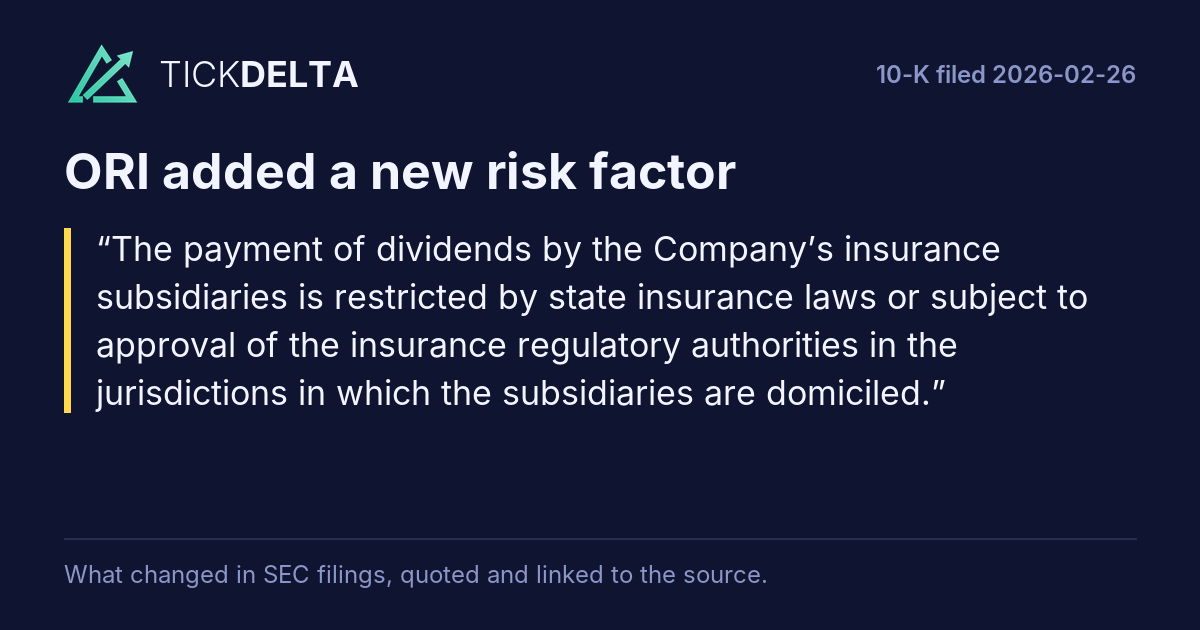
1 paragraph in Risk Factors of the 10-K filed Feb 26, 2026 with nothing like it in the 10-K filed Feb 27, 2025. Quoted exactly. Paragraphs that were only edited are under 10-K change.
The payment of dividends by the Company’s insurance subsidiaries is restricted by state insurance laws or subject to approval of the insurance regulatory authorities in the jurisdictions in which the subsidiaries are domiciled.
Paragraphs in the 10-Q filed Oct 30, 2026 that were not in the one before
New in the latest 10-Q
16 paragraphs in the 10-Q filed Oct 30, 2026 with nothing like them in the 10-Q filed Jul 31, 2026 (at least half the words must differ; new numbers alone do not count). Quoted exactly, grouped by the item heading above them. This is text that changed, not a judgement of how serious it is.
10-Q
On July 1, 2026, a 25 % quota share agreement between Old Republic and ECM Insurance Company that was entered into as of January 1, 2026 was terminated and the resulting balances were commuted.
Read in the 10-Q
The acquired business contributed revenues of $ 55.1 and pretax income of $ 14.0 to the Company during the three months ended September 30, 2026. The following table presents unaudited pro forma consolidated financial information for the quarter and nine months ended September 30, 2026 and 2025 as if the acquisition had occurred on January 1, 2025. The pro forma amounts were determined using ECM Insurance Group's results adjusted for purchase accounting effects and related tax impacts.
Read in the 10-Q
The financial statements reflect management's current best estimate of the purchase price allocation. Final valuation of the assets acquired and liabilities assumed will be completed within a year from the acquisition date. The initial acquisition accounting resulted in a bargain purchase gain of $ 124.9, which represents the excess of the fair value of net assets acquired over the purchase price. Before recognizing the gain, the Company reassessed the methods used in purchase accounting and verified that all assets acquired and liabilities assumed had been identified. The bargain purchase gain was primarily attributable to ECM Insurance Group's legal structure and the nature of the subscription rights offering.
Read in the 10-Q
Acquisition costs of $ 7.7 incurred in connection with the transaction, of which $ 4.3 and $ 5.9 were recognized in the third quarter and first nine months of 2026, respectively, were recorded as Underwriting, acquisition, and other expenses in the consolidated statements of income.
Read in the 10-Q
The following table summarizes the estimated fair value of assets acquired and liabilities assumed:
Read in the 10-Q
Show the other 11
Assets acquired: Investments $ 233.6 Cash 19.2 Accrued investment income 1.5 Accounts and notes receivable 57.7 Reinsurance recoverable 19.7 Deferred tax assets 2.0 Other assets 4.9 Intangible assets, including value of business acquired 44.3 Total assets acquired $ 383.3 Liabilities assumed: Loss and loss adjustment expense reserves $ 85.8 Unearned premiums 116.0 Other policyholders' benefits and funds held 3.6 Commissions, expenses, fees, and taxes 8.8 Reinsurance balances and funds held 0.5 Debt 25.2 Other liabilities 4.1 Total liabilities assumed $ 244.3 Fair value of net assets acquired $ 139.0 Bargain purchase gain $ 124.9
Read in the 10-Q
In accordance with GAAP, purchase accounting effects may be adjusted up to one year from the acquisition date upon finalization of the valuation process.
Read in the 10-Q
1 Represents ECM Insurance Group reserves at July 1, 2026, net of reinsurance losses recoverable of $35.1.
Read in the 10-Q
auto, and workers' compensation. This was partially offset by unfavorable development in financial indemnity, largely attributable to run-off transactional risk business, and to a lesser extent, general liability.
Read in the 10-Q
1 Non-GAAP financial measure. See "Use of Non-GAAP financial measures" earlier in this section for additional information.
Read in the 10-Q
Specialty Insurance underwriting ratios reflect the impact of the write-up to retail pricing on certain auto warranty programs. Under these programs, as the retail premiums are earned a corresponding commission expense is recognized. The combined ratio analysis above illustrates the resulting increase in the expense ratios and corresponding decrease in the loss ratios.
Read in the 10-Q
The average invested asset base increased as a result of strong operating results and proceeds from the May 2026 debt issuance, however there was a notable shift to short-term investments as capital was held to support key priorities including the return of capital to shareholders through share repurchases, the acquisition of ECM Insurance
Read in the 10-Q
Group, and certain intercompany capital transactions. The lower yields associated with these short-term investments partially offset the returns generated by long-term fixed income securities. The total fixed income portfolio book yield ended the third quarter 2026 at 4.86%, up 10 basis points from the end of 2025.
Read in the 10-Q
Specialty Insurance net premiums written continues to reflect significant growth in auto warranty programs. This growth reflects a deliberate strategic initiative to expand presence in a market that serves as a source of diversification, as its performance is influenced more by the quality of partnerships and underlying programs than by the broader property and casualty underwriting cycle. Several of these auto warranty programs require net premiums written to include the retail selling price of service contracts, in addition to a corresponding commission expense recognized as the retail premiums are earned. The combined ratio analysis above illustrates the resulting increase in the expense ratios and corresponding decrease in the loss ratios.
Read in the 10-Q
Title Insurance net premiums and fees earned increased 7.3% and 9.8% for the third quarter and first nine months of 2026. Although interest rates increased in the quarter, Title Insurance delivered solid growth supported by continued strength in the agency channel. Agency premiums, which are reported on a lag relative to direct premiums, experienced solid growth from the segment's national presence, while directly produced premiums with a more limited geographical reach were relatively flat as a result of the interest rate environment. Commercial premiums represented nearly 24% of net premiums earned in the third quarter 2026 compared to 26% in the third quarter 2025, and residential refinancing activity was generally consistent over the same periods.
Read in the 10-Q
Reference is here made to "Segment Information" appearing elsewhere in this report.
Read in the 10-Q
The 10-Q's risk factors against the 10-K
Item 1A of the 10-Q filed Oct 30, 2026 against Item 1A of the 10-K filed Feb 26, 2026.
A 10-Q repeats only the risks that changed, so a 10-K paragraph that is missing from it is not counted as removed.
Added is a paragraph with nothing like it in the 10-K, Reworded a sentence that is in both with several words changed,
Quiet changes a sentence in both where one to four words changed and one is a hedge or a modal
(cut words struck through, new words highlighted).
Text on the page, not a score; each links to the filing at sec.gov.
This 10-Q has no Item 1A (Risk Factors) text of its own, so there is nothing to compare. Many companies leave it out when their risks have not changed.
Phrases used for the first time
Two-word phrases in Risk Factors of the 10-K filed Feb 26, 2026 that are in none of the 1 earlier 10-Ks stored, back to Feb 27, 2025
Where each one is used
- fraudulent transfers: In addition, the email and computer systems used by the Company, its service providers, and agents for the transfer of funds have been subject to phishing and spoofing attacks designed to fraudulently direct the transfer of funds or information to an attacker. These attacks have been widely reported to involve the...
Used at least twice, small words left out. Counted, not picked: a phrase can be new because the company renamed something.
Sources
Item 1A of each 10-K and 10-Q on EDGAR, quoted exactly. Each paragraph links to the filing at sec.gov.
Also
10-K change: what was reworded or cut, section by section.
Work with it
Excel workbook · CSV. Google Sheet that stays up to date: paste =IMPORTDATA("https://tickdelta.com/company/ORI/export.csv") into a cell.