Oscar Health, Inc. OSCR
New risk paragraphs, branching off last year
Each branch is a paragraph in Risk Factors with nothing like it in the 10-K filed Feb 20, 2025. A box jumps to the paragraph as filed, below.
Paragraphs with nothing like them in last year's 10-K
26 paragraphs in Risk Factors of the 10-K filed Feb 13, 2026 with nothing like them in the 10-K filed Feb 20, 2025. Quoted exactly. Paragraphs that were only edited are under 10-K change.
•regulatory or legislative actions are implemented that impact the ACA market, including (i) actions to improve the integrity in the ACA eligibility and enrollment process, such as the CMS Program Integrity Rules and the OBBBA and (ii) if the federal government funds a CSR program;
•we increase pricing as a result of changes or developments in the Health Insurance Marketplaces, including as a result of increased morbidity in the market;
•we exit markets, or otherwise reduce or limit the plan offerings we offer within markets, as a result of regulatory or market dynamics;
•members are removed by CMS in accordance with fraud, waste and abuse laws and regulations; or
For example, CMS is increasingly focused on improving integrity in the Health Insurance Marketplaces eligibility and enrollment process, and we expect this focus to continue. During the second half of 2024, CMS enacted new measures to respond to increases in unauthorized changes in consumer enrollments by agents and brokers and to reduce consumer burdens related to unauthorized enrollments, and these measures may make it more difficult for members to enroll in new plans or switch from one plan to another. In addition, on June 25, 2025, CMS issued the Program Integrity Rules which, among other things, created stricter eligibility verification processes for APTCs, as well as other requirements related to ACA plan enrollment, including shorter OEPs and the suspension of certain SEPs. For instance, certain provisions that went into effect in August 2025 include a pause in the SEP for individuals making below 150% of the FPL. In addition, starting in 2026 with respect to policy year 2027, the rules will change the annual OEP for all individual market coverage to run from November 1 through December 15 preceding the coverage year, instead of through January 15 of the coverage year. Many of the provisions of the Program Integrity Rules would have impacted enrollment processes and APTC eligibility in the 2026 OEP, except that a federal district court in Maryland stayed certain provisions of the rules in connection with City of Columbus v. Kennedy. The court found that the plaintiffs were likely to succeed on the merits with respect to their claims that certain provisions were contrary to law or arbitrary and capricious and therefore stayed these provisions pending the outcome of the litigation. The stayed provisions included stricter income eligibility verification processes for APTCs, such as provisions requiring more frequent reconciliation of APTC eligibility against tax returns, which would have impacted the number of individuals that qualified for APTCs. In addition, the court stayed the provision imposing a $5 monthly premium on enrollees in $0 premium plans who do not actively reenroll during open enrollment, which would have effectively prevented automatic re-enrollment in the 2026 OEP. The stayed provisions were not in effect during the 2026 OEP, but may be in effect for future OEPs.
We expect the Program Integrity Rules could result in a number of individuals in states where we operate losing eligibility for APTCs and could therefore reduce the number of individuals enrolled in the Health Insurance Marketplace. Although the provisions stayed by the court in City of Columbus v. Kennedy were not effective for the 2026 OEP, the provisions that have taken effect, and/or the uncertainty caused by the stayed provisions, may still impact participation in the Health Insurance Marketplaces during 2026. In addition, we are unable to predict with certainty the outcome of this litigation, but if the stayed provisions are reinstated in 2026, they are expected to impact enrollment processes and APTC eligibility during the 2027 and other future OEPs
The OBBBA enacted several provisions that may impact the number of enrollees in Health Insurance Marketplaces and, by extension, the size of our member population. These include ending the APTCs for individuals who enroll in plans via the SEP with income below 150% of the FPL, prohibiting automatic re-enrollment for tax year 2028, and eliminating APTC eligibility for some formerly covered individuals (such as refugees and other immigrant populations). While we expect these provisions to result in a reduction in the number of enrolled individuals in the Health Insurance Marketplace, we cannot predict with certainty the magnitude of the impact on our membership or our business.
The Program Integrity Rules, as well as the OBBBA, could have a material impact on the Health Insurance Marketplaces and could also have a material impact on our membership, business, revenue, operating results, and financial condition.
Even though the eAPTCs expired at the end of 2025, it is possible that they could be renewed, but the timing of such a decision, and the manner in which the eAPTCs could be renewed, is uncertain and could occur in 2026, which could cause potential disruption and uncertainty for the 2026 OEP. Our failure to effectively anticipate, implement, and manage the operational and regulatory complexities associated with the extension of eAPTCs could also result in a negative member experience and make it difficult to manage membership changes effectively, and negatively affect our reputation, financial condition, and results of operations. If the eAPTCs are renewed, it is possible that a SEP would be initiated which could alter member mix and enrollment levels (including by allowing individuals who enrolled with us during open enrollment to switch to a competitor’s plan), as well as shift consumer behavior. Because these changes would likely occur with limited advance notice and implementation guidance, we may be required to quickly modify our systems, pricing, enrollment processes, and customer support operations to accommodate new eligibility rules, or marketplace workflows. Accelerated timelines increase the risk of operational errors, system disruptions, and member service issues, including delayed or incorrect premium billing, or data reconciliation challenges with federal and state marketplaces. Additionally, sudden enrollment surges may strain our customer service capacity, technology infrastructure, and third-party vendor relationships, potentially reducing service quality. While we are actively planning for various legislative and regulatory outcomes, including full or partial renewal, and have analyzed several operational pathways to mitigate these risks, these efforts may not be sufficient to prevent adverse impacts on our operations and financial results if the APTCs are renewed in whole or in part in 2026, or are renewed on unfavorable terms.
CMS announced the resumption of periodic data matching operations at least twice per calendar year to decrease the number of people simultaneously enrolled in Medicaid/CHIP and a subsidized ACA health plan. These initiatives include sharing lists of dually-enrolled individuals with states and state-based exchanges, and for those dually enrolled in Medicaid/CHIP and a federally-facilitated exchange plan, directly notifying them so they can rectify their enrollment status. These provisions may result in a reduction in the number of enrolled individuals in the Health Insurance Marketplace, but we cannot predict with certainty the magnitude of the impact on our membership, overall market morbidity, or our business.
•the impact on the morbidity of our members or the broader market member population from ongoing regulatory actions, including actions to improve the integrity in the ACA eligibility and enrollment process (such as the Program Integrity Rules and the OBBBA), the expiration of eAPTCs in 2025, or the potential extension of eAPTCs, in whole or in part, in 2026, if the federal government funds a CSR program, and Medicaid redeterminations;
•the impact on the morbidity of our members or the broader market member population from any shrinkage in the Health Insurance Marketplaces that results from price increases by us or our competitors;
Show the other 8
•lack of credible data in new regions or with respect to new plan offerings or newly enrolling member populations;
For example, on December 15, 2026, one of our competitors in Georgia, Kaiser Foundation Health Plan of Georgia, Inc. (“Kaiser”), entered into a consent order with the Georgia Office of the Commissioner of Insurance (the “Georgia Regulator”) to suppress all of Kaiser’s plans from the Georgia Health Insurance Marketplace, effective as of January 16, 2026 (the “Suppression Order”). Because we have the next-lowest priced plans in the Georgia Health Insurance Marketplace, if the Suppression Order had remained in place, we might have acquired a disproportionate number of members who enroll after open enrollment, during an SEP. SEP members have historically had a higher overall medical loss ratio than members who enroll during open enrollment. Because an increased share of SEP members was not reflected in our premium rate assumptions for policy year 2026, the medical expenses, net of risk adjustment, for this population could have developed unfavorably relative to our original pricing expectations, which could have had a material negative impact on our financial condition, results of operations, and cash flows. We successfully challenged the Suppression Order through an administrative hearing procedure before the Georgia Regulator and the Suppression Order was permanently stayed. Kaiser may seek to pursue a legal challenge to the administrative decision, and if Kaiser is successful, the Suppression Order could be reinstated. If this were to occur, we could petition the Georgia Regulator to take additional actions to address the impact of the Suppression Order. These actions could include a petition to suppress our plans or revise our policy rates, but such petitions may be denied. We have also prepared mitigation plans, if needed, but those efforts may not be successful.
Even though the eAPTCs expired at the end of 2025, it is possible that they could be renewed, but the timing of such a decision, and the manner in which the eAPTCs could be renewed, is uncertain and could occur in 2026, which could cause potential disruption and uncertainty for the 2026 OEP. If eAPTCs are renewed, in whole or in part, failure to effectively anticipate, implement, and manage the regulatory and operational complexities could negatively affect our financial condition and results of operations. There are a number of scenarios that regulators could implement, such as requiring plans to refile rates, attempting to reduce premiums on a uniform basis, or requiring us to rebate a portion of our premiums to members or the federal government. Any of these efforts would need to be implemented in a highly compressed timeline, could strain our operational resources and lead to delays, errors, or increased costs, and increase the risk of pricing inaccuracies, margin compression, and/or that premiums are insufficient to cover the cost of our members’ medical expenses. The overall market disruption caused by this uncertainty could also create an unstable operating environment, making it challenging to accurately forecast enrollment and manage our financial outlook. While we are actively planning for various legislative and regulatory outcomes, including full or partial renewal, and have analyzed several operational pathways to mitigate these risks, these efforts may not be sufficient to prevent adverse impacts on our operations and financial results if the eAPTCs are renewed in whole or in part in 2026, or are renewed on unfavorable terms.
As a result of the variability in the mechanics of the program itself, or of certain factors that go into the development of the risk transfers we recognize, such as risk scores, and other market level factors where applicable, the actual amount of revenue could be materially more or less than our estimates. The data that we rely upon to calculate these estimates includes data received from independent third parties. In addition, the data may be incomplete, can vary considerably from period to period, requires considerable judgment in interpretation, lacks context and provides limited insight. Moreover, our estimates are subject to change due to factors outside of our control, such as changes in legislation and regulations (including the expiration of the eAPTCs and the CMS program integrity rules), regulatory enforcement, enrollment in government health plans, inflation, market size, market morbidity, the actions of our competitors, and other uncertainties. Consequently, our estimates of our health plans’ risk scores for any period, our estimates of the risk scores for the markets in which we participate, and any resulting change in our accrual of risk adjustment transfers related thereto, has had a negative impact in the past and could in the future have a material adverse effect on our results of operations, financial condition, and cash flows. For example, in the second and third quarters of 2025, the Company received third party reports indicating that the ACA average market risk scores (a measure of market morbidity) were significantly higher than the overall market expectation, which resulted in the Company significantly increasing its estimated risk adjustment transfer payable for such quarters. In the fourth quarter, the Company received third party reports indicating that overall market morbidity had stabilized, but that the Company had lower-than-anticipated relative risk scores, which resulted in the Company increasing its estimated risk adjustment transfer payable as of December 31, 2025. Furthermore, a significant change in our risk adjustment transfer estimates could require us to contribute additional capital to our Health Insurance Subsidiaries to meet statutory capital requirements. We may not be able to fund the increased capital contribution requirements with our available cash resources on a timely basis, or at all and may need to incur indebtedness or issue additional capital stock. In the event we need access to capital for such purposes, our ability to obtain such capital may be limited and may come at significant cost and could require us to raise capital during periods where additional capital is not available on favorable terms, or at all.
Furthermore, on January 15, 2026, the Trump administration announced “The Great Healthcare Plan,” which calls on Congress to act on a number of healthcare proposals, including shifting federal funds away from the eAPTCs previously sent to insurers, and providing them instead directly to eligible individuals; funding a CSR program; “plain English” standards for rate and coverage information; and increased transparency regarding certain financial metrics and claims denial rates. The plan currently exists as a broad framework, and does not yet include detailed legislative text or specific implementation mechanisms. If certain of these proposals were to be implemented, there could be a significant restructuring of the funding mechanisms of the ACA, which could lead to fluctuations in participation in the Health Insurance Marketplaces from individuals seeking insurance coverage, possible non-renewal of existing policies, and/or increased administrative complexity and costs. In addition, if Congress enacts a CSR program, as a result of the rating methodology and benchmark dynamics in the ACA, Silver plan premiums may decrease, which could result in lower APTCs and therefore higher net premiums for members purchasing Bronze or Gold plans. As a result, these members may face increased out-of-pocket premium costs compared to current levels, significantly limiting access to affordable coverage options. Reduced affordability could lead to lower enrollment across ACA plans, adversely affecting membership levels. Reductions in membership levels in the Health Insurance Marketplace could lead to higher market morbidity and therefore impact the risk adjustment program and MLR.
In addition, on February 9, 2026, HHS released the proposed NBPP for policy year 2027. The NBPP is a rulemaking proposal, and it is unknown whether the provisions proposed in the NBPP ultimately will be adopted, either in whole or in part, or what changes to the proposed provisions may ultimately be adopted in the final NBPP. However, the NBPP includes a number of proposed provisions that, if adopted, could significantly impact the Health Insurance Marketplace. For instance, certain of the proposed provisions could provide greater flexibility with respect to plan designs, but given the uncertainty around the final terms of the rule and the short timeline for implementation once finalized, we may or may not be able to take advantage of that flexibility, and in the event that our competitors are able to take advantage of that flexibility and we are not, this could put us at a competitive disadvantage. Certain aspects of the proposed provisions could also lead to new
entrants entering the market, or otherwise create market instability. Furthermore, certain aspects of the proposed provisions could, among other things, impact member enrollment levels in the Health Insurance Marketplaces, including as a result of enhanced enrollment and eligibility requirements or reduction in the perceived value of plans due to an increase in member cost shares. Reductions in membership levels in the Health Insurance Marketplaces could lead to higher market morbidity and therefore impact the Company’s risk adjustment position and the Company’s MLR. In addition, once the NBPP rules are finalized, due to the short implementation period anticipated for these rules, we may fail to effectively anticipate, implement, or manage the regulatory and operational complexities involved in preparing for and adhering to the new standards. Any of the above mentioned impacts could negatively affect our business, financial condition and results of operations. For more information, see Part I, Item 1, “Business–Government Regulation–Ongoing Requirements and Changes to the ACA”, and Part I, Item 1A. “Risk Factors-Most Material Risks to Us-Our success and ability to grow our business depend in part on retaining and expanding our member base. If we fail to add new members or retain current members, or manage our membership growth appropriately to meet our business objectives, our business, revenue, operating results, and financial condition could be harmed,” and “Risk Factors–Most Material Risks to Us–Failure to accurately estimate our incurred medical expenses or overall market morbidity, or effectively manage our medical costs or related administrative costs could negatively affect our financial position, results of operations, and cash flows.”
Changes in laws, regulations or rules relating to taxes or tariffs could adversely affect us.
Changes in laws relating to taxes and tariffs could adversely impact our business, results of operations, financial condition and cash flows. On July 4, 2025, the OBBBA was signed into law. In addition to the changes to the ACA discussed above, OBBBA included business tax provisions such as the reinstatement of rules related to the deductibility of research and experimental (“R&E”) expenditures and the reinstatement of bonus depreciation deductions for qualified property and modifications to EBITDA-based business interest expense limitations. Pursuant to the OBBBA’s transition rules, the Company elected to expense all unamortized, domestic R&E costs previously capitalized between 2022 and 2024. As the Company maintains a valuation allowance against its net deferred tax assets, including NOLs, this election resulted in no change to tax expense for the year ended December 31, 2025.
The Trump administration has indicated that tariffs may be imposed on a variety of products relevant to our business, including certain pharmaceutical products and ingredients and medical devices and supplies imported into the United States. Any such tariffs could result in higher costs for medical providers and facilities, higher pharmaceutical prices, higher costs of medical devices, and shortages of certain medicines and medical supplies. Shortages in medicines and supplies may also impact the health of our members, which in turn may result in higher medical costs. The substantial uncertainty regarding the potential imposition and implementation of tariffs could adversely impact our ability to accurately estimate and manage medical costs and expenses and adversely affect our results of operations and financial position.
While software and other of our proprietary works may be protected under copyright law, we have not registered any copyrights in these works, and instead, we primarily rely on protecting our software as a trade secret and through contractual protections. In order to bring a copyright infringement lawsuit in the United States, the copyright must first be registered. Accordingly, the remedies and damages available to us for unauthorized use of our software or other proprietary works may be limited to those available in connection with trade secret misappropriation and breach of contract actions.
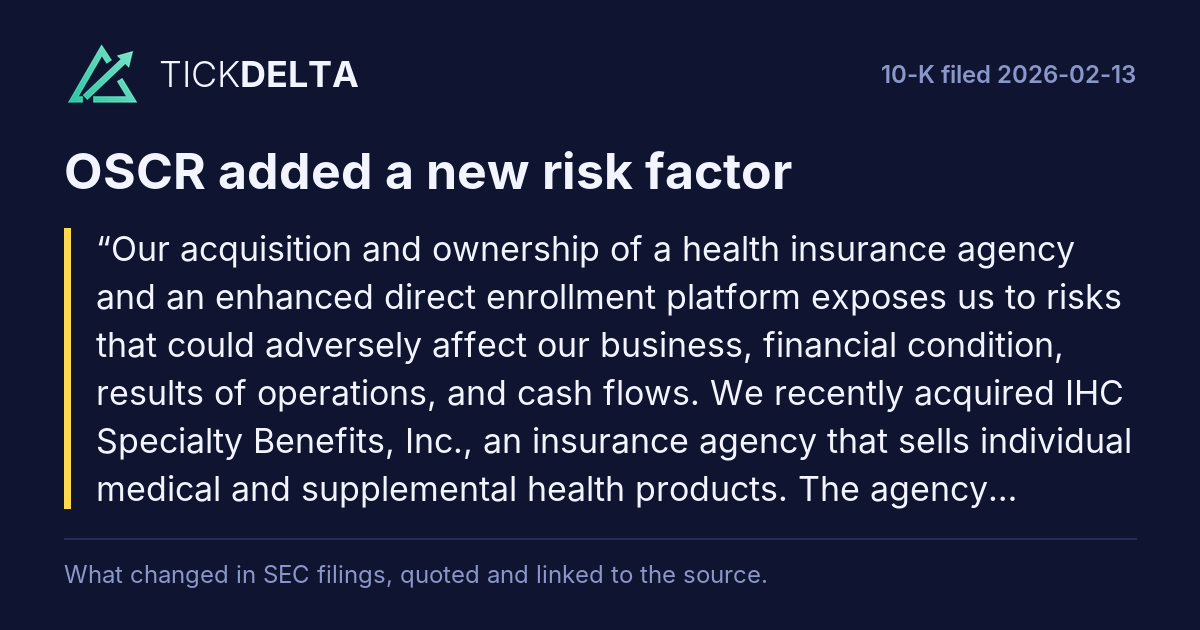
Our acquisition and ownership of a health insurance agency and an enhanced direct enrollment platform exposes us to risks that could adversely affect our business, financial condition, results of operations, and cash flows.
We recently acquired IHC Specialty Benefits, Inc., an insurance agency that sells individual medical and supplemental health products. The agency business model differs in material respects from our core health insurance operations and subjects us to additional operational, regulatory, and financial risks. For example, the agency generates a substantial portion of its revenue from commissions and other compensation paid by health insurance carriers, including us and third-party carriers. Any reduction in commission levels or termination of carrier agreements could materially and adversely affect the agency’s revenues. Health insurance agencies are also subject to extensive and evolving federal and state regulation unique to health insurance distribution. Noncompliance with these requirements—whether due to agency conduct, producer actions, or third-party vendors—could result in fines, penalties, enrollment suspensions, loss of licenses or certifications, corrective action plans, or reputational harm. The agency also faces the risk of claims alleging failure to properly advise clients, enroll members accurately, or comply with applicable marketing and disclosure requirements. Such claims may arise from misunderstandings regarding coverage, benefits, provider networks, or eligibility for subsidies or government programs. The agency is also subject to strict regulation as a fiduciary for any client premium funds or claims payments it may handle in the course of its business. While the agency maintains errors and omissions insurance, coverage may be insufficient, subject to exclusions, or unavailable on acceptable terms. In addition, ownership of a health insurance agency may create perceived or actual conflicts of interest, particularly where the agency distributes our health plans alongside competing products. Regulators, customers, or carrier partners may scrutinize product recommendations, disclosure practices regarding the relationship between us and the agency, marketing practices, and compensation arrangements. Any restrictions imposed to address such concerns could limit the agency’s growth or profitability. Furthermore, regulators, third-party carriers or other entities could bring claims with respect to antitrust law violations or breach of contract to the extent they believe that competitively sensitive information is inappropriately shared between IHC Specialty Benefits, Inc. and Lucie, Inc., on the one hand, and our Health Insurance Subsidiaries or other entities on the other hand. Due to the inherent uncertainties of litigation and regulatory proceedings, we cannot accurately predict the ultimate outcome of any such proceedings. An unfavorable outcome could have a material adverse impact on our business and financial position, results of operations, and/or cash flows, and may affect our reputation and brand. Our ability to realize the anticipated benefits of the acquisition and successfully manage this new line of business depends on successfully managing these risks.
We also recently acquired Lucie, Inc., an approved EDE entity that facilitates consumer enrollment in health insurance coverage, including plans offered on the Health Insurance Marketplaces. The operation of an EDE platform differs significantly from our traditional health insurance operations and exposes us to increased regulatory oversight, operational complexity, and compliance obligations. For example, EDE platforms operate pursuant to approvals, technical requirements, and ongoing oversight by CMS and, in some cases, state regulators. These requirements govern platform functionality, consumer disclosures, data sharing, marketing practices, enrollment processes, and audit rights. Failure to comply with applicable federal or state rules, technical standards, or program guidance could result in corrective action plans, suspension or revocation of EDE approval, civil monetary penalties, reputational harm, or restrictions on our ability to enroll members through the platform. In addition, the EDE platform depends on real-time integration with HealthCare.gov (the Federally Facilitated Marketplace), applicable state-based exchanges, and other third-party systems to determine eligibility, subsidies, and enrollment status. System outages, interface changes, data transmission errors, or delays caused by government systems or third-party service providers could disrupt enrollment activity, impair the consumer experience, lead to inaccurate enrollments, or result in compliance violations. Errors in platform functionality, eligibility determinations, subsidy calculations, plan displays, or enrollment transmissions could also result in improper enrollments, coverage gaps, consumer complaints, or disputes regarding coverage or premiums. Such issues may expose us to regulatory scrutiny, contractual liability, errors and omissions claims, or increased member attrition, particularly if they occur during open enrollment periods when enrollment volumes are highest. Operating an EDE platform may create perceived or actual conflicts of interest, particularly where the platform presents our health plans alongside competing products. Regulators may scrutinize plan display algorithms, default options, and consumer decision-support tools to ensure compliance with marketing, non-discrimination, and anti-steering requirements. Any findings of noncompliance could result in enforcement actions or restrictions on platform operations. Finally, because the EDE platform serves as a primary consumer-facing enrollment channel, any widely publicized system failures, data incidents, compliance violations, or negative consumer experiences could harm our brand and reputation, reduce consumer trust, and adversely affect enrollment and retention across our broader health insurance business. Our ability to realize the anticipated benefits of the acquisition and successfully manage this new line of business depends on successfully managing these risks.
Paragraphs in the 10-Q filed Nov 5, 2026 that were not in the one before
New in the latest 10-Q
7 paragraphs in the 10-Q filed Nov 5, 2026 with nothing like them in the 10-Q filed Aug 7, 2026 (at least half the words must differ; new numbers alone do not count). Quoted exactly, grouped by the item heading above them. This is text that changed, not a judgement of how serious it is.
Financial statements and notes
The Company operates as one reportable segment and offers health insurance through the federal and state-based healthcare exchanges established under the Patient Protection and Affordable Care Act (“ACA”). The Company serves consumers, employers, brokers, and partners through Oscar’s insurance business (“Oscar Insurance”), Lucie, Inc., Trove Group Inc., and HealthInsurance.org, LLC (Lucie, Inc., Trove Group Inc., and HealthInsurance.org, LLC collectively, the “Marketplace Subsidiaries”). Together, these businesses deliver exceptional lifestyle products and technology platforms that make healthcare easy to choose, use, and experience.
Read in the 10-Q
In September 2025 the Company entered into capped call transactions in connection with the 2030 Notes (as defined in “Note 9 - Debt”). The effect of the capped call transactions was excluded from the calculation of diluted earnings per share for all periods presented, as the effect of the capped calls would have been anti-dilutive. The capped calls are generally expected to reduce the potential dilution to the Company’s common stock upon any conversion of the 2030 Notes.
Read in the 10-Q
On November 4, 2026, the Company issued a notice to redeem the remaining $ 35 million aggregate principal amount of its 2031 Notes on December 31, 2026 (the “Redemption Date”), at a cash redemption price equal to the principal amount of the 2031 Notes plus accrued and unpaid interest (if any) to, but excluding, the Redemption Date.
Read in the 10-Q
Noteholders may elect to convert their 2031 Notes during the applicable redemption period. The Company has elected to settle any 2031 Notes surrendered for conversion during the redemption period by physical settlement. A maximum of 4,206,023 shares of Class A Common Stock may be issued upon any such conversion of the outstanding 2031 Notes, based on an initial conversion rate of 120.1721 shares of the Company’s Class A common stock per $1,000 principal amount, which is subject to customary adjustments upon the occurrence of certain events. Following the redemption (or earlier conversion by the noteholders), no principal amount of the 2031 Notes will remain outstanding.
Read in the 10-Q
As of September 30, 2026, $ 410 million aggregate principal amount of the 2030 Notes remained outstanding. A maximum of 16,520,786 shares of Class A Common Stock may be issued upon conversion of the outstanding 2030 Notes, based on an initial conversion rate of 40.2946 shares of the Company’s Class A common stock per $1,000 principal amount, which is subject to customary adjustments upon the occurrence of certain events.
Read in the 10-Q
Show the other 2
Oscar is a leading consumer healthcare company whose mission is to give people power over their healthcare. We offer health insurance through the federal and state-based healthcare exchanges established under the Patient Protection and Affordable Care Act (“ACA”). We serve consumers, employers, brokers, and partners through Oscar’s insurance business (“Oscar Insurance”), Lucie, Inc. Trove Group Inc., and HealthInsurance.org, LLC (Lucie, Inc., Trove Group Inc., and HealthInsurance.org, LLC collectively, the “Marketplace Subsidiaries”). Together, these businesses deliver exceptional lifestyle products and technology platforms that make healthcare easy to choose, use, and experience.
Read in the 10-Q
• Separately, in May 2026, CMS announced that effective as of October 12, 2026, enhanced direct enrollment (“EDE”) platforms must require identity proofing (“ID Proofing”) before an agent or broker may proceed with an application or enrollment for (i) new consumers, including someone moving to a different coverage state, (ii) a consumer with a net premium of $30 or less per month after subsidies that is actively enrolling, or (iii) a consumer working with a new agent. Identity proofing generally requires a consumer to verify its identity through a remote process, which may include validation through CMS’ identity-proofing service or another CMS-approved service. We expect that these requirements may make enrollment more difficult for certain consumers, which could reduce enrollment in the Health Insurance Marketplaces.
Read in the 10-Q
The 10-Q's risk factors against the 10-K
Item 1A of the 10-Q filed Nov 5, 2026 against Item 1A of the 10-K filed Feb 13, 2026.
A 10-Q repeats only the risks that changed, so a 10-K paragraph that is missing from it is not counted as removed.
Added is a paragraph with nothing like it in the 10-K, Reworded a sentence that is in both with several words changed,
Quiet changes a sentence in both where one to four words changed and one is a hedge or a modal
(cut words struck through, new words highlighted).
Text on the page, not a score; each links to the filing at sec.gov.
What the 10-Q itself says about its risk factors:The risks that we believe are material to our investors are disclosed in Part I, Item 1A, of our Annual Report on Form 10-K for the year ended December 31, 2025.
Read in the 10-Q
1 paragraph in the 10-Q's Item 1A, and none of them adds, rewords or quietly edits a paragraph of the 10-K's.
Phrases used for the first time
Two-word phrases in Risk Factors of the 10-K filed Feb 13, 2026 that are in none of the 1 earlier 10-Ks stored, back to Feb 20, 2025
Where each one is used
- insurance entities: We operate in a highly competitive environment and some of the Health Insurance Entities with which we compete have greater financial and other resources, offer a broader scope of products, and may be able to price their products more competitively than ours. Many of our competitors also have relationships with...
- program integrity: •regulatory or legislative actions are implemented that impact the ACA market, including (i) actions to improve the integrity in the ACA eligibility and enrollment process, such as the CMS Program Integrity Rules and the OBBBA and (ii) if the federal government funds a CSR program;
- integrity rules: •regulatory or legislative actions are implemented that impact the ACA market, including (i) actions to improve the integrity in the ACA eligibility and enrollment process, such as the CMS Program Integrity Rules and the OBBBA and (ii) if the federal government funds a CSR program;
- overall market: CMS announced the resumption of periodic data matching operations at least twice per calendar year to decrease the number of people simultaneously enrolled in Medicaid/CHIP and a subsidized ACA health plan. These initiatives include sharing lists of dually-enrolled individuals with states and state-based exchanges,...
- suppression order: For example, on December 15, 2026, one of our competitors in Georgia, Kaiser Foundation Health Plan of Georgia, Inc. (“Kaiser”), entered into a consent order with the Georgia Office of the Commissioner of Insurance (the “Georgia Regulator”) to suppress all of Kaiser’s plans from the Georgia Health Insurance...
- lucie inc: We may also pursue opportunistic partnerships and acquisitions to allow us to provide better healthcare options for our members as well as to augment existing operations, and we may be in discussions with respect to one or more partnerships or acquisitions at any given time. For example, in May 2025, we purchased...
- ihc specialty: We may also pursue opportunistic partnerships and acquisitions to allow us to provide better healthcare options for our members as well as to augment existing operations, and we may be in discussions with respect to one or more partnerships or acquisitions at any given time. For example, in May 2025, we purchased...
- specialty benefits: We may also pursue opportunistic partnerships and acquisitions to allow us to provide better healthcare options for our members as well as to augment existing operations, and we may be in discussions with respect to one or more partnerships or acquisitions at any given time. For example, in May 2025, we purchased...
Used at least twice, small words left out. Counted, not picked: a phrase can be new because the company renamed something.
What was taken out
13 paragraphs of last year's Risk Factors with nothing like them now. The longest are quoted.
Sources
Item 1A of each 10-K and 10-Q on EDGAR, quoted exactly. Each paragraph links to the filing at sec.gov.
Also
10-K change: what was reworded or cut, section by section.
Work with it
Excel workbook · CSV. Google Sheet that stays up to date: paste =IMPORTDATA("https://tickdelta.com/company/OSCR/export.csv") into a cell.