Paragraph 61 · 28% changed
Every version of it
Screener
/
SEC EDGAR
/CIK 0001039065
/10-K filed Aug 21, 2026, compared with Aug 25, 2025
/Numbers from the XBRL of the 10-Ks
Nasdaq
Technology · Semiconductors
OSI Systems Inc OSIS
The 10-K against last year's
64 changes: 12 added, 6 removed, 44 reworded, 2 quiet changes
10-K Aug 21, 2026 vs Aug 25, 2025
Risk Factors
6.5%
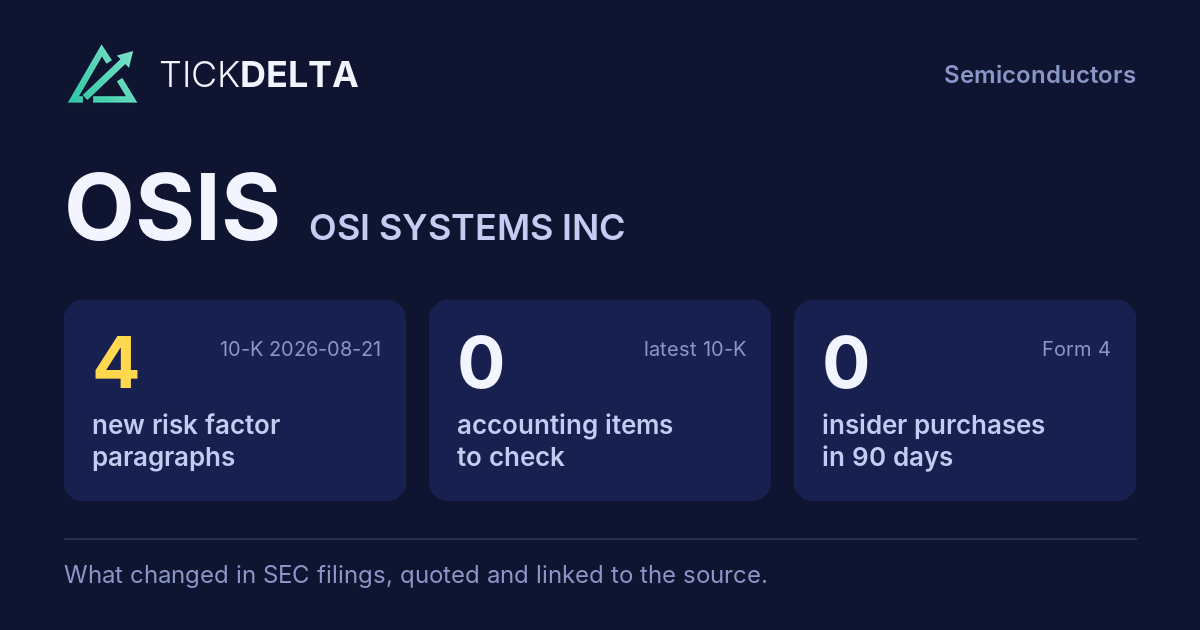
of the text changed · 13,233 words now · 4 new paragraphs, 5 gone
MD&A
20.9%
of the text changed · 5,453 words now · 8 new paragraphs, 1 gone
Legal Proceedings
8.9%
of the text changed · 769 words now
Accounting Policies
27.1%
of the text changed · 6,616 words now
10-K 0001104659-26-099752 (Aug 21, 2026) vs 10-K 0001410578-25-001887 (Aug 25, 2025)
Every paragraph, and how much of it changed
One bar per paragraph, in the order of the 10-K. Height and colour show the share of its words not in the closest paragraph a year earlier; the tallest bars are new paragraphs.
Risk Factors
70 paragraphs · 4 new · 19 reworded · 5 gone · 10-K Aug 21, 2026 against Aug 25, 2025
New paragraph
Reworded (5% of its words or more)
Same or nearly
Paragraph 60 · 25% changed
Every version of it
Our patient monitoring, cardiology and remote monitoring, and connected care systems must also comply with the laws and regulations of foreign countries in which we develop, manufacture and market such products. In general, the extent and complexity of medical device regulation is increasing worldwide. This trend is likely to continue, and the cost and time required to obtain marketing clearance in any given country may increase as a result. Our products may not obtain any necessary foreign clearances on a timely basis, or at all. Once any of our patient monitoring, cardiology and remote monitoring, or connected care systems is cleared for sale, regulatory authorities may still limit the use of such product, prevent its sale or manufacture or require a recall or withdrawal of such product from the marketplace. Following initial clearance from regulatory authorities, we continue to be subject to extensive regulatory requirements. Government authorities can withdraw marketing clearance or impose sanctions due to our failure to comply with regulatory standards or due to the occurrence of unforeseen problems following initial clearance. Ongoing regulatory requirements are wide-ranging and govern, among other things: (i) annual inspections to retain a CE mark for sale of products in the EU; (ii) product manufacturing; (iii) patient health data protection and medical device security; (iv) supplier substitution; (v) product changes; (vi) process modifications; (vii) medical device reporting; and (viii) product sales and distribution.
Paragraph 49 · 24% changed
Every version of it
The Support Anti-terrorism by Fostering Effective Technologies Act of 2002 (SAFETY Act) may not shield us against legal claims we may face following an act of terrorism. The SAFETY Act provides important legal liability protections for providers of qualified anti-terrorism products and services. Under the SAFETY Act, providers, such as our Security division, may apply to the U.S. Department of Homeland Security for coverage of their products and services. If granted coverage, such providers receive certain legal protections against product liability, professional liability and certain other claims that could arise following an act of terrorism. We have applied to the U.S. Department of Homeland Security for many of the products and services offered by our Security division, but we do not enjoy coverage under the SAFETY Act (or the highest level of coverage) for every product line, model number and service offering that our Security division provides. Also, the terms of the SAFETY Act coverage decisions awarded to us by the U.S. Department of Homeland Security restrict coverage to specific model numbers, software, and options within our product lines, sales to specific customers, and impose various other limitations, and contain conditions and requirements that we may not continue to satisfy in the future. Delays by the U.S. Department of Homeland Security in granting coverage and in our ability to meet the evolving standards of the SAFETY Act application process has and may in the future continue to result in coverage limitations for our products and services. If we fail to maintain SAFETY Act protections for each of our product models, options, offerings, software and services, or fail to apply in a timely way for coverage for new products, models, and services as we acquire or introduce them, or if the U.S. Department of Homeland Security limits the scope of any coverage previously awarded to us, denies us coverage or continued coverage for a particular product, product line, model, option, offering, software feature, or service, or delays in making decisions about whether to grant us coverage, we may become exposed to legal claims that the SAFETY Act was otherwise designed to prevent. Moreover, the SAFETY Act was not designed to shield providers of qualified anti-terrorism products and services from all types of claims that may arise from acts of terrorism, including from many types of claims lodged in courts outside of the United States or acts of terrorism that occur outside of the United States, which exposes us to legal claims and litigation defense costs despite the SAFETY Act awards we have received.
Paragraph 50 · 24% changed
Every version of it
Paragraph 30 · 17% changed
Every version of it
Paragraph 22 · 8% changed
Every version of it
Paragraph 10 · 6% changed
Every version of it
U.S. budgeting process disruptions could reduce government spending, which could adversely impact our revenues, earnings, cash flows and financial condition. Funding for U.S. federal Government activities takes place on an annual basis with the Government fiscal year beginning on October 1 and ending on September 30. In recent years, the budgeting process has often not been completed by October 1st, which has required the temporary extension of funding authority. This in turn can and has resulted in temporary Government shutdowns, causing delays in procurements and contract awards. Because the provision of appropriated funds is undertaken on an annual basis and subject to budgetary rules and requirements, there can be disruptions to federal funding of current and future procurements.
Paragraph 35 · 5% changed
Every version of it
Depending on the corrective action we take to redress a product’s deficiencies or defects, the FDA or applicable foreign regulatory authority may require, or we may decide, that we will need to obtain new approvals or clearances for the device before we may market or distribute the corrected device. Seeking such approvals or clearances may delay our ability to replace the recalled devices in a timely manner. Moreover, we may face additional regulatory enforcement action, including FDA warning letters, product seizure, injunctions, administrative penalties, civil penalties or criminal fines. We may also be required to bear other costs or take other actions that may have a negative impact on our sales as well as face material adverse publicity or regulatory consequences, which could harm our business, including our ability to market our products in the future. Any adverse event involving our products, whether in the United States or abroad, could result in future voluntary corrective actions, such as recalls or customer notifications, or agency action, such as inspection, mandatory recall, orders of repair, replacement or refund or other enforcement action. Any corrective action, whether voluntary or involuntary, as well as defending ourselves in a lawsuit, will require the dedication of our time and capital and may harm our reputation and financial results.
Paragraph 61 · 28% changed
Every version of it
10-K Aug 25, 2025Our patient monitoring, cardiology and remote monitoring, and connected care systems must also comply with the laws and regulations of foreign countries in which we develop, manufacture and market such products. In general, the extent and complexity of medical device regulation is increasing worldwide. This trend is likely to continue, and the cost and time required to obtain marketing clearance in any given country may increase as a result. Our products may not obtain any necessary foreign clearances on a timely basis, or at all. Once any of our patient monitoring, cardiology and remote monitoring, or connected care systems is cleared for sale, regulatory authorities may still limit the use of such product, prevent its sale or manufacture or require a recall or withdrawal of such product from the marketplace. Following initial clearance from regulatory authorities, we continue to be subject to extensive regulatory requirements. Government authorities can withdraw marketing clearance or impose sanctions due to our failure to comply with regulatory standards or due to the occurrence of unforeseen problems following initial clearance. Ongoing regulatory requirements are wide-ranging and govern, among other things: (i) annual inspections to retain a CE mark for sale of products in the EU; (ii) product manufacturing; (iii) patient health data protection and medical device security; (iv) supplier substitution; (v) product changes; (vi) process modifications; (vii) medical device reporting; and (viii) product sales and distribution.
10-K Aug 21, 2026
the marketplace. Following initial clearance from regulatory authorities, we continue to be subject to extensive regulatory requirements. Government authorities can withdraw marketing clearance or impose sanctions due to our failure to comply with regulatory standards or due to the occurrence of unforeseen problems following initial clearance. Ongoing regulatory requirements are wide-ranging and govern, among other things: (i) annual inspections to retain a CE mark for sale of products in the EU; (ii) product manufacturing; (iii) patient health data protection and medical device security; (iv) supplier substitution; (v) product changes; (vi) process modifications; (vii) medical device reporting; and (viii) product sales and distribution.
Paragraph 60 · 25% changed
Every version of it
10-K Aug 25, 2025
Our patient monitoring, cardiology and remote monitoring, and connected care systems must also comply with the laws and regulations of foreign countries in which we develop, manufacture and market such products. In general, the extent and complexity of medical device regulation is increasing worldwide. This trend is likely to continue, and the cost and time required to obtain marketing clearance in any given country may increase as a result. Our products may not obtain any necessary foreign clearances on a timely basis, or at all. Once any of our patient monitoring, cardiology and remote monitoring, or connected care systems is cleared for sale, regulatory authorities may still limit the use of such product, prevent its sale or manufacture or require a recall or withdrawal of such product from the marketplace. Following initial clearance from regulatory authorities, we continue to be subject to extensive regulatory requirements. Government authorities can withdraw marketing clearance or impose sanctions due to our failure to comply with regulatory standards or due to the occurrence of unforeseen problems following initial clearance. Ongoing regulatory requirements are wide-ranging and govern, among other things: (i) annual inspections to retain a CE mark for sale of products in the EU; (ii) product manufacturing; (iii) patient health data protection and medical device security; (iv) supplier substitution; (v) product changes; (vi) process modifications; (vii) medical device reporting; and (viii) product sales and distribution.
10-K Aug 21, 2026
Our patient monitoring, cardiology and remote monitoring, and connected care systems must also comply with the laws and regulations of foreign countries in which we develop, manufacture and market such products. In general, the extent and complexity of medical device regulation is increasing worldwide. This trend is likely to continue, and the cost and time required to obtain marketing clearance in any given country may increase as a result. Our products may not obtain any necessary foreign clearances on a timely basis, or at all. Once any of our patient monitoring, cardiology and remote monitoring, or connected care systems is cleared for sale, regulatory authorities may still limit the use of such product, prevent its sale or manufacture or require a recall or withdrawal of such product from
Paragraph 49 · 24% changed
Every version of it
10-K Aug 25, 2025
The Support Anti-terrorism by Fostering Effective Technologies Act of 2002 (SAFETY Act) may not shield us against legal claims we may face following an act of terrorism. The SAFETY Act provides important legal liability protections for providers of qualified anti-terrorism products and services. Under the SAFETY Act, providers, such as our Security division, may apply to the U.S. Department of Homeland Security for coverage of their products and services. If granted coverage, such providers receive certain legal protections against product liability, professional liability and certain other claims that could arise following an act of terrorism. We have applied to the U.S. Department of Homeland Security for many of the products and services offered by our Security division, but we do not enjoy coverage under the SAFETY Act (or the highest level of coverage) for every product line, model number and service offering that our Security division provides. Also, the terms of the SAFETY Act coverage decisions awarded to us by the U.S. Department of Homeland Security restrict coverage to specific model numbers, software, and options within our product lines, sales to specific customers, and impose various other limitations, and contain conditions and requirements that we may not continue to satisfy in the future. Delays by the U.S. Department of Homeland Security in granting coverage and in our ability to meet the evolving standards of the SAFETY Act application process has and may in the future continue to result in coverage limitations for our products and services. If we fail to maintain SAFETY Act protections for each of our product models, options, offerings, software and services, or fail to apply in a timely way for coverage for new products, models, and services as we acquire or introduce them, or if the U.S. Department of Homeland Security limits the scope of any coverage previously awarded to us, denies us coverage or continued coverage for a particular product, product line, model, option, offering, software feature, or service, or delays in making decisions about whether to grant us coverage, we may become exposed to legal claims that the SAFETY Act was otherwise designed to prevent. Moreover, the SAFETY Act was not designed to shield providers of qualified anti-terrorism products and services from all types of claims that may arise from acts of terrorism, including from many types of claims lodged in courts outside of the United States or acts of terrorism that occur outside of the United States, which exposes us to legal claims and litigation defense costs despite the SAFETY Act awards we have received.
10-K Aug 21, 2026
The Support Anti-terrorism by Fostering Effective Technologies Act of 2002 (SAFETY Act) may not shield us against legal claims we may face following an act of terrorism. The SAFETY Act provides important legal liability protections for providers of qualified anti-terrorism products and services. Under the SAFETY Act, providers, such as our Security division, may apply to the U.S. Department of Homeland Security for coverage of their products and services. If granted coverage, such providers receive certain legal protections against product liability, professional liability and certain other claims that could arise following an act of terrorism. We have applied to the U.S. Department of Homeland Security for many of the products and services offered by our Security division, but we do not enjoy coverage under the SAFETY Act (or the highest level of coverage) for every product line, model number and service offering that our Security division provides. Also, the terms of the SAFETY Act coverage decisions awarded to us by the U.S. Department of Homeland Security restrict coverage to specific model numbers, software, and options within our product lines, sales to specific customers, and impose various other limitations, and contain conditions and requirements that we may not continue to satisfy in the future. Delays by the U.S. Department of Homeland Security in granting coverage and in our ability to meet the evolving standards
Paragraph 50 · 24% changed
Every version of it
10-K Aug 25, 2025The Support Anti-terrorism by Fostering Effective Technologies Act of 2002 (SAFETY Act) may not shield us against legal claims we may face following an act of terrorism. The SAFETY Act provides important legal liability protections for providers of qualified anti-terrorism products and services. Under the SAFETY Act, providers, such as our Security division, may apply to the U.S. Department of Homeland Security for coverage of their products and services. If granted coverage, such providers receive certain legal protections against product liability, professional liability and certain other claims that could arise following an act of terrorism. We have applied to the U.S. Department of Homeland Security for many of the products and services offered by our Security division, but we do not enjoy coverage under the SAFETY Act (or the highest level of coverage) for every product line, model number and service offering that our Security division provides. Also, the terms of the SAFETY Act coverage decisions awarded to us by the U.S. Department of Homeland Security restrict coverage to specific model numbers, software, and options within our product lines, sales to specific customers, and impose various other limitations, and contain conditions and requirements that we may not continue to satisfy in the future. Delays by the U.S. Department of Homeland Security in granting coverage and in our ability to meet the evolving standards of the SAFETY Act application process has and may in the future continue to result in coverage limitations for our products and services. If we fail to maintain SAFETY Act protections for each of our product models, options, offerings, software and services, or fail to apply in a timely way for coverage for new products, models, and services as we acquire or introduce them, or if the U.S. Department of Homeland Security limits the scope of any coverage previously awarded to us, denies us coverage or continued coverage for a particular product, product line, model, option, offering, software feature, or service, or delays in making decisions about whether to grant us coverage, we may become exposed to legal claims that the SAFETY Act was otherwise designed to prevent. Moreover, the SAFETY Act was not designed to shield providers of qualified anti-terrorism products and services from all types of claims that may arise from acts of terrorism, including from many types of claims lodged in courts outside of the United States or acts of terrorism that occur outside of the United States, which exposes us to legal claims and litigation defense costs despite the SAFETY Act awards we have received.
10-K Aug 21, 2026
of the SAFETY Act application process has and may in the future continue to result in coverage limitations for our products and services. If we fail to maintain SAFETY Act protections for each of our product models, options, offerings, software and services, or fail to apply in a timely way for coverage for new products, models, and services as we acquire or introduce them, or if the U.S. Department of Homeland Security limits the scope of any coverage previously awarded to us, denies us coverage or continued coverage for a particular product, product line, model, option, offering, software feature, or service, or delays in making decisions about whether to grant us coverage, we may become exposed to legal claims that the SAFETY Act was otherwise designed to prevent. Moreover, the SAFETY Act was not designed to shield providers of qualified anti-terrorism products and services from all types of claims that may arise from acts of terrorism, including from many types of claims lodged in courts outside of the United States or acts of terrorism that occur outside of the United States, which exposes us to legal claims and litigation defense costs despite the SAFETY Act awards we have received.
Paragraph 30 · 17% changed
Every version of it
10-K Aug 25, 2025In 2025, the U.S. government announced the imposition of additional tariffs on certain goods imported from numerous countries. Multiple nations responded with reciprocal tariffs and other trade actions. The recent enactment of tariffs by the U.S. government, along with the unpredictability of the rates and other potential actions that may be taken by the U.S. government and foreign governments (including trade restrictions, new or increased tariffs or quotas, embargoes, sanctions and counter sanctions, safeguards or customs restrictions) may materially increase our costs and reduce our margins. These actions may also lead to higher pricing for our products, potentially reducing consumer demand and impacting our sales. We are actively monitoring the impact of any tariffs that become effective, as well as potential retaliatory actions by other countries. We are currently taking actions to mitigate this cost pressure, including accelerating, increasing or canceling inventory, further diversifying suppliers and re-sourcing to countries with lower tariffs, working with longstanding factory partners to reduce costs, identifying further cost reductions across our business and planning for
10-K Aug 21, 2026
The enactment of tariffs by the U.S. Government, along with the unpredictability of the rates and other potential actions that may be taken by the U.S. Government and foreign governments (including trade restrictions, new or increased tariffs or quotas, reciprocal tariffs, embargoes, sanctions and counter sanctions, safeguards or customs restrictions) may materially increase our costs and reduce our margins. These actions may also lead to higher pricing for our products, potentially reducing consumer demand and impacting our sales. We are actively monitoring the impact of any tariffs that become effective, as well as potential retaliatory actions by other countries. We are currently taking actions to mitigate this cost pressure, including accelerating, increasing or canceling inventory, further diversifying suppliers and re-sourcing to countries with lower tariffs, working with longstanding factory partners to reduce costs, identifying further cost reductions across our business, planning for strategic price increases and pursuing potential tariff refunds. However, there can be no assurance that we will be able to implement any strategies in a timely fashion, that these measures will be successful, or that they will offset the negative impact of the tariffs and other government actions on our business.
Paragraph 22 · 8% changed
Every version of it
10-K Aug 25, 2025incurred by the agency in procuring undelivered items from an alternative source. Decisions by an agency to terminate one of our contracts for default could negatively affect our ability to win future awards not only from such agency, but also from other government agencies and commercial customers, many of whom evaluate past performance, or are required to review past performance information, when making their procurement decisions. U.S. Government agencies may also initiate civil False Claims Act litigation against us based on allegations related to our performance of contracts for the U.S. Government, or to our compliance with procurement regulations and other legal requirements to which such contracts are subject, or both. Such litigation can be expensive to defend and if found liable can result in treble damages and significant civil penalties. The U.S. Government may also initiate administrative proceedings that, if resulting in an adverse finding against us or any of our subsidiaries as to our present responsibility to be a U.S. Government contractor or subcontractor, could result in our company or our subsidiaries being suspended for a period of time from eligibility for award of new government contracts or task orders or in a loss of export privileges and, if satisfying the requisite level of seriousness, in our debarment from contracting with the U.S. Government for a specified term as well as being subject to other remedies available to the U.S. Government. The occurrence of any of the foregoing events could result in a material adverse effect on our business, financial condition and results of operations.
10-K Aug 21, 2026
agencies and commercial customers, many of whom evaluate past performance, or are required to review past performance information, when making their procurement decisions. U.S. Government agencies may also initiate civil False Claims Act litigation against us based on allegations related to our performance of contracts for the U.S. Government, or to our compliance with procurement regulations and other legal requirements to which such contracts are subject, or both. Such litigation can be expensive to defend and if found liable can result in treble damages and significant civil penalties. The U.S. Government may also initiate administrative proceedings that, if resulting in an adverse finding against us or any of our subsidiaries as to our present responsibility to be a U.S. Government contractor or subcontractor, could result in our company or our subsidiaries being suspended for a period of time from eligibility for award of new government contracts or task orders or in a loss of export privileges and, if satisfying the requisite level of seriousness, in our debarment from contracting with the U.S. Government for a specified term as well as being subject to other remedies available to the U.S. Government. The occurrence of any of the foregoing events could result in a material adverse effect on our business, financial condition and results of operations.
Paragraph 10 · 6% changed
Every version of it
10-K Aug 25, 2025
U.S. budgeting process disruptions could reduce government spending, which could adversely impact our revenues, earnings, cash flows and financial condition. Funding for U.S. federal Government activities takes place on an annual basis with the Government fiscal year beginning on October 1 and ending on September 30. In recent years, the budgeting process has often not been completed by October 1st, which has required the temporary extension of funding authority. Because the provision of appropriated funds is undertaken on an annual basis and subject to budgetary rules and requirements, there can be disruptions to federal funding of current and future procurements.
10-K Aug 21, 2026
U.S. budgeting process disruptions could reduce government spending, which could adversely impact our revenues, earnings, cash flows and financial condition. Funding for U.S. federal Government activities takes place on an annual basis with the Government fiscal year beginning on October 1 and ending on September 30. In recent years, the budgeting process has often not been completed by October 1st, which has required the temporary extension of funding authority. This in turn can and has resulted in temporary Government shutdowns, causing delays in procurements and contract awards. Because the provision of appropriated funds is undertaken on an annual basis and subject to budgetary rules and requirements, there can be disruptions to federal funding of current and future procurements.
Paragraph 35 · 5% changed
Every version of it
10-K Aug 25, 2025
Depending on the corrective action we take to redress a product’s deficiencies or defects, the FDA or applicable foreign regulatory authority may require, or we may decide, that we will need to obtain new approvals or clearances for the device before we may market or distribute the corrected device. Seeking such approvals or clearances may delay our ability to replace the recalled devices in a timely manner. Moreover, we may face additional regulatory enforcement action, including FDA warning letters, product seizure, injunctions, administrative penalties, civil penalties or criminal fines. We may also be required to bear other costs or take other actions that may have a negative impact on our sales as well as face material adverse publicity or regulatory consequences, which could harm our business, including our ability to market our products in the future. Any adverse event involving our products, whether in the United States or abroad, could result in future voluntary corrective actions, such as recalls or customer notifications, or agency action, such as inspection, mandatory recall, orders of repair, replacement or refund or other enforcement action. Any corrective action, whether
10-K Aug 21, 2026
Depending on the corrective action we take to redress a product’s deficiencies or defects, the FDA or applicable foreign regulatory authority may require, or we may decide, that we will need to obtain new approvals or clearances for the device before we may market or distribute the corrected device. Seeking such approvals or clearances may delay our ability to replace the recalled devices in a timely manner. Moreover, we may face additional regulatory enforcement action, including FDA warning letters, product seizure, injunctions, administrative penalties, civil penalties or criminal fines. We may also be required to bear other costs or take other actions that may have a negative impact on our sales as well as face material adverse publicity or regulatory consequences, which could harm our business, including our ability to market our products in the future. Any adverse event involving our products, whether in the United States or abroad, could result in future voluntary corrective actions, such as recalls or customer notifications, or agency action, such as inspection, mandatory recall, orders of repair, replacement or refund or other enforcement action. Any corrective action, whether voluntary or involuntary, as well as defending ourselves in a lawsuit, will require the dedication of our time and capital and may harm our reputation and financial results.
MD&A
58 paragraphs · 8 new · 25 reworded · 1 gone · 10-K Aug 21, 2026 against Aug 25, 2025
New paragraph
Reworded (5% of its words or more)
Same or nearly
Paragraph 43 · 44% changed
Fiscal 2025 2026 Compared with Fiscal 2024. 2025. For the fiscal year ended June 30, 2025, 2026, interest and other expense, net was $31.4 $26.2 million as compared to $27.8 $31.4 million in the prior fiscal year. The increase decrease in interest and other expense, net was driven primarily by a result of a decrease in interest expense from lower average interest rates on our borrowings due to issuance of convertible notes and concurrent paydown of our revolving credit facility, and higher average interest income on increased levels of borrowings cash in fiscal 2026 compared to support the increase in working capital associated with the growth in revenues, business acquisition activity, and for the repurchase of approximately $80 million of shares of common stock in July 2024. This was same prior year period. These favorable impacts were partially offset by lower interest an increase in other expense associated with the 2029 Notes which resulted in fiscal 2026 of $4.4 million for prior service cost amortization due to a decrease pension plan amendment in overall average borrowing rate, including the December 2025 for our former CEO and a $1.3 million reduction in benefit from the interest rate swap. Interest expense for swap in fiscal 2025 and 2024 included a benefit of $2.4 million and $3.6 million, respectively, from 2026 compared to the interest rate swap. prior year.
Paragraph 17 · 44% changed
Paragraph 50 · 42% changed
Cash Provided by Financing Activities. Net cash provided by financing activities was $30.8 $46.7 million during fiscal 2025, 2026, compared to $144.3 $30.8 million during the prior fiscal year. The changes increase in cash flows from financing activities was primarily relate due to net proceeds of $562.9 million from issuance of $350.0 million in senior convertible notes, net of issuance costs of $9.5 million, the 2031 Notes, partially offset by (i) (1) net repayments repayment of $178.0 million on bank lines our revolving credit facility and (2) the repurchase of credit common shares of 214.2 million $271.9 million. This is compared to net proceeds in fiscal 2025 compared to of $340.6 million from issuance of the 2029 Notes, partially offset by (1) net borrowings repayment of $162.0 $228.0 million on our revolving credit facility and (2) repurchases of common shares for an aggregate of $80.4 million in the prior fiscal year; same prior-year period. In connection with the July 2025 amendment and (iii) share repurchases totaling $80.4 extension of our revolving credit facility, we replaced the $128.1 million in fiscal 2025 compared to no share repurchases in the prior fiscal year. term loan with a new $100.0 million term
Paragraph 36 · 34% changed
Fiscal 2025 2026 Compared with Fiscal 2024. 2025. Gross profit is impacted by sales volume and changes in overall manufacturing-related costs, such as raw materials and component costs, warranty expense, provision for inventory, freight, tariffs, and logistics. Gross profit increased approximately $56.7 $5.9 million in fiscal 2025 2026 as compared to the prior year on an 11.3% a 4.3% increase in net revenue. The gross margin in fiscal year 2025 2026 was relatively comparable lower than the prior year due to the prior year. sales mix in the Security division arising from an unfavorable shift in revenue mix. Revenue from Security division customers in Mexico, which generated margins above the division average, declined by $148.8 million year-over-year, while revenue increased in businesses that generally carried lower margins. Gross margin was also adversely affected by lower margins in aviation and checkpoint inspection systems. These impacts were partially offset by higher revenue and improved profitability from RF systems.
Paragraph 29 · 33% changed
Paragraph 48 · 31% changed
Cash Provided by (Used in) Operating Activities. Cash flows from operating activities can fluctuate significantly from period to period, as period due to changes in net income, adjusted for non-cash items, and working capital fluctuations impact cash flows. capital. During fiscal 2025, 2026, cash provided by operations was $97.6 $275.9 million compared to cash used in provided by operations of $87.5 $97.6 million in the prior fiscal year. The positive change net increase in cash flows from operating activities was due primarily to improvements in collection of accounts receivable and utilization of inventories associated with the revenue growth in our Security division, partially offset by other favorable changes in net working capital compared with the same period last year, capital, largely from lower accounts receivable, an increase in deferred revenue and other liabilities, as well as the impact of higher net income compared to the same prior-year period. These favorable changes were partially offset by unfavorable fluctuations in fiscal 2025 compared with the prior fiscal year. accounts payable, advances from customers, inventory and prepaid expenses and other assets.
Paragraph 38 · 29% changed
Fiscal 2025 2026 Compared with Fiscal 2024. 2025. SG&A expense for the fiscal year ended June 30, 2025 increased $21.2 2026 decreased $12.5 million compared to the same prior-year period, primarily due to increases in compensation expense, professional fees, information technology costs and the unfavorable a favorable impact of from foreign currency exchange rates, rates and decreased employee compensation, including reduced stock-based compensation expense related to the retirement of our former CEO in fiscal year 2025, partially offset by lower higher bad debt expense compared to the same prior-year period. Although SG&A expense increased in fiscal 2025 compared to fiscal 2024, as a percentage of net revenues, SG&A expense decreased from 17.5% in fiscal 2024 to 17.0% in fiscal 2025.
Paragraph 47 · 29% changed
Paragraph 43 · 44% changed
10-K Aug 25, 2025
Fiscal 2025 Compared with Fiscal 2024. For the fiscal year ended June 30, 2025, interest and other expense, net was $31.4 million as compared to $27.8 million in the prior fiscal year. The increase in interest and other expense, net was driven primarily by higher average levels of borrowings to support the increase in working capital associated with the growth in revenues, business acquisition activity, and for the repurchase of approximately $80 million of shares of common stock in July 2024. This was partially offset by lower interest expense associated with the 2029 Notes which resulted in a decrease in overall average borrowing rate, including the benefit from the interest rate swap. Interest expense for fiscal 2025 and 2024 included a benefit of $2.4 million and $3.6 million, respectively, from the interest rate swap.
10-K Aug 21, 2026
Fiscal 2026 Compared with Fiscal 2025. For the fiscal year ended June 30, 2026, interest and other expense, net was $26.2 million as compared to $31.4 million in the prior fiscal year. The decrease in interest and other expense, net was a result of a decrease in interest expense from lower average interest rates on our borrowings due to issuance of convertible notes and concurrent paydown of our revolving credit facility, and higher interest income on increased levels of cash in fiscal 2026 compared to the same prior year period. These favorable impacts were partially offset by an increase in other expense in fiscal 2026 of $4.4 million for prior service cost amortization due to a pension plan amendment in December 2025 for our former CEO and a $1.3 million reduction in benefit from the interest rate swap in fiscal 2026 compared to the prior year.
Paragraph 17 · 44% changed
10-K Aug 25, 2025Russia-Ukraine and Israel-Hamas Conflicts. The invasion of Ukraine by Russia and the sanctions imposed in response to this conflict as well as the Israel-Hamas conflict have increased global economic and political uncertainty. This has the potential to indirectly disrupt our supply chain and access to certain resources. While we have not experienced significant adverse impacts to date resulting from these conflicts, we have certain research and development activities within Ukraine for our Healthcare division which have been somewhat impacted. The conflicts also have increased the threat of malicious cyber-activity from other countries and other actors.
10-K Aug 21, 2026
development activities within Ukraine for our Healthcare division which have been somewhat impacted. The conflicts also have increased the threat of malicious cyber-activity from other countries and other actors.
Paragraph 50 · 42% changed
10-K Aug 25, 2025
Cash Provided by Financing Activities. Net cash provided by financing activities was $30.8 million during fiscal 2025, compared to $144.3 million during the prior fiscal year. The changes in cash flows from financing activities primarily relate to proceeds from issuance of $350.0 million in senior convertible notes, net of issuance costs of $9.5 million, partially offset by (i) net repayments on bank lines of credit of 214.2 million in fiscal 2025 compared to net borrowings of $162.0 million in the prior fiscal year; and (iii) share repurchases totaling $80.4 million in fiscal 2025 compared to no share repurchases in the prior fiscal year.
10-K Aug 21, 2026
Cash Provided by Financing Activities. Net cash provided by financing activities was $46.7 million during fiscal 2026, compared to $30.8 million during the prior fiscal year. The increase in cash flows from financing activities was primarily due to net proceeds of $562.9 million from issuance of the 2031 Notes, partially offset by (1) net repayment of $178.0 million on our revolving credit facility and (2) the repurchase of common shares of $271.9 million. This is compared to net proceeds in fiscal 2025 of $340.6 million from issuance of the 2029 Notes, partially offset by (1) net repayment of $228.0 million on our revolving credit facility and (2) repurchases of common shares for an aggregate of $80.4 million in the same prior-year period. In connection with the July 2025 amendment and extension of our revolving credit facility, we replaced the $128.1 million term loan with a new $100.0 million term
Paragraph 36 · 34% changed
10-K Aug 25, 2025
Fiscal 2025 Compared with Fiscal 2024. Gross profit is impacted by sales volume and changes in overall manufacturing-related costs, such as raw materials and component costs, warranty expense, provision for inventory, freight, tariffs, and logistics. Gross profit increased approximately $56.7 million in fiscal 2025 as compared to the prior year on an 11.3% increase in net revenue. The gross margin in fiscal year 2025 was relatively comparable to the prior year.
10-K Aug 21, 2026
Fiscal 2026 Compared with Fiscal 2025. Gross profit is impacted by sales volume and changes in overall manufacturing-related costs, such as raw materials and component costs, warranty expense, provision for inventory, freight, tariffs, and logistics. Gross profit increased approximately $5.9 million in fiscal 2026 as compared to the prior year on a 4.3% increase in net revenue. The gross margin in fiscal year 2026 was lower than the prior year due to the sales mix in the Security division arising from an unfavorable shift in revenue mix. Revenue from Security division customers in Mexico, which generated margins above the division average, declined by $148.8 million year-over-year, while revenue increased in businesses that generally carried lower margins. Gross margin was also adversely affected by lower margins in aviation and checkpoint inspection systems. These impacts were partially offset by higher revenue and improved profitability from RF systems.
Paragraph 29 · 33% changed
10-K Aug 25, 2025Subsequent to the fiscal year end, on July 4, 2025, the One Big Beautiful Bill Act (the “OBBBA”) was signed into law. Key income-tax related provisions of the OBBBA relevant to our Company include the removal of mandatory capitalization of domestic research and development expenditures, permanent extension of bonus depreciation and revisions to international tax regimes. We are evaluating the financial impact of OBBBA, which will be in effect for the fiscal year ending June 30, 2026. The legislation will affect the timing and recognition of certain deductions, which, if implemented, could impact our effective tax rate and deferred tax balances in future periods.
10-K Aug 21, 2026
On July 4, 2025, the One Big Beautiful Bill Act (the “OBBBA”) was signed into law. Key income-tax related provisions of the OBBBA relevant to our Company include the removal of mandatory capitalization of domestic research and development expenditures, permanent extension of bonus depreciation and revisions to international tax regimes. The Company evaluated the provisions of the legislation and based on the Company’s analysis, the OBBBA did not have a material impact on the Company’s consolidated financial statements. The Company will continue to monitor any future administrative guidance related to the legislation.
Paragraph 48 · 31% changed
10-K Aug 25, 2025
Cash Provided by (Used in) Operating Activities. Cash flows from operating activities can fluctuate significantly from period to period, as net income, adjusted for non-cash items, and working capital fluctuations impact cash flows. During fiscal 2025, cash provided by operations was $97.6 million compared to cash used in operations of $87.5 million in the prior fiscal year. The positive change in cash flows from operating activities was due primarily to improvements in collection of accounts receivable and utilization of inventories associated with the revenue growth in our Security division, partially offset by other changes in net working capital compared with the same period last year, as well as the impact of higher net income in fiscal 2025 compared with the prior fiscal year.
10-K Aug 21, 2026
Cash Provided by Operating Activities. Cash flows from operating activities can fluctuate significantly from period to period due to changes in net income, adjusted for non-cash items, and working capital. During fiscal 2026, cash provided by operations was $275.9 million compared to cash provided by operations of $97.6 million in the prior fiscal year. The net increase in cash flows from operating activities was due primarily to favorable changes in net working capital, largely from lower accounts receivable, an increase in deferred revenue and other liabilities, as well as higher net income compared to the same prior-year period. These favorable changes were partially offset by unfavorable fluctuations in accounts payable, advances from customers, inventory and prepaid expenses and other assets.
Paragraph 38 · 29% changed
10-K Aug 25, 2025
Fiscal 2025 Compared with Fiscal 2024. SG&A expense for the fiscal year ended June 30, 2025 increased $21.2 million compared to the same prior-year period, primarily due to increases in compensation expense, professional fees, information technology costs and the unfavorable impact of foreign currency exchange rates, partially offset by lower bad debt expense compared to the same prior-year period. Although SG&A expense increased in fiscal 2025 compared to fiscal 2024, as a percentage of net revenues, SG&A expense decreased from 17.5% in fiscal 2024 to 17.0% in fiscal 2025.
10-K Aug 21, 2026
Fiscal 2026 Compared with Fiscal 2025. SG&A expense for the fiscal year ended June 30, 2026 decreased $12.5 million compared to the same prior-year period, primarily due to a favorable impact from foreign currency exchange rates and decreased employee compensation, including reduced stock-based compensation expense related to the retirement of our former CEO in fiscal year 2025, partially offset by higher bad debt expense compared to the same prior-year period.
Paragraph 47 · 29% changed
10-K Aug 25, 2025Our credit facility comprised a term loan and a $600 million revolving credit facility, which included a $300 million sub-facility for letters of credit. As of June 30, 2025, there was $128.1 million outstanding under the term loan, $178.0 million outstanding under our revolving credit facility and $82.8 million of outstanding letters of credit. As of June 30, 2025, the total amount available under our revolving credit facility was $339.2 million. Subsequent to June 30, 2025, in July 2025 we amended and extended the credit facility, now maturing in July 2030, and paid down the delayed draw term loan. See Note 8 to the consolidated financial statements for further discussion.
10-K Aug 21, 2026
In July 2025 we amended and extended our credit facility to mature in July 2030, to increase the revolving limit from $600 million to $725 million and replaced the $128.1 million term loan with a new $100.0 million term loan. The sub-limit for letters of credit was increased from $300 million to $350 million, which includes up to $300 million for borrowings in certain foreign currencies. As of June 30, 2026, there were no borrowings under the revolving credit facility, $95.8 million outstanding under the letters of credit sub-facility, and $92.5 million outstanding under the term loan. As of June 30, 2026, the amount available to borrow under the credit facility was $629.2 million. See Note 8 to the consolidated financial statements for further discussion.
A paragraph is matched with the one last year that shares the most of its words; under half in common makes it new. The paragraphs shown are the 8 reworded the most in each section.
The paragraph that changed most in each section
The redline
Marked against last year's 10-K: cut words struck through, new words highlighted.
Accounting Policies574 words changed in this paragraph; it is 37% similar to last year's version.
Income Taxes - Deferred income taxes are provided for temporary differences between the financial statement and income tax basis of our assets and liabilities, based on enacted tax rates. A valuation allowance is provided when it is more likely than not that some portion or all of the deferred income tax assets will not be realized. Income tax accounting standards prescribe a two-step process for the financial statement measurement and recognition of a tax position taken or expected to be taken in a tax return. The first step involves the determination of whether it is more likely than not (greater than 50 percent likelihood) that a tax position will be sustained upon examination, based on the technical merits of the position. The second step requires that any tax position that meets the more likely than not recognition threshold be measured and recognized in the financial statements at the largest amount of benefit that is greater than 50 percent likely of being realized upon ultimate settlement. See Note 10 for additional information. Fair Value of Financial Instruments - Our financial instruments consist primarily of cash and cash equivalents, insurance company contracts, accounts receivable, accounts payable, debt instruments, an interest rate swap contract and foreign currency forward contracts. The carrying values of financial instruments, other than long-term debt instruments and our interest rate swap contract, are representative of their fair values due to their short-term maturities. The carrying values of our term loan and lease obligations are considered to approximate their fair values because the interest rates of these instruments are variable or comparable to current rates for financing available to us. The fair values of our foreign currency forward contracts were not significant as of June 30, 2025. Fair value is the price that would be received in the sale of an asset or paid to transfer a liability in an orderly transaction between market participants at the measurement date. The “Level 1” category comprises assets and liabilities measured at quoted prices in active markets for identical assets and liabilities. The “Level 2” category comprises assets and liabilities measured from observable inputs other than quoted market prices. The “Level 3” category comprises assets and liabilities for which valuation inputs are unobservable and significant to the fair value measurement. Our contingent payment obligations related to acquisitions, which are further discussed in Note 11 to the consolidated financial statements, are in the “Level 3” category for valuation purposes. The fair values of our financial assets and liabilities as of June 30, 2024 and 2025 are categorized as follows (in thousands): June 30, 2024 June 30, 2025 Level 1 Level 2 Level 3 Total Level 1 Level 2 Level 3 Total Assets - Insurance company contracts $ $ 49,679 $ - $49,679 $ $54,437 $ - $54,437 Assets - Interest rate swap contract $ $ 4,735 $ - $4,735 $ $932 $ - $932 Liabilities - Convertible notes $ $ - $ - $ - $ $472,770 $ - $472,770 Liabilities - Contingent consideration $ $ - $ 15,375 $15,375 $ $ - $ 19,086 $19,086 ────────────────────────────────────────────────────────────────────────────────────────────────────────────────────────────────────────────────────────────────────────────────────────────────── Derivative Instruments and Hedging Activity - Our use of derivatives consists of foreign currency forward contracts and an interest rate swap agreement. Our foreign currency forward contracts are utilized to partially mitigate certain balance sheet exposures or used as a net investment hedge to protect against potential changes resulting from short-term foreign currency fluctuations. These contracts have original maturities of up to three months. We also manage our risk to changes in interest rates using derivative instruments. We use fixed interest rate swaps to effectively convert a portion of the variable interest rate payments to fixed interest rate payments. We do not use hedging instruments for speculative purposes. The net gains or losses from our foreign currency forward contracts, which are not designated as hedge instruments, are reported in the consolidated statements of operations, and the amounts reported for the years ending June 30, 2023, 2024 and 2025 were not significant. The fair value of our foreign currency forward contracts is estimated using a standard valuation model and market-based observable inputs over the contractual term. Unrealized gains are recognized as assets and unrealized losses are recognized as liabilities. As of June 30, 2024 and 2025, we held foreign currency forward contracts with notional amounts totaling $96.4 million and $99.9 million, respectively. Unrealized gains and losses from our foreign currency forward contracts as of June 30, 2024 and 2025 were not significant.
Source: 10-K text, Note 1 – SUMMARY OF SIGNIFICANT ACCOUNTING POLICIES, 10-K 0001104659-26-099752 vs 10-K text, Note 1 – SUMMARY OF SIGNIFICANT ACCOUNTING POLICIES, 10-K 0001410578-25-001887
Risk Factors199 words changed in this paragraph; it is 69% similar to last year's version.
The Support Anti-terrorism by Fostering Effective Technologies Act of 2002 (SAFETY Act) may not shield us against legal claims we may face following an act of terrorism. The SAFETY Act provides important legal liability protections for providers of qualified anti-terrorism products and services. Under the SAFETY Act, providers, such as our Security division, may apply to the U.S. Department of Homeland Security for coverage of their products and services. If granted coverage, such providers receive certain legal protections against product liability, professional liability and certain other claims that could arise following an act of terrorism. We have applied to the U.S. Department of Homeland Security for many of the products and services offered by our Security division, but we do not enjoy coverage under the SAFETY Act (or the highest level of coverage) for every product line, model number and service offering that our Security division provides. Also, the terms of the SAFETY Act coverage decisions awarded to us by the U.S. Department of Homeland Security restrict coverage to specific model numbers, software, and options within our product lines, sales to specific customers, and impose various other limitations, and contain conditions and requirements that we may not continue to satisfy in the future. Delays by the U.S. Department of Homeland Security in granting coverage and in our ability to meet the evolving standards of the SAFETY Act application process has and may in the future continue to result in coverage limitations for our products and services. If we fail to maintain SAFETY Act protections for each of our product models, options, offerings, software and services, or fail to apply in a timely way for coverage for new products, models, and services as we acquire or introduce them, or if the U.S. Department of Homeland Security limits the scope of any coverage previously awarded to us, denies us coverage or continued coverage for a particular product, product line, model, option, offering, software feature, or service, or delays in making decisions about whether to grant us coverage, we may become exposed to legal claims that the SAFETY Act was otherwise designed to prevent. Moreover, the SAFETY Act was not designed to shield providers of qualified anti-terrorism products and services from all types of claims that may arise from acts of terrorism, including from many types of claims lodged in courts outside of the United States or acts of terrorism that occur outside of the United States, which exposes us to legal claims and litigation defense costs despite the SAFETY Act awards we have received.
Source: Item 1A, 10-K 0001104659-26-099752 vs Item 1A, 10-K 0001410578-25-001887
MD&A158 words changed in this paragraph; it is 44% similar to last year's version.
Fiscal 2025 2026 Compared with Fiscal 2024. 2025. For the fiscal year ended June 30, 2025, 2026, interest and other expense, net was $31.4 $26.2 million as compared to $27.8 $31.4 million in the prior fiscal year. The increase decrease in interest and other expense, net was driven primarily by a result of a decrease in interest expense from lower average interest rates on our borrowings due to issuance of convertible notes and concurrent paydown of our revolving credit facility, and higher average interest income on increased levels of borrowings cash in fiscal 2026 compared to support the increase in working capital associated with the growth in revenues, business acquisition activity, and for the repurchase of approximately $80 million of shares of common stock in July 2024. This was same prior year period. These favorable impacts were partially offset by lower interest an increase in other expense associated with the 2029 Notes which resulted in fiscal 2026 of $4.4 million for prior service cost amortization due to a decrease pension plan amendment in overall average borrowing rate, including the December 2025 for our former CEO and a $1.3 million reduction in benefit from the interest rate swap. Interest expense for swap in fiscal 2025 and 2024 included a benefit of $2.4 million and $3.6 million, respectively, from 2026 compared to the interest rate swap. prior year.
Source: Item 7, 10-K 0001104659-26-099752 vs Item 7, 10-K 0001410578-25-001887
Legal Proceedings3 words changed in this paragraph; it is 99% similar to last year's version.
Legal Proceedings - We are involved in various other potential or actual claims and legal proceedings arising in the ordinary course of business. In our opinion after consultation with legal counsel, the ultimate disposition of such proceedings is not likely to have a material adverse effect on our business, financial condition, results of operations or cash flows. We have not accrued for loss contingencies relating to any non-ordinary course matters because we believe that, although unfavorable outcomes in the proceedings are possible, they are not considered by management to be probable and reasonably estimable. If one or more of these matters are resolved in a manner adverse to our company, the impact on our business, financial condition, results of operations and cash flows could be material.
Source: Item 3, via Note 11 – COMMITMENTS AND CONTINGENCIES, 10-K 0001104659-26-099752 vs Item 3, via Note 11 – COMMITMENTS AND CONTINGENCIES, 10-K 0001410578-25-001887
Sentences and paragraphs added, removed or reworded
Every change, by type
Sentences and paragraphs of OSIS's Risk Factors and MD&A, 10-K Aug 21, 2026 against 10-K Aug 25, 2025. Each links to the text at sec.gov.
Quiet changes are sentences kept from last year with one to four words changed, at least one of them a hedge, a modal or a qualifier (may, could, will, not, significant, material…). A year or date rolling forward is not counted.
The full word list
adverse, adversely, all, although, anticipate, anticipates, any, approximately, believe, believes, can, cannot, certain, could, expect, expects, generally, however, if, intend, intends, largely, likely, many, material, materially, may, might, most, must, never, no, not, possible, primarily, probable, should, significant, significantly, some, substantial, substantially, unlikely, will, would
AddedRisk Factors
Geopolitical instability and conflicts in the Middle East could adversely affect our operations, supply chain, and financial performance. Ongoing military conflict and political instability in the Middle East have created heightened uncertainty in global markets. Escalating hostilities in the region, including disruptions affecting key shipping lanes and energy-producing areas, may result in increased transportation costs, longer transit times, or interruptions in the availability of critical materials. These conditions could impair our ability to fulfill customer orders and maintain normal production schedules and could disrupt customer operations, procurement activities, and project timing. In addition, conflict-related volatility in global oil and gas markets may lead to higher input costs, inflationary pressure, and reduced customer demand in certain end markets. If the conflict expands geographically or intensifies, governments may impose new sanctions, export controls, or other regulatory restrictions that limit our ability to transact with certain suppliers, customers, or financial institutions.
Read it in 10-K Aug 21, 2026 at sec.gov
AddedRisk Factors
We also rely on third-party logistics providers and carriers that operate in or near affected regions. Any disruption to their operations—including port closures, airspace restrictions, or rerouting of vessels—could materially affect our delivery timelines and cost structure. Because the duration and outcome of the conflict are uncertain, we may experience additional unforeseen impacts. Any of these factors, individually or collectively, could materially and adversely affect our business, financial condition, and results of operations.
Read it in 10-K Aug 21, 2026 at sec.gov
AddedRisk Factors
risks, damage our reputation, and adversely affect demand for our products and force us to expend significant capital and other resources to address the privacy and security requirements of HIPAA.
Read it in 10-K Aug 21, 2026 at sec.gov
AddedRisk Factors
In addition, regulators, including the European Union and the State of California, have adopted, or are considering adopting, regulations regarding ESG matters, including, but not limited to, climate change-related matters. Such regulatory approaches are not uniform, which may increase the cost and complexity of compliance. Addressing stakeholder expectations, including regulations, entails costs and any failure to successfully navigate such expectations may result in reputational harm, loss of customers or contracts, potential regulatory or investor engagement, or other adverse impacts to our business.
Read it in 10-K Aug 21, 2026 at sec.gov
RemovedRisk Factors
RemovedRisk Factors
RemovedRisk Factors
RemovedRisk Factors
Show the other 36
RemovedRisk Factors
RewordedRisk Factors
RewordedRisk Factors
Any failure or perceived failure of our Company or our products to meet HIPAA standards and related regulatory requirements could expose us to certain notification, penalty, and enforcement risks, damage our reputation, and adversely affect demand for our products and force us to expend significant capital and other resources to address the privacy and security requirements of HIPAA.
Read it in 10-K Aug 21, 2026 at sec.gov
RewordedRisk Factors
RewordedRisk Factors
Department of Homeland Security in granting coverage and in our ability to meet the evolving standards of the SAFETY Act application process has and may in the future continue to result in coverage limitations for our products and services.
Read it in 10-K Aug 21, 2026 at sec.gov
RewordedRisk Factors
In addition, in connection with the current status of international relations with Russia, particularly in light of the conflict between Russia and Ukraine, the U.S. government has imposed enhanced export controls on certain products and sanctions on certain industry sectors and parties in Russia.
Read it in 10-K Aug 21, 2026 at sec.gov
RewordedRisk Factors
Under that method, the underlying equity component potential common shares issuable upon conversion of the 2029 Notes will have a net impact on diluted earnings per share when the average price of our common stock exceeds the conversion price of $191.98 because the principal amount of the 2029 Notes will be settled in cash upon conversion,, conversion, then we will calculate our diluted earnings per share assuming that all of the 2029 Notes were converted at the beginning of the reporting period and that we issued shares of our common stock to settle the excess.
Read it in 10-K Aug 21, 2026 at sec.gov
RewordedRisk Factors
Any changes to the membership of the EU, such as the departure of the United Kingdom under Brexit, may impact the regulatory requirements for impacted countries and impair our business operations and our ability to market products in such countries.
Read it in 10-K Aug 21, 2026 at sec.gov
RewordedRisk Factors
Shares of our common stock issuable upon conversion of the 2.25% Convertible Senior Notes due 2029 (the “2029 Notes”) or the 0.50% Convertible Senior Notes due 2031 (the “2031 Notes”), collectively the “Notes”, may dilute the ownership interest of our stockholders or may adversely affect the market price of our common stock.
Read it in 10-K Aug 21, 2026 at sec.gov
RewordedRisk Factors
If an agency terminates a contract with us for default, we may be denied any recovery and may be liable for excess costs incurred by the agency in procuring undelivered items from an alternative source.
Read it in 10-K Aug 21, 2026 at sec.gov
RewordedRisk Factors
We are currently taking actions to mitigate this cost pressure, including accelerating, increasing or canceling inventory, further diversifying suppliers and re-sourcing to countries with lower tariffs, working with longstanding factory partners to reduce costs, identifying further cost reductions across our business and business, planning for strategic price increases and pursuing potential tariff refunds.
Read it in 10-K Aug 21, 2026 at sec.gov
RewordedRisk Factors
RewordedRisk Factors
Ongoing instability and current conflicts in global markets, and the potential for other conflicts and future terrorist activities and other recent geopolitical events throughout the world, including the ongoing conflict between Russia and Ukraine, the ongoing conflict Ukraine and in the Middle East and its regional effects, and increased tensions in Asia, have created and may continue to create economic and political uncertainties and impacts that could have a material adverse effect on our business, operations, and profitability.
Read it in 10-K Aug 21, 2026 at sec.gov
Quiet changesRisk Factors
The conversion of any portion of the 2029 Notes may dilute the ownership interests of our stockholders.
Read it in 10-K Aug 21, 2026 at sec.gov
AddedMD&A
Fiscal 2026 Compared with Fiscal 2025. Fiscal 2026 was highlighted by continued revenue and earnings growth, and strong operating cash flow generation. Revenues increased to approximately $1.8 billion, driven by our Security and Optoelectronics divisions, partially offset by lower Healthcare division revenues. Cash generated from operating activities increased significantly to approximately $275.9 million, driven largely by improved working capital, including collections on large Security projects, and higher net income.
Read it in 10-K Aug 21, 2026 at sec.gov
AddedMD&A
Supply and Demand for Memory and Semiconductor Components. We have experienced tighter supply conditions and increased costs for certain memory associated and semiconductor components, reflecting a broader global imbalance between supply and demand for memory used in data center and AI related infrastructure. While we have taken actions to mitigate these impacts, continued constraints in component availability could adversely affect our business.
Read it in 10-K Aug 21, 2026 at sec.gov
AddedMD&A
Geopolitical Environment. The global security environment remains subject to significant uncertainty due to ongoing geopolitical tensions, military conflicts, terrorist threats, and regional instability, including recent hostilities in the Middle East. Governments, transportation authorities, border protection agencies, and critical infrastructure operators continue to assess evolving security risks and may increase investments in security screening, inspection, and detection technologies. As a result, demand for certain of our security inspection products and related services could be affected by changes in government spending priorities and security requirements. At the same time, geopolitical events may influence the timing and execution of customer procurement decisions, funding approvals, contract awards, and project implementations. The extent to which current or future conflicts may affect our business will depend on the duration, geographic scope, and economic consequences of such events, as well as governmental responses that remain difficult to predict.
Read it in 10-K Aug 21, 2026 at sec.gov
AddedMD&A
Conflicts in the Middle East. We generate a significant portion of our revenues from international markets and maintain a global supply chain supporting the design, manufacture, and servicing of our products. Escalation of geopolitical conflicts, including military activity in the Middle East, could disrupt transportation routes, logistics networks, supplier operations, and international trade flows. Such disruptions may result in shipment delays, longer lead times, project schedule delays, inventory management challenges, or higher operating costs. The conflicts in the Middle East had an impact on our operating results in the fourth quarter of fiscal year 2026 through delays in timing of shipments, customer acceptance procedures, project schedules, and new orders. Material future developments could adversely affect our ability to procure components, fulfill customer orders, deploy personnel, or complete installations in a timely manner and could have an adverse effect on our results of operations and financial condition.
Read it in 10-K Aug 21, 2026 at sec.gov
AddedMD&A
Government Policies. Our results of operations and cash flows could be materially affected by changes in U.S. or foreign government legislative, regulatory or enforcement policies, as well as potential or actual U.S. government shutdowns, including the impact on near-term bookings and revenues of the recent Department of Homeland Security shutdown.
Read it in 10-K Aug 21, 2026 at sec.gov
AddedMD&A
conditions, among other items. If these factors become less favorable than those projected, additional inventory write-downs may be required.
Read it in 10-K Aug 21, 2026 at sec.gov
AddedMD&A
loan. Taxes paid related to net share settlement of equity awards were $36.3 million during fiscal 2026 compared to $22.6 million in the same prior-year period.
Read it in 10-K Aug 21, 2026 at sec.gov
AddedMD&A
On August 20, 2026, we announced that our Board of Directors has approved an additional 1,000,000 shares for repurchase under our stock repurchase program, increasing the total remaining authorization to 1,078,731 shares.
Read it in 10-K Aug 21, 2026 at sec.gov
RemovedMD&A
RewordedMD&A
During the fiscal year ended June 30, 2025, 2026, impairment, restructuring and other charges were $5.3 $16.6 million and consisted of $0.7 $5.1 million for employee terminations, $2.1 million in acquisition related costs, $1.2 million for impairment of assets, $0.2 million for facility closure costs for operational efficiency activities, $2.7 million for employee terminations, $0.6 million in acquisition related costs, and $1.3 $1.6 million in legal charges. charges, $2.2 million for non-recurring charges in our Security division, and $4.2 million for non-recurring charges in our Healthcare division.
Read it in 10-K Aug 21, 2026 at sec.gov
RewordedMD&A
SG&A expense for the fiscal year ended June 30, 2025 increased $21.2 2026 decreased $12.5 million compared to the same prior-year period, primarily due to increases in compensation expense, professional fees, information technology costs and the unfavorable a favorable impact of from foreign currency exchange rates, rates and decreased employee compensation, including reduced stock-based compensation expense related to the retirement of our former CEO in fiscal year 2025, partially offset by lower higher bad debt expense compared to the same prior-year period.
Read it in 10-K Aug 21, 2026 at sec.gov
RewordedMD&A
Revenues for the Healthcare division during the fiscal year ended June 30, 2025 2026 decreased by $5.6 million year-over-year due primarily to a reduction in cardiology sales of $4.8 million and patient monitoring sales of $9.6 million, in service revenue of $1.9 million and in supplies and accessories revenue of $1.8 million, partially offset by increases in service revenue cardiology sales of $2.4 million and supplies and accessories revenue of $1.1 $7.7 million.
Read it in 10-K Aug 21, 2026 at sec.gov
RewordedMD&A
During fiscal years 2023 2024, 2025 and 2024, our Security division was awarded three significant international contracts valued in aggregate greater than $800 million During fiscal years 2023, 2024 and 2025, 2026, we recognized revenues generated from these contracts of approximately $17 $404 million, $404 $231 million and $231 $79 million, respectively.
Read it in 10-K Aug 21, 2026 at sec.gov
RewordedMD&A
Revenues for the Optoelectronics and Manufacturing division during the fiscal year ended June 30, 2025 2026 increased year-over year mainly year-over-year by $26.7 million due to an increase of $23.5 million increases in the our optoelectronics business and our contract manufacturing business. business of $8.2 million and $18.5 million, respectively.
Read it in 10-K Aug 21, 2026 at sec.gov
RewordedMD&A
RewordedMD&A
During fiscal years 2023 and 2024, our Security division was awarded three significant international contracts valued in aggregate greater than $800 million During fiscal years 2023, 2024 and 2025, we recognized revenues generated from these contracts of approximately $17 million, $404 million and $231 million, respectively. million.
Read it in 10-K Aug 21, 2026 at sec.gov
RewordedMD&A
(b) Optoelectronics and Manufacturing, providing specialized electronic components and electronic manufacturing services for our Security and Healthcare divisions, as well as to third parties for applications in the defense and aerospace markets, among others; others, and for our Security and Healthcare divisions; and (c) Healthcare, providing patient monitoring, cardiology and remote monitoring, and connected care systems and associated accessories.
Read it in 10-K Aug 21, 2026 at sec.gov
RewordedMD&A
See Note 8 to the consolidated financial statements for further discussion. discussion, including future contractual maturities and potential cash settlement upon conversion or redemption of the 2029 Notes and 2031 Notes.
Read it in 10-K Aug 21, 2026 at sec.gov
RewordedMD&A
RewordedMD&A
These foreign funds were held primarily by our subsidiaries in India, United Kingdom, Singapore, Canada, Singapore, and Malaysia, and to a lesser extent in Australia, Albania, Indonesia, Uruguay and Germany, among other countries. Malaysia.
Read it in 10-K Aug 21, 2026 at sec.gov
RewordedMD&A
Revenues for the Security division during the fiscal year ended June 30, 2025 2026 increased by $51.8 million on a year-over-year basis primarily due to an increase in product and service revenues of approximately $97.0 million and $56.1 million, respectively. revenues.
Read it in 10-K Aug 21, 2026 at sec.gov
Quiet changesMD&A
None of these acquisitions was were considered material. significant.
Read it in 10-K Aug 21, 2026 at sec.gov
Sources
The two latest 10-Ks on EDGAR, section by section. Each change links to the text at sec.gov.
Also
New risk factors: paragraphs with nothing like them last year, quoted in full.
Work with it
Excel workbook · CSV. Google Sheet that stays up to date: paste =IMPORTDATA("https://tickdelta.com/company/OSIS/export.csv") into a cell.