Paragraph 7 · 48% changed
Every version of it
Screener
/
SEC EDGAR
/CIK 0000775158
/10-K filed Feb 17, 2026, compared with Feb 20, 2025
/Numbers from the XBRL of the 10-Ks
NYSE
Consumer discretionary · Automakers
Oshkosh Corp OSK
The 10-K against last year's
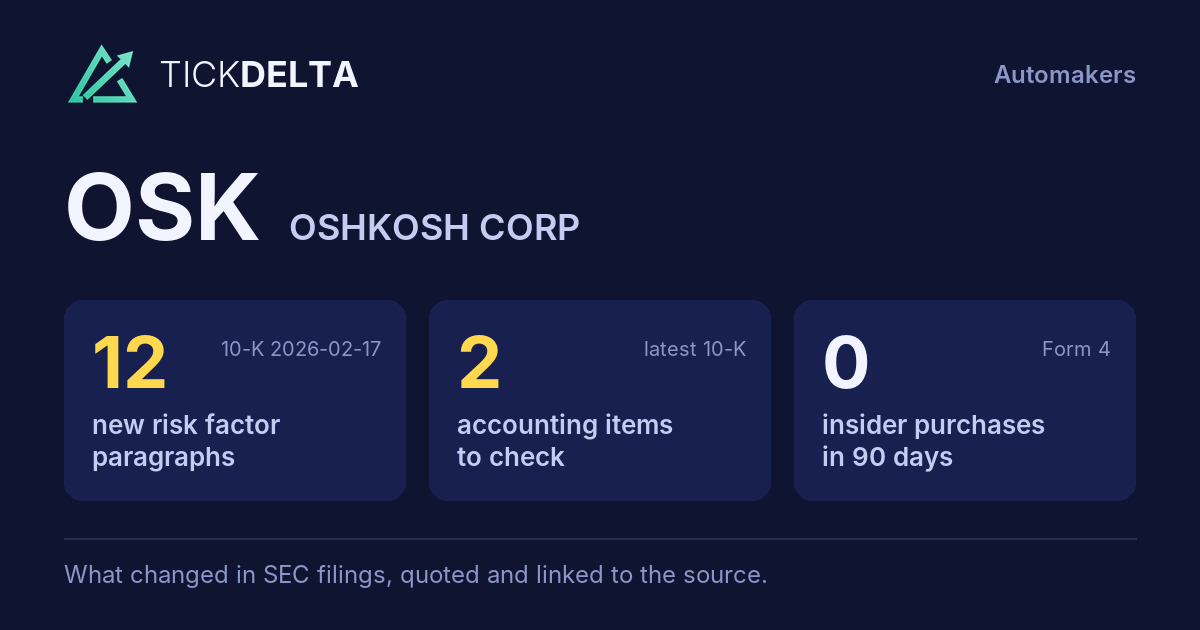
120 changes: 22 added, 18 removed, 75 reworded, 5 quiet changes
10-K Feb 17, 2026 vs Feb 20, 2025
Risk Factors
25.0%
of the text changed · 7,343 words now · 12 new paragraphs, 3 gone
MD&A
37.5%
of the text changed · 5,463 words now · 10 new paragraphs, 15 gone
Legal Proceedings
0.9%
of the text changed · 496 words now
Accounting Policies
12.5%
of the text changed · 5,861 words now
10-K 0001193125-26-054061 (Feb 17, 2026) vs 10-K 0000950170-25-024305 (Feb 20, 2025)
Every paragraph, and how much of it changed
One bar per paragraph, in the order of the 10-K. Height and colour show the share of its words not in the closest paragraph a year earlier; the tallest bars are new paragraphs.
Risk Factors
83 paragraphs · 12 new · 40 reworded · 3 gone · 10-K Feb 17, 2026 against Feb 20, 2025
New paragraph
Reworded (5% of its words or more)
Same or nearly
Paragraph 28 · 39% changed
Every version of it
•Most of our contracts with the DoD are multi-year firm, fixed-price contracts. These contracts typically contain annual sales price increases. We attempt to limit the risk related to raw material price fluctuations for major defense components by obtaining firm pricing from suppliers at the time a contract is awarded. However, if these suppliers do not honor their contracts, then we could face profit margin pressure. Furthermore, if our actual costs on any of these contracts exceed our projected costs, it could result in profits lower than historically realized or than we anticipate.
Paragraph 12 · 38% changed
Every version of it
Paragraph 77 · 36% changed
Every version of it
Paragraph 6 · 30% changed
Every version of it
•The USPS ordering fewer units than we expect which could result in an impairment of our deferred contract asset. We estimate that deferred contract costs exceed future profits on existing orders by approximately $135 million at December 31, 2025.
Paragraph 56 · 27% changed
Every version of it
Paragraph 9 · 26% changed
Every version of it
•If additional orders are received, the mix of internal combustion engine and battery electric vehicles could be different from our expectations, which could reduce revenues that we expect under the contract and negatively affect anticipated margins. expectations.
Paragraph 3 · 25% changed
Every version of it
The access equipment market is highly cyclical and impacted (i) by the strength of economies and customers’ perceptions concerning the timing of economic cycles, (ii) by residential and non-residential construction spending, (iii) by the ability of rental companies to obtain third-party financing to purchase revenue generating assets, (iv) by capital expenditures of rental companies in general, including the rate at which they replace aged rental equipment, (v) by the timing of regulatory standard changes, and (vi) by other factors, including oil and gas related activity and government spending. Municipal fire apparatus markets are cyclical later in an economic cycle and are impacted by the economy generally and by municipal tax receipts. Refuse and recycling collection vehicle markets are also cyclical and impacted by the strength of economies in general, by municipal tax receipts and by the size and timing of capital expenditures, including replacement demand, by large waste haulers. Airport products markets are also cyclical and impacted by global demand for air transportation services. If demand for our products is lower than what we or the market expect, due to a recession or other factors, then there could be an adverse effect on our net sales, financial condition, profitability and/or cash flows. In addition, those impacts could be more than we anticipate.
Paragraph 7 · 48% changed
Every version of it
10-K Feb 20, 2025•It may take longer or cost more than we anticipate to scale our production to full rate production, which may result from additional costs, product design changes, supplier product quality issues or delays in receiving products from suppliers, costs and other challenges associated with recruiting and training a new workforce or other challenges associated with scaling production.
10-K Feb 17, 2026
•The ramp-up of NGDV production has taken longer and cost more than we anticipated, which has resulted in lower revenues and higher costs than we anticipated. It is possible that production may continue to lag our expectations due to equipment design issues, supplier quality issues, supplier performance issues or other challenges associated with scaling production.
Paragraph 28 · 39% changed
Every version of it
10-K Feb 20, 2025
•Most of our contracts with the DoD are multi-year firm, fixed-price contracts. These contracts typically contain annual sales price increases. We attempt to limit the risk related to raw material price fluctuations for major defense components by obtaining firm pricing from suppliers at the time a contract is awarded. However, if these suppliers do not honor their contracts, then we could face profit margin pressure. Furthermore, if our actual costs on any of these contracts exceed our projected costs, it could result in profits lower than historically realized or than we anticipate.
10-K Feb 17, 2026
•Most of our contracts with the DoD are multi-year firm, fixed-price contracts. These contracts typically contain annual sales price increases. We attempt to limit the risk related to raw material price fluctuations for major defense components by
Paragraph 12 · 38% changed
Every version of it
10-K Feb 20, 2025In 2024, we directly imported from Mexico, China and Canada approximately $600 million, $175 million and $100 million, respectively. Geopolitical tensions and trade disputes can disrupt supply chains and increase the cost of our products, which could cause our products to be more expensive for customers. Countries could adopt restrictive trade measures such as tariffs, taxation, foreign exchange controls, capital controls and controls on imports or exports of goods, technology or data, any of which could adversely affect our operations and supply chain or limit our ability to offer our products and services as intended. Changes in laws or regulations governing the terms of foreign trade, and in particular increased trade restrictions, tariffs or taxes on imports from countries where we manufacture products or from where we import products or raw materials (either directly or through our suppliers) could have a material adverse effect on our competitive position, results of operations, financial condition, and/or cash flows. For example, in June 2024, the European Commission imposed a tariff that applies to imports of certain access equipment into European Union countries from China, which resulted in additional costs and could result in lower sales and/or profitability of the Access segment in the European Union. Countries may implement additional restrictive trade actions, including tariffs, export controls, sanctions, legislation favoring domestic investment and other actions impacting the import and export of goods in jurisdictions in which we or our suppliers operate. These kinds of restrictions could be adopted with little to no advance notice and could escalate in response to tariffs or restrictions imposed by the U.S. or other countries, and we may not be able to effectively mitigate any adverse impacts from such measures. Political uncertainty surrounding trade or other international disputes also could have a negative impact on customer confidence, inflation, interest rates and the level of investments by our customers and on the economy in general. Any of these events could increase the cost of our products, impact demand for our products, create disruptions to supply chains or impair our ability to effectively operate and compete in countries where we do business.
10-K Feb 17, 2026
Countries may implement additional restrictive trade actions, including tariffs, export controls, sanctions, legislation favoring domestic investment and other actions impacting the import and export of goods in jurisdictions in which we or our suppliers operate. These kinds of restrictions could be adopted with little to no advance notice and could escalate in response to tariffs or restrictions imposed by the U.S. or other countries, and we may not be able to effectively mitigate any adverse impacts from such measures. Changes in laws or regulations governing foreign trade, particularly in countries where we manufacture products or from which we import products or raw materials, either directly or through our suppliers, including materials subject to China’s export control requirements such as rare earth minerals, could have a material adverse effect on our competitive position, results of operations, financial condition, and/or cash flows.
Paragraph 77 · 36% changed
Every version of it
10-K Feb 20, 2025We rely extensively on information technology systems and networks, some of which third parties manage, supporting a variety of business activities. Operating these information technology systems and networks and processing and maintaining related data in a secure manner is critical to our business operations and strategy. Information technology security threats, from user error to cybersecurity attacks designed to gain unauthorized access to our systems, networks and data, are increasing in frequency and sophistication. Cybersecurity attacks may range from random attempts to coordinated and targeted attacks, including sophisticated computer crime and advanced persistent threats. These threats pose a risk to the security of our systems and networks and the confidentiality, availability and integrity of our data. Cybersecurity attacks could also include attacks targeting the security, integrity and/or reliability of the hardware and software that we have installed in our products. It is possible that our information technology systems and networks, or those that third parties manage or provide, could have vulnerabilities, which could go unnoticed for a period of time. Further, as a defense contractor, we face many cyber and security threats that can range from attacks common to most industries, which could have financial or reputational consequences, to advanced persistent threats on our defense programs, which could involve information that is considered a matter of national security. While we have utilized and continue to utilize various procedures and controls to mitigate such risks, we cannot assure that the actions and controls we have implemented and are implementing, or that we cause or have caused third-party service providers to implement, will be sufficient to protect our systems, information or other property. We have experienced cybersecurity threats and vulnerabilities in our systems and those of our third-party providers, and we have experienced viruses and attacks targeting our information technology systems and networks. Such prior events have not had a material impact on our financial condition, results of operations or liquidity. However, the potential consequences of a future material cybersecurity attack may include reputational damage, litigation with third parties, government enforcement actions, penalties, disruption to our systems or operations of our facilities, unauthorized release of confidential or otherwise protected information, corruption of data, diminution in the value of our investment in research, development and engineering, increased cybersecurity protection costs and unplanned investigation, remediation and other costs, which in turn could adversely affect our competitiveness, results of operations and financial condition.
10-K Feb 17, 2026
providers to implement, will be sufficient to protect our systems, information or other property. We have experienced cybersecurity threats and vulnerabilities in our systems and those of our third-party providers, and we have experienced viruses and attacks targeting our information technology systems and networks. Such prior events have not had a material impact on our financial condition, results of operations or liquidity. However, the potential consequences of a future material cybersecurity attack may include reputational damage, litigation with third parties, government enforcement actions, penalties, disruption to our systems or operations of our facilities, unauthorized release of confidential or otherwise protected information, corruption of data, diminution in the value of our investment in research, development and engineering, increased cybersecurity protection costs and unplanned investigation, remediation and other costs, which in turn could adversely affect our competitiveness, results of operations and financial condition.
Paragraph 6 · 30% changed
Every version of it
10-K Feb 20, 2025
•The USPS ordering fewer units than we expect which could result in an impairment of our deferred contract asset.
10-K Feb 17, 2026
•The USPS ordering fewer units than we expect which could result in an impairment of our deferred contract asset. We estimate that deferred contract costs exceed future profits on existing orders by approximately $135 million at December 31, 2025.
Paragraph 56 · 27% changed
Every version of it
10-K Feb 20, 2025In response to legislative, regulatory, investment community and societal concerns regarding global climate change and related efforts to limit greenhouse gas emissions, including changes in customer preferences and changes in regulations, we face greater pressure to develop products that generate less greenhouse gas emissions. Many manufacturers foresee sales of electric-powered vehicles and mobile equipment becoming increasingly important to their businesses, and we may not have the expertise or resources to successfully address these pressures on a cost-effective basis. Continued development of enhanced propulsion choices will require us to spend additional funds on research and development and subject us to the risk that our competitors may respond to these pressures in a manner that gives them a competitive advantage. If we do not accurately predict, prepare for and respond to new kinds of technological innovations with respect to electric-powered vehicles or mobile equipment and other technologies that minimize emissions, competition from others could make our specialty vehicles or mobile equipment less desirable in the marketplace.
10-K Feb 17, 2026
propulsion choices will require us to spend additional funds on research and development and subject us to the risk that our competitors may respond to these pressures in a manner that gives them a competitive advantage. If we do not accurately predict, prepare for and respond to new kinds of technological innovations with respect to electric-powered vehicles or mobile equipment and other technologies that minimize emissions, competition from others could make our specialty vehicles or mobile equipment less desirable in the marketplace.
Paragraph 9 · 26% changed
Every version of it
10-K Feb 20, 2025
•If additional orders are received, the mix of internal combustion engine and battery electric vehicles could be different from our expectations, which could reduce revenues that we expect under the contract and negatively affect anticipated margins.
10-K Feb 17, 2026
•If additional orders are received, the mix of internal combustion engine and battery electric vehicles could be different from our expectations.
Paragraph 3 · 25% changed
Every version of it
10-K Feb 20, 2025
receipts. Refuse and recycling collection vehicle markets are also cyclical and impacted by the strength of economies in general, by municipal tax receipts and by the size and timing of capital expenditures, including replacement demand, by large waste haulers. Airport products markets are also cyclical and impacted by global demand for air transportation services. If demand for our products is lower than what we or the market expect, due to a recession or other factors, then there could be an adverse effect on our net sales, financial condition, profitability and/or cash flows. In addition, those impacts could be more than we anticipate.
10-K Feb 17, 2026
The access equipment market is highly cyclical and impacted (i) by the strength of economies and customers’ perceptions concerning the timing of economic cycles, (ii) by residential and non-residential construction spending, (iii) by the ability of rental companies to obtain third-party financing to purchase revenue generating assets, (iv) by capital expenditures of rental companies in general, including the rate at which they replace aged rental equipment, (v) by the timing of regulatory standard changes, and (vi) by other factors, including oil and gas related activity and government spending. Municipal fire apparatus markets are cyclical later in an economic cycle and are impacted by the economy generally and by municipal tax receipts. Refuse and recycling collection vehicle markets are also cyclical and impacted by the strength of economies in general, by municipal tax receipts and by the size and timing of capital expenditures, including replacement demand, by large waste haulers. Airport products markets are also cyclical and impacted by global demand for air transportation services. If demand for our products is lower than what we or the market expect, due to a recession or other factors, then there could be an adverse effect on our net sales, financial condition, profitability and/or cash flows. In addition, those impacts could be more than we anticipate.
MD&A
77 paragraphs · 10 new · 45 reworded · 15 gone · 10-K Feb 17, 2026 against Feb 20, 2025
New paragraph
Reworded (5% of its words or more)
Same or nearly
Paragraph 70 · 49% changed
During the second quarter of 2024, the Company determined that a triggering event had occurred at Pratt Miller due to unfavorable performance compared to forecast and adverse market conditions related to mobility and motorsports and, therefore, assessed the reporting unit for impairment. For the income approach, a discount rate of 13.0% (14.0% at October 1, 2023) and a terminal growth rate of 3.0% (3.0% at October 1, 2023) were used. As a result of the assessment, the Company recorded an impairment charge of $38.7 million in 2024. During 2025, the second quarter of 2024. Changes in estimates or Company impaired the application of alternative assumptions could have produced significantly different results. At December 31, 2024, the remaining Pratt Miller goodwill ($5.7 million) as changes to royalties expected on defense contracts led to a further decline in the Company's expectations of future performance of the reporting unit had $5.7 million unit. A combination of goodwill remaining. the income and market approaches were used to calculate the fair values of the reporting unit, weighted consistently with the Company’s annual impairment test.
Paragraph 34 · 49% changed
Vocational segment net sales increased due to the timing of the AeroTech acquisition ($429 million), improved organic higher sales volume ($212 million) ($261 million), largely as a result of increased production rates, and improved pricing in response to higher input costs ($160 million), offset in part by the impact of the sale of the rear-discharge concrete mixer business in the first quarter of 2023 ($65 ($157 million).
Paragraph 56 · 47% changed
On March 23, 2022, 31, 2025, the Company entered into a Third Amended and Restated Credit Agreement credit agreement with various lenders to borrow funds under a $500 million unsecured term loan (the “Credit Agreement”). The Credit Agreement provides for an unsecured revolving credit facility (the “Revolving Credit Facility”) “Term Loan”) that matures in March 2027 with an initial maximum aggregate amount 2027. The Company used the proceeds from the Term Loan to repay a portion of availability of $1.10 billion. On April 3, 2024, the Company amended the Credit Agreement to increase the maximum aggregate amount of availability borrowings that were outstanding under the Revolving Credit Facility by $450 million to $1.55 billion. At December 31, 2024, borrowings under the Revolving Credit Facility of $360.0 million and specified outstanding letters of credit of $26.3 million reduced available capacity under the Revolving Credit Facility to $1.16 billion. Facility.
Paragraph 31 · 47% changed
The increase decrease in gross margin in the Access segment gross margin was primarily due to improved product higher sales discounts (190 basis points) and customer mix (80 higher labor and overhead costs (140 basis points). points) due in part to lower absorption of fixed costs as a result of lower production.
Paragraph 17 · 45% changed
The Company expects Defense Transport segment sales will be approximately $2.3 $2.5 billion in 2025, 2026, an increase of approximately 7% 19% compared to 2024 2025 sales. The Company's estimates reflect estimate reflects improved pricing under recent contracts and a progressive increase in production under the expected ramp-up of NGDV production, offset in part by the completion of production on the domestic Joint Light Tactical Company's Next Generation Delivery Vehicle (JLTV) contract in early 2025. (NGDV) contract. The Company expects Defense Transport segment operating margin will be approximately 4.0% in 2025, 2026, compared to 2.4% 3.7% in 2024, as a result 2025, reflecting the elimination of lower adverse cumulative catch-up adjustments experienced in 2025 and the ramp-up expected receipt of a follow-on delivery order from the USPS are expected to be offset in part by higher engineering spending and the non-recurrence in 2026 of the impact of a sale of a license of Joint Light Tactical Vehicles (JLTV)-related intellectual property to the U.S. government for $25 million. The Company's expectations contemplate a receipt of a follow-on NGDV production. delivery order from the USPS, which the Company expects would result in a favorable cumulative catch-up adjustment at the time the order is received.
Paragraph 15 · 44% changed
The Company expects Access segment sales will be approximately $4.4 $4.2 billion in 2025, 2026, a decrease of approximately 15% 7.0% compared to 2024 2025 sales reflecting market conditions as non-residential construction activity is expected to be relatively consistent with 2025. The Company expects that Access segment sales in North America and Europe and conclusion the first quarter of 2026 will be lower than the agreement first quarter of 2025 due to produce Caterpillar-branded telehandlers. its strong sales in the fourth quarter of 2025, which the Company believes were a result of strong customer purchases in advance of announced 2026 pricing actions. The Company expects operating income margin in the Access segment in 2025 2026 will be approximately 12.5%, 9.7%, down from 15.6% 11.2% in 2024 as a result of adverse sales mix and 2025 due to the impact of fixed costs relative to lower expected sales levels on fixed costs. levels.
Paragraph 30 · 44% changed
Access segment net sales increased decreased primarily as a result of improved lower organic sales volume in North America ($277 ($659 million) as a result of softer market conditions and the inclusion expiration in 2024 of an agreement to produce Caterpillar-branded telehandlers, as well as higher sales related to the AUSA acquisition ($44 discounts ($118 million), offset in part by lower sales volume in the Europe, Africa and Middle East ($103 million) and Rest of the World ($43 million) regions. The Company's long-term license agreement with Caterpillar Inc. to produce Caterpillar branded telehandlers ended in the fourth quarter of 2024. Caterpillar-branded telehandlers accounted for $315.4 million in incremental sales in 2024. 2025 related to the September 2024 acquisition of AUSA ($91 million).
Paragraph 22 · 42% changed
Paragraph 70 · 49% changed
10-K Feb 20, 2025
During the second quarter of 2024, the Company determined that a triggering event occurred at Pratt Miller and assessed the reporting unit for impairment. For the income approach, a discount rate of 13.0% (14.0% at October 1, 2023) and a terminal growth rate of 3.0% (3.0% at October 1, 2023) were used. As a result of the assessment, the Company recorded an impairment charge of $38.7 million in the second quarter of 2024. Changes in estimates or the application of alternative assumptions could have produced significantly different results. At December 31, 2024, the Pratt Miller reporting unit had $5.7 million of goodwill remaining.
10-K Feb 17, 2026
During 2024, the Company determined that a triggering event had occurred at Pratt Miller due to unfavorable performance compared to forecast and adverse market conditions related to mobility and motorsports and, therefore, assessed the reporting unit for impairment. As a result of the assessment, the Company recorded an impairment charge of $38.7 million in 2024. During 2025, the Company impaired the remaining Pratt Miller goodwill ($5.7 million) as changes to royalties expected on defense contracts led to a further decline in the Company's expectations of future performance of the reporting unit. A combination of the income and market approaches were used to calculate the fair values of the reporting unit, weighted consistently with the Company’s annual impairment test.
Paragraph 34 · 49% changed
10-K Feb 20, 2025
Vocational segment sales increased due to the timing of the AeroTech acquisition ($429 million), improved organic sales volume ($212 million) and improved pricing in response to higher input costs ($160 million), offset in part by the impact of the sale of the rear-discharge concrete mixer business in the first quarter of 2023 ($65 million).
10-K Feb 17, 2026
Vocational segment net sales increased due to higher sales volume ($261 million), largely as a result of increased production rates, and improved pricing ($157 million).
Paragraph 56 · 47% changed
10-K Feb 20, 2025
On March 23, 2022, the Company entered into a Third Amended and Restated Credit Agreement (the “Credit Agreement”). The Credit Agreement provides for an unsecured revolving credit facility (the “Revolving Credit Facility”) that matures in March 2027 with an initial maximum aggregate amount of availability of $1.10 billion. On April 3, 2024, the Company amended the Credit Agreement to increase the maximum aggregate amount of availability under the Revolving Credit Facility by $450 million to $1.55 billion. At December 31, 2024, borrowings under the Revolving Credit Facility of $360.0 million and specified outstanding letters of credit of $26.3 million reduced available capacity under the Revolving Credit Facility to $1.16 billion.
10-K Feb 17, 2026
On March 31, 2025, the Company entered into a credit agreement with various lenders to borrow funds under a $500 million unsecured term loan (the “Term Loan”) that matures in March 2027. The Company used the proceeds from the Term Loan to repay a portion of the borrowings that were outstanding under the Revolving Credit Facility.
Paragraph 31 · 47% changed
10-K Feb 20, 2025
The increase in Access segment gross margin was primarily due to improved product and customer mix (80 basis points).
10-K Feb 17, 2026
The decrease in gross margin in the Access segment was primarily due to higher sales discounts (190 basis points) and higher labor and overhead costs (140 basis points) due in part to lower absorption of fixed costs as a result of lower production.
Paragraph 17 · 45% changed
10-K Feb 20, 2025
The Company expects Defense segment sales will be approximately $2.3 billion in 2025, an increase of approximately 7% compared to 2024 sales. The Company's estimates reflect the expected ramp-up of NGDV production, offset in part by the completion of production on the domestic Joint Light Tactical Vehicle (JLTV) contract in early 2025. The Company expects Defense segment operating margin will be approximately 4.0% in 2025, compared to 2.4% in 2024, as a result of lower adverse cumulative catch-up adjustments and the ramp-up of NGDV production.
10-K Feb 17, 2026
The Company expects Transport segment sales will be approximately $2.5 billion in 2026, an increase of approximately 19% compared to 2025 sales. The Company's estimate reflects improved pricing under recent contracts and a progressive increase in production under the Company's Next Generation Delivery Vehicle (NGDV) contract. The Company expects Transport segment operating margin will be approximately 4.0% in 2026, compared to 3.7% in 2025, reflecting the elimination of adverse cumulative catch-up adjustments experienced in 2025 and the expected receipt of a follow-on delivery order from the USPS are expected to be offset in part by higher engineering spending and the non-recurrence in 2026 of the impact of a sale of a license of Joint Light Tactical Vehicles (JLTV)-related intellectual property to the U.S. government for $25 million. The Company's expectations contemplate a receipt of a follow-on NGDV delivery order from the USPS, which the Company expects would result in a favorable cumulative catch-up adjustment at the time the order is received.
Paragraph 15 · 44% changed
10-K Feb 20, 2025
The Company expects Access segment sales will be approximately $4.4 billion in 2025, a decrease of approximately 15% compared to 2024 sales reflecting market conditions in North America and Europe and conclusion of the agreement to produce Caterpillar-branded telehandlers. The Company expects operating margin in the Access segment in 2025 will be approximately 12.5%, down from 15.6% in 2024 as a result of adverse sales mix and the impact of lower sales levels on fixed costs.
10-K Feb 17, 2026
The Company expects Access segment sales will be approximately $4.2 billion in 2026, a decrease of approximately 7.0% compared to 2025 sales as non-residential construction activity is expected to be relatively consistent with 2025. The Company expects that Access segment sales in the first quarter of 2026 will be lower than the first quarter of 2025 due to its strong sales in the fourth quarter of 2025, which the Company believes were a result of strong customer purchases in advance of announced 2026 pricing actions. The Company expects operating income margin in the Access segment in 2026 will be approximately 9.7%, down from 11.2% in 2025 due to the impact of fixed costs relative to lower expected sales levels.
Paragraph 30 · 44% changed
10-K Feb 20, 2025
Access segment sales increased primarily as a result of improved sales volume in North America ($277 million) and the inclusion of sales related to the AUSA acquisition ($44 million), offset in part by lower sales volume in the Europe, Africa and Middle East ($103 million) and Rest of the World ($43 million) regions. The Company's long-term license agreement with Caterpillar Inc. to produce Caterpillar branded telehandlers ended in the fourth quarter of 2024. Caterpillar-branded telehandlers accounted for $315.4 million in sales in 2024.
10-K Feb 17, 2026
Access segment net sales decreased primarily as a result of lower organic sales volume ($659 million) as a result of softer market conditions and the expiration in 2024 of an agreement to produce Caterpillar-branded telehandlers, as well as higher sales discounts ($118 million), offset in part by incremental sales in 2025 related to the September 2024 acquisition of AUSA ($91 million).
Paragraph 22 · 42% changed
10-K Feb 20, 2025The increase in consolidated selling, general and administrative expenses was primarily a result of operating costs related to acquired businesses ($52 million), offset in part by lower incentive compensation costs ($14 million).
10-K Feb 17, 2026
Consolidated selling, general and administrative expenses decreased primarily due to lower incentive compensation accruals ($30 million).
A paragraph is matched with the one last year that shares the most of its words; under half in common makes it new. The paragraphs shown are the 8 reworded the most in each section.
The paragraph that changed most in each section
The redline
Marked against last year's 10-K: cut words struck through, new words highlighted.
Risk Factors362 words changed in this paragraph; it is 30% similar to last year's version.
Source: Item 1A, 10-K 0001193125-26-054061 vs Item 1A, 10-K 0000950170-25-024305
MD&A184 words changed in this paragraph; it is 72% similar to last year's version.
Source: Item 7, 10-K 0001193125-26-054061 vs Item 7, 10-K 0000950170-25-024305
Accounting Policies118 words changed in this paragraph; it is 52% similar to last year's version.
Reclassifications — Certain reclassifications have been made to the prior period financial statements to conform with the 2024 2025 presentation and improve comparability between periods. "Intangible asset impairments", "Unrealized (gain) loss on investments", which was previously presented as a separate line item within the Consolidated Statements of Cash Flows, is now presented within "Other non-cash adjustments". "Additions to equipment held for rental", which was previously presented within "Other non-cash adjustments" investing activities" within the Consolidated Statement Statements of Cash Flows, is now presented as a separate line item. "Deferred contract costs", "Repayments of debt", which was previously presented as a separate line item within the Consolidated Statements of Cash Flows, is now presented within "Other financing activities". "Proceeds from issuance of debt", which was previously presented within "Other non-current assets and liabilities" financing activities" within the Consolidated Statement Statements of Cash Flows, is now presented as a separate line item. "Other current assets" and "Other non-current assets and liabilities", which were previously presented as separate line items within the Consolidated Statements of Cash Flows, are now presented within "Other operating assets and liabilities".
Source: Item 8, Note 2 – Summary of Significant Accounting Policies, 10-K 0001193125-26-054061 vs Item 8, Note 2 – Summary of Significant Accounting Policies, 10-K 0000950170-25-024305
Legal Proceedings9 words changed in this paragraph; it is 97% similar to last year's version.
Certain risks are inherent in doing business with the DoD, including technological changes and changes in levels of defense spending. The USPS and all DoD contracts contain a provision that they may be terminated at any time at the convenience of the customer. In such an event, the Company is entitled to recover allowable costs plus a reasonable profit earned to the date of termination. Major contracts for defense, defense and delivery and other specialty vehicles and mobility systems are performed over extended periods of time and are subject to changes in scope of work and delivery schedules. Pricing negotiations on changes and settlement of claims often extend over prolonged periods of time. The Company’s ultimate profitability on such contracts may depend on the eventual outcome of an equitable settlement of contractual issues with the Company’s customers.
Source: Item 3, via Note 19 – Commitments and Contingencies, 10-K 0001193125-26-054061 vs Item 3, via Note 19 – Commitments and Contingencies, 10-K 0000950170-25-024305
Sentences and paragraphs added, removed or reworded
Every change, by type
Sentences and paragraphs of OSK's Risk Factors and MD&A, 10-K Feb 17, 2026 against 10-K Feb 20, 2025. Each links to the text at sec.gov.
Quiet changes are sentences kept from last year with one to four words changed, at least one of them a hedge, a modal or a qualifier (may, could, will, not, significant, material…). A year or date rolling forward is not counted.
The full word list
adverse, adversely, all, although, anticipate, anticipates, any, approximately, believe, believes, can, cannot, certain, could, expect, expects, generally, however, if, intend, intends, largely, likely, many, material, materially, may, might, most, must, never, no, not, possible, primarily, probable, should, significant, significantly, some, substantial, substantially, unlikely, will, would
AddedRisk Factors
•Throughout the product lifecycle, discontinuation of production parts by suppliers may result in unanticipated design costs.
Read it in 10-K Feb 17, 2026 at sec.gov
AddedRisk Factors
The United States has announced changes to U.S. trade policies, including increasing tariffs on imports and potentially renegotiating or terminating existing trade agreements. The exact scope and duration of any such tariffs that have been or will ultimately be implemented, or retaliatory tariffs that have been or could be implemented by other countries on U.S. exports, is not known, and the impacts on our business are uncertain. Tariffs implemented by the U.S. during 2025 cost us approximately $35 million in 2025, and we estimate that will increase to approximately $200 million in 2026. Geopolitical tensions and trade wars can disrupt supply chains and increase the cost of our products, which could cause our products to be more expensive for customers. Countries have adopted restrictive trade measures such as tariffs, taxation, foreign exchange controls, capital controls and controls on imports or exports of goods, technology or data, any of which could adversely affect our operations and supply chain or limit our ability to offer our products and services as intended.
Read it in 10-K Feb 17, 2026 at sec.gov
AddedRisk Factors
Uncertainty surrounding trade or other international disputes has adversely impacted, and could continue to adversely impact, customer confidence, inflation, interest rates and the level of investments by our customers and on the economy in general. Any of these events could increase the cost of our products, reduce demand for our products, create disruptions to supply chains or impair our ability to effectively operate and compete in countries where we do business.
Read it in 10-K Feb 17, 2026 at sec.gov
AddedRisk Factors
Our capacity expansion plans may take longer or cost more than we expect or may not achieve the benefits we anticipate.
Read it in 10-K Feb 17, 2026 at sec.gov
AddedRisk Factors
We are pursuing initiatives to expand and optimize our manufacturing capacity. Such initiatives may include facility expansions or reconfigurations, capital investments in equipment and automation, workforce hiring and training, supplier capacity development and the implementation of new processes or systems. The execution of these capacity expansion plans is subject to a variety of risks and uncertainties, including delays in construction or equipment delivery, challenges in recruiting and retaining skilled labor, supply chain constraints, cost inflation, permitting or regulatory requirements and difficulties integrating new capacity into existing operations. In addition, our assumptions regarding demand levels, timing and product mix may change over time, which could affect the timing, scale or economic returns of these investments. If our capacity expansion initiatives take longer or cost more than we anticipate or fail to deliver the operational efficiencies or throughput improvements we expect, we may be unable to meet forecasted sales, incur higher operating or capital costs or experience reduced margins. Any such delays or inefficiencies could adversely affect our results of operations, cash flows or competitive position.
Read it in 10-K Feb 17, 2026 at sec.gov
AddedRisk Factors
•Although we believe there is demand from international customers for our tactical wheeled vehicles, there is no assurance that additional orders will materialize.
Read it in 10-K Feb 17, 2026 at sec.gov
AddedRisk Factors
•In January 2026, the U.S. President issued an executive order directing the DoD and other defense-related agencies to prioritize the warfighter in procurement decisions, including increased emphasis on speed of delivery, affordability, domestic sourcing and operational readiness. While intended to enhance military effectiveness, this directive could result
Read it in 10-K Feb 17, 2026 at sec.gov
AddedRisk Factors
in changes to acquisition strategies, contract structures, technical requirements, pricing expectations or supplier selection criteria. Such changes could increase competition, reduce margins, accelerate delivery schedules or require additional capital investments, which could in turn have a material adverse effect on our net sales, financial condition, results of operations and/or cash flows. Under the executive order, the DoD could also impose conditions or otherwise create disincentives that could limit our ability to repurchase shares of our Common Stock or to pay dividends to our shareholders.
Read it in 10-K Feb 17, 2026 at sec.gov
Show the other 58
AddedRisk Factors
Our use of artificial intelligence and autonomy technologies may expose us to additional risks and may not deliver the benefits we anticipate.
Read it in 10-K Feb 17, 2026 at sec.gov
AddedRisk Factors
We are developing, integrating and using artificial intelligence (AI) and autonomy in certain products, services and internal operations. These technologies are evolving and, in many cases, rely on third-party tools, data, software or infrastructure. Our ability to realize benefits from their use depends on factors such as data quality, system integration, workforce adoption, computing resources and the ongoing performance and availability of third-party technology providers. AI-enabled systems may not perform as intended under all operating conditions and may generate inaccurate, incomplete or biased outputs. As these technologies are introduced into products, services or operations, failures or perceived failures, whether due to design limitations, data constraints, integration challenges, cybersecurity incidents, operator misuse, inadequate training or other causes, could result in product performance issues, safety incidents, increased costs, reputational harm or reduced customer acceptance. In addition, the legal and regulatory framework governing AI and data use is rapidly evolving and remains uncertain. New or changing laws, regulations or standards could increase compliance costs, limit permissible uses, require changes to
Read it in 10-K Feb 17, 2026 at sec.gov
AddedRisk Factors
product design or governance practices or expose us to litigation or enforcement actions. If we are unable to effectively develop, integrate, govern or manage AI-enabled technologies, or if these technologies fail to deliver benefits we expect, our results of operations, financial condition or competitive position could be adversely affected.
Read it in 10-K Feb 17, 2026 at sec.gov
AddedRisk Factors
incorporate calculations that are sensitive to minor changes in underlying assumptions. Management’s assumptions change as more information becomes available. Changes in these events and conditions or other assumptions could result in an impairment charge in the future, which could have a significant adverse impact on our reported earnings.
Read it in 10-K Feb 17, 2026 at sec.gov
RemovedRisk Factors
RemovedRisk Factors
RemovedRisk Factors
RewordedRisk Factors
Delays in obtaining parts, materials, components and final assemblies may result from a number of factors affecting our suppliers including shipping disruptions, capacity constraints, labor constraints, supplier product quality issues, decisions by suppliers to discontinue or modify components or parts, including to meet changing regulatory requirements, suppliers’ impaired financial condition condition, interruptions in suppliers' information technology systems and suppliers’ allocations to other purchasers.
Read it in 10-K Feb 17, 2026 at sec.gov
RewordedRisk Factors
Costs for these items may increase in the future due to a variety of factors, including: the level outbreaks of tariffs that the U.S. imposes on imported steel, aluminum and other commodities; an outbreak of conflicts conflict in regions of the world that produce the commodities or the raw materials that go into the commodities or through which the commodities are transported; or a weakening U.S. dollar.
Read it in 10-K Feb 17, 2026 at sec.gov
RewordedRisk Factors
Increases in parts, materials, components or final assemblies costs negatively impact could reduce the profitability of orders in backlog as those sales prices on those orders are generally less flexible. have already been negotiated.
Read it in 10-K Feb 17, 2026 at sec.gov
RewordedRisk Factors
RewordedRisk Factors
RewordedRisk Factors
While we have utilized and continue to utilize various procedures and controls to mitigate such risks, we cannot assure that the actions and controls we have implemented and are implementing, or that we cause or have caused third-party service providers to implement, will be sufficient to protect our systems, information or other property.
Read it in 10-K Feb 17, 2026 at sec.gov
RewordedRisk Factors
Factors such as the imposition of duties and tariffs and other trade barriers, supply and demand, the level of imports, freight costs, availability of transportation, the cost or availability of manufacturing labor, availability of labor, inventory levels and general economic conditions may affect the price of our prices we pay for parts, materials, components or final assembly purchases.
Read it in 10-K Feb 17, 2026 at sec.gov
RewordedRisk Factors
We attempt to limit the risk related to raw material price fluctuations for major defense components by obtaining firm pricing from suppliers at the time a contract is awarded.
Read it in 10-K Feb 17, 2026 at sec.gov
RewordedRisk Factors
Furthermore, price increases may not be accepted by our customers, resulting customers and may result in them choosing to order from our competitors instead of us. competitors.
Read it in 10-K Feb 17, 2026 at sec.gov
RewordedRisk Factors
Determination of the fair value of a reporting unit includes developing estimates which are highly subjective and incorporate calculations that are sensitive to minor changes in underlying assumptions.
Read it in 10-K Feb 17, 2026 at sec.gov
RewordedRisk Factors
If these audits result in assessments different from amounts that the Company has we have reserved for potential tax liabilities, future financial results may include unfavorable adjustments to the Company’s our tax liabilities, which could have a material adverse effect on the Company’s our results of operations.
Read it in 10-K Feb 17, 2026 at sec.gov
RewordedRisk Factors
At December 31, 2024, 2025, approximately 77% 78% of these intangibles were concentrated in the Access segment. within JLG.
Read it in 10-K Feb 17, 2026 at sec.gov
Quiet changesRisk Factors
If we are not able to recover cost increases through price increases to our customers, then such increases will would have an adverse effect on our financial condition, profitability and/or cash flows.
Read it in 10-K Feb 17, 2026 at sec.gov
Quiet changesRisk Factors
Additionally, if costs decrease and we are unable to negotiate timely component cost decreases commensurate with any decrease in costs, then our higher component costs could put us at a material disadvantage as compared to our competition which could have a material adverse effect on our net sales, financial condition, profitability and/or cash flows.
Read it in 10-K Feb 17, 2026 at sec.gov
Quiet changesRisk Factors
We are dependent on U.S. and foreign government contracts for a substantial significant portion of our business.
Read it in 10-K Feb 17, 2026 at sec.gov
AddedMD&A
Oshkosh Corporation is a global industrial technology company that designs and deploys advanced technologies to empower everyday heroes who build, serve and protect communities around the world. Across construction, firefighting, aviation, refuse collection, defense and delivery industries, we create purpose-built vehicles, equipment and integrated ecosystems that are safe, intuitive and highly productive. As an innovator and integrator, we work directly with our customers to solve real-world challenges – developing and applying breakthrough technologies in autonomy, artificial intelligence, connectivity and electrification. Through these advancements, we make some of the world’s toughest jobs safe, efficient, sustainable and connected — delivering measurable impact for the people who depend on us every day.
Read it in 10-K Feb 17, 2026 at sec.gov
AddedMD&A
The Company experienced a dynamic and unpredictable international trade environment throughout 2025. The continuously-changing environment contributed to economic uncertainty and the Company saw some customers being judicious with spending on new equipment. Tariffs enacted in the U.S. during the year cost the Company $35 million, or $0.42 per share. Despite all of this, the Company reported solid 2025 earnings per share of $10.02.
Read it in 10-K Feb 17, 2026 at sec.gov
AddedMD&A
Driven by the dedication and hard work of its more than 18,000 team members, the Company made tremendous progress on its initiatives during the year. As a result of increased production rates, sales of delivery vehicles were up $365 million, or 352%, in 2025 compared to 2024. The Access segment reported an operating income margin of 11.2% in an environment where sales were down 13.0%. Continued production throughput in the Vocational segment contributed, in large part, to the 12.6% increase in Vocational segment sales over the prior year, while increasing margins to 14.7%, an increase of 270 basis points over 2024. Higher Vocational segment sales and higher sales in the delivery vehicle business as well as improved pricing nearly offset the decline in revenue in the access equipment and defense businesses.
Read it in 10-K Feb 17, 2026 at sec.gov
AddedMD&A
Improved communications with customers led to strong customer advances, resulting in cash flows from operations in 2025 of $783 million, an increase of $233 million from 2024. In addition, the One Big Beautiful Bill Act (OBBBA), enacted in the U.S. in July 2025, lowered tax payments in 2025 by approximately $90 million as a result of the acceleration of deductions.
Read it in 10-K Feb 17, 2026 at sec.gov
AddedMD&A
In March 2025, the Company entered into an unsecured term loan with various lenders to borrow $500 million. The Company used the proceeds from the term loan to reduce the borrowings outstanding under its Revolving Credit Facility (as defined in “Liquidity”). The term loan, which is fully prepayable, carries a slightly lower interest rate than the Revolving Credit Facility and matures in March 2027.
Read it in 10-K Feb 17, 2026 at sec.gov
AddedMD&A
The Company continued to repurchase shares of its Common Stock throughout the year, repurchasing nearly 2.3 million shares for $278 million. Share repurchases during the previous twelve months benefited earnings per share by $0.19 compared to 2024.
Read it in 10-K Feb 17, 2026 at sec.gov
AddedMD&A
The effective tax rate in 2025 included net discrete tax benefits of $17 million primarily related to the release of uncertain tax positions on the resolution of a multi-year federal income tax audit. The effective tax rate in 2024 included net discrete tax
Read it in 10-K Feb 17, 2026 at sec.gov
AddedMD&A
Transport segment net sales decreased primarily due to lower sales volume of the JLTV to the Department of Defense ($687 million) due to completion of production under the Company's JLTV contract, offset in part by the ramp up of NGDV production ($365 million), higher international tactical wheeled vehicle sales volumes ($142 million), higher Family of Heavy Tactical Vehicles sales volume ($119 million) and the license of JLTV-related intellectual property to the U.S. government ($25 million).
Read it in 10-K Feb 17, 2026 at sec.gov
AddedMD&A
The Company’s cash and cash equivalents and capitalization were as follows (in millions):
Read it in 10-K Feb 17, 2026 at sec.gov
AddedMD&A
Operating activities provided $783.4 million of cash in 2025 compared to $550.1 million in 2024. The increase in cash provided by operating activities was primarily due to lower tax payments, an increase in customer advances and investments in the NGDV program in 2024. Net cash tax payments for 2025 of $159.9 million were down $238.6 million compared to 2024 primarily due to higher taxable income in 2023 as a result of the timing of customer advances and lower tax payments following the enactment of the OBBBA.
Read it in 10-K Feb 17, 2026 at sec.gov
RemovedMD&A
RemovedMD&A
RemovedMD&A
RemovedMD&A
RemovedMD&A
RemovedMD&A
RemovedMD&A
RemovedMD&A
RemovedMD&A
RemovedMD&A
RemovedMD&A
RemovedMD&A
RewordedMD&A
The increase decrease in consolidated operating income was primarily due to improved pricing ($166 million), the impact of higher lower gross margin associated with higher lower sales volume ($134 ($107 million), higher labor and overhead costs ($90 million) and higher warranty expense ($37 million), offset in part by improved sales mix ($63 pricing ($69 million), partially offset by lower intangible asset impairments ($52 ($46 million), the impact of lower selling, general and administrative expenses ($34 million) and lower adverse changes in cumulative catch-up adjustments on contracts ($50 million), higher engineering costs ($47 million) and higher production costs ($43 ($12 million).
Read it in 10-K Feb 17, 2026 at sec.gov
RewordedMD&A
The increase in operating income in the Vocational segment was primarily due to largely a result of improved pricing ($160 million), ($157 million) and the impact of higher gross margin associated with higher sales volume ($55 million), improved product mix ($31 million), the absence of the loss on the sale of the rear-discharge concrete mixer business ($13 million) and the absence of acquisition costs related to AeroTech ($13 ($76 million), offset in part by higher labor and overhead costs ($45 million), higher material costs ($25 million) and adverse production variances ($25 higher warranty expense ($16 million).
Read it in 10-K Feb 17, 2026 at sec.gov
RewordedMD&A
RewordedMD&A
The increase in consolidated gross margin in the Transport segment was primarily due to improved pricing (120 basis points), improved sales mix (80 basis points) and lower unfavorable cumulative catch-up adjustments (40 basis points), offset in part by changes in cumulative catch-up adjustments on contracts in the Defense segment (50 higher warranty expense (110 basis points).
Read it in 10-K Feb 17, 2026 at sec.gov
RewordedMD&A
The Company expects Access segment sales will be approximately $4.4 $4.2 billion in 2025, 2026, a decrease of approximately 15% 7.0% compared to 2024 2025 sales reflecting market conditions in North America and Europe and conclusion of the agreement as non-residential construction activity is expected to produce Caterpillar-branded telehandlers. be relatively consistent with 2025.
Read it in 10-K Feb 17, 2026 at sec.gov
RewordedMD&A
RewordedMD&A
Vocational segment backlog increased 15.6% 4.7% to $6.32 $6.6 billion at December 31, 2025, compared to $6.3 billion at December 31, 2024, compared to $5.46 billion at December 31, 2023, due to higher pricing on future deliveries and continued strong demand for municipal fire apparatus and price increases. apparatus.
Read it in 10-K Feb 17, 2026 at sec.gov
RewordedMD&A
Vocational — custom and commercial firefighting vehicles and equipment; equipment sold to municipal fire departments; aviation ground support products, gate equipment and airport services provided sold to commercial airlines, airports, air-freight carriers, ground handling customers and the military; aircraft rescue and firefighting (ARFF) vehicles; vehicles sold to airports and the U.S. military; refuse and recycling collection vehicles sold to commercial and municipal waste haulers; field service vehicles and truck-mounted cranes sold to mining, construction and other equipment rental companies; simulators, mobile command and control vehicles and other emergency vehicles primarily sold to fire departments, airports departments and other governmental units units; and front-discharge concrete mixers sold to ready-mix companies.
Read it in 10-K Feb 17, 2026 at sec.gov
RewordedMD&A
The Company expects operating income margin in the Access segment in 2025 2026 will be approximately 12.5%, 9.7%, down from 15.6% 11.2% in 2024 as a result of adverse sales mix and 2025 due to the impact of fixed costs relative to lower expected sales levels on fixed costs. levels.
Read it in 10-K Feb 17, 2026 at sec.gov
RewordedMD&A
The Company believes the decrease in backlog is believed to was primarily be the result of slowing demand in North America due to the uncertain macro environment and the normalization of orders in connection with improved product availability and slowing demand in North America. availability.
Read it in 10-K Feb 17, 2026 at sec.gov
RewordedMD&A
The Company expects Vocational segment sales of approximately $3.8 $4.2 billion in 2025, 2026, an increase of approximately 15% 13.0% compared to 2024 2025 sales reflecting expected increases in production volume from improved throughput and pricing. improvements in pricing in municipal fire apparatus as the Vocational segment delivers its backlog.
Read it in 10-K Feb 17, 2026 at sec.gov
RewordedMD&A
Quiet changesMD&A
The fair value of all but one each reporting unit exceeded its carrying value by more than 10%.
Read it in 10-K Feb 17, 2026 at sec.gov
Quiet changesMD&A
Changes in estimates or the application of alternative assumptions could have produced significantly different results.
Read it in 10-K Feb 17, 2026 at sec.gov
Sources
The two latest 10-Ks on EDGAR, section by section. Each change links to the text at sec.gov.
Also
New risk factors: paragraphs with nothing like them last year, quoted in full.
Work with it
Excel workbook · CSV. Google Sheet that stays up to date: paste =IMPORTDATA("https://tickdelta.com/company/OSK/export.csv") into a cell.