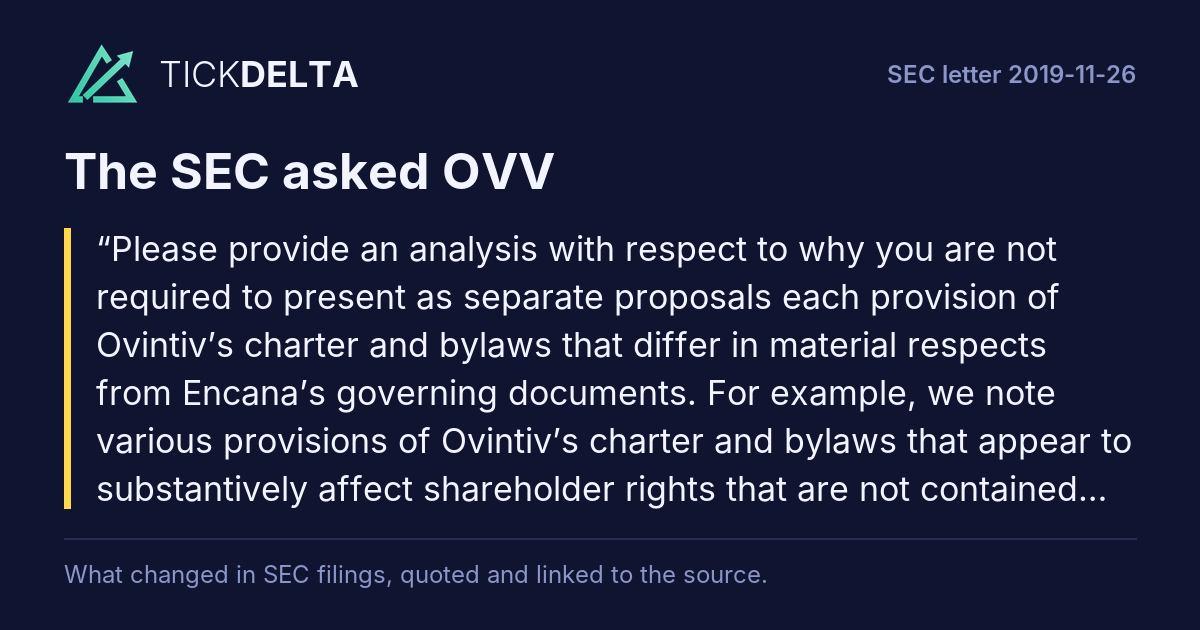
The Company acknowledges the Staff’s comment and has reviewed Rule 14a-4(a)(3) and the
Staff’s guidance regarding unbundling, including the Compliance and Disclosure Interpretations. The crux of the reorganization transaction is the redomestication of Encana into Delaware, in which Ovintiv will for the first time become subject to Delaware law.
Rest of the answer
Consequently, the reorganization proposal constitutes a single matter: in essence, the establishment of Ovintiv as a Delaware corporation governed by the Delaware General Corporation Law (“DGCL”) in place of the continued existence of Encana as a Canadian corporation governed by the Canada Business Corporations Act (the “CBCA”). More particularly, the matters identified in the Staff’s comment applicable to Encana shareholders, on the one hand, and Ovintiv stockholders, on the other hand, relate directly to the differences in the governing law applicable to Encana under the CBCA and Ovintiv under the DGCL. These changes are fundamentally statutory in nature, inextricably linked to the redomestication of a foreign corporation organized under the laws of Canada as a U.S. corporation organized under the laws of Delaware. That is, they are not matters that derive from a change in the respective governing documents of Encana and Ovintiv but instead are differences that arise from the respective corporate statutes governing the corporation immediately prior to and following the redomestication. As matters that derive from the corporate statutes and not the governing documents, the Company respectfully submits they are not matters that require unbundling under Rule 14a-4(a)(3).
Set forth below is a further discussion of each of the provisions identified in the Staff’s comment. In addition, the Company has reviewed the governing documents of Encana and the proposed charter and bylaws of Ovintiv and respectfully submits that the differences in such governing documents either result from the change in governing law
(i.e. they are statutory in nature) or are not material governanceand control-related provisions and, therefore, do not require unbundling under Rule 14a-4(a)(3).
Exclusive Forum
The
CBCA contains various exclusive forum provisions that require a shareholder (or other party) to bring certain claims against a CBCA corporation and its directors and officers solely in certain Canadian courts specified in the CBCA (a
“Canadian Court”). For example, under the CBCA, the right of a shareholder to obtain certain remedies, including with respect to derivative actions, oppression claims and dissent rights, may be pursued solely in a Canadian
Court. Likewise, under the CBCA, an application in respect of various matters related to a CBCA corporation, including with respect to reorganizations, plans of arrangements, rights to indemnity and creditors rights, may be brought solely in a
Canadian Court. In contrast, the DGCL does not contain a default exclusive forum provision like the CBCA but instead explicitly permits a corporation to include in its charter or bylaws an exclusive forum provision designating the Court of Chancery of the State of Delaware as the sole and exclusive forum for certain types of actions and proceedings that may be initiated by stockholders. In connection with becoming a Delaware corporation, the Company has elected to include an exclusive forum provision in its charter whereas Encana’s governing documents are silent on this matter because it is mandated by the CBCA. Based on the above, the Company respectfully submits that the inclusion of an exclusive forum provision in the Ovintiv charter does not represent a material change from the rights presently afforded to Encana shareholders under the CBCA and does not require unbundling under Rule 14a-4(a)(3). Moreover, the Company respectfully submits that, in any event, the exclusive forum provision is not a governanceand control-related provision that meets the standard requiring unbundling under Rule 14a-4(a)(3).
The Company acknowledges the Staff’s comment requesting a discussion of the exclusive forum provision in the section entitled
“Comparison of Rights of Encana Shareholders and Ovintiv Stockholders” in the proxy statement/prospectus included in the Registration Statement and will revise the disclosure in response to the comment in Amendment No. 1 to the
Registration Statement (“Amendment No. 1”) to be filed by the Company via EDGAR subsequent to this letter.
Percentage of Stockholders Required to Call a Special Meeting
The CBCA, like other Canadian corporate statutes, contains a provision that permits shareholders of 5% of the issued and outstanding shares that carry the right to vote to requisition a special meeting of the corporation. In contrast, the DGCL does not contain a provision granting stockholders the right to call a special meeting. Encana’s articles of incorporation and by-law are silent on this issue because it is mandated by the CBCA. Accordingly, if Ovintiv’s charter and bylaws were consistent with Encana’s articles of incorporation and by-law, Ovintiv stockholders would have no right to call a special meeting. The provision to be included in Ovintiv’s bylaws granting stockholders holding 20% of Ovintiv shares the right to call a special meeting will provide Ovintiv stockholders with more rights than they would otherwise enjoy under the DGCL and is consistent with similar provisions adopted by certain U.S. peers of Ovintiv. The inclusion of this provision is, thus, favorable to Encana shareholders in the exercise of their future rights as Ovintiv stockholders. The Company, therefore, respectfully submits that the inclusion of a right more favorable to Ovintiv stockholders than that provided by the DGCL should not require unbundling under Rule 14a-4(a)(3).
Stockholder Action by Written Consent
The CBCA contains a provision that permits shareholders holding 100% of all issued and outstanding shares of a corporation to take action by written consent in lieu of a meeting of shareholders. In contrast, the DGCL explicitly permits a corporation to elect to adopt in its charter any standard with respect to stockholders taking action by written consent and, in the absence of such election, any action that could be taken at a meeting of stockholders may be taken by written consent. In connection with becoming a Delaware corporation, Ovintiv has elected to include a provision in its charter eliminating action by written consent. Encana’s articles of incorporation and by-law are silent on this matter as the 100% shareholder consent standard is mandated by the CBCA. The Company respectfully submits that there is no practical difference between the right of shareholders of a Canadian public corporation (with thousands of beneficial shareholders) having a right to take action by unanimous written consent, on the one hand, and stockholders of a Delaware public corporation having no right to take action by written consent, on the other hand. By eliminating the right to take action by written consent in Ovintiv’s charter, as specifically contemplated by the DGCL, Ovintiv stockholders are effectively in the same position as Encana shareholders today. The rights of Encana shareholders are changing in form, but not substance, and such change is the product of a difference between the DGCL and the CBCA. Based on the above, the Company respectfully submits that the inclusion of a provision eliminating action by written consent in the Ovintiv charter does not represent a material change from the rights presently afforded to Encana shareholders under the CBCA and does not require unbundling under Rule 14a-4(a)(3).