tickdelta
Sign in

Tickdelta is free for now. Sign up and get Pro free

← Screener

OXYOccidental Petroleum

Energy · Oil & Gas Production · NYSE
Compare with peers → Embed
SEC comment letters, last 20 years

6 reviews of OXY's filings by SEC staff

UPLOAD and CORRESP
ReviewsRead ↓
6
latest letter 2024-04-30
Questions asked
42
each answered in the company's own letter
No closing letter
2
reviews without a letter saying the staff completed it

When the SEC's staff reviews a filing, it writes to the company with numbered questions, and the company answers each one in a letter. SEC publishes the exchange once the review is over, at least 20 business days later. A question is not an accusation; most reviews end with the company adding detail to its next filing.

Form 10-K

2024-04-30 to 2024-05-21 · 3 questions · 1 letter from the SEC, 1 from the company
Review closed 2024-05-21
SegmentsClimateReserves and insuranceRevenueResults discussion (MD&A)
Financial Statements and Supplementary Data · Note 16 - Geographic Areas and Industry Segments, page 112
SEC asked (1)
We note from your disclosure on page 3 that the midstream and marketing segment includes your low-carbon ventures businesses (“OLCV”) and that these businesses seek not only to leverage carbon management in your operations but also to “strategically partner with other industries to help reduce their emissions.” We further note disclosure on page 44 that OLCV provides services to third parties to facilitate the
Rest of the question

implementation of their CCUS projects and that “OLCV is fostering emerging technologies, including DAC and low-carbon power sources, and other business models with the potential to position Occidental as a leader in the production of low-carbon energy and products.” Please explain in sufficient detail how you evaluated whether OLCV is considered a separate operating segment under the guidance of FASB ASC 280-10-50. As part of your response, please address the following: • If you do not consider OLCV to be a separate operating segment, provide an analysis to support your position in accordance with FASB ASC paragraphs 280-10-50-1 through 50-9. • If you do consider OLCV to be a separate operating segment that you aggregate for reporting purposes into the midstream and marketing segment, provide an analysis to support your position that OLCV meets the aggregation criteria in FASB ASC paragraph 280-10-50-11.

OXY answered
We respectfully advise the Staff that the Company regularly reviews its segment analysis and will continue to assess OLCV given the expected continued investment in this portfolio of assets. The Company’s December 2023 analysis, particularly with respect to OLCV, concluded that OLCV did not meet the operating segment criteria under FASB ASC paragraphs 28-10-50-1 through 50-9.
Rest of the answer

The below discussion summarizes the Company’s analysis of the applicable sections of ASC 280-10-50-1 through 50-9.

The Company’s President and CEO is the Chief Operating Decision Maker (CODM) and is responsible for allocating resources and assessing the performance across the Company’s operations. The oil and gas, midstream and marketing, and chemicals segments each have separate segment management directly accountable to the CODM as described by ASC 280-10-50-7, whereas OLCV does not have a segment manager who is directly accountable to the CODM. The segment managers allocate resources within their segments and are not part of the CODM function.

The CODM reviews a consolidated financial package for the Company and discrete financial packages for each of the Company’s three operating segments: oil and gas, midstream and marketing and chemicals. All reports present the Company’s business activities classified in these three areas, with the corporate and eliminations included in the consolidated package.

OLCV seeks to partner with other industries by offering CO2 sequestration services at one of several still to be developed sequestration hubs. OLCV also seeks to capture CO2 directly from the atmosphere through its first direct air capture plant, which is expected to be completed in mid-2025. OLCV’s operating results are incorporated in the midstream and marketing segment’s financial package as this segment also includes the Company’s legacy CO2 processing and transportation activities. Legacy midstream CO2 assets may be utilized for low-carbon projects, at such time that any sequestration hubs or direct air capture facilities are completed. OLCV has no material intercompany or third-party revenue as the direct air capture and sequestration projects are currently in pre-operational, developmental stage. OLCV’s remaining activity is related to several equity method investments the aggregate book value of which is less than 1% of the

Company’s total assets. OLCV’s net assets and pre-tax profit operating losses are less than 5% and 0.6%, respectively, of the Company’s corresponding consolidated amounts for 2023.

Because OLCV’s business activities are still in development, information about OLCV revenue and expenses are not presented or regularly reviewed as discrete financial information by the CODM, therefore OLCV does not meet the second characteristic of ASC 280-10-50-1 and is not a separate operating segment. ASC 280-10-50-3 indicates that start-up activities may be considered an operating segment, however, at this time, the OLCV operating results do not rise to the significance for the CODM to review separately.

The aggregation criteria in FASB ASC paragraph 280-10-50-11 are not applicable as OLCV is not a separate operating segment.

Read in the reply ↗
In its next report

First report after the company's reply of 2024-05-09: 10-Q filed 2024-08-07 ↗, against the 10-Q filed 2023-11-07 ↗.

Tickdelta does not hold the text of both reports, so they are not compared here.
Supplemental Oil and Gas Information · Oil and Gas Reserves, page 114
SEC asked (2)
Tell us the quantity of reported reserves that are attributable to investments that are accounted for by the equity method and where they are reflected in your supplemental oil and gas reserve disclosure. Additionally, explain to us how your presentation takes into consideration the guidance in FASB ASC paragraph 932-235-50-8(c).
OXY answered
We respectfully advise the Staff that the Company does not have any oil and gas reserves or production associated with investments that are accounted for under the equity method for any of the periods presented in the Form 10-K. The equity method investee referenced in footnote (b) to the Company’s presentation of results of operations on page 121 is related to the Company’s investment in a Gulf of Mexico well containment company that has no oil and gas reserves or production. Read in the reply ↗
In its next report

First report after the company's reply of 2024-05-09: 10-Q filed 2024-08-07 ↗, against the 10-Q filed 2023-11-07 ↗.

Tickdelta does not hold the text of both reports, so they are not compared here.

Results of Operations, page 121
SEC asked (3)
Footnote (b) to your presentation of results of operations indicates, in part, that revenues include income from equity investments. Explain to us how this presentation takes into consideration the guidance of FASB ASC paragraph 932-235-50-28.
OXY answered
We respectfully advise the Staff that the income associated with the equity method investments referenced in footnote (b) accounts for 0.1% or less of total revenues for each period presented in the Form 10-K. Due to its immaterial nature, the

Company will remove the reference to the equity method investees from similar disclosure in future filings.

If you need any further information or elaboration, or if you wish to discuss any of the information presented above, please call me at your convenience at (713) 985-6901. Read in the reply ↗
In its next report

First report after the company's reply of 2024-05-09: 10-Q filed 2024-08-07 ↗, against the 10-Q filed 2023-11-07 ↗.

Tickdelta does not hold the text of both reports, so they are not compared here.

Also in this review: closing letter, 2024-05-21
Form 10-K for the fiscal year ended December 31, 2019

2020-06-18 to 2020-07-24 · 2 questions · 1 letter from the SEC, 1 from the company
Review closed 2020-07-24
Reserves and insuranceResults discussion (MD&A)
Management's Discussion and Analysis · Changes in Proved Reserves, page 27
SEC asked (1)
Your disclosure under this section identifies multiple factors impacting your proved reserves without indicating the amount attributable to each factor. For example, you indicate that 200 MMBOE of negative revisions of previous estimates primarily related to negative price revisions, changes to development plans and reservoir performance in the Permian Basin without indicating the amount attributable to each factor.
Rest of the question

Separately, you indicate that 293 MMBOE positive revisions due to improved recovery are due to multiple factors. If multiple factors materially contribute to changes in reported reserve quantities, indicate the quantity attributable to each factor. Note that this comment also applies to your discussion of changes in proved undeveloped reserves appearing on page 28 as well as your presentation of changes in proved reserves appearing on pages 110 to 113.

OXY answered
We advise that in future filings we will expand our disclosure to provide additional explanation of significant changes in proved reserves. We propose to revise our future disclosures in a manner similar to the following for each instance referenced above.

Revisions of Previous Estimates, page 27

“In 2019, Occidental’s revisions of previous estimates of proved reserves were negative 200 MMBOE, of which approximately 91 MMBOE were negative price revisions.
Rest of the answer

The negative price revisions were primarily associated with the Permian Basin (103 MMBOE), which were partially offset by positive price revisions of 14 MMBOE on international production sharing contracts.

An additional 84 MMBOE of the negative revisions were related to management changes in development plans due to lower average commodity prices compared to the prior year and the reallocation of capital to higher return projects. These changes were primarily associated with Permian Basin (65 MMBOE).

Further negative revisions of 35 MMBOE were associated with updates based on reservoir performance. The remaining 10 MMBOE of offsetting positive revisions were associated with various other cost related revisions.”

Improved Recovery, page 27

“In 2019, Occidental added proved reserves of 293 MMBOE from improved recovery primarily due to additional development projects in the Permian Basin, which accounted for approximately two-thirds of the reserve additions. Further positive additions of 63 MMBOE came from development drilling in the DJ Basin.”

Proved Undeveloped Reserves, page 28

“Purchases of proved undeveloped reserves added 317 MMBOE, of which two thirds were related to the DJ Basin with the remaining split between the Permian Basin and Gulf of Mexico. Total improved recovery additions of 192 MMBOE were primarily the result of additional development drilling in the Permian Basin (105 MMBOE) and DJ

Basin (63 MMBOE). The 2019 additions to proved undeveloped reserves were partially offset by transfers to proved developed reserves and negative revisions of previous estimates. Transfers to proved developed reserves were a total of 196 MMBOE. More than half of the transfers were in the Permian Basin (121 MMBOE) with another 61 MMBOE occurring in the DJ Basin. Revisions of previous estimates were a negative

166 MMBOE. Approximately 79 MMBOE of the negative revisions were related to management changes in development plans, mainly in the Permian Basin due to lower average commodity prices versus the prior year and the reallocation of capital. An additional 61 MMBOE of negative revisions were associated with updates based on reservoir performance. The remaining negative revisions were primarily price revisions, mainly in the Permian Basin.”

Oil Reserves - Revisions of Previous Estimates, page 110

“Revisions of previous estimates in 2019 primarily reflected negative price revisions of 52 MMBOE associated with the Permian Basin, partially offset by positive price revisions on international production sharing contracts. Another 47 MMBOE and 64 MMBOE in negative revisions were related to changes in development plans and reservoir performance, primarily in the Permian Basin.”

NGL Reserves – Revisions of Previous Estimates, page 111

“Revisions of previous estimates in 2019 reflected negative price revisions of 20 MMBOE in the Permian Basin and DJ Basin partially offset by positive price revisions on international production sharing contracts. Another 24 MMBOE in negative revisions were related to changes in development plans, which were offset by 27 MMBOE in positive revisions related to updates based on reservoir performance.”

Natural Gas Reserves – Revisions of Previous Estimates, page 112

“Revisions of previous estimates in 2019 reflected negative price revisions of 187 BCF in the Permian Basin, partially offset by positive price revisions on international production sharing contracts. Another 79 BCF in negative revisions were related to changes in development plans primarily in the Permian Basin.”

Total Reserves – Revisions of Previous Estimates, page 113

“Revisions of previous estimates in 2019 reflected negative price revisions of 103 MMBOE in the Permian Basin, partially offset by positive price revisions on international production sharing contracts. Another 84 MMBOE and 35 MMBOE in negative revisions were related to changes in development plans and reservoir performance, primarily in the Permian Basin.”

Read in the reply ↗
In its next report

First report after the company's reply of 2020-06-29: 10-Q filed 2020-08-10 ↗, against the 10-Q filed 2020-05-06 ↗.

Tickdelta does not hold the text of both reports, so they are not compared here.

Proved Undeveloped Reserves, page 28
SEC asked (2)
Revise your disclosure under this section to explain the reasons why material amounts of proved undeveloped reserves in individual fields or countries remain undeveloped for five years or more after disclosure as proved reserves. See Item 1203(d) of Regulation S-K.
Rest of the question

Please note the statement that your "proved undeveloped reserves in international locations are associated with approved long-term international development projects" does not appear to provide the required disclosure.

OXY answered
We propose that in any future filings in which we disclose proved undeveloped reserves, we will expand our disclosure to explain the reasons why material amounts remain undeveloped for five years or more. In future filings, we propose to revise any such disclosure in a manner similar to the following:

“At December 31, 2019, Occidental had 210 MMBOE of pre-2015 proved undeveloped reserves that remained undeveloped.
Rest of the answer

These proved undeveloped reserves relate to approved long-term development plans, 185 MMBOE of which are associated with international development projects with physical limitations in existing gas processing capacity and 25 MMBOE associated with certain Permian EOR projects.

Occidental remains committed to these projects and continues to actively progress the development of these volumes. Occidental also had an additional 68 MMBOE of proved undeveloped reserves scheduled to be developed more than five years from their initial date of booking, primarily related to approved long-term development plans in other Permian EOR projects associated with physical limitations in existing gas processing capacity.”

If you need any further information or elaboration, or if you wish to discuss any of the information presented above, please call me at your convenience at (713)

366-5149.

Read in the reply ↗
In its next report

First report after the company's reply of 2020-06-29: 10-Q filed 2020-08-10 ↗, against the 10-Q filed 2020-05-06 ↗.

Tickdelta does not hold the text of both reports, so they are not compared here.

Also in this review: closing letter, 2020-07-24

Form S-4

2019-07-01 to 2019-07-05 · 5 questions · 1 letter from the SEC, 2 from the company
No closing letter
DebtRisk factorsLegal and contingencies
Unaudited Pro Forma Condensed Combined Financial Data, page 131
SEC asked (1)
Expand the disclosure under the fifth bullet point to explain how the maturities on the new indebtedness ranging "from one to 30" years described under the bullet point are consistent with the disclosure under the caption "Financing of the Merger and Treatment of Existing Debt", provided on page 16, which appears to indicate shorter maturities.
OXY answered
We have expanded the disclosure under the caption “Financing of the Merger and Treatment of Existing Debt” regarding the committed $21.8 billion 364-day senior unsecured bridge loan facility to include the following:

“Such commitments were reduced by an aggregate principal amount of $8.8 billion, to an aggregate principal amount of $13.0 billion, upon Occidental’s entry into the term loan credit agreement described below and will be further reduced to the extent that Occidental obtains certain other long-term debt financing or debt financing commitments...including asset sales pursuant to
Rest of the answer

the Total transaction.”

We have expanded the disclosure under the fifth bullet point to include the following:

“the incurrence by Occidental of $21.8 billion of new indebtedness to finance a portion of the cash merger consideration, consisting of (i) $8.8 billion in term loans incurred under the term loan credit agreement, with maturities of 364 days and two years, and (ii) $13 billion in long-term debt issued or incurred in lieu of borrowings pursuant to, and which would reduce to $0 the commitments under, the bridge loan commitment letter, with maturities of up to thirty years.”

Read in the reply ↗
Notes to Pro Forma Financial Statements · Pro Forma Adjustment (e), page 143
SEC asked (2)
Expand your disclosure in pro forma adjustment (e)(i) to explain how the estimated average annual interest rate of 4.3% assumed on the new indebtedness of $21.8 billion was determined.
OXY answered
We have expanded the disclosure in pro forma adjustment (e)(i) to include the following:

“Issuance of $21.8 billion of new indebtedness, with an estimated average annual interest rate of 4.3%, yielding net proceeds of $4.4 billion and $17.2 billion in shortand long-term debt, respectively. Anticipated proceeds are net of $238 million in debt issuance costs.
Rest of the answer

After giving effect to the pay down of $8.8 billion in aggregate principal amount of term loans with the proceeds from the anticipated divestiture and other sources, the estimated average annual interest rate of the remaining $13 billion of new indebtedness is 4.6%. Estimated interest rates are based on underlying U.S. Treasury rates adjusted for Occidental’s anticipated credit spreads across a range of maturities.”

Read in the reply ↗
Notes to Pro Forma Financial Statements · Pro Forma Adjustment (e), page 143
SEC asked (3)
Provide us a supplemental analysis that shows, in reasonable detail, how the pro forma interest expense and amortization on the new debt is approximately $154 million and $615 million for the three months ended March 31, 2019 and for the year ended December 31, 2018, has been calculated.
OXY answered
We have expanded the disclosure in pro forma adjustment (e)(ii) to include the following:

“After giving effect to the pay down of $8.8 billion in aggregate principal amount of term loans, the associated pro forma interest expense and amortization on the remaining $13 billion of new indebtedness is approximately $154 million and $615 million for the three months ended March 31, 2019 and for the year ended December 31, 2018, respectively.
Rest of the answer

A one percent change in the assumed interest rate of the $13 billion in new indebtedness would increase or decrease the interest expense by $33 million and $130 million for the three months ended March 31, 2019 and for the year ended December 31, 2018, respectively. In the event the $8.8 billion of term loans are not repaid and remain outstanding, pro forma interest expense would increase by approximately $84 million and $336 million for the three months ended March 31, 2019 and for the year ended December 31, 2018, respectively.”

We also advise the Staff that pro forma interest expense and amortization on the new debt of $154 million and $615 million for the three months ended March 31, 2019 and the year ended December 31, 2018 have been calculated as follows:

in millions

Year ended

December 31, 2018

New indebtedness issued and outstanding after giving effect to pay down of $8.8 billion in aggregate principal amount of term loans

Read in the reply ↗
Pro Forma Adjustment (f), page 143
SEC asked (4)
Pro forma adjustment (d) indicates that the fair value adjustments to Anadarko's property, plant and equipment, intangible assets, and debt were $38,839 million, $2,335 million, and $(2,133) million, respectively. Expand the disclosure under note (f) to reconcile the adjustments shown under that note to the amounts reflected in note (d). General
OXY answered
We have expanded the disclosure in pro forma adjustment (f) to include the following table to reconcile the adjustments shown under the note to the amounts reflected in note (d):

as of March 31, 2019

Fair value of Anadarko property, plant and equipment excluding Anadarko’s Africa assets

47,891

Less: Anadarko historical value property, plant and equipment excluding Anadarko’s Africa assets

(17,613

)

Fair value adjustment to increase Anadarko property, plant and equipment, net of Anadarko’s Africa assets

30,278

Fair value of property and equipment held for sale related to Anadarko’s
Rest of the answer

Africa assets

9,384

Less: Anadarko historical value property and equipment related to Africa assets

(2,693

Fair value adjustment to increase value related to Anadarko’s Africa assets(1)

6,691

Fair value of WES property, plant and equipment

10,500

Less: WES historical property, plant and equipment

(8,630

Fair value adjustment to increase WES property, plant and equipment

1,870

Fair value adjustment to Anadarko’s property, plant and equipment per Note (d)

38,839

Fair value of Intangible assets

3,168

Less: WES historical intangible assets

(833

Fair value adjustment to increase Intangible assets per Note (d)

2,335

Fair value adjustment to increase Intangible assets

Less: fair value adjustment attributable to noncontrolling interests

(1,892

Fair value adjustment to increase WES property, plant and equipment and intangibles

2,313

Fair value of debt attributable to Anadarko, excluding WES, assumed by Occidental

12,628

Less: Anadarko historical debt, excluding WES debt

(10,512

Fair value adjustment to Anadarko debt, excluding WES debt, assumed by Occidental

2,116

Fair value adjustment for WES debt

Fair value adjustment to increase debt per Note (d)

2,133

(1)

For additional information regarding the assumed transfer tax liability associated with Anadarko’s Africa assets, see “—Preliminary Purchase Price Allocation” above.

Fair value adjustment to Anadarko’s debt, excluding WES debt, assumed by Occidental (2)

(2,116

30,475

Estimated statutory domestic tax rate for the combined entity

7,009

(2)

Excludes fair value adjustment to WES debt of $17 million because the impact to deferred tax liabilities net of noncontrolling interests and the estimated statutory domestic tax rate was immaterial.

Read in the reply ↗
Pro Forma Adjustment (f), page 143
SEC asked (5)
Consistent with the requirements of Item 103 of Regulation S-K and pursuant to Item 10(a) of Form S-4, please revise your disclosure to describe any pending material litigation relating to the merger transaction. In that regard, we note the lawsuit filed on May 30, 2019, in the Court of Chancery of the State of Delaware seeking to inspect Occidental's books and records.
Rest of the question

In your related Rule 425 submission on May 30, you state that you "will respond in due course." We also note your risk factor disclosure at page 34 captioned: "Potential litigation against Occidental and Anadarko could result in an injunction preventing the completion of the merger or a judgment resulting in the payment of damages."

OXY answered
While we respectfully do not believe the matters described below are material to the merger, in response to the Staff’s comment, we have included under a new heading “Litigation Relating to the Merger” the following disclosure:

“On May 30, 2019, Anadarko received a demand letter from counsel to a purported Anadarko stockholder, seeking inspection of Anadarko’s books and records pursuant to Section 220 of the DGCL.
Rest of the answer

On May 9, 2019, Anadarko received a demand letter from counsel to a different purported Anadarko stockholder, seeking inspection of Anadarko’s books and records pursuant to Section 220 of the DGCL.

On May 30, 2019, a complaint was filed in the Court of Chancery of the State of Delaware by purported Occidental stockholders High River Limited Partnership, Icahn Partners Master Fund LP and Icahn Partners LP, seeking inspection of Occidental’s books and records pursuant to Section 220 of the DGCL. On June 14, 2019, Occidental filed an answer to the complaint in the Court of Chancery of the State of Delaware.”

We have also revised the relevant risk factor as follows:

“On May 30, 2019, Anadarko received a demand letter from counsel to a purported Anadarko stockholder, seeking inspection of Anadarko’s books and records pursuant to Section 220 of the DGCL. On May 9, 2019, Anadarko received a demand letter from counsel to a different purported Anadarko stockholder, seeking inspection of Anadarko’s books and records pursuant to Section 220 of the DGCL. On May 30, 2019, a complaint was filed in the Court of Chancery of the State of Delaware by purported Occidental stockholders High River Limited Partnership, Icahn Partners Master Fund LP and Icahn Partners LP, seeking inspection of Occidental’s books and records pursuant to Section 220 of the DGCL. On June 14, 2019,

Occidental filed an answer to the complaint in the Court of Chancery of the State of Delaware.

In addition, other stockholders of Occidental or Anadarko may file lawsuits against Occidental, Anadarko and/or the directors and officers of either company in connection with the merger. These lawsuits, including the matters described above, could prevent or delay the completion of the merger and result in significant costs to Anadarko and/or Occidental, including any costs associated with the indemnification of directors and officers. The defense or settlement of any lawsuit or claim, including the matters described above, that remains unresolved at the time the merger is completed may adversely affect Occidental’s business, financial condition, results of operations and cash flows.”

If you need any further information or elaboration, or if you wish to discuss any of the information presented above, please call me at your convenience at (713) 215-7802.

Read in the reply ↗

Also in this review: company letter, 2019-07-05

Schedule 14A

2019-07-01 to 2019-11-12 · 20 questions · 4 letters from the SEC, 0 from the company
No closing letter
SEC letter of 2019-07-01 ↗ no reply letter on EDGAR (the company may have answered in an amended filing)
Preliminary Proxy Statement filed on Schedule 14A
SEC asked (1)
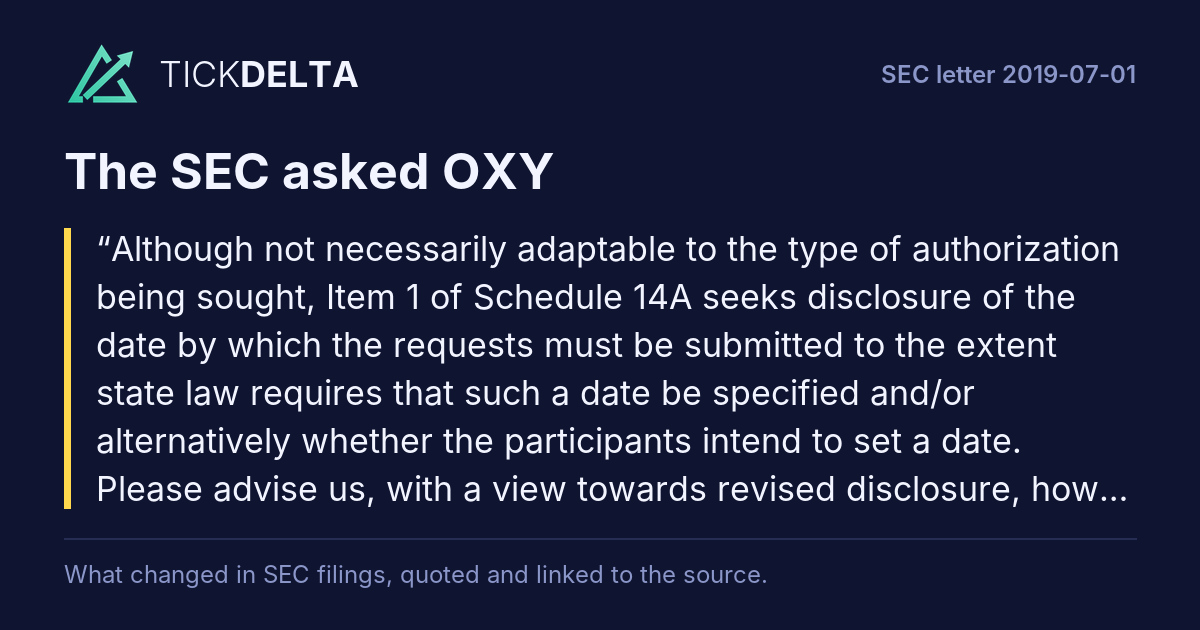
Although not necessarily adaptable to the type of authorization being sought, Item 1 of Schedule 14A seeks disclosure of the date by which the requests must be submitted to the extent state law requires that such a date be specified and/or alternatively whether the participants intend to set a date.
Rest of the question

Please advise us, with a view towards revised disclosure, how the participants have complied with this item requirement or have otherwise concluded that it is inapplicable. Refer to Rule 14a-1(f) which defines the term “proxy” to include an authorization within the meaning of Section 14(a) that is being sought by the participants.

OXY answered

No reply letter found.

Preliminary Proxy Statement filed on Schedule 14A
SEC asked (2)
Please advise us, with a view toward revised disclosure, how the participants complied with Item 6(b) regarding the record date or absence thereof. To the extent the right to give the solicited request is not considered a vote or consent, please advise us of the basis for that conclusion and any criteria to be used in determining who is eligible to give the request.
OXY answered

No reply letter found.

Preliminary Proxy Statement filed on Schedule 14A
SEC asked (3)
Please advise us how the participants complied with Item 23 regarding the distribution of this proxy statement.
OXY answered

No reply letter found.

Certain Information Regarding the Participants, page 17
SEC asked (4)
Please advise us, with a view toward revised disclosure, why the Icahn Parties are viewed as only being “deemed” to be the beneficial owners of approximately 4.4% of the outstanding as distinguished from being the beneficial owners of shares without qualification.
OXY answered

No reply letter found.

SEC letter of 2019-07-03 ↗ no reply letter on EDGAR (the company may have answered in an amended filing)
Schedule 14A
SEC asked (1)
The legend required by Rule 14a-6(e)(1) regarding identification of the proxy statement as “preliminary” similarly should appear on the first page of the proxy statement, as defined in Rule 14a-1(g), as distinguished from correspondence to shareholders. The correspondence to shareholders is not required to be disclosed in the instant filing under Rule 14a-101. Please revise the proxy statement, in Amendment No.
Rest of the question

1, in light of the permissibility under Rule 14a-3(a) for the registrant to lawfully solicit while using a preliminary proxy statement.

OXY answered

No reply letter found.

Schedule 14A
SEC asked (2)
Please advise us, with a view toward revised disclosure, how the registrant complied with Item 6(b) regarding the record date or absence thereof. To the extent the right to give the solicited request is not considered a vote or consent, please advise us of the basis for that conclusion and any criteria to be used in determining who is eligible to give the request.
OXY answered

No reply letter found.

Form of Revocation Card
SEC asked (3)
Please advise us, how the registrant complied with Rule 14a-4(e). At present, it appears as though the registrant has only attempted to comply by representing in bold typeface that any previously executed requests will be revoked unless the shareholder has specified otherwise.
OXY answered

No reply letter found.

Form of Revocation Card
SEC asked (4)
Please advise us, with a view toward revised disclosure, of the purpose of the representation in bold typeface that successful execution of the revocation card will be “deemed to have revoked” any previously executed written requests. Alternatively, please revise to make clear, if true, that a properly signed and dated revocation card will revoke a previously executed written request without further qualification.
OXY answered

No reply letter found.

Effect of the White Revocation Card, page 9
SEC asked (5)
Please advise of the necessity of using the formulation “deemed to have requested” on page 10, or revise to remove the implication that an interpretive or other assessment must be first undertaken before an executed written request will be treated as an unqualified request.
OXY answered

No reply letter found.

Effect of the White Revocation Card, page 9
SEC asked (6)
Please refer to the following formulation on page 10: “…or deemed revoked by a reduction in the number of shares that you hold…” Please revise to remove the implication that a simple reduction in the amount of shares held will result in a written request being entirely revoked instead of partially revoked in proportion to the amount of shares no longer held.
OXY answered

No reply letter found.

SEC letter of 2019-07-08 ↗ no reply letter on EDGAR (the company may have answered in an amended filing)
Preliminary Proxy Statement filed on Schedule 14A
SEC asked (1)
We recognize that the instant solicitation is not asking security holders to vote on any of the proposals delineated in the request solicitation statement, but noticed that the type of proposals that might be presented would implicate Rule 14a-4(a)(3) if introduced now.
Rest of the question

Given that only the Board is authorized to expand the number of directors on the Board, Proposal 1E is invalid unless Proposal 3 is first approved by the stockholders. Proposal 3 sets forth amendments to the By-laws which would allow a majority of stockholders to adopt a resolution to set the number of directors on the Board. Please reflect Proposal 1E to reflect its dependence upon the successful passage of Proposal 3, or advise.

OXY answered

No reply letter found.

Preliminary Proxy Statement filed on Schedule 14A
SEC asked (2)
Please revise the request solicitation statement to explain how nominees will be determined to actually become a director if more director nominees are elected pursuant to Proposals 2A–2D than existing directors are removed pursuant to Proposals 1A–1D (and either Proposal 1E or Proposal 3 is not approved), or advise us why no changes are necessary.
OXY answered

No reply letter found.

Preliminary Proxy Statement filed on Schedule 14A
SEC asked (3)
Please revise the description of Proposal 4 to remove the implication that the participants are seeking to mandate that the Board create a committee that will have its membership partially determined via a by-law provision given that such a mandate, if Proposal 4 were to be construed as such and passed, may be interpreted as impermissibly infringing up on the directors’ substantive authority to manage the business
Rest of the question

and affairs of Occidental under Sections 141(a) and 141(c)(2) of the DGCL, or advise.

OXY answered

No reply letter found.

Preliminary Proxy Statement filed on Schedule 14A
SEC asked (4)
Please revise the description of Proposal 5 to direct security holders to the exact location(s) within Exhibit D that are the subject of the proposed change should a Record Date be fixed. At present, no changes appear to have been made to the text of Article III, Section 3 in Exhibit D, which exhibit appears to be using a since superseded edition of the By-laws.
OXY answered

No reply letter found.

Preliminary Proxy Statement filed on Schedule 14A
SEC asked (5)
Please make similar revisions to Proposals 6 and 7 to reflect more exactly where in Exhibit E changes have been made to reflect how the changes specified by the proposals would appear in an amended charter. At present, Exhibit E does not distinguish between which proposed changes are the subject of Proposal 6 and which are the subject of Proposal 7.
OXY answered

No reply letter found.

Annex B | Two Year Summary Table
SEC asked (6)
Please reconcile the disclosure in footnote # 1 that indicates forward contracts were executed on June 21, 2019 with the disclosure in the background section that indicates forward contracts were executed on June 22, 2019.
OXY answered

No reply letter found.

Exhibit B-2
SEC asked (7)
Please reconsider the reference in this exhibit to “proposals set forth in full under ‘Plans for the Special Meeting’”. No such section exists in the request solicitation statement. Please revise or advise.
OXY answered

No reply letter found.

SEC letter of 2019-11-12 ↗ no reply letter on EDGAR (the company may have answered in an amended filing)
Soliciting Material filed pursuant to Rule 14a-12 under cover of Schedule 14A
SEC asked (1)
The explanatory legend encourages security holders to read the proxy statement related to the solicitation of proxies for the annual meeting “if and when” it becomes available. Rule 14a12, however, does not create an exception to Rule 14a-3. A person soliciting in reliance on Rule 14a-12, titled “Solicitations before furnishing a proxy statement,” must perfect that reliance by filing a proxy statement.
Rest of the question

See Rule 14a-12(a)(2) as well as the July 2001 Third Supplement to the Manual of Publicly Available Telephone Interpretations at interpretation I.D.3 (explaining that one “basis for permitting free communications under Rule 14a-12 was that security holders will receive a complete disclosure document” before making a voting decision). Please confirm that any future attempt to solicit in reliance on Rule 14a-12 will comply with the requirements codified in that rule, and otherwise will remove the implication that the rule created an exemption from the Rule 14a-3 requirement to furnish a proxy statement when soliciting in the absence of an exemption available under Rule 14a-2.

OXY answered

No reply letter found.

Soliciting Material filed pursuant to Rule 14a-12 under cover of Schedule 14A
SEC asked (2)
Please refer to this statement: “Each of Icahn Onshore, Icahn Capital, IPH, Icahn Enterprises Holdings, Icahn Enterprises GP, Beckton and Mr. Icahn, by virtue of their relationships to Icahn Partners, may be deemed to indirectly beneficially own (as that term is defined in Rule 13d-3 [ ])….” It appears, however, that such persons indisputably are beneficial owners as determined under the text of Rule 13d-3(a).
Rest of the question

Please note that use of the term “deemed” in this context is not synonymous with the term “considered.” As such, “deemed” not only has a distinguishable meaning, but also serves a specific legal purpose that ultimately results in the term intentionally only appearing within the regulatory text of Rule 13d-3(b) and Rule 13d3(d)(which subparagraphs, together with subparagraph (a), determine – but do not define -- who is a beneficial owner). Accordingly, please remove the implication that a legal question or doubt exists as to whether such persons are in fact beneficial owners by deleting the “may be deemed” qualification here and throughout this legend for any other persons.

OXY answered

No reply letter found.

Soliciting Material filed pursuant to Rule 14a-12 under cover of Schedule 14A
SEC asked (3)
Out of an interest in facilitating security holders’ understanding of this newly-introduced solicitation effort, please advise us, with a view toward disclosure in a future filing, whether or not the participants’ consent solicitation effectuated through the definitive proxy statement filed on July 18, 2019, remains ongoing or has been terminated.
OXY answered

No reply letter found.

Form 10-K

2017-06-21 to 2017-09-28 · 9 questions · 2 letters from the SEC, 2 from the company
Review closed 2017-09-28
Reserves and insuranceResults discussion (MD&A)Goodwill and impairmentLiquidity and cashCritical estimatesNon-GAAP measures
Business Review, page 15 · Proved Undeveloped Reserves, page 18
SEC asked (1)
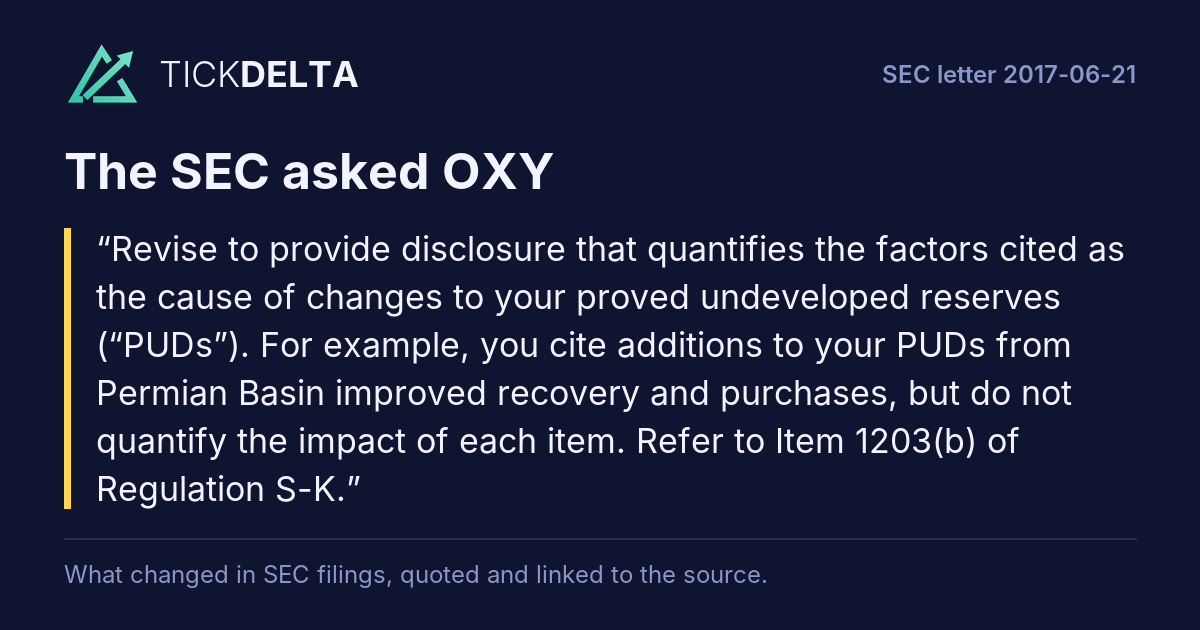
Revise to provide disclosure that quantifies the factors cited as the cause of changes to your proved undeveloped reserves (“PUDs”). For example, you cite additions to your PUDs from Permian Basin improved recovery and purchases, but do not quantify the impact of each item. Refer to Item 1203(b) of Regulation S-K.
OXY answered
We acknowledge the Staff’s comment. We propose that in any future filings in which we disclose material changes in our proved undeveloped reserves, we will expand our disclosure to quantify the factors that contributed to such changes in our proved undeveloped reserves. In reports going forward, we propose to revise any such disclosure in a manner similar to the following:

“In 2016, Occidental had proved undeveloped reserve additions of 195 million BOE from Permian Basin improved recovery of 112 million BOE and purchases of 83 million BOE.” Read in the reply ↗
In its next report

First report after the company's reply of 2017-06-30: 10-Q filed 2017-08-02 ↗, against the 10-Q filed 2017-05-04 ↗.

Tickdelta does not hold the text of both reports, so they are not compared here.

Business Review, page 15 · Proved Undeveloped Reserves, page 18
SEC asked (2)
We note that you converted approximately 14% and 13% of your PUDs during the fiscal years ended December 31, 2016 and 2015, respectively. Tell us how your plan to commit capital to your highest return projects will affect your ability to drill PUDs with less attractive returns in a timely manner. Refer to Rule 4-10(a)(31) of Regulation S-X.
OXY answered
We acknowledge the Staff’s comment and advise that we comply with the requirements of Rule 4-10(a)(31) of Regulation S-X by removing any PUDs that remain undeveloped after five years from initial disclosure and limit PUDs recognition to a five-year development window unless PUDs are tied to approved long-term development projects.
Rest of the answer

We plan to develop all of our PUDs in a timely manner in accordance with Rule 4-10(a)(31) of Regulation S-X.

In 2016, we continued the plan to streamline our asset portfolio by exiting non-core areas and focusing our development in the Permian Basin on higher-return projects. Our highest return projects and our most active development areas are located in the Permian Basin, which represents 75 percent of the total year-end PUDs. We plan to spend over $7 billion, which is 76 percent of total estimated future oil and gas development costs, over the next five years to develop our PUDs locations in the Permian Basin. The remaining PUDs are associated with approved long-term international development projects.

Read in the reply ↗
In its next report

First report after the company's reply of 2017-06-30: 10-Q filed 2017-08-02 ↗, against the 10-Q filed 2017-05-04 ↗.

Tickdelta does not hold the text of both reports, so they are not compared here.

Industry Outlook, page 19
SEC asked (3)
Disclosure in your annual report identifies factors that “make it impossible to predict the future direction of oil, NGLs, and domestic gas prices reliably.” However, it appears that you could provide additional information to promote an understanding of the reasonably likely effect of material trends and uncertainties, including with regard to commodity prices.
Rest of the question

For example, remarks attributed to management during your earnings call on February 9, 2017 include statements that you anticipate oil prices rising moderately through the year and that your planned capital spending anticipate oil prices remaining approximately as reflected in the futures markets. In providing revised disclosure, consider the financial and nonfinancial information available to management and whether this type of information should be disclosed. Refer to Item 303(a) of Regulation S-K and section III of SEC Release 338350.

OXY answered
We acknowledge the Staff’s comment. We propose to revise our disclosure in future filings to provide additional information to promote an understanding of the reasonably likely effect of commodity price trends on our plans. We propose to revise our disclosure in a manner similar to the following, to be modified as appropriate based on prevailing market conditions and expectations:

“These and other factors make it difficult to predict the future direction of oil, NGLs and domestic gas prices reliably, however for purposes of our current capital plan, we have anticipated oil prices to remain
Rest of the answer

approximately as reflected in the futures market, with oil prices expected to rise moderately through 2017.”

Read in the reply ↗
In its next report

First report after the company's reply of 2017-06-30: 10-Q filed 2017-08-02 ↗, against the 10-Q filed 2017-05-04 ↗.

Tickdelta does not hold the text of both reports, so they are not compared here.

Critical Accounting Policies and Estimates, page 32 · Oil and Gas Properties, page 33
SEC asked (4)
You have identified a number of material assumptions used in your impairment test including estimates of future product prices and future operating and development costs. In addition, you state that factors such as prolonged low or further declines in commodity prices could result in additional impairments.
Rest of the question

Revise your disclosure to explain how key assumptions used in your impairment test are determined, including your basis for estimating future product prices. Include information that provides insight into the uncertainty associated with key assumptions and address the degree to which your future cash flows can change significantly over time. Refer to section V of SEC Release No. 33-

OXY answered
We acknowledge the Staff’s comment. We propose to expand our disclosure in future filings to address how key assumptions in our impairment tests are determined and how we estimate future product prices. We propose to revise our future disclosure in a manner similar to the following, to be modified as appropriate:

“For impairment testing, Occidental used observable forward strip prices for oil and natural gas in the period the impairment was identified, unless prices were contractually fixed.
Rest of the answer

Future operating and development costs were estimated using the current cost environment applied to expectations of future operating and development activities to develop and produce oil and gas reserves. Market prices for crude oil, natural gas and NGLs have been volatile and may continue to be volatile in the future. Current market fundamentals indicate improved prices for crude oil, natural gas and NGLs in 2017; however, changes in global supply and demand, transportation capacity, currency exchange rates, and applicable laws and regulations, and the effect of changes in these variables on market perceptions could impact current forecasts. Future fluctuations in commodity prices could result in estimates of future cash flows to vary significantly.”

Read in the reply ↗
In its next report

First report after the company's reply of 2017-06-30: 10-Q filed 2017-08-02 ↗, against the 10-Q filed 2017-05-04 ↗.

Tickdelta does not hold the text of both reports, so they are not compared here.

Note 1. Summary of Significant Accounting Policies, page 46 · Impairments and Related Items, page 49
SEC asked (5)
Revise to describe the assets to which the allowance for doubtful accounts of $541 million recorded during 2016 relates. In addition, provide disclosure regarding the methodology used to estimate an allowance when trade receivables are deemed uncollectible. Refer to FASB ASC 310-10-50-2 and 50-14.
OXY answered
We acknowledge the Staff’s comment.

For clarification, the allowance for doubtful accounts of $541 million is not associated with trade receivables. Please reference page 40 for the allowance for doubtful accounts for trade receivables which was $16 million in 2016 and $17 million in 2015.

The allowance for doubtful accounts of $541 million was against a long term receivable related to Maxus-indemnified sites.
Rest of the answer

The Company recorded a reserve against this receivable due to the uncertainty of collection as a result of the Maxus bankruptcy.

We propose to revise our disclosure in future filings to include the following:

“The allowance for doubtful accounts recorded during 2016 includes a reserve against the long-term receivable related to the Maxus-indemnified sites described in Note 8, Environmental Liabilities and Expenditures. Occidental recorded a reserve against this receivable due to the uncertainty of collection as a result of the Maxus bankruptcy. We are vigorously pursuing Maxus’ current and former parent companies, including YPF S.A. and Repsol, as the alter egos of Maxus to recover all indemnified costs.”

Read in the reply ↗
In its next report

First report after the company's reply of 2017-06-30: 10-Q filed 2017-08-02 ↗, against the 10-Q filed 2017-05-04 ↗.

Tickdelta does not hold the text of both reports, so they are not compared here.

Note 8. Environmental Liabilities and Expenditures, page 59 · Environmental Remediation, page 59
SEC asked (6)
We note that you accrued for a reserve relating to your estimated allocable share of remedial activities associated with the proposed clean-up plan for a portion of the Lower Passaic River and that you continue to evaluate the costs to be incurred to comply with the required remedial actions.
Rest of the question

Revise to disclose the total amount accrued for this site and the reasonably possible additional loss or explain to us why this type of disclosure is not necessary. As part of your revised disclosure, address whether the estimates associated with the accrued loss is gross or net of any recoveries for costs indemnified by Maxus Energy Corporation (“Maxus”). Refer to FASB ASC 410-30-50-10d. Also address other individual Maxusindemnified sites to the degree they are relevant to an understanding of your financial position, cash flows, or results of operations.

OXY answered
We acknowledge the Staff’s comment. With respect to the Staff’s comment regarding whether the accrued loss is gross or net of any recoveries for indemnified costs, we advise that, in accordance with FASB ASC 410-30-35-8, the estimated environmental reserve recorded for the Lower Passaic River does not consider any recoveries from Maxus.
Rest of the answer

We propose to expand our disclosure in future filings to state that our estimated environmental reserves do not consider any recoveries for indemnified costs.

With respect to your request to either revise our disclosure or explain why it is unnecessary regarding the total amount accrued for the site and the reasonably possible additional loss, we reviewed the disclosure requirements for environmental reserves in preparing our Form 10-K disclosures and believe that we are in compliance with FASB ASC 410-30, Environmental Obligations. We note that the disclosures by individual site discussed in FASB ASC 410-30-50-

10(d) are encouraged but not required disclosures. We believe that disclosure of the aggregated environmental accrual provides the information necessary for an understanding of our financial position, cash flows and results of operations related to environmental liabilities.

The amount of the accrual for the Lower Passaic River is included in the aggregate for NPL sites in Note 8 on page 60 of the 2016 Form 10-K. In addition, we disclosed that three sites, including the Diamond Alkali Superfund site, accounted for 95% of the accrual related to NPL sites.

With respect to the Staff’s comments regarding other Maxus-indemnified sites, our aggregated environmental accrual does include 26 Maxus-indemnified sites. We do not believe that specific disclosures regarding those sites is necessary for an understanding of our financial position, cash flows, or results of operations.

Read in the reply ↗
In its next report

First report after the company's reply of 2017-06-30: 10-Q filed 2017-08-02 ↗, against the 10-Q filed 2017-05-04 ↗.

Tickdelta does not hold the text of both reports, so they are not compared here.

Form 8-K filed February 9, 2017 · Exhibit 99.1
SEC asked (7)
Revise your presentation of the non-GAAP measure “Core earnings per share” to provide a reconciliation to GAAP-basis earnings per share. With your response, describe your approach for dilutive shares in your computation when the GAAP and non-GAAP measures do not both result in income.
Rest of the question

Refer to Item 10(e)(1)(i)(B) of Regulation S-K and Question 102.05 of the Compliance and Disclosure Interpretations regarding Non-GAAP Financial Measures.

OXY answered
We acknowledge the Staff’s comment. We calculate the non-GAAP measure “Core earnings per share” as after-tax core earnings (loss) divided by average basic and dilutive shares outstanding used to calculate GAAP-basis reported earnings per share. The difference of average basic and diluted shares outstanding for non-GAAP measure core income (loss) compared to average basic and dilutive shares outstanding for GAAP-basis earnings (loss) is immaterial and does not impact the resulting Core earnings per share.
Rest of the answer

We propose that in any future filings or releases presenting the non-GAAP measure Core earnings per share, we will revise our disclosure to provide a reconciliation of the non-GAAP measure “Core earnings per share” to GAAP-basis earnings per share and disclose the method of how Core earnings per share is calculated.

If you need any further information or elaboration, or if you wish to discuss any of the information presented above, please call me at your convenience at (713) 215-7011.

Read in the reply ↗
In its next report

First report after the company's reply of 2017-06-30: 10-Q filed 2017-08-02 ↗, against the 10-Q filed 2017-05-04 ↗.

Tickdelta does not hold the text of both reports, so they are not compared here.

Business Review, page 15 · Proved Undeveloped Reserves, page 18
SEC asked (1)
We note from your response to prior comment 2 that, to ensure compliance with Rule 410(a)(31) of Regulation S-X, you remove proved undeveloped reserves (“PUDs”) which remain undeveloped after five years from initial disclosure.
Rest of the question

Tell us the steps routinely taken to review your development plan annually and to evaluate interim and annual changes in the development schedule to determine whether your PUDs continue to meet the requirements for disclosure. For additional guidance, refer to Question 131.04 in our Compliance and Disclosure Interpretations.

OXY answered
We acknowledge the Staff’s comment and advise the following relevant to our annual review of our development plan and related review of our PUDs locations.

We maintain a five year detailed field-level development plan, which includes the timing, location and capital commitment of wells to be drilled. The development plan is reviewed and approved annually by senior management with input from our asset managers.
Rest of the answer

Per the guidance associated with Question 131.04 of the Compliance and Disclosure Interpretations, only PUDs which are reasonably certain to be drilled within five years of booking and are supported by a final investment decision to drill them are included in the development plan.

Annually a detailed review is performed by the Reserves Group and our asset managers of all PUDs on a lease-by-lease basis to assess whether PUDs are being converted on a timely basis within five years from the initial disclosure date. Any leases not showing timely transfers from PUDs to proved developed reserves are reviewed by senior management to determine if the remaining balance will be developed in a timely manner and has sufficient capital committed in the development plan in accordance with Rule 4-10(a)(31) of Regulation S-X. In the interim, two reviews are performed, which would identify any PUDs aging issues and changes from the development plan. If we determine that a PUDs location is not reasonably certain to be drilled within five years of initial booking and/or no longer has the capital commitment, we remove that PUDs location from our proved reserves.

We have a Corporate Reserves Review Committee (Reserves Committee), consisting of senior corporate officers, to review and approve the Company’s oil and gas reserves. The Reserves Committee reports to the Audit Committee of the Company's Board of Directors. We have retained Ryder Scott Company, L.P., independent petroleum engineering consultants, to annually review our oil and gas reserve estimation processes.

Read in the reply ↗
In its next report

First report after the company's reply of 2017-09-08: 10-Q filed 2017-11-01 ↗, against the 10-Q filed 2017-05-04 ↗.

Tickdelta does not hold the text of both reports, so they are not compared here.

Critical Accounting Policies and Estimates, page 32 · Oil and Gas Properties, page 33
SEC asked (2)
The revised disclosure provided in response to prior comment 4 states that observable forward strip prices for oil and natural gas are used as your basis for estimating future product prices in impairment testing. Further revise this disclosure to describe how you estimate future prices for production expected to occur beyond the period covered by forward strip prices.
OXY answered
We acknowledge the Staff’s comment. We will further revise our disclosure provided in prior comment 4 to describe how we estimate future prices for production expected to occur beyond the period covered by forward strip prices by including the following, to be modified as appropriate:

“…with prices subsequent to the last period covered by forward strip prices held constant as the benchmark price in our undiscounted future net cash flows, unless prices were contractually fixed.”

If you need any further information or elaboration, or if you wish to discuss any of the information presented
Rest of the answer

above, please call me at your convenience at (713) 215-7011.

Read in the reply ↗
In its next report

First report after the company's reply of 2017-09-08: 10-Q filed 2017-11-01 ↗, against the 10-Q filed 2017-05-04 ↗.

Tickdelta does not hold the text of both reports, so they are not compared here.

Also in this review: closing letter, 2017-09-28

Form 10-K for the Fiscal Year Ended December 31, 2015

2016-06-23 to 2016-07-05 · 3 questions · 1 letter from the SEC, 1 from the company
Review closed 2016-07-05
SegmentsInventoryNon-GAAP measuresResults discussion (MD&A)Liquidity and cash
Oil and Gas Segment, page 14 · United States Assets, Permian Basin, page 15
SEC asked (1)
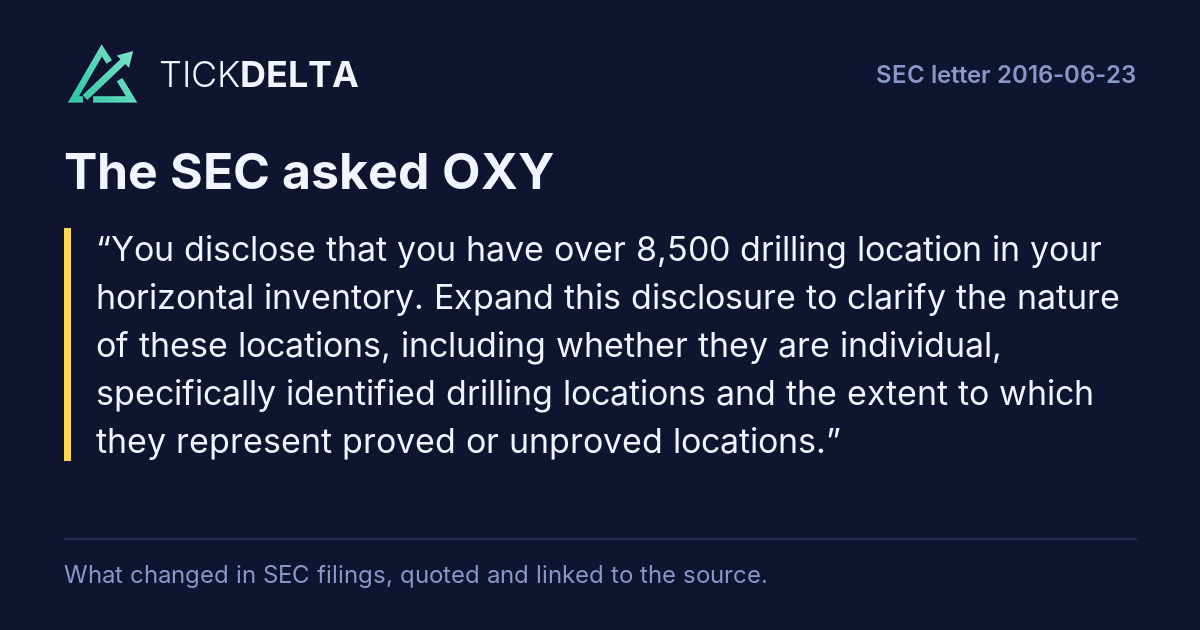
You disclose that you have over 8,500 drilling location in your horizontal inventory. Expand this disclosure to clarify the nature of these locations, including whether they are individual, specifically identified drilling locations and the extent to which they represent proved or unproved locations.
OXY answered
The Company acknowledges the Staff’s comment. In any future filings in which the Company discloses the number of its drilling locations, the Company will expand this disclosure to clarify the nature of these locations, including whether they are individual, specifically identified drilling locations and the extent to which they represent proved or unproved locations.
Rest of the answer

The Company proposes to revise any such disclosure in a manner similar to the following in reports going forward:

“The Company has over [ ] individual, specifically identified drilling locations in its horizontal inventory located in the Midland and Delaware sub-basins of the Permian Basin. This inventory was developed using data gathered from our appraisal efforts and development drilling, along with offset operators drilling activities. As of year end, [ ] of these represented proved locations.”

Read in the reply ↗
In its next report

First report after the company's reply of 2016-06-30: 10-Q filed 2016-08-03 ↗, against the 10-Q filed 2016-05-05 ↗.

Tickdelta does not hold the text of both reports, so they are not compared here.

Form 8-K Filed May 5, 2016
SEC asked (2)
The discussion of quarterly results appearing on pages two and three of the earnings release provided under Exhibit 99.1 is based on non-GAAP “core earnings”, and does not include a corresponding presentation and discussion of GAAP results. This is inconsistent with the updated Compliance and Disclosure Interpretations issued on May 17, 2016, in particular C&DI 102.10.
Rest of the question

Please review this guidance when preparing your next earnings release.

OXY answered
The Company acknowledges the Staff’s comment on the updated Compliance and Disclosure Interpretations issued subsequent to the filing of the Form 8-K. In future documents filed or furnished with the Commission, the Company will include a corresponding presentation and discussion of GAAP results along with the presentation of non-GAAP “core earnings”, as applicable. The Company will apply the guidance consistent with the updated Compliance and Disclosure Interpretations issued on May 17, 2016, in particular C&DI 102.10. Read in the reply ↗
Management’s Discussion and Analysis of Financial Condition and Results of Operations, page 17 · Liquidity and Capital Resources, page 23
SEC asked (3)
We note that cash used for capital expenditures plus dividends exceeded cash flow from operations for the year ended December 31, 2015 and for the quarter ended March 31, 2016, despite significant reductions in capital expenditures in response to the current commodity price environment.
Rest of the question

We also note that restricted cash, which had been used to fund dividends in recent periods, had been fully utilized as of March 31, 2016. Expand your discussion under this section to describe the impact of these trends on your cash management decisions, including with respect to the payment of dividends. See Section IV of SEC Release 34-48960.

OXY answered
The Company acknowledges the Staff’s comment and will provide additional disclosures in future annual and quarterly reports, as applicable, describing the impact of capital expenditure and cash flow trends on the Company’s cash management decisions, including with respect to dividends. The Company expects that such additional disclosure will vary from quarter-to-quarter in response to fluctuations in the commodity price environment, demand for the Company’s products, and other market conditions and contingencies.
Rest of the answer

In the future, the Company proposes to revise its disclosure in a manner similar to the following, to be modified as appropriate to actual results and market conditions:

“At [ ], 2016, Occidental had $[ ] billion in cash. Income and cash flows are largely dependent on the oil and gas segment’s realized prices, sales volumes and operating costs. In the [ ] quarter, Occidental continued to significantly reduce its capital expenditures compared to the prior year period. Subsequent to the quarter end, the oil and natural gas commodity price environment continued to improve, and, with a continued reduction in capital expenditures and forecasted operational improvements, Occidental expects to fund its liquidity needs, including future dividend payments, through cash on hand, cash generated from operations, monetization of non-core assets or investments and, if necessary, through future borrowings or proceeds from other forms of capital issuance.”

Occidental acknowledges that:

•

Occidental is responsible for the adequacy and accuracy of the disclosure in the filing;

Staff comments or changes to disclosure in response to staff comments do not foreclose the Commission from taking any action with respect to the filing; and

Occidental may not assert staff comments as a defense in any proceeding initiated by the Commission or any person under the federal securities laws of the United States.

If you need any further information or elaboration, or if you wish to discuss any of the information presented above, please call me at your convenience at 713-215-7123.

Read in the reply ↗
In its next report

First report after the company's reply of 2016-06-30: 10-Q filed 2016-08-03 ↗, against the 10-Q filed 2016-05-05 ↗.

Tickdelta does not hold the text of both reports, so they are not compared here.

Also in this review: closing letter, 2016-07-05

Other letters

Letters without questions

UPLOAD and CORRESP
3 other letters: notices that a filing will not be reviewed, requests to declare a registration effective, and the like

From the SEC's correspondence on EDGAR: staff letters (form UPLOAD) and company letters (form CORRESP), 24 letters filed since 2016-06-23. Questions and answers are matched by their numbers; topics come from words in each question. The reports are compared word for word (same form, before the first SEC letter against the first report after the company's reply). No AI.

Next in Owners and insiders Insider trades →