Form 10-K
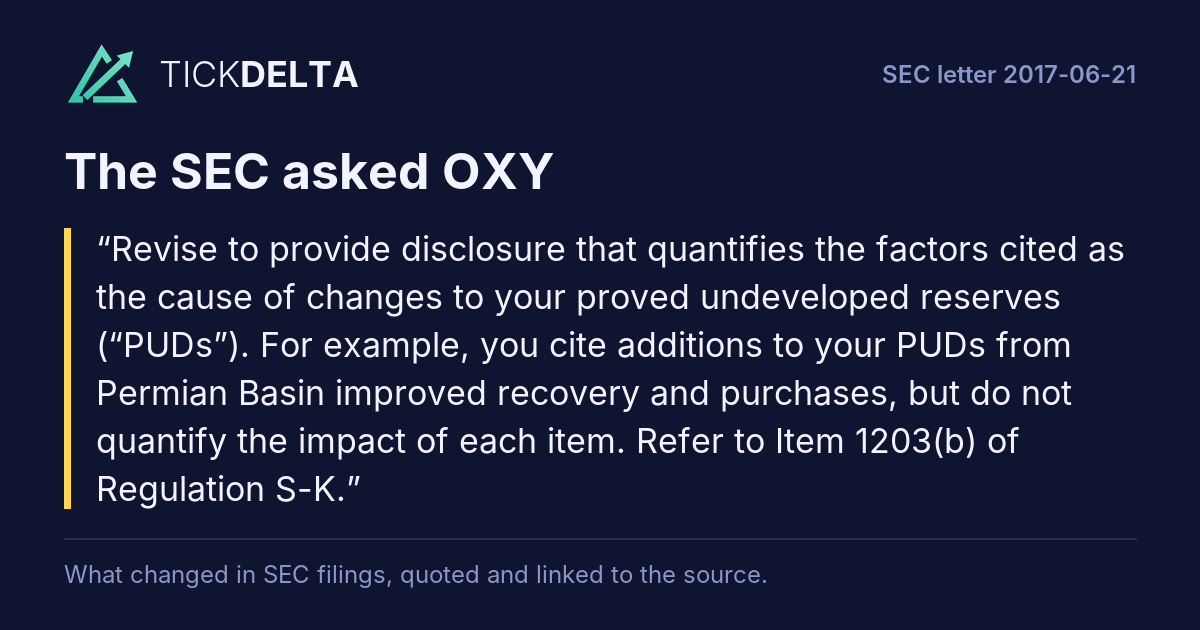
Revise to provide disclosure that quantifies the factors cited as the cause of changes to your proved undeveloped reserves (“PUDs”). For example, you cite additions to your PUDs from Permian Basin improved recovery and purchases, but do not quantify the impact of each item. Refer to Item 1203(b) of Regulation S-K.
We acknowledge the Staff’s comment. We propose that in any future filings in which we disclose material changes in our proved undeveloped reserves, we will expand our disclosure to quantify the factors that contributed to such changes in our proved undeveloped reserves. In reports going forward, we propose to revise any such disclosure in a manner similar to the following:
“In 2016, Occidental had proved undeveloped reserve additions of 195 million BOE from Permian Basin improved recovery of 112 million BOE and purchases of 83 million BOE.” Read in the reply ↗
First report after the company's reply of 2017-06-30: 10-Q filed 2017-08-02 ↗, against the 10-Q filed 2017-05-04 ↗.
Tickdelta does not hold the text of both reports, so they are not compared here.
We note that you converted approximately 14% and 13% of your PUDs during the fiscal years ended December 31, 2016 and 2015, respectively. Tell us how your plan to commit capital to your highest return projects will affect your ability to drill PUDs with less attractive returns in a timely manner. Refer to Rule 4-10(a)(31) of Regulation S-X.
We acknowledge the Staff’s comment and advise that we comply with the requirements of Rule 4-10(a)(31) of Regulation S-X by removing any PUDs that remain undeveloped after five years from initial disclosure and limit PUDs recognition to a five-year development window unless PUDs are tied to approved long-term development projects.Read in the reply ↗Rest of the answer
We plan to develop all of our PUDs in a timely manner in accordance with Rule 4-10(a)(31) of Regulation S-X.
In 2016, we continued the plan to streamline our asset portfolio by exiting non-core areas and focusing our development in the Permian Basin on higher-return projects. Our highest return projects and our most active development areas are located in the Permian Basin, which represents 75 percent of the total year-end PUDs. We plan to spend over $7 billion, which is 76 percent of total estimated future oil and gas development costs, over the next five years to develop our PUDs locations in the Permian Basin. The remaining PUDs are associated with approved long-term international development projects.
First report after the company's reply of 2017-06-30: 10-Q filed 2017-08-02 ↗, against the 10-Q filed 2017-05-04 ↗.
Tickdelta does not hold the text of both reports, so they are not compared here.
Disclosure in your annual report identifies factors that “make it impossible to predict the future direction of oil, NGLs, and domestic gas prices reliably.” However, it appears that you could provide additional information to promote an understanding of the reasonably likely effect of material trends and uncertainties, including with regard to commodity prices.Rest of the question
For example, remarks attributed to management during your earnings call on February 9, 2017 include statements that you anticipate oil prices rising moderately through the year and that your planned capital spending anticipate oil prices remaining approximately as reflected in the futures markets. In providing revised disclosure, consider the financial and nonfinancial information available to management and whether this type of information should be disclosed. Refer to Item 303(a) of Regulation S-K and section III of SEC Release 338350.
We acknowledge the Staff’s comment. We propose to revise our disclosure in future filings to provide additional information to promote an understanding of the reasonably likely effect of commodity price trends on our plans. We propose to revise our disclosure in a manner similar to the following, to be modified as appropriate based on prevailing market conditions and expectations:
“These and other factors make it difficult to predict the future direction of oil, NGLs and domestic gas prices reliably, however for purposes of our current capital plan, we have anticipated oil prices to remainRead in the reply ↗Rest of the answer
approximately as reflected in the futures market, with oil prices expected to rise moderately through 2017.”
First report after the company's reply of 2017-06-30: 10-Q filed 2017-08-02 ↗, against the 10-Q filed 2017-05-04 ↗.
Tickdelta does not hold the text of both reports, so they are not compared here.
You have identified a number of material assumptions used in your impairment test including estimates of future product prices and future operating and development costs. In addition, you state that factors such as prolonged low or further declines in commodity prices could result in additional impairments.Rest of the question
Revise your disclosure to explain how key assumptions used in your impairment test are determined, including your basis for estimating future product prices. Include information that provides insight into the uncertainty associated with key assumptions and address the degree to which your future cash flows can change significantly over time. Refer to section V of SEC Release No. 33-
We acknowledge the Staff’s comment. We propose to expand our disclosure in future filings to address how key assumptions in our impairment tests are determined and how we estimate future product prices. We propose to revise our future disclosure in a manner similar to the following, to be modified as appropriate:
“For impairment testing, Occidental used observable forward strip prices for oil and natural gas in the period the impairment was identified, unless prices were contractually fixed.Read in the reply ↗Rest of the answer
Future operating and development costs were estimated using the current cost environment applied to expectations of future operating and development activities to develop and produce oil and gas reserves. Market prices for crude oil, natural gas and NGLs have been volatile and may continue to be volatile in the future. Current market fundamentals indicate improved prices for crude oil, natural gas and NGLs in 2017; however, changes in global supply and demand, transportation capacity, currency exchange rates, and applicable laws and regulations, and the effect of changes in these variables on market perceptions could impact current forecasts. Future fluctuations in commodity prices could result in estimates of future cash flows to vary significantly.”
First report after the company's reply of 2017-06-30: 10-Q filed 2017-08-02 ↗, against the 10-Q filed 2017-05-04 ↗.
Tickdelta does not hold the text of both reports, so they are not compared here.
Revise to describe the assets to which the allowance for doubtful accounts of $541 million recorded during 2016 relates. In addition, provide disclosure regarding the methodology used to estimate an allowance when trade receivables are deemed uncollectible. Refer to FASB ASC 310-10-50-2 and 50-14.
We acknowledge the Staff’s comment.
For clarification, the allowance for doubtful accounts of $541 million is not associated with trade receivables. Please reference page 40 for the allowance for doubtful accounts for trade receivables which was $16 million in 2016 and $17 million in 2015.
The allowance for doubtful accounts of $541 million was against a long term receivable related to Maxus-indemnified sites.Read in the reply ↗Rest of the answer
The Company recorded a reserve against this receivable due to the uncertainty of collection as a result of the Maxus bankruptcy.
We propose to revise our disclosure in future filings to include the following:
“The allowance for doubtful accounts recorded during 2016 includes a reserve against the long-term receivable related to the Maxus-indemnified sites described in Note 8, Environmental Liabilities and Expenditures. Occidental recorded a reserve against this receivable due to the uncertainty of collection as a result of the Maxus bankruptcy. We are vigorously pursuing Maxus’ current and former parent companies, including YPF S.A. and Repsol, as the alter egos of Maxus to recover all indemnified costs.”
First report after the company's reply of 2017-06-30: 10-Q filed 2017-08-02 ↗, against the 10-Q filed 2017-05-04 ↗.
Tickdelta does not hold the text of both reports, so they are not compared here.
We note that you accrued for a reserve relating to your estimated allocable share of remedial activities associated with the proposed clean-up plan for a portion of the Lower Passaic River and that you continue to evaluate the costs to be incurred to comply with the required remedial actions.Rest of the question
Revise to disclose the total amount accrued for this site and the reasonably possible additional loss or explain to us why this type of disclosure is not necessary. As part of your revised disclosure, address whether the estimates associated with the accrued loss is gross or net of any recoveries for costs indemnified by Maxus Energy Corporation (“Maxus”). Refer to FASB ASC 410-30-50-10d. Also address other individual Maxusindemnified sites to the degree they are relevant to an understanding of your financial position, cash flows, or results of operations.
We acknowledge the Staff’s comment. With respect to the Staff’s comment regarding whether the accrued loss is gross or net of any recoveries for indemnified costs, we advise that, in accordance with FASB ASC 410-30-35-8, the estimated environmental reserve recorded for the Lower Passaic River does not consider any recoveries from Maxus.Read in the reply ↗Rest of the answer
We propose to expand our disclosure in future filings to state that our estimated environmental reserves do not consider any recoveries for indemnified costs.
With respect to your request to either revise our disclosure or explain why it is unnecessary regarding the total amount accrued for the site and the reasonably possible additional loss, we reviewed the disclosure requirements for environmental reserves in preparing our Form 10-K disclosures and believe that we are in compliance with FASB ASC 410-30, Environmental Obligations. We note that the disclosures by individual site discussed in FASB ASC 410-30-50-
10(d) are encouraged but not required disclosures. We believe that disclosure of the aggregated environmental accrual provides the information necessary for an understanding of our financial position, cash flows and results of operations related to environmental liabilities.
The amount of the accrual for the Lower Passaic River is included in the aggregate for NPL sites in Note 8 on page 60 of the 2016 Form 10-K. In addition, we disclosed that three sites, including the Diamond Alkali Superfund site, accounted for 95% of the accrual related to NPL sites.
With respect to the Staff’s comments regarding other Maxus-indemnified sites, our aggregated environmental accrual does include 26 Maxus-indemnified sites. We do not believe that specific disclosures regarding those sites is necessary for an understanding of our financial position, cash flows, or results of operations.
First report after the company's reply of 2017-06-30: 10-Q filed 2017-08-02 ↗, against the 10-Q filed 2017-05-04 ↗.
Tickdelta does not hold the text of both reports, so they are not compared here.
Revise your presentation of the non-GAAP measure “Core earnings per share” to provide a reconciliation to GAAP-basis earnings per share. With your response, describe your approach for dilutive shares in your computation when the GAAP and non-GAAP measures do not both result in income.Rest of the question
Refer to Item 10(e)(1)(i)(B) of Regulation S-K and Question 102.05 of the Compliance and Disclosure Interpretations regarding Non-GAAP Financial Measures.
We acknowledge the Staff’s comment. We calculate the non-GAAP measure “Core earnings per share” as after-tax core earnings (loss) divided by average basic and dilutive shares outstanding used to calculate GAAP-basis reported earnings per share. The difference of average basic and diluted shares outstanding for non-GAAP measure core income (loss) compared to average basic and dilutive shares outstanding for GAAP-basis earnings (loss) is immaterial and does not impact the resulting Core earnings per share.Read in the reply ↗Rest of the answer
We propose that in any future filings or releases presenting the non-GAAP measure Core earnings per share, we will revise our disclosure to provide a reconciliation of the non-GAAP measure “Core earnings per share” to GAAP-basis earnings per share and disclose the method of how Core earnings per share is calculated.
If you need any further information or elaboration, or if you wish to discuss any of the information presented above, please call me at your convenience at (713) 215-7011.
First report after the company's reply of 2017-06-30: 10-Q filed 2017-08-02 ↗, against the 10-Q filed 2017-05-04 ↗.
Tickdelta does not hold the text of both reports, so they are not compared here.
We note from your response to prior comment 2 that, to ensure compliance with Rule 410(a)(31) of Regulation S-X, you remove proved undeveloped reserves (“PUDs”) which remain undeveloped after five years from initial disclosure.Rest of the question
Tell us the steps routinely taken to review your development plan annually and to evaluate interim and annual changes in the development schedule to determine whether your PUDs continue to meet the requirements for disclosure. For additional guidance, refer to Question 131.04 in our Compliance and Disclosure Interpretations.
We acknowledge the Staff’s comment and advise the following relevant to our annual review of our development plan and related review of our PUDs locations.
We maintain a five year detailed field-level development plan, which includes the timing, location and capital commitment of wells to be drilled. The development plan is reviewed and approved annually by senior management with input from our asset managers.Read in the reply ↗Rest of the answer
Per the guidance associated with Question 131.04 of the Compliance and Disclosure Interpretations, only PUDs which are reasonably certain to be drilled within five years of booking and are supported by a final investment decision to drill them are included in the development plan.
Annually a detailed review is performed by the Reserves Group and our asset managers of all PUDs on a lease-by-lease basis to assess whether PUDs are being converted on a timely basis within five years from the initial disclosure date. Any leases not showing timely transfers from PUDs to proved developed reserves are reviewed by senior management to determine if the remaining balance will be developed in a timely manner and has sufficient capital committed in the development plan in accordance with Rule 4-10(a)(31) of Regulation S-X. In the interim, two reviews are performed, which would identify any PUDs aging issues and changes from the development plan. If we determine that a PUDs location is not reasonably certain to be drilled within five years of initial booking and/or no longer has the capital commitment, we remove that PUDs location from our proved reserves.
We have a Corporate Reserves Review Committee (Reserves Committee), consisting of senior corporate officers, to review and approve the Company’s oil and gas reserves. The Reserves Committee reports to the Audit Committee of the Company's Board of Directors. We have retained Ryder Scott Company, L.P., independent petroleum engineering consultants, to annually review our oil and gas reserve estimation processes.
First report after the company's reply of 2017-09-08: 10-Q filed 2017-11-01 ↗, against the 10-Q filed 2017-05-04 ↗.
Tickdelta does not hold the text of both reports, so they are not compared here.
The revised disclosure provided in response to prior comment 4 states that observable forward strip prices for oil and natural gas are used as your basis for estimating future product prices in impairment testing. Further revise this disclosure to describe how you estimate future prices for production expected to occur beyond the period covered by forward strip prices.
We acknowledge the Staff’s comment. We will further revise our disclosure provided in prior comment 4 to describe how we estimate future prices for production expected to occur beyond the period covered by forward strip prices by including the following, to be modified as appropriate:
“…with prices subsequent to the last period covered by forward strip prices held constant as the benchmark price in our undiscounted future net cash flows, unless prices were contractually fixed.”
If you need any further information or elaboration, or if you wish to discuss any of the information presentedRead in the reply ↗Rest of the answer
above, please call me at your convenience at (713) 215-7011.
First report after the company's reply of 2017-09-08: 10-Q filed 2017-11-01 ↗, against the 10-Q filed 2017-05-04 ↗.
Tickdelta does not hold the text of both reports, so they are not compared here.
Also in this review: closing letter, 2017-09-28