Added10-Q Oct 29, 2026 vs 10-K Feb 12, 2026
The accounting method for the 2032 Exchangeable Notes could adversely affect our financial condition and consolidated financial results.
Each branch is a paragraph in Risk Factors with nothing like it in the 10-K filed Feb 13, 2025. A box jumps to the paragraph as filed, below.
10 paragraphs in Risk Factors of the 10-K filed Feb 12, 2026 with nothing like them in the 10-K filed Feb 13, 2025. Quoted exactly. Paragraphs that were only edited are under 10-K change.
•Uncertainty in U.S. trade policy, including uncertainty surrounding changes in tariffs, trade agreements or other trade restrictions imposed by the U.S. or other governments;
•The amount and the timing of cost savings and operational efficiencies to be achieved through our Refining Business Improvement (“RBI”) initiative;
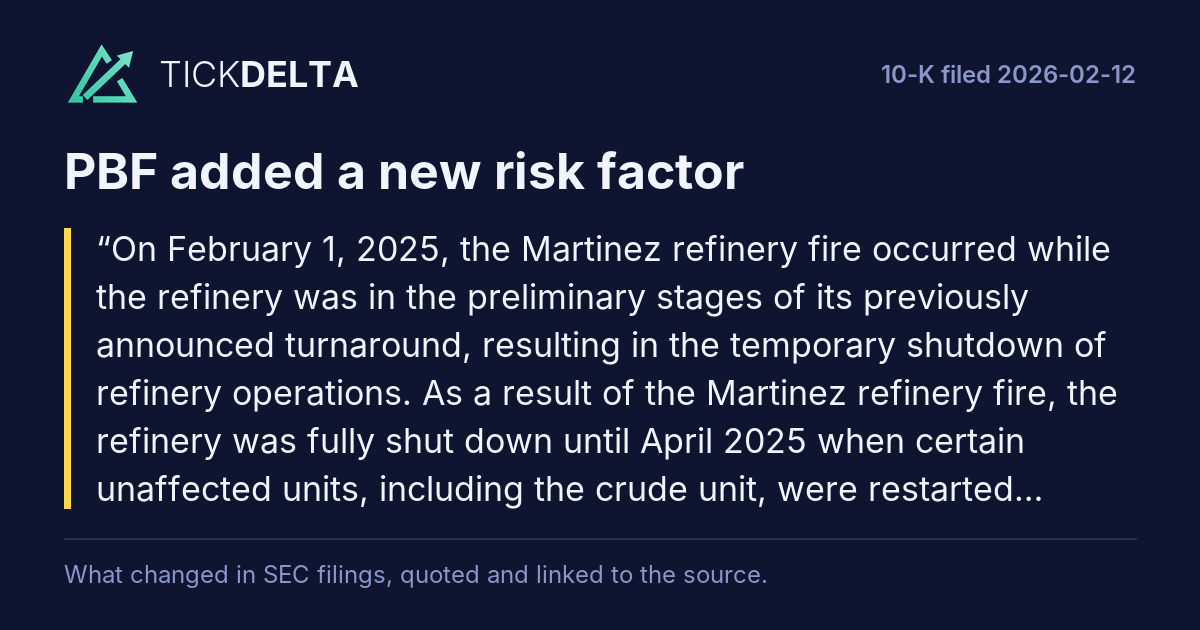
On February 1, 2025, the Martinez refinery fire occurred while the refinery was in the preliminary stages of its previously announced turnaround, resulting in the temporary shutdown of refinery operations. As a result of the Martinez refinery fire, the refinery was fully shut down until April 2025 when certain unaffected units, including the crude unit, were restarted. Investigations are being conducted by various regulatory agencies, including the CalOSHA, the BAAD, CCC, the DOJ, the USAO, the EPA, and the CSB. There are uncertainties around these inquiries and investigations and potential results and consequences, including whether any financial penalties will be assessed or changes to the operations of the Martinez refinery will result therefrom. Although we expect that the cost of repairs to the fire-damaged units and the restoration of the refinery to full operational status will be largely covered under our property insurance coverage, there is no guarantee that all losses, including business interruption, will be fully collected as anticipated, in a timely manner. Restart of the units damaged by the Martinez refinery fire is expected to be completed by February 2026 and we expect to achieve planned operating rates by the beginning of March 2026. However, there is no guarantee that we will meet this restart timeline and additional work or repairs may be required that delay our planned restart. Such delays may negatively impact our earnings and cash flows. Furthermore, at this time, potential liabilities arising from the incident, including any regulatory penalties, remain unknown, and the full operational and/or financial impact cannot be reasonably estimated.
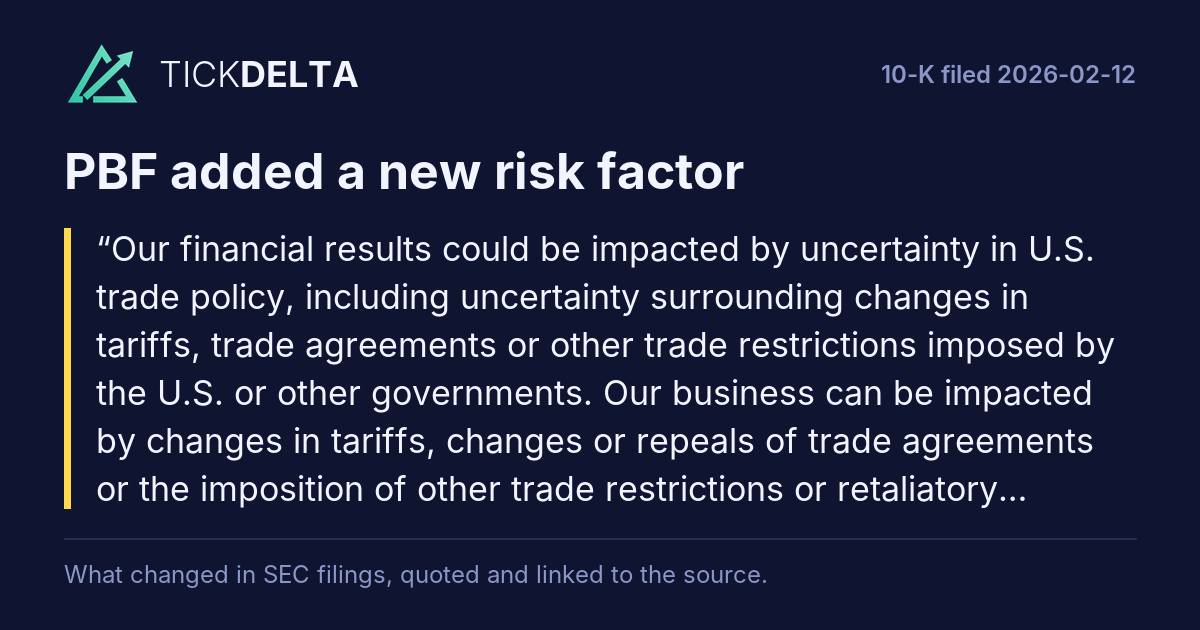
Our financial results could be impacted by uncertainty in U.S. trade policy, including uncertainty surrounding changes in tariffs, trade agreements or other trade restrictions imposed by the U.S. or other governments.
Our business can be impacted by changes in tariffs, changes or repeals of trade agreements or the imposition of other trade restrictions or retaliatory actions imposed by various governments, the status, duration and scope of which remain uncertain and unpredictable. Throughout 2025, the U.S. presidential administration announced broad-based tariffs on goods imported from certain countries where we purchase feedstocks. Certain tariffs remain in effect and continue to apply to certain of our purchases, which could increase our costs and adversely affect our results of operations. If the provisions of those tariffs are maintained, we would expect added market volatility, with the longer term impacts to our refining and marketing margin uncertain. In addition, evolving legal, political or regulatory developments relating to tariffs, and their impact on global trade relationships and geopolitical tensions, remain uncertain. Other effects of these changes, including responsive actions from governments and the unpredictability of U.S. governmental action and response, could also have significant impacts on our business, capital expenditures, and results of operations.
In addition, various states, individually as well as in some cases on a regional basis, have taken steps to control GHG emissions, including adoption of GHG reporting requirements, cap and trade systems and renewable portfolio standards. For example, the State of California’s AB 32 imposes a statewide cap on GHG emissions, including emissions from transportation fuels, with the aim of returning the state to 1990 emission levels by 2020.
However, in June 2025, the current U.S. presidential administration signed into law three Congressional Review Act resolutions, approved by congress, revoking CAA waivers that were granted by the previous presidential administration that allowed California to set its own stringent vehicle emissions standards (i.e., ACCII and ACF). California and other states have challenged the revocation of the CAA waivers. While the CAA resolutions are currently being litigated, it is currently uncertain whether and to what extent California, other states and local governments will still pursue the vehicle emission standards. In the event we do incur increased costs as a result of increased efforts to control GHG emissions through future adopted regulatory requirements, we may not be able to pass these costs to our customers. These future regulatory requirements also could adversely affect demand for the refined products that we produce. Any increased costs or reduced demand could materially and adversely affect our business and results of operations.
adversely affect our business, financial condition, results of operations and cash flow. See “Item 1. Business—Environmental, Health and Safety Matters” and “Item 7. Management’s Discussion and Analysis of Financial Condition and Results of Operations—Material Cash Requirements”.
If we fail to realize the expected benefits from our RBI initiative, our financial results may be negatively impacted.
During 2025, we launched our RBI initiative as part of our ongoing strategic efforts to extract incremental value across our business through improved reliability and efficiency. We are focused on several main areas, including projects and turnarounds, strategic procurement opportunities, our six-refinery system, and the corporate and refining organizational structures. We may experience delays or unanticipated costs in implementing our cost saving plans, and may not be able to timely or fully achieve and sustain the expected savings. Certain of these cost saving measures could also have a negative impact on our operations and our financial results.
New in the latest 10-Q
43 paragraphs in the 10-Q filed Oct 29, 2026 with nothing like them in the 10-Q filed Jul 30, 2026 (at least half the words must differ; new numbers alone do not count). Quoted exactly, grouped by the item heading above them. This is text that changed, not a judgement of how serious it is.
• our obligations under the indebtedness of PBF Holding that is exchangeable for shares of our common stock under certain circumstances and the extent to which our Class A common stock may be diluted as a result of any exchanges of such indebtedness;
Read in the 10-Q
The consideration for the Hydrogen Plants Asset Purchase included a cash payment of $ 44.8 million at closing, plus related transaction costs, and a promissory note issued by PBF LLC and guaranteed by PBF Energy (the “Promissory Note”). The Promissory Note was issued on September 9, 2026, in connection with the transaction and was initially recorded as debt of approximately $ 341.1 million. Refer to “Note 4 - Credit Facilities and Debt” for further information.
Read in the 10-Q
As a result of the Hydrogen Plants Asset Purchase, the Company recognized property, plant and equipment associated with the acquired hydrogen production plants of approximately $ 388.4 million and derecognized the operating lease liability and related right-of-use asset associated with the hydrogen plants of approximately $ 139.7 million and $ 140.2 million, respectively.
Read in the 10-Q
On September 30, 2025, through a subsidiary of PBF Logistics LP (“PBFX”), the Company closed on the sale of two of its non-core refined product terminal facilities located in Philadelphia, PA and Knoxville, TN for $ 175.4 million, excluding commissions and customary closing costs. The sale resulted in a gain of approximately $ 94.0 million in the three and nine months ended September 30, 2025, included in Gain on sale of assets on the Condensed Consolidated Statements of Operations.
Read in the 10-Q
(1) On October 26, 2026, the Company fully redeemed all of the $800.0 million in aggregate principal amount outstanding of its 2030 9.875% Senior Notes, including incurred but unpaid interest. Refer to “Note 15 - Subsequent Events” for more details.
Read in the 10-Q
The 2032 Exchangeable Notes do not bear regular interest, and the principal amount of the 2032 Exchangeable Notes will not accrete. The Issuers will pay special interest, if any, at a rate per annum not exceeding 0.50 % under certain circumstances specified in the 2032 Exchangeable Notes Indenture. The 2032 Exchangeable Notes will mature on January 15, 2032, unless earlier exchanged, repurchased or redeemed.
Read in the 10-Q
The 2032 Exchangeable Notes are exchangeable by the holders thereof prior to October 15, 2031 under certain specified circumstances and, on or after October 15, 2031, may be exchanged at any time prior to the close of business on the second scheduled trading day immediately preceding the maturity date. The initial exchange rate is 10.3306 shares of PBF Energy Class A common stock per $ 1,000 principal amount of 2032 Exchangeable Notes, equivalent to an initial exchange price of approximately $ 96.80 per share of Class A common stock, which is subject to adjustment under certain circumstances. Upon exchange, the 2032 Exchangeable Notes will be settled in cash up to the aggregate principal amount of the notes being exchanged and, in respect of the Issuers’ exchange obligations in excess of the aggregate principal amount, if any, in cash, Class A common stock or a combination thereof, at the election of the Issuers.
Read in the 10-Q
The 2032 Exchangeable Notes are not redeemable prior to January 20, 2030, except when the aggregate outstanding principal amount of the 2032 Exchangeable Notes is less than 10 % of the aggregate principal amount initially issued under the 2032 Exchangeable Notes Indenture. On or after January 20, 2030, and prior to the 31st scheduled trading day immediately preceding the maturity date, the 2032 Exchangeable Notes will be redeemable, in whole at the Issuers’ option, but only if the last reported sale price per share of the Company’s Class A common stock exceeds 130 % of the exchange price for a specified period of time and certain other conditions specified in the 2032 Exchangeable Notes Indenture are satisfied. If certain corporate events constituting a Fundamental Change (as defined in the 2032 Exchangeable Notes Indenture) occur, holders may require the Issuers to repurchase all or a portion of their 2032 Exchangeable Notes for cash at a repurchase price equal to 100 % of the principal amount of the 2032 Exchangeable Notes to be repurchased, plus accrued and unpaid special interest, if any.
Read in the 10-Q
The 2032 Exchangeable Notes Indenture contains customary covenants and events of default, including non-payment of principal or special interest when due. Upon such an event of default, the 2032 Exchangeable Notes may be declared immediately due and payable. The 2032 Exchangeable Notes Indenture also sets forth certain bankruptcy or insolvency events of default involving the Issuers and PBF Energy, after which the 2032 Exchangeable Notes become automatically due and payable.
Read in the 10-Q
In connection with the issuance and sale of the 2032 Exchangeable Notes, the Issuers and the Company entered into a Registration Rights Agreement (the “Registration Rights Agreement”) with the initial purchasers under which the Company agreed for the benefit of the holders of the 2032 Exchangeable Notes and the shares of Class A common stock, if any, issuable or deliverable upon the exchange of the 2032 Exchangeable Notes that it will, at its cost, file a shelf registration statement or a resale prospectus supplement to an effective shelf registration statement with the Securities Exchange Commission, covering resales of the shares of Class A common stock, if any, issuable or deliverable upon exchange of the 2032 Exchangeable Notes, on or prior to December 31, 2026.
Read in the 10-Q
If the Issuers do not fulfill certain of their obligations under the Registration Rights Agreement, the Issuers will be required to pay special interest to holders of the 2032 Exchangeable Notes, at a rate of 0.25 % per annum to and including the 90th day following such registration default, and 0.50 % per annum thereafter.
Read in the 10-Q
In connection with the issuance of the 2032 Exchangeable Notes, the Issuers and PBF Energy entered into capped call transactions with certain of the initial purchasers of the 2032 Exchangeable Notes or their respective affiliates and certain other financial institutions. The capped call transactions cover, subject to anti-dilution adjustments substantially similar to those applicable to the 2032 Exchangeable Notes, the number of shares of Class A common stock initially underlying the 2032 Exchangeable Notes. The capped call transactions are expected generally to reduce potential dilution to the Class A common stock upon exchange of the 2032 Exchangeable Notes and/or offset certain cash payments the Issuers may be required to make in excess of the principal amount of exchanged 2032 Exchangeable Notes, in each case subject to a cap. The capped call transactions were recorded as a reduction to additional paid-in capital and will not be remeasured.
Read in the 10-Q
The capped call transactions have an initial strike price of approximately $ 96.80 per share of Class A common stock, subject to certain adjustments, and an initial cap price of approximately $ 123.20 per share of Class A common stock, subject to certain adjustments under the terms of the capped call transactions. Conditions that cause adjustments to the initial cap price mirror conditions that result in corresponding adjustments in the exchange price for the 2032 Exchangeable Notes.
Read in the 10-Q
On September 30, 2026, PBF Holding and certain of its wholly owned subsidiaries, as borrowers or subsidiary guarantors, entered into an amendment and restatement of its existing asset-based revolving credit agreement with Bank of America, National Association as administrative agent, and certain other lenders (the “Revolving Credit Agreement”). The Revolving Credit Agreement amended and restated the previously existing revolving credit agreement dated as of August 23, 2023 (as amended from time to time, the “Prior Credit Agreement”). Among other things, the Revolving Credit Agreement extended the Revolving Credit Facility through September 30, 2031, increased the maximum commitment from $ 3.5 billion to $ 4.0 billion, and reduced the commitment fees on the unused portion of the Revolving Credit Facility. The interest rate on advances and the fees for letters of credit are generally consistent with those under the Prior Credit Agreement. The Revolving Credit Facility contains representations, warranties and covenants by PBF Holding and the other borrowers, as well as customary events of default and indemnification obligations that are consistent with those in the Prior Credit Agreement.
Read in the 10-Q
On September 9, 2026, in connection with the Hydrogen Plants Asset Purchase, PBF LLC issued a Promissory Note, guaranteed by PBF Energy, as partial consideration for the acquisition of two hydrogen production plants located at the Torrance refinery, which provides for periodic payments through April 2039. Refer to “Note 1 - Description of the Business and Basis of Presentation” for further information.
Read in the 10-Q
The Promissory Note was recorded as debt of approximately $ 341.1 million at closing. The initial carrying amount of the Promissory Note was measured at the net present value of the applicable payment obligations, discounted using a rate of approximately 6.94 %, which represented the Company’s incremental borrowing rate as of the closing date. The resulting discount is amortized to interest expense over the term of the Promissory Note using the effective interest method.
Read in the 10-Q
During the three and nine months ended September 30, 2026, the Company received a cash distribution of $ 20.0 million from SBR. The distribution was accounted for as a return of investment and reduced the carrying value of the Company’s investment in SBR.
Read in the 10-Q
In addition, during the three and nine months ended September 30, 2026, the Company received a non-cash distribution from SBR consisting of 3.8 million Section 45Z Clean Fuel Production Credits (“CFPCs”). The CFPCs were distributed to SBR’s members in accordance with the operating agreement and had a fair value of $ 1.00 per credit, or approximately $ 3.8 million, on the date of distribution. Upon receipt, the Company recognized the CFPCs as a reduction of its income tax liability, which is included in accrued expenses, and recorded a corresponding reduction to the carrying value of its investment in SBR.
Read in the 10-Q
The table below summarizes the changes in fair value measurements categorized in Level 3 of the fair value hierarchy, which primarily relates to the change in unrealized earnings related to options for the three and nine months ended September 30, 2026:
Read in the 10-Q
The dilutive effect of the 2032 Exchangeable Notes is calculated using the if-converted method. For purposes of this calculation, the 2032 Exchangeable Notes are assumed to be exchanged at the beginning of the reporting period, or at issuance if later, and the resulting shares are included in diluted net income (loss) per share to the extent dilutive. As the principal amount of the 2032 Exchangeable Notes must be settled in cash upon exchange, only any exchange value in excess of principal may be settled at the Issuers’ option in shares of the Company’s Class A common stock. Accordingly, the 2032 Exchangeable Notes would result in incremental shares in the diluted earnings per share calculation only when the market price of the Company’s Class A common stock exceeds the applicable exchange price, subject to the anti-dilution provisions of ASC 260, Earnings Per Share. The 2032 Exchangeable Notes had no dilutive impact on earnings per share for the three and nine months ended September 30, 2026.
Read in the 10-Q
(3) No incremental shares attributable to the 2032 Exchangeable Notes were included in diluted weighted-average shares outstanding because the market price of the Company’s Class A common stock did not exceed the applicable exchange price during the period. Only the portion of the exchange value, if any, in excess of the principal amount of the notes may be settled in shares and result in incremental shares for diluted net income (loss) per share. Such shares are included only when their effect is dilutive and are excluded when anti-dilutive, including during periods in which the Company reports a net loss.
Read in the 10-Q
On September 30, 2026, PBF Holding amended and restated its existing asset-based revolving credit agreement (the “Revolving Credit Agreement”), extending the maturity of the PBF Holding’s asset-based revolving credit facility (the “Revolving Credit Facility”) through September 30, 2031 and increasing the maximum commitment from $3.5 billion to $4.0 billion. Refer to “Note 4 - Credit Facilities and Debt”, “Factors Affecting Comparability Between Periods”, and “Liquidity and Capital Resources” for further information.
Read in the 10-Q
On September 9, 2026, PBF LLC closed on an agreement with Air Products West Coast Hydrogen LLC (“Air Products”) to acquire two hydrogen production plants located at the Torrance refinery (the “Hydrogen Plants Asset Purchase”) that were previously subject to operating lease arrangements. Upon closing, PBF LLC became the owner of the hydrogen plants, which, following a transition period with Air Products, will be operated by its subsidiary, Torrance Refining Company LLC (“Torrance Refining”). Refer to “Note 1 - Description of the Business and Basis of Presentation”, “Note 4 - Credit Facilities and Debt”, “Factors Affecting Comparability Between Periods”, and “Liquidity and Capital Resources” for further information.
Read in the 10-Q
Refer to “Note 4 - Credit Facilities and Debt” of our Notes to Condensed Consolidated Financial Statements, for further information.
Read in the 10-Q
The consideration for the Hydrogen Plants Asset Purchase included a cash payment of $44.8 million at closing, plus related transaction costs, and a promissory note issued by PBF LLC and guaranteed by us (the “Promissory Note”). The Promissory Note was issued on September 9, 2026, and was initially recorded as debt of approximately $341.1 million. Refer to “Note 4 - Credit Facilities and Debt” of our Notes to Condensed Consolidated Financial Statements, for further information.
Read in the 10-Q
As a result of the Hydrogen Plants Asset Purchase, we recognized property, plant and equipment associated with the acquired hydrogen production plants of approximately $388.4 million and derecognized the operating lease liability and related right-of-use asset associated with the hydrogen plants of approximately $139.7 million and $140.2 million, respectively.
Read in the 10-Q
On September 30, 2025, through a subsidiary of PBFX, we closed on the sale of two of our non-core refined product terminal facilities located in Philadelphia, PA and Knoxville, TN for $175.4 million, excluding commissions and customary closing costs. The sale resulted in a gain of approximately $94.0 million in the three and nine months ended September 30, 2025, included in Gain on sale of assets on the Condensed Consolidated Statements of Operations.
Read in the 10-Q
No incremental shares attributable to the 2032 Exchangeable Notes were included in diluted weighted-average shares outstanding because the market price of the Class A common stock did not exceed the applicable exchange price during the period. Only the portion of the exchange value, if any, in excess of the principal amount of the notes may be settled in shares and result in incremental shares for diluted net income (loss) per share. Such shares are included only when their effect is dilutive and are excluded when anti-dilutive, including during periods in which the Company reports a net loss.
Read in the 10-Q
On September 30, 2026, we entered into the Revolving Credit Agreement. The Revolving Credit Agreement amended and restated the Prior Credit Agreement. Among other things, the Revolving Credit Agreement extended the Revolving Credit Facility through September 30, 2031, increased the maximum commitment to $4.0 billion from $3.5 billion, and reduced the commitment fees on the unused portion of the Revolving Credit Facility as compared to the Prior Credit Agreement. The interest rate on advances and the fees for letters of credit are generally consistent with the Prior Credit Agreement.
Read in the 10-Q
On September 9, 2026, PBF LLC issued the Promissory Note, as partial consideration for the acquisition from Air Products of two hydrogen production plants located at the Torrance refinery, which provides for periodic payments through April 2039. Refer to “Note 1 - Description of the Business and Basis of Presentation” for further information. The Promissory Note was recorded as debt of approximately $341.1 million at closing.
Read in the 10-Q
The consideration for the Hydrogen Plants Asset Purchase included a cash payment of $44.8 million at closing, plus related transaction costs, and the Promissory Note of approximately $341.1 million. Refer to “Note 1 - Description of the Business and Basis of Presentation” and “Note 4 - Credit Facilities and Debt” of our Notes to Condensed Consolidated Financial Statements, for further information.
Read in the 10-Q
The following risk factors supplement and/or update the risk factors previously disclosed in our Annual Report on Form 10-K for the year ended December 31, 2025:
Read in the 10-Q
The accounting method for the 2032 Exchangeable Notes could adversely affect our financial condition and consolidated financial results.
Read in the 10-Q
The accounting method for reflecting the 2032 Exchangeable Notes on our Condensed Consolidated Balance Sheets, recognizing amortized interest expense, and reflecting the underlying shares of common stock in diluted earnings per share could adversely affect our reported earnings, financial condition, and liquidity.
Read in the 10-Q
In accordance with GAAP, the 2032 Exchangeable Notes, are reflected as a liability on our Condensed Consolidated Balance Sheets, with an initial carrying amount equal to the principal amount of the 2032 Exchangeable Notes, net of issuance costs. The issuance costs are treated as a debt discount for accounting purposes, and amortized into interest expense over the term of the 2032 Exchangeable Notes. As a result of this amortization, the interest expense recognized for accounting purposes will be greater than the cash interest payments on the 2032 Exchangeable Notes, which will result in lower reported income.
Read in the 10-Q
In addition, we expect that the shares underlying the 2032 Exchangeable Notes will be reflected in our diluted earnings per share using the “if-converted” method. Under that method, diluted earnings per share would generally be calculated assuming that all of the 2032 Exchangeable Notes were exchanged solely into shares of common stock at the beginning of the reporting period, unless the result would be anti-dilutive. The application of the if-converted method may reduce our reported diluted earnings per share. However, if the principal amount of the exchangeable debt security being exchanged is required to be paid in cash (as with the 2032 Exchangeable Notes) and only the excess is permitted to be settled in shares, the if-converted method will produce a similar result as the “treasury stock” method. Because the principal amount of the 2032 Exchangeable Notes upon exchange is required to be paid in cash, and only the excess is permitted to be settled in shares, the effect of the treasury stock method is that the shares issuable upon exchange of such notes are not included in the calculation of diluted earnings per share except to the extent that the exchange value of such 2032 Exchangeable Notes exceeds their principal amount. As a result, our earnings per share could be lower than it would be if the issuers had not issued the 2032 Exchangeable Notes, even at times when the 2032 Exchangeable Notes are not exchangeable but the exchange value of such 2032 Exchangeable Notes exceeds their principal amount. The requirement that the principal amount of the 2032 Exchangeable Notes upon exchange must be paid in cash could adversely affect the issuers’ liquidity.
Read in the 10-Q
Furthermore, if any of the conditions to the exchangeability of the 2032 Exchangeable Notes are satisfied, then we (and the issuers) may be required under GAAP to reclassify the liability carrying value of the 2032 Exchangeable Notes as a current, rather than a long-term, liability. This reclassification could be required even if no noteholders exchange their 2032 Exchangeable Notes, and could materially reduce our (and the issuers’) reported consolidated working capital.
Read in the 10-Q
In connection with the pricing of the 2032 Exchangeable Notes, PBF Holding and PBF Holding’s wholly-owned subsidiary, PBF Finance Corporation (together with PBF Holding, the “Issuers”) and PBF Energy entered into capped call transactions with certain of the initial purchasers of the 2032 Exchangeable Notes or their respective affiliates and certain other financial institutions (the “Option Counterparties”). The capped call transactions cover, subject to anti-dilution adjustments substantially similar to those applicable to the 2032 Exchangeable Notes, the number of shares of Class A common stock initially underlying the 2032 Exchangeable Notes, and are intended generally to reduce potential dilution to the Class A common stock upon exchange of the 2032 Exchangeable Notes and/or offset certain cash payments the Issuers may be required to make in excess of the principal amount of exchanged 2032 Exchangeable Notes, in each case subject to a cap.
Read in the 10-Q
The Option Counterparties are, or are affiliates of, financial institutions, and we are subject to the risk that they might default under the capped call transactions. Our exposure to the credit risk of the Option Counterparties will not be secured by any collateral. Global economic conditions have from time to time resulted in the actual or perceived failure or financial difficulties of many financial institutions. If an Option Counterparty becomes subject to insolvency proceedings, then we would become unsecured creditors in those proceedings with a claim equal to our exposure at that time under our transactions with that option counterparty. Our exposure will depend on many factors, and can provide no assurances as to the financial stability or viability of the Option Counterparties.
Read in the 10-Q
In addition, upon a default by an Option Counterparty, we may suffer adverse tax consequences and there may be more dilution than currently anticipated with respect to our Class A common stock.
Read in the 10-Q
The capped call transactions are complex, and they may not operate as planned. For example, the terms of the capped call transactions may be subject to adjustment, modification or, in some cases, renegotiation if certain corporate or other transactions occur. Accordingly, these transactions may not operate as we intend if the terms of the capped call transactions are adjusted as a result of transactions in the future or upon unanticipated developments that may adversely affect the functioning of the capped call transactions.
Read in the 10-Q
In addition, the option counterparties and/or their respective affiliates may modify their hedge positions by entering into or unwinding various derivatives with respect to our Class A common stock and/or purchasing or selling our Class A common stock in secondary market transactions prior to the maturity of the 2032 Exchangeable Notes (and are likely to do so (x) during any observation period related to an exchange of 2032 Exchangeable Notes, following any redemption of 2032 Exchangeable Notes by the Issuers or following any repurchase of 2032 Exchangeable Notes by the Issuers in connection with any fundamental change and (y) following any repurchase of the 2032 Exchangeable Notes by the Issuers other than in connection with any such redemption or any fundamental change if the Issuers elect to unwind a corresponding portion of the capped call transactions in connection with such repurchase). This activity could cause or avoid an increase or a decrease in the market price of our Class A common stock.
Read in the 10-Q
Pursuant to Item 601(b)(4)(iii)(A) of Regulation S-K, PBF Energy has omitted from the foregoing list of exhibits, and hereby agrees to furnish to the SEC upon its request, copies of certain instruments, each relating to long-term debt not exceeding ten percent of the total assets of PBF Energy and its subsidiaries on a consolidated basis.
Read in the 10-Q
Item 1A of the 10-Q filed Oct 29, 2026 against Item 1A of the 10-K filed Feb 12, 2026.
A 10-Q repeats only the risks that changed, so a 10-K paragraph that is missing from it is not counted as removed.
Added is a paragraph with nothing like it in the 10-K, Reworded a sentence that is in both with several words changed,
Quiet changes a sentence in both where one to four words changed and one is a hedge or a modal
(cut words struck through, new words highlighted).
Text on the page, not a score; each links to the filing at sec.gov.
What the 10-Q itself says about its risk factors:The following risk factors supplement and/or update the risk factors previously disclosed in our Annual Report on Form 10-K for the year ended December 31, 2025:
Read in the 10-Q
Two-word phrases in Risk Factors of the 10-K filed Feb 12, 2026 that are in none of the 1 earlier 10-Ks stored, back to Feb 13, 2025
Used at least twice, small words left out. Counted, not picked: a phrase can be new because the company renamed something.
Item 1A of each 10-K and 10-Q on EDGAR, quoted exactly. Each paragraph links to the filing at sec.gov.
10-K change: what was reworded or cut, section by section.
Excel workbook · CSV. Google Sheet that stays up to date: paste =IMPORTDATA("https://tickdelta.com/company/PBF/export.csv") into a cell.