Paragraph 61 · 43% changed
Every version of it
Screener
/
SEC EDGAR
/CIK 0001534504
/10-K filed Feb 12, 2026, compared with Feb 13, 2025
/Numbers from the XBRL of the 10-Ks
NYSE
Energy · Oil Refining
PBF Energy Inc. PBF
The 10-K against last year's
157 changes: 21 added, 7 removed, 127 reworded, 2 quiet changes
10-K Feb 12, 2026 vs Feb 13, 2025
Risk Factors
7.4%
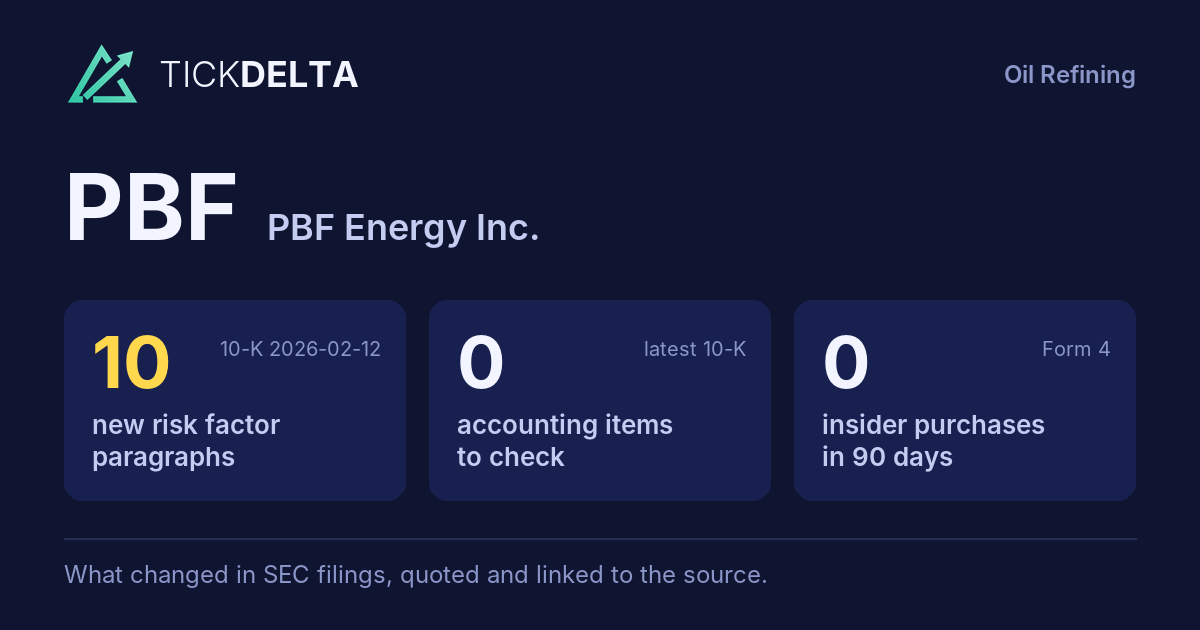
of the text changed · 17,940 words now · 10 new paragraphs, 0 gone
MD&A
16.3%
of the text changed · 18,032 words now · 11 new paragraphs, 7 gone
Legal Proceedings
54.6%
of the text changed · 2,000 words now
Accounting Policies
1.4%
of the text changed · 4,505 words now
10-K 0001534504-26-000010 (Feb 12, 2026) vs 10-K 0001534504-25-000011 (Feb 13, 2025)
Every paragraph, and how much of it changed
One bar per paragraph, in the order of the 10-K. Height and colour show the share of its words not in the closest paragraph a year earlier; the tallest bars are new paragraphs.
Risk Factors
198 paragraphs · 10 new · 39 reworded · 0 gone · 10-K Feb 12, 2026 against Feb 13, 2025
New paragraph
Reworded (5% of its words or more)
Same or nearly
Paragraph 171 · 37% changed
Every version of it
Paragraph 38 · 33% changed
Every version of it
Our insurance program includes a number of insurance carriers. Significant disruptions in financial markets could lead to a deterioration in the financial condition of many financial institutions, including insurance companies and, therefore, we may not be able to obtain the full amount of our insurance coverage for insured events. Even where we have insurance in place, there can be no assurance that the carriers will honor their obligations under the policies. We are assessing the extent of the property damage arising from the recent Martinez refinery fire and potential recoveries from insurance coverage are also being evaluated. At this time, as the cost of repairs, the length of the shutdown and other potential liabilities, including regulatory penalties, arising from the incident are unknown, the operational and/or financial impact cannot be reasonably estimated. In the event the Martinez refinery is forced to shut down for a significant period of time, it could have a material adverse effect on our earnings, our other results of operations and our financial condition as a whole.
Paragraph 99 · 25% changed
Every version of it
Paragraph 33 · 24% changed
Every version of it
Additionally, governmental and regulatory actions, including continued resolutions sanctions against oil exporting countries and decisions by the Organization of the Petroleum Exporting Countries to restrict crude oil production levels and executive actions by the new U.S. presidential administration to advance certain energy infrastructure projects such as the Keystone XL pipeline or Enbridge's Line 5 pipeline, may continue to impact crude oil prices and crude oil differentials. Recent U.S. actions related to Venezuela’s oil sector have included sanction-related seizures of certain oil tankers, as well as public statements by the U.S. presidential administration indicating that authorized sales of Venezuelan crude oil into the U.S. have commenced. While these developments may present opportunities through increased crude oil supply and improved crude oil differentials, they also remain subject to significant political, regulatory, and geopolitical uncertainty. Any increase in crude oil prices or unfavorable movements in crude oil differentials due to such actions or changing regulatory environment may negatively impact our ability to acquire crude oil at economical prices and could have a material adverse effect on our business and profitability.
Paragraph 77 · 16% changed
Every version of it
In September 2023, the Governor of the State of California directed the CEC to begin the regulatory processes concerning (i) potential penalties for exceeding a maximum gross gasoline refining margin GGRM and (ii) the timing of refinery turnarounds and maintenance. Consequently, the CEC adopted an order requiring an informational proceeding on a maximum gross gasoline refining margin GGRM and penalty under SBx 1-2. It also adopted an order initiating rulemaking activity under SBx 1-2 that will be focused on refinery maintenance and turnarounds. However, in August 2025, CEC adopted a resolution to pause rulemaking on a maximum GGRM and penalty for five years, but will continue to collect and analyze information to assess a maximum GGRM and penalty during the five-year pause.
Paragraph 170 · 16% changed
Every version of it
PBF Energy has recognized, as of December 31, 2024, 2025, a total liability for the Tax Receivable Agreement of $293.6 million, of which $125.4 million is recorded as a current liability and was paid in January 2025 related to the 2023 tax year. $168.2 million. As future taxable income is recorded, increases in our Tax Receivable Agreement liability may be necessary in conjunction with the revaluation of deferred tax assets. If PBF Energy does not have taxable income, PBF Energy generally is not required (absent a change of control or circumstances requiring an early termination payment) to make payments under the Tax Receivable Agreement for that taxable year because no benefit will have been actually realized. However, any tax benefits that do not result in realized benefits in a given tax year will likely generate tax attributes that may be utilized to generate benefits in previous or future tax years. The utilization of such tax attributes will result in payments under the Tax Receivable Agreement. The foregoing are merely estimates based on assumptions that are subject to change due to various factors, including, among other factors, the timing of exchanges of PBF LLC Series A Units for shares of PBF Energy Class A common stock as contemplated by the Tax Receivable Agreement, the price of PBF Energy Class A common stock at the time of such exchanges, the extent to which such exchanges are taxable, and the amount and timing of PBF Energy’s income. The actual payments under the Tax Receivable Agreement could differ materially. It is possible that future transactions or events could increase the actual tax benefits realized and the corresponding Tax Receivable Agreement payments. There may be a material negative effect on our liquidity if, as a result of timing discrepancies or otherwise, (i) the payments under the Tax Receivable Agreement exceed the actual benefits PBF Energy realizes in respect of the tax attributes subject to the Tax Receivable Agreement, and/or (ii) distributions to PBF Energy by PBF LLC are not sufficient to permit PBF Energy, after it has paid its taxes and other obligations, to make payments under the Tax Receivable Agreement. The payments under the Tax Receivable Agreement are not conditioned upon any recipient’s continued ownership of us.
Paragraph 35 · 14% changed
Every version of it
Our business currently consists of owning and operating six refineries and related assets, as well as logistics terminals, pipelines and other facilities and our investment in SBR. As a result, our operations could be subject to significant interruption if any of our refineries or other facilities were to experience a major accident, be damaged by severe weather, wildfires or other natural disasters, or otherwise be forced to shut down or curtail production due to unforeseen events, such as acts of God, nature, orders of governmental authorities, supply chain disruptions impacting our crude rail facilities or other logistics assets, power outages, acts of terrorism, fires, toxic emissions and maritime hazards. Any such shutdown or disruption would reduce the production from that refinery. There is also risk of mechanical failure and equipment shutdowns both in general and following unforeseen events. Further, in such situations, undamaged refinery processing units may be dependent on or interact with damaged sections of our refineries and, accordingly, are also subject to being shut down. In the event any of our refineries is forced to shut down for a significant period of time or permanently, it could have a material adverse effect on our earnings, our other results of operations and our financial condition as a whole. In addition, a shutdown or disruption of our Chalmette refinery could impact the operations of SBR. On February 1, 2025, a fire occurred at our Martinez refinery during preliminary turnaround activities, which resulted in the temporary shutdown of refinery operations. The cause of the fire is currently under investigation. We are assessing the extent of the property damage arising from the fire and potential recoveries from insurance coverage are also being evaluated. At this time, as the cost of repairs, the length of the shutdown and other potential liabilities, including regulatory penalties, arising from the incident are unknown, the operational and/or financial impact cannot be reasonably estimated.
Paragraph 61 · 43% changed
Every version of it
10-K Feb 13, 2025Both houses of Congress have actively considered legislation to reduce emissions of GHGs, such as carbon dioxide and methane, including proposals to: (i) establish a cap and trade system, (ii) create a federal renewable energy or “clean” energy standard requiring electric utilities to provide a certain percentage of power from such sources, and (iii) create enhanced incentives for use of renewable energy and increased efficiency in energy supply and use. In addition, EPA has taken steps to regulate GHGs under the existing federal Clean Air Act. EPA has adopted regulations limiting GHG emissions for light- and medium-duty vehicles and heavy-duty highway vehicles. EPA has also adopted regulations addressing the permitting of GHG emissions from stationary sources, and requiring the reporting of GHG emissions from specified large GHG emission sources, including refineries. These and similar regulations could require us to incur costs to monitor and report GHG emissions or reduce emissions of GHGs associated with our operations. In addition, various states, individually as well as in some cases on a regional basis, have taken steps to control GHG emissions, including adoption of GHG reporting requirements, cap and trade systems and renewable portfolio standards (such as AB 32). On September 23, 2020 the Governor of California issued an executive order effectively banning the sale of new gasoline-powered passenger cars and trucks by 2035 and requiring zero-emission medium to heavy duty vehicles by 2045 everywhere feasible. The executive order requires state agencies to build out sufficient electric vehicle charging infrastructure. It is not possible at this time to predict the ultimate form, timing or extent of federal or state regulation. In the event we do incur increased costs as a result of increased efforts to control GHG emissions, we may not be able to pass on any of these costs to our customers. Regulatory requirements also could adversely affect demand for the refined products that we produce. Any increased costs or reduced demand could materially and adversely affect our business and results of operations.
10-K Feb 12, 2026
The U.S. federal government under previous presidential administrations took a number of actions to address GHG emissions. For example, both houses of Congress actively considered legislation to reduce emissions of GHGs, such as carbon dioxide and methane, including proposals to: (i) establish a cap and trade system, (ii) create a federal renewable energy or “clean” energy standard requiring electric utilities to provide a certain percentage of power from such sources, and (iii) create enhanced incentives for use of renewable energy and increased efficiency in energy supply and use. In addition, EPA has taken steps to regulate GHGs under the existing federal Clean Air Act (“CAA”). EPA has adopted regulations limiting GHG emissions for light- and medium-duty vehicles and heavy-duty highway vehicles. EPA has also adopted regulations addressing the permitting of GHG emissions from stationary sources, and requiring the reporting of GHG emissions from specified large GHG emission sources, including refineries. However, the current U.S. presidential administration has expressed a different approach with respect to U.S. climate, environmental, and energy policies and has revoked many of the existing executive orders and directives, and has indicated an intention to modify or eliminate many of the aforementioned laws and regulations, several of which are also currently being litigated, or may be subject to future legal challenges. However, the ultimate timing and outcome with respect to any modifications or eliminations of such laws and regulations, which may require action by the U.S. Congress or a federal agency or department, as well as pending or future litigation, are currently unknown and are subject to considerable uncertainty. It is also currently uncertain whether and to what extent any U.S. state and local governments may still pursue the prior administration’s agenda on such matters.
Paragraph 171 · 37% changed
Every version of it
10-K Feb 13, 2025PBF Energy has recognized, as of December 31, 2024, a total liability for the Tax Receivable Agreement of $293.6 million, of which $125.4 million is recorded as a current liability and was paid in January 2025 related to the 2023 tax year. As future taxable income is recorded, increases in our Tax Receivable Agreement liability may be necessary in conjunction with the revaluation of deferred tax assets. If PBF Energy does not have taxable income, PBF Energy generally is not required (absent a change of control or circumstances requiring an early termination payment) to make payments under the Tax Receivable Agreement for that taxable year because no benefit will have been actually realized. However, any tax benefits that do not result in realized benefits in a given tax year will likely generate tax attributes that may be utilized to generate benefits in previous or future tax years. The utilization of such tax attributes will result in payments under the Tax Receivable Agreement. The foregoing are merely estimates based on assumptions that are subject to change due to various factors, including, among other factors, the timing of exchanges of PBF LLC Series A Units for shares of PBF Energy Class A common stock as contemplated by the Tax Receivable Agreement, the price of PBF Energy Class A common stock at the time of such exchanges, the extent to which such exchanges are taxable, and the amount and timing of PBF Energy’s income. The actual payments under the Tax Receivable Agreement could differ materially. It is possible that future transactions or events could increase the actual tax benefits realized and the corresponding Tax Receivable Agreement payments. There may be a material negative effect on our liquidity if, as a result of timing discrepancies or otherwise, (i) the payments under the Tax Receivable Agreement exceed the actual benefits PBF Energy realizes in respect of the tax attributes subject to the Tax Receivable Agreement, and/or (ii) distributions to PBF Energy by PBF LLC are not sufficient to permit PBF Energy, after it has paid its taxes and other obligations, to make payments under the Tax Receivable Agreement. The payments under the Tax Receivable Agreement are not conditioned upon any recipient’s continued ownership of us.
10-K Feb 12, 2026
It is possible that future transactions or events could increase the actual tax benefits realized and the corresponding Tax Receivable Agreement payments. There may be a material negative effect on our liquidity if, as a result of timing discrepancies or otherwise, (i) the payments under the Tax Receivable Agreement exceed the actual benefits PBF Energy realizes in respect of the tax attributes subject to the Tax Receivable Agreement, and/or (ii) distributions to PBF Energy by PBF LLC are not sufficient to permit PBF Energy, after it has paid its taxes and other obligations, to make payments under the Tax Receivable Agreement. The payments under the Tax Receivable Agreement are not conditioned upon any recipient’s continued ownership of us.
Paragraph 38 · 33% changed
Every version of it
10-K Feb 13, 2025
Our insurance program includes a number of insurance carriers. Significant disruptions in financial markets could lead to a deterioration in the financial condition of many financial institutions, including insurance companies and, therefore, we may not be able to obtain the full amount of our insurance coverage for insured events. Even where we have insurance in place, there can be no assurance that the carriers will honor their obligations under the policies. We are assessing the extent of the property damage arising from the recent Martinez refinery fire and potential recoveries from insurance coverage are also being evaluated. At this time, as the cost of repairs, the length of the shutdown and other potential liabilities, including regulatory penalties, arising from the incident are unknown, the operational and/or financial impact cannot be reasonably estimated. In the event the Martinez refinery is forced to shut down for a significant period of time, it could have a material adverse effect on our earnings, our other results of operations and our financial condition as a whole.
10-K Feb 12, 2026
Our insurance program includes a number of insurance carriers. Significant disruptions in financial markets could lead to a deterioration in the financial condition of many financial institutions, including insurance companies and, therefore, we may not be able to obtain the full amount of our insurance coverage for insured events. Even where we have insurance in place, there can be no assurance that the carriers will honor their obligations under the policies.
Paragraph 99 · 25% changed
Every version of it
10-K Feb 13, 2025Current inflation within the economy has resulted in increased interest rates and capital costs, contributed to supply shortages, increased the cost of living and labor, and other related items. As a result of inflation, which may continue, including due to tariffs and other trade measures that may be imposed by the new U.S. presidential administration, we expect to potentially continue to encounter increases in the cost of feedstocks, labor, materials, and other inputs necessary in the refining of crude oil and other feedstocks. Although we may take actions to counteract the impacts of inflation, if these actions are not effective it could have a material adverse effect on our business, results of operations and financial condition. Additionally, higher future inflation or concerns of a recession could impact the demand for our products and services.
10-K Feb 12, 2026
Inflationary pressures have contributed to increased interest rates and capital costs, supply chain disruptions, increased cost of living and labor, and other related items. Although inflation has fluctuated, inflationary pressures may persist or re-emerge, including due to tariffs and other trade measures that may be imposed or enacted, we expect to continue to experience increases in the cost of feedstocks, labor, materials, and other inputs necessary in the refining of crude oil and other feedstocks. Although we may take actions to counteract or mitigate the impacts of inflation, there can be no assurance that such actions will be effective, and sustained or renewed inflationary pressures could have a material adverse effect on our business, results of operations and financial condition. Additionally, higher inflation, elevated interest rates, or concerns of an economic slowdown or recession could impact the demand for our products and services.
Paragraph 33 · 24% changed
Every version of it
10-K Feb 13, 2025
Additionally, governmental and regulatory actions, including continued resolutions by the Organization of the Petroleum Exporting Countries to restrict crude oil production levels and executive actions by the new U.S. presidential administration to advance certain energy infrastructure projects such as the Keystone XL pipeline or Enbridge's Line 5 pipeline, may continue to impact crude oil prices and crude oil differentials. Any increase in crude oil prices or unfavorable movements in crude oil differentials due to such actions or changing regulatory environment may negatively impact our ability to acquire crude oil at economical prices and could have a material adverse effect on our business and profitability.
10-K Feb 12, 2026
Additionally, governmental and regulatory actions, including sanctions against oil exporting countries and decisions by the Organization of the Petroleum Exporting Countries to restrict crude oil production levels and executive actions by the U.S. presidential administration to advance certain energy infrastructure projects such as the Keystone XL pipeline or Enbridge's Line 5 pipeline, may continue to impact crude oil prices and crude oil differentials. Recent U.S. actions related to Venezuela’s oil sector have included sanction-related seizures of certain oil tankers, as well as public statements by the U.S. presidential administration indicating that authorized sales of Venezuelan crude oil into the U.S. have commenced. While these developments may present opportunities through increased crude oil supply and improved crude oil differentials, they also remain subject to significant political, regulatory, and geopolitical uncertainty. Any increase in crude oil prices or unfavorable movements in crude oil differentials due to such actions or changing regulatory environment may negatively impact our ability to acquire crude oil at economical prices and could have a material adverse effect on our business and profitability.
Paragraph 77 · 16% changed
Every version of it
10-K Feb 13, 2025
In September 2023, the Governor of the State of California directed the CEC to begin the regulatory processes concerning (i) potential penalties for exceeding a maximum gross gasoline refining margin and (ii) the timing of refinery turnarounds and maintenance. Consequently, the CEC adopted an order requiring an informational proceeding on a maximum gross gasoline refining margin and penalty under SBx 1-2. It also adopted an order initiating rulemaking activity under SBx 1-2 that will be focused on refinery maintenance and turnarounds.
10-K Feb 12, 2026
In September 2023, the Governor of the State of California directed the CEC to begin the regulatory processes concerning (i) potential penalties for exceeding a maximum GGRM and (ii) the timing of refinery turnarounds and maintenance. Consequently, the CEC adopted an order requiring an informational proceeding on a maximum GGRM and penalty under SBx 1-2. It also adopted an order initiating rulemaking activity under SBx 1-2 that will be focused on refinery maintenance and turnarounds. However, in August 2025, CEC adopted a resolution to pause rulemaking on a maximum GGRM and penalty for five years, but will continue to collect and analyze information to assess a maximum GGRM and penalty during the five-year pause.
Paragraph 170 · 16% changed
Every version of it
10-K Feb 13, 2025
PBF Energy has recognized, as of December 31, 2024, a total liability for the Tax Receivable Agreement of $293.6 million, of which $125.4 million is recorded as a current liability and was paid in January 2025 related to the 2023 tax year. As future taxable income is recorded, increases in our Tax Receivable Agreement liability may be necessary in conjunction with the revaluation of deferred tax assets. If PBF Energy does not have taxable income, PBF Energy generally is not required (absent a change of control or circumstances requiring an early termination payment) to make payments under the Tax Receivable Agreement for that taxable year because no benefit will have been actually realized. However, any tax benefits that do not result in realized benefits in a given tax year will likely generate tax attributes that may be utilized to generate benefits in previous or future tax years. The utilization of such tax attributes will result in payments under the Tax Receivable Agreement. The foregoing are merely estimates based on assumptions that are subject to change due to various factors, including, among other factors, the timing of exchanges of PBF LLC Series A Units for shares of PBF Energy Class A common stock as contemplated by the Tax Receivable Agreement, the price of PBF Energy Class A common stock at the time of such exchanges, the extent to which such exchanges are taxable, and the amount and timing of PBF Energy’s income. The actual payments under the Tax Receivable Agreement could differ materially. It is possible that future transactions or events could increase the actual tax benefits realized and the corresponding Tax Receivable Agreement payments. There may be a material negative effect on our liquidity if, as a result of timing discrepancies or otherwise, (i) the payments under the Tax Receivable Agreement exceed the actual benefits PBF Energy realizes in respect of the tax attributes subject to the Tax Receivable Agreement, and/or (ii) distributions to PBF Energy by PBF LLC are not sufficient to permit PBF Energy, after it has paid its taxes and other obligations, to make payments under the Tax Receivable Agreement. The payments under the Tax Receivable Agreement are not conditioned upon any recipient’s continued ownership of us.
10-K Feb 12, 2026
PBF Energy has recognized, as of December 31, 2025, a total liability for the Tax Receivable Agreement of $168.2 million. As future taxable income is recorded, increases in our Tax Receivable Agreement liability may be necessary in conjunction with the revaluation of deferred tax assets. If PBF Energy does not have taxable income, PBF Energy generally is not required (absent a change of control or circumstances requiring an early termination payment) to make payments under the Tax Receivable Agreement for that taxable year because no benefit will have been actually realized. However, any tax benefits that do not result in realized benefits in a given tax year will likely generate tax attributes that may be utilized to generate benefits in previous or future tax years. The utilization of such tax attributes will result in payments under the Tax Receivable Agreement. The foregoing are merely estimates based on assumptions that are subject to change due to various factors, including, among other factors, the timing of exchanges of PBF LLC Series A Units for shares of PBF Energy Class A common stock as contemplated by the Tax Receivable Agreement, the price of PBF Energy Class A common stock at the time of such exchanges, the extent to which such exchanges are taxable, and the amount and timing of PBF Energy’s income. The actual payments under the Tax Receivable Agreement could differ materially.
Paragraph 35 · 14% changed
Every version of it
10-K Feb 13, 2025
Our business currently consists of owning and operating six refineries and related assets, as well as logistics terminals, pipelines and other facilities and our investment in SBR. As a result, our operations could be subject to significant interruption if any of our refineries or other facilities were to experience a major accident, be damaged by severe weather, wildfires or other natural disasters, or otherwise be forced to shut down or curtail production due to unforeseen events, such as acts of God, nature, orders of governmental authorities, supply chain disruptions impacting our crude rail facilities or other logistics assets, power outages, acts of terrorism, fires, toxic emissions and maritime hazards. Any such shutdown or disruption would reduce the production from that refinery. There is also risk of mechanical failure and equipment shutdowns both in general and following unforeseen events. Further, in such situations, undamaged refinery processing units may be dependent on or interact with damaged sections of our refineries and, accordingly, are also subject to being shut down. In the event any of our refineries is forced to shut down for a significant period of time or permanently, it could have a material adverse effect on our earnings, our other results of operations and our financial condition as a whole. In addition, a shutdown or disruption of our Chalmette refinery could impact the operations of SBR. On February 1, 2025, a fire occurred at our Martinez refinery during preliminary turnaround activities, which resulted in the temporary shutdown of refinery operations. The cause of the fire is currently under investigation. We are assessing the extent of the property damage arising from the fire and potential recoveries from insurance coverage are also being evaluated. At this time, as the cost of repairs, the length of the shutdown and other potential liabilities, including regulatory penalties, arising from the incident are unknown, the operational and/or financial impact cannot be reasonably estimated.
10-K Feb 12, 2026
Our business currently consists of owning and operating six refineries and related assets, as well as logistics terminals, pipelines and other facilities and our investment in SBR. As a result, our operations could be subject to significant interruption if any of our refineries or other facilities were to experience a major accident, be damaged by severe weather, wildfires or other natural disasters, or otherwise be forced to shut down or curtail production due to unforeseen events, such as acts of God, nature, orders of governmental authorities, supply chain disruptions impacting our crude rail facilities or other logistics assets, power outages, acts of terrorism, fires, toxic emissions and maritime hazards. Any such shutdown or disruption would reduce the production from that refinery. There is also risk of mechanical failure and equipment shutdowns both in general and following unforeseen events. Further, in such situations, undamaged refinery processing units may be dependent on or interact with damaged sections of our refineries and, accordingly, are also subject to being shut down. In the event any of our refineries is forced to shut down for a significant period of time or permanently, it could have a material adverse effect on our earnings, our other results of operations and our financial condition as a whole. In addition, a shutdown or disruption of our Chalmette refinery could impact the operations of SBR.
MD&A
204 paragraphs · 11 new · 86 reworded · 7 gone · 10-K Feb 12, 2026 against Feb 13, 2025
New paragraph
Reworded (5% of its words or more)
Same or nearly
Paragraph 109 · 48% changed
Paragraph 185 · 48% changed
We currently purchase all of our crude and feedstock needs from various suppliers, primarily through short-term and spot market agreements. We also have a crude supply agreement with Saudi Aramco, the term of which is currently year to year, for up to approximately 100,000 bpd that is processed at the Paulsboro refinery and crude supply agreements with Shell Trading (US) Company (primarily serving our Martinez refinery) for up to approximately 65,000 bpd, through 2026.
Paragraph 36 · 46% changed
Paragraph 99 · 45% changed
Consolidated gross margin and gross refining margin for the year ended December 31, 2025 were negatively impacted by a non-cash LCM adjustment of $313.0 million resulting from the decrease in crude oil and refined product prices from the current prior year, and a LIFO inventory decrement charge of $5.4 million primarily associated with the Martinez refinery. Consolidated gross margin and gross refining margin for the year ended December 31, 2024 were negatively impacted by a LIFO inventory decrement charge of $124.5 million mainly related to our East Coast and Gulf Coast LIFO inventory layers. During Consolidated gross margin and gross refining margin excluding special items increased primarily due to favorable movements in crack spreads, partially offset by lower crude oil differentials, as well as lower throughput volumes and barrels sold at the year ended December 31, 2023, majority of our margin calculations were not impacted by special items. refineries. In addition, the temporary shutdown of the Martinez refinery following the fire negatively affected our margins.
Paragraph 148 · 43% changed
Paragraph 143 · 36% changed
Paragraph 146 · 33% changed
Paragraph 38 · 31% changed
On August 21, 2023, March 17, 2025, we issued $500.0 $800.0 million in aggregate principal amount of the 2030 9.875% Senior Notes. The net proceeds from this the offering were approximately $488.8 $776.0 million after deducting the initial purchasers’ discount and offering expenses. We used the net proceeds, together with cash on hand, to fully redeem repay outstanding borrowings under the outstanding 7.25% senior unsecured notes due 2025 (the “2025 Senior Notes”), including accrued Revolving Credit Facility and unpaid interest, on September 13, 2023 for approximately $664.5 million. general corporate purposes.
Paragraph 109 · 48% changed
10-K Feb 13, 2025Loss (gain) on sale of assets— There was a net loss of $0.4 million for the year ended December 31, 2024 related primarily to the sale of non-operating refinery assets. There was a net gain of $1.3 million for the year ended December 31, 2023 related primarily to the sale of a parcel of land at our Torrance refinery.
10-K Feb 12, 2026
Gain on insurance recoveries, net— There was a gain on insurance recoveries of $832.5 million, associated with the Martinez refinery fire for the year ended December 31, 2025, which was net of the $61.0 million receivable that was recorded at March 31, 2025. There were no such gains for the year ended December 31, 2024.
Paragraph 185 · 48% changed
10-K Feb 13, 2025
We currently purchase all of our crude and feedstock needs from various suppliers, primarily through short-term and spot market agreements. We also have a crude supply agreement with Saudi Aramco, the term of which is currently year to year, for up to approximately 100,000 bpd that is processed at the Paulsboro refinery and crude supply agreements with Shell Trading (US) Company (primarily serving our Martinez refinery) for up to approximately 65,000 bpd, through 2026.
10-K Feb 12, 2026
We currently purchase all of our crude and feedstock needs from various suppliers, primarily through short-term and spot market agreements.
Paragraph 36 · 46% changed
10-K Feb 13, 2025During the year ended December 31, 2023, we closed on a third-party sale of a parcel of real property acquired as part of the Torrance refinery, but not part of the refinery itself. The sale resulted in a gain of approximately $1.7 million, included within Gain on sale of assets in the Consolidated Statements of Operations.
10-K Feb 12, 2026
On September 30, 2025, through a subsidiary of PBFX, we closed on the sale of two non-core refined product terminal facilities located in Philadelphia, PA and Knoxville, TN, for $175.4 million, excluding commissions and customary closing costs. The sale resulted in a gain of approximately $94.0 million for the year ended December 31, 2025, which is included within Gain on sale of assets in the Consolidated Statements of Operations.
Paragraph 99 · 45% changed
10-K Feb 13, 2025
Consolidated gross margin and gross refining margin were negatively impacted in the current year by a LIFO inventory decrement charge of $124.5 million mainly related to our East Coast and Gulf Coast LIFO inventory layers. During the year ended December 31, 2023, our margin calculations were not impacted by special items.
10-K Feb 12, 2026
Consolidated gross margin and gross refining margin for the year ended December 31, 2025 were negatively impacted by a non-cash LCM adjustment of $313.0 million resulting from the decrease in crude oil and refined product prices from the prior year, and a LIFO inventory decrement charge of $5.4 million primarily associated with the Martinez refinery. Consolidated gross margin and gross refining margin for the year ended December 31, 2024 were negatively impacted by a LIFO inventory decrement charge of $124.5 million mainly related to our East Coast and Gulf Coast LIFO inventory layers. Consolidated gross margin and gross refining margin excluding special items increased primarily due to favorable movements in crack spreads, partially offset by lower crude oil differentials, as well as lower throughput volumes and barrels sold at the majority of our refineries. In addition, the temporary shutdown of the Martinez refinery following the fire negatively affected our margins.
Paragraph 148 · 43% changed
10-K Feb 13, 2025Gain on land sales - During the year ended December 31, 2023, we recorded a gain on the sale of a separate parcel of real property acquired as part of the Torrance refinery, but not part of the refinery itself, which increased income from operations and net income by $1.7 million and $1.3 million, respectively. There were no such gains in any other periods presented.
10-K Feb 12, 2026
Costs related to RBI initiative - During the year ended December 31, 2025, we launched our RBI initiative as part of our ongoing strategic efforts to extract incremental value across our business. As a result, we recorded expenses related to the execution of this initiative that decreased income from operations and net income by $29.6 million and $21.9 million, respectively. These charges are included within General and administrative expenses. There were no such charges in any of the other periods presented.
Paragraph 143 · 36% changed
10-K Feb 13, 2025Gain on land sales - During the year ended December 31, 2023, we recorded a gain on the sale of a separate parcel of real property acquired as part of the Torrance refinery, but not part of the refinery itself, which increased income from operations and net income by $1.7 million and $1.3 million, respectively. There were no such gains in any other periods presented.
10-K Feb 12, 2026
PBF Energy LCM inventory adjustment - During the year ended December 31, 2025, we recorded an adjustment to value our inventories to the LCM which decreased income from operations and net income by $313.0 million and $231.6 million, respectively. There were no such adjustments in any of the other periods presented.
Paragraph 146 · 33% changed
10-K Feb 13, 2025Gain on land sales - During the year ended December 31, 2023, we recorded a gain on the sale of a separate parcel of real property acquired as part of the Torrance refinery, but not part of the refinery itself, which increased income from operations and net income by $1.7 million and $1.3 million, respectively. There were no such gains in any other periods presented.
10-K Feb 12, 2026
Martinez refinery fire expenses - During the year ended December 31, 2025, we recorded operating expenses associated with the Martinez refinery fire that decreased income from operations and net income by $163.7 million and $121.1 million, respectively. There were no such costs in any of the other periods presented.
Paragraph 38 · 31% changed
10-K Feb 13, 2025
On August 21, 2023, we issued $500.0 million in aggregate principal amount of the 2030 Senior Notes. The net proceeds from this offering were approximately $488.8 million after deducting the initial purchasers’ discount and offering expenses. We used the net proceeds, together with cash on hand, to fully redeem the outstanding 7.25% senior unsecured notes due 2025 (the “2025 Senior Notes”), including accrued and unpaid interest, on September 13, 2023 for approximately $664.5 million.
10-K Feb 12, 2026
On March 17, 2025, we issued $800.0 million in aggregate principal amount of the 2030 9.875% Senior Notes. The net proceeds from the offering were approximately $776.0 million after deducting the initial purchasers’ discount and offering expenses. We used the net proceeds, to repay outstanding borrowings under the Revolving Credit Facility and for general corporate purposes.
A paragraph is matched with the one last year that shares the most of its words; under half in common makes it new. The paragraphs shown are the 8 reworded the most in each section.
The paragraph that changed most in each section
The redline
Marked against last year's 10-K: cut words struck through, new words highlighted.
Legal Proceedings483 words changed in this paragraph; it is 53% similar to last year's version.
On February 17, 2017, in Arnold Goldstein, et al. v. Exxon Mobil Corporation, et al., we and PBF LLC, and our subsidiaries, PBF Western Region and Region, Torrance Refining and the manager of our Torrance refinery along with ExxonMobil were named as defendants in a putative class action and representative action complaint. The complaint was filed in the Superior Court of the State of California, County of Los Angeles Angeles, alleging negligence, nuisance, trespass, and alleges negligence, strict liability, ultra-hazardous activity, liability claims arising from a continuing private nuisance, a permanent private nuisance, a continuing public nuisance, a permanent public nuisance and trespass resulting from the February 18, 2015 electrostatic precipitator (“ESP”) explosion at the Torrance refinery, which at the time was then owned and operated by ExxonMobil. The operation ExxonMobil, and subsequent operations by Torrance Refining after the acquisition of the Torrance refinery by the PBF entities subsequent to our acquisition in July 2016 is also referenced in the complaint. 2016. To the extent that plaintiffs’ the claims relate to the ESP explosion, ExxonMobil retained responsibility for any resulting liabilities that would arise from the lawsuit pursuant to the agreement relating to the acquisition of the Torrance refinery. On July 2, 2018, the Court granted leave to for plaintiffs to file a Second Amended Complaint second amended complaint alleging groundwater contamination. With the filing of the Second Amended Complaint, plaintiffs contamination and added an additional plaintiff, Hany Youssef. On October 15, 2019, the judge Court granted certification to of two limited classes of property owners with Youssef as the sole class representative and named plaintiff, rejecting two other proposed subclasses based on negligence and on strict liability for ultrahazardous activities. The certified subclasses relate related to trespass claims for ground contamination (“Ground Subclass”) and nuisance for air emissions. emissions (“Air Subclass”). On May 5, 2021, the Court granted leave for plaintiffs leave to amend their a third amended complaint for the third time to substitute Navarro for Youssef. On July 5, 2022, the Court issued a final order ruling that plaintiffs’ Motion motion to Substitute substitute Navarro as Class class Representative was denied and decertifying both of plaintiffs’ proposed Air and Ground Subclasses. The order provided that the case will proceed with Navarro as the sole plaintiff. On September 22, 2022, the Ninth Circuit Court of Appeals affirmed. On February 27, 2023, the Court issued an order granting our motion for judgment on the pleadings and dismissed plaintiff’s trespass claim with prejudice and granted plaintiff leave to amend his nuisance claims in conformity with the order if he can do so consistent with Rule 11 of the Federal Rules of Civil Procedures. On March 27, 2023, plaintiff filed a Fourth Amended Complaint relating to the remaining nuisance claims. On May 23, 2023, the Court denied our motion to dismiss on the pleadings for plaintiff’s failure to establish standing to bring the nuisance claims. After completing further discovery, on August 28, 2023, we filed a Motion for Summary Judgment. On October 18, 2023, the Court issued an order granting our motion, adjudged that plaintiff take nothing, and that the action be dismissed with prejudice. The order also allows us to recover the costs of suit pursuant to a bill of costs. On October 30, 2023, plaintiff filed a notice of appeal appealed the Court’s ruling to the Ninth Circuit. On April 15, 2025, the Ninth Circuit issued a ruling that reversed the Court’s dismissal of the individual trespass claim and vacated the decertification of the Ground Subclass. The Ninth Circuit, however, affirmed the Court’s grant of summary judgment as to plaintiff’s individual nuisance claims and decertification of the Air Subclass. On August 12, 2025, the Ninth Circuit remanded the case back to the Court regarding the Court’s order granting summary judgment. The trespass claim and Ground Subclass decertification for reconsideration. On January 12, 2026, the Court has granted plaintiff extensions of approximately 90 days directed the parties to file his opening brief, which was filed a joint status report by March 2, 2026, to propose a briefing schedule regarding class representative substitution, renewed class certification for the Ground Subclass, and a discovery schedule. We intend to continue to defend this matter vigorously. Based on May 27, 2024. After being granted a similar 90-day extension, information currently available, we filed our answering brief on September 25, 2024. Plaintiff filed his reply brief on January 21, 2025. The Ninth Circuit has set oral argument on plaintiff’s appeal for March 25, 2025. We presently do not believe that the outcome ultimate resolution of this litigation matter will not have a material impact adverse effect on our financial position, results of operations, or cash flows.
Source: Item 3, 10-K 0001534504-26-000010 vs Item 3, 10-K 0001534504-25-000011
Risk Factors336 words changed in this paragraph; it is 46% similar to last year's version.
Source: Item 1A, 10-K 0001534504-26-000010 vs Item 1A, 10-K 0001534504-25-000011
MD&A310 words changed in this paragraph; it is 43% similar to last year's version.
Our results for the year ended December 31, 2025 were positively impacted by special items consisting of a gain on insurance recoveries, net of $832.5 million, or $616.1 million net of tax, gain on the sale of terminal assets of $94.0 million, or $69.6 million net of tax, and our share of the adjustment to the SBR LCM inventory reserve of $10.4 million, or $7.7 million net of tax, partially offset by a non-cash, pre-tax LCM inventory adjustment of approximately $313.0 million, or $231.6 million net of tax, expenses associated with the Martinez refinery fire of $163.7 million, or $121.1 million net of tax, costs related to the RBI initiative of approximately $29.6 million, or $21.9 million net of tax, and a LIFO inventory decrement of $5.4 million, or $4.0 million net of tax. Our results for the year ended December 31, 2024 were negatively impacted by special items consisting of a LIFO inventory decrement of $124.5 million, or $92.1 million net of tax, and a decrease to our gain on the formation of the SBR equity method investment of $8.7 million, or $6.4 million net of tax, partially offset by our share of the adjustment to the SBR LCM inventory reserve of $18.9 million, or $14.0 million net of tax, and a change in fair value of contingent consideration of $3.3 million, or $2.4 million net of tax, related to changes in our earn-out obligation obligations associated with the acquisition of the Martinez refinery and logistic assets (the “Martinez Contingent Consideration”). Our results for the year ended December 31, 2023 were positively impacted by special items consisting of a gain on the formation of the SBR equity method investment of $925.1 million, or $684.6 million net of tax, a change in fair value of contingent consideration of $45.8 million, or $33.9 million net of tax, pre-tax benefit associated with the change in the Tax Receivable Agreement liability of $2.0 million, or $1.5 million net of tax and a gain on the sale of a parcel of land at our Torrance refinery of $1.7 million or $1.3 million net of tax, partially offset by our share of the SBR LCM inventory reserve of $38.7 million, or $28.6 million net of tax, a $5.7 million, or $4.2 million net of tax, loss on extinguishment of debt related to the redemption of our 2025 Senior Notes and the amendment and restatement of the Revolving Credit Facility, and exit costs associated with the early termination of the Inventory Intermediation Agreement of $13.5 million, or $10.0 million, net of tax.
Source: Item 7, 10-K 0001534504-26-000010 vs Item 7, 10-K 0001534504-25-000011
Accounting Policies74 words changed in this paragraph; it is 78% similar to last year's version.
In December 2023, the FASB issued ASU 2023-09, “Income Taxes (Topic 740) - Improvements to Income Tax Disclosures” which focuses on the rate reconciliation and income taxes paid. This ASU No. 2023-09 requires a public business entity to disclose, on an annual basis, a tabular rate reconciliation using both percentages and currency amounts, broken out into specified categories with certain reconciling items further broken out by nature and jurisdiction to the extent those items exceed a specified threshold. In addition, all entities are required to disclose income taxes paid, net of refunds received disaggregated by federal, state/local, and foreign and by jurisdiction if the amount is at least 5% of total income tax payments, net of refunds received. For public business entities, the new standard The guidance applies to all entities subject to income taxes and is effective for annual periods beginning after December 15, 2024, with early adoption permitted. An entity may apply 2024. The Company adopted this standard for the amendments in this ASU prospectively or retrospectively. The Company’s adoption of this guidance will result in year ended December 31, 2025. See “Note 18 - Income Taxes” for additional disclosure requirements but is not anticipated to have a significant impact on its Consolidated Financial Statements. information.
Source: 10-K text, Note 2 – SUMMARY OF SIGNIFICANT ACCOUNTING POLICIES, 10-K 0001534504-26-000010 vs 10-K text, Note 2 – SUMMARY OF SIGNIFICANT ACCOUNTING POLICIES, 10-K 0001534504-25-000011
Sentences and paragraphs added, removed or reworded
Every change, by type
Sentences and paragraphs of PBF's Risk Factors and MD&A, 10-K Feb 12, 2026 against 10-K Feb 13, 2025. Each links to the text at sec.gov.
Quiet changes are sentences kept from last year with one to four words changed, at least one of them a hedge, a modal or a qualifier (may, could, will, not, significant, material…). A year or date rolling forward is not counted.
The full word list
adverse, adversely, all, although, anticipate, anticipates, any, approximately, believe, believes, can, cannot, certain, could, expect, expects, generally, however, if, intend, intends, largely, likely, many, material, materially, may, might, most, must, never, no, not, possible, primarily, probable, should, significant, significantly, some, substantial, substantially, unlikely, will, would
AddedRisk Factors
•Uncertainty in U.S. trade policy, including uncertainty surrounding changes in tariffs, trade agreements or other trade restrictions imposed by the U.S. or other governments;
Read it in 10-K Feb 12, 2026 at sec.gov
AddedRisk Factors
•The amount and the timing of cost savings and operational efficiencies to be achieved through our Refining Business Improvement (“RBI”) initiative;
Read it in 10-K Feb 12, 2026 at sec.gov
AddedRisk Factors
On February 1, 2025, the Martinez refinery fire occurred while the refinery was in the preliminary stages of its previously announced turnaround, resulting in the temporary shutdown of refinery operations. As a result of the Martinez refinery fire, the refinery was fully shut down until April 2025 when certain unaffected units, including the crude unit, were restarted. Investigations are being conducted by various regulatory agencies, including the CalOSHA, the BAAD, CCC, the DOJ, the USAO, the EPA, and the CSB. There are uncertainties around these inquiries and investigations and potential results and consequences, including whether any financial penalties will be assessed or changes to the operations of the Martinez refinery will result therefrom. Although we expect that the cost of repairs to the fire-damaged units and the restoration of the refinery to full operational status will be largely covered under our property insurance coverage, there is no guarantee that all losses, including business interruption, will be fully collected as anticipated, in a timely manner. Restart of the units damaged by the Martinez refinery fire is expected to be completed by February 2026 and we expect to achieve planned operating rates by the beginning of March 2026. However, there is no guarantee that we will meet this restart timeline and additional work or repairs may be required that delay our planned restart. Such delays may negatively impact our earnings and cash flows. Furthermore, at this time, potential liabilities arising from the incident, including any regulatory penalties, remain unknown, and the full operational and/or financial impact cannot be reasonably estimated.
Read it in 10-K Feb 12, 2026 at sec.gov
AddedRisk Factors
Our financial results could be impacted by uncertainty in U.S. trade policy, including uncertainty surrounding changes in tariffs, trade agreements or other trade restrictions imposed by the U.S. or other governments.
Read it in 10-K Feb 12, 2026 at sec.gov
AddedRisk Factors
Our business can be impacted by changes in tariffs, changes or repeals of trade agreements or the imposition of other trade restrictions or retaliatory actions imposed by various governments, the status, duration and scope of which remain uncertain and unpredictable. Throughout 2025, the U.S. presidential administration announced broad-based tariffs on goods imported from certain countries where we purchase feedstocks. Certain tariffs remain in effect and continue to apply to certain of our purchases, which could increase our costs and adversely affect our results of operations. If the provisions of those tariffs are maintained, we would expect added market volatility, with the longer term impacts to our refining and marketing margin uncertain. In addition, evolving legal, political or regulatory developments relating to tariffs, and their impact on global trade relationships and geopolitical tensions, remain uncertain. Other effects of these changes, including responsive actions from governments and the unpredictability of U.S. governmental action and response, could also have significant impacts on our business, capital expenditures, and results of operations.
Read it in 10-K Feb 12, 2026 at sec.gov
AddedRisk Factors
In addition, various states, individually as well as in some cases on a regional basis, have taken steps to control GHG emissions, including adoption of GHG reporting requirements, cap and trade systems and renewable portfolio standards. For example, the State of California’s AB 32 imposes a statewide cap on GHG emissions, including emissions from transportation fuels, with the aim of returning the state to 1990 emission levels by 2020.
Read it in 10-K Feb 12, 2026 at sec.gov
AddedRisk Factors
However, in June 2025, the current U.S. presidential administration signed into law three Congressional Review Act resolutions, approved by congress, revoking CAA waivers that were granted by the previous presidential administration that allowed California to set its own stringent vehicle emissions standards (i.e., ACCII and ACF). California and other states have challenged the revocation of the CAA waivers. While the CAA resolutions are currently being litigated, it is currently uncertain whether and to what extent California, other states and local governments will still pursue the vehicle emission standards. In the event we do incur increased costs as a result of increased efforts to control GHG emissions through future adopted regulatory requirements, we may not be able to pass these costs to our customers. These future regulatory requirements also could adversely affect demand for the refined products that we produce. Any increased costs or reduced demand could materially and adversely affect our business and results of operations.
Read it in 10-K Feb 12, 2026 at sec.gov
AddedRisk Factors
adversely affect our business, financial condition, results of operations and cash flow. See “Item 1. Business—Environmental, Health and Safety Matters” and “Item 7. Management’s Discussion and Analysis of Financial Condition and Results of Operations—Material Cash Requirements”.
Read it in 10-K Feb 12, 2026 at sec.gov
Show the other 46
AddedRisk Factors
If we fail to realize the expected benefits from our RBI initiative, our financial results may be negatively impacted.
Read it in 10-K Feb 12, 2026 at sec.gov
AddedRisk Factors
During 2025, we launched our RBI initiative as part of our ongoing strategic efforts to extract incremental value across our business through improved reliability and efficiency. We are focused on several main areas, including projects and turnarounds, strategic procurement opportunities, our six-refinery system, and the corporate and refining organizational structures. We may experience delays or unanticipated costs in implementing our cost saving plans, and may not be able to timely or fully achieve and sustain the expected savings. Certain of these cost saving measures could also have a negative impact on our operations and our financial results.
Read it in 10-K Feb 12, 2026 at sec.gov
RewordedRisk Factors
In addition, imbalances between the production and capacity to export crude in Canada and reduced supply of heavy, sour grades of crude oil in general due to production curtailments or sanction restrictions may continue to result in price volatility and the narrowing of the WTI/WCS differential, which is a proxy for the difference between WTI/WCS, Mars/Brent, and other light U.S. and heavy Canadian crude oil, differentials, and may reduce our refining margins and adversely affect our profitability and earnings.
Read it in 10-K Feb 12, 2026 at sec.gov
RewordedRisk Factors
RewordedRisk Factors
PBF Energy has recognized, as of December 31, 2024, 2025, a total liability for the Tax Receivable Agreement of $293.6 million, of which $125.4 million is recorded as a current liability and was paid in January 2025 related to the 2023 tax year. $168.2 million.
Read it in 10-K Feb 12, 2026 at sec.gov
RewordedRisk Factors
RewordedRisk Factors
As a result, we could also experience fluctuating compliance costs in the future if as the volumes finalized by EPA differ from what has been proposed. continues to adjust the volume requirements and potentially enacts further changes to the program.
Read it in 10-K Feb 12, 2026 at sec.gov
RewordedRisk Factors
Although we may take actions to counteract or mitigate the impacts of inflation, if these there can be no assurance that such actions are not effective it will be effective, and sustained or renewed inflationary pressures could have a material adverse effect on our business, results of operations and financial condition.
Read it in 10-K Feb 12, 2026 at sec.gov
RewordedRisk Factors
The 6.0% 6.00% senior unsecured notes due 2028 (the “2028 6.00% Senior Notes”) and Notes”), the 7.875% senior unsecured notes due 2030 (the “2030 7.875% Senior Notes”) and the 9.875% senior unsecured notes due 2030 (the “2030 9.875% Senior Notes”) are rated Ba3 B1 by Moody’s, BB by S&P, and BB by Fitch.
Read it in 10-K Feb 12, 2026 at sec.gov
RewordedRisk Factors
RewordedRisk Factors
Fuel and utility prices have been, and will continue to be, affected by factors outside our control, such as supply and demand for fuel and utility services in both local and regional markets. markets, including increased demand resulting from data center development and liquefied natural gas infrastructure and export build-out.
Read it in 10-K Feb 12, 2026 at sec.gov
RewordedRisk Factors
On June 21, 2023, EPA finalized the volumes of renewable fuels that obligated refineries must blend into their final petroleum fuels for years 2023, 2024, and 2025, and finalized volume requirements and percentage standards under the RFS program for 2023, 2024, and 2025, as well as making a series of important modifications to strengthen and expand the RFS program. 2025.
Read it in 10-K Feb 12, 2026 at sec.gov
RewordedRisk Factors
For example, natural disasters or severe weather events (such as hurricanes, earthquakes or extreme cold) could damage transportation infrastructures infrastructures, impede access to waterways and lead to interruptions of our operations, including our ability to deliver our products, or increases in costs to receive crude oil.
Read it in 10-K Feb 12, 2026 at sec.gov
RewordedRisk Factors
To the extent that the CEC in the future establishes a maximum gross gasoline refining margin GGRM and imposes a financial penalty for profits above such maximum gross gasoline refining margin, GGRM, inventory requirements, or timing of turnaround schedules schedules, our financial results and profitability could be adversely affected.
Read it in 10-K Feb 12, 2026 at sec.gov
Quiet changesRisk Factors
We believe the issue of climate change will likely may continue to receive scientific and political attention, with the potential for further laws and regulations that could materially adversely affect our ongoing operations.
Read it in 10-K Feb 12, 2026 at sec.gov
AddedMD&A
•the risk and uncertainties associated with the Martinez refinery fire, including our expectations with respect to the full restart of the Martinez refinery, our ability to procure necessary permits and equipment and materials required to rebuild the Martinez refinery, the timing of the restart of certain units damaged by the Martinez refinery fire, the throughput of the Martinez refinery during this period, estimated costs, the anticipated amount and timing of the remaining insurance recoveries related to the Martinez refinery fire, and the results and consequences of any governmental and regulatory investigations related to the Martinez refinery fire;
Read it in 10-K Feb 12, 2026 at sec.gov
AddedMD&A
•the amount and the timing of cost savings and operational efficiencies to be achieved through our RBI initiative;
Read it in 10-K Feb 12, 2026 at sec.gov
AddedMD&A
On February 1, 2025, the Martinez refinery fire occurred. As a result, the refinery was fully shut down until April 2025, when certain unaffected units, including the crude unit, were restarted and the refinery began producing limited quantities of gasoline, jet fuel, and intermediates. Investigations by various regulatory agencies are ongoing. Consequently, throughput volumes at the Martinez refinery in 2025 were significantly below 2024 levels.
Read it in 10-K Feb 12, 2026 at sec.gov
AddedMD&A
During the year ended December 31, 2025, we received unallocated insurance proceeds totaling $893.5 million, net of deductibles and retentions. As a result, we recognized $832.5 million as Gain on insurance recoveries in the Consolidated Statements of Operations for the year ended December 31, 2025. This amount is net of the $61.0 million receivable previously recorded at March 31, 2025, related to the recovery of the write-down of the net book value of the damaged refinery units and certain fire response costs.
Read it in 10-K Feb 12, 2026 at sec.gov
AddedMD&A
In addition, during the year ended December 31, 2025, we recorded operating expenses associated with the Martinez refinery fire of approximately $163.7 million.
Read it in 10-K Feb 12, 2026 at sec.gov
AddedMD&A
During 2025, we launched our RBI initiative as part of our ongoing strategic efforts to extract incremental value across our business. For the year ended December 31, 2025, we recorded $29.6 million in expenses related to this initiative, which includes $4.7 million in severance charges recognized during the second quarter of 2025. These charges are reflected in General and administrative expenses in the Consolidated Statements of Operations.
Read it in 10-K Feb 12, 2026 at sec.gov
AddedMD&A
Excluding the impact of these special items, our results for the year ended December 31, 2025 reflected an overall increase in refining margins compared to the same period in 2024. This improvement was primarily driven by favorable movements in crack spreads, partially offset by lower crude oil differentials, as well as lower throughput volumes and barrels sold at the majority of our refineries. In addition, the temporary shutdown of the Martinez refinery following the fire negatively impacted results due to lower and sub-optimal refinery yields for most of the year. Higher interest expense resulting from increased debt balances also weighed on earnings in 2025.
Read it in 10-K Feb 12, 2026 at sec.gov
AddedMD&A
LCM inventory adjustment - LCM is a GAAP requirement for inventory valuation that mandates inventory to be stated at the lower of cost or market. Our inventories are valued at the lower of cost or market with cost determined using the LIFO methodology, under which the most recently incurred costs are charged to cost of sales and inventories are valued at base layer acquisition costs. Market price is determined based on an assessment of the current estimated replacement cost and net realizable selling price of the inventory. When the market price of our inventory declines substantially, cost values of inventory may exceed market values. In such instances, we record an adjustment to write down the value of inventory to market value in accordance with GAAP. In subsequent periods, the value of inventory is reassessed and an LCM inventory adjustment is recorded to reflect the net change in the LCM inventory reserve between periods. The net impact of these LCM inventory adjustments is included in the Refining segment’s income from operations, but excluded from the operating results presented, as applicable, to ensure comparability between periods.
Read it in 10-K Feb 12, 2026 at sec.gov
AddedMD&A
We expect that the cost of repairs to the fire-damaged units and restoring the refinery to full operational status will largely be covered under our property insurance coverage, subject to our deductible and retentions totaling $30.0 million. Our insurance policy also includes business interruption coverage, which contains a 60-day waiting period. This coverage commenced on April 3, 2025. While we expect our insurance coverage will significantly offset the financial impact of the Martinez refinery fire, other than for the business interruption waiting period, deductibles and retentions, the timing of insurance proceeds may impact our results and our cash flow in a given reporting period.
Read it in 10-K Feb 12, 2026 at sec.gov
AddedMD&A
During 2025, we received unallocated insurance proceeds totaling $893.5 million, net of deductibles and retentions. We expect to be able to negotiate future interim payments through final settlement of the claim. The timing and amount of any agreed future interim payments will be dependent on the quantum of actual, covered expenditures and calculated losses.
Read it in 10-K Feb 12, 2026 at sec.gov
AddedMD&A
On September 30, 2025, through a subsidiary of PBFX, we closed on the sale of two of our non-core refined product terminal facilities located in Philadelphia, PA and Knoxville, TN for $175.4 million, excluding commissions and customary closing costs. The combined assets include 38 storage tanks with approximately 1.9 million barrels of storage capacity, and associated truck racks. The sale resulted in a gain of approximately $94.0 million in the year ended December 31, 2025, included within Gain on sale of assets in the Consolidated Statements of Operations.
Read it in 10-K Feb 12, 2026 at sec.gov
RemovedMD&A
RemovedMD&A
RemovedMD&A
RemovedMD&A
RemovedMD&A
RemovedMD&A
RemovedMD&A
RewordedMD&A
Special items for the periods presented relate to a LIFO LCM inventory decrement, adjustments, our share of the SBR LCM inventory adjustment, a LIFO inventory decrement, expenses associated with the Martinez refinery fire, gain on insurance recoveries, costs related to the RBI initiative, gain on sale of our terminal assets, net changes in fair value of contingent consideration, loss (gain) on formation of the SBR equity method investment, loss on extinguishment of debt and termination of the Inventory Intermediation Agreement, gains on land sales, and changes in the Tax Receivable Agreement liability, gains on land sales, and net tax benefit on remeasurement of deferred tax assets. liability.
Read it in 10-K Feb 12, 2026 at sec.gov
RewordedMD&A
Cash and cash equivalents $ 527.9 $ 536.1 $ 1,783.5 Inventories 2,563.1 2,595.3 3,183.1 Total assets 13,019.9 12,703.2 14,387.8 Total debt 2,148.3 1,457.3 1,245.9 Net debt 1,620.4 921.2 (537.6) Total equity 5,449.9 5,678.6 6,631.3 Total equity excluding special items (6) 4,143.5 4,686.8 5,557.4 Total capitalization 7,598.2 7,135.9 7,877.2 Total debt to capitalization ratio 28 % 20 % 16 % Total debt to capitalization ratio, excluding special items (6) 34 % 24 % 18 % Net debt to capitalization ratio* ratio 23 % 14 % (9) % Net debt to capitalization ratio, excluding special items* items (6) 28 % 16 % (11) % * Negative ratio exists at December 31, 2023 as cash was in excess of debt.
Read it in 10-K Feb 12, 2026 at sec.gov
RewordedMD&A
Year Ended December 31, 2025 2024 2023 2022 Key Operating Information Production (bpd in thousands) 838.5 913.1 918.3 937.1 Crude oil and feedstocks throughput (bpd in thousands) 832.9 904.0 909.4 925.1 Total crude oil and feedstocks throughput (millions of barrels) 304.0 330.9 329.0 337.7 Consolidated gross margin per barrel of throughput $ (1.87) $ (1.13) $ 7.29 $ 13.85 Gross refining margin, excluding special items, per barrel of throughput (1) $ 8.77 $ 7.89 $ 16.07 $ 22.00 Refinery operating expense, per barrel of throughput $ 8.38 $ 7.52 $ 7.85 $ 7.39 Crude and feedstocks (% of total throughput) (2) Heavy 25 % 31 % 27 % 32 Medium 37 % Medium 38 % 35 % 36 Light 21 % Light 17 % 20 % 18 % Other feedstocks and blends 17 % 14 % 18 % 14 % Total throughput 100 % 100 % 100 % Yield (% of total throughput) Gasoline and gasoline blendstocks 47 45 % 47 % 47 % Distillates and distillate blendstocks 35 % 34 % 34 % 35 % Lubes 1 % 1 % 1 % Chemicals 1 % 1 % 1 % Other 19 % 18 % 18 % 17 % Total yield 101 % 101 % 101 %
Read it in 10-K Feb 12, 2026 at sec.gov
RewordedMD&A
Payments Due by Period Short-Term Long-Term Total Credit facilities and debt (a) $ — $ 1,501.6 2,201.6 $ 1,501.6 2,201.6 Interest payments on credit facilities and debt 108.9 374.2 483.1 186.2 539.0 725.2 Leases and other rental-related commitments (b) 390.0 1,738.6 2,128.6 387.3 1,791.0 2,178.3 Purchase obligations (c) 4,712.0 1,097.2 5,809.2 3,549.9 546.0 4,095.9 Construction obligations 85.5 220.1 — 85.5 220.1 Environmental obligations (d) 9.8 154.4 164.2 152.8 162.6 Pension and post-retirement obligations (e) 37.4 409.4 446.8 42.8 520.6 563.4 Tax Receivable Agreement obligation (f) 125.4 — 168.2 293.6 168.2 Total material cash requirements $ 5,469.0 4,396.1 $ 5,443.6 5,919.2 $ 10,912.6 10,315.3
Read it in 10-K Feb 12, 2026 at sec.gov
RewordedMD&A
Adjusted EBITDA is defined as EBITDA before adjustments for items such as stock-based compensation expense, change in the fair value of catalyst obligations, LIFO LCM inventory decrement, adjustment, our share of the SBR LCM inventory adjustment, changes in LIFO inventory decrement, expenses associated with the Tax Receivable Agreement liability, Martinez refinery fire, gain on insurance recoveries, costs related to RBI initiative, gain on sale of our terminal assets, net change in the fair value of contingent consideration, loss (gain) on the formation of the SBR equity method investment, loss on extinguishment of debt, gain on land sales, changes in the Tax Receivable Agreement liability, and certain other non-cash items.
Read it in 10-K Feb 12, 2026 at sec.gov
RewordedMD&A
Gross refining margin excluding special items totaled $2,665.9 million, or $8.77 per barrel of throughput, for the year ended December 31, 2025 compared to $2,612.1 million, or $7.89 per barrel of throughput, for the year ended December 31, 2024 compared to $5,287.7 million, or $16.07 per barrel of throughput, for the year ended December 31, 2023, a decrease of $2,675.6 million. 2024.
Read it in 10-K Feb 12, 2026 at sec.gov
RewordedMD&A
Gain on land sales insurance recoveries, net - During the year ended December 31, 2023, 2025, we recorded a gain on insurance recoveries associated with the sale of a separate parcel of real property acquired as part of the Torrance refinery, but not part of the Martinez refinery itself, which fire that increased income from operations and net income by $1.7 $832.5 million and $1.3 $616.1 million, respectively.
Read it in 10-K Feb 12, 2026 at sec.gov
RewordedMD&A
Gross refining margin (as described below in Non-GAAP Financial Measures) totaled $2,347.5 million, or $7.72 per barrel of throughput, for the year ended December 31, 2025 compared to $2,487.6 million, or $7.51 per barrel of throughput, for the year ended December 31, 2024 compared to $5,287.7 million, or $16.07 per barrel of throughput, for the year ended December 31, 2023, 2024, a decrease of approximately $2,800.1 $140.1 million.
Read it in 10-K Feb 12, 2026 at sec.gov
RewordedMD&A
Cost of products and other 26,627.0 30,266.7 32,671.3 39,049.1 Operating expenses (excluding depreciation and amortization expense as reflected below) 2,646.0 2,606.2 2,694.9 2,599.0 Depreciation and amortization expense 630.3 614.6 560.0 503.6 Cost of sales 29,903.3 33,487.5 35,926.2 42,151.7 General and administrative expenses (excluding depreciation and amortization expense as reflected below) 332.3 260.4 362.5 468.7 Depreciation and amortization expense 14.4 13.2 11.5 7.5 Gain on insurance recoveries, net (832.5) — — Change in fair value of contingent consideration, net — (3.3) (45.8) 48.3 Equity loss in investee 62.2 47.4 45.3 — Loss (gain) on formation of SBR equity method investment — 8.7 (925.1) — Loss (gain) (Gain) loss on sale of assets (93.1) 0.4 (1.3) 0.9 Total cost and expenses 29,386.6 33,814.3 35,373.3 42,677.1 Income (loss) from operations (54.3) (699.0) 2,951.5 4,153.2 Other income (expense):
Read it in 10-K Feb 12, 2026 at sec.gov
RewordedMD&A
Gain on land sales sale of terminal assets - During the year ended December 31, 2023, 2025, we recorded a gain on the sale of our terminal assets, through a separate parcel subsidiary of real property acquired as part of the Torrance refinery, but not part of the refinery itself, PBFX, which increased income from operations and net income by $1.7 $94.0 million and $1.3 $69.6 million, respectively.
Read it in 10-K Feb 12, 2026 at sec.gov
RewordedMD&A
Interest expense (net of interest income of $24.3, $51.2, and $75.0, and $20.6, respectively) (181.6) (72.0) (63.8) (246.0) Change in Tax Receivable Agreement liability — — 2.0 (290.3) Change in fair value of catalyst obligations — — 1.1 (2.0) Loss on extinguishment of debt — — (5.7) (66.1) Other non-service components of net periodic benefit cost 1.3 2.4 0.7 8.8 Income (loss) before income taxes (234.6) (768.6) 2,885.8 3,557.6 Income tax (benefit) expense (74.1) (228.4) 723.8 584.8 Net income (loss) (160.5) (540.2) 2,162.0 2,972.8 Less: net income (loss) attributable to noncontrolling interests (2.0) (6.4) 21.5 96.0 Net income (loss) attributable to PBF Energy Inc. stockholders $ (158.5) $ (533.8) $ 2,140.5 $ 2,876.8 Consolidated gross margin $ (571.0) $ (372.2) $ 2,398.6 $ 4,678.6 Gross refining margin (1) $ 2,347.5 $ 2,487.6 $ 5,287.7 $ 7,429.9 Net income (loss) available to Class A common stock per share:
Read it in 10-K Feb 12, 2026 at sec.gov
RewordedMD&A
The net cash flows used in investing activities for the year ended December 31, 2024 2025 was comprised of capital expenditures totaling $705.2 million, expenditures for refinery turnarounds of $576.7 million, capital expenditures totaling $390.9 $379.5 million, expenditures for other assets of $40.7 $77.1 million and contributions to our equity method investee of $35.0 $25.0 million, partially offset by insurance proceeds of $532.9 million, proceeds from the sale of assets of $170.3 million, and return of capital from our equity method investee of $1.8 $3.4 million.
Read it in 10-K Feb 12, 2026 at sec.gov
Quiet changesMD&A
Currently, crude oil delivered by rail is may be consumed at our East Coast refineries.
Read it in 10-K Feb 12, 2026 at sec.gov
Sources
The two latest 10-Ks on EDGAR, section by section. Each change links to the text at sec.gov.
Also
New risk factors: paragraphs with nothing like them last year, quoted in full.
Work with it
Excel workbook · CSV. Google Sheet that stays up to date: paste =IMPORTDATA("https://tickdelta.com/company/PBF/export.csv") into a cell.