Form 10-K
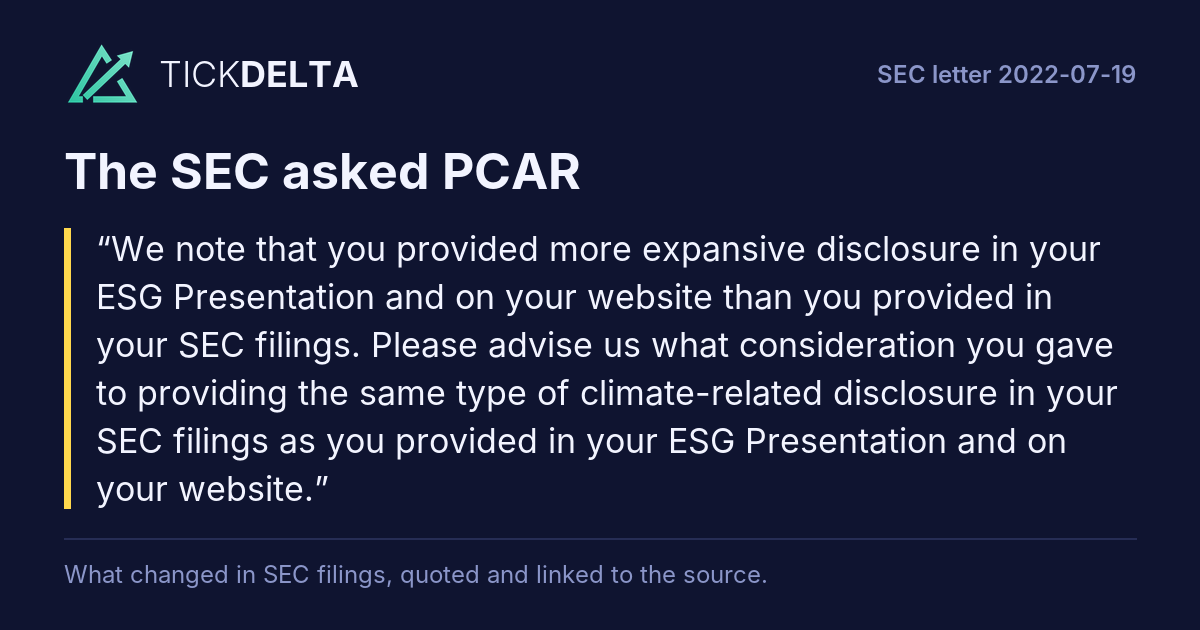
We note that you provided more expansive disclosure in your ESG Presentation and on your website than you provided in your SEC filings. Please advise us what consideration you gave to providing the same type of climate-related disclosure in your SEC filings as you provided in your ESG Presentation and on your website.
PACCAR is proud to be a global environmental leader. As disclosed in the 2021 Form 10-K and the Company’s ESG Presentation, PACCAR has established greenhouse gas emission reduction targets approved by the Science-Based
Targets Initiative (SBTi) to meet the goals of the Paris Agreement (i.e., “limiting global warming to well-below 2°C above pre-industrial levels and pursuing efforts to limit warming to
1.5°C”).
A wide range of stakeholders are interested in PACCAR’s initiatives to reduce the environmental impact of its products, facilities, and operations.Read in the reply ↗Rest of the answer
The Company provides such information in its ESG Presentation, in its Annual Report to Stockholders, and on the Environmental, Social, and Governance section of the PACCAR website (available at https://www.paccar.com/about-us/environmental-social-and-governance/). The Company also participates in non-binding reporting initiatives, such as CDP (formerly the Carbon Disclosure Project). The information provided is intended to respond to the interests of this broader group of stakeholders and contains a significant amount of detail, including information that PACCAR does not consider to be material in the context of its annual reports on Form 10-K.
When considering whether to include climate-related information in the 2021 Form 10-K, the Company evaluated the requirements of the form, its other obligations under applicable law, including the Securities Exchange Act of 1934, and the rules and regulations and guidance of the Commission, including the Commission’s 2010 Guidance Regarding
Disclosure Related to Climate Change (the “2010 Guidance”). The Company assessed the materiality of climate-related factors relative to PACCAR’s annual Truck, Parts and Other expenses of $19.9 billion in 2021.
Given PACCAR’s environmental commitment, the Company enhanced its disclosure in the 2021 Form 10-K by adding the information under the ENVIRONMENTAL AND SUSTAINABILITY LEADERSHIP heading on pages 7-8. The 2021 Form 10-K also discussed known trends, demands, commitments, and uncertainties relating to environmental matters in Management’s Discussion and
Analysis of Financial Condition and Results of Operations. The Company further considered as part of its assessment as to materiality the existing rules and the 2010 Guidance in crafting disclosures in the 2021 Form
10-K as summarized in the responses to Comments 2 through 9 below.
First report after the company's reply of 2022-08-30: 10-Q filed 2022-10-28 ↗, against the 10-Q filed 2022-05-03 ↗.
Tickdelta does not hold the text of both reports, so they are not compared here.
Disclose the material effects of transition risks related to climate change that may affect your business, financial condition, and results of operations, such as policy and regulatory changes that could impose operational and compliance burdens, market trends that may alter business opportunities, credit risks, or technological changes.
PACCAR’s risk assessment process for purposes of preparing the Company’s Risk Factor disclosures in its annual reports on Form 10-K and in other filings with the Commission seeks to assess the level of financial, operational, reputational, and other effects on the Company. This process considers the magnitude and probability of potential financial impacts, the materiality of risks in accordance with generally accepted accounting principles, and any other potential concerns that might affect the Company’s operation, finances, or reputation.Read in the reply ↗Rest of the answer
Risks are assessed on a site, product, division, and global basis and are evaluated over short-, medium-, and long-term time horizons. Senior management meets regularly to discuss risks and opportunities affecting PACCAR, including climate-related risks. Material risks are reported to PACCAR’s Board of Directors.
With respect to transition risks related to climate change, the material effects of these risks were reflected in the Risk Factors included in the 2021 Form 10-K. PACCAR’s primary transition risks related to climate change are meeting changing customer demand and achieving its science-based targets. PACCAR has ongoing product development programs intended to address these risks, which involve the continuing development of compliant diesel powertrains and the design, manufacture, and sale of alternative powertrain commercial vehicles (e.g., battery-electric, hybrid, hydrogen combustion and hydrogen fuel cell). The pace of transition from diesel combustion to alternative powertrain commercial vehicles is highly uncertain and will be influenced by:
• the success of the Company’s research and development programs customer demand for alternative powertrain vehicles advancements in battery-electric, hydrogen fuel cell, and hydrogen combustion technology the cost of batteries, hydrogen fuel cells and liquid hydrogen global regulations requiring the use of alternative powertrain vehicles and/or providing incentives to facilitate the transition to alternative powertrain commercial vehicles investments in energy and power infrastructure (e.g., renewable power supply, electric charging services, hydrogen supply and distribution) in key markets, as well as the associated utility costs the availability of skilled engineering and manufacturing personnel the ability of the supply chain to deliver components, including commodities and raw materials that are not required for diesel-powered vehicles the success of new and existing competitors in developing and selling alternative powertrain commercial vehicles
The Company continues to evaluate climate change-related transitions and their impact to its business, operations, or financial condition. Risk factors disclosed in the 2021 Form 10-K that address the transition risks discussed above include risks under the subheadings Commercial Truck Market Demand is Variable,
Competition and Prices, Production Costs, Capacity and Inflation, and Environmental Regulations, among others. PACCAR believes that its current strategies, programs, and resources are sufficient to manage the transition from diesel combustion to alternative powertrain vehicles. If the Company is not successful with this transition, there could be a material adverse impact on the Company’s business, operations, or financial condition. The Company will continue to monitor any future climate-related transition risks and will consider additional disclosure of these risks in its Form 10-K.
First report after the company's reply of 2022-08-30: 10-Q filed 2022-10-28 ↗, against the 10-Q filed 2022-05-03 ↗.
Tickdelta does not hold the text of both reports, so they are not compared here.
Please disclose any material litigation risks related to climate change and explain the potential impact to the company.
The Company monitors and assesses its litigation risks in advance of relevant filings with the Commission to determine whether the risks may have a material effect on its business, financial condition, reputation, or results of operations. The Company has not experienced any actual claims related to climate change and is not presently aware of any potential litigation that may affect the
Company related to climate change.
When evaluating the scope of disclosure required under Item 105 of Regulation S-K and the 2010 Guidance for the 2021 Form 10-K, the Company considered the current andRead in the reply ↗Rest of the answer
historical absence of litigation relating to climate change and PACCAR’s ongoing compliance with environmental regulations in the markets in which it operates. The Company’s assessment to date is that PACCAR is not subject to material litigation risks related to climate change. The Company will continue to evaluate potential litigation risks related to climate change and will disclose such risks should they become material.
First report after the company's reply of 2022-08-30: 10-Q filed 2022-10-28 ↗, against the 10-Q filed 2022-05-03 ↗.
Tickdelta does not hold the text of both reports, so they are not compared here.
There have been significant developments in federal and state legislation and regulation and international accords regarding climate change that you have not discussed in your filing. Please revise your disclosure to identify material pending or existing climate change-related legislation, regulations, and international accords and describe any material effect on your business, financial condition, and results ofRest of the question
operations.
As a manufacturer of heavy-duty commercial vehicles and diesel combustion engines, PACCAR is subject to extensive statutory and regulatory requirements governing greenhouse gas and non-greenhouse gas emissions. These include standards imposed by the U.S. Environmental Protection Agency (EPA), the European Union, U.S. state regulatory agencies
(such as the California Air Resources Board), regulatory agencies in other international markets where the Company operates, and non-binding international accords related to climate change.Read in the reply ↗Rest of the answer
The primary developments in these laws and regulations involve stricter requirements under the EPA’s Greenhouse Gas Emissions Standards and Fuel Efficiency Standards for Medium and Heavy-Duty Engines and Vehicles, the Regulation of the European Parliament and of the Council on the Monitoring and Reporting of CO2 Emissions from Fuel Consumption of New Heavy-Duty Vehicles, and the Heavy-Duty Omnibus Regulation of the California Air Resources
Board.
Environmental compliance has been an integral part of the Company’s business for many decades. PACCAR is an environmental leader and has established the staffing, facilities, and programs to address environmental laws and regulations now and in the future. PACCAR established its science-based targets to meet the goals of the Paris Agreement, and the Company’s product planning through 2030 uses a climate change scenario analysis to limit global warming to below 2°C. PACCAR participates in non-binding disclosure initiatives that will assist in compliance with emerging climate change-related disclosure regulations.
In assessing recent developments in climate change-related laws and regulations, the Company evaluates whether such developments could have a material adverse impact on the Company’s financial condition or results of operations relative to its annual Truck, Parts and Other expenses, which were $19.9 billion in 2021.
The Company considers its estimated compliance costs in connection with emerging environmental regulations as compared with prior estimates of such costs. The Company also assesses whether regulatory developments could require a significant change to the Company’s product development strategy or operations. The Company believes that recent developments in climate change-related laws and regulations have not had a material adverse impact on PACCAR’s business, financial condition, or results of operations.
As reductions in greenhouse gas emissions result in fuel efficiency improvements, and
PACCAR’s customers appreciate fuel efficiency improvements to lower their operating costs, there is strong alignment between customer and regulatory requirements expected for the truck industry in the coming years. Even without legislation to reduce greenhouse gas emissions, PACCAR would significantly invest in technologies to improve fuel efficiency for our customers which would also reduce vehicle greenhouse gas emissions.
PACCAR anticipates being subject to future climate change-related laws and regulations as additional countries and regulatory bodies establish their own environmental commitments. The Company cannot predict whether future environmental laws and regulations could materially increase PACCAR’s environmental compliance costs or impact its product development strategy or operations, so this remains a risk. The Company disclosed the risk of changes to environmental regulations under the Environmental Regulations subheading of the Risk Factors in the 2021 Form 10-K (page 12,
“The Company could experience higher research and development and manufacturing costs due to changes in government requirements for its products, including changes in emissions, fuel, greenhouse gas or other regulations”).
The Company will continue to monitor laws and regulations related to climate change and will consider disclosure of additional developments in its Form 10-K.
First report after the company's reply of 2022-08-30: 10-Q filed 2022-10-28 ↗, against the 10-Q filed 2022-05-03 ↗.
Tickdelta does not hold the text of both reports, so they are not compared here.
It appears you have identified climate-related projects in your ESG Presentation, such as projects related to a transition to zero emissions. Tell us how you considered providing disclosure regarding past and future capital expenditures for climate-related projects. Include quantitative information for the periods covered by your Form 10-K and for future periods as part of your response.
PACCAR invests in technologies that reduce greenhouse gas emissions such as fuel-efficient diesel engines, natural gas and biofuel engines, and next-generation batteryelectric, hybrid, hydrogen combustion, and hydrogen fuel cell powertrains. To develop and manufacture these industry leading products and technologies, the Company makes significant investments in capital expenditures and R&D each year.Read in the reply ↗Rest of the answer
Total capital investments and R&D expenses for the periods covered by the 2021 Form 10-K were as follows (page 16, shown in millions):
2019
2020
2021
Capital investments
$
743.9
569.5
511.8
R&D expenses
326.6
273.9
324.1
Capital investments are expected to be $425 to $475 million and R&D expenses are expected to be $350 to $400 million in 2022 (page 26).
The Company’s investment programs are primarily focused on developing cost-effective and fuel-efficient transportation solutions. There is no universally accepted definition of what constitutes a “climate-related project” and its related expenditures. The Company does not formally categorize its capital investments and R&D expenses as “climate-related” and “not climate-related” – as these projects and initiatives have multiple goals, including reduction of environmental impacts. Capital investments and R&D expenses incurred to develop next-generation truck models and engines have combined goals of reducing emissions and improving fuel efficiency while also enhancing performance, reliability, and durability. Capital investments incurred to expand or enhance the Company’s manufacturing facilities similarly have the combined goals of reducing emissions and promoting sustainability by conserving energy and natural resources and lowering operating costs. Reducing emissions and improving fuel efficiency are critical aspects of meeting PACCAR’s science-based targets. The Company currently estimates that approximately 60 to 80 percent of its capital investments and R&D expenses are directly or indirectly related to climate-related projects and this is expected to continue in the foreseeable future.
Consistent with disclosures made throughout the 2021 Form 10-K, including on pages 7, 17, and 26, the Company expects to continue to invest in lower-emissions diesel and zero emissions powertrains, autonomous driving systems, connected vehicle technologies, next-generation manufacturing, and efficient distribution capabilities to remain an industry and environmental leader. The Company currently anticipates that its capital expenditures and R&D expense will increase approximately 10 percent annually over the next five years. Such estimate is subject to change based on market and other conditions.
First report after the company's reply of 2022-08-30: 10-Q filed 2022-10-28 ↗, against the 10-Q filed 2022-05-03 ↗.
Tickdelta does not hold the text of both reports, so they are not compared here.
To the extent material, discuss the indirect consequences of climate-related regulation or business trends, such as the following: • decreased demand for goods that produce significant greenhouse gas emission or are related to carbon-based energy sources; • increased demand for goods that result in lower emissions than competing products; • increased competition to develop to develop new products that result inRest of the question
lower emissions; • increased demand for generation and transmission of energy from alternative energy sources; and • any anticipated reputational risks resulting from operations or products that produce material greenhouse gas emissions.
Trucking is an essential industry and economies around the world rely on PACCAR’s products and the logistics services of its customers.
The Company evaluates the impact of indirect climate-related risks and opportunities by tracking global regulation of greenhouse gas emissions, shifting customer preferences and expectations, and technological advances in truck design and logistics.Read in the reply ↗Rest of the answer
It collaborates with suppliers, customers, and third parties with knowledge of emerging trends related to road freight and participates in trade associations, such as The Truck and Engine Manufacturers Association in the U.S. and Canada and the European Automobile Manufacturers’ Association in the E.U. By continuing to evaluate climate-related risks and opportunities, PACCAR’s strategic decisions regarding the focus and scale of R&D budgets will evolve as commercial transportation solutions are developed.
As noted above in response to Comment 2, the pace of transition from diesel combustion to alternative powertrain commercial vehicles is highly uncertain. The transition will be influenced by, among other things, the success of the Company’s ongoing research and development efforts, changes in customer demand, technological advancements in energy storage, the cost of alternative powertrain components, investments in alternative power generation and charging infrastructure, and government regulations requiring or incentivizing the use of alternative powertrain vehicles.
PACCAR’s existing competitors are also developing alternative powertrain commercial vehicles and new competitors may intend to enter this rapidly evolving market. Supply chains will need to source components and raw materials that are not currently required for diesel-powered vehicles, and suppliers will need to mitigate direct and indirect climate change-related risks to their businesses.
These indirect consequences of shifting customer preferences and expectations, and competition in developing lower emission products were described in the 2021 Form 10-K in the Risk Factors section in the risks under the subheadings Commercial Truck Market Demand is Variable and Competition and Prices.
PACCAR has been working for decades to reduce the greenhouse gas emissions of its diesel-powered vehicles and has a proven track record of meeting and exceeding emissions requirements. The Company does not currently anticipate any reputational risk resulting from the greenhouse gas emissions of its diesel-powered vehicles distinct from such risks affecting the industry generally.
First report after the company's reply of 2022-08-30: 10-Q filed 2022-10-28 ↗, against the 10-Q filed 2022-05-03 ↗.
Tickdelta does not hold the text of both reports, so they are not compared here.
Please discuss the physical effects of climate change on your operations and results. This disclosure may include the following: • severity of weather, such as floods, hurricanes, sea levels, extreme fires, and water availability and quality; • quantification of material weather-related damages to your property or operations; • potential for indirect weather-related impacts that have affected or may affect yourRest of the question
major customers or suppliers; and • any weather-related impacts on the cost or availability of insurance. Include quantitative information for each of the periods covered by your Form 10-K and explain whether increased amounts are expected in future periods as part of your response.
The Company prepares for and addresses weather-related disruptions as they occur, and management of weather-related risks is part of
PACCAR’s standard operating costs. Accordingly, it is not possible for PACCAR to calculate any such costs incurred solely in the context of climate change. PACCAR recognizes the potential of physical risks to its production facilities and supply chains from severe weather.Read in the reply ↗Rest of the answer
These are identified and assessed on a global basis through the Company’s business continuity evaluation and planning process.
The Company has not experienced any material physical effects of climate change on its operations and results during the periods covered by the
2021 Form 10-K. The most significant weather-related event was the severe winter storm, freezing temperatures and rolling blackouts that impacted the state of Texas in 2021. PACCAR’s manufacturing facility in Denton, Texas experienced a multi-day production shutdown and suffered physical damage. The costs of lost production and repairs were approximately $10 million, most of which were covered by insurance. Weather-related events affecting PACCAR have not been material relative to its annual Truck, Parts and Other expenses of $19.9 billion in 2021. The Company has also not experienced any material weather-related impacts on the cost or availability of insurance. PACCAR’s insurance costs represent less than 0.03 percent of its annual expenses.
The Company’s physical facilities are globally distributed and located in areas that are not expected to suffer material increases in adverse weather events due to climate change. Vehicle production is regionally localized with manufacturing operations in each market where PACCAR vehicles are sold. PACCAR does not anticipate an increase in weather-related disruptions that would be material to its business, financial condition, or results of operations.
The Company disclosed the risk of extreme weather events under the Production Costs,
Capacity and Inflation subheading of the Risk Factors in the 2021 Form 10-K (page 10, “Unexpected events, including natural disasters, extreme weather events, or global pandemics, may increase the
Company’s cost of doing business or disrupt the Company’s or its suppliers’ operations”). The Company will continue to monitor the physical effects of climate change and the likelihood of increases in severe weather as a result of climate change and will consider additional disclosure of the physical effects of climate change in its future annual reports on Form 10-K.
First report after the company's reply of 2022-08-30: 10-Q filed 2022-10-28 ↗, against the 10-Q filed 2022-05-03 ↗.
Tickdelta does not hold the text of both reports, so they are not compared here.
We note your disclosure on page 12 regarding the costs to comply with environmental laws and regulations. Tell us about and quantify any compliance costs related to climate change for each of the last three fiscal years and explain whether increased amounts are expected to be incurred in future periods.
PACCAR meets vehicle and engine emissions regulations and has developed the staffing, processes, and facilities to address environmental compliance. The Company currently estimates that approximately 60 to 80 percent of its total R&D expenses
($326.6 million in 2019, $273.9 million in 2020, and $324.1 million in 2021) are directly or indirectly related to emissions compliance. The Company estimates that R&D expenses will be $350 to $400 million in 2022 and currently believes that this amount will increase annually over the next five years.Read in the reply ↗Rest of the answer
As noted above in response to Comment 5, the Company does not formally categorize R&D expenses as “climate-related” and “not climate-related” – as engine development and testing programs have goals of reducing emissions and improving fuel efficiency while also enhancing performance, reliability, and durability. The Company does not believe that the proportion of capital investments and R&D expenses that are directly or indirectly related to climate-related projects is material information with respect to the Company.
PACCAR complies with environmental laws and regulations, such as supplier management, facility design/testing/permitting, land use, water management, energy management, zero-waste-to-landfill, end-of-life recovery and recyclability, and reporting on binding and non-binding environmental disclosures. These costs represented less than 0.5 percent of PACCAR’s annual Truck, Parts and Other expenses of $19.9 billion in 2021, and therefore the Company did not separately disclose this information in the 2021 Form
10-K.
First report after the company's reply of 2022-08-30: 10-Q filed 2022-10-28 ↗, against the 10-Q filed 2022-05-03 ↗.
Tickdelta does not hold the text of both reports, so they are not compared here.
If material, provide disclosure about your purchase or sale of carbon credits or offsets and any material effects on your business, financial condition, and results of operations. We remind you that the company and its management are responsible for the accuracy and adequacy of their disclosures, notwithstanding any review, comments, action or absence of action by the staff.
PACCAR engages in the purchase of European Union Allowances (EUAs) on a limited basis. EUAs are carbon credits utilized in the European Union
Emissions Trading Scheme. The Company purchased 12,979 EUAs at a cost of less than €1 million in 2021. The Company does not consider this to be material to its business, financial condition, or results of operations.
If you have any further comments or questions regarding this letter, please contact me at (425) 468-7154. Read in the reply ↗
First report after the company's reply of 2022-08-30: 10-Q filed 2022-10-28 ↗, against the 10-Q filed 2022-05-03 ↗.
Tickdelta does not hold the text of both reports, so they are not compared here.
Your response to prior comment two states that your primary transition risks related to climate change are meeting changing customer demand and achieving your science-based targets. However, it does not appear that disclosure in your Form 10-K addresses these risks in the context of climate change.Rest of the question
Please revise to provide disclosure that specifically addresses the transition risks you have identified related to climate change and their impact to your business, operations, and financial condition.
The Company intends to add the following Risk Factor (or similar text) to its Annual Report on Form 10-K for 2022:
Transition Risks Related to Climate Change. The
Company has ongoing product development programs intended to address changing customer demand in the context of climate change and achieve its targeted reductions in emissions. These involve the continuing development of compliant clean diesel powertrains and the design, manufacture, and sale of alternative powertrain commercial vehicles (e.g., battery-electric, hybrid, hydrogen fuel cell, and hydrogen combustion).Read in the reply ↗Rest of the answer
The pace of transition from diesel combustion to alternative powertrain commercial vehicles is highly uncertain and will be influenced by:
• the success of the Company’s research and development programs customer demand for alternative powertrain vehicles advancements in battery-electric, hydrogen fuel cell, and hydrogen combustion technology the cost of batteries, hydrogen fuel cells and liquid hydrogen global regulations requiring the use of alternative powertrain vehicles and/or providing incentives to facilitate the transition to alternative powertrain commercial vehicles investments in energy and power infrastructure (e.g., renewable power supply, electric charging services, hydrogen supply and distribution) in key markets, as well as the associated utility costs the ability of the supply chain to deliver components, including commodities and raw materials that are unique to alternative powertrain commercial vehicles the success of new and existing competitors in developing and selling alternative powertrain commercial vehicles
The Company believes that its current strategies, programs, and resources are sufficient to address changes in customer demand in the context of climate change and to meet its emissions reduction targets. If the Company is not successful in addressing the risks noted above, there may be a material adverse impact on its business, operations, and financial condition.
To clarify the response to prior comment two, the Company’s assessment through the filing of the 2021 Form 10-K was that the transition risks of changing customer demand and achieving PACCAR’s science-based targets were, to the extent material, addressed in the Risk Factors in the
2021 Form 10-K.
First report after the company's reply of 2022-10-13: 10-Q filed 2022-10-28 ↗, against the 10-Q filed 2022-05-03 ↗.
Tickdelta does not hold the text of both reports, so they are not compared here.
In response to prior comment four, you detail various statutory and regulatory requirements governing emissions relevant to your business and operations. You also state that you have set emissions targets to meet the goals of the Paris Agreement. Consistent with our prior comment, please revise your disclosure to identify legislation, regulations, and international accords related to climate change.
The Company intends to add the following Risk
Factor (or similar text) to its Annual Report on Form 10-K for 2022:
Emissions Requirements and
Reduction Targets. PACCAR’s operations and products are subject to extensive statutory and regulatory requirements governing greenhouse gas and non-greenhouse gas emissions. These include standards imposed by the U.S. Environmental Protection Agency (EPA), the European Union, U.S.Read in the reply ↗Rest of the answer
state regulatory agencies (such as the California Air Resources Board), regulatory agencies in other international markets where the Company operates, and non-binding international accords related to climate change. The primary laws and regulations are the EPA’s Greenhouse Gas Emissions Standards and Fuel Efficiency Standards for Medium and Heavy-Duty Engines and Vehicles, the Regulation of the European Parliament and of the Council on the Monitoring and Reporting of CO2 Emissions from Fuel
Consumption of New Heavy-Duty Vehicles, and the Heavy-Duty Omnibus Regulation of the California Air Resources Board. PACCAR established its science-based greenhouse gas emission reduction targets to meet the goals of the Paris Agreement. The Company continually monitors developments in emissions and climate change-related laws and regulations in the markets in which the Company conducts business.
The Company’s product planning through 2030 is aligned with these statutory and regulatory requirements, and uses a climate change scenario analysis to limit global warming to below 2°C. Even without legislation to reduce greenhouse gas emissions, PACCAR expects to continue to significantly invest in technologies to improve fuel efficiency for its customers, which would also reduce greenhouse gas emissions.
PACCAR expects that climate change-related laws, regulations, and international accords will continue to evolve. The Company cannot reasonably predict whether future laws, regulations, and international accords could materially increase its environmental compliance costs, alter its product development strategy, or impact its business, financial condition, or results of operations.
The Company also intends to revise the Business section of its Annual Report on Form 10-K for 2022 to identify or cross-reference the legislation, regulations, and international accords noted above. Although this comment was made with respect to Management’s Discussion and Analysis of Financial
Condition and Results of Operations (“MD&A”), the Company believes that the proposed new disclosures are responsive to the requirements of the Risk Factors and Business sections and will supplement the prior disclosures regarding environmental laws and regulations in those sections.
First report after the company's reply of 2022-10-13: 10-Q filed 2022-10-28 ↗, against the 10-Q filed 2022-05-03 ↗.
Tickdelta does not hold the text of both reports, so they are not compared here.
Your responses to prior comments five and eight appear to suggest that you are incurring material amounts of capital expenditures and compliance costs related to reducing environmental impacts and emissions compliance with increases expected in future periods.Rest of the question
Please further explain to us how you considered providing quantitative disclosure regarding past and future capital expenditures for climate-related projects and compliance costs related to climate change. In addition, as your response states that you do not categorize amounts incurred as “climate-related” and “not climate-related," please describe your consideration of the disclosure requirement per Item 101(c)(2)(i) of Regulation S-K.
The Company discloses its past and future capital investments and R&D expenses on an aggregate annual basis, with additional narrative disclosure to explain the objectives of these investments to investors. This includes disclosure in the 2021 Form 10-K that PACCAR will continue to fund capital and R&D projects to meet future emissions and certification requirements through the introduction of new technologies to its engines and exhaust after-treatment systems and will increase its investment in clean diesel and zero emissions powertrain technologies.
The Company determined the estimatesRead in the reply ↗Rest of the answer
noted in its August 30, 2022 response letter (i.e., the proportion of capital investments and
R&D expenses directly or indirectly related to climate-related projects and the proportion of R&D expenses directly or indirectly related to emissions compliance) as part of its participation in CDP’s non-binding disclosure initiative. This was done in response to evolving, open-ended inquiries from CDP that required management’s subjective judgment to assess direct and indirect relationships to climate change and emissions compliance. There was no authoritative guidance or other published financial reporting standards to define these relationships or classify these expenses. These estimates could also change based on climate-related reporting methodologies under development. The Company established these estimates after filing the 2021 Form 10-K. PACCAR currently believes that disclosure of this wide range of quantitative estimates would not provide meaningful information to investors.
Item 101(c)(2)(i) of Regulation S-K calls for disclosure, to the extent material to an understanding of the Company’s business as a whole or any of its segments, of the material effects that compliance with government regulations, including environmental regulations, may have on the capital expenditures, earnings, and competitive position of the Company. The 2021 Form 10-K states that the Company complies with applicable laws and regulations and, as noted above, that it will continue to fund capital and R&D projects to meet future emissions and certification requirements through the introduction of new technologies to its engines and after-treatment systems. This disclosure cross-references information in the MD&A and the corresponding financial statements, including disclosures regarding anticipated future capital investments and R&D expenses, costs incurred relating to environmental activities in the fiscal years reported in the financial statements, and the current expectation that future environmental cleanup costs would not have a significant effect on the Company’s consolidated financial position. In view of PACCAR’s long history of meeting and exceeding emissions requirements and the fact that its competitors are subject to the same requirements, the Company considered the totality of the disclosures in the Business section, the information cross-referenced to the MD&A, and the corresponding financial statements and believes that the 2021 Form 10-K is responsive to the requirements of Item 101(c)(2)(i) of Regulation S-K.
First report after the company's reply of 2022-10-13: 10-Q filed 2022-10-28 ↗, against the 10-Q filed 2022-05-03 ↗.
Tickdelta does not hold the text of both reports, so they are not compared here.
We note your response to prior comment six does not provide all of the requested information. Please more fully describe the indirect consequences of climate-related regulation or business trends, including the specific items noted in our comment, and tell us how you concluded whether they were material.
To supplement the Company’s response to prior comment six and the information in the 2021 Form 10-K, the Company’s responses to the specific items noted by the Staff are set forth under the bullets below. The Company has not experienced a material impact to its business, financial condition, or results of operations as a result of the indirect consequences of climate-related regulation or business trends for the periods covered by the 2021 Form 10-K or in 2022 to date.Read in the reply ↗Rest of the answer
As a manufacturer of heavy-duty commercial vehicles and diesel combustion engines, the indirect consequences of climate-related regulation and business trends overlap significantly with the matters discussed in connection with the transition from diesel-powered to alternative powertrain commercial vehicles in response to comment one and prior comment two.
decreased demand for goods that produce significant greenhouse gas emission or are related to carbon-based energy sources;
increased demand for goods that result in lower emissions than competing products;
The Company has not experienced a decrease in demand for its diesel combustion vehicles in favor of alternative powertrain commercial vehicles during the periods covered by the 2021 Form 10-K. Sales of alternative powertrain commercial vehicles represented less than one percent of the Company’s total truck sales during these periods, as higher prices and limited applications (such as local delivery, refuse and port operations) currently temper demand for these products. PACCAR has experienced an increase in interest in zero emissions vehicles that are appropriate for customers’ operational, financial, and environmental goals. The first two Risk Factors of the 2021 Form 10-K under the subheadings Commercial Truck Market Demand is Variable and Competition and Prices disclose the variable demand in the commercial truck market and that the Company operates in a highly competitive environment. The discussion in these Risk Factors addresses material adverse impacts to PACCAR if it does not develop competitive products to meet future customer demand, including potential changes in demand related to emissions from diesel-powered vehicles.
The
Company is aware that environmental regulations and evolving customer preferences may shift demand from diesel combustion to alternative powertrain commercial vehicles in the medium to long term. The focus and scale of PACCAR’s capital and
R&D budgets are guided by management’s assessment of the opportunities and risks associated with this transition. The Company’s Risk Factor in response to comment one will address changing customer demand as part of the transition from diesel combustion to alternative powertrain commercial vehicles.
increased competition to develop new products that result in lower emissions;
PACCAR operates in a highly competitive market and its future financial results will reflect its ability to develop, manufacture, and market competitive products that meet future customer demand. The Company has invested in technologies that reduce greenhouse gas emissions such as next generation diesel engines, natural gas and biofuel engines, and zero emissions battery-electric and hydrogen fuel cell powertrains. PACCAR is aware that its competitors are also developing lower emissions diesel and alternative powertrain commercial vehicles and that other companies are attempting to enter the alternative powertrain commercial vehicle market.
The Company’s first two Risk Factors in the 2021 Form
10-K under the subheadings Commercial Truck Market Demand is Variable and Competition and Prices disclose the competitive risks facing PACCAR, including increased competition resulting from new technologies (“Demand for commercial vehicles may also be affected by the introduction of new vehicles and technologies by the Company or its competitors”). When considering this Risk Factor and the limited market for alternative powertrain commercial vehicles in the near term, the Company concluded that additional disclosure specific to alternative powertrain commercial vehicles, as distinct from competition in all other aspects of PACCAR’s business, would not be material for purposes of the 2021 Form 10-K.
increased demand for generation and transmission of energy from alternative energy sources;
The Company is not aware of any material impact on its business, financial condition or results of operations related to an increased demand for generation and transmission of energy from alternative energy sources. Sales of alternative powertrain commercial vehicles have represented less than one percent of the Company’s total truck sales, and PACCAR has not experienced a material decrease in customer demand for diesel vehicles in favor of alternative powertrain vehicles. When considering these factors for purposes of the 2021 Form 10-K, the Company concluded that its disclosures in the Business section under the ENVIRONMENTAL AND SUSTAINABILITY LEADERSHIP heading (regarding its investments in alternative fuel technologies) and Risk Factors (regarding variable customer demand and the highly competitive environment in which the Company operates) appropriately addressed any material indirect consequences regarding demand for energy derived from alternative sources.
PACCAR is aware that significant public and private investments in alternative energy generation, storage, and distribution will be required to support the adoption of alternative powertrain commercial vehicles in the medium to long term. The Company’s Risk Factor in response to comment one will address investments in energy and power infrastructure, as well as the impact of associated utility costs, as part of the transition to alternative powertrain commercial vehicles.
Any anticipated reputational risks resulting from operations or products that produce material greenhouse gas emissions.
As described in the response to prior comment six, the Company does not anticipate any material reputational risks resulting from emissions of its diesel combustion products that are distinct from such risks affecting the industry generally.
First report after the company's reply of 2022-10-13: 10-Q filed 2022-10-28 ↗, against the 10-Q filed 2022-05-03 ↗.
Tickdelta does not hold the text of both reports, so they are not compared here.
We note your response to prior comment seven and reissue in part. Please include the quantification requested by our comment on an aggregate basis, rather than as a quantitative example, for each of the periods covered by your Form 10-K and those subsequent to year-end.Rest of the question
In addition, your response states that you recognize the potential of physical risks to your production facilities and supply chains from severe weather. Please provide us with additional detail explaining how you considered providing disclosure regarding the potential for the physical effects of climate change to affect your operations and results and possible indirect financial and operational impacts to you from disruptions to the operations of your customers from severe weather.
The Company has not experienced any physical effects of climate change that were material to its operations and financial results during the periods covered by the 2021 Form 10-K or in 2022 to date. PACCAR’s expenses to (i) repair weather-related damages to its property and operations, and (ii) upgrade its facilities and/or replace equipment in preparation for potential severe weather, totaled approximately $0.1 million in 2019, $1.8 million in 2020, $4.0 million in 2021, and $6.9 million in 2022 to date.Read in the reply ↗Rest of the answer
These amounts represent, or are expected to represent, less than 0.1 percent of the Company’s annual Truck, Parts and Other expenses for each period. The Company did not experience any measurable weather-related production losses during these periods other than the 2021 Texas winter storm described in response to prior comment seven (substantially all such losses were covered by insurance).
When considering whether to include additional disclosure regarding the potential for the physical effects of climate change in the 2021 Form 10-K, the Company evaluated the absence of material physical effects of climate change to date, the geographic distribution of the Company’s manufacturing and distribution facilities, the geographic proximity of the Company’s suppliers to its primary manufacturing facilities, the breadth of the
Company’s supply base, management’s determination that PACCAR’s facilities are located in areas that are not significantly likely to experience a material increase in weather-related disruptions due to climate change, the scope of the
Company’s casualty and business interruption insurance, and PACCAR’s financial resources to respond to future severe weather events. When considering the totality of these factors, the Company believes the Risk Factor disclosure in the
2021 Form 10-K (“Unexpected events, including natural disasters, extreme weather events, or global pandemics, may increase the Company’s cost of doing business or disrupt the Company’s or its suppliers’ operations.”) addressed the Company’s risks. In light of the Staff’s comment, the Company intends to add the following (or similar text) to this Risk Factor in its Annual Report on Form 10-K for 2022:
The likelihood or severity of these unexpected events may increase due to the effects of climate change.
First report after the company's reply of 2022-10-13: 10-Q filed 2022-10-28 ↗, against the 10-Q filed 2022-05-03 ↗.
Tickdelta does not hold the text of both reports, so they are not compared here.
We note your response to prior comment nine. Beyond your purchase of European Union Allowances in 2021, please also provide us with quantitative information related to your purchase of carbon credits or offsets for the other periods for which financial statements are presented in your Form 10-K, and for the sale of carbon credits or offsets, if applicable.Rest of the question
Please also tell us about any planned future period transactions. Please contact Erin Donahue at 202-551-6063 or Sergio Chinos at 202-551-7844 with any questions.
The Company did not purchase any carbon credits or offsets in 2019 and purchased carbon credits or offsets in amounts of approximately €0.02 million in 2020, €0.75 million in 2021, and €0.61 million in 2022 to date. PACCAR has not purchased carbon credits or offsets other than European Union Allowances during these periods. These purchases represent less than 0.1 percent of the Company’s annual Truck, Parts and Other expenses for each period.Read in the reply ↗Rest of the answer
There are no material transactions in carbon credits or offsets currently planned for future periods.
If you have any further comments or questions regarding this letter, please contact me at (425)
468-7154.
First report after the company's reply of 2022-10-13: 10-Q filed 2022-10-28 ↗, against the 10-Q filed 2022-05-03 ↗.
Tickdelta does not hold the text of both reports, so they are not compared here.
Your response to prior comment four states, in part, that you do not anticipate any material reputational risks resulting from emissions of your diesel combustion products that are distinct from such risks affecting the industry in which you operate.Rest of the question
However, it is not clear from your response how you considered providing disclosure regarding reputational risks related to the commercial truck manufacturing industry in general, including those that could affect the perception of investors or lenders. Please advise or revise your disclosure accordingly.
PACCAR is proud of its reputation for producing high-quality products and meeting and exceeding its emissions compliance requirements. Trucking is an essential industry and economies around the world rely on commercial trucks and logistics services every day. Commercial trucks transport approximately 75 percent of freight in the U.S. The importance of the commercial truck industry was reinforced during the COVID-19 pandemic when the industry was designated as critical infrastructure by the U.S.Read in the reply ↗Rest of the answer
Cybersecurity &
Infrastructure Security Agency under both the “Transportation Systems” and “Critical Manufacturing” sectors.
In considering whether to provide disclosure of reputational risks related to the commercial truck industry in general, the Company believes that investors and lenders are aware (i) of the essential nature of the commercial truck manufacturing industry, (ii) that virtually all commercial trucks are currently powered by diesel-combustion engines, and (iii) of PACCAR’s and the industry’s continuing efforts to reduce the environmental impact of its products (i.e., manufacturers of heavy-duty commercial trucks in the U.S. and many large fleets and suppliers have committed to science-based greenhouse gas emissions reduction targets to meet the goals of the Paris Agreement). The Company regularly communicates with equity investors and its finance subsidiaries access the debt capital markets numerous times throughout the year. The Company believes that any potential negative perception of the commercial truck industry by investors or lenders is already reflected in the securities and lending markets. The Company also believes that any potential reputational risks from the production of diesel-powered trucks are offset by the reputational opportunities that manufacturers have with alternative powertrain commercial trucks. PACCAR currently leads the industry with nine zero emissions models in production.
Regulation S-K Item 303 calls for disclosure of known trends or uncertainties that are reasonably likely to have a material favorable or unfavorable impact on results of operations. After considering the factors outlined above, management believes that the reputational risks related to manufacturing diesel-powered commercial trucks are not reasonably likely to have a material unfavorable impact on the Company’s operations in future periods. For these reasons,
PACCAR concluded that disclosure regarding reputational risks of the commercial truck manufacturing industry in general was not warranted.
If you have any further comments or questions regarding this letter, please contact me at (425) 468-7154.
First report after the company's reply of 2022-10-31: 10-K filed 2023-02-22 ↗, against the 10-K filed 2022-02-23 ↗.
Tickdelta does not hold the text of both reports, so they are not compared here.
Also in this review: closing letter, 2022-11-04