PCGPG&E Corporation
PG&E Corporation, incorporated in California in 1995, is a holding company whose primary operating subsidiary is Pacific Gas and Electric Company, a public utility operating in Northern and Central California. 10-K, Item 1
- Headquarters
- Oakland, CA
- CEO
- Patricia K. Poppe
- Next results
- around Feb 11, 2027
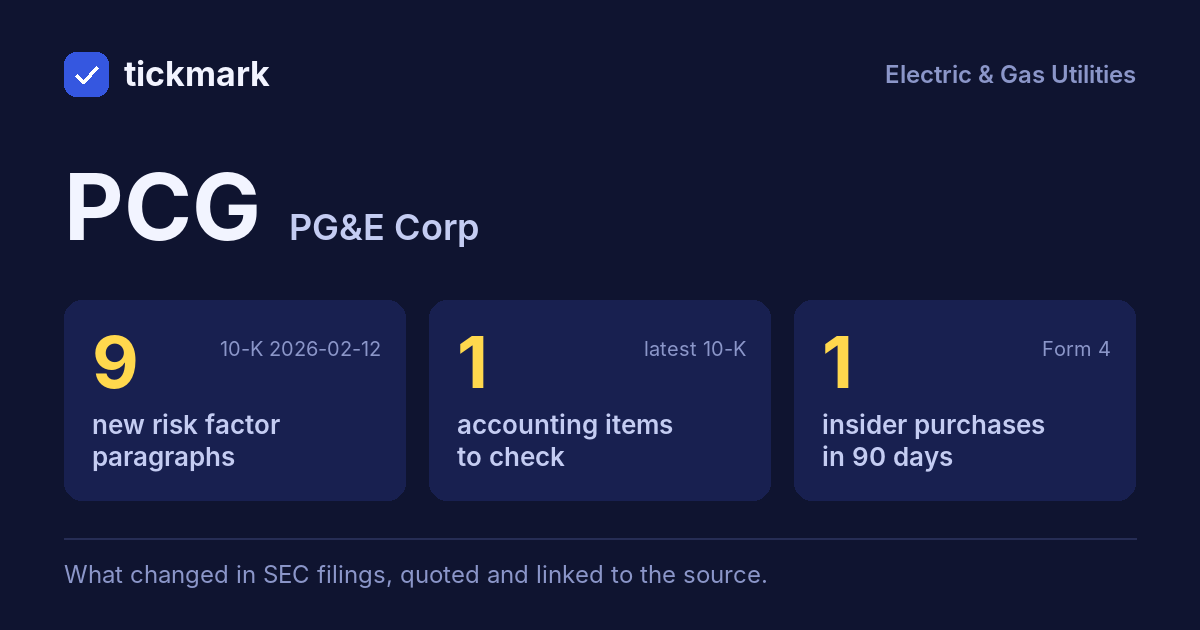
9 paragraphs in Risk Factors of the 10-K filed Feb 12, 2026 with nothing like them in the 10-K filed Feb 13, 2025. Quoted exactly. Paragraphs that were only edited are under 10-K change.
Compared with the Risk Factors in the latest 10-K of the other 30 Utilities companies: a paragraph with at least half its words the same at another company is called similar, and the companies are listed under it. A paragraph most of them have is marked boilerplate. No line means no other company has one like it. This counts text; it does not say how serious a risk is.
An Enhanced Oversight and Enforcement Process proceeding could result in the Utility losing its license to operate as a utility.
Read in the 10-K ↗
The Utility relies on technology to operate its business, including complex operational, interconnected networks and information technology systems that support critical functions. The Utility also depends on information technology systems to help it monitor and operate the electric grid, detect ignitions and collect other wildfire-related information, process transactions, track and collect revenues, manage customer billing and energy usage data, maintain internal control over financial reporting, and produce accurate and timely financial statements and regulatory filings. These information technology systems allow the Utility to create, collect, use, disclose, store, and otherwise process sensitive information, including regarding customers, employees, and other individuals. These systems can be damaged or disrupted by malicious events such as cyber or physical attacks, or by technology failure.
Read in the 10-K ↗
The systems and networks of PG&E Corporation and the Utility may also be damaged or disrupted by technology failures due to errors in software or platforms or the inability to appropriately support, update, expand, recover or integrate technology within PG&E Corporation and the Utility’s networks.
PG&E Corporation and the Utility add, modify and replace information technology systems and technology vendors from time to time. The Utility is engaged in complex projects regarding its billing and enterprise resource planning systems. Modifying existing systems or implementing new or replacement systems or providers is costly and involves risks, including the risks involved in integrating with the Utility’s existing systems and processes, implementing associated changes in accounting procedures and controls, and ensuring that data conversion is accurate and consistent.
Physical attacks targeting the Utility’s physical assets or personnel have caused damage, disrupted operations, and caused injuries and could do so in the future.
Read in the 10-K ↗
PG&E Corporation’s and the Utility’s business activities are concentrated in one industry and in one region.
Similar paragraph at 1 of 30 other Utilities companies: EIXPG&E Corporation’s and the Utility’s business activities are concentrated in one industry (electric and gas utility) and in one region (Northern and Central California). As a result, their business performance may be affected by events, environmental conditions and economic factors unique to such industry or region, or by regional regulation, legislation or judicial decisions, without the benefit of geographic or business diversification.
Read in the 10-K ↗
The Utility’s environmental remediation costs could exceed its liability estimates.
Read in the 10-K ↗
Environmental remediation costs could also increase in the future as a result of new legislation or regulation. See “PG&E Corporation and the Utility could be adversely affected by legislative and regulatory developments, including through increased compliance costs and penalties” above.
Read in the 10-K ↗
New in the latest 10-Q
19 paragraphs in the 10-Q filed Oct 22, 2026 with nothing like them in the 10-Q filed Jul 23, 2026 (at least half the words must differ; new numbers alone do not count). Quoted exactly, grouped by the item heading above them. This is text that changed, not a judgement of how serious it is.
10-Q
• the timing and outcome of the strategic review, including whether any strategic alternative will be identified and approved by PG&E Corporation’s Board of Directors, and any potential disruption to PG&E Corporation’s or the Utility’s business, or costs incurred, as a result of the strategic review and related uncertainty;
Read in the 10-Q ↗
• the risk that no strategic alternative is consummated, including the possibility that required regulatory approvals from any applicable governmental entities (or any conditions, limitations or restrictions placed on such approvals) required for certain strategic alternatives are not able to be obtained, or that legal, regulatory, or other constraints may limit PG&E Corporation’s ability to pursue certain strategic alternatives that PG&E Corporation’s Board of Directors or management determines would otherwise be in the best interests of PG&E Corporation and the Utility;
Read in the 10-Q ↗
• the possibility that, even if a strategic alternative is achieved, any or all of the intended or expected benefits of such strategic alternative will not be achieved;
Read in the 10-Q ↗
Item 1A
Despite extensive wildfire mitigation measures, the Utility still faces significant wildfire risk, which is exacerbated by climate change, severe weather events, aging infrastructure, and vegetation growth. Once an ignition has occurred, the Utility may be unable to control the extent of damages, which is determined primarily by environmental and vegetation conditions, third-party suppression efforts, and the location of the wildfire. The Utility can be liable for these damages and the costs of fire suppression efforts, the Utility’s own assets may be damaged or destroyed, and certain of the Utility’s wildfire mitigation costs are subject to reasonableness review. The extent to which the Utility will be able to recover these costs through rates is uncertain. The Utility will recover its wildfire-related claims in excess of available insurance and legal fees through rates only to the extent that the CPUC or the FERC, as applicable, determines that the Utility has met the applicable prudency standard. The Utility could also face fines, penalties, enforcement action, or other adverse legal or regulatory consequences for noncompliance related to wildfire mitigation efforts.
Read in the 10-Q ↗
• Strategic Review and Revised Capital Plan. PG&E Corporation and the Utility announced on September 2, 2026, that they are conducting a strategic review, reducing their planned capital expenditures for 2027 from $13.4 billion to $11.4 billion, and withdrawing the previously disclosed forecast of capital expenditures for 2028 through 2030. The strategic review is evaluating the full range of regulatory, financial, operational and strategic alternatives reasonably available, including the full range of options related to how PG&E Corporation and the Utility are organized and financed to best serve customers and California. Becoming financially strong and securing an investment-grade credit rating is a foundational objective of the review.
Read in the 10-Q ↗
• an increase in electric procurement costs driven by lower sales of renewable portfolio standard compliance instruments into the market and lower CAISO-related revenues; and
Read in the 10-Q ↗
• a decrease in collections driven by recoveries related to 2020 to 2023 WMCE rate cases.
Read in the 10-Q ↗
• On August 13, 2026, the CPUC adopted an administrative consent order approving a settlement with the CPUC’s enforcement division for the 2022 Mosquito fire.
Read in the 10-Q ↗
• On September 23, 2026, the CPUC issued a PD in the Utility’s 2027 GRC proceeding that would authorize the Utility to recover $456 million in interim rate recovery effective January 1, 2027.
Read in the 10-Q ↗
• On September 30, 2026, the Utility filed a ten-year Electrical Undergrounding Plan (“EUP”) for the years 2028 through 2037 with the OEIS.
Read in the 10-Q ↗
On September 18, 2026, the CPUC issued a PD that would authorize recovery of approximately $1.8 billion of the $2.3 billion of Track 1 costs requested by the Utility, consisting primarily of Wildfire Mitigation Plan Memorandum Account and Fire Risk Mitigation Memorandum Account balances. The PD does not address recovery of amounts recorded in the Gas Storage Balancing Account, In-Line Inspection Memorandum Account, and other memorandum and balancing accounts that are being considered separately in Track 2 of the proceeding. The PD would also disallow approximately $477 million of requested costs, including approximately $291 million of capital expenditures that would be permanently excluded from rate base.
Read in the 10-Q ↗
On September 30, 2026, the Utility filed a ten-year Electrical Undergrounding Plan (“EUP”) for the years 2028 through 2037 with the OEIS.
Read in the 10-Q ↗
Under the proposed plan, the Utility would install 5,000 miles of electrical distribution conduit underground to mitigate wildfire risk and increase electric reliability by reducing the need to de-energize electric distribution lines during periods of increased wildfire risk. The Utility estimates the cost of the proposed EUP, if fully approved, as $16.6 billion in capital expenditures over the ten-year period.
Read in the 10-Q ↗
Pursuant to Public Utilities Code Section 8388.5, the OEIS has nine months to review and approve or deny the plan. Before approving the plan, the OEIS may require the Utility to modify the plan or to modify and resubmit the plan. If OEIS approves the plan, the Utility will file an application within 60 days to recover associated costs from the CPUC, which will have nine months to review and approve or deny the application.
Read in the 10-Q ↗
Financial statements and notes
On August 24, 2026, the Utility received $ 272 million from the DOE’s Civil Nuclear Credit Program related to partial payment of award years 2023 and 2024. As of September 30, 2026, the Condensed Consolidated Balance Sheets reflected $ 272 million of cash as restricted cash within Other noncurrent assets - Other.
Read in the 10-Q ↗
Contract Volume at Underlying Product Instruments September 30, 2026 December 31, 2025 Natural Gas (1) (MMBtus (2)) Forwards, futures, and swaps 196,386,942 232,825,834 Options 62,440,000 48,215,000 Electricity (MWh) Forwards, futures, and swaps 5,588,429 7,196,942 Options 2,206,000 1,650,800 Congestion Revenue Rights (3) 67,268,155 93,712,644
Read in the 10-Q ↗
PG&E Corporation initially recorded a liability in the aggregate amount of $ 300 million, which represented its best estimate of probable losses for the Wildfire-Related Securities Claims. On August 25, 2026, the District Court granted final approval of the $ 100 million class settlement with the Public Employee Retirement Association of New Mexico (“PERA”), which resolved substantially all the Wildfire-Related Securities Claims. As a result, PG&E Corporation has recorded a reduction of the aggregate accrued liability from $ 300 million to $ 260 million in the third quarter of 2026.
Read in the 10-Q ↗
Item 6
10.1 Amendment No. 1 to Credit Agreement, dated as of September 23, 2026, between Pacific Gas and Electric Company and Wells Fargo Bank, National Association, as administrative agent
Read in the 10-Q ↗
10.2 PG&E Corporation 2010 Executive Stock Ownership Guidelines, as amended effective as of September 16, 2026
Read in the 10-Q ↗
The 10-Q's risk factors against the 10-K
Item 1A of the 10-Q filed Oct 22, 2026 against Item 1A of the 10-K filed Feb 12, 2026.
A 10-Q repeats only the risks that changed, so a 10-K paragraph that is missing from it is not counted as removed.
Added is a paragraph with nothing like it in the 10-K, Reworded a sentence that is in both with several words changed,
Quiet changes a sentence in both where one to four words changed and one is a hedge or a modal
(cut words struck through, new words highlighted and underlined).
Text on the page, not a score; each links to the filing at sec.gov.
This 10-Q has no Item 1A (Risk Factors) text of its own, so there is nothing to compare. Many companies leave it out when their risks have not changed.
Work on PCG in a spreadsheet:
Excel workbook (a sheet per section, ten years by column, charts, links to the filings) ·
CSV.
For a Google Sheet that stays up to date, paste =IMPORTDATA("https://tickdelta.com/company/PCG/export.csv") into a cell.