Paragraph 86 · 41% changed
Every version of it
Screener
/
SEC EDGAR
/CIK 0001476204
/10-K filed Feb 10, 2026, compared with Feb 11, 2025
/Numbers from the XBRL of the 10-Ks
Nasdaq
Real estate · REIT
Phillips Edison & Company, Inc. PECO
The 10-K against last year's
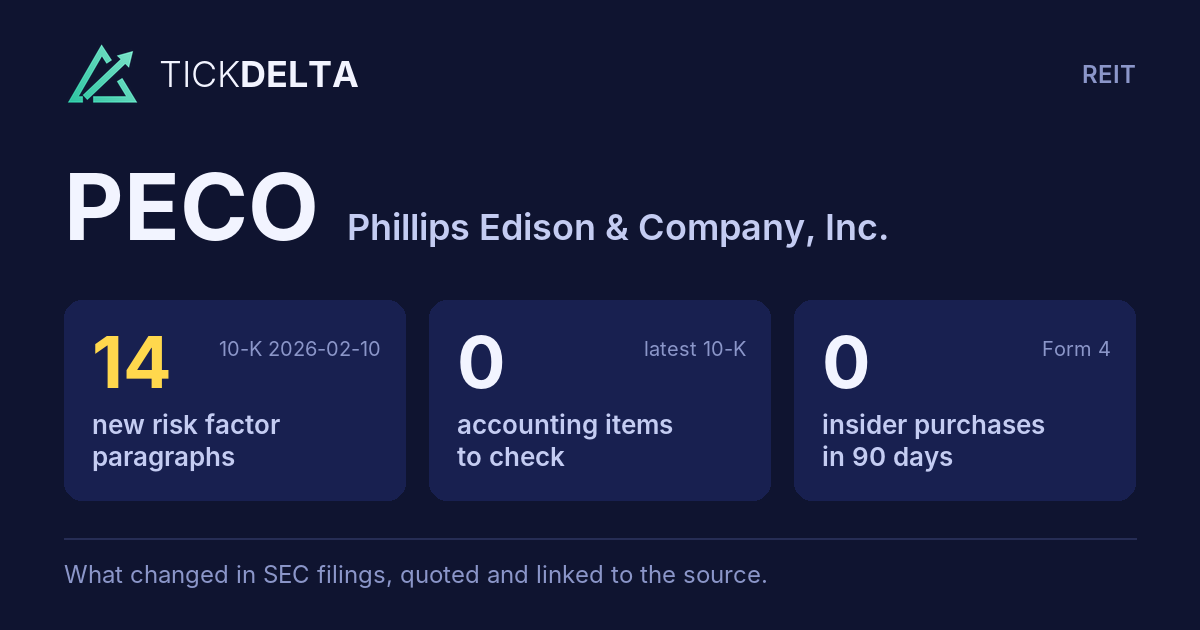
139 changes: 23 added, 46 removed, 67 reworded, 3 quiet changes
10-K Feb 10, 2026 vs Feb 11, 2025
Risk Factors
21.9%
of the text changed · 15,148 words now · 14 new paragraphs, 37 gone
MD&A
15.9%
of the text changed · 8,967 words now · 9 new paragraphs, 9 gone
Legal Proceedings
1.1%
of the text changed · 415 words now
Accounting Policies
7.6%
of the text changed · 6,826 words now
10-K 0001476204-26-000005 (Feb 10, 2026) vs 10-K 0001476204-25-000030 (Feb 11, 2025)
Every paragraph, and how much of it changed
One bar per paragraph, in the order of the 10-K. Height and colour show the share of its words not in the closest paragraph a year earlier; the tallest bars are new paragraphs.
Risk Factors
151 paragraphs · 14 new · 36 reworded · 37 gone · 10-K Feb 10, 2026 against Feb 11, 2025
New paragraph
Reworded (5% of its words or more)
Same or nearly
Paragraph 52 · 36% changed
Every version of it
Paragraph 122 · 36% changed
Every version of it
Paragraph 20 · 35% changed
Every version of it
Paragraph 78 · 34% changed
Every version of it
Paragraph 105 · 33% changed
Every version of it
Paragraph 90 · 29% changed
Every version of it
We intend to make distributions to our stockholders to comply with the REIT requirements of the IRC and to avoid corporate income tax and the 4% excise tax. We may be required to make distributions to our stockholders at times when it would be more advantageous to reinvest cash in the business or when we do not have funds readily available for distribution. Thus, compliance with the REIT requirements may hinder our ability to operate solely on the basis of maximizing profits.
Paragraph 118 · 29% changed
Every version of it
We and our Neighbors face risks relating to cybersecurity attacks, which attacks. These attacks could cause loss of confidential information and other lead to significant disruptions to our and our Neighbor’s business operations, third party lawsuits, and compliance adverse regulatory actions. Efforts to respond to these attacks and comply with new laws and regulations regarding cybersecurity and privacy may result in substantial costs and may decrease cash available for distributions.
Paragraph 86 · 41% changed
Every version of it
10-K Feb 11, 2025To qualify as a REIT for U.S. federal income tax purposes, we hold, and plan to continue to hold, substantially all of our non-qualifying REIT assets and conduct certain of our non-qualifying REIT income activities in or through one or more taxable REIT subsidiary (“TRS”) entities. A TRS is a corporation other than a REIT in which a REIT directly or indirectly holds stock, and that has made a joint election with such REIT to be treated as a TRS. A TRS also includes any corporation other than a REIT with respect to which a TRS owns securities possessing more than 35% of the total voting power or value of the outstanding securities of such corporation. Other than some activities relating to lodging and health care facilities, a TRS may generally engage in any business, including the provision of customary or non-customary services to tenants of its parent REIT. A TRS is subject to U.S. federal income tax as a regular C-corporation at a current rate of 21%.
10-K Feb 10, 2026
We may utilize TRS entities to hold non-qualifying REIT assets and to conduct activities that generate non-qualifying REIT income. A TRS is a corporation other than a REIT in which a REIT directly or indirectly holds stock, and that has made a joint election with such REIT to be treated as a TRS. A TRS also includes any corporation other than a REIT with respect to which a TRS owns securities possessing more than 35% of the total voting power or value of the outstanding securities of such corporation. TRS entities are taxed as regular C corporations and may engage in activities our REIT cannot. Income earned by our TRS entities is not required to be distributed to us, and any dividends received from our TRS entities generally qualify under the 95%, but not the 75%, gross income test. We monitor TRS income and distributions to comply with REIT income limits, but we cannot guarantee compliance in all cases. A failure to meet these tests could result in loss of REIT status.
Paragraph 52 · 36% changed
Every version of it
10-K Feb 11, 2025Although a significant amount of our outstanding debt has fixed interest rates, we borrow funds at variable interest rates under our credit facilities and term loans. As of December 31, 2024, 7.0% of our outstanding debt was variable rate debt. Increases in interest rates would increase our interest expense on any variable rate debt to the extent we have not hedged our exposure to changes in interest rates. In addition, increases in interest rates will affect the terms under which we refinance our existing debt as it matures, to the extent we have not hedged our exposure to changes in interest rates, resulting in higher interest rates and increased interest expense. Either of these events would reduce our future earnings and cash flows, which may adversely affect our ability to service our debt and meet our other obligations and also may reduce the amount we are able to distribute to stockholders.
10-K Feb 10, 2026
resulting in higher interest rates and increased interest expense. Either of these events would reduce our future earnings and cash flows, which may adversely affect our ability to service our debt and meet our other obligations and also may reduce the amount we are able to distribute to stockholders.
Paragraph 122 · 36% changed
Every version of it
10-K Feb 11, 2025As have many companies, we and our third party vendors have been impacted by security incidents in the past, and will likely continue to experience security incidents of varying degrees. While we do not believe these incidents have had a material impact to date, as our reliance on technology has increased, so have the risks posed to our systems, both internal and those we have outsourced. The primary risks that could directly result from the occurrence of a cyber incident include operational interruption, damage to our relationship with our Neighbors, and private data exposure. Our financial results and business operations may be negatively affected by such an incident or the resulting negative media attention. A cybersecurity attack could: (i) disrupt the proper functioning of our networks and systems and therefore our operations and/or those of certain of our Neighbors; (ii) compromise the confidential or proprietary information of our Neighbors, associates, and vendors, which others could use to compete against us or for disruptive, destructive, or otherwise harmful purposes and outcomes; (iii) result in our inability to maintain the building systems relied upon by our Neighbors for the efficient use of their leased space; (iv) require significant management attention and resources to remedy the damages that result; (v) result in misstated financial reports, violations of loan covenants, and/or missed reporting deadlines; (vi) result in our inability to properly monitor our compliance with the rules and regulations regarding our qualification as a REIT; (vii) subject us to claims for breach of contract, damages, credits, penalties, or termination of leases or other agreements or relationships; (viii) cause reputational damage that adversely affects Neighbor, investor, and associate confidence in us, which could negatively affect our ability to attract and retain Neighbors, investors, and associates; (ix) result in significant remediation costs, some or all of which may not be recoverable from our insurance carriers; and (x) result in increases in the cost of obtaining insurance on favorable terms, or at all, if the attack results in significant insured losses. Such security breaches also could result in a violation of applicable federal and state privacy and other laws, and subject us to private consumer, business partner, or securities litigation and governmental investigations and proceedings, any of which could result in our exposure to material civil or criminal liability, and we may not be able to recover these expenses from our service providers, responsible parties, or insurance carriers. Similarly, our Neighbors rely extensively on IT systems to process transactions and manage their businesses and thus are also at risk from and may be adversely affected by cybersecurity attacks. An interruption in the business operations of our Neighbors or a deterioration in their reputation resulting from a cybersecurity attack, including unauthorized access to customers’ credit card data and other confidential information, could indirectly negatively affect our business and cause lost revenues.
10-K Feb 10, 2026
could negatively affect our ability to attract and retain Neighbors, investors, and associates; (ix) result in significant remediation costs, some or all of which may not be recoverable from our insurance carriers; and (x) result in increases in the cost of obtaining insurance on favorable terms, or at all, if the attack results in significant insured losses. Such security incidents could also result in a violation of applicable federal and state privacy and other laws, and subject us to private consumer, business partner, or securities litigation and governmental investigations and proceedings, any of which could result in our exposure to material civil or criminal liability, and we may not be able to recover these expenses from our service providers, responsible parties, or insurance carriers. Similarly, our Neighbors rely extensively on IT systems to process transactions and manage their businesses and thus are also at risk from and may be adversely affected by cybersecurity attacks. An interruption in the business operations of our Neighbors or a deterioration in their reputation resulting from a cybersecurity attack, including unauthorized access to customers’ information, credit card data, and other confidential information, could indirectly negatively affect our business and cause lost revenues.
Paragraph 20 · 35% changed
Every version of it
10-K Feb 11, 2025•We actively reinvest in our portfolio in the form of development and redevelopment projects, which have inherent risks that could adversely affect our financial condition, cash flows, and results of operations.
10-K Feb 10, 2026
Our development and redevelopment projects involve inherent risks and may not achieve their underwritten returns, which could adversely affect our financial condition, cash flows, and results of operations.
Paragraph 78 · 34% changed
Every version of it
10-K Feb 11, 2025Even if we qualify as a REIT for U.S. federal income tax purposes, we may be subject to certain U.S. federal, state, and local taxes on our income and assets, including taxes on any undistributed income, tax on income from some activities conducted as a result of a foreclosure, and state or local income, property, and transfer taxes. Any of these taxes would decrease cash available for distributions to stockholders.
10-K Feb 10, 2026
as a result of a foreclosure, and state or local income, property, and transfer taxes. Any of these taxes would decrease cash available for distributions to stockholders.
Paragraph 105 · 33% changed
Every version of it
10-K Feb 11, 2025The maximum tax rate for “qualified dividends” paid by corporations to non-corporate stockholders generally is 20%. Distributions paid by REITs to non-corporate stockholders generally are taxed at rates lower than ordinary income rates, but those rates are higher than the 20% tax rate on qualified dividend income paid by corporations. Although this does not adversely affect the taxation of REITs or dividends payable by REITs, to the extent that the preferential rates continue to apply to regular corporate qualified dividends, the more favorable rates for corporate dividends may cause non-corporate investors to perceive that an investment in a REIT is less attractive than an investment in a non-REIT entity that pays dividends, thereby reducing the demand and market price of shares of our common stock.
10-K Feb 10, 2026
apply to regular corporate qualified dividends, the more favorable rates for corporate dividends may cause non-corporate investors to perceive that an investment in a REIT is less attractive than an investment in a non-REIT entity that pays dividends, thereby reducing the demand and market price of shares of our common stock.
Paragraph 90 · 29% changed
Every version of it
10-K Feb 11, 2025
We intend to make distributions to our stockholders to comply with the REIT requirements of the IRC and to avoid corporate income tax and the 4% excise tax. We may be required to make distributions to our stockholders at times when it would be more advantageous to reinvest cash in the business or when we do not have funds readily available for distribution. Thus, compliance with the REIT requirements may hinder our ability to operate solely on the basis of maximizing profits.
10-K Feb 10, 2026
We intend to make distributions to our stockholders to comply with the REIT requirements of the IRC and to avoid corporate income tax and the 4% excise tax. We may be required to make distributions to our stockholders at times when it would be
Paragraph 118 · 29% changed
Every version of it
10-K Feb 11, 2025
We and our Neighbors face risks relating to cybersecurity attacks, which could cause loss of confidential information and other disruptions to business operations, and compliance with new laws and regulations regarding cybersecurity and privacy may result in substantial costs and may decrease cash available for distributions.
10-K Feb 10, 2026
We and our Neighbors face risks relating to cybersecurity attacks. These attacks could lead to significant disruptions to our and our Neighbor’s business operations, third party lawsuits, and adverse regulatory actions. Efforts to respond to these attacks and comply with new laws and regulations regarding cybersecurity and privacy may result in substantial costs and may decrease cash available for distributions.
MD&A
171 paragraphs · 9 new · 60 reworded · 9 gone · 10-K Feb 10, 2026 against Feb 11, 2025
New paragraph
Reworded (5% of its words or more)
Same or nearly
Paragraph 44 · 50% changed
Paragraph 54 · 50% changed
Paragraph 111 · 50% changed
Paragraph 73 · 47% changed
•The $12.8 $13.4 million increase in depreciation and amortization was primarily due to increased interest rates our net acquisition activity and debt outstanding in 2024. Interest Expense, Net was comprised the impact of the following (dollars in thousands): our tear down and redevelopment of certain Publix locations.
Paragraph 55 · 46% changed
•For the year ended December 31, 2024, 2025, we acquired twelve disposed of nine properties and four outparcels one outparcel for a net cash outlay proceeds of $296.3 million, adding 1.1 $121.7 million of GLA to our portfolio. which were used for portfolio recycling opportunities.
Paragraph 32 · 43% changed
Paragraph 72 · 36% changed
•The $1.2 $6.0 million increase in general and administrative expenses is was primarily due to investment in our growth initiatives, resulting in increased compensation expense owing largely to increased headcount and higher share-based compensation expense. performance-based compensation.
Paragraph 157 · 36% changed
•Investment in unconsolidated joint ventures—During the year ended December 31, 2024, 2025, we invested $8.4 $13.7 million in our new investments unconsolidated joint ventures, as compared to $8.4 million during the same period in NRV and Neighborhood Grocery Catalyst Fund LLC (“NGCF”). 2024.
Paragraph 44 · 50% changed
10-K Feb 11, 2025•Total ABR PSF for executed new leases improved 3.6% to $22.53, and inline ABR PSF for executed new leases improved 8.4% to $28.16 during the year ended December 31, 2024.
10-K Feb 10, 2026
•For the year ended December 31, 2025, comparable rent spreads were 30.9% for new leases, 20.7% for renewal leases, and 23.3% combined.
Paragraph 54 · 50% changed
10-K Feb 11, 2025•During the year ended December 31, 2024, we repaid $28.1 million in mortgage debt.
10-K Feb 10, 2026
•In December 2025, we repaid the $100 million outstanding term loan balance that was set to mature in July 2026.
Paragraph 111 · 50% changed
10-K Feb 11, 2025•During the year ended December 31, 2024, we repaid $28.1 million in mortgage debt.
10-K Feb 10, 2026
•In December 2025, we repaid the $100 million outstanding term loan balance that was set to mature in July 2026.
Paragraph 73 · 47% changed
10-K Feb 11, 2025
•The $12.8 million increase was primarily due to increased interest rates and debt outstanding in 2024. Interest Expense, Net was comprised of the following (dollars in thousands):
10-K Feb 10, 2026
•The $13.4 million increase in depreciation and amortization was primarily due to our net acquisition activity and the impact of our tear down and redevelopment of certain Publix locations.
Paragraph 55 · 46% changed
10-K Feb 11, 2025
•For the year ended December 31, 2024, we acquired twelve properties and four outparcels for a net cash outlay of $296.3 million, adding 1.1 million of GLA to our portfolio.
10-K Feb 10, 2026
•For the year ended December 31, 2025, we disposed of nine properties and one outparcel for net proceeds of $121.7 million which were used for portfolio recycling opportunities.
Paragraph 32 · 43% changed
10-K Feb 11, 2025As of December 31, 2024, we owned equity interests in 316 shopping centers, including 294 wholly-owned shopping centers and 22 shopping centers owned through three unconsolidated joint ventures, which comprised approximately 35.7 million square feet in 31 states. In addition to managing our shopping centers, our third-party investment management business provides comprehensive real estate management services to our unconsolidated joint ventures and one private fund (collectively, the “Managed Funds”).
10-K Feb 10, 2026
provides comprehensive real estate management services to our unconsolidated joint ventures and one private fund (collectively, the “Managed Funds”).
Paragraph 72 · 36% changed
10-K Feb 11, 2025
•The $1.2 million increase in general and administrative expenses is primarily due to higher share-based compensation expense.
10-K Feb 10, 2026
•The $6.0 million increase in general and administrative expenses was primarily due to investment in our growth initiatives, resulting in increased compensation expense owing largely to increased headcount and higher performance-based compensation.
Paragraph 157 · 36% changed
10-K Feb 11, 2025
•Investment in unconsolidated joint ventures—During the year ended December 31, 2024, we invested $8.4 million in our new investments in NRV and Neighborhood Grocery Catalyst Fund LLC (“NGCF”).
10-K Feb 10, 2026
•Investment in unconsolidated joint ventures—During the year ended December 31, 2025, we invested $13.7 million in our unconsolidated joint ventures, as compared to $8.4 million during the same period in 2024.
A paragraph is matched with the one last year that shares the most of its words; under half in common makes it new. The paragraphs shown are the 8 reworded the most in each section.
The paragraph that changed most in each section
The redline
Marked against last year's 10-K: cut words struck through, new words highlighted.
Risk Factors228 words changed in this paragraph; it is 70% similar to last year's version.
As have many companies, we and our third party vendors have been impacted by security incidents in the past, and will likely continue to experience security incidents of varying degrees. While we do not believe these incidents have had a material impact to date, as our reliance on technology has increased, so have the risks posed to our systems, both internal and those we have outsourced. The primary risks that could directly result from the occurrence of a cyber incident include operational interruption, damage to our relationship with our Neighbors, and private data exposure. loss of competitive confidential information. Our financial results and business operations may be negatively affected by such an incident or the resulting negative media attention. A cybersecurity attack could: on our or third party IT systems could also: (i) disrupt the proper functioning of our networks and systems and therefore our operations and/or those of certain of our Neighbors; (ii) compromise the personal information, confidential information, or proprietary information of our Neighbors, associates, and vendors, which others could use to compete against us or for disruptive, destructive, or otherwise harmful purposes and outcomes; (iii) result in our inability to maintain the building systems relied upon by our Neighbors for the efficient use of their leased space; space possibly resulting in harm to customers of those neighbors; (iv) require significant management attention and resources to remedy the damages that result; (v) result in misstated financial reports, violations of loan covenants, and/or missed reporting deadlines; (vi) result in our inability to properly monitor our compliance with the rules and regulations regarding our qualification as a REIT; (vii) subject us to claims for breach of contract, damages, credits, penalties, or termination of leases or other agreements or relationships; (viii) cause reputational damage that adversely affects Neighbor, investor, and associate confidence in us, which could negatively affect our ability to attract and retain Neighbors, investors, and associates; (ix) result in significant remediation costs, some or all of which may not be recoverable from our insurance carriers; and (x) result in increases in the cost of obtaining insurance on favorable terms, or at all, if the attack results in significant insured losses. Such security breaches also could result in a violation of applicable federal and state privacy and other laws, and subject us to private consumer, business partner, or securities litigation and governmental investigations and proceedings, any of which could result in our exposure to material civil or criminal liability, and we may not be able to recover these expenses from our service providers, responsible parties, or insurance carriers. Similarly, our Neighbors rely extensively on IT systems to process transactions and manage their businesses and thus are also at risk from and may be adversely affected by cybersecurity attacks. An interruption in the business operations of our Neighbors or a deterioration in their reputation resulting from a cybersecurity attack, including unauthorized access to customers’ credit card data and other confidential information, could indirectly negatively affect our business and cause lost revenues.
Source: Item 1A, 10-K 0001476204-26-000005 vs Item 1A, 10-K 0001476204-25-000030
Accounting Policies82 words changed in this paragraph; it is 64% similar to last year's version.
Use of Estimates - The preparation of the consolidated financial statements in conformity with accounting principles generally accepted in the United States (“GAAP”) requires management to make estimates and assumptions that affect the reported amounts of assets and liabilities and the disclosure of contingent assets and liabilities at the date of the consolidated financial statements and the reported amounts of revenues and expenses during the reporting periods. For example, significant estimates and assumptions have been made with respect to the useful lives of assets; remaining hold periods of assets; recoverable amounts of receivables; initial valuations of tangible and intangible assets and liabilities, including goodwill, and related amortization periods of deferred costs and intangibles, particularly with respect to property acquisitions; the valuation and nature of derivatives and their effectiveness as hedges; valuations of contingent consideration; and other fair value measurement assessments required for the preparation of the consolidated financial statements. Actual results could differ from those estimates.
Source: 10-K text, Note 2 – SUMMARY OF SIGNIFICANT ACCOUNTING POLICIES, 10-K 0001476204-26-000005 vs 10-K text, Note 2 – SUMMARY OF SIGNIFICANT ACCOUNTING POLICIES, 10-K 0001476204-25-000030
MD&A79 words changed in this paragraph; it is 68% similar to last year's version.
We have an off-balance sheet arrangement arrangements that includes include being the limited guarantor of a $174.0 $173.8 million, $102.7 million, and $31.8 million in mortgage loan loans secured by properties owned by our unconsolidated joint venture, ventures, Grocery Retail Partners I LLC (“GRP I”). I”), Necessity Retail Venture LLC (“NRV”), and Neighborhood Grocery Catalyst Fund LLC (“NGCF”), respectively. Our guaranty guaranties for the GRP I I, NRV, and NGCF debt is are limited to being the non-recourse carveout guarantor and the environmental indemnitor. Further, we are also party to an agreement agreements with each of GRP I I, NRV, and NGCF in which any potential liability under such guaranty guaranties will be apportioned between us and GRP I I, NRV, or NGCF, as applicable, based on our respective ownership percentage percentages in the joint venture. ventures. As of December 31, 2024, 2025, GRP I I, NRV, and NGCF had an outstanding debt balance balances of $174.0 million. $173.8 million, $102.7 million, and $31.8 million, respectively.
Source: Item 7, 10-K 0001476204-26-000005 vs Item 7, 10-K 0001476204-25-000030
Legal Proceedings7 words changed in this paragraph; it is 92% similar to last year's version.
Captive Insurance - Our captive insurance company, Silver Rock Insurance, Inc. (“Silver Rock”), provides general liability insurance, wind, reinsurance, and other coverage to us and our GRP I I, NRV, and NGCF joint venture. ventures. We capitalize Silver Rock in accordance with applicable regulatory requirements.
Source: Item 3, via Note 11 – COMMITMENTS AND CONTINGENCIES, 10-K 0001476204-26-000005 vs Item 3, via Note 11 – COMMITMENTS AND CONTINGENCIES, 10-K 0001476204-25-000030
Sentences and paragraphs added, removed or reworded
Every change, by type
Sentences and paragraphs of PECO's Risk Factors and MD&A, 10-K Feb 10, 2026 against 10-K Feb 11, 2025. Each links to the text at sec.gov.
Quiet changes are sentences kept from last year with one to four words changed, at least one of them a hedge, a modal or a qualifier (may, could, will, not, significant, material…). A year or date rolling forward is not counted.
The full word list
adverse, adversely, all, although, anticipate, anticipates, any, approximately, believe, believes, can, cannot, certain, could, expect, expects, generally, however, if, intend, intends, largely, likely, many, material, materially, may, might, most, must, never, no, not, possible, primarily, probable, should, significant, significantly, some, substantial, substantially, unlikely, will, would
AddedRisk Factors
Our financial performance depends on the stability and success of our Neighbors, and the loss, failure, departure or bankruptcy of significant Neighbors – including major anchor stores – or a high volume of smaller Neighbors, could adversely affect our revenues, occupancy, and results of operations.
Read it in 10-K Feb 10, 2026 at sec.gov
AddedRisk Factors
Our anchor Neighbors (generally those occupying 10,000 square feet or more) pay a significant portion of the total rent at a property and draw customer traffic to other stores. If a major anchor Neighbor ceases or downsizes operations – whether due to bankruptcy, insolvency, business downturn, lease default, or a decision not to renew its lease – we would lose a primary income source and traffic driver. This could also trigger co-tenancy provisions in other Neighbors’ leases allowing them to pay reduced rent or terminate their leases, further eroding our rental income. If an anchor “goes dark” (stops operating but continues to pay rent), the lack of an active anchor can significantly diminish shopper traffic, impairing sales for other Neighbors. Re-leasing a vacated anchor space can be challenging and costly because anchor spaces may require substantial capital investments or reconfiguration (for example, subdividing into smaller units) to attract new Neighbors, and prolonged downtime is likely during this repositioning. In some cases, an anchor’s lease may allow it to assign or transfer the space to a new retailer not originally anticipated, which could change the center’s draw and potentially reduce foot traffic, or give other Neighbors the right to renegotiate or exit their leases.
Read it in 10-K Feb 10, 2026 at sec.gov
AddedRisk Factors
A significant portion of our revenue comes from non-anchor Neighbors, some of which may have more limited financial resources than anchor Neighbors and could be vulnerable in an adverse economic climate. If a large number of these smaller Neighbors experience financial distress, default on their leases, or choose to close their businesses, our occupancy levels and rental income would decline. We may need to offer rent concessions, reduced rental rates, or fund additional tenant improvements and inducements to attract or retain replacement Neighbors, which would increase our costs and reduce cash flows. Competitive pressures – including from other shopping centers or e-commerce alternatives – can make it difficult to backfill vacant space on favorable terms, leading to extended vacancies or the acceptance of lower-paying or less creditworthy Neighbors. High vacancy or a suboptimal tenant mix at a given property can also diminish the property’s overall resale value.
Read it in 10-K Feb 10, 2026 at sec.gov
AddedRisk Factors
In addition, certain lease provisions can restrict our re-leasing flexibility. Some Neighbors have exclusive-use rights preventing us from leasing other space in the center to competitors or to users of certain product categories. These clauses can limit the pool of replacement tenants for a vacant unit (especially if the departed tenant had such protection or if existing Neighbors hold exclusive rights that constrain new leases), potentially resulting in longer vacancy periods or the need to accept a less optimal tenant at a lower rent. Similarly, co-tenancy clauses may reduce what remaining Neighbors are obligated to pay (or allow them to terminate their leases) until we satisfy certain conditions (such as securing a replacement anchor or achieving a specified occupancy threshold), prolonging the financial impact of an anchor loss.
Read it in 10-K Feb 10, 2026 at sec.gov
AddedRisk Factors
Furthermore, if Neighbors file for bankruptcy, they may exercise their legal right to reject leases, resulting in termination of rental obligations and leaving us with vacant space and unrecoverable past due rent. Our claims for unpaid rent in a tenant’s bankruptcy are typically general unsecured claims, for which recovery, if any, is usually limited and obtained only after lengthy proceedings. A bankruptcy by a major Neighbor (or multiple Neighbors) with locations across several of our centers could abruptly eliminate significant rental streams, and we may incur legal and re-leasing expenses while trying to mitigate the loss. Even in cases of a single-store bankruptcy, we may face delays and costs re-leasing that space, and any gap in occupancy reduces property revenue.
Read it in 10-K Feb 10, 2026 at sec.gov
AddedRisk Factors
If our Neighbors – whether large anchors or smaller shop tenants – fail to perform, downsize, or depart our centers in significant numbers, our rental income and occupancy rates would decline, we could incur substantial costs to attract new tenants or adapt our properties, and the value of our shopping centers could be negatively affected. Any such developments could have a material adverse effect on our business, financial condition, cash flows, and results of operations, including our ability to service debt and make distributions to stockholders.
Read it in 10-K Feb 10, 2026 at sec.gov
AddedRisk Factors
modify or repeal the laws with respect to Section 1031 Exchanges, which could make it more difficult or impossible for us to dispose of shopping centers on a tax-deferred basis.
Read it in 10-K Feb 10, 2026 at sec.gov
AddedRisk Factors
We actively pursue opportunities to develop outparcels and redevelop existing properties; however, these activities require various government and other approvals, and any delay or failure in obtaining necessary entitlements can significantly postpone or even prevent a project, jeopardizing our ability to recover our investment. Development and redevelopment projects are subject to numerous risks, including (i) difficulties in leasing new or renovated spaces on the expected timeline or at projected rental rates (resulting in occupancy levels or rents that may be insufficient to make the project profitable); (ii) cost overruns and construction delays that cause actual project costs to exceed original estimates and reduce expected returns; (iii) the potential abandonment of projects mid-stream due to adverse market conditions, which would result in the loss of our invested capital; and (iv) strain on our personnel and capital resources from managing a large pipeline of projects, which could impair our ability to complete developments on schedule and on budget, further pressuring investment returns. Moreover, fluctuations in the level of our development activity can impact our results of operations by limiting the amount of
Read it in 10-K Feb 10, 2026 at sec.gov
Show the other 61
AddedRisk Factors
internal overhead costs we are able to capitalize. External economic factors — such as inflationary cost pressures, rising interest rates, increases in the cost of construction materials due to tariffs or trade disputes, supply chain disruptions, and labor shortages — can exacerbate many of these challenges by driving costs higher or causing additional delays. As a result of these factors, the actual incremental unlevered yields (i.e., the return on our investment at project stabilization, excluding financing effects) for development and redevelopment projects may fall short of our underwritten incremental unlevered yield targets, which are based solely on our estimates, using data available to us in our development and redevelopment underwriting processes. The total cost to complete a project might ultimately be substantially higher than initially budgeted, and the incremental net operating income realized at stabilization can be lower than anticipated, due to a number of factors, including slower lease-up, lower-than-expected rental rates or occupancy, inability to collect anticipated rents, or Neighbors (tenants) vacating or defaulting (for example, through bankruptcy). If we fail to successfully reinvest in our portfolio through development and redevelopment or if our projects encounter significant delays, cost overruns, or fail to achieve the anticipated financial performance, our business, financial condition, cash flows, and results of operations could be adversely affected.
Read it in 10-K Feb 10, 2026 at sec.gov
AddedRisk Factors
There is continued scrutiny from investors, policymakers, and other stakeholders on how companies address climate change, human capital, and a variety of other corporate responsibility factors. Although we engage in certain voluntary initiatives, including disclosures, to improve our corporate responsibility profile or respond to stakeholder expectations, such initiatives entail costs and may not have the desired effect. For example, methodologies, standards, and data regarding corporate responsibility matters continue to evolve, and our approach to such matters may not align with the expectations or preferences of any particular stakeholder. Stakeholder expectations are not uniform, and may, at times, conflict. Additionally, the regulatory environment may create conflicting pressures. While policymakers in some jurisdictions have adopted or are looking at adopting requirements on corporate responsibility matters, policymakers in other jurisdictions advocate for laws to constrain consideration of corporate responsibility matters in certain circumstances. Additional actions may be taken by both proponents and opponents of corporate responsibility matters. For example, there have been increased instances of greenwashing or other litigation against companies for alleged failures in disclosure, methodology, or performance. Failure to successfully navigate competing policymaker and stakeholder expectations on corporate responsibility, including in association with any ratings or disclosures, or unfavorable comparisons in these areas to other companies, could result in reputational harm, loss of tenants or capital availability, investor engagement on our corporate responsibility initiatives and disclosures, increased costs, or other adverse impacts to our business. Additionally, certain of our stakeholders are subject to similar risks, which may augment or create additional risks relating to such matters, including in ways that we may not be aware of or may be difficult to predict.
Read it in 10-K Feb 10, 2026 at sec.gov
AddedRisk Factors
We use AI Technologies licensed from third parties in certain internal business practices and our ability to continue to use such technologies at the scale we need may be dependent on access to specific third-party software and infrastructure. We cannot control the availability or pricing of such third-party AI Technologies, especially in a highly competitive environment, and we may be unable to negotiate favorable economic terms with the applicable providers.
Read it in 10-K Feb 10, 2026 at sec.gov
AddedRisk Factors
If we mortgage a property and there is a shortfall between the cash flows from that property and the cash flows needed to service mortgage debt on that property, then the amount of cash available for distributions to stockholders may be reduced.
Read it in 10-K Feb 10, 2026 at sec.gov
RemovedRisk Factors
RemovedRisk Factors
RemovedRisk Factors
RemovedRisk Factors
RemovedRisk Factors
RemovedRisk Factors
RemovedRisk Factors
RemovedRisk Factors
RemovedRisk Factors
RemovedRisk Factors
RemovedRisk Factors
RemovedRisk Factors
RewordedRisk Factors
RewordedRisk Factors
RewordedRisk Factors
We may face such cybersecurity attacks through malware, computer viruses, attachments to e-mails, malicious persons inside our organization organization, vulnerabilities in our or persons third party software, or other security issues with access to systems inside our organization, and other significant disruptions of our third party information technology (“IT”) systems.
Read it in 10-K Feb 10, 2026 at sec.gov
RewordedRisk Factors
The issuance of a substantial number of shares of our common stock in the public market, or upon exchange of common units of limited partnership interest in our OP units, or the perception that such issuances might occur, could adversely affect the market price of our common stock.
Read it in 10-K Feb 10, 2026 at sec.gov
RewordedRisk Factors
We may be required to make distributions to our stockholders at times when it would be more advantageous to reinvest cash in the business or when we do not have funds readily available for distribution.
Read it in 10-K Feb 10, 2026 at sec.gov
RewordedRisk Factors
Such risks also include, but are not limited to, those that could impact the financial stability of our Neighbors, including their ability to pay rent and expense reimbursements, such as supply chain disruptions and constraints, inflationary pressures throughout the supply chain, including those due to tariffs, labor shortages and shortages, inflationary pressures on wages, increases in retail theft, changes in consumer demand due to macroeconomic conditions or otherwise, and other risks and uncertainties described elsewhere in this "Risk Factors" section.
Read it in 10-K Feb 10, 2026 at sec.gov
RewordedRisk Factors
While we attempt to acquire shopping centers that are already in compliance with the ADA or place the burden of compliance on the seller or other third party, such as a Neighbor, we cannot assure stockholders that we will be able to acquire shopping centers or allocate responsibilities in this manner.
Read it in 10-K Feb 10, 2026 at sec.gov
RewordedRisk Factors
Retailers are increasingly continue to be affected by e-commerce and changes in customer buying habits, which were further accelerated as a result of the COVID-19 pandemic, including the delivery or curbside pick-up of items ordered online.
Read it in 10-K Feb 10, 2026 at sec.gov
RewordedRisk Factors
Even if we qualify as a REIT for U.S. federal income tax purposes, we may be subject to certain U.S. federal, state, and local taxes on our income and assets, including taxes on any undistributed income, tax on income from some activities conducted as a result of a foreclosure, and state or local income, property, and transfer taxes.
Read it in 10-K Feb 10, 2026 at sec.gov
RewordedRisk Factors
(viii) cause reputational damage that adversely affects Neighbor, investor, and associate confidence in us, which could negatively affect our ability to attract and retain Neighbors, investors, and associates;
Read it in 10-K Feb 10, 2026 at sec.gov
RewordedRisk Factors
Our portfolio is predominantly comprised of omni-channel neighborhood grocery-anchored shopping centers, and during the year ended December 31, 2024, 2025, our holdings in Florida, California, Florida and Texas California accounted for 12.2%, 10.6%, 12.3% and 10.1%, 10.5%, respectively, of our ABR (including our wholly-owned portfolio as well as the prorated portion of shopping centers owned through our joint ventures).
Read it in 10-K Feb 10, 2026 at sec.gov
RewordedRisk Factors
We currently use artificial intelligence (“AI”) and automated decision-making technologies (collectively, “AI Technologies”), including generative AI Technologies (i.e., AI Technologies that can produce and output new content, software code, data and information) information), in certain internal business practices. practices and are making additional investments in this area.
Read it in 10-K Feb 10, 2026 at sec.gov
Quiet changesRisk Factors
Also, the failure of the Operating Partnership to qualify as a partnership would cause it to become subject to U.S. federal corporate income tax, which would significantly reduce significantly the amount of its cash available for debt service and for distribution to its partners, including us.
Read it in 10-K Feb 10, 2026 at sec.gov
Quiet changesRisk Factors
As a result of this lower aggregate tax basis, the Operating Partnership will may recognize higher more taxable gain upon the sale of these assets, and the Operating Partnership will be entitled to lower depreciation deductions on these assets than if it had purchased these shopping centers in taxable transactions at the time of the acquisition.
Read it in 10-K Feb 10, 2026 at sec.gov
Quiet changesRisk Factors
Such security breaches incidents could also could result in a violation of applicable federal and state privacy and other laws, and subject us to private consumer, business partner, or securities litigation and governmental investigations and proceedings, any of which could result in our exposure to material civil or criminal liability, and we may not be able to recover these expenses from our service providers, responsible parties, or insurance carriers.
Read it in 10-K Feb 10, 2026 at sec.gov
AddedMD&A
•As of December 31, 2025, for our wholly-owned shopping centers, 95.0% of our ABR was generated from shopping centers anchored by grocers and 83.3% of our ABR was generated from shopping centers anchored by the #1 or #2 grocer by sales within their respective trade area.
Read it in 10-K Feb 10, 2026 at sec.gov
AddedMD&A
•At December 31, 2025, we reported strong leased portfolio occupancy of 97.3% and same-center leased portfolio occupancy of 97.6%
Read it in 10-K Feb 10, 2026 at sec.gov
AddedMD&A
KNOWN TRENDS AND UNCERTAINTIES—We continue to operate in a resilient yet evolving retail real estate environment characterized by strong tenant demand, limited new supply, and sustained leasing momentum. Grocery-anchored shopping centers remain defensive, with healthy occupancy, stable foot traffic, and durable tenant performance; however, broader macroeconomic conditions continue to introduce uncertainty. Interest rates remain elevated relative to historical norms, and while rate volatility has moderated, higher financing costs may affect acquisition activity, redevelopment yields, and capital-market execution. Inflation has eased but remains uneven across categories, influencing operating expenses, construction costs, and retailer margins. Recently implemented or proposed tariff adjustments have created incremental uncertainty around sourcing and input costs for certain tenants, though to date we have observed minimal disruption to leasing activity or rent‑collection trends. Additionally, ongoing retailer rationalization, including periodic bankruptcy filings and strategic store closures, may create near-term downtime but also provide opportunities to re‑lease space at higher rents. Consumer behavior has remained broadly stable, supported by the essential-needs orientation of our centers; however, pressure on lower-income shoppers and any broader economic slowdown could impact retailer sales performance and, in turn, leasing decisions. We continue to monitor these trends, along with evolving insurance markets, property-tax environments, and regulatory developments, each of which could influence operating results, cash flows, or asset valuations in future periods.
Read it in 10-K Feb 10, 2026 at sec.gov
AddedMD&A
(1)Line items that result in a percent change that exceed certain limitations are considered not meaningful (“NM”) and indicated as such.
Read it in 10-K Feb 10, 2026 at sec.gov
AddedMD&A
•The $2.0 million increase in fees and management income was primarily due to higher insurance premium income through our consolidated captive insurance company and an increase in fees from our unconsolidated joint ventures.
Read it in 10-K Feb 10, 2026 at sec.gov
AddedMD&A
•The $38.8 million increase in gain (loss) on disposal of property, net was due to the disposition of nine properties and one outparcel with a net gain of $38.8 million in 2025, as compared to no sales during the year ended December 31, 2024.
Read it in 10-K Feb 10, 2026 at sec.gov
AddedMD&A
(1)The revolving credit facility matures in January 2029, with options to extend the maturity for two additional six-month periods.
Read it in 10-K Feb 10, 2026 at sec.gov
AddedMD&A
•In January 2026, we extended the maturity of our $161.8 million term loan from January 2026 to January 2027.
Read it in 10-K Feb 10, 2026 at sec.gov
AddedMD&A
(3)During the year ended December 31, 2025, one of our property sales included a seller financing component. We sold the property for $24.9 million and provided secured financing, receiving a note receivable of $17.4 million.
Read it in 10-K Feb 10, 2026 at sec.gov
RemovedMD&A
RemovedMD&A
RemovedMD&A
RemovedMD&A
RemovedMD&A
RemovedMD&A
RemovedMD&A
RemovedMD&A
RemovedMD&A
RewordedMD&A
Depreciation and amortization of corporate assets 1,540 1,766 2,183 3,653 Change in fair value of earn-out liability — — 1,809 Impairment of investment in third parties — — 3,000 — Transaction and acquisition expenses 5,523 4,993 5,675 10,551 Loss on extinguishment or modification of debt and other, net 90 1,290 368 1,025 Amortization of Adjustments related to unconsolidated joint venture basis differences ventures 469 13 17 220 Realized performance income(1) (30) — (75) (2,742) Core FFO attributable to stockholders and OP unit holders $ 360,680 $ 331,833 $ 310,716 $ 295,263 Nareit FFO/Core FFO Attributable to Stockholders and OP Unit Holders per diluted share Weighted-average shares of common stock outstanding - diluted 138,899 136,821 132,970 130,332 Nareit FFO attributable to stockholders and OP unit holders per share - diluted $ 2.54 $ 2.37 $ 2.25 $ 2.15 Core FFO attributable to stockholders and OP unit holders per share - diluted $ 2.60 $ 2.43 $ 2.34 $ 2.27
Read it in 10-K Feb 10, 2026 at sec.gov
RewordedMD&A
Year Ended December 31, 2025 2024 2023 Interest on senior notes $ 54,889 $ 27,180 Interest on unsecured term loans and senior notes, loans, net $ 63,808 $ 48,803 26,324 36,628 Interest on secured debt 14,892 17,413 18,614 Interest on revolving credit facility, net 6,376 6,354 8,785 Non-cash amortization and other 7,767 8,125 7,662 Loss on extinguishment or modification of debt and other, net(1) net 90 1,290 368 Interest expense, net $ 110,338 $ 96,990 $ 84,232 Weighted-average interest rate as of end of year 4.5 % 4.3 % 4.2 % Weighted-average term (in years) as of end of year 5.2 5.6 3.9
Read it in 10-K Feb 10, 2026 at sec.gov
RewordedMD&A
We have an off-balance sheet arrangement arrangements that includes include being the limited guarantor of a $174.0 $173.8 million, $102.7 million, and $31.8 million in mortgage loan loans secured by properties owned by our unconsolidated joint venture, ventures, Grocery Retail Partners I LLC (“GRP I”). I”), Necessity Retail Venture LLC (“NRV”), and Neighborhood Grocery Catalyst Fund LLC (“NGCF”), respectively.
Read it in 10-K Feb 10, 2026 at sec.gov
RewordedMD&A
Impairment of investment in third parties — — 3,000 — Change in fair value of earn-out liability — — 1,809 Transaction and acquisition expenses 5,523 4,993 5,675 10,551 Amortization of Adjustments related to unconsolidated joint venture basis differences ventures 60 13 17 220 Realized performance income(1) (30) — (75) (2,742) Adjusted EBITDAre $ 473,950 $ 430,584 $ 396,103 $ 367,385
Read it in 10-K Feb 10, 2026 at sec.gov
RewordedMD&A
CASH FLOW ACTIVITIES—As of December 31, 2024, 2025, we had cash and cash equivalents and restricted cash of $8.6 $43.3 million, a net cash decrease increase of $0.2 $34.7 million during the year ended December 31, 2024. 2025, which was primarily due to $37.9 million in Section 1031 like-kind exchange funds held at December 31, 2025 in restricted accounts.
Read it in 10-K Feb 10, 2026 at sec.gov
RewordedMD&A
Depreciation and amortization 266,374 253,016 236,443 236,224 Interest expense, net 110,338 96,990 84,232 71,196 Loss (gain) (Gain) loss on disposal of property, net (38,790) 30 (1,110) (7,517) Impairment of real estate assets — — 322 Federal, state, and local tax expense 1,307 1,821 438 806 Adjustments related to unconsolidated joint ventures 6,200 4,025 3,721 1,987 EBITDAre $ 468,397 $ 425,578 $ 387,486 $ 357,547 Calculation of Adjusted EBITDAre EBITDAre $ 468,397 $ 425,578 $ 387,486 $ 357,547 Adjustments:
Read it in 10-K Feb 10, 2026 at sec.gov
RewordedMD&A
Year Ended December 31, 2025 2024 2023 Transaction and acquisition expenses $ (5,523) $ (4,993) $ (5,675) Impairment of investment in third parties (see Note 15) — (3,000) Federal, state, and local income tax expense (1,307) (1,821) (438) Equity in net (loss) income of unconsolidated investments (77) 86 372 Other income 2,577 996 1,429 Other expense, net $ (4,330) $ (5,732) $ (7,312)
Read it in 10-K Feb 10, 2026 at sec.gov
RewordedMD&A
Fees and management income (12,751) (10,731) (9,646) Straight-line rental income(1) (10,705) (9,646) (10,185) Net amortization of above- and below-market leases (8,643) (6,587) (5,178) Lease buyout income (2,517) (867) (1,222) General and administrative expenses 51,638 45,611 44,366 Depreciation and amortization 266,374 253,016 236,443 Interest expense, net 110,338 96,990 84,232 Loss (gain) (Gain) loss on disposal of property, net (38,790) 30 (1,110) Other expense, net 4,330 5,732 7,312 Property operating expenses related to fees and management income 4,111 3,323 2,059 NOI for real estate investments 486,353 446,567 410,833 Less:
Read it in 10-K Feb 10, 2026 at sec.gov
RewordedMD&A
Depreciation and amortization of real estate assets 264,834 251,250 234,260 232,571 Impairment of real estate assets — — 322 Loss (gain) (Gain) loss on disposal of property, net (38,790) 30 (1,110) (7,517) Adjustments related to unconsolidated joint ventures 4,076 2,795 2,636 842 Nareit FFO attributable to stockholders and OP unit holders $ 353,088 $ 323,771 $ 299,548 $ 280,747 Calculation of Core FFO Attributable to Stockholders and OP Unit Holders Nareit FFO attributable to stockholders and OP unit holders $ 353,088 $ 323,771 $ 299,548 $ 280,747 Adjustments:
Read it in 10-K Feb 10, 2026 at sec.gov
RewordedMD&A
The offering resulted in gross proceeds of $345.0 $347.2 million, which were used to pay down $202 million of our revolving credit facility and $135 million of our $240 million term loan that was set to mature in November 2025. facility.
Read it in 10-K Feb 10, 2026 at sec.gov
RewordedMD&A
Further, we are also party to an agreement agreements with each of GRP I I, NRV, and NGCF in which any potential liability under such guaranty guaranties will be apportioned between us and GRP I I, NRV, or NGCF, as applicable, based on our respective ownership percentage percentages in the joint venture. ventures.
Read it in 10-K Feb 10, 2026 at sec.gov
RewordedMD&A
Capital improvements $ 23,884 $ 21,793 $ 22,766 Tenant improvements 27,074 25,184 26,663 Redevelopment Development and development redevelopment 73,934 39,079 38,206 Total capital expenditures for real estate 124,892 86,056 87,635 Corporate asset capital expenditures 1,792 813 963 Capitalized indirect costs(1) 7,040 4,977 4,103 Total capital spending activity(2) $ 133,724 $ 91,846 $ 92,701
Read it in 10-K Feb 10, 2026 at sec.gov
Sources
The two latest 10-Ks on EDGAR, section by section. Each change links to the text at sec.gov.
Also
New risk factors: paragraphs with nothing like them last year, quoted in full.
Work with it
Excel workbook · CSV. Google Sheet that stays up to date: paste =IMPORTDATA("https://tickdelta.com/company/PECO/export.csv") into a cell.