Form 10-K
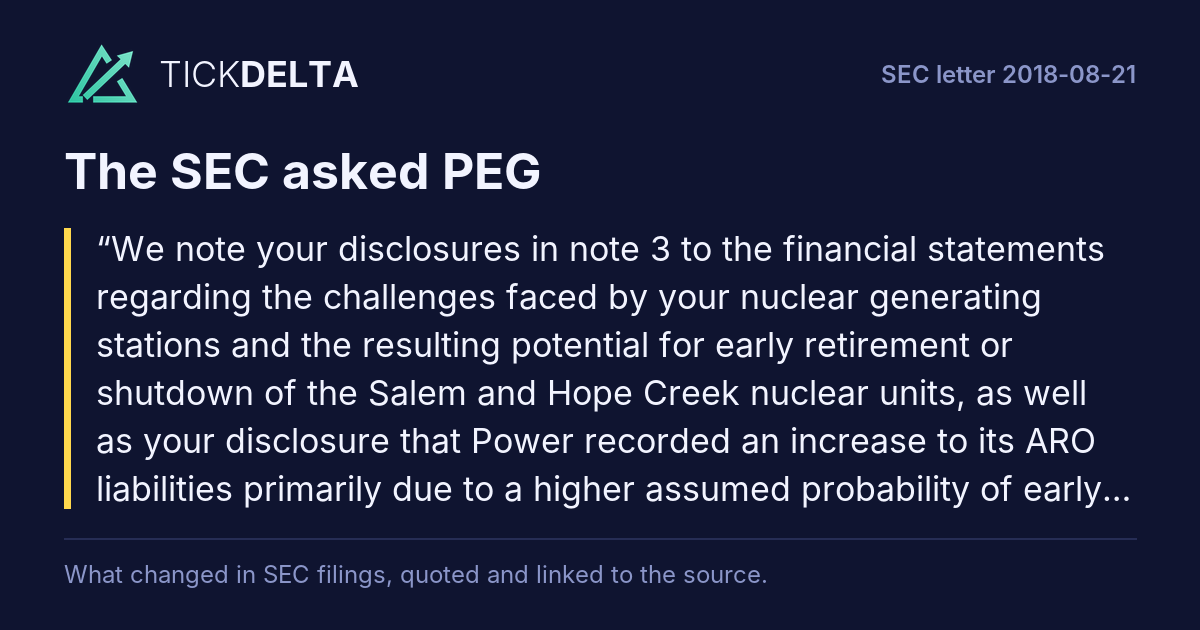
We note your disclosures in note 3 to the financial statements regarding the challenges faced by your nuclear generating stations and the resulting potential for early retirement or shutdown of the Salem and Hope Creek nuclear units, as well as your disclosure that Power recorded an increase to its ARO liabilities primarily due to a higher assumed probability of early retirement of its nuclear units.Rest of the question
Please tell us your consideration of providing additional critical accounting policy disclosure that allows for an assessment of the probability, magnitude and timing of future material charges associated with early retirement or shutdown of these units, along with a description of the specific events and/or changes in circumstances that could reasonably be expected to result in early retirement or shutdown. Refer to Section V of SEC Release 34-48960 and Item 303(a)(3)(ii), which requires a description of a known uncertainty.
to the Staff’s comment, beginning with our annual report on Form
10-K for the year ended December 31, 2018, we propose revising our discussion of Critical Accounting Estimates relating to Long-Lived Assets included in our MD&A as follows (underline indicates additions, strike-through indicates deletions):
Long-Lived Assets
Management evaluates long-lived assets for impairment and reassesses the reasonableness of their related estimated useful lives whenever events or changes in circumstances, such as significant adverse changes in regulation, business climate or market conditions, couldRead in the reply ↗Rest of the answer
potentially indicate an asset’s or asset group’s carrying amount may not be recoverable or an asset’s probability of operating through its estimated remaining useful life changes.
Assumptions and Approach
Used: In the event certain triggers exist indicating an asset/asset group may not be recoverable, an undiscounted cash flow test is performed to determine if an impairment exists. When the carrying value of a long-lived asset/asset group exceeds the undiscounted estimate of future cash flows associated with the asset/asset group, an impairment may exist to the extent that the fair value of the asset/asset group is less than its carrying amount. These tests require significant estimates and judgment when developing expected future cash flows. Significant inputs include forward power prices, fuel costs, dispatch rates, other operating and capital expenditures and the cost of borrowing.
In addition, long-lived assets are depreciated under the straight-line method based on estimated useful lives. An asset’s operating useful life is generally based upon operational experience with similar asset types and other non-operational factors. In the ordinary course, management, together with an asset’s co-owners in the case of certain of our jointly-owned assets, makes a number of decisions that impact the operation of our generation assets beyond the current year. These decisions may have a direct impact on the estimated remaining useful lives of our assets and will be influenced by the financial outlook of the assets, including future market conditions such as forward energy and capacity prices, operating and capital investment costs and any state or federal legislation and regulations, among other items.
The assumptions used by management incorporate inherent uncertainties that are at times difficult to predict and could result in impairment charges or accelerated depreciation in future periods if actual results materially differ from the estimated assumptions utilized in our forecasts.
Effect if Different Assumptions Used: The above cash flow tests, and fair value estimates and estimated remaining useful lives may be impacted by a change in the assumptions noted above and could significantly impact the outcome, triggering additional impairment tests, or write-offs or accelerated depreciation. For additional information on the potential impacts on our future financial statements that may be caused by a change in useful lives of certain of our generating assets, see Note 3. Early Plant Retirements and Note 5. Property,
Plant and Equipment and Jointly-Owned Facilities.
First report after the company's reply of 2018-08-31: 10-Q filed 2018-10-30 ↗, against the 10-Q filed 2018-08-01 ↗.
Tickdelta does not hold the text of both reports, so they are not compared here.
Similar to the preceding comment, please tell us your consideration of providing investors with additional information that allows for an assessment of the probability, magnitude and timing of future material charges due to a significant shortening of the expected economic useful lives of the Keystone and Conemaugh generating stations, along with a description of the specific events and/or changes in circumstancesRest of the question
that could reasonably be expected to negatively affect the economic viability of these assets through their currently designated useful lives. Refer to Section V of SEC Release 34-48960 and Item 303(a)(3)(ii), which requires a description of a known uncertainty.
Similar to our response in Comment 1 above, we discuss factors that may impact the useful lives of our generating assets in Note 3. We further disclose the then-current book value of each of our Keystone and Conemaugh interests, including accumulated depreciation, in Note 5. Property, Plant and Equipment and Jointly-Owned Facilities to our consolidated financial statements, which serve as quantitative estimates of the magnitude of the potential for future income statement charges should these plants be retired or shut down earlier then their current estimated useful lives.
The proposedRead in the reply ↗Rest of the answer
revisions to our discussion of Critical Accounting Estimates relating to Long-Lived Assets, discussed in response to Comment 1 above, are also in response to this Comment 2.
* * * *
Once you have had time to review our responses to the Staff’s comments, we would appreciate the opportunity to discuss any additional questions or concerns that you may have. Please feel free to call me at (973) 430-6424.
First report after the company's reply of 2018-08-31: 10-Q filed 2018-10-30 ↗, against the 10-Q filed 2018-08-01 ↗.
Tickdelta does not hold the text of both reports, so they are not compared here.
Also in this review: closing letter, 2018-09-06