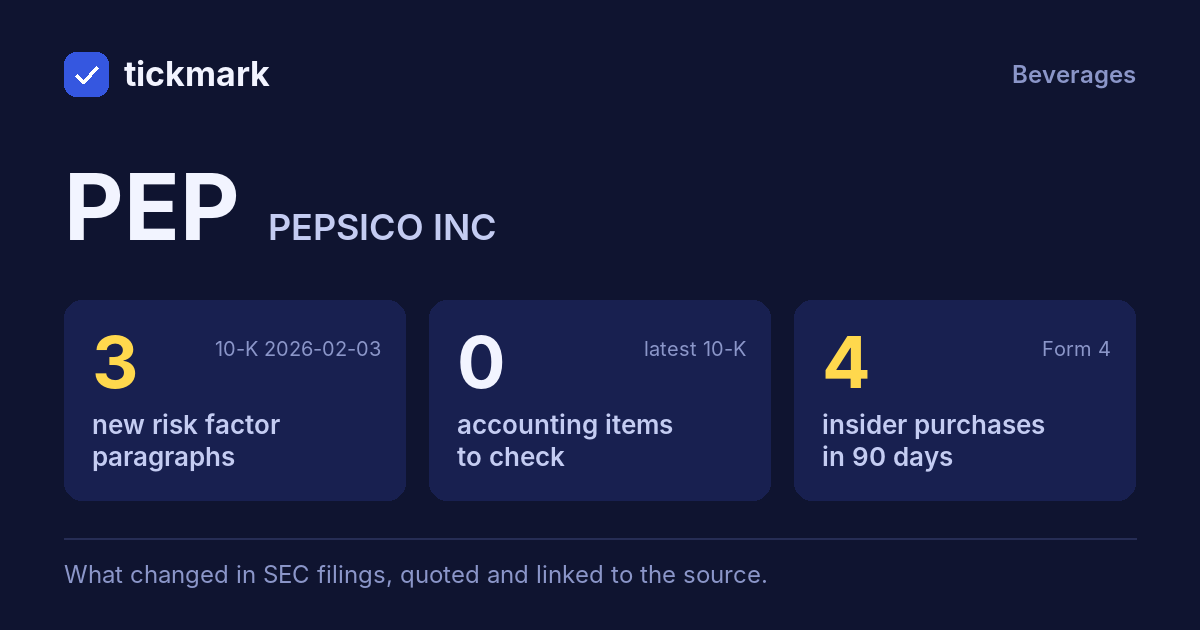
Marked against last year's 10-K:
cut words struck through, new words highlighted and underlined.
Risk Factors 365 words changed in this paragraph; it is 54% similar to last year's version.
Demand for our products depends in part on our ability to innovate and anticipate and effectively respond to shifts in consumer trends and preferences, including the types of products our consumers want and how they browse for, purchase and consume them. Consumer preferences continuously evolve due to a variety of factors, including: changes in consumer demographics, consumption patterns, patterns (including increased food purchased away-from-home), diet (whether due to changes in consumer behavior and eating habits, increasing use of weight-loss drugs drugs, such as GLP-1 medications, or other factors) and channel preferences (including continued increases in the e-commerce and online-to-offline channels); channels and use of artificial intelligence shopping agents that autonomously select products that may not be ours); pricing (including the effective impact of tariffs and taxes imposed on the manufacture, distribution or sale of certain of our products as a result of ingredients contained in such products); affordability pressures and changes in consumer spending patterns (including if consumers switch to private label or lower-priced product offerings); changes in funding for or restrictions on the inclusion of our products in benefit programs, such as the Supplemental Nutrition Assistance Program (SNAP) in the United States; product quality; product functionality (including products high in protein or fiber-enriched); concerns or perceptions regarding packaging and its environmental impact (such as single-use and other plastic packaging); concerns or perceptions regarding the processing, nutrition profile and health effects of, or location of origin of, ingredients or substances in our products or packaging, including due to public statements by government officials, increased litigation, changes in regulations, regulatory scrutiny or the results of third-party studies (whether or not scientifically valid); and concerns or perceptions regarding our workforce policies and initiatives. Concerns with any of the foregoing could have affected and may continue to affect consumer behaviors and can lead consumers to reduce or publicly boycott the purchase or consumption of our products. Pandemics, epidemics or other disease outbreaks and geopolitical events and tensions, wars and other military conflicts, including the ongoing conflicts in Ukraine and the Middle East, have also impacted and could continue to impact consumer preferences and demand for our products, including negative consumer sentiment toward non-local products. Consumer preferences are also influenced by perception of our brand image or the brand images of our products, the success of our advertising and marketing campaigns, our ability to engage with our consumers in the manner they prefer, including through the use of digital media or assets, and the perception of our use of social media and our response to political and social issues, geopolitical events and tensions, wars and other military conflicts or catastrophic events. These and other factors have reduced and could continue to reduce consumers’ willingness to purchase certain of our products, including as a result of public boycotts. Any inability on our part to anticipate or react to changes in consumer preferences and trends, or make the right strategic investments to do so, including investments in artificial intelligence and data analytics to understand consumer trends, can lead to reduced demand for our products, lead to inventory write-offs or erode our competitive and financial position, thereby adversely affecting our business. In addition, our business operations, including our supply chain, are subject to disruption by geopolitical events and tensions, wars and other military conflicts, natural disasters, pandemics, epidemics or other events beyond our control that could negatively impact product availability and decrease demand for our products if our crisis management plans do not effectively mitigate these issues.
Source: Item 1A, 10-K 0000077476-26-000007 vs Item 1A, 10-K 0000077476-25-000007
MD&A 196 words changed in this paragraph; it is 39% similar to last year's version.
In 2022, we entered into an agreement with Celsius Holdings, Inc. (Celsius) to distribute Celsius energy drinks in the United States and invested $550 million in Series A convertible preferred shares (Series A shares) issued by Celsius, which included certain conversion and redemption features. The Shares underlying the transaction were priced at $75 per share ($25 per share after a three-for-one stock split in 2023), and are entitled to a 5% annual dividend, payable either in cash or in-kind. On August 28, 2025, as part of the Celsius Transaction described in Note 4, we acquired Series B convertible preferred shares automatically (Series B shares) issued by Celsius, valued at $585 million upon acquisition, excluding acquisition-related charges. Shares underlying the transaction were priced at $51.75 per share and are entitled to a 5% annual dividend, payable either in cash or in-kind. In addition, as part of this transaction, the conversion and redemption periods of the Series A shares were extended to match the terms of the newly issued Series B shares, which was accounted for as a modification. Both series of shares include certain conversion and redemption features and convert into Celsius common shares after six years from issuance of the Series B shares if certain market-based conditions are met, or can be redeemed for cash after seven years. Shares underlying years from issuance of the transaction were priced at $75 per share, and the Series B shares. Given our redemption rights associated with both series of shares, we classified our investments as Level 3 investments in available-for-sale debt securities.
Source: Item 7, 10-K 0000077476-26-000007 vs Item 7, 10-K 0000077476-25-000007
Accounting Policies 133 words changed in this paragraph; it is 33% similar to last year's version.
currently required In July 2025, the FASB issued guidance to be disclosed to be included in the same tabular disclosure provide for a practical expedient that an entity may assume that conditions as these disaggregation requirements. Furthermore, on an annual and interim basis, a public entity is required to separately disclose selling expenses and annually, disclose a description of the selling expenses. balance sheet date remain unchanged over the remaining life of the asset when estimating expected credit losses for current accounts receivable and current contract assets arising from revenue transactions from contracts with customers. The guidance is effective for 2027 annual reporting, and in the first quarter of 2028 for interim reporting, 2026 with early adoption permitted, to be applied on a prospective basis, with retrospective application permitted. basis. We will adopt the guidance when it becomes effective, in effective. The guidance is not expected to have a material impact on our 2027 annual reporting and each quarter thereafter, on a prospective basis. consolidated financial statements.
Source: 10-K text, Note 2 – Our Significant Accounting Policies, 10-K 0000077476-26-000007 vs 10-K text, Note 2 – Our Significant Accounting Policies, 10-K 0000077476-25-000007
Legal Proceedings 32 words changed in this paragraph; it is 80% similar to last year's version.
•On October 29, 2024, County Counsel for the County of Los Angeles, on behalf of the people of the State of California, filed a lawsuit against PepsiCo, Inc., Pepsi Bottling Ventures LLC, and two other unrelated parties (the Los Angeles Matter). This lawsuit was filed in the Superior Court of the State of California for Los Angeles County. On December 2, 2024, May 21, 2025, Pepsi Bottling Ventures LLC was dismissed from the defendants removed the case to the United States District Court for the Central District of California, where the matter is currently pending. suit.
Source: Item 3, 10-K 0000077476-26-000007 vs Item 3, 10-K 0000077476-25-000007