tickdelta
Sign in

Tickdelta is free for now. Sign up and get Pro free

← Screener

PEPPepsiCo

Consumer staples · Beverages · Nasdaq

We were incorporated in Delaware in 1919 and reincorporated in North Carolina in 1986. 10-K, Item 1

Employees
306,000
Headquarters
Purchase, NY
CEO
Ramon Laguarta
Next results
around Feb 2, 2027
Compare with peers → Embed

When the SEC's staff reviews a filing, it writes to the company with numbered questions, and the company answers each one in a letter. SEC publishes the exchange once the review is over, at least 20 business days later. Below: what the staff asked PEP, and the company's answer to each question, quoted from the letters. A question is not an accusation; most reviews end with the company adding detail to its next filing.

Schedule 14A

2022-09-08 to 2022-10-25 · 3 questions · 1 letter from the SEC, 0 from the company
Review closed 2022-10-25
CybersecurityControls
SEC letter of 2022-09-08 ↗ no reply letter on EDGAR (the company may have answered in an amended filing)
Definitive Proxy Statement on Schedule 14A filed March 24, 2022 · General
SEC asked (1)
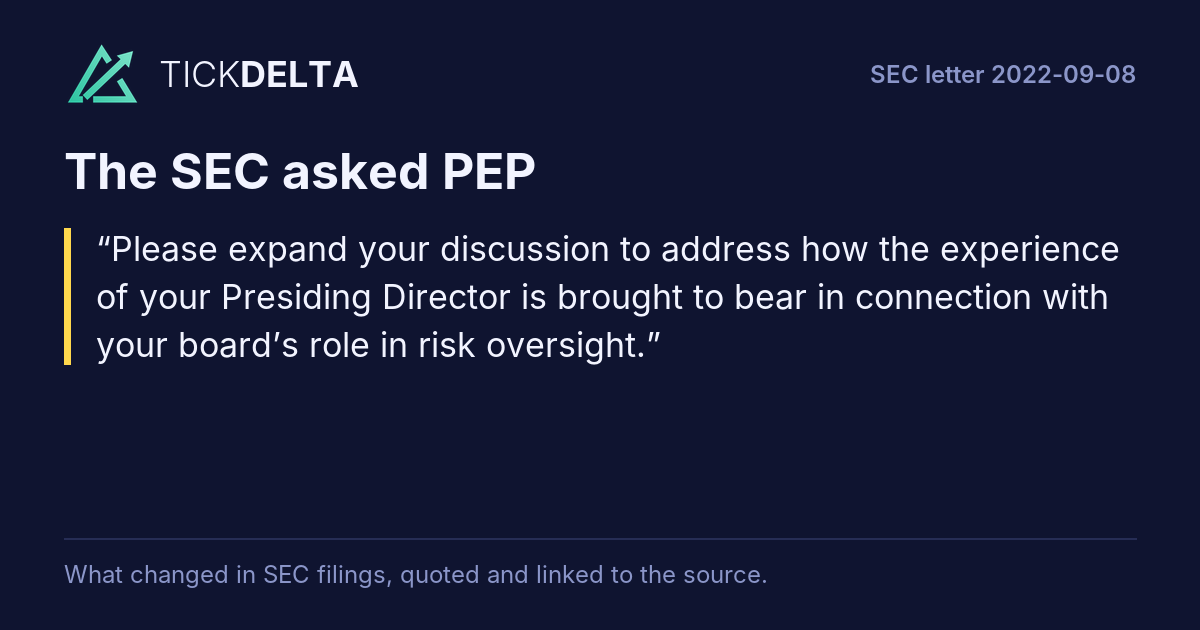
Please expand your discussion to address how the experience of your Presiding Director is brought to bear in connection with your board’s role in risk oversight.
PEP answered

No reply letter found.

Definitive Proxy Statement on Schedule 14A filed March 24, 2022 · General
SEC asked (2)
Please expand upon the role that your Presiding Director plays in the leadership of the board. For example, please enhance your disclosure to address whether or not your Presiding Director may: • represent the board in communications with shareholders and other stakeholders; • require board consideration of, and/or override your CEO on, any risk matters; or • provide input on design of the board itself.
PEP answered

No reply letter found.

Definitive Proxy Statement on Schedule 14A filed March 24, 2022 · General
SEC asked (3)
Please expand upon how your board administers its risk oversight function. For example, please disclose: • why your board elected to retain direct oversight responsibility for cybersecurity risk rather than assign oversight to a board committee; • the timeframe over which you evaluate risks (e.g., short-term, intermediate-term, or long-term) and how you apply different oversight standards based upon the immediacy of
Rest of the question

the risk assessed; • whether you consult with outside advisors and experts to anticipate future threats and trends, and how often you re-assess your risk environment; • how the board interacts with management to address existing risks and identify significant emerging risks; • to whom your Global Chief Compliance & Ethics Officer reports; and • how your risk oversight process aligns with your disclosure controls and procedures.

PEP answered

No reply letter found.
Also in this review: closing letter, 2022-10-25
Form 10-K

2016-04-22 to 2016-05-25 · 2 questions · 1 letter from the SEC, 2 from the company
Review closed 2016-05-25
Russia and UkraineRevenue
General
SEC asked (1)
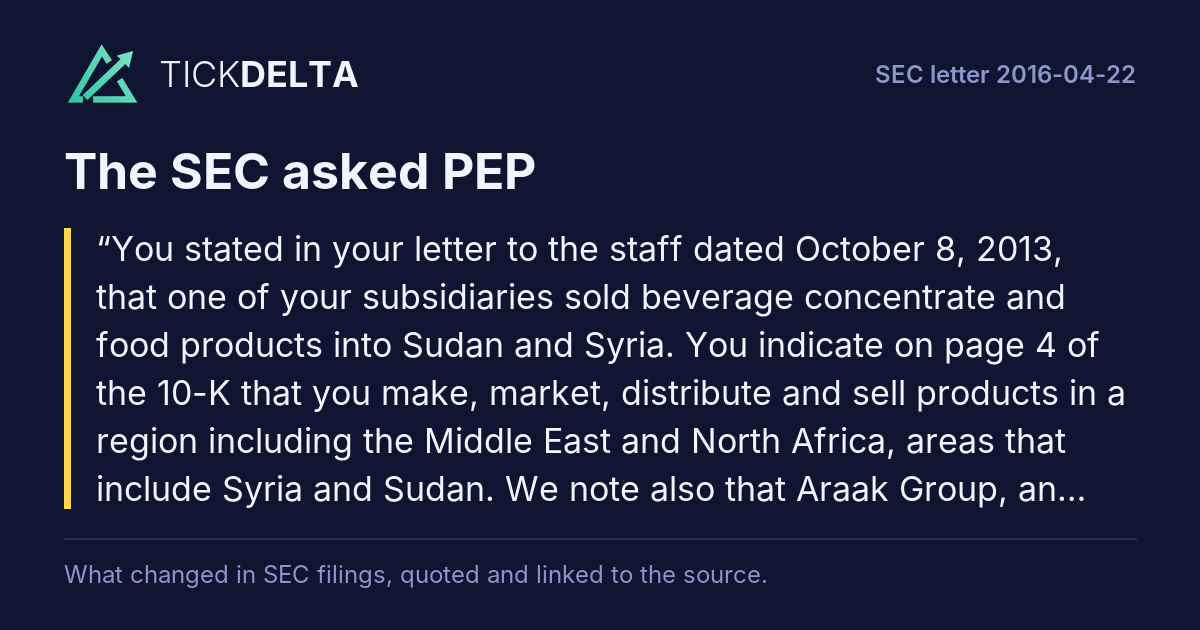
You stated in your letter to the staff dated October 8, 2013, that one of your subsidiaries sold beverage concentrate and food products into Sudan and Syria. You indicate on page 4 of the 10-K that you make, market, distribute and sell products in a region including the Middle East and North Africa, areas that include Syria and Sudan.
Rest of the question

We note also that Araak Group, an entity operating in Sudan, identifies Pepsi on its website as one of its brands and states that it bottles Pepsi in Sudan. As you know, Sudan and Syria are designated by the Department of State as state sponsors of terrorism, and are subject to U.S. economic sanctions and export controls. Your Form 10-K does not include disclosure about operations in Sudan or Syria. Please describe to us the nature and extent of any past, current, and anticipated contacts with Sudan and Syria since your letter to us dated October 8, 2013, whether through subsidiaries, affiliates, distributors, bottlers, partners, joint ventures or other direct or indirect arrangements. You should describe any services, products, information or technology you have provided to Sudan or Syria, directly or indirectly, and any agreements, commercial arrangements, or other contacts you have had with the governments of those countries or entities they control.

PEP answered
PepsiCo has limited business connections in Sudan and Syria, each of which we believe to be in full compliance with U.S. laws. While we have no equity investments in these countries, certain of our products are distributed in these countries by independent third parties. In each case, these arrangements comply with U.S. laws, including, where required, licenses issued by the Office of Foreign Assets Control of the U.S.
Rest of the answer

Department of the Treasury under the Trade Sanctions Reform and Export Enhancement Act of 2000.

PepsiCo does not work with the governments of Sudan or Syria, or with entities controlled by these governments, other than as necessary to preserve our trademarks (including through local legal counsel).

Sudan

A PepsiCo subsidiary sells beverage concentrate to Araak Food Industries Company Limited (“Araak”), a Sudanese company, and Araak produces and sells in Sudan certain beverage brands owned by PepsiCo. Araak is not affiliated with or controlled by PepsiCo, and PepsiCo does not have any equity interest in Araak.

A PepsiCo subsidiary sells finished snack products to a third-party distributor, Trans Africa, in Sudan. Trans Africa is not affiliated with or controlled by PepsiCo, and PepsiCo does not have any equity interest in Trans Africa.

A PepsiCo subsidiary has a 48% ownership interest in International Dairy & Juice Ltd. (“IDJ”), an entity organized outside of Sudan. The remaining 52% ownership interest in IDJ is held by Almarai Company and Almarai Investment Holding WLL, which are organized outside of Sudan and are not affiliated with or controlled by PepsiCo. PepsiCo accounts for its interest in IDJ under the equity method of accounting. IDJ and its subsidiaries, which are organized outside of Sudan, have sold certain products to entities in Sudan that are not affiliated with PepsiCo, and these entities sell these products in Sudan. To our knowledge, IDJ and its subsidiaries do not have physical assets or employees in Sudan.

In addition to the arrangements described above, we understand certain third-party distributors of our products outside of Sudan sell our products, without our involvement, through other distributors in Sudan. Our arrangements with these third-party distributors do not specifically permit or prohibit these sales.

PepsiCo has no physical assets or employees in Sudan.

Syria

A PepsiCo subsidiary sells beverage concentrate to Joud Co. (“Joud”), a Syrian company, and Joud produces and sells in Syria certain beverage brands owned by PepsiCo. In addition, a PepsiCo subsidiary sells finished snack products to Joud and Joud sells these snack products in Syria. Joud is not affiliated with or controlled by PepsiCo, and PepsiCo does not have any equity interest in Joud.

In addition to the matters described above with respect to Sudan, IDJ and its subsidiaries, which are organized outside of Syria, have sold certain products to entities in Syria that are not affiliated with PepsiCo, and these entities sell these products in Syria. To our knowledge, IDJ and its subsidiaries do not have physical assets or employees in Syria.

In addition to the arrangements described above, we understand certain third-party distributors of our products outside of Syria sell our products, without our involvement, through other distributors in Syria. Our arrangements with these third-party distributors do not specifically permit or prohibit these sales.

PepsiCo has no physical assets or employees in Syria.

Read in the reply ↗
General
SEC asked (2)
Please discuss the materiality of any contacts with Sudan and Syria you describe in response to the comment above, and whether those contacts constitute a material investment risk for your security holders. You should address materiality in quantitative terms, including the approximate dollar amounts of any associated revenues, assets, and liabilities for the last three fiscal years and the subsequent interim
Rest of the question

period. Also, address materiality in terms of qualitative factors that a reasonable investor would deem important in making an investment decision, including the potential impact of corporate activities upon a company's reputation and share value. Various state and municipal governments, universities, and other investors have proposed or adopted divestment or similar initiatives regarding investment in companies that do business with U.S.- designated state sponsors of terrorism. You should address the potential impact of the investor sentiment evidenced by such actions directed toward companies that have operations associated with Sudan and Syria.

PEP answered
As noted in our response to question 1 above, PepsiCo has limited business connections in Sudan and Syria. We do not believe that our contacts with Sudan and Syria constitute a material investment risk for our security holders, whether analyzed on a quantitative or a qualitative basis.

Rule 83 Confidential Treatment Request by PepsiCo, Inc.
Rest of the answer

Request #1

From a quantitative standpoint, aggregate net revenues by PepsiCo and by the unconsolidated IDJ entity described above to Sudan and Syria were approximately [**] in 2015, 2014 and 2013, respectively, and approximately [**] for the first quarter of 20161, which for each period represented 0.03% or less of PepsiCo’s total net revenues. Total assets, consisting primarily of receivables, associated with these countries were approximately [**] at the end of 2015, 2014 and 2013, respectively, and approximately [**] at the end of the first quarter of 2016, which for each period represented 0.003% or less of PepsiCo’s total assets. Total liabilities associated with these countries were approximately [**] at the end of 2015, 2014 and 2013, respectively, and [**] at the end of the first quarter of 2016, which for each period represented 0.004% or less of PepsiCo’s total liabilities.

1 For the first quarter of 2016, PepsiCo’s results include the United States and Canada, which are reported on a twelve-week basis, and our international operations, the majority of which are reported on a monthly calendar basis and reflect results for the months of January and February (including results from Sudan and Syria).

PepsiCo, Inc. respectfully requests that the information contained in Request #1 be treated as confidential information and that the Commission provide timely notice to Cynthia A. Nastanski, Senior Vice President, Corporate Law & Deputy Corporate Secretary, PepsiCo, Inc., 700 Anderson Hill Road, Purchase, NY 10577, telephone 914-253-3271, before it permits any disclosure of the bracketed information contained in Request #1.

From a qualitative standpoint, we believe that it is important to recognize that we sell food, snacks and beverage items. In addition, we believe that our activities conform to all applicable laws and licensing regimes, including, where necessary, licenses issued by the U.S. Department of the Treasury under the Trade Sanctions Reform and Export Enhancement Act of 2000, and it is PepsiCo’s policy to abide by the laws and regulations around the world that apply to our business. We value our investors and are sensitive to potential concerns among some investors regarding operations in Sudan and Syria, including the potential impact of activities upon our reputation and the value of our securities, and we will continue to monitor activities in these countries and investor sentiment, as we do on a routine basis. The U.S. regulatory regime permits the sale of food, snacks and beverages in Sudan and Syria, subject, in some cases, to licensing requirements. We believe that a reasonable investor would understand the difference between the sale of food, snack and beverage products which is permitted and the sale of equipment or arms that could be used to support terrorism or repression. Given the de minimis amount of net revenues, assets and liabilities into Sudan and Syria relative to PepsiCo’s total consolidated net revenues, assets and liabilities, our limited business connections in these countries, and the nature of the products sold in these countries, we do not believe that these business connections have or should have a material adverse impact on PepsiCo’s reputation or decisions with respect to an investment in PepsiCo’s securities.

* * *

PepsiCo hereby acknowledges that: (i) PepsiCo is responsible for the adequacy and accuracy of the disclosure in the filing; (ii) Staff comments or changes to disclosure in response to Staff comments do not foreclose the Commission from taking any action with respect to the filing; and (iii) PepsiCo may not assert Staff comments as a defense in any proceeding initiated by the Commission or any person under the federal securities laws of the United States.

If you require additional information or have any questions about this letter, please call me at (914) 253-3030.

Read in the reply ↗

Also in this review: company letter, 2016-05-03, closing letter, 2016-05-25

4 other letters: notices that a filing will not be reviewed, requests to declare a registration effective, and the like

From the SEC's correspondence on EDGAR: staff letters (form UPLOAD) and company letters (form CORRESP), 10 letters filed since 2016-04-22. Questions and answers are matched by their numbers; topics come from words in each question. The reports are compared word for word (same form, before the first SEC letter against the first report after the company's reply). No AI.

Work on PEP in a spreadsheet: Excel workbook (a sheet per section, ten years by column, charts, links to the filings) · CSV. For a Google Sheet that stays up to date, paste =IMPORTDATA("https://tickdelta.com/company/PEP/export.csv") into a cell.