Screener / SEC EDGAR /CIK 0001745916 /10-K filed Feb 20, 2026, compared with Feb 19, 2025 /Numbers from the XBRL of the 10-Ks
NYSE Financials · Mortgage Bankers & Loan Correspondents

PennyMac Financial Services, Inc. PFSI

Compare with peers Embed
SEC comment letters, last 20 years

2 reviews of PFSI's filings by SEC staff

UPLOAD and CORRESP
Reviews 2 latest letter Jul 28, 2023
Questions asked 8 each answered in the company's own letter
No closing letter 0 reviews without a letter saying the staff completed it

When the SEC's staff reviews a filing, it writes to the company with numbered questions, and the company answers each one in a letter. SEC publishes the exchange once the review is over, at least 20 business days later. A question is not an accusation; most reviews end with the company adding detail to its next filing.

How the reviews went

Every review on EDGAR, from the first staff letter to the letter that closes it

  1. 1. Staff letters 2 UPLOAD
  2. 2. Questions in them 8 numbered comments
  3. 3. Company replies 2 CORRESP
  4. 4. Reviews closed 2 of 2 closing letter

Half the closed reviews took 81 days or less from the first letter to the closing letter.

Form 10-K for the fiscal year ended December 31, 2022

2023-07-28 to 2023-08-11 · 1 question · 1 letter from the SEC, 1 from the company
Review closed 2023-08-11
Income taxes
Notes to Consolidated Financial Statements · Note 3 - Significant Accounting Policies - Servicing Advances, page F-12
SEC asked
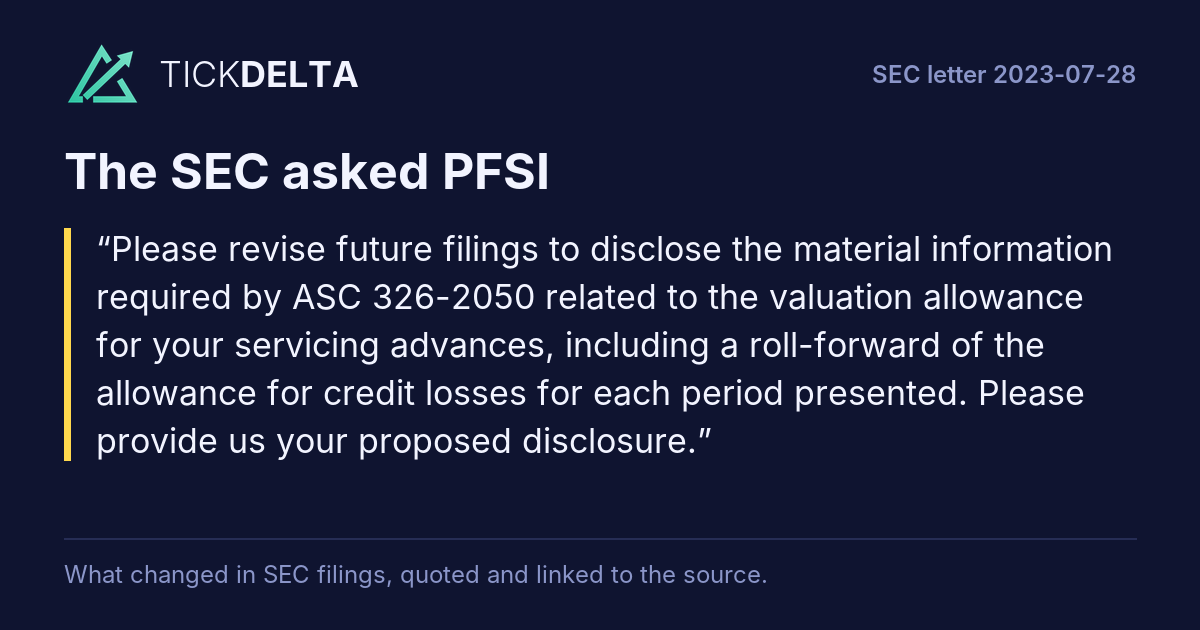
Please revise future filings to disclose the material information required by ASC 326-2050 related to the valuation allowance for your servicing advances, including a roll-forward of the allowance for credit losses for each period presented. Please provide us your proposed disclosure.
PFSI answered
We will include the material information required by ASC 326-20-50 related to the valuation allowance for our servicing advances in future filings.

We will make the following change to our accounting policy disclosure in our Annual Report on Form 10-K for the year ending December 31, 2023:

Servicing Advances

Servicing advances represent contractually required protective advances the Company makes on behalf of the loans’ beneficial interest holders.
Rest of the answer

In addition to scheduled principal and interest amounts due to the beneficial interest holders on delinquent loans, servicing advances may include advances of property taxes, insurance premiums and out-of-pocket collection amounts (e.g., preservation and restoration of mortgaged property or real estate acquired in the settlement of loans (“REO”), legal fees, and appraisals) made to protect beneficial interest holders’ interests in the properties collateralizing their loans. Servicing advances are made in compliance with the respective servicing agreements and Agency loan servicing guides.

The Company does not expect to incur credit losses on servicing advances since servicing advances are recoverable from government Agencies and government-sponsored entities. Certain of the Company’s loan servicing agreements and Agency loan servicing guides limit the amounts of collection and liquidation amounts that the beneficial interest holders, loan insurers or guarantors will reimburse the Company and beneficial interest holders, insurers or guarantors may dispute the level of certain charges incurred in the collection process.

The Company is contractually responsible for making the payments required to protect its beneficial interest holders’ interests in the properties collateralizing their loans and may, therefore, be required to incur amounts in excess of insurer or guarantor reimbursement limits. Therefore, the Company provides a valuation allowance on the servicing advances for these amounts in excess of amounts that are expected to ultimately be recovered from the loans’ insurers, guarantors or beneficial interest holders.

The servicing advance valuation allowance is estimated based on relevant qualitative and quantitative information about past events, including historical collection and loss experience, current conditions, and reasonable and supportable forecasts that affect collectable amounts. The provision for losses on servicing advances is included in Servicing expense in the consolidated statements of income. Servicing advances are written off when they are deemed unrecoverable.

We will also include the following roll forward of our valuation allowance in Note 5 – Loan Sales and Servicing Activities to our consolidated financial statements in future periodic filings, beginning with our Quarterly Report on Form 10-Q for the quarterly period ended September 30, 2023:

Following is a summary of the allowance for losses on servicing advances:

Year ended December 31,

2022

2021

2020

(in thousands)

Balance at beginning of year

$

120,940

181,443

82,157

(Reversals of) Provision for losses

(36,075)

(47,878)

125,898

Charge-offs, net

(5,873)

(12,625)

(26,622)

Balance at end of year

78,992

181,433

We also considered the other disclosure guidance in ASC 326-20-50, and have concluded the above planned changes and the other existing disclosures address the material information required.

Closing

You may call me at (818) 224-7136 if you require clarification or have additional questions. I can also be reached by U.S. mail or by e-mail at [email protected].

Read in the reply
In its next report

First report after the company's reply of Aug 9, 2023: 10-Q filed Oct 31, 2023 ↗, against the 10-Q filed May 3, 2023 ↗.

Tickdelta does not hold the text of both reports, so they are not compared here.
Also in this review: closing letter, 2023-08-11

Form 10-K for the fiscal year ended December 31, 2019

2020-07-27 to 2020-10-16 · 7 questions · 1 letter from the SEC, 1 from the company
Review closed 2020-10-16
RevenueDerivatives and hedgingResults discussion (MD&A)Liquidity and cashInventory
After reviewing your response to these comments, we may have additional comments. Item 1. Business, page 6
SEC asked (1)
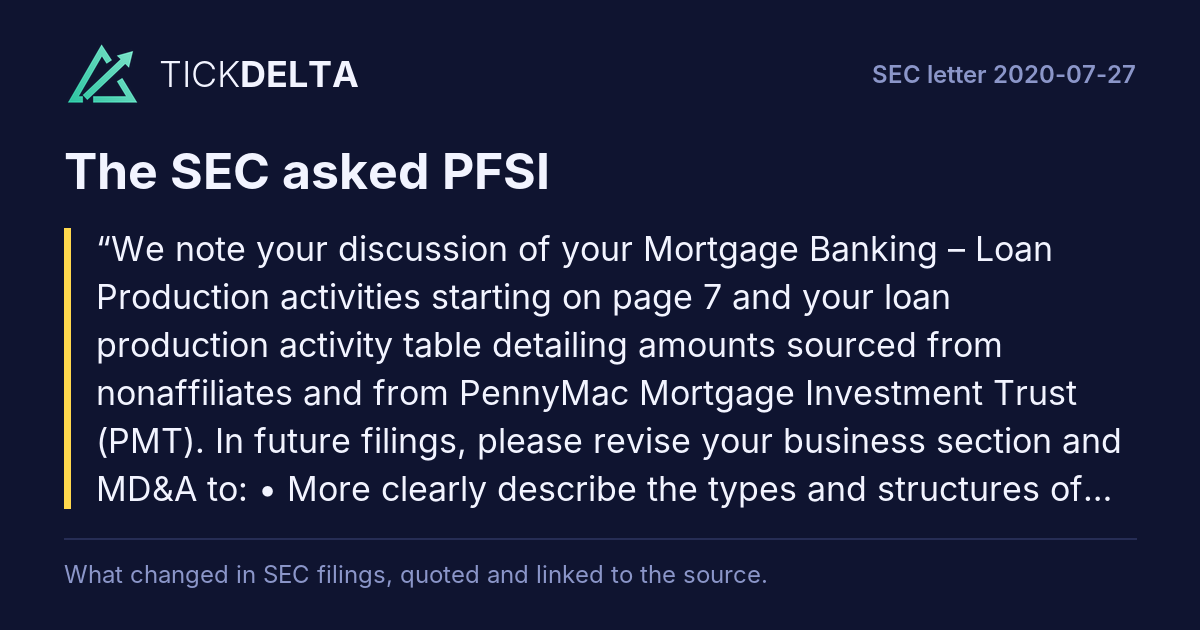
We note your discussion of your Mortgage Banking – Loan Production activities starting on page 7 and your loan production activity table detailing amounts sourced from nonaffiliates and from PennyMac Mortgage Investment Trust (PMT).
Rest of the question

In future filings, please revise your business section and MD&A to: • More clearly describe the types and structures of your mortgage banking activities, comparing and contrasting how each structure impacts your financial statements and financial results. For example, clarify how loan production managed on behalf of PMT versus for your own account impacts your financial statements and financial results. • For each type/structure of mortgage banking activity clearly describe the source of loans distinguishing between affiliated and non-affiliated sources, the type of loans (e.g. conventional, government insured, etc.) and relevant details regarding the structure and characteristics of sales/transfers (e.g. who is the transferee (PMT, institutional investors, etc.), are they packaged into MBS, etc.). • For each type/structure of mortgage banking activity clearly describe the types of revenue generated (e.g. loans origination fees, fulfillment fees, gain on sale, etc.). We note your disclosure on page 51 that you recognized $542 million from sales to non-affiliates and $183 million from sales to PMT. Your disclosure should clearly explain how each loan production activity described and quantified in your loan production activity table is recognized in your income statement so an investor can more fully understand the relationship between each activity and the amount, trend and uncertainty of each type of revenue recognized. Please provide us your proposed disclosure.

PFSI answered
Company’s Response to Question #1

In future filings beginning with our Annual Report on Form 10-K for the year ended December 31, 2020, we will revise the loan production discussion in our Business section as shown below:

Loan Production

Our loan production segment sources new prime credit quality first-lien residential conventional and government-insured or guaranteed mortgage loans through three channels: correspondent production, consumer direct and broker direct lending as described below.

Correspondent Production

In correspondent production we manage, on behalf of PMT and for our
Rest of the answer

own account, the purchase from non-affiliates of mortgage loans that have been underwritten to investor guidelines. Our correspondent loans are directed based on the guarantor of the mortgage-backed securities (“MBS”) created from the loans: our production focus has been on loans guaranteed or insured by the FHA or VA for sale into Ginnie Mae-guaranteed MBS, whereas PMT’s production focus has been on loans that can be sold into MBS guaranteed by Fannie Mae or Freddie Mac.

This arrangement exists, in part, because PMT is not approved by Ginnie Mae as an issuer of Ginnie Mae-guaranteed MBS which are backed by government-insured or guaranteed loans. As a result, PMT sells the government-insured or guaranteed loans that it purchases from correspondent sellers to us and we pay PMT a sourcing fee ranging from one to two basis points, generally based on the average number of calendar days that PMT holds the loans prior to our purchase. We generally pool the government-insured or guaranteed loans into Ginnie Mae guaranteed MBS and then sell such MBS to institutional investors.

In our correspondent production activities, for loans we source for our own account, we earn loan origination fees from the correspondent sellers, interest income on the loans during the time we hold such loans, gains or losses from the date we make a commitment to purchase the loans through the sale of these loans, and, in sales to entities other than PMT, we retain and recognize the value of the associated mortgage servicing rights (“MSRs”).

In our loan fulfillment activities in support of PMT’s correspondent production activities, we earn fulfillment fees and tax service fees.

We may also serve as a correspondent seller of newly originated loans from our consumer direct and broker direct lending channels to PMT under a mortgage loan purchase agreement. During our 2017, 2018, 2019 and early 2020 fiscal years, we sold newly originated conventional conforming loans to PMT as PMT had available a selling arrangement that offered us more attractive pricing for certain conventional conforming loans than was otherwise available to us. When we sell loans to PMT, PMT obtains the mortgage servicing rights relating to such loans. As such, our gains on sale of loans to PMT are primarily cash gains. We ceased such sales to PMT during the second quarter of 2020 as the more attractive pricing was no longer available to us. However, we may in the future enter into other sales arrangements with PMT where such arrangements are attractive to us and approved by both companies’ boards of directors/trustees’ related party matters committees. Both companies’ related party matters committees are comprised of independent directors/trustees from the respective board.

Consumer Direct Lending

Through our consumer direct lending channel, we originate mortgage loans on a national basis. Our consumer direct model relies on the Internet and call center-based staff to acquire and interact with customers across the country. We do not have a “brick and mortar” branch network.

In our consumer direct lending activities, we earn loan origination fees from the borrower, interest income during the time we hold the loan before sale, gains or losses from the date we make a commitment to fund the loan through the sale of these loans, and, in sales to entities other than to PMT, we retain and recognize the value of the associated MSRs.

To the extent we refinance loans that we subservice for PMT where PMT owns the related MSRs, we are generally required to transfer and convey to PMT a recapture fee payable in cash in an amount equal to:

Through June 30, 2020, 30% of the fair market value of the MSRs related to all such mortgage loans; and

Beginning July 1, 2020, a tiered amount ranging from 30% to 40% of the fair market value of the MSRs relating to the recaptured loans based on the recapture rate we achieve during the respective month. The “recapture rate” means, during each month, the ratio of (i) the aggregate unpaid principal balance of all mortgage loans for which PMT held the MSRs and that were refinanced or otherwise paid off in such month, to (ii) the aggregate unpaid principal balance (“UPB”) of all recaptured loans.

The change in recapture compensation to PMT during 2020 was the result of the renewal of our MSR recapture agreement before its expiration during the year.

Broker Direct Lending

In broker direct lending, we obtain loan application packages from nonaffiliated mortgage loan brokers, underwrite and fund the resulting loans for sale to PMT or investors. In our broker direct lending activities, we earn interest income, gains or losses from the date we make a commitment to fund the loan through the sale of these loans, and, in sales to entities other than PMT, we retain and recognize the value of the associated MSRs.

Our loan production activity is summarized below:

Year ended December 31,

2020

2019

2018

2017

2016

(in thousands)

UPB of loans purchased and originated for sale:

Loans sourced through our correspondent lending channel:

From PMT

$

—

47,937,306

36,415,933

40,561,241

39,908,163

From non-affiliates

1,686,472

49,623,778

Loans sourced through our consumer direct channel

9,752,500

4,650,316

5,466,669

6,491,107

Loans sourced through our broker direct channel

2,154,817

378,544

61,531,095

41,444,793

46,027,910

46,399,270

UPB of conventional loans fulfilled for PMT

56,033,704

26,194,303

23,188,386

Total loan production

117,564,799

67,639,096

69,587,656

The effect of our loan production transactions with PMT on our financial statements are summarized below:

Net gains on loans held for sale at fair value:

Net gains on loans held for sale to PMT

190,416

69,359

28,238

Mortgage servicing rights and excess servicing spread recapture incurred

(7,051)

(4,776)

(6,249)

(8,029)

Read in the reply
In its next report

First report after the company's reply of Aug 28, 2020: 10-Q filed Nov 6, 2020 ↗, against the 10-Q filed May 7, 2020 ↗.

Tickdelta does not hold the text of both reports, so they are not compared here.

Loan Servicing, page 8
SEC asked (2)
We note you service loans as the owner of the MSRs and on behalf of other MSR or loan owners. Please revise future filings to compare and contrast how servicing the loan as the owner of the MSR as compared to subservicing the loan impacts your financial statements and financial results. Specifically discuss how each activity impacts the quality of and potential variability of your earnings and cash flows.
Rest of the question

Please provide us your proposed disclosure.

PFSI answered
Company’s Response to Question #2

In future filings, beginning with our Annual Report on Form 10-K for the year ended December 31, 2020, we will revise the loan servicing discussion in the Business section as follows:

Loan Servicing

Our loan servicing segment performs loan administration, collection, and default management activities, including the collection and remittance of loan payments; response to customer inquiries; accounting for principal and interest; holding custodial (impounded) funds for the payment of property taxes and insurance premiums; counseling delinquent borrowers; and
Rest of the answer

supervising foreclosures and property dispositions.

We service loans both as the owner of MSRs and as the subservicer on behalf of PMT.

The UPB of our loan servicing portfolio is summarized below:

December 31,

Investor:

Non-affiliated entities:

Originated

168,842,011

145,224,596

120,853,138

89,516,155

Purchased

59,703,547

56,990,486

47,016,708

41,735,847

228,545,558

202,215,082

167,869,846

131,252,002

Loans held for sale

4,724,006

2,420,636

2,998,377

2,101,283

Total owned servicing

233,269,564

204,635,718

170,868,223

133,353,285

Subserviced for PennyMac Mortgage Investment Trust

135,414,668

94,658,154

74,980,268

60,886,717

Total

368,684,232

299,293,872

245,848,491

194,240,002

Our responsibilities and risks relating to loans we service in arrangements where we own the MSRs or mortgage servicing liabilities (“MSLs”) differ from those where we act as subservicer for the owner of the servicing rights. As the owner of the servicing rights:

We recognize our investment in the servicing rights received in loan sale transactions where we retain the obligation to service the loans as well the investment we make when we buy MSRs or assume MSLs. We carry these assets and liabilities at fair value and as such they are subject to subsequent changes in fair value owing to realization of the cash flows anticipated in the asset or liability or to changes in the market for such MSRs and MSLs;

Because our investment in MSRs can be significant and the fair value of this asset is sensitive to changes in prepayment activity, the cost to service the loans and marketplace return requirements, we incur costs to hedge this investment – primarily the risk of changes in fair value arising from changes in interest rates; and

We are responsible for advancing our corporate funds to protect the loan owners’ interest in the collateral securing such loans for such items as hazard insurance, property taxes and foreclosure-related costs, subject to future reimbursement, as well as advancing delinquent principal and interest payments to the MBS holders.

As the subservicer for the owner of servicing rights, we do not carry MSRs or MSLs on our balance sheet and therefore do not recognize changes in the fair value of MSRs or MSLs and are generally not responsible for financing the advance of corporate funds to protect the loan owners’ interest in the collateral securing such loans. As a result, the fees we earn from such arrangements are generally less on a per-loan basis than those we earn from holding MSRs and MSLs.

Following is a summary of our net loan servicing fees:

Net loan servicing fees:

From non-affiliates:

Loan servicing fees:

Contractually specified

730,165

585,101

475,848

385,633

Other

98,564

64,133

58,924

46,910

828,729

649,234

534,772

432,543

Change in fair value of mortgage servicing rights, mortgage servicing liabilities

(988,614)

(116,344)

(74,787)

(198,160)

Amortization and impairment of mortgage servicing rights and mortgage servicing liabilities (1)

(179,946)

(152,443)

Change in fair value of excess servicing spread financing payable to PMT

9,256

(8,500)

19,350

23,923

Hedging results

395,497

(121,045)

(37,855)

26,405

(583,861)

(245,889)

(273,238)

(300,275)

Net loans servicing fees from non-affiliates

244,868

403,345

261,534

132,268

From affiliates:

48,797

42,045

43,064

50,615

From Investment Funds

1,461

2,583

42,048

44,525

53,198

Net loan servicing fees

293,665

445,393

306,059

185,466

(1) Through December 31, 2017, we accounted for a portion of our investment in MSRs using the amortization method. We adopted fair value accounting for those assets effective January 1, 2018.

Read in the reply
In its next report

First report after the company's reply of Aug 28, 2020: 10-Q filed Nov 6, 2020 ↗, against the 10-Q filed May 7, 2020 ↗.

Tickdelta does not hold the text of both reports, so they are not compared here.

Item 7A. Quantitative and Qualitative Disclosures About Market Risk, page 65
SEC asked (3)
We note your disclosure that you use derivative financial instruments acquired with the intention of moderating the risk that changes in market interest rates will result in unfavorable changes in the fair value of your IRLCs, inventory of mortgage loans held for sale and MSRs.
Rest of the question

We also note your disclosure in slide 14 of your March 31, 2020 Earnings Report included in your Form 8-K filed on May 7, 2020 that your “utilizing of option coverage for significant movement in rates provided substantial benefit in 1Q20.” Please revise future filings to more comprehensively describe the objectives of your hedging strategies, the context needed to understand those objectives and your strategies for achieving those objectives. Please refer to ASC 815-10-50-1A for guidance. Please provide us your proposed disclosure.

PFSI answered
Company’s Response to Question #3

In future filings, beginning with our Quarterly Report on Form 10-Q for the quarterly period ended September 30, 2020, we will enhance its Quantitative and Qualitative Disclosures about Market Risk as shown below:

Item 7A. Quantitative and Qualitative Disclosures About Market Risk

Market risk is the exposure to loss resulting from changes in interest rates, foreign currency exchange rates, commodity prices, equity prices, real estate values and other market-based risks.
Rest of the answer

The primary market risks that we are exposed to are fair value risk, interest rate risk and prepayment risk.

Fair Value Risk

Our IRLCs, mortgage loans held for sale, MSRs, MSLs and ESS financing are reported at their fair values. The fair value of these assets fluctuates primarily due to changes in interest rates. The fair value risk we face is primarily attributable to interest rate risk and prepayment risk.

Interest Rate Risk

Interest rate risk is highly sensitive to many factors, including governmental monetary and tax policies, domestic and international economic and political considerations, and other factors beyond our control. Changes in interest rates affect both the fair value of, and interest income we earn from, our mortgage-related investments and our derivative financial instruments. This effect is most pronounced with fixed-rate mortgage assets. In general, rising interest rates negatively affect the fair value of our IRLCs, inventory of mortgage loans held for sale and ESS financing and positively affect the fair value of our MSRs.

Our operating results will depend, in part, on differences between the income from our investments and our financing costs. Presently our debt financing is based on a floating rate of interest calculated on a fixed spread over the relevant index, as determined by the particular financing arrangement.

Prepayment Risk

To the extent that the actual prepayment rate on the mortgage loans underlying our MSRs differs from what we projected when we initially recognized these assets and liabilities when we measure fair value as of the end of each reporting period, the carrying value of these assets and liabilities will be affected. In general, a decrease in the principal balances of the mortgage loans underlying our MSRs or an increase in prepayment expectations will decrease our estimates of the fair value of the MSRs, thereby reducing net servicing income, partially offset by the beneficial effect on net servicing income of a corresponding reduction in the fair value of our MSLs and ESS.

Risk Management Activities

We engage in risk management activities primarily in an effort to mitigate the effect of changes in interest rates on the fair value of our assets. To manage this price risk, we use derivative financial instruments acquired with the intention of moderating the risk that changes in market interest rates will result in unfavorable changes in the fair value of our assets, primarily prepayment exposure on our MSR investments as well as IRLCs and our inventory of loans held for sale. Our objective is to minimize our hedging expense and maximize our loss coverage based on a given hedge expense target. We do not use derivative financial instruments other than IRLCs and repurchase agreement derivatives (both of which arise from our operations) for purposes other than in support of our risk management activities.

Our strategies are reviewed daily within a disciplined risk management framework. We use a variety of interest rate and spread shifts and scenarios and define target limits for market value and liquidity loss in those scenarios. With respect to our IRLCs and inventory of loans held for sale, we use MBS forward sale contracts to lock in the price at which we will sell the mortgage loans or resulting MBS, and further use MBS put options to mitigate the risk of our IRLCs not closing at the rate we expect. With respect to our MSRs, we seek to mitigate mortgage-based loss exposure utilizing MBS forward purchase and sale contracts to address exposures to smaller interest rate shifts with Treasury and interest rate swap futures, and use options and swaptions to achieve target coverage levels for larger interest rate shocks.

Fair Value Sensitivities

The following sensitivity analyses are limited in that they were performed at a particular point in time; only contemplate the movements in the indicated variables; do not incorporate changes to other variables; are subject to the accuracy of various models and inputs used; and do not incorporate other factors that would affect our overall financial performance in such scenarios, including operational adjustments made by management to account for changing circumstances. For these reasons, the following estimates should not be viewed as earnings forecasts.

Mortgage Servicing Rights

The following tables summarize the estimated change in fair value of our MSRs as of December 31, 2019, given several shifts in pricing spreads, prepayment speed and annual per loan cost of servicing:

Change in fair value attributable to shift in:

-20%

-10%

-5%

+5%

+10%

+20%

(dollar amounts in thousands)

Pricing spread

193,469

93,548

46,014

(44,561)

(87,734)

(170,155)

Prepayment speed

285,318

136,043

66,474

(63,569)

(124,411)

(238,549)

Annual per-loan cost of servicing

98,065

49,032

24,516

(24,516)

(49,032)

(98,065)

Excess Servicing Spread Financing

The following tables summarize the estimated change in fair value of our ESS accounted for using the fair value method as of December 31, 2019, given several shifts in pricing spreads and prepayment speed (decrease in the liabilities’ fair values increases net income):

Pricing spread shift in %

4,907

2,422

1,203

(1,188)

(2,361)

(4,662)

Prepayment Speed

18,565

8,878

4,344

(4,164)

(8,160)

(15,680)

Read in the reply
In its next report

First report after the company's reply of Aug 28, 2020: 10-Q filed Nov 6, 2020 ↗, against the 10-Q filed May 7, 2020 ↗.

Tickdelta does not hold the text of both reports, so they are not compared here.

Note 3 - Significant Accounting Policies and Recently Issued Accounting Pronouncments, page · F-10
SEC asked (4)
Please revise future filings to disclose your revenue recognition policy related to loan origination fees.
PFSI answered
Company’s Response to Question #4

In future filings, beginning with our Annual Report on Form 10-K for the year ended December 31, 2020, we will include disclosure of our revenue recognition policy with respect to loan origination fees as shown below:

Loan origination fees

Loan origination fees represent compensation to the Company for the origination or purchase of loans.
Rest of the answer

Loan origination fees are earned and recognized upon funding or purchase of the loan by the Company and are collected either at purchase from the correspondent seller or at origination when paid by the borrower or upon sale of the loan when the origination fees are financed by the borrower.

Read in the reply
In its next report

First report after the company's reply of Aug 28, 2020: 10-Q filed Nov 6, 2020 ↗, against the 10-Q filed May 7, 2020 ↗.

Tickdelta does not hold the text of both reports, so they are not compared here.

Note 8 - Derivative Activities, page F-45
SEC asked (5)
We note your disclosure on page F-49 of the gains (losses) recognized on derivative financial instruments and the income statement line where such gains and losses are included. Please revise future filings to disclose this information separately by type of contract. Refer to ASC 815-10-50-4C, ASC 815-10-50-4D and ASC 815-10-55-182 for guidance.
PFSI answered
815-10-50-4C

This section of the ASC deals with derivative financial instruments for which hedge accounting is applied. We disclose in Note 3—Significant Accounting Policies and Recently Issued Accounting Pronouncement – Derivative Financial Instruments in the penultimate paragraph that we do not designate our derivative financial instruments for hedge accounting.

815-10-50-4D

In future filings, beginning with our Quarterly Report on Form 10-Q for the quarterly period ended September 30, 2020, we will revise the disclosure as follows (change indicated in bold face):

Following are the
Rest of the answer

gains (losses) recognized by the Company on derivative financial instruments and the income statement line items where such gains and losses are included:

Derivative activity

Income statement line

Interest rate lock commitments

Net gains on loans held for sale at fair value

87,312

(8,934)

(1,120)

15,618

Repurchase agreement derivatives

Interest expense

(1,609)

(1,704)

(330)

Hedged item (1):

Interest rate lock commitments and loans held for sale

(157,806)

81,522

(21,255)

20,619

Mortgage servicing rights

Net loan servicing fees–Change in fair value of mortgage servicing rights and mortgage servicing liabilities

(1): All the hedging derivatives are interest rate derivatives and are used as economic hedges.

Response

815-10-55-182 - Tabular disclosure of derivative instruments

Fair Values of Derivative Instruments

We make this disclosure in Note 8 – Derivative Activities – Derivative Notional Amounts and Fair Value of Derivatives. As all of our derivative financial instruments are included on a single Derivative assets and Derivative liabilities line item on the consolidated balance sheets, we do not believe the Balance Sheet Location column is applicable to our disclosures.

The Effect of Derivative Instruments on the Statement of Financial Performance

We believe the information required by this illustration is included in the table above. Most of the information included in these illustrations relate to derivatives designated and qualifying as either fair value or cash flow hedges. As we indicated above and in Note 3—Significant Accounting Policies and Recently Issued Accounting Pronouncement – Derivative Financial Instruments, we do not presently apply hedge accounting to any of our activities.

Read in the reply
In its next report

First report after the company's reply of Aug 28, 2020: 10-Q filed Nov 6, 2020 ↗, against the 10-Q filed May 7, 2020 ↗.

Tickdelta does not hold the text of both reports, so they are not compared here.

Note 19 - Net Gains on Loans Held for Sale, page F-66
SEC asked (6)
Please revise future filings to more clearly disclose the amount of gain or loss from the sale of transferred financial assets separately from the gains or losses on loans and related financial instruments still held at period end. Please ensure you clearly disclose all information required by ASC 860-20-50 in your financial statements.
PFSI answered
Company’s Response to Question #6

We respectfully believe that we have disclosed the amount of gain on sale of transferred assets separated from the loans sold and the gains and losses still held at period end. Specifically, near the bottom of the Net Gains on Loans Held for Sale table, we have a section titled Change in fair value of loans and derivatives held at year end. These amounts represent the changes in fair value relating to instruments still held at the end of the period by instrument type.

We believe we have clearly disclosed all information required by ASC 860-20-50.
Rest of the answer

The information is included in Notes 5 – Loan Sales and Servicing Activities, 6—Fair Value - Valuation Techniques and Inputs – Mortgage Servicing Rights and Mortgage Servicing Liabilities, and 19 – Net Gains on Loans Held for Sale.

Read in the reply
In its next report

First report after the company's reply of Aug 28, 2020: 10-Q filed Nov 6, 2020 ↗, against the 10-Q filed May 7, 2020 ↗.

Tickdelta does not hold the text of both reports, so they are not compared here.

Note 19 - Net Gains on Loans Held for Sale, page F-66
SEC asked (7)
We note that you provide significant detail regarding gains and losses related to activities with non-affiliates but significantly less detail regarding gains and losses related to activities with PMT. Please revise future filings to separately present any significant components related to these gains from PMT.
PFSI answered
Company’s Response to Question #7

The detail we provide the financial statement user is a breakdown of the cash versus non-cash components of the net gains on loans held for sale. The largest non-cash component of our gain on sale is the MSRs we receive in the sale transactions. We do not retain the servicing obligation on loans we sell to PMT, so we recognize no MSRs in those transactions.

It should be noted that we sold less than $3 million in loans to PMT during the quarter ended June 30, 2020, as compared to $21.2 billion to non-affiliates, and we do not presently anticipate significant
Rest of the answer

sales in the future as the program under which we sold loans beginning in 2017 is winding down. In future filings we will separately disclose our provision for representations and warranties relating to sales of loans to PMT to the extent we make significant loan sales to PMT and such amount is significant. We will also clarify that our gains on sales of loans to PMT are primarily cash as shown in boldface below:

Note 19—Net Gains on Loans Held for Sale

Net gains on mortgage loans held for sale at fair value is summarized below:

Cash loss:

Loans

(190,853)

(469,647)

(174,669)

Hedging activities

(175,305)

93,288

(16,866)

(366,158)

(376,359)

(191,535)

Non-cash gain:

Mortgage servicing rights and mortgage servicing liabilities resulting from loan sales

846,888

584,156

563,872

Provision for losses relating to representations and warranties:

Pursuant to loan sales

(8,377)

(5,824)

(5,890)

Reduction in liability due to change in estimate

7,877

4,672

4,301

Change in fair value of loans and derivatives held at year end:

(42,878)

(1,506)

4,576

Hedging derivatives

17,499

(11,766)

(4,389)

542,163

184,439

369,815

From PennyMac Mortgage Investment Trust (1)

725,528

249,022

391,804

(1) Gains on sales of loans to PMT are primarily cash gains.

Closing

You may call me at (818) 224-7392 if you require clarification or have additional questions. I can also be reached by U.S. mail or by e-mail at [email protected].

Read in the reply
In its next report

First report after the company's reply of Aug 28, 2020: 10-Q filed Nov 6, 2020 ↗, against the 10-Q filed May 7, 2020 ↗.

Tickdelta does not hold the text of both reports, so they are not compared here.

Also in this review: closing letter, 2020-10-16

From the SEC's correspondence on EDGAR: staff letters (form UPLOAD) and company letters (form CORRESP), 6 letters filed since 2020-07-27. Questions and answers are matched by their numbers; topics come from words in each question. The reports are compared word for word (same form, before the first SEC letter against the first report after the company's reply). No AI.

Sources

The SEC's correspondence on EDGAR: staff letters (form UPLOAD) and company letters (form CORRESP), matched question by question. No AI.

Also

Filings: the letters in the filing list.

Work with it

Excel workbook · CSV. Google Sheet that stays up to date: paste =IMPORTDATA("https://tickdelta.com/company/PFSI/export.csv") into a cell.

Next in Owners and insiders:Insider trades
Esc

Type a ticker such as AAPL, a name, an investor such as Buffett, or a topic such as tariffs. ↑ ↓ to move, Enter to open.