Form 10-K for the Fiscal Year Ended December 31, 2024
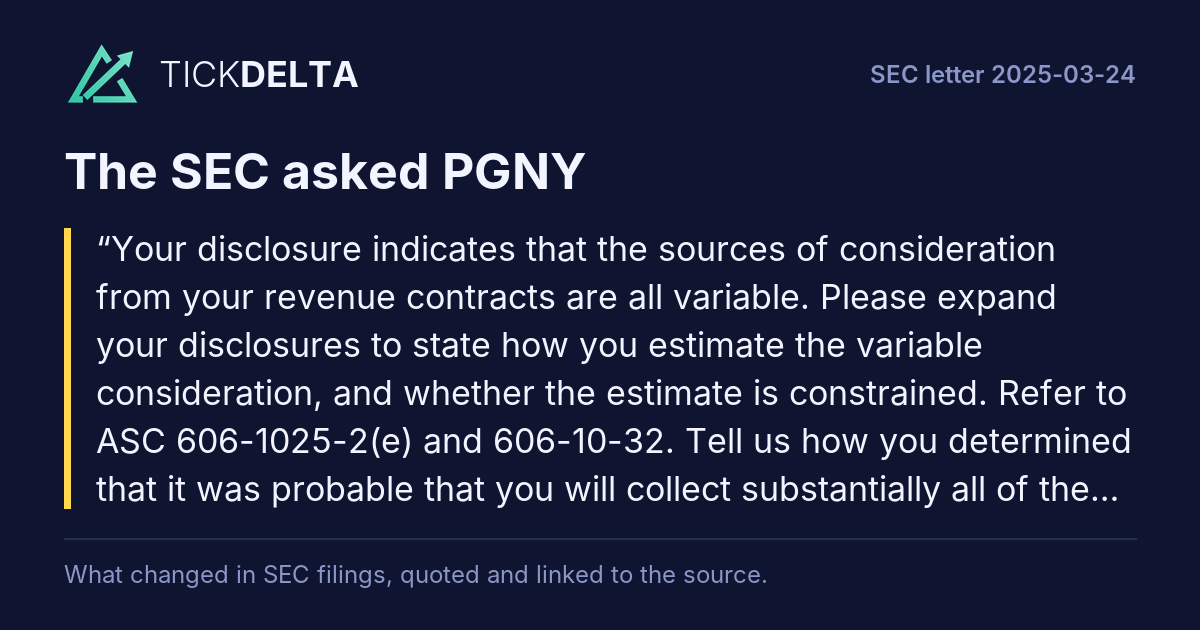
Your disclosure indicates that the sources of consideration from your revenue contracts are all variable. Please expand your disclosures to state how you estimate the variable consideration, and whether the estimate is constrained. Refer to ASC 606-1025-2(e) and 606-10-32.Rest of the question
Tell us how you determined that it was probable that you will collect substantially all of the consideration to which you are entitled under your revenue contracts. See ASC 606-10-55-3A through 55-3. Finally, provide the disclosures required by ASC 606-10-50-17 and 50-20. Note 2. Accounts Receivable and Allowance for Doubtful Accounts, page 73 We note that your allowance for doubtful accounts is material in relation to your accounts receivable balance. Tell us and revise your disclosures to address the estimates and assumptions underlying your determination of the allowance as well as your write-off policy. Identify the point in time at which you (i) provide an allowance and (ii) write off a receivable, including the extent to which your allowance and writeoffs are made on a specific versus general basis. Given your allowance for doubtful accounts represents approximately 20% of your gross accounts receivable balance, 2. please revise your disclosures to explain the underlying factors that result in the allowance, including whether potential collectability issues associated with your accounts receivable are due to the nature of your customers, the nature of your products or other factors.
CORRESP filename1.htm progyny.com 1359 Broadway, 2nd Floor, New York, NY 10018 May 5, 2025 Securities and Exchange Commission Division of Corporation Finance 100 F. Street, N.E. Washington, D.C. 20549 Attn: Al Pavot and Jeanne Baker Re: Progyny, Inc. Form 10-K for the Fiscal Year Ended December 31, 2024 File No. 001-39100 Dear Mr. Pavot and Ms. Baker: Progyny, Inc.Read in the replyRest of the answer
(the “Company”, “we” or “our”) submits this letter in response to comments from the staff (the “Staff”) of the Division of Corporation Finance of the United States Securities and Exchange Commission (the “Commission”) contained in the Staff’s letter dated March 24, 2025 relating to the Company’s Form 10-K for the fiscal year ended December 31, 2024, as filed with the Commission on March 3, 2025 (the “2024 Form 10- K”). For the Staff’s convenience, the Staff’s comments have been stated below in their entirety in bold, followed by the corresponding responses from the Company. Capitalized terms used but not defined in this letter have the meanings ascribed to such terms in the 2024 Form 10-K. Form 10-K for the Fiscal Year Ended December 31, 2024 Financial Statements Note 2. Revenue Recognition, page 71 1. Your disclosure indicates that the sources of consideration from your revenue contracts are all variable. Please expand your disclosures to state how you estimate the variable consideration, and whether the estimate is constrained. Refer to ASC 60610-25-2(e) and 606-10-32. Tell us how you determined that it was probable that you will collect substantially all of the consideration to which you are entitled under your revenue contracts. See ASC 606-10-55-3A through 55-3. Finally, provide the disclosures required by ASC 606-10-50-17 and 50-20. Company Response: The Company respectfully acknowledges the Staff’s comment and will revise its disclosures in Note 2, Revenue Recognition in its future filings with the SEC to provide further clarity on its variable consideration and significant judgements in accordance with ASC 606-10-17 and 50-20. Both Progyny’s fertility and pharmacy benefits solutions include a single performance obligation, which is a stand-ready obligation that is a series of distinct days of service satisfied over the contract term. Progyny’s fertility and pharmacy benefits solutions contracts include both the following sources of consideration, which are variable: a per employee per month (‘‘PEPM”) administration fee (in most, but not all contracts) and a stated fixed rate per Smart Cycle or fertility drug dispensed, respectively. The PEPM administration fee, which although based on a fixed rate, is contingent upon the number of employees covered by the benefit and represents 1% of total revenue. Progyny’s contracts also include potential service level agreement refunds, based on a percentage of the PEPM fee, related to outcome-based service metrics for a full plan year, which have not historically resulted in significant adjustments to the transaction price. The PEPM administration fee, net of service level agreement refunds, is estimated using the expected value method and is allocated between the fertility benefits solution and the pharmacy benefits solution based on relative standalone selling price. The fees for Smart Cycles and fertility drugs, which, although based on fixed rates per cycle or fertility drug, are contingent upon how many Smart Cycles are completed or prescriptions are filled and delivered to members. The fixed rate per Smart Cycle or fertility drug meet the variable consideration allocation exception as the usage-based fees relate specifically to the entity’s efforts to satisfy the performance obligation to provide services and are allocated to the distinct period during which the related fertility services were performed or drugs delivered as those fees relate specifically to the Company’s efforts to provide its benefits in those periods. There is no constraint on variable consideration included within Progyny’s fertility benefits contracts as it is not probable that a significant reversal of revenue will occur in future periods. The Company also respectively advises the Staff that it determines it is probable it will collect substantially all of the consideration to which it is entitled to under its revenue contracts after considering all relevant facts and circumstances, including, but not limited to, the items as discussed below. The Company’s customers primarily include large self-insured employers and labor populations with at least 1,000 employees, which included 473 employers as of December 31, 2024. The Company evaluates its customers’ ability and intent to pay the amount of consideration when it is due based on consideration of the financial condition of its customers, the contractual terms within its agreements with customers, and the
Company’s customary business practices in order to conclude that its contracts represent a substantive transaction between the Company and its customers. The Company’s contracts, which create enforceable rights and obligations, include standard contractual terms requiring payment between 30 to 60 days from the invoice issuance. In the event that a customer fails to pay consideration when it is due, the Company has the ability to terminate the contract and to cease transferring any future services to its customers, which would limit future exposure to credit risk. In addition, the Company does not expect, nor does it have a historical business practice or policy, to provide non-contractual price concessions or otherwise accept a lower amount of consideration than that which the customer is contractually obligated to pay. The Company further notes its receivables include amounts billed to customers (referred to as client billings) as well as individual members for their cost share (e.g. deductibles and coinsurance) associated with using the Company’s services. The Company’s collection rate is approximately 99% of total client billings and 90% of total members billings. In addition, the nature of its billings to members and, to a lesser extent, clients are high volume but low dollar individual transactions. Given these strong collection rates and low individual transaction value, there is no indication of significant collectability issues related to the Company’s revenue contracts. As such, the Company believes it appropriately mitigates its exposure to credit risk and concludes its customers have the ability and intent to pay as amounts become due, and it is therefore probable the Company will collect substantially all of the consideration to which it will be entitled from its revenue contracts. The Company notes that its significant judgements in accordance with ASC 606-1050-17 and 606-10-50-20 relate to its estimate of revenue recognized in the period as disclosed in the accrued receivables disclosure in the consolidated financial statements. A draft of the Company’s proposed disclosure is included below. For the Staff’s convenience, the proposed new text is underlined below. Notes to Consolidated Financial Statements Note 2 – Revenue Recognition Revenue Recognition Revenue is recognized when control of the promised goods or services is transferred to clients in an amount that reflects the consideration the Company expects to be entitled to in exchange for those goods or services.
The Company applies the following five-step model to recognize revenue from contracts with clients: •Identification of the contract, or contracts, with a client •Identification of the performance obligations in the contract •Determination of the transaction price •Allocation of the transaction price to the performance obligations in the contract; and •Recognition of revenue when, or as, a performance obligation is satisfied Progyny’s contracts typically have a stated term of three years and include contractual termination options after the first year, allowing the client to terminate the contract with 30 to 90 days’ notice. Fertility Benefits Solution Revenue Progyny primarily generates revenue through its fertility benefits solution, in which Progyny provides self-insured enterprise entities (‘‘clients”) and their employees and partners (together, ‘‘members”) with fertility benefits. As part of the fertility benefits solution, Progyny provides access to effective and cost-efficient fertility treatments, referred to as Smart Cycles, as well as other related services. Smart Cycles are proprietary treatment bundles that include certain medical services available to members through Progyny’s proprietary, credentialed network of provider clinics. In addition to access to Progyny’s Smart Cycle treatment bundles and access to Progyny’s network of provider clinics, the fertility benefits solution includes other comprehensive services, which Progyny refers to as care management services, such as active management of the provider clinic network, real-time member eligibility and treatment authorization, member-facing digital tools throughout the Smart Cycle and detailed quarterly reporting all supported by client facing account management and end-to-end comprehensive member support provided by Progyny’s in house staff of PCAs. The promises within Progyny’s fertility benefits contract with a client represent a single performance obligation because Progyny provides a significant service of integrating the Progyny designed Smart Cycles and access to the fertility treatment services provided by provider clinics with the other comprehensive services into the combined fertility benefits solution that the client contracted to receive. Progyny’s fertility benefits solution is a stand-ready obligation that is satisfied over the contract term.
Progyny’s contracts include the following sources of consideration, which are all variable: a per employee per month (‘‘PEPM’’) administration fee (in most, but not all contracts), and a fixed rate per Smart Cycle. The PEPM administration fee is estimated using the expected value method and is allocated between the fertility benefits solution and the pharmacy benefits solution based on standalone selling price, estimated using an expected cost-plus margin method. The Company allocates the variable consideration related to the The fixed rate per Smart Cycle meets the variable consideration allocation exception as the usage-based fees relate specifically to the Company’s efforts to satisfy the performance obligation to provide services and is allocated to the distinct period during which the related services were performed as those fees relate specifically to the Company’s efforts to provide its fertility benefits solution to its clients in the period and represents the consideration the Company is entitled to for the fertility benefits services provided. As a result, the fixed rate per Smart Cycle is included in the transaction price for the fertility benefits solution. and recognized in the period in which the Smart Cycle is provided to the member. Progyny’s contracts also include potential service level agreement refunds related to outcome-based service metrics. These service level refunds, which are determined based on results of a full plan year, if met, are based on a percentage of the PEPM fee paid by clients. The Company estimates the variable consideration related to the total PEPM administration fee, less estimated refunds related to service level agreements using the expected value method and recognizes the amounts allocated to the fertility benefits solution ratably over the contract term. Progyny’s estimates of service level agreement refunds, have not historically resulted in significant adjustments to the transaction price. There is no constraint on variable consideration within Progyny’s fertility benefits contracts. The Company recognizes revenue for its fertility benefit solution in the period in which the Smart Cycle services are provided to the member. The services provided in a reporting period are based on actual claims received from the provider clinic and an estimate of services provided but for which a claim has not been received at the end of the reporting period, which we refer to as accrued receivables, and is discussed in further detail below. Clients are typically invoiced on a monthly basis for the PEPM administration fee. Progyny invoices its clients and members for their respective portions of the fixed rate per Smart Cycle bundle when all treatment services within a Smart Cycle are completed by the provider clinic. Once an invoice is issued, payment terms are typically between 30 to 60 days.
The Company assesses whether it is the principal or the agent for each arrangement with a client, since fertility treatment services are provided by a third party—the provider clinics. The Company is the principal in its arrangements with clients and therefore presents revenue gross of the amounts paid to the provider clinics because Progyny controls the specified service (the fertility benefits solution) before it is transferred to the client. Progyny integrates the fertility treatment services provided by the provider clinics into the overall fertility benefits solution that the client contracted to receive. In addition, Progyny defines the scope of the potential services to be performed by the provider clinics and monitors the performance of the provider clinics. Furthermore, Progyny is primarily responsible for fulfilling the promise to the client and has discretion in setting the pricing, as Progyny separately negotiates agreements with the provider clinics, which establish pricing for each treatment service. Pricing of services from provider clinics is independent from the fees charged to clients. Pharmacy Benefits Solution Revenue For clients that have the fertility benefits solution, Progyny offers, as an add-on, its pharmacy benefits solution, which is a separate, fully integrated pharmacy benefit. As part of the pharmacy benefits solution, Progyny provides care management services, which include Progyny’s formulary plan design, prescription fulfillment, simplified authorization and timely delivery of the medications used during treatment through Progyny’s network of specialty pharmacies, and clinical services consisting of member assessments, UnPack It calls, telephone support, online education, medication administration training, pharmacy support services and continuing PCA support. The pharmacy-related promises represent a single performance obligation because Progyny provides a significant service of integrating the formulary plan design, prescription fulfillment, clinical services and PCA support into the combined pharmacy benefits solution that the client contracted to receive. The pharmacy benefits solution is a standready obligation that is satisfied over the contract term. Progyny’s contracts include the following sources of consideration, all of which are variable: a PEPM administration fee (in most, but not all contracts) and a fixed fee per fertility drug. As described above, the PEPM administration fee, less estimated refunds related to service level agreements, is allocated to the pharmacy benefits solution and recognized ratably over the contract term. The Company allocates the variable consideration related to the The fixed fee per fertility drug meets the variable consideration allocation exception as the usage-based fees relate specifically to the Company’s efforts to satisfy the performance obligation to provide services and is allocated to the distinct period during which the related services were performed, as those fees relate specifically to the Company’s efforts to provide its pharmacy benefits solution to clients in the period and represents the consideration the Company is entitled to for the pharmacy benefits services provided. As a result, the fixed fee per fertility drug is included in the transaction price and recognized in the period in which the Company is entitled to consideration from a client, which is when a prescription is filled and delivered to the members. There is no constraint on variable consideration within Progyny’s pharmacy benefits contracts. As stated above, clients are invoiced on a monthly basis for the PEPM administration fee. Progyny invoices the client and the member for their respective portions of the fixed fee per fertility drug, when the prescription services are completed by the specialty pharmacies. Once an invoice is issued, payment terms are typically between 30 to 60 days. The Company assesses whether it is the principal or the agent for each arrangement with a client, as prescription fulfillment and clinical services are provided by a third party— the specialty pharmacies. The Company is the principal in its arrangements with clients, and therefore presents revenue gross of the amounts paid to the specialty pharmacies. Progyny controls the specified service (the pharmacy benefits solution) before it is transferred to the client. Progyny integrates the prescription fulfillment and clinical services provided by the pharmacies and PCAs into the overall pharmacy benefits solution that the client contracted to receive. In addition, Progyny defines the scope of the potential services to be performed by the specialty pharmacies and monitors the performance of the specialty pharmacies. Furthermore, Progyny is primarily responsible for fulfilling the promise to the client and has discretion in setting the pricing, as Progyny separately negotiates agreements with pharmacies, which establish pricing for each drug. Pricing of fertility drugs is independent from the fees charged to clients. The Company does not disclose the transaction price allocated to remaining performance obligations because all of the transaction price is variable and is allocated to the distinct periods to which the services relate, as discussed above. The remaining contract term is typically less than one year, due to the client’s contractual termination options. There were no material contract asset or contract liability balances as of December 31, 2024 and 2023. Note 2. Accounts Receivable and Allowance for Doubtful Accounts, page 73 2. We note that your allowance for doubtful accounts is material in relation to your accounts receivable balance. Tell us and revise your disclosures to address the estimates and assumptions underlying your determination of the allowance as well as your write-off policy. Identify the point in time at which you (i) provide an allowance and (ii) write off a receivable, including the extent to which your allowance and writeoffs are made on a specific versus general basis. Given your allowance for doubtful accounts represents approximately 20% of your gross accounts receivable balance, please revise your disclosures to explain the underlying factors that result in the allowance, including whether potential collectability issues associated with your accounts receivable are due to the nature of your customers, the nature of your products or other factors. Company Response: The Company respectfully acknowledges the Staff’s comment and advises the Staff that it estimates credit losses, including its allowance for doubtful accounts, in accordance with ASC 326 based on the lifetime expected credit losses for receivables, aggregated on the basis of similar risk characteristics, which include the client and member receivable pools. The client pool primarily includes receivables with large selfinsured employers and labor populations with at least 1,000 employees and the member pool represents receivables with individual members for their cost share (e.g. deductibles and coinsurance) associated with using the Company’s services. The Company recognizes an allowance for credit losses at the time its accounts receivable is recognized, including for current or not yet due amounts. The allowance is primarily based on the Company’s historical experience of losses for each of its receivable pools on a general basis and considers the migration of receivables from current to aged buckets and collection rates associated with receivables that are delinquent. The Company’s collection rate for total billings is approximately 99% for its client pool and 90% for its member pool. In addition, the nature of the Company’s billings to members and, to a lesser extent, clients are high volume but low dollar individual transactions. The Company collects the substantial majority of its receivables within 90 days of billing. While aged unpaid balances represent a small proportion of overall billings and are more concentrated to the member pool, the Company does continue its collection efforts for up to several years from the initial billing. These efforts are part of a robust collection process, leveraging both internal and external resources and tools to pursue unpaid balances, and continues to yield cash conversion throughout the entirety of the process. This in turn results in a high allowance for doubtful accounts in proportion to the gross accounts receivable balance on the Company’s consolidated balance sheet, although given the strong collection rates, it is not indicative of potential collectability issues.
The Company writes off receivables when it has exhausted its efforts or is no longer pursuing collection of the receivable. The Company’s writeoff policy is applied on a general basis to its receivables with the passage of time and also considers individual facts and circumstances on a specific basis, as applicable (e.g. notification of a member bankruptcy). In response to the Staff’s comment, the Company will also revise its disclosures in Note 2, Accounts Receivable and Allowance for Doubtful Accounts in its future filings with the SEC. A draft of the Company’s proposed disclosure is included below. For the Staff’s convenience, the proposed new text is underlined below. Notes to Consolidated Financial Statements Note 2. Accounts Receivable and Allowance for Doubtful Accounts The accounts receivable balance primarily includes amounts due from clients and members. The Company estimates the allowance for doubtful accounts based on the lifetime expected credit losses for the client and member receivable pools, respectively. Under this current expected credit losses model, the Company determines the allowance for doubtful accounts based on factors such as the age of the receivable balance, historical experience of losses, current economic conditions, and reasonable and supportable forecasts of future economic conditions in order to develop loss rates for each of its receivable pools. An allowance for credit losses is applied at the time the asset is recognized, including to current or not yet due amounts, based on the Company’s estimated loss rates which consider the migration of receivables from current to aged and collection rates associated with receivables that are delinquent. Expected credit losses are recorded as general and administrative expenses on the consolidated statements of operations. The Company records write-offs, as a deduction from the allowance for doubtful accounts, in the period in which its receivables are deemed uncollectible, which is when all efforts of collection have been exhausted or it is no longer pursuing collection of the receivable, and can take up to several years from the initial billing based on the nature of the Company’s receivables, which consist of a high volume of low dollar balances, particularly on the member receivable pool. We appreciate the Staff’s time and attention on this matter. If you have any questions or comments regarding the foregoing, please do not hesitate to contact us. Sincerely, /s/ Mark Livingston Mark Livingston Chief Financial Officer
First report after the company's reply of May 5, 2025: 10-Q filed May 9, 2025 ↗, against the 10-Q filed Nov 12, 2024 ↗.
Tickdelta does not hold the text of both reports, so they are not compared here.
Also in this review: closing letter, 2025-05-15