Screener / SEC EDGAR /CIK 0001114995 /10-K filed Feb 9, 2026, compared with Feb 10, 2025 /Numbers from the XBRL of the 10-Ks
Nasdaq Technology · Electronic Components

Impinj Inc PI

Compare with peers Embed
SEC comment letters, last 20 years

2 reviews of PI's filings by SEC staff

UPLOAD and CORRESP
Reviews 2 latest letter May 9, 2023
Questions asked 8 each answered in the company's own letter
No closing letter 0 reviews without a letter saying the staff completed it

When the SEC's staff reviews a filing, it writes to the company with numbered questions, and the company answers each one in a letter. SEC publishes the exchange once the review is over, at least 20 business days later. A question is not an accusation; most reviews end with the company adding detail to its next filing.

How the reviews went

Every review on EDGAR, from the first staff letter to the letter that closes it

  1. 1. Staff letters 2 UPLOAD
  2. 2. Questions in them 8 numbered comments
  3. 3. Company replies 2 CORRESP
  4. 4. Reviews closed 2 of 2 closing letter

Half the closed reviews took 69 days or less from the first letter to the closing letter.

Form 10-K for the Fiscal Year Ended December 31, 2022

2023-05-09 to 2023-07-17 · 2 questions · 1 letter from the SEC, 1 from the company
Review closed 2023-07-17
Non-GAAP measuresResults discussion (MD&A)Income taxes
Management's Discussion and Analysis of Financial Condition and Results of Operations · Non-GAAP Financial Measures, page 42
SEC asked (1)
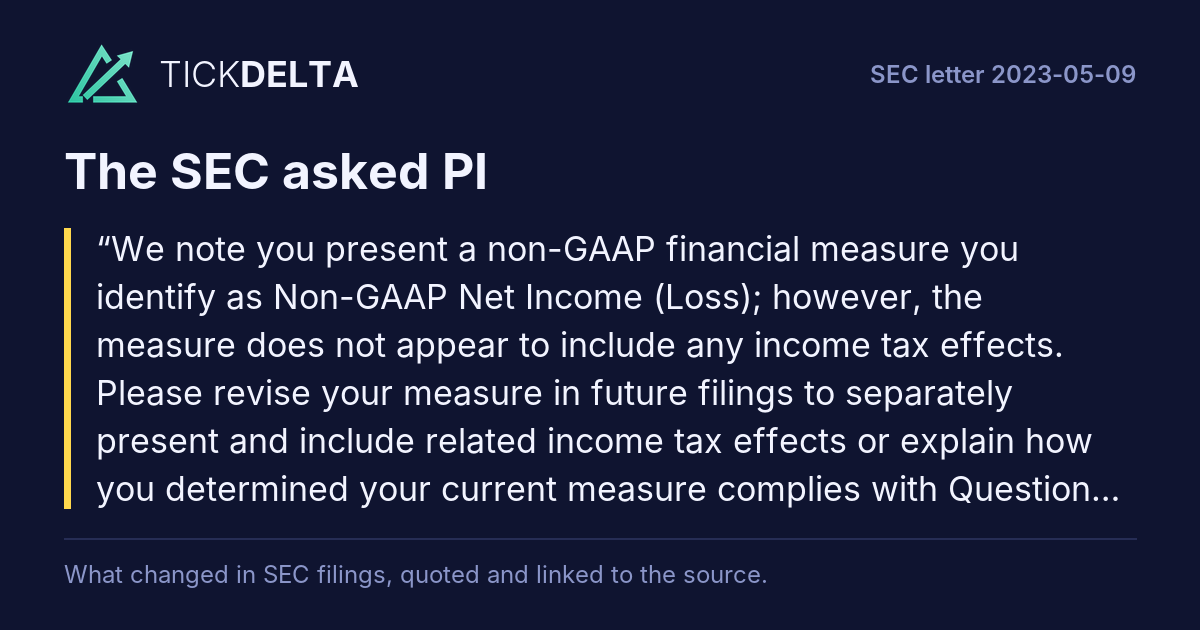
We note you present a non-GAAP financial measure you identify as Non-GAAP Net Income (Loss); however, the measure does not appear to include any income tax effects. Please revise your measure in future filings to separately present and include related income tax effects or explain how you determined your current measure complies with Question 102.11 of the SEC’s Division of Corporation Finance C&DIs related to Non-
Rest of the question

GAAP Financial Measures which requires that non-GAAP financial measures include current and deferred income tax expense commensurate with the non-GAAP measure of profitability. Please be advised, although we note you recorded GAAP net losses during the periods presented, it would not be appropriate to consider potential tax benefits from GAAP losses in determining the income tax effects related to Non-GAAP Net Income since that would not result in current and deferred income tax expense commensurate with the non-GAAP measure of profitability. This comment is also applicable to your presentation of Non-GAAP Net Income in Earnings Releases filed under Form 8-K and quarterly filings under Form 10-Q.

PI answered
The Company acknowledges the Staff’s comment, and confirms that in future earnings releases and filings, the Company will reflect the impact of income tax adjustments as a separate line item and explain how the tax impact is calculated. The Company will also adjust prior period results to align with the revised methodology.
Read in the reply
In its next report

First report after the company's reply of May 23, 2023: 10-Q filed Jul 26, 2023 ↗, against the 10-Q filed Apr 26, 2023 ↗.

Tickdelta does not hold the text of both reports, so they are not compared here.
Consolidated Financial Statements · Note 9. Stock-Based Awards, page 73
SEC asked (2)
You state you estimated volatility based on a combination of your historical volatility and reported market value data for a group of publicly traded entities that you believe are relatively comparable. Since your company has been public since 2016, please explain why you believe your methodology is appropriate and tell us when you expect you will no longer consider the volatility of other entities.
Rest of the question

Tell us what your volatility would have been if you only considered the company’s expected and historical volatility and tell us how that would have impacted stock compensation expense. Refer to ASC 718-10-5537 and SAB Topic 14.D.1 Question 6. In addition, explain why you believe it is appropriate to apply the simplified approach to determine the expected term of stock options. Refer to SAB Topic 14.D.2 Question 6.

PI answered
The Company respectfully acknowledges the Staff’s comment. The

Company uses the Black-Scholes option-pricing model to determine the fair value of stock options granted. Inputs to this option-pricing model include the exercise price of the option, the current price of the underlying share, the expected volatility of the price of the underlying share, the expected dividends on the underlying share, and the risk-free interest rate for the expected term of the option. The Company generally begins its estimation of the expected volatility rate by analyzing historical realized volatility.
Rest of the answer

ASC 718-10-55-37(a) indicates that historical realized volatility should be measured over a period equivalent to the expected term of the option. While the Company’s shares have been publicly traded since June 2016; through 2021, the last year in which the Company issued stock options, the length of time its shares have been publicly traded is shorter than the expected term of its options. To compensate for this limitation in Company-specific historical data, the Company used a historical volatility rate that considered both Company realized volatility and the volatilities of peer companies.

ASC

718-10-55-37(c) permits newly public entities to use of the volatility of similar entities. Additionally, in SAB Topic 14.D.1, the Staff stated that it would not object to a public entity basing its estimate of expected volatility on the volatility of similar entities for those periods for which it does not have sufficient information available. The Company acknowledges that the Staff has indicated that at least two years of daily or weekly historical data could provide a reasonable basis on which to base an estimate of expected volatility if a company has no reason to believe that its future volatility will differ materially during the expected term, as applicable, from the volatility calculated from this past information. However, the Company believes that its historical volatility since becoming a public company may not be indicative of its future volatility over the expected term of its options. The Company would respectfully draw the Staff’s attention to the section of its Annual Reports on Form 10-K titled “Management’s Discussion and

Analysis of Financial Condition and Results of Operations—Factors Affecting Performance;” and, in particular, “—Market Adoption.” Market adoption of RAIN is still in its early stages, and was even more so in the years immediately following the Company’s 2016 initial public offering. This has led to greater than expected variability in the Company’s operating and financial results that was reflected in the volatility of its stock price. The Company believes this shorter-term volatility may not be reflective of volatility of its stock price over a longer period as the RAIN market continues to mature. Given the unusually high volatility, the Company derived a historical volatility rate that considered both Company-specific volatility and the volatility of a group of the Company’s publicly traded peers. The Company respectfully submits that its approach best represented the expected volatilities over the expected term.

Tell us when you expect you will no longer consider the volatility of other entities.

Consistent with SAB Topic 14.D.1, the Company has consistently applied the foregoing approach with respect to estimating stock price volatility through 2021.

The Company did not issue stock options in 2022, nor does the Company have a present intention to issue stock options in the future. If the Company does issue stock options in the future, the Company expects to use company realized historical volatility as the input to its option pricing model.

Tell us what your volatility would have been if you only considered the company’s expected and historical volatility and tell us how that would have impacted stock compensation expense. Refer to ASC 718-10-55-37 and SAB Topic 14.D.1 Question 6.

There were no stock options issued in 2022. Beginning in 2021, the Company began primarily offering restricted stock units to employees in lieu of stock options, and only 10,000 options were issued with a total fair value of $370,000, an immaterial amount. Thus, the last significant grant of stock options awards was 656,000 options during 2020. In 2020, the weighted average volatility of the Company’s peer group over the expected term of the stock options granted was approximately 68.8%, and the Company’s historical weighted average volatility of shares underlying stock options for the same period was approximately 80.8%. The resulting impact of using the Company’s historical volatility rather than the volatility of the Company’s peer group would have increased stock compensation expense by approximately $180,000, $325,000, and $325,000 and would have been 0.16%, 0.24%, and 0.21% of total operating expenses for each of 2020, 2021, and 2022, respectively. The Company respectfully submits that these differences are immaterial.

In addition, explain why you believe it is appropriate to apply the simplified approach to determine the expected term of stock options. Refer to SAB Topic 14.D.2 Question 6.

The Company respectfully submits it is appropriate to apply the simplified approach to determine the expected term of stock options because the Company does not have sufficient historical exercise data to provide a reasonable basis for an estimate of expected term. Question 6 of SAB Topic 14.D.2 permits the use of the simplified method for “plain vanilla” options when an entity believes its historical exercise experience does not provide a reasonable basis with which to estimate expected term. The Company does not believe that it has sufficient historical option exercise data to provide a reasonable basis upon which to estimate the term of its stock option grants due to the following factors:

•

From the Company’s June 2016 initial public offering through 2019, the timeframe the Company analyzed in determining the expected term for options granted in 2020, holders exercised options for an aggregate of approximately 1.3 million shares of common stock. Of these, approximately 78%, or options for 1.0 million shares of underlying common stock, were granted prior to the initial public offering.

These options granted prior to the initial public offering have a much lower weighted average exercise price

(approximately $4.00 per share) compared to options granted subsequent to the initial public offering (approximately $16.00 per share). The initial public offering provided employees with their first liquidity event which has resulted in a substantial number of stock option exercises thereafter. As a result, the exercise pattern of these options was not deemed to be a reliable indicator of future exercise behavior for stock options granted after the initial public offering.

Between the Company’s June 2016 initial public offering and April 2018, the Company issued options to purchase an aggregate of approximately 2.0 million shares of common stock, and approximately half were forfeited and exchanged per a voluntary exchange program offered by the Company for out-of-the-money stock options. Of the exchanged options, only 16% were exercised through 2019. In addition, of the options that had not been exchanged, only 8% were exercised through 2019.

As a result of the insufficient historical exercises of options granted subsequent to the Company’s initial public offering as noted above, the Company believes it does not have sufficient historical exercise data to provide a reasonable basis for an estimate of expected term, and believes that the use of the simplified approach to determine the expected term of stock options is appropriate.

Read in the reply
In its next report

First report after the company's reply of May 23, 2023: 10-Q filed Jul 26, 2023 ↗, against the 10-Q filed Apr 26, 2023 ↗.

Tickdelta does not hold the text of both reports, so they are not compared here.

Also in this review: closing letter, 2023-07-17

Form 10-K for the Fiscal Year Ended December 31, 2018

2019-12-09 to 2020-01-08 · 6 questions · 1 letter from the SEC, 1 from the company
Review closed 2020-01-08
Non-GAAP measuresResults discussion (MD&A)Liquidity and cashRevenueDebtIncome taxes
Item 7 Management’s Discussion and Analysis of Financial Condition and Results of Operations · Results of Operations, page 48
SEC asked (1)
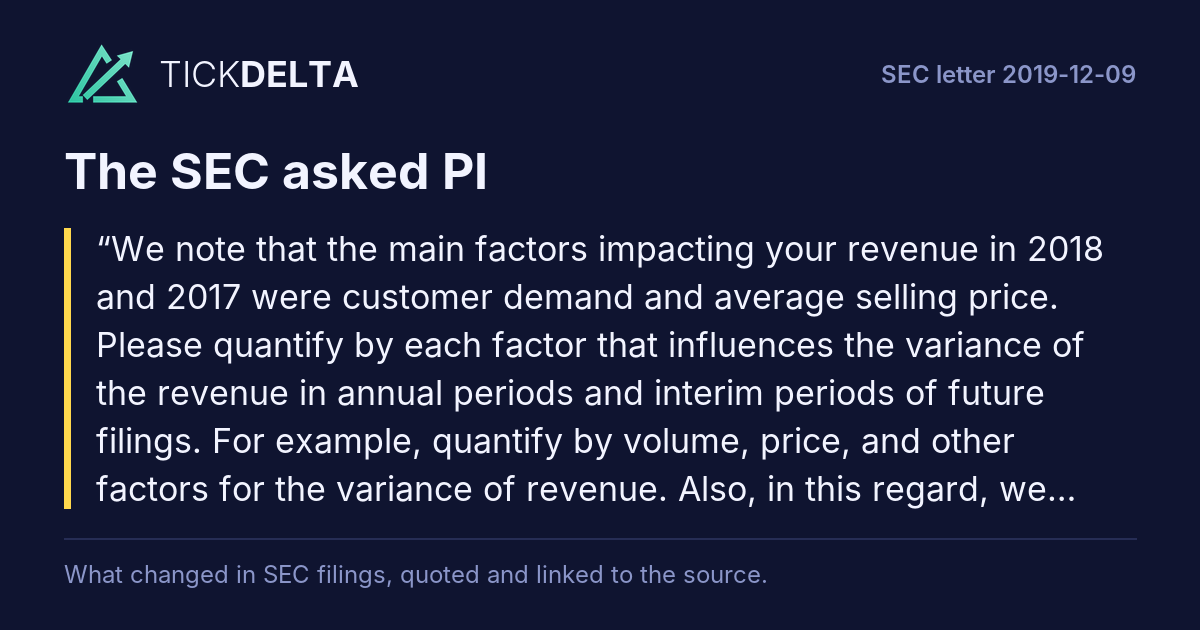
We note that the main factors impacting your revenue in 2018 and 2017 were customer demand and average selling price. Please quantify by each factor that influences the variance of the revenue in annual periods and interim periods of future filings. For example, quantify by volume, price, and other factors for the variance of revenue.
Rest of the question

Also, in this regard, we note a discussion of gross profit but did not observe a separate discussion of the cost of revenue. Given the significance of such costs to your results of operations for each period presented, please revise and expand your MD&A of future filings to separately quantify and discuss factors responsible for changes in the company’s cost of revenue. Refer to Item 303 of Regulation S-K.

PI answered
to the

Staff’s comment, the Company intends to provide additional detail in future filings regarding the factors affecting revenue. For illustrative purposes, below please find a comparative analysis of third quarter 2019 and 2018 endpoint and systems revenue. The Company intends to provide a similar level of disclosure in future filings.

Three months ended September 30, 2019 compared with three months ended September 30, 2018

Endpoint IC revenue increased $2.7 million, or 11.2%.
Rest of the answer

Increased shipment volumes accounted for a $3.7 million increase which was partially offset by a $1.0 million decrease from average selling price. The decrease in average selling price was driven by mix and, to a lesser extent, price decreases associated with our annual pricing renegotiation as discussed above under “ —Factors Affecting Our Performance—Seasonality”.

Systems revenue increased $3.7 million, or 34.6%, primarily due to a $5.3 million and $0.9 million increase in gateway and reader revenue, respectively. Such increases were offset by a $2.5 million decrease in reader IC revenue. Revenue from both gateways and readers increased primarily due to increased shipment volumes, with the former favorably impacted by a large, North American project. The decrease in reader IC revenue is due to lower shipment volumes in the current year primarily due to prior year revenue being unusually high due to improved inventory availability in the third quarter of 2018 that allowed us to meet demand that was previously supply constrained.

In response to the Staff’s comment regarding costs of revenue, the

Company will revise future filings for annual and interim periods to provide additional quantification and discussion of factors that materially influence such item. For illustrative purposes, below please find a discussion of cost of revenue for the third quarter ended September 30, 2019.

Three Months Ended September 30,

(in thousands, except percentages)

2019

2018

Change

Cost of Revenue

$

20,981

17,857

3,124

Gross profit

19,781

16,548

3,233

Gross margin

48.5

%

48.1

0.4

Three months ended September 30, 2019 compared with three months ended September 30, 2018

Cost of revenue increased $3.1 million, or 17.5%. The increase was primarily due to the increase in revenue due to increased shipment volumes. Gross margin increased due to leverage derived from comparable overhead costs and excess and obsolescence charges as a percentage of higher revenue, partially offset by lower margin due to product mix.

Read in the reply
In its next report

First report after the company's reply of Jan 3, 2020: 10-K filed Mar 2, 2020 ↗.

No earlier 10-K before the SEC's letter is in Tickdelta, so there is nothing to compare with.

Item 7 Management’s Discussion and Analysis of Financial Condition and Results of Operations · Results of Operations, page 48
SEC asked (2)
We also note from page 73 that you reserved for $3.2 million related to a product exchange that you completed in the first quarter of 2018. Please explain to us in greater detail the facts and circumstance behind this adjustment.
PI answered
The Company received a request in December 2017 for a product return from a customer in connection with purchases of Monza R6, one of the

Company’s endpoint IC products, that the customer made earlier in the year. The original 2017 sales transactions did not include a right of return, and the Company does not regularly accept product returns, except in the case of standard warranty claims.
Rest of the answer

The Company decided, prior to issuing its 2017 financial statements in the first quarter of 2018, to enter into a stock return agreement with the customer pursuant to which it accepted a $3.2 million return of Monza R6 and gave a corresponding credit to the customer in exchange for a Monza R6-P product order for $3.2 million, which the customer prepaid.

Given the adoption of ASC 606, Revenue From Contracts With Customers as of January 1, 2018, management considered both ASC 605-15-15-2 in connection with the preparation of its financial statements for inclusion in the Annual Report on Form 10-K for the year ended December 31, 2017, and ASC 606-10-55-22, as it related to recognition of the transaction in the year ended December 31, 2018. Management determined that there would be no difference in the treatment of the transaction between the two standards. In considering ASC 606-10-55-28 (and ASC 605-15-15-2) management determined that the exchange agreement provided an exchange right for products that were not considered the same type, and therefore did not qualify for exchange accounting. Additionally, management evaluated ASC 855-10-25-1 and noted that the exchange was related to 2017 sales transactions that had taken place before December 31, 2017, and that the exchange was completed after such balance sheet date but before the 2017 financial statements were issued. The Company therefore concluded that the return and exchange of product was a recognized subsequent event pursuant to ASC 855-10-25-1 and the Company recorded a $3.2 million reserve for sales returns for Monza R6 related to the 2017 sales transactions as of December 31, 2017. Upon shipment of the Monza R6-P order in March 2018, the

Company concluded that revenue recognition criteria under ASC 606 were met and recognized $3.2 million of revenue during the three months ended March 31, 2018 related to the product exchange.

Read in the reply
In its next report

First report after the company's reply of Jan 3, 2020: 10-K filed Mar 2, 2020 ↗.

No earlier 10-K before the SEC's letter is in Tickdelta, so there is nothing to compare with.

Non-GAAP Financial Measures, page 52
SEC asked (3)
We note that your key non-GAAP liquidity and performance measures include adjusted EBITDA and non-GAAP net income (loss). Please clarify to us whether these two measures are non-GAAP liquidity measures or non-GAAP performance measures.
PI answered
The Company incorrectly referred to

Adjusted EBITDA and non-GAAP net income (loss) as liquidity measures. In future filings, it will characterize such metrics as performance measures only.
Read in the reply
In its next report

First report after the company's reply of Jan 3, 2020: 10-K filed Mar 2, 2020 ↗.

No earlier 10-K before the SEC's letter is in Tickdelta, so there is nothing to compare with.

Non-GAAP Financial Measures, page 52
SEC asked (4)
In regards to your non-GAAP liquidity measures, explain to us how you considered the guidance under Question 102.06 of Non-GAAP Financial Measures Compliance & Disclosure Interpretations (CD&I).
PI answered
Please refer to the Company’s response to Staff comment No. 3. Given that it considers Adjusted EBITDA and non-GAAP net income (loss) as performance measures, the Company respectfully submits that CD&I 102.06 is not applicable.
Read in the reply
In its next report

First report after the company's reply of Jan 3, 2020: 10-K filed Mar 2, 2020 ↗.

No earlier 10-K before the SEC's letter is in Tickdelta, so there is nothing to compare with.

Non-GAAP Financial Measures, page 52
SEC asked (5)
We note that you define non-GAAP net income (loss) as net income (loss) determined in accordance with GAAP, excluding the effects of amortization of debt issuance costs and write-off of unamortized debt issuance costs among others. Debt issuance costs and the write-offs related to those costs appear to be cash operating expenses necessary to operate your company’s business.
Rest of the question

Please refer to Question 100.01 of Non-GAAP Financial Measures CD&I, and explain to us why the exclusion of those items is appropriate.

PI answered
to the Staff’s comment, the Company will revise future disclosures, on both a historical and prospective basis, to no longer exclude the impact of amortization of debt issuance costs, including write-off of unamortized debt issuance costs, and non-cash income tax expense when calculating non-GAAP net income (loss).

The Company has determined it would be appropriate to inform the Staff that in conjunction with a December 2019 convertible senior notes offering, the Company terminated its senior credit facility and incurred a prepayment fee.
Rest of the answer

The Company intends to exclude the prepayment fee for termination of the senior credit facility from its calculation of

Non-GAAP net income (loss) for the period (that is, it plans to make an adjustment in the reconciliation for the prepayment penalty). In addition, the Company plans to exclude the accretion of debt discount on the convertible senior notes which resulted solely from the bifurcation of the debt and equity components. The Company considered Question 100.01 and determined that neither the prepayment penalty and accretion of the debt discount on the convertible senior notes constituted cash operating expenses necessary to operate the Company’s business.

Read in the reply
In its next report

First report after the company's reply of Jan 3, 2020: 10-K filed Mar 2, 2020 ↗.

No earlier 10-K before the SEC's letter is in Tickdelta, so there is nothing to compare with.

Notes to the Financial Statements · Note 6 Income Taxes, page 80
SEC asked (6)
Please tell us why you do not disclose the components of income (loss) before income tax expense (benefit) as either domestic or foreign. Refer to Rule 4-08(j)(1) of Regulation S- X.
PI answered
The Company respectfully advises the Staff that it did not disclose the domestic and foreign components of loss before income taxes because the foreign component was not material. However, it will include disclosure of the components in the income tax footnote in future annual financial statements.
Read in the reply
In its next report

First report after the company's reply of Jan 3, 2020: 10-K filed Mar 2, 2020 ↗.

No earlier 10-K before the SEC's letter is in Tickdelta, so there is nothing to compare with.

Also in this review: closing letter, 2020-01-08

From the SEC's correspondence on EDGAR: staff letters (form UPLOAD) and company letters (form CORRESP), 6 letters filed since 2019-12-09. Questions and answers are matched by their numbers; topics come from words in each question. The reports are compared word for word (same form, before the first SEC letter against the first report after the company's reply). No AI.

Sources

The SEC's correspondence on EDGAR: staff letters (form UPLOAD) and company letters (form CORRESP), matched question by question. No AI.

Also

Filings: the letters in the filing list.

Work with it

Excel workbook · CSV. Google Sheet that stays up to date: paste =IMPORTDATA("https://tickdelta.com/company/PI/export.csv") into a cell.

Next in Owners and insiders:Insider trades
Esc

Type a ticker such as AAPL, a name, an investor such as Buffett, or a topic such as tariffs. ↑ ↓ to move, Enter to open.