Polaris Inc. PII
New risk paragraphs, branching off last year
Each branch is a paragraph in Risk Factors with nothing like it in the 10-K filed Feb 18, 2025. A box jumps to the paragraph as filed, below.
Paragraphs with nothing like them in last year's 10-K
7 paragraphs in Risk Factors of the 10-K filed Feb 13, 2026 with nothing like them in the 10-K filed Feb 18, 2025. Quoted exactly. Paragraphs that were only edited are under 10-K change.
Tariffs on goods imported to the United States, or countermeasures imposed in response to such tariffs, have increased, and may in the future increase, the cost of goods for our products and reduce our ability to sell our products globally, which may adversely affect our operating results and financial condition. The U.S. government has implemented a general tariff on all imports from countries not exempted under certain trade reciprocity criteria and elevated tariffs have been imposed on imports from major trading partners. We currently procure components from countries subject to such tariffs, which are utilized in our facilities in the United States and Mexico. A portion of our annual sales originate from products manufactured in our facilities in Mexico, and we sell our products globally. As a result of the current tariffs, we anticipate increased supply chain challenges, commodity cost volatility, economic uncertainty, and economic pressures on customers and consumers as a result of the challenges of high inflation combined with the effects of increased tariffs. The tariff policy environment is rapidly evolving, however, and it is impossible to predict with any certainty the effects that these and any new tariffs may ultimately have on our industry or our financial condition. The ultimate impact of any tariffs will depend on various factors, including how long such tariffs remain in place, the ultimate levels of such tariffs and how other countries respond to the U.S. tariffs. While we have implemented measures to mitigate these potential impacts and continue to evaluate additional measures that may be appropriate, the current and proposed tariffs and these other factors have had, and may in the future have, a material negative effect on our profitability. We continue to evaluate these factors and their potential effects.
levels to meet fluctuating demand, or adjust pricing to offset inflation, tariffs or increased supply chain costs could materially and adversely affect our financial results and have a material adverse effect on our performance.
We currently expect that the separation of Indian Motorcycle will be accretive to our Adjusted EBITDA and adjusted earnings per share due to the anticipated benefits and cost savings. The anticipated benefits and cost savings of the separation of Indian Motorcycle may not be realized fully or at all, may take longer than expected, and may require more non-recurring costs and expenditures to realize than expected. Additionally, the separation of Indian Motorcycle could have other adverse effects that are not currently anticipated.
If we are the subject of legal proceedings, regardless of the merits of the claims at issue or the ultimate outcome of a case or claim, any litigation could be costly to defend, result in an increase of our insurance premiums, and exhaust any available insurance coverage. Claims against us that result in entry of a judgment or that we settle that are not covered or not sufficiently covered by insurance (particularly an uninsured issue), or which fall within retained liability under our insurance, could materially and adversely affect our financial position, results of operations or cash flows.
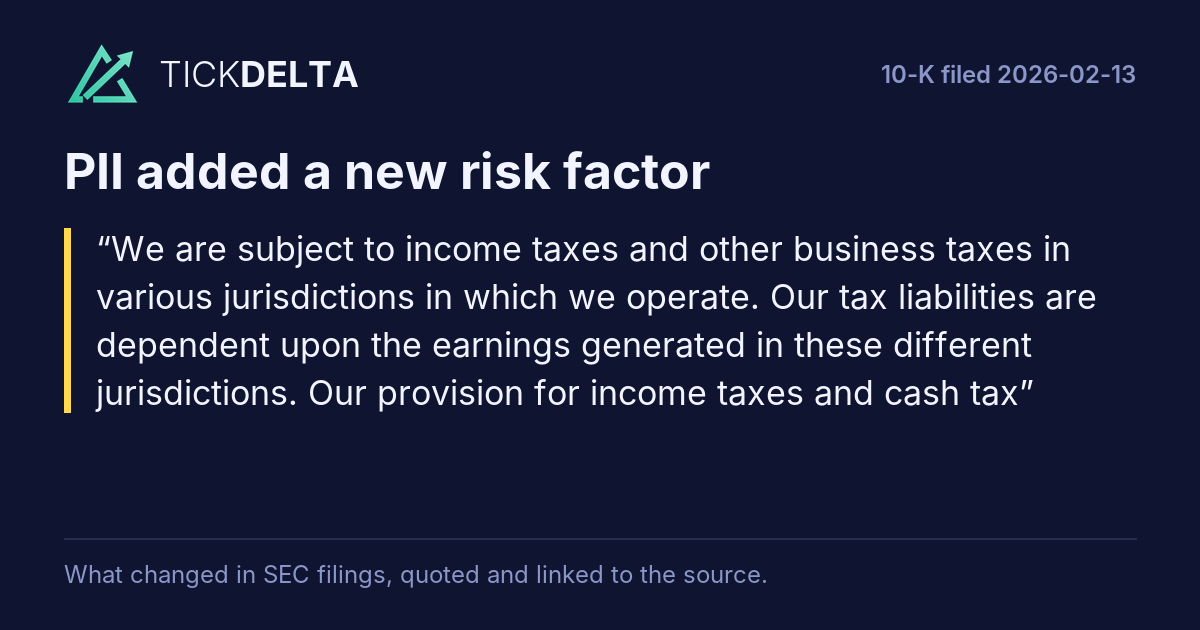
We are subject to income taxes and other business taxes in various jurisdictions in which we operate. Our tax liabilities are dependent upon the earnings generated in these different jurisdictions. Our provision for income taxes and cash tax
Show the other 1
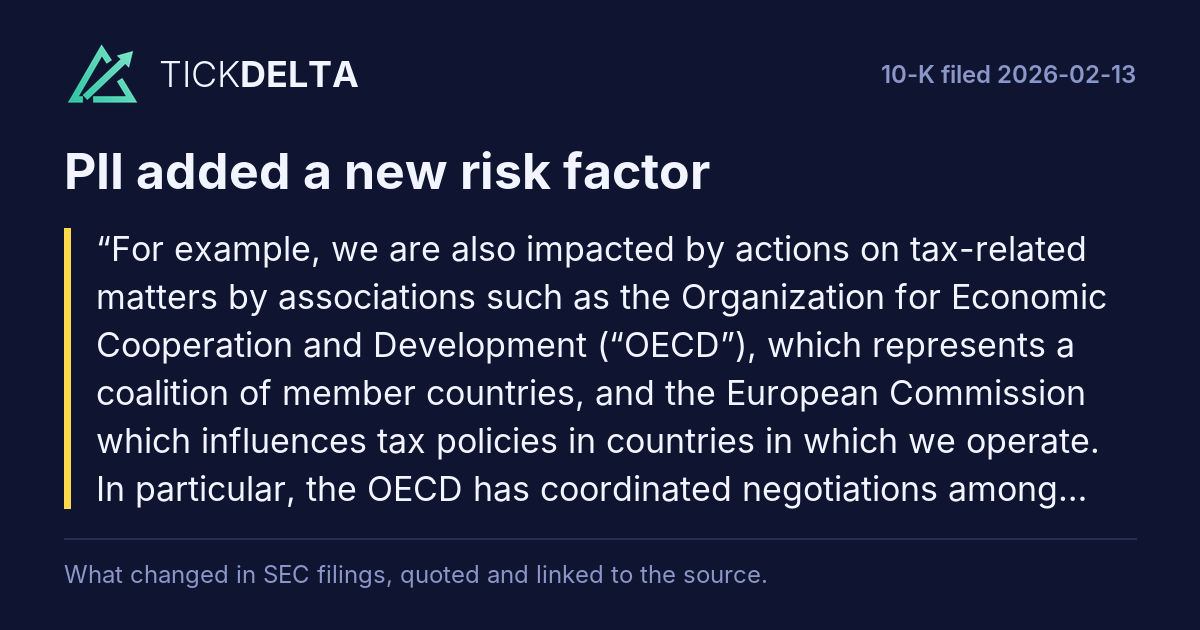
For example, we are also impacted by actions on tax-related matters by associations such as the Organization for Economic Cooperation and Development (“OECD”), which represents a coalition of member countries, and the European Commission which influences tax policies in countries in which we operate. In particular, the OECD has coordinated negotiations among more than 140 jurisdictions with the goal of achieving consensus on various substantial changes to the international tax framework, including a 15% global minimum taxation regime (“Pillar Two”). Pillar Two took effect in several jurisdictions in which we operate starting in 2024 and will increase the burden and costs of our tax compliance. We continue to monitor these legislative developments, which based on information available, have not had material impacts to the financial statements.
Additionally, the One Big Beautiful Bill Act (the “OBBBA”) was enacted on July 4, 2025. The OBBBA includes the reinstatement of 100% bonus depreciation, immediate expensing of domestic research and experimental (“R&E”) expenditures under new Section 174A of the Internal Revenue Code (“IRC”), and modifications to the interest deduction limitations under Section 163(j) of the IRC. In addition, the OBBBA includes changes to international tax provisions, notably the treatment of Net CFC Tested Income (“NCTI”), formally known as Global Intangible Low-Taxed Income (“GILTI”) and Foreign-Derived Deduction-Eligible Income (“FDDEI”), formally known as Foreign-Derived Intangible Income (“FDII”). The revised NCTI regime eliminates the qualified business asset investment (“QBAI”) exemption, adopts a country-by-country calculation, and reduces deductions under Section 250 of the IRC, which may increase the Company’s effective tax rate on foreign earnings. The FDDEI deduction has also been adjusted, potentially affecting the tax benefits associated with the Company’s export-related income. The OBBBA is not expected to have a material impact on our consolidated financial statements in future periods.
Paragraphs in the 10-Q filed Oct 27, 2026 that were not in the one before
New in the latest 10-Q
3 paragraphs in the 10-Q filed Oct 27, 2026 with nothing like them in the 10-Q filed Jul 28, 2026 (at least half the words must differ; new numbers alone do not count). Quoted exactly, grouped by the item heading above them. This is text that changed, not a judgement of how serious it is.
Financial statements and notes
(5) Represents adjustments for pending class action lawsuit settlements and the related litigation costs, as well as certain legal costs associated with the Company’s active federal patent infringement matter
Read in the 10-Q
Legal proceedings
vacated the pretrial deadlines and the May 5, 2025 trial date. On August 7, 2026, the Company and the plaintiffs agreed to a settlement in principle, which is subject to the approval of the court.
Read in the 10-Q
Item 6
10.a Amendment No. 1 to Amended and Restated Polaris Inc. 2024 Omnibus Incentive Plan, effective as of July 30, 2026.
Read in the 10-Q
The 10-Q's risk factors against the 10-K
Item 1A of the 10-Q filed Oct 27, 2026 against Item 1A of the 10-K filed Feb 13, 2026.
A 10-Q repeats only the risks that changed, so a 10-K paragraph that is missing from it is not counted as removed.
Added is a paragraph with nothing like it in the 10-K, Reworded a sentence that is in both with several words changed,
Quiet changes a sentence in both where one to four words changed and one is a hedge or a modal
(cut words struck through, new words highlighted).
Text on the page, not a score; each links to the filing at sec.gov.
What the 10-Q itself says about its risk factors:Please consider the factors discussed in Part I, Item 1A. “Risk Factors” in our Annual Report on Form 10-K for the year ended December 31, 2025. There have been no material changes or additions to our risk factors discussed in such report which could materially affect the Company’s business, financial condition, or future results.
Read in the 10-Q
1 paragraph in the 10-Q's Item 1A, and none of them adds, rewords or quietly edits a paragraph of the 10-K's.
Phrases used for the first time
Two-word phrases in Risk Factors of the 10-K filed Feb 13, 2026 that are in none of the 1 earlier 10-Ks stored, back to Feb 18, 2025
Where each one is used
- indian motorcycle: Divestiture activity, including the recently completed separation of Indian Motorcycle, poses similar risks, including the potential to: disrupt operations in core, adjacent or acquired businesses; require more time or resources than anticipated to be fully completed; deleverage manufacturing operations or reduce...
- systems products: We use many information technology systems, some of which are managed or hosted by third parties, and manufacture products, some of which are managed by third parties, in operating our business. Those systems and products process potentially sensitive information, including intellectual property; proprietary...
- cybersecurity laws: Our business, data, services and products are subject to increasingly complex data privacy and cybersecurity laws and regulations in the United States (federal and state) as well as internationally, and any failure to comply with these laws and regulations could harm our reputation, expose us to damages and...
- products globally: Tariffs on goods imported to the United States, or countermeasures imposed in response to such tariffs, have increased, and may in the future increase, the cost of goods for our products and reduce our ability to sell our products globally, which may adversely affect our operating results and financial condition....
- recently completed: Divestiture activity, including the recently completed separation of Indian Motorcycle, poses similar risks, including the potential to: disrupt operations in core, adjacent or acquired businesses; require more time or resources than anticipated to be fully completed; deleverage manufacturing operations or reduce...
- completed separation: Divestiture activity, including the recently completed separation of Indian Motorcycle, poses similar risks, including the potential to: disrupt operations in core, adjacent or acquired businesses; require more time or resources than anticipated to be fully completed; deleverage manufacturing operations or reduce...
- anticipated benefits: We currently expect that the separation of Indian Motorcycle will be accretive to our Adjusted EBITDA and adjusted earnings per share due to the anticipated benefits and cost savings. The anticipated benefits and cost savings of the separation of Indian Motorcycle may not be realized fully or at all, may take...
- current presidential: events caused by climate change), the inability to manufacture at or distribute products from the affected facility may result in harm to our reputation, supply shortages, long lead times in supply, increased costs, lower revenues and the loss of customers. We may have to cease operations at impacted facilities or...
Used at least twice, small words left out. Counted, not picked: a phrase can be new because the company renamed something.
What was taken out
4 paragraphs of last year's Risk Factors with nothing like them now. The longest are quoted.
Sources
Item 1A of each 10-K and 10-Q on EDGAR, quoted exactly. Each paragraph links to the filing at sec.gov.
Also
10-K change: what was reworded or cut, section by section.
Work with it
Excel workbook · CSV. Google Sheet that stays up to date: paste =IMPORTDATA("https://tickdelta.com/company/PII/export.csv") into a cell.