Paragraph 23 · 33% changed
Every version of it
Screener
/
SEC EDGAR
/CIK 0000931015
/10-K filed Feb 13, 2026, compared with Feb 18, 2025
/Numbers from the XBRL of the 10-Ks
NYSE
Consumer discretionary · Miscellaneous Transportation Equipment
Polaris Inc. PII
The 10-K against last year's
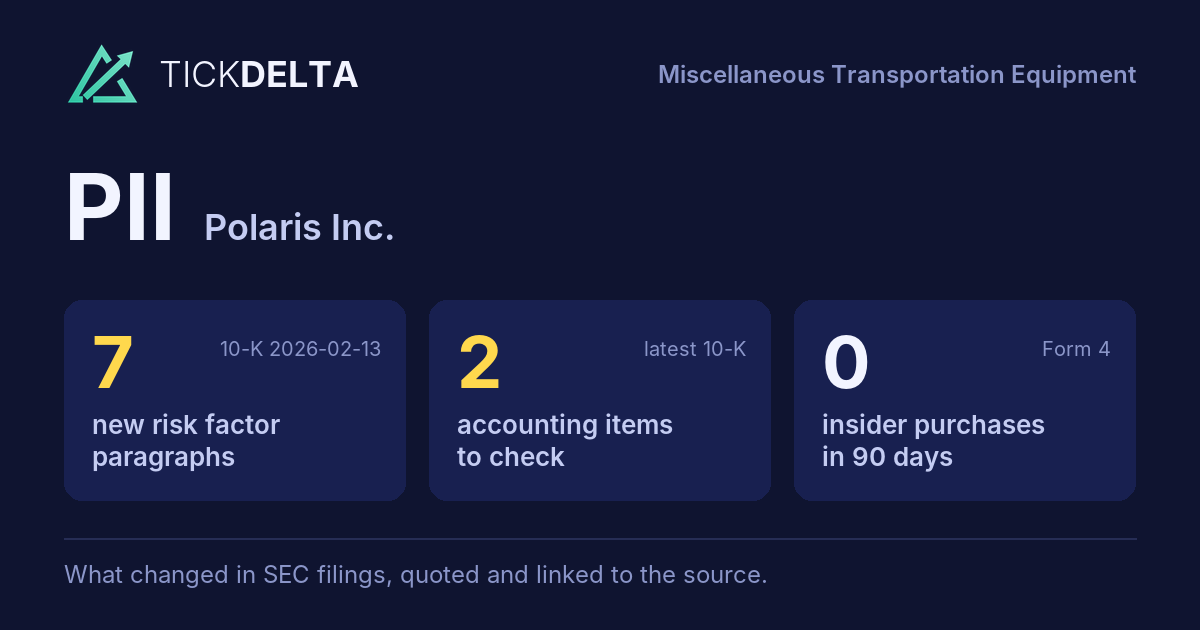
110 changes: 13 added, 7 removed, 90 reworded
10-K Feb 13, 2026 vs Feb 18, 2025
Risk Factors
21.0%
of the text changed · 7,795 words now · 7 new paragraphs, 4 gone
MD&A
25.1%
of the text changed · 6,314 words now · 6 new paragraphs, 3 gone
Legal Proceedings
12.6%
of the text changed · 537 words now
Accounting Policies
11.5%
of the text changed · 4,518 words now
10-K 0001628280-26-008033 (Feb 13, 2026) vs 10-K 0001628280-25-006009 (Feb 18, 2025)
Every paragraph, and how much of it changed
One bar per paragraph, in the order of the 10-K. Height and colour show the share of its words not in the closest paragraph a year earlier; the tallest bars are new paragraphs.
Risk Factors
80 paragraphs · 7 new · 38 reworded · 4 gone · 10-K Feb 13, 2026 against Feb 18, 2025
New paragraph
Reworded (5% of its words or more)
Same or nearly
Paragraph 31 · 32% changed
Every version of it
We assemble vehicles at various facilities around the world. Our facilities are typically designed to produce particular models for particular geographic markets. No single facility is designed to manufacture our full range of vehicles. We also have several locations that serve as wholegoods and PG&A distribution centers, warehouses and office facilities. In addition, we have agreements with other third-party manufacturers to manufacture products on our behalf. behalf, and certain of our distribution centers are third-party managed. Should these or other facilities become unavailable either temporarily or permanently for any number of reasons, including such as supply chain constraints, labor disruptions, changes in legal or regulatory requirements, the occurrence of a contagious disease or illness or catastrophic weather events (including events caused by climate change), the inability to manufacture at the affected facility may result in harm to our reputation, supply shortages, long lead times in supply, increased costs, lower revenues and the loss of customers. We may have to cease operations at impacted facilities or may not be able to easily shift production to other facilities or to make up for lost production. In addition, inefficiencies in our manufacturing due to labor shortages, part shortages, new production lines and the complexity of the start-up of manufacturing new premium products may impact operations negatively. There can be no assurance that our current or future manufacturing footprint will improve and be sufficient to meet customer demand or that we will be able to successfully expand or contract our manufacturing capacity to meet changing demand in a more efficient manner, which could result in loss of revenue, decreased margins and loss of market share.
Paragraph 5 · 32% changed
Every version of it
In addition, we have current and prior financial services arrangements with subsidiaries of Wells Fargo Bank, N.A. and a subsidiary of Huntington Bancshares Incorporated that require us to repurchase products financed and repossessed pursuant to the terms of such arrangements and subject to certain limitations. From time to time, we may also elect to provide guarantees or other credit support in favor of, or related to, these arrangements, including to increase capacity thereunder. If adverse changes to economic conditions result in increased defaults on the loans made under these arrangements, our contractual repurchase obligations (or demands under any guarantees or other credit support) could adversely affect our liquidity and harm our business.
Paragraph 80 · 32% changed
Every version of it
views of regulators in various jurisdictions in which we operate. Any failure, or perceived failure, by us to achieve our goals, further our initiatives, adhere to our public statements, comply with federal, state or international ESG laws and regulations, or meet evolving and varied stakeholder expectations and standards could result in reputational harm, loss of investor confidence, legal and regulatory proceedings against us and materially adversely affect our business, reputation, results of operations, financial condition and stock price. Furthermore, in recent years, “anti-ESG” sentiment has gained momentum across the United States, with several states and the federal government having proposed or enacted anti-ESG policies, legislation or initiatives or issued related legal opinions. The Trump Administration also recently current presidential administration issued an executive order in 2025 opposing diversity, equity and inclusion (“DEI”) initiatives in the private sector, which may draw drawing additional attention to companies who provide products and services to the U.S. government. Such anti-ESG and anti-DEI-related policies, legislation, initiatives, litigation, legal opinions and scrutiny could result in us facing additional compliance obligations, becoming the subject of investigations, enforcement actions or litigation, or sustaining reputational harm.
Paragraph 6 · 29% changed
Every version of it
Paragraph 32 · 29% changed
Every version of it
Paragraph 63 · 25% changed
Every version of it
As a global company, we are subject to laws and regulations in the United States and other countries concerning the handling of personal data, including but not limited to those related to the collection, storage, handling, use, disclosure, transfer, and security of personal data. In addition, we may be required to comply with emerging and established vehicle cybersecurity regulations that govern the protection of electronic systems, software, and data within vehicles. These laws and regulations include, for example, the European Union’s General Data Protection Regulation (“GDPR”) and (“GDPR”), the California Consumer Privacy Act (“CCPA”), the United States Department of Commerce Supply Chain Security Rule, the EU Cyber Resilience Act (“CRA”), the EU Machinery Regulation, the United Nations Regulation 155 Cybersecurity and Cybersecurity Management System, and other similar United privacy and cybersecurity laws. These laws and regulations
Paragraph 22 · 25% changed
Every version of it
There can be no assurance that Strategic Transactions will be completed or that, if completed, they will be successful. Strategic Transactions pose risks with respect to our ability to project and evaluate market demand, potential synergies and cost savings, make correct accounting estimates and achieve anticipated business goals and objectives. As we continue to grow, in part, through Strategic Transactions, our success depends on our ability to anticipate and effectively manage these risks. If acquired businesses do not achieve forecasted results or otherwise fail to meet projections, it could affect our results.
Paragraph 23 · 33% changed
Every version of it
10-K Feb 18, 2025There can be no assurance that Strategic Transactions will be completed or that, if completed, they will be successful. Strategic Transactions pose risks with respect to our ability to project and evaluate market demand, potential synergies and cost savings, make correct accounting estimates and achieve anticipated business goals and objectives. As we continue to grow, in part, through Strategic Transactions, our success depends on our ability to anticipate and effectively manage these risks. If acquired businesses do not achieve forecasted results or otherwise fail to meet projections, it could affect our results.
10-K Feb 13, 2026
continue to grow, in part, through Strategic Transactions, our success depends on our ability to anticipate and effectively manage these risks. If acquired businesses do not achieve forecasted results or otherwise fail to meet projections, it could affect our results.
Paragraph 31 · 32% changed
Every version of it
10-K Feb 18, 2025
We assemble vehicles at various facilities around the world. Our facilities are typically designed to produce particular models for particular geographic markets. No single facility is designed to manufacture our full range of vehicles. We also have several locations that serve as wholegoods and PG&A distribution centers, warehouses and office facilities. In addition, we have agreements with other third-party manufacturers to manufacture products on our behalf. Should these or other facilities become unavailable either temporarily or permanently for any number of reasons, including supply chain constraints, labor disruptions, changes in legal or regulatory requirements, the occurrence of a contagious disease or illness or catastrophic weather events (including events caused by climate change), the inability to manufacture at the affected facility may result in harm to our reputation, supply shortages, long lead times in supply, increased costs, lower revenues and the loss of customers. We may have to cease operations at impacted facilities or may not be able to easily shift production to other facilities or to make up for lost production. In addition, inefficiencies in our manufacturing due to labor shortages, part shortages, new production lines and the complexity of the start-up of manufacturing new premium products may impact operations negatively. There can be no assurance that our current or future manufacturing footprint will improve and be sufficient to meet customer demand or that we will be able to successfully expand or contract our manufacturing capacity to meet changing demand in a more efficient manner, which could result in loss of revenue, decreased margins and loss of market share.
10-K Feb 13, 2026
We assemble vehicles at various facilities around the world. Our facilities are typically designed to produce particular models for particular geographic markets. No single facility is designed to manufacture our full range of vehicles. We also have several locations that serve as wholegoods and PG&A distribution centers, warehouses and office facilities. In addition, we have agreements with other third-party manufacturers to manufacture products on our behalf, and certain of our distribution centers are third-party managed. Should these or other facilities become unavailable either temporarily or permanently for any number of reasons, such as supply chain constraints, labor disruptions, changes in legal or regulatory requirements, the occurrence of a contagious disease or illness or catastrophic weather events (including
Paragraph 5 · 32% changed
Every version of it
10-K Feb 18, 2025
In addition, we have current and prior financial services arrangements with subsidiaries of Wells Fargo Bank, N.A. and a subsidiary of Huntington Bancshares Incorporated that require us to repurchase products financed and repossessed pursuant to the terms of such arrangements and subject to certain limitations. From time to time, we may also elect to provide guarantees or other credit support in favor of, or related to, these arrangements, including to increase capacity thereunder. If adverse changes to economic conditions result in increased defaults on the loans made under these arrangements, our contractual repurchase obligations (or demands under any guarantees or other credit support) could adversely affect our liquidity and harm our business.
10-K Feb 13, 2026
In addition, we have current and prior financial services arrangements with subsidiaries of Wells Fargo Bank, N.A. and a subsidiary of Huntington Bancshares Incorporated that require us to repurchase products financed and repossessed pursuant to the terms of such arrangements and subject to certain limitations. From time to time, we may also elect to
Paragraph 80 · 32% changed
Every version of it
10-K Feb 18, 2025
momentum across the United States, with several states and the federal government having proposed or enacted anti-ESG policies, legislation or initiatives or issued related legal opinions. The Trump Administration also recently issued an executive order opposing diversity, equity and inclusion (“DEI”) initiatives in the private sector, which may draw additional attention to companies who provide products and services to the U.S. government. Such anti-ESG and anti-DEI-related policies, legislation, initiatives, litigation, legal opinions and scrutiny could result in us facing additional compliance obligations, becoming the subject of investigations, enforcement actions or litigation, or sustaining reputational harm.
10-K Feb 13, 2026
views of regulators in various jurisdictions in which we operate. Any failure, or perceived failure, by us to achieve our goals, further our initiatives, adhere to our public statements, comply with federal, state or international ESG laws and regulations, or meet evolving and varied stakeholder expectations and standards could result in reputational harm, loss of investor confidence, legal and regulatory proceedings against us and materially adversely affect our business, reputation, results of operations, financial condition and stock price. Furthermore, in recent years, “anti-ESG” sentiment has gained momentum across the United States, with several states and the federal government having proposed or enacted anti-ESG policies, legislation or initiatives or issued related legal opinions. The current presidential administration issued an executive order in 2025 opposing diversity, equity and inclusion (“DEI”) initiatives in the private sector, drawing additional attention to companies who provide products and services to the U.S. government. Such anti-ESG and anti-DEI-related policies, legislation, initiatives, litigation, legal opinions and scrutiny could result in us facing additional compliance obligations, becoming the subject of investigations, enforcement actions or litigation, or sustaining reputational harm.
Paragraph 6 · 29% changed
Every version of it
10-K Feb 18, 2025In addition, we have current and prior financial services arrangements with subsidiaries of Wells Fargo Bank, N.A. and a subsidiary of Huntington Bancshares Incorporated that require us to repurchase products financed and repossessed pursuant to the terms of such arrangements and subject to certain limitations. From time to time, we may also elect to provide guarantees or other credit support in favor of, or related to, these arrangements, including to increase capacity thereunder. If adverse changes to economic conditions result in increased defaults on the loans made under these arrangements, our contractual repurchase obligations (or demands under any guarantees or other credit support) could adversely affect our liquidity and harm our business.
10-K Feb 13, 2026
provide guarantees or other credit support in favor of, or related to, these arrangements, including to increase capacity thereunder. If adverse changes to economic conditions result in increased defaults on the loans made under these arrangements, our contractual repurchase obligations (or demands under any guarantees or other credit support) could adversely affect our liquidity and harm our business.
Paragraph 32 · 29% changed
Every version of it
10-K Feb 18, 2025We assemble vehicles at various facilities around the world. Our facilities are typically designed to produce particular models for particular geographic markets. No single facility is designed to manufacture our full range of vehicles. We also have several locations that serve as wholegoods and PG&A distribution centers, warehouses and office facilities. In addition, we have agreements with other third-party manufacturers to manufacture products on our behalf. Should these or other facilities become unavailable either temporarily or permanently for any number of reasons, including supply chain constraints, labor disruptions, changes in legal or regulatory requirements, the occurrence of a contagious disease or illness or catastrophic weather events (including events caused by climate change), the inability to manufacture at the affected facility may result in harm to our reputation, supply shortages, long lead times in supply, increased costs, lower revenues and the loss of customers. We may have to cease operations at impacted facilities or may not be able to easily shift production to other facilities or to make up for lost production. In addition, inefficiencies in our manufacturing due to labor shortages, part shortages, new production lines and the complexity of the start-up of manufacturing new premium products may impact operations negatively. There can be no assurance that our current or future manufacturing footprint will improve and be sufficient to meet customer demand or that we will be able to successfully expand or contract our manufacturing capacity to meet changing demand in a more efficient manner, which could result in loss of revenue, decreased margins and loss of market share.
10-K Feb 13, 2026
events caused by climate change), the inability to manufacture at or distribute products from the affected facility may result in harm to our reputation, supply shortages, long lead times in supply, increased costs, lower revenues and the loss of customers. We may have to cease operations at impacted facilities or may not be able to easily shift production or distribution to other facilities or to make up for lost production. In addition, inefficiencies in our manufacturing due to labor shortages, part shortages, new production lines and the complexity of the start-up of manufacturing new premium products may impact operations negatively. Furthermore, we continue to evaluate our manufacturing footprint in light of tariffs imposed by the current presidential administration and have shifted, and intend to continue shifting, our Chinese manufacturing to other facilities in response to such tariffs. There can be no assurance that our current or future manufacturing and distribution footprint will improve and be sufficient to meet customer demand or that we will be able to successfully expand or contract our manufacturing and distribution capacity in a more efficient manner, which could result in loss of revenue, decreased margins and loss of market share.
Paragraph 63 · 25% changed
Every version of it
10-K Feb 18, 2025
As a global company, we are subject to laws and regulations in the United States and other countries concerning the handling of personal data, including but not limited to those related to the collection, storage, handling, use, disclosure, transfer, and security of personal data. These laws and regulations include, for example, the European Union’s General Data Protection Regulation (“GDPR”) and the California Consumer Privacy Act (“CCPA”), and other similar United
10-K Feb 13, 2026
As a global company, we are subject to laws and regulations in the United States and other countries concerning the handling of personal data, including but not limited to those related to the collection, storage, handling, use, disclosure, transfer, and security of personal data. In addition, we may be required to comply with emerging and established vehicle cybersecurity regulations that govern the protection of electronic systems, software, and data within vehicles. These laws and regulations include, for example, the European Union’s General Data Protection Regulation (“GDPR”), the California Consumer Privacy Act (“CCPA”), the United States Department of Commerce Supply Chain Security Rule, the EU Cyber Resilience Act (“CRA”), the EU Machinery Regulation, the United Nations Regulation 155 Cybersecurity and Cybersecurity Management System, and other similar privacy and cybersecurity laws. These laws and regulations
Paragraph 22 · 25% changed
Every version of it
10-K Feb 18, 2025
There can be no assurance that Strategic Transactions will be completed or that, if completed, they will be successful. Strategic Transactions pose risks with respect to our ability to project and evaluate market demand, potential synergies and cost savings, make correct accounting estimates and achieve anticipated business goals and objectives. As we continue to grow, in part, through Strategic Transactions, our success depends on our ability to anticipate and effectively manage these risks. If acquired businesses do not achieve forecasted results or otherwise fail to meet projections, it could affect our results.
10-K Feb 13, 2026
There can be no assurance that Strategic Transactions will be completed or that, if completed, they will be successful. Strategic Transactions pose risks with respect to our ability to project and evaluate market demand, potential synergies and cost savings, make correct accounting estimates and achieve anticipated business goals and objectives. As we
MD&A
91 paragraphs · 6 new · 69 reworded · 3 gone · 10-K Feb 13, 2026 against Feb 18, 2025
New paragraph
Reworded (5% of its words or more)
Same or nearly
Paragraph 70 · 49% changed
We repurchased a total of 1.0 million did not repurchase shares of our common stock for $82.7 million in open-market transactions under our share repurchase program during 2024, which had a favorable impact on diluted net income from continuing operations per share of three cents. 2025. As of December 31, 2024, our Board of Directors has authorized us to repurchase 2025, up to an additional $1,109.3 million $1.1 billion of our common stock. stock remains available for repurchase under our share repurchase program.
Paragraph 17 · 49% changed
The year-over-year decrease increase in cost of sales was primarily due to decreased shipments and lower net pricing higher materials costs driven by higher promotional costs, incremental tariff charges, partially offset by product mix. reduced warranty expense.
Paragraph 13 · 47% changed
Sales in the United States decreased increased primarily as a result of lower shipments in all segments. higher Marine and ORV shipments, partially offset by reduced snowmobile and motorcycle shipments.
Paragraph 31 · 44% changed
Sales to customers outside of North America decreased 11 percent were approximately flat in 2024 due to lower 2025. This was primarily the result of reduced ORV and shipments, mostly offset by increased snowmobile shipments.
Paragraph 12 · 43% changed
Paragraph 19 · 43% changed
Operating expenses for 2024, 2025, in absolute dollars, decreased due to reduced selling dollars and marketing and research and development expenses, partially offset by increased general and administrative expenses. Operating expenses for 2024, as a percentage of sales, increased compared to 2023, primarily due to decreased leverage of fixed costs impairment and other charges recorded as a result of reduced sales volumes. the Indian Motorcycle business being classified as held for sale, goodwill and other intangible asset impairment charges recorded, and higher general and administrative and research and development expenses.
Paragraph 66 · 43% changed
The agreements governing the credit facility and the Master Note Purchase Agreement contain agreement contains covenants that require us to maintain certain financial ratios, including minimum interest coverage and maximum leverage ratios. The agreements require us to maintain an interest coverage ratio of not less than 3.00 to 1.00 and a leverage ratio of not more than 3.50 to 1.00 on a rolling four quarter basis. In December 2024, The interest coverage ratio is calculated as Adjusted EBITDA to interest expense for the Company entered into an amendment (the “NPA Amendment”) to the Existing Master Note Purchase Agreement. then most-recently ended four fiscal quarters. The NPA Amendment amended the Existing Note Purchase Agreement to revise the leverage ratio covenant from a gross leverage ratio is calculated as consolidated funded indebtedness less cash and cash equivalents, capped at $300 million, to a net leverage ratio and revise Adjusted EBITDA for the then most-recently ended four fiscal quarters. The Credit Facility Amendment completed in June 2025 modified the requirements related to the interest coverage ratio covenant definition to be based on EBITDA to interest expense. The credit facility was also amended in December 2024 and, as part of such amendment, and leverage ratio during the Covenant Relief Period. During the Covenant Relief Period, the interest coverage ratio covenant definition was revised is 2.50 to be based on EBITDA 1.00 for the quarters ending June 30, 2025, September 30, 2025 and December 31, 2025, and 2.00 to interest expense. 1.00 for the quarters ending March 31, 2026 and June 30, 2026. During the Covenant Relief Period, the leverage ratio is 4.00 to 1.00 for the quarter ending June 30, 2025, 4.50 to 1.00 for the quarter ending September 30, 2025, and 5.50 to 1.00 for the quarters ending December 31, 2025, March 31, 2026 and June 30, 2026.
Paragraph 85 · 43% changed
Paragraph 70 · 49% changed
10-K Feb 18, 2025
We repurchased a total of 1.0 million shares of our common stock for $82.7 million during 2024, which had a favorable impact on diluted net income from continuing operations per share of three cents. As of December 31, 2024, our Board of Directors has authorized us to repurchase up to an additional $1,109.3 million of our common stock.
10-K Feb 13, 2026
We did not repurchase shares of our common stock in open-market transactions under our share repurchase program during 2025. As of December 31, 2025, up to an additional $1.1 billion of our common stock remains available for repurchase under our share repurchase program.
Paragraph 17 · 49% changed
10-K Feb 18, 2025
The year-over-year decrease in sales was due to decreased shipments and lower net pricing driven by higher promotional costs, partially offset by product mix.
10-K Feb 13, 2026
The year-over-year increase in cost of sales was primarily due to higher materials costs driven by incremental tariff charges, partially offset by reduced warranty expense.
Paragraph 13 · 47% changed
10-K Feb 18, 2025
Sales in the United States decreased primarily as a result of lower shipments in all segments.
10-K Feb 13, 2026
Sales in the United States increased primarily as a result of higher Marine and ORV shipments, partially offset by reduced snowmobile and motorcycle shipments.
Paragraph 31 · 44% changed
10-K Feb 18, 2025
Sales to customers outside of North America decreased 11 percent in 2024 due to lower ORV and snowmobile shipments.
10-K Feb 13, 2026
Sales to customers outside of North America were approximately flat in 2025. This was primarily the result of reduced ORV shipments, mostly offset by increased snowmobile shipments.
Paragraph 12 · 43% changed
10-K Feb 18, 2025Gross profit for 2024, as a percentage of sales, decreased primarily due to lower net pricing driven by higher promotional costs, product mix, and decreased leverage of fixed costs as a result of reduced sales volumes, partially offset by favorable operational costs.
10-K Feb 13, 2026
The year-over-year volume decrease was primarily due to reduced recreational ORV, snowmobile and On Road shipments, partially offset by increased utility ORV shipments. Product mix was favorable as a result of a higher sales mix of ORVs. This favorability was partially offset by lower net pricing driven by higher promotional costs.
Paragraph 19 · 43% changed
10-K Feb 18, 2025
Operating expenses for 2024, in absolute dollars, decreased due to reduced selling and marketing and research and development expenses, partially offset by increased general and administrative expenses. Operating expenses for 2024, as a percentage of sales, increased compared to 2023, primarily due to decreased leverage of fixed costs as a result of reduced sales volumes.
10-K Feb 13, 2026
Operating expenses for 2025, in absolute dollars and as a percentage of sales, increased primarily due to impairment and other charges recorded as a result of the Indian Motorcycle business being classified as held for sale, goodwill and other intangible asset impairment charges recorded, and higher general and administrative and research and development expenses.
Paragraph 66 · 43% changed
10-K Feb 18, 2025
The agreements governing the credit facility and the Master Note Purchase Agreement contain covenants that require us to maintain certain financial ratios, including minimum interest coverage and maximum leverage ratios. The agreements require us to maintain an interest coverage ratio of not less than 3.00 to 1.00 and a leverage ratio of not more than 3.50 to 1.00 on a rolling four quarter basis. In December 2024, the Company entered into an amendment (the “NPA Amendment”) to the Existing Master Note Purchase Agreement. The NPA Amendment amended the Existing Note Purchase Agreement to revise the leverage ratio covenant from a gross leverage ratio to a net leverage ratio and revise the interest coverage ratio covenant definition to be based on EBITDA to interest expense. The credit facility was also amended in December 2024 and, as part of such amendment, the interest coverage ratio covenant definition was revised to be based on EBITDA to interest expense.
10-K Feb 13, 2026
The credit agreement contains covenants that require us to maintain certain financial ratios, including minimum interest coverage and maximum leverage ratios. The agreements require us to maintain an interest coverage ratio of not less than 3.00 to 1.00 and a leverage ratio of not more than 3.50 to 1.00 on a rolling four quarter basis. The interest coverage ratio is calculated as Adjusted EBITDA to interest expense for the then most-recently ended four fiscal quarters. The leverage ratio is calculated as consolidated funded indebtedness less cash and cash equivalents, capped at $300 million, to Adjusted EBITDA for the then most-recently ended four fiscal quarters. The Credit Facility Amendment completed in June 2025 modified the requirements related to the interest coverage ratio and leverage ratio during the Covenant Relief Period. During the Covenant Relief Period, the interest coverage ratio is 2.50 to 1.00 for the quarters ending June 30, 2025, September 30, 2025 and December 31, 2025, and 2.00 to 1.00 for the quarters ending March 31, 2026 and June 30, 2026. During the Covenant Relief Period, the leverage ratio is 4.00 to 1.00 for the quarter ending June 30, 2025, 4.50 to 1.00 for the quarter ending September 30, 2025, and 5.50 to 1.00 for the quarters ending December 31, 2025, March 31, 2026 and June 30, 2026.
Paragraph 85 · 43% changed
10-K Feb 18, 2025In estimating fair value using the market approach, we identify a group of comparable publicly traded companies for each reporting unit that are similar in terms of size and product offering. These groups of comparable companies are used to develop multiples based on total market-based invested capital as a multiple of EBITDA. We determine our estimated values by applying these comparable EBITDA multiples to the operating results of our reporting units. The ultimate fair value of each reporting unit is determined considering the results of both valuation methods. Inputs used to estimate these fair values include significant unobservable inputs that reflect our assumptions about the inputs that market participants would use and, therefore, the fair value assessments are classified within Level 3 of the fair value hierarchy.
10-K Feb 13, 2026
methods. Inputs used to estimate these fair values include significant unobservable inputs that reflect our assumptions about the inputs that market participants would use and, therefore, the fair value assessments are classified within Level 3 of the fair value hierarchy.
A paragraph is matched with the one last year that shares the most of its words; under half in common makes it new. The paragraphs shown are the 8 reworded the most in each section.
The paragraph that changed most in each section
The redline
Marked against last year's 10-K: cut words struck through, new words highlighted.
MD&A227 words changed in this paragraph; it is 39% similar to last year's version.
The agreements governing the credit facility and the Master Note Purchase Agreement contain agreement contains covenants that require us to maintain certain financial ratios, including minimum interest coverage and maximum leverage ratios. The agreements require us to maintain an interest coverage ratio of not less than 3.00 to 1.00 and a leverage ratio of not more than 3.50 to 1.00 on a rolling four quarter basis. In December 2024, The interest coverage ratio is calculated as Adjusted EBITDA to interest expense for the Company entered into an amendment (the “NPA Amendment”) to the Existing Master Note Purchase Agreement. then most-recently ended four fiscal quarters. The NPA Amendment amended the Existing Note Purchase Agreement to revise the leverage ratio covenant from a gross leverage ratio is calculated as consolidated funded indebtedness less cash and cash equivalents, capped at $300 million, to a net leverage ratio and revise Adjusted EBITDA for the then most-recently ended four fiscal quarters. The Credit Facility Amendment completed in June 2025 modified the requirements related to the interest coverage ratio covenant definition to be based on EBITDA to interest expense. The credit facility was also amended in December 2024 and, as part of such amendment, and leverage ratio during the Covenant Relief Period. During the Covenant Relief Period, the interest coverage ratio covenant definition was revised is 2.50 to be based on EBITDA 1.00 for the quarters ending June 30, 2025, September 30, 2025 and December 31, 2025, and 2.00 to interest expense. 1.00 for the quarters ending March 31, 2026 and June 30, 2026. During the Covenant Relief Period, the leverage ratio is 4.00 to 1.00 for the quarter ending June 30, 2025, 4.50 to 1.00 for the quarter ending September 30, 2025, and 5.50 to 1.00 for the quarters ending December 31, 2025, March 31, 2026 and June 30, 2026.
Source: Item 7, 10-K 0001628280-26-008033 vs Item 7, 10-K 0001628280-25-006009
Risk Factors166 words changed in this paragraph; it is 56% similar to last year's version.
We assemble vehicles at various facilities around the world. Our facilities are typically designed to produce particular models for particular geographic markets. No single facility is designed to manufacture our full range of vehicles. We also have several locations that serve as wholegoods and PG&A distribution centers, warehouses and office facilities. In addition, we have agreements with other third-party manufacturers to manufacture products on our behalf. behalf, and certain of our distribution centers are third-party managed. Should these or other facilities become unavailable either temporarily or permanently for any number of reasons, including such as supply chain constraints, labor disruptions, changes in legal or regulatory requirements, the occurrence of a contagious disease or illness or catastrophic weather events (including events caused by climate change), the inability to manufacture at the affected facility may result in harm to our reputation, supply shortages, long lead times in supply, increased costs, lower revenues and the loss of customers. We may have to cease operations at impacted facilities or may not be able to easily shift production to other facilities or to make up for lost production. In addition, inefficiencies in our manufacturing due to labor shortages, part shortages, new production lines and the complexity of the start-up of manufacturing new premium products may impact operations negatively. There can be no assurance that our current or future manufacturing footprint will improve and be sufficient to meet customer demand or that we will be able to successfully expand or contract our manufacturing capacity to meet changing demand in a more efficient manner, which could result in loss of revenue, decreased margins and loss of market share.
Source: Item 1A, 10-K 0001628280-26-008033 vs Item 1A, 10-K 0001628280-25-006009
Legal Proceedings92 words changed in this paragraph; it is 89% similar to last year's version.
As of the date of the filing of this Annual Report, we are party to certain class action and putative class action lawsuits brought by the same plaintiff’s counsel and largely repeating the same allegations regarding various state consumer protection laws focused on rollover protection structures’ certifications for various Polaris off-road vehicles sold in California. The first case brought in federal court in California related to this matter—Guzman/Albright—was first reported in the Company’s Annual Report on Form 10-K for the year ended December 31, 2020. The district court granted summary judgment against both plaintiffs’ claims, which the plaintiffs appealed. The Ninth Circuit issued two rulings in September 2022 that reversed the district court’s summary judgment rulings and remanded the case to the district court with instructions to dismiss one plaintiff’s claims without prejudice. The plaintiff whose claims were dismissed without prejudice refiled the putative class action in California State Court under the name Albright. In June 2023, the Albright court granted the parties’ stipulation to stay that case pending a decision on class certification in federal court in the Guzman case. On September 27, 2023, the district court in Guzman entered an order granting in part and denying in part plaintiff’s motion for class certification. The district court certified a California class for plaintiff’s claim seeking money damages under the California Consumers Legal Remedies Act but denied class certification on plaintiff’s claim seeking injunctive relief under Fed. R. Civ. P. 23(b)(2). On October 11, 2023, Polaris filed a petition to appeal the portion of the district court’s order granting class certification. On December 14, 2023, the Ninth Circuit denied Polaris’s petition. On December 18, 2024, January 16, 2026, the state court in Albright entered an order setting a hearing for June 20, 2025 March 24, 2026 to review the stay of proceedings in that case. Plaintiff’s counsel’s related case—Hellman/Berlanga—was first reported in the Company’s quarterly report for the period ended June 30, 2021. Since then, the Hellman plaintiff has been dismissed and, in May 2023, the remaining plaintiff in the Berlanga case filed a motion for class certification, which we opposed. On July 16, 2024, the federal district court entered an order granting in part and denying in part plaintiff’s motion for class certification. The federal district court certified a California class for plaintiff’s claim seeking money damages but denied class certification on plaintiff’s claim seeking injunctive relief. On July 17, 2024, the federal district court ordered that the Guzman case and the Berlanga case be consolidated for all purposes. Trial is currently set to begin on On February 27, 2025, the federal district court vacated the pretrial deadlines and the May 5, 2025. 2025 trial date. The court will issue a new schedule and trial date upon its rulings on the pending summary judgment and class decertification motions.
Source: Item 3, 10-K 0001628280-26-008033 vs Item 3, 10-K 0001628280-25-006009
Accounting Policies91 words changed in this paragraph; it is 56% similar to last year's version.
Source: Item 8, Note 1 – Organization and Significant Accounting Policies, 10-K 0001628280-26-008033 vs Item 8, Note 1 – Organization and Significant Accounting Policies, 10-K 0001628280-25-006009
Sentences and paragraphs added, removed or reworded
Every change, by type
Sentences and paragraphs of PII's Risk Factors and MD&A, 10-K Feb 13, 2026 against 10-K Feb 18, 2025. Each links to the text at sec.gov.
Quiet changes are sentences kept from last year with one to four words changed, at least one of them a hedge, a modal or a qualifier (may, could, will, not, significant, material…). A year or date rolling forward is not counted.
The full word list
adverse, adversely, all, although, anticipate, anticipates, any, approximately, believe, believes, can, cannot, certain, could, expect, expects, generally, however, if, intend, intends, largely, likely, many, material, materially, may, might, most, must, never, no, not, possible, primarily, probable, should, significant, significantly, some, substantial, substantially, unlikely, will, would
AddedRisk Factors
Tariffs on goods imported to the United States, or countermeasures imposed in response to such tariffs, have increased, and may in the future increase, the cost of goods for our products and reduce our ability to sell our products globally, which may adversely affect our operating results and financial condition. The U.S. government has implemented a general tariff on all imports from countries not exempted under certain trade reciprocity criteria and elevated tariffs have been imposed on imports from major trading partners. We currently procure components from countries subject to such tariffs, which are utilized in our facilities in the United States and Mexico. A portion of our annual sales originate from products manufactured in our facilities in Mexico, and we sell our products globally. As a result of the current tariffs, we anticipate increased supply chain challenges, commodity cost volatility, economic uncertainty, and economic pressures on customers and consumers as a result of the challenges of high inflation combined with the effects of increased tariffs. The tariff policy environment is rapidly evolving, however, and it is impossible to predict with any certainty the effects that these and any new tariffs may ultimately have on our industry or our financial condition. The ultimate impact of any tariffs will depend on various factors, including how long such tariffs remain in place, the ultimate levels of such tariffs and how other countries respond to the U.S. tariffs. While we have implemented measures to mitigate these potential impacts and continue to evaluate additional measures that may be appropriate, the current and proposed tariffs and these other factors have had, and may in the future have, a material negative effect on our profitability. We continue to evaluate these factors and their potential effects.
Read it in 10-K Feb 13, 2026 at sec.gov
AddedRisk Factors
levels to meet fluctuating demand, or adjust pricing to offset inflation, tariffs or increased supply chain costs could materially and adversely affect our financial results and have a material adverse effect on our performance.
Read it in 10-K Feb 13, 2026 at sec.gov
AddedRisk Factors
We currently expect that the separation of Indian Motorcycle will be accretive to our Adjusted EBITDA and adjusted earnings per share due to the anticipated benefits and cost savings. The anticipated benefits and cost savings of the separation of Indian Motorcycle may not be realized fully or at all, may take longer than expected, and may require more non-recurring costs and expenditures to realize than expected. Additionally, the separation of Indian Motorcycle could have other adverse effects that are not currently anticipated.
Read it in 10-K Feb 13, 2026 at sec.gov
AddedRisk Factors
If we are the subject of legal proceedings, regardless of the merits of the claims at issue or the ultimate outcome of a case or claim, any litigation could be costly to defend, result in an increase of our insurance premiums, and exhaust any available insurance coverage. Claims against us that result in entry of a judgment or that we settle that are not covered or not sufficiently covered by insurance (particularly an uninsured issue), or which fall within retained liability under our insurance, could materially and adversely affect our financial position, results of operations or cash flows.
Read it in 10-K Feb 13, 2026 at sec.gov
AddedRisk Factors
We are subject to income taxes and other business taxes in various jurisdictions in which we operate. Our tax liabilities are dependent upon the earnings generated in these different jurisdictions. Our provision for income taxes and cash tax
Read it in 10-K Feb 13, 2026 at sec.gov
AddedRisk Factors
For example, we are also impacted by actions on tax-related matters by associations such as the Organization for Economic Cooperation and Development (“OECD”), which represents a coalition of member countries, and the European Commission which influences tax policies in countries in which we operate. In particular, the OECD has coordinated negotiations among more than 140 jurisdictions with the goal of achieving consensus on various substantial changes to the international tax framework, including a 15% global minimum taxation regime (“Pillar Two”). Pillar Two took effect in several jurisdictions in which we operate starting in 2024 and will increase the burden and costs of our tax compliance. We continue to monitor these legislative developments, which based on information available, have not had material impacts to the financial statements.
Read it in 10-K Feb 13, 2026 at sec.gov
AddedRisk Factors
Additionally, the One Big Beautiful Bill Act (the “OBBBA”) was enacted on July 4, 2025. The OBBBA includes the reinstatement of 100% bonus depreciation, immediate expensing of domestic research and experimental (“R&E”) expenditures under new Section 174A of the Internal Revenue Code (“IRC”), and modifications to the interest deduction limitations under Section 163(j) of the IRC. In addition, the OBBBA includes changes to international tax provisions, notably the treatment of Net CFC Tested Income (“NCTI”), formally known as Global Intangible Low-Taxed Income (“GILTI”) and Foreign-Derived Deduction-Eligible Income (“FDDEI”), formally known as Foreign-Derived Intangible Income (“FDII”). The revised NCTI regime eliminates the qualified business asset investment (“QBAI”) exemption, adopts a country-by-country calculation, and reduces deductions under Section 250 of the IRC, which may increase the Company’s effective tax rate on foreign earnings. The FDDEI deduction has also been adjusted, potentially affecting the tax benefits associated with the Company’s export-related income. The OBBBA is not expected to have a material impact on our consolidated financial statements in future periods.
Read it in 10-K Feb 13, 2026 at sec.gov
RemovedRisk Factors
Show the other 36
RemovedRisk Factors
RemovedRisk Factors
RemovedRisk Factors
RewordedRisk Factors
Should these or other facilities become unavailable either temporarily or permanently for any number of reasons, including such as supply chain constraints, labor disruptions, changes in legal or regulatory requirements, the occurrence of a contagious disease or illness or catastrophic weather events (including events caused by climate change), the inability to manufacture at the affected facility may result in harm to our reputation, supply shortages, long lead times in supply, increased costs, lower revenues and the loss of customers.
Read it in 10-K Feb 13, 2026 at sec.gov
RewordedRisk Factors
Our operations and sales are also subject to risks related to political and economic instability, trade and political tension between the United States and countries in which we have operations or do business, increased enforcement and scrutiny from tax and trade authorities across the globe, acts of war, increased costs of customizing products for foreign countries, labor market conditions, the imposition of tariffs and other trade barriers or costs, the impact of government laws and regulations, the effects of income and withholding taxes, governmental expropriation and differences in business practices in different markets, and multiple, changing, and often inconsistent enforcement of laws, rules, and regulations, including rules relating to environmental, health, and safety matters.
Read it in 10-K Feb 13, 2026 at sec.gov
RewordedRisk Factors
These laws and regulations include, for example, the European Union’s General Data Protection Regulation (“GDPR”) and (“GDPR”), the California Consumer Privacy Act (“CCPA”), the United States Department of Commerce Supply Chain Security Rule, the EU Cyber Resilience Act (“CRA”), the EU Machinery Regulation, the United Nations Regulation 155 Cybersecurity and Cybersecurity Management System, and other similar United privacy and cybersecurity laws.
Read it in 10-K Feb 13, 2026 at sec.gov
RewordedRisk Factors
A negative outcome in one or more of these lawsuits lawsuits, whether pursuant to a judgment, ruling or a settlement, could result in an award or the payment of damages (for which we are not insured or for which our insurance policies are insufficient to fully cover), including punitive damages, or fines, reputational harm, interruption or modification of our business, or other sanctions, as well as legal and punitive damages, or fines, reputational harm, interruption or modification of our business, or other sanctions, as well as legal and other costs, any of which may be significant and may have a negative impact on our business, operating results and cash flows.
Read it in 10-K Feb 13, 2026 at sec.gov
RewordedRisk Factors
RewordedRisk Factors
From time to time, we drive growth in manage our businesses and accelerate opportunities to expand our global presence and customer base portfolio through targeted acquisitions, non-consolidated investments, alliances, and new joint ventures and partnerships partnerships, as well as through divestitures (each a “Strategic Transaction”).
Read it in 10-K Feb 13, 2026 at sec.gov
RewordedRisk Factors
For example, lack of snowfall during winter has, has in the past, and may continue to, in the future, materially adversely affect snowmobile sales; excessive rain (including as a result of hurricanes or other extreme storm events) before and during spring and summer may materially adversely affect sales of off-road vehicles and boats; boats during rainy seasons in various geographies; a lack of rain in certain areas may limit boat usage and may materially adversely affect sales of boats; and wild fires may damage areas where our customers ride our off-road vehicles.
Read it in 10-K Feb 13, 2026 at sec.gov
RewordedRisk Factors
Our business, data, services and products are subject to United States federal and state and international increasingly complex data privacy and cybersecurity laws and regulations in the United States (federal and state) as well as internationally, and any failure to comply with these laws and regulations could harm our reputation, expose us to damages and otherwise adversely affect our business.
Read it in 10-K Feb 13, 2026 at sec.gov
RewordedRisk Factors
RewordedRisk Factors
Product development requires significant financial, financial resources, technological resources, innovations (including technological advancements, such as artificial intelligence, machine learning and augmented reality) and other resources.
Read it in 10-K Feb 13, 2026 at sec.gov
RewordedRisk Factors
Additionally, weak demand for, or quality issues with, our products or any failure on our end to actively manage dealer inventory levels of our products may cause dealers and distributors to voluntarily or involuntarily reduce or terminate their relationship with us.
Read it in 10-K Feb 13, 2026 at sec.gov
RewordedRisk Factors
AddedMD&A
On October 10, 2025, we entered into a definitive agreement to sell a majority interest in the Indian Motorcycle business. During the year ended December 31, 2025, operating results of the Indian Motorcycle business were reported in our On Road segment and its assets and liabilities were classified as held for sale as of December 31, 2025. The sale closed in the first quarter of 2026.
Read it in 10-K Feb 13, 2026 at sec.gov
AddedMD&A
We continue to monitor macroeconomic trends and uncertainties and changes in international trade relations and trade policy, including those related to tariffs. The U.S. government has implemented a general tariff on all imports from countries not exempted under certain trade reciprocity criteria and elevated tariffs have been imposed on imports from major trading partners. Impacted countries have and may impose retaliatory tariffs, and such actions could give rise to an escalation of other trade measures by the countries subjected to such tariffs. Although the validity of certain tariffs are being challenged in litigation pending before the Supreme Court of the United States, there can be no guarantee about the outcome of such proceedings. The tariff policy environment is rapidly evolving and there is no guarantee that additional or increased tariffs will not be imposed.
Read it in 10-K Feb 13, 2026 at sec.gov
AddedMD&A
We currently procure components from countries subject to such tariffs, which are utilized in our facilities in the United States and Mexico. A portion of our annual sales originate from products manufactured in our facilities in Mexico, and we sell our products globally. As a result of the current tariffs, we anticipate increased supply chain challenges, commodity cost volatility, economic uncertainty, and economic pressures on customers and consumers as a result of the challenges of high inflation combined with the effects of increased tariffs. To mitigate the impact of tariffs on our supply chain and manufacturing, we continue to evaluate sourcing alternatives, negotiate with suppliers, and work to increase the percentage of shipments qualified under favorable trade agreements. Incremental tariffs and changed trade policies had a notable impact on our financial results for 2025, and could continue to adversely impact our results in the future. We will continue to evaluate the impact of tariffs on our operations and profitability.
Read it in 10-K Feb 13, 2026 at sec.gov
AddedMD&A
The income tax benefit for 2025 was primarily due to the pre-tax loss generated, partially offset by unfavorable adjustments related to non-deductible impairment charges.
Read it in 10-K Feb 13, 2026 at sec.gov
AddedMD&A
In July 2024, we amended the credit facility to provide for a new incremental 364-day term loan in the amount of $400 million (the “Incremental Term Loan Facility”). At the time of issuance, the Incremental Term Loan Facility had a term ending in July 2025. The Credit Facility Amendment extended the maturity date of the Incremental Term Loan Facility to June 26, 2026. The Incremental Term Loan Facility was prepaid in full in November 2025 using proceeds from the Company’s Senior Notes due 2031 issued in November 2025 in an underwritten public offering.
Read it in 10-K Feb 13, 2026 at sec.gov
AddedMD&A
In the second quarter of 2025, as a result of a continued decline in financial performance and prolonged deterioration of industry conditions, the Company determined it was more-likely-than-not that the fair value of the On Road reporting unit was less than its carrying value. As a result, the Company performed an interim quantitative goodwill impairment test of the On Road reporting unit in the second quarter of 2025. As a result of this analysis, the Company recorded an impairment charge of $52.6 million in the second quarter of 2025 related to goodwill of the On Road reporting unit. Subsequent to the impairment charge, there is no remaining goodwill balance for the On Road reporting unit.
Read it in 10-K Feb 13, 2026 at sec.gov
RemovedMD&A
RemovedMD&A
RemovedMD&A
RewordedMD&A
For the Years Ended December 31, ($ in millions) 2025 2024 2023 2022 Sales $ 7,152.0 $ 7,175.4 $ 8,934.4 $ 8,589.0 FTR Product wind down (1) downs (5) (9.2) (0.7) — — Adjusted sales $ 7,142.8 $ 7,174.7 $ 8,934.4 Net (loss) income $ 8,589.0 Net income from continuing operations (464.8) $ 111.2 $ 502.7 $ 603.4 Provision (Benefit) provision for income taxes (67.9) 29.6 117.7 158.0 Interest expense 131.4 137.0 125.0 71.7 Depreciation 263.5 264.4 241.2 214.0 Intangible amortization (2) (1) 23.0 21.9 17.7 18.8 Distributions from other affiliates (3) (2) — — (1.4) (0.7) Acquisition-related costs (4) (3) 0.2 1.4 1.3 — Restructuring (5) (4) 20.1 23.4 8.2 6.2 FTR Product wind down (1) downs (5) 10.4 10.0 — — Class action litigation expenses (6) 8.0 7.0 8.5 4.5 Intangible asset and investment impairment Impairment charges (7) 155.9 29.5 — Loss on disposal group held for sale (8) 330.4 — — Adjusted EBITDA $ 410.2 $ 635.4 $ 1,020.9 $ 1,075.9 Adjusted EBITDA Margin 5.7 % 8.9 % 11.4 % 12.5 % (1) Represents adjustments for the wind down of the FTR product line within the Company’s On Road segment (2) Represents amortization expense for intangible assets acquired through business combinations and asset acquisitions (3) (2) Represents distributions received related to an impaired investment held by the Company (4) (3) Represents adjustments for integration and acquisition-related expenses (5) (4) Represents adjustments for corporate restructuring (5) Represents adjustments related to product wind downs, including the FTR product line within the Company’s On Road segment and the Timbersled product line within the Company’s Off Road segment (6) Represents adjustments for certain class action litigation-related expenses (7) Represents goodwill impairment charges associated with the Company’s On Road segment, impairment charges related to other intangible assets associated with the Company’s Off Road segment segment, and an impairment charge charges related to an investment strategic investments held by the Company (8) Represents impairment and other charges recorded to report the held for sale Indian Motorcycle business at fair value less an amount of estimated transaction costs
Read it in 10-K Feb 13, 2026 at sec.gov
RewordedMD&A
RewordedMD&A
For the Years Ended December 31, ($ in millions) 2025 2024 Change 2023 Change 2022 Change 2025 vs. 2024 2024 vs. 2023 2023 vs. 2022 Income from Polaris Acceptance joint venture $ 42.1 $ 53.8 (22)% $ 41.5 30% $ 15.1 175% Income from retail credit agreements 39.5 42.7 (7)% 39.0 9% 34.3 14% Net income (expense) from other financial services activities 2.7 1.1 NM (0.1) NM (1.0) NM Total income from financial services $ 84.3 $ 97.6 (14)% $ 80.4 21% $ 48.4 66% Percentage of sales 1.2 % 1.4 % -18 basis points 0.9 % +46 basis points 0.6 % +34 basis points
Read it in 10-K Feb 13, 2026 at sec.gov
RewordedMD&A
Gross profit for 2024, 2025, as a percentage of sales, decreased primarily due to as a result of incremental tariff charges, lower net pricing driven by higher promotional costs and increased incentive compensation costs, product mix, and decreased leverage of fixed costs as a result of reduced sales volumes, partially offset by favorable operational costs. costs and reduced warranty expense.
Read it in 10-K Feb 13, 2026 at sec.gov
RewordedMD&A
RewordedMD&A
Gross profit, as a percentage of sales, decreased in 2024 2025 primarily due to lower net pricing driven by higher promotional costs, decreased leverage of fixed operational costs as a result of reduced sales volumes, and unfavorable product mix, and higher finance interest, partially offset by favorable operational costs. higher net pricing.
Read it in 10-K Feb 13, 2026 at sec.gov
RewordedMD&A
Gross profit, as a percentage of sales, decreased primarily due to incremental tariff charges, lower net pricing driven by higher promotional costs and increased incentive compensation costs, product mix, partially offset by favorable operational costs and decreased leverage of fixed costs as a result of reduced sales volumes. warranty expense.
Read it in 10-K Feb 13, 2026 at sec.gov
RewordedMD&A
As of December 31, 2024, our Board of Directors has authorized us to repurchase 2025, up to an additional $1,109.3 million $1.1 billion of our common stock. stock remains available for repurchase under our share repurchase program.
Read it in 10-K Feb 13, 2026 at sec.gov
RewordedMD&A
Income from financial services increased 21 decreased 14 percent in 2024, 2025, primarily due to higher as a result of lower wholesale financing income from Polaris Acceptance driven by higher due to reduced interest rates and dealer inventory levels.
Read it in 10-K Feb 13, 2026 at sec.gov
RewordedMD&A
Adjusted EBITDA, in absolute dollars and as a percentage of sales, decreased in 2024 2025 primarily as a result of decreased shipments due to increased incentive compensation costs, incremental tariff charges and lower net pricing driven by higher promotional costs, partially offset by favorable operating costs.
Read it in 10-K Feb 13, 2026 at sec.gov
RewordedMD&A
Weighted average diluted shares outstanding decreased increased throughout 2024 2025 primarily due to reduced share repurchases and repurchases, partially offset by a reduction in the dilutive effect of share-based equity awards. awards as a result of the net loss incurred during 2025.
Read it in 10-K Feb 13, 2026 at sec.gov
RewordedMD&A
The decrease increase in net cash used for financing activities was primarily the result of net repayments under debt arrangements in 2025 compared to net borrowings under debt arrangements in 2024 compared to net repayments under debt arrangements in 2023, 2024, as well as lower share repurchases.
Read it in 10-K Feb 13, 2026 at sec.gov
Sources
The two latest 10-Ks on EDGAR, section by section. Each change links to the text at sec.gov.
Also
New risk factors: paragraphs with nothing like them last year, quoted in full.
Work with it
Excel workbook · CSV. Google Sheet that stays up to date: paste =IMPORTDATA("https://tickdelta.com/company/PII/export.csv") into a cell.