Form 10-K for the Fiscal Year Ended December 31, 2022
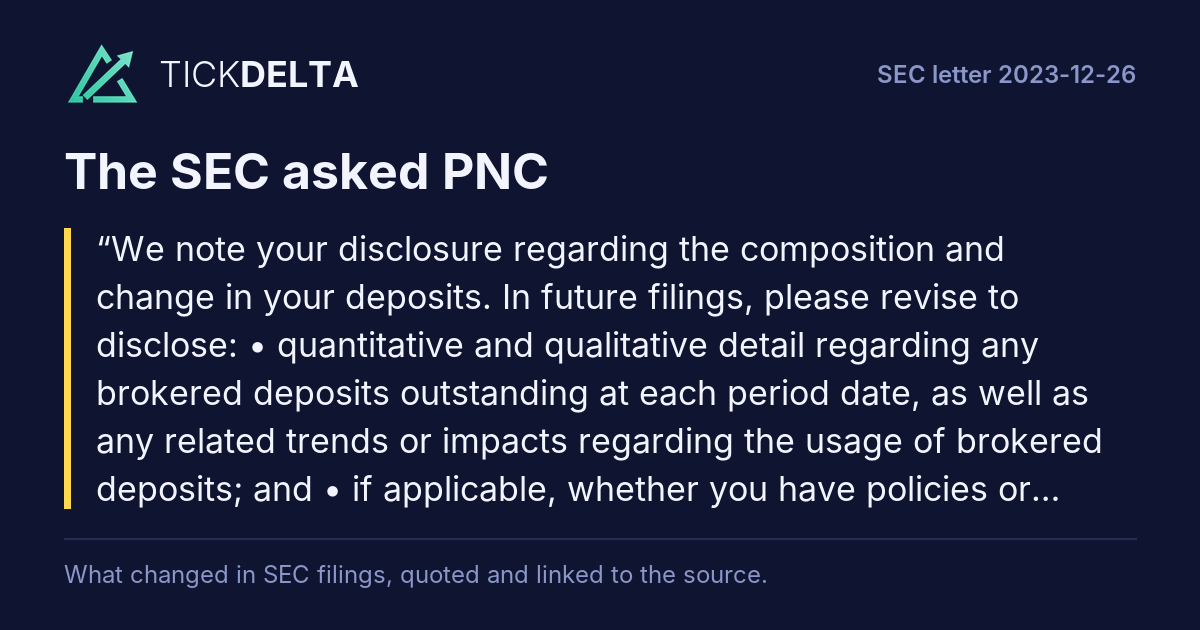
We note your disclosure regarding the composition and change in your deposits. In future filings, please revise to disclose: • quantitative and qualitative detail regarding any brokered deposits outstanding at each period date, as well as any related trends or impacts regarding the usage of brokered deposits; and • if applicable, whether you have policies or internal limits regarding concentrations in uninsured andRest of the question
/ or brokered deposits, in total or by type of depositor, and whether you have complied with any such internal requirements for the periods presented.
•We will include quantitative disclosure of brokered deposit balances for each period presented in the Funding Sources section of our Management Discussion and Analysis of Financial Condition and Results of Operations. The company will also include qualitative discussion on brokered deposits to explain period-over-period trends.Read in the reply ↗Rest of the answer
We will also disclose the existence of any material deviations from internal and regulatory guidelines and limits, if applicable.
•We will disclose uninsured deposits as an estimated percentage of total deposits in the Liquidity and Capital Management section, along with a qualitative statement on the types of uninsured deposits.
First report after the company's reply of 2024-01-26: 10-K filed 2024-02-21 ↗, against the 10-K filed 2023-02-22 ↗.
Tickdelta does not hold the text of both reports, so they are not compared here.
Please revise future filings to expand the discussion of the commercial real estate portfolio to provide further disaggregation by owner and non-owner occupied and characteristics, such as loan-to-value ratios, where material.
•We will revise our Risk Management disclosures to clarify our classification of owner and non-owner occupied commercial real estate for financial reporting purposes and will also provide an overview of these two categories including the related balances.
•Also, we will provide additional detail on the commercial real estate portfolio. We will focus our enhanced disclosure around our office exposure and include characteristics such as nonperforming, criticized, delinquency, reserve rates and loan-to-value. Read in the reply ↗
First report after the company's reply of 2024-01-26: 10-K filed 2024-02-21 ↗, against the 10-K filed 2023-02-22 ↗.
Tickdelta does not hold the text of both reports, so they are not compared here.
We note your liquidity and capital management disclosures regarding management oversight and monitoring of liquidity, which includes reference to certain established limits. In future filings, please address the items below.Rest of the question
• Expand your discussion of liquidity policy guidelines and provide examples of specific metrics used to manage liquidity, including whether you have been in compliance with internal guidelines and liquidity related limits for periods covered in each filing and, if not, planned actions to remediate non-compliance. • Consider expanding discussion of your contingency funding plan to describe actions that would be taken to address liquidity risk during a stress event, such as balance sheet repositioning, capital raises, promotional efforts for deposits, increased usage of brokered deposits, etc., as applicable. • When there have been changes in deposit composition (such as a shift between noninterest-bearing and interest-bearing deposit levels) or the level of reliance on different funding sources (such as a heavier reliance on Federal Home Loan Bank borrowings), expand your disclosures to discuss and quantify the impact these changes have had on liquidity and funding costs.
•We will enhance our disclosures related to liquidity monitoring to include qualitative discussion of metrics used to measure and manage liquidity, including Liquidity Coverage Ratio (LCR) and Net Stable Funding Ratio (NSFR), and our internal liquidity stress testing program. We will also disclose material deviations from both internal guidelines and regulatory minimums for metrics within PNC’s Enterprise Liquidity Management Policy for the periods presented, if applicable.
•We will include qualitative discussion of our contingency funding plan, including certain actions that PNC wouldRead in the reply ↗Rest of the answer
consider to address liquidity risk during a stress event.
•We will include quantitative disclosure on changes to deposit composition and funding sources as well as qualitative discussion on the related impacts to funding costs and liquidity.
First report after the company's reply of 2024-01-26: 10-K filed 2024-02-21 ↗, against the 10-K filed 2023-02-22 ↗.
Tickdelta does not hold the text of both reports, so they are not compared here.
Please disclose a table summarizing your total available sources of liquidity, by type of borrowing capacity, showing total borrowing capacity less borrowings outstanding to arrive at remaining capacity, then adding in other sources of liquidity such as cash, securities, etc. to arrive at total available liquidity, or tell us where this information is disclosed in the aggregate.
•We will disclose total sources of liquidity in the Liquidity and Capital Management section, as follows:
◦Primary contingent liquidity sources in tabular form. These sources include cash balances with the Federal Reserve Bank, investment securities that are available for sale or that can be used for pledging or to secure other sources of funding, and unused borrowing capacity with both the Federal Home Loan Bank and the Federal Reserve Bank.
◦Other liquidity sources in narrative form, including the remaining capacity under PNC Bank’s 2014 bank note program and 2013 commercial paper program. Read in the reply ↗
First report after the company's reply of 2024-01-26: 10-K filed 2024-02-21 ↗, against the 10-K filed 2023-02-22 ↗.
Tickdelta does not hold the text of both reports, so they are not compared here.
Please expand your disclosures, in future filings, to include a discussion of your deposit beta and/or cumulative deposit beta to the extent that it is monitored and used by management. In this regard, we note that you appear to include a slide addressing cumulative deposit in your earnings call presentation slides (e.g., slide 5 of the October 13, 2023 Form 8-K).Rest of the question
In addition, include a discussion of how the metric is used, how it has changed from period to period and how it is calculated.
•We will enhance our disclosures to include quantitative disclosure of current cumulative deposit beta and qualitative discussion of near-term forward-looking deposit betas, including how they are defined, calculated, monitored and used by management, and how they have changed from period to period. Read in the reply ↗
First report after the company's reply of 2024-01-26: 10-K filed 2024-02-21 ↗, against the 10-K filed 2023-02-22 ↗.
Tickdelta does not hold the text of both reports, so they are not compared here.
We note your disclosure regarding interest rate sensitivity analysis. In future filings, please enhance your disclosure to address the items below. • Discuss key assumptions including, as applicable, future balance sheet composition; loan and deposit pricing; assumptions related to the magnitude of asset prepayments; earlier than anticipated deposit withdrawals; and impacts from derivatives.Rest of the question
• Provide a discussion of how any assumptions have changed from period to period, including any changes to the data source used or significant changes in the actual assumption itself due to, and for example, internal data, market conditions or significant changes in the judgments and determinations made by management as you refine your modeling over time. • To the extent that your ALCO or management receives information and uses any other metrics, such as economic value of equity ("EVE"), for purposes of managing or monitoring interest rate risk, consider expanding your disclosure to include discussion of those other metrics and how they are used by management. • To the extent that your ALCO or management receives information with interest rate shocks (parallel changes) greater than your disclosed 100 basis point shifts, consider expanding your sensitivity disclosures to also include those wider ranges. We remind you that the company and its management are responsible for the accuracy and adequacy of their disclosures, notwithstanding any review, comments, action or absence of action by the staff.
•We will enhance market risk disclosures to include qualitative discussion of all applicable key assumptions used in our net interest income (NII) and economic value of equity (EVE) sensitivity analyses, and any material changes to those assumptions, including changes to data sources, for the periods presented.
•We will include a quantitative sensitivity analysis of EVE using +/- 200 basis point shifts, along with a qualitative discussion of how this metric is being used by management for interest rate risk management purposes.
•Based on what is provided to management currently, we willRead in the reply ↗Rest of the answer
update our NII sensitivity disclosures to replace the +/- 100 basis point shift with a wider range of +/- 200 basis points, and include a qualitative sensitivity comparison to a 100 basis point shift.
•To the extent additional information or scenarios are necessary to understanding PNC’s NII or EVE sensitivity, we will ensure such information is included in our future filings.
* * * * *
We thank you in advance for your prompt attention to this response and look forward to hearing from you at your earliest convenience. Please direct any questions regarding the Company’s response to Greg Kozich, Senior Vice President and Controller, at gregory.kozich@pnc.com (412-762-0790), or Dan Janiak, Director of Accounting Policy and Financial Reporting, at dan.janiak@pnc.com (412-498-1462).
First report after the company's reply of 2024-01-26: 10-K filed 2024-02-21 ↗, against the 10-K filed 2023-02-22 ↗.
Tickdelta does not hold the text of both reports, so they are not compared here.
Also in this review: closing letter, 2024-01-31