tickdelta
Sign in

Tickdelta is free for now. Sign up and get Pro free

← Screener

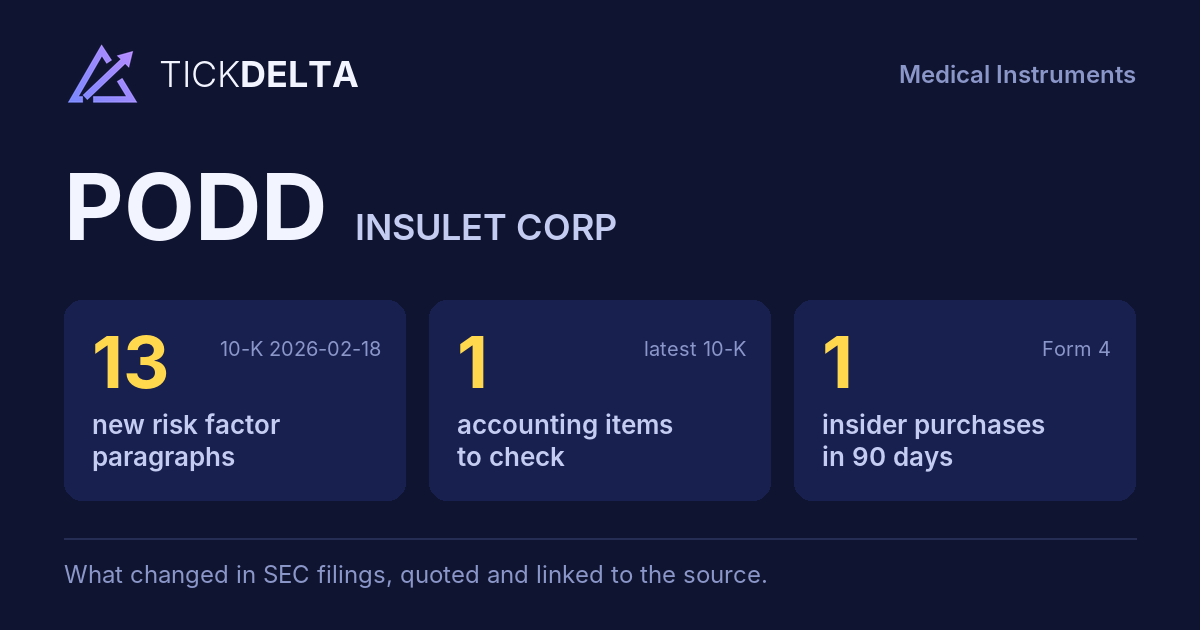
PODDInsulet Corporation

Health care · Medical Instruments · Nasdaq

Insulet Corporation (“we” or the “Company”) is primarily engaged in the development, manufacture, and sale of its proprietary continuous insulin delivery systems for people with insulin-dependent diabetes. 10-K, Item 1

Employees
5,400
Headquarters
Acton, MA
CEO
Ashley McEvoy
Next results
around Feb 17, 2027
Compare with peers → Embed

When the SEC's staff reviews a filing, it writes to the company with numbered questions, and the company answers each one in a letter. SEC publishes the exchange once the review is over, at least 20 business days later. Below: what the staff asked PODD, and the company's answer to each question, quoted from the letters. A question is not an accusation; most reviews end with the company adding detail to its next filing.

Form 10-K

2026-03-17 to 2026-03-24 · 1 question · 1 letter from the SEC, 1 from the company
Review closed 2026-03-24
Segments
Note 3. Segment and Geographic Data, page 53
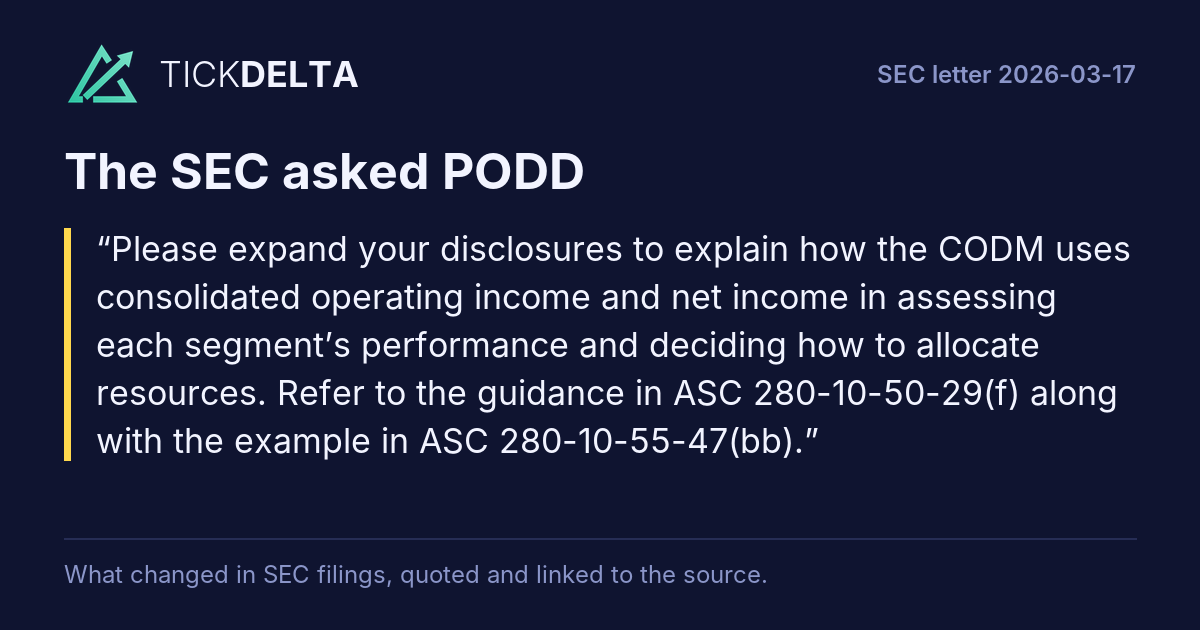
SEC asked
Please expand your disclosures to explain how the CODM uses consolidated operating income and net income in assessing each segment’s performance and deciding how to allocate resources. Refer to the guidance in ASC 280-10-50-29(f) along with the example in ASC 280-10-55-47(bb).
PODD answered
In response to the Staff’s comment, the Company will revise its segment and geographic data disclosure to include the following statement beginning with its Form 10-Q for the first quarter of 2026:

The Company’s CODM uses operating income and net income to monitor actual results against forecast and budget to identify business trends, assess operating performance, and modify capital allocation as necessary.

The Company acknowledges that it and its management are responsible for the accuracy and adequacy of its disclosures, notwithstanding any review, comments, actions or absence of action
Rest of the answer

by the Staff.

Read in the reply ↗
In its next report

First report after the company's reply of 2026-03-23: 10-Q filed 2026-05-06 ↗, against the 10-Q filed 2025-11-06 ↗.

Note 3, Accounts Receivable, Net: 1 paragraph changed.

Reworded

The Company outsources outsourced the insurance claim submissions process to a third-party service provider in one country in which it operates. Under this agreement, in 2025, the Company transfers transferred certain receivables in exchange for cash in advance. If the third-party service provider is was unable to collect on the transferred receivables, the third-party service provider has had recourse to the Company. This arrangement is was accounted for as a secured borrowing with a pledge of collateral as the transfer does did not meet the criteria for sale accounting. Receivables pledged as collateral of $16.5 million and $12.2 million are included in accounts receivable on the consolidated balance sheet as of September 30, 2025 and December 31, 2024, respectively. Liabilities associated with the secured borrowings of $16.5 million and $12.2 million are included within accrued expenses and other current liabilities in the consolidated balance sheet at September 30, 2025 and December 31, 2024, respectively. The classification within current liabilities is based on the expected resolution of the underlying receivables. The proceeds from and repayments of secured borrowings are reflected as cash flows provided by (used in) financing activities in the consolidated statement of cash flows.

86 words cut, 8 added sec.gov ↗

Paragraphs where only numbers, dates or period words changed are not shown. Cut words struck through, new words highlighted and underlined.

Also in this review: closing letter, 2026-03-24

Form 10-K for the Fiscal Year Ended December 31, 2021

2022-04-14 to 2022-04-19 · 1 question · 1 letter from the SEC, 1 from the company
Review closed 2022-04-19
Consolidated Financial Statements, page 44
SEC asked
In future filings, please revise to separately disclose the amount of related party transactions on the face of the consolidated balance sheet and statement of income. Refer to Rule 4-08(k) of Regulation S-X.
PODD answered
In response to the Staff’s comment, in future filings the Company will separately disclose on the face of the financial statements the related party transaction amounts that are currently disclosed in Note 5 of the financial statements in the 10-K. Read in the reply ↗
In its next report

First report after the company's reply of 2022-04-18: 10-Q filed 2022-05-06 ↗, against the 10-Q filed 2021-11-05 ↗.

Tickdelta does not hold the text of both reports, so they are not compared here.

Also in this review: closing letter, 2022-04-19

Form 10-K for the Fiscal Year Ended December 31, 2015

2016-06-30 to 2016-09-08 · 20 questions · 2 letters from the SEC, 2 from the company
Review closed 2016-09-08
RevenueResults discussion (MD&A)SegmentsGoodwill and impairmentRisk factorsAcquisitions
Patents, page 7
SEC asked (1)
Please tell us when your patents expire. See Regulation S-K Item 101(c)(1)(iv).
PODD answered
The issued United States patents referenced in our Form 10-K for the Fiscal Year Ended December 31, 2015 have expiration dates that range from 2020 through 2031. We respectfully acknowledge the Staff’s comments and we will include this information in future filings. Read in the reply ↗
Government Regulation, page 9
SEC asked (2)
Please tell us the nature of the FDA inspectional observations that you mention in the last sentence of the second paragraph on page 11.
PODD answered
The FDA inspectional observations received on December 11, 2015 identified issues in product design control, proper assessment of design changes and procedural opportunities in device acceptance which were all specifically related to the Field Safety Notification of July 2015. Insulet has worked closely with the FDA to address these observations. We have received no objections to date on the responses provided to the FDA and we are awaiting final closure from the FDA. Read in the reply ↗
In its next report

First report after the company's reply of 2016-07-29: 10-Q filed 2016-08-04 ↗, against the 10-Q filed 2016-04-29 ↗.

Tickdelta does not hold the text of both reports, so they are not compared here.

Third-Party Reimbursement, page 13
SEC asked (3)
Please tell us whether any material private third-party payers have declined to reimburse expenses for products like yours, other than in the “limited number of cases” that you mention in the second sentence of the third paragraph of this section.
PODD answered
In the United States, our products are generally reimbursed by third-party payors, and we bill those payors for products provided to patients. There are no material private third-party payors that have declined to reimburse expenses for our products for their overall covered lives population. As disclosed, in certain cases, some third-party payors have declined to reimburse us for a particular patient because such patient failed to meet its criteria, most often because the patient already received reimbursement for an insulin pump from that payor within the warranty period, which is generally
Rest of the answer

four years, or because the patient did not meet their medical criteria for an insulin infusion device. Reimbursement may also be declined by specific employer self-insurance plans based on specific provisions within those individual plans. This represents a much smaller subset of our overall potential patient population and is not believed to be material to our business.

Read in the reply ↗
In its next report

First report after the company's reply of 2016-07-29: 10-Q filed 2016-08-04 ↗, against the 10-Q filed 2016-04-29 ↗.

Tickdelta does not hold the text of both reports, so they are not compared here.

Risk Factors, page 13 · Our ability to grow our revenue, page 28
SEC asked (4)
Please tell us the names of the customers mentioned in the third sentence of the second paragraph of this risk factor. Also provide us your analysis of whether these names must be disclosed per Regulation S-K Item 101(c)(1)(vii).
PODD answered
The significant customers discussed in the risk factor that make up over 10 percent of consolidated revenue are Ypsomed Distribution AG, our exclusive European distributor, and RGH Enterprises, Inc., one of our distributors in the United States, for each of the years ended December 31, 2014 and 2015. For the year ended December 31, 2013, RGH Enterprises, Inc. represents the only customer with revenue in excess of 10 percent of consolidated revenues.
Rest of the answer

We respectfully acknowledge the Staff's comment and, in future filings, we will disclose the names of those customers that comprise over 10% of the Company’s consolidated revenue, in accordance with the guidance in Item 101(c)(1)(vii).

Read in the reply ↗
In its next report

First report after the company's reply of 2016-07-29: 10-Q filed 2016-08-04 ↗, against the 10-Q filed 2016-04-29 ↗.

Tickdelta does not hold the text of both reports, so they are not compared here.

Management’s Discussion and Analysis, page 37 · Results of Operations, page 39
SEC asked (5)
Please tell us the amount of OmniPod revenue separate from the amount of revenue from your handheld Personal Diabetes Manager device during each period presented in this filing and in your Form 10-Q for the fiscal quarter ended March 31, 2016.
Rest of the question

Address in your response (1) whether these separate results provide clarification regarding your disclosure related to the effect of customer retention or new patient starts, and (2) whether the information is required to be disclosed per Regulation S-K Item 101(c)(1)(i) or as a trend per Regulation S-K Item 303. In this regard, we note your reference to your product lines on page 39.

PODD answered
We respectfully acknowledge the Staff's comment. Sales of the Personal Diabetes Manager (PDM) and other accessories (which accessories are typically packaged together with the PDM and sold collectively, not separately) represent less than six percent of consolidated sales for each of the periods presented in the Form 10-K for the year ended December 31, 2015 and for each of the periods presented in the Form 10-Q for the quarter ended March 31, 2016.
Rest of the answer

With respect to the OmniPod system, more than 90 percent of the system revenue was from stand-alone sales of the OmniPod disposable device for each of the periods presented in the Form 10-K for the year ended December 31, 2015 and for each of the periods presented in the Form 10-Q for the quarter ended March 31, 2016. The remaining amount, which represents less than approximately 10 percent of system revenue, was attributable to sales of the PDM and other accessories. More specifically, revenue from the sales of the PDM and accessories were approximately $11.6M, $11.3M, and $14.2M for the years ended December 31, 2015, December 31, 2014, and December 31, 2013, respectively. Revenue from the sales of the PDM and accessories were approximately $2.5M and $2.8M for the quarters ended March 31, 2015 and March 31, 2016, respectively. PDM sales may be made for a variety of reasons including new patient starts and replacements made for existing customers after expiration of the original warranty period. Due to the relative insignificance of revenue attributable to the PDM, we do not believe the relative revenue between the OmniPod device and the PDM is meaningful to identifying or understanding trends or uncertainties that would have a material impact on our revenue, or provide clarification regarding the effect of customer retention or new patient starts. Furthermore, changes in PDM revenue in any given period may be from other factors such as customer mix, pricing, or new product offerings. As the PDM sales are not meaningful to trends, are within the same class of products as the OmniPod device, and are less than 10 percent of total consolidated revenue, we determined no additional disclosure was warranted in accordance with Regulation S-K Item 303 and Regulation S-K Item 101(c)(1)(i) for each of the respective periods.

Read in the reply ↗
In its next report

First report after the company's reply of 2016-07-29: 10-Q filed 2016-08-04 ↗, against the 10-Q filed 2016-04-29 ↗.

Tickdelta does not hold the text of both reports, so they are not compared here.

Management’s Discussion and Analysis, page 37 · Results of Operations, page 39
SEC asked (6)
Please tell us with specificity the nature and causes of the “ordering patterns” that led to the changes mentioned in this section and on page 27 of your Form 10-Q for the fiscal quarter ended March 31, 2016. Address in your response the effect of any minimum purchase obligations.
Rest of the question

Also tell us the magnitude of these changes and the offsetting factors disclosed in your “Revenue” discussion and analysis in the Form 10-K and Form 10-Q. In your response, please ensure that the extent of customer retention and the extent of your installed base growth in the relevant periods are clear.

PODD answered
During the twelve months ended December 31, 2014, our U.S. and international distributors built up a level of safety stock, among other reasons, we believe, to mitigate risk associated with potential production capacity restraints and their ability to meet end-user demand. During the first quarter of 2015, our U.S. distributors reduced days-on-hand inventory as we increased our production capacity and demonstrated the ability to supply high-quality product to meet customer demand.
Rest of the answer

During the first and second quarters of 2015, the improved production capacity enabled our international distributor to reduce on-hand inventory levels to better manage their working capital and offset the financial impact of the strength of the U.S. dollar on their business. This change in ordering patterns was not driven by minimum purchase obligations and was not a result of changes in our customer retention or installed base growth. While we are unable to quantify the exact magnitude of the impact of the change in ordering patterns, we believe the factors driving the changes for both U.S. OmniPod and International OmniPod were disclosed in order of magnitude. That is, the increased U.S. OmniPod revenue was primarily driven by growth in installed base and the change in distributor ordering patterns was less significant, whereas the change in International OmniPod revenue was primarily a result of the unfavorable distributor ordering patterns in the first quarter of 2015 and the increase in installed base was less significant, but still an important factor.

Read in the reply ↗
In its next report

First report after the company's reply of 2016-07-29: 10-Q filed 2016-08-04 ↗, against the 10-Q filed 2016-04-29 ↗.

Tickdelta does not hold the text of both reports, so they are not compared here.

Management’s Discussion and Analysis, page 37 · Results of Operations, page 39
SEC asked (7)
We note your reference to a reduction in royalty revenue. Please tell us the total royalty revenue in each period presented and the nature of your business that generates royalty revenue.
PODD answered
Our consolidated revenue included royalty revenue of $3.5 million, $6.7 million and $6.9 million in the years ended December 31, 2015, December 31, 2014 and December 31, 2013, respectively. Our rights to incorporate the FreeStyle blood glucose meter into the OmniPod System are governed by a development and license agreement with Abbott Diabetes Care, Inc. (Abbott). Under the terms of this agreement, Abbott pays us a royalty for qualified new patient starts which is the primary driver of the royalty revenue recognized in each of the years presented.
Rest of the answer

Due to changes in the structure of the arrangement over time, historic changes in royalty revenue have not necessarily been indicative of trends in new patient starts or other related metrics.

Read in the reply ↗
In its next report

First report after the company's reply of 2016-07-29: 10-Q filed 2016-08-04 ↗, against the 10-Q filed 2016-04-29 ↗.

Tickdelta does not hold the text of both reports, so they are not compared here.

Note 2. Summary of Significant Accounting Policies · Segment Reporting, page 53
SEC asked (8)
Please revise future filings to report revenues from external customers for each product and service or each group of similar products and services unless it is impracticable to do so. If providing the information is impracticable, disclose that fact. Refer to ASC 28010-50-40.
PODD answered
We respectfully acknowledge the Staff's comment. In future filings we will report within our segment footnote disclosure revenues from external customers for each product and service or each group of similar products and services. Specifically, in future filings, we will include within the segment footnote disclosure revenues for U.S. OmniPod, International OmniPod, and Drug Delivery as presented in our Results of Operations section of our Form 10-Q for the period ended March 31, 2016. Read in the reply ↗
In its next report

First report after the company's reply of 2016-07-29: 10-Q filed 2016-08-04 ↗, against the 10-Q filed 2016-04-29 ↗.

Tickdelta does not hold the text of both reports, so they are not compared here.

Note 2. Summary of Significant Accounting Policies · Segment Reporting, page 53
SEC asked (9)
In future filings, please disclose the geographic information relating to revenues and long-lived assets required by ASC 280-10-50-41 unless it is impracticable to do so. This includes disclosing revenues from external customers attributed to the U. S. and attributed to all foreign countries from which you derive revenues.
Rest of the question

If revenues from external customers attributed to an individual foreign country are material, disclose those revenues separately. Also disclose the basis for attributing revenues from external customers to individual countries. Refer to ASC 280-10-50-41.

PODD answered
We respectfully acknowledge the Staff's comment. In future filings we will disclose within our segment footnote disclosure information relating to revenues and long-lived assets required by ASC 280-10-50-41. Read in the reply ↗
In its next report

First report after the company's reply of 2016-07-29: 10-Q filed 2016-08-04 ↗, against the 10-Q filed 2016-04-29 ↗.

Tickdelta does not hold the text of both reports, so they are not compared here.

Goodwill, page 53
SEC asked (10)
You disclose that you operate in one segment and you have a single reporting unit as you do not have segment managers and you do not review discrete financial information below consolidated results on a regular basis. Please tell us about how you applied ASC 350-20-35-33 through 35-37 in determining that you had only one reporting unit.
PODD answered
In concluding that the Company only has one reporting unit in accordance with ASC 350-20-35-33 through 35-37, we:

· identified the components that constitute a business within our single operating segment, evaluated the financial information that is made available for the components, evaluated our management reporting structure to identify segment management, and evaluated whether segment management reviews the operating results of the components on a regular basis.

Components that constitute a business

As of December 31, 2015, the Company had four components that engage in business
Rest of the answer

activities from which it may earn revenue and incur expenses; specifically U.S. OmniPod, International OmniPod, Drug Delivery, and Neighborhood Diabetes (Neighborhood) defined as follows:

OmniPod – U.S.

The Company is engaged in the development, manufacture and sale of the OmniPod System, an innovative, discreet and easy-to-use continuous insulin delivery system for people with insulin-dependent diabetes. The Company began commercial sale of the OmniPod System in the United States in 2005 and sells the OmniPod System in the United States through direct sales to customers and through distribution partners.

OmniPod – International

The OmniPod System is currently available in multiple countries in Europe and in Canada. In Europe, the OmniPod System is sold through an exclusive distribution partner, Ypsomed Distribution AG. In July 2015, the Company executed an asset purchase agreement with GlaxoSmithKline whereby the Company acquired assets associated with the Canadian distribution of the Company’s products and the Company assumed the distribution, sales, marketing, training and support activities for the OmniPod system in Canada.

Drug Delivery

The Company partners with global pharmaceutical and biotechnology companies to tailor the OmniPod technology platform for the subcutaneous delivery of pharmaceuticals.

Neighborhood

The Company acquired Neighborhood, a distributor of medical supplies for the treatment of diabetes, in June 2011. The main operations of the distribution business included order intake, customer support, sales, distribution and billing. The acquisition provided the Company with additional products, customers and bandwidth in these areas. This expertise was strategic to the Company as it was anticipating the launch of its second generation OmniPod and believed the additional infrastructure was needed to support a successful launch. As further outlined in our response to question #13 below, the acquisition of Neighborhood had specific benefits that supported the core OmniPod business.

Availability and Utilization of Discrete Financial Information

As of December 31, 2015, revenue was measured and reported for U.S. OmniPod, International OmniPod, Drug Delivery, and Neighborhood. A measure of profit by component is not made available to, nor used by, the Chief Operating Decision Maker (CODM, as identified below) or his direct reports. The only discrete financial information at the component level that is reviewed by the CODM and direct reports is revenue (see separate discussion of Neighborhood results provided to Chief Financial Officer (CFO) below).

While the CODM and direct reports are provided with revenue for each component as noted above, the consolidated income statement is used by the CODM and direct reports to manage and assess the performance of the business. Specifically, the CODM utilizes consolidated revenue, gross margin, operating expenses and earnings before interest and taxes (EBIT) as key performance indicators. Decisions are made and resources are allocated based on consolidated operating results and non-financial information as discussed in the sections below.

Evaluation of Management Reporting Structure

Identification of Chief Operating Decision Maker

In order to properly identify segment management, we first identified our CODM. The Chief Executive Officer (CEO) has the overall responsibility of making managerial decisions for the Company and is considered the CODM. This conclusion was reached based on the fact that the CEO is the key operating decision maker for the Company and is the individual that allocates resources and assesses the operating results of the Company. The CEO views the Company as a consolidated organization focused on the manufacture and distribution of medical devices for subcutaneous drug delivery. Key operating decisions are made to drive the consolidated results of the organization.

Primary areas of focus for the CEO during 2015 included: 1) putting in place an effective team to capitalize on current opportunities, 2) improving product quality and positioning the current products for greater adoption, and 3) establishing product development roadmaps for the business to drive long-term growth. The ultimate goal was to maximize revenue and profits through the marketing and distribution of medical devices for subcutaneous drug delivery for diabetes and other medical needs utilizing the Company’s core OmniPod technology. Resource allocation decisions are made by the CEO utilizing consolidated financial results and other operational information. While there are separate components that constitute a business, those components simply represent ways in which the underlying technology is penetrating the market. In this regard, the allocation of resources is primarily based on improvement to the core technology and manufacturing capacity. For example, from a research and development standpoint, research and development is viewed as a shared service given that projects generally benefit multiple components as the same platform technology is utilized for subcutaneous drug delivery. Current projects which are aimed to benefit the organization include Bluetooth technology, mobile applications, and various types and sizes of pods that can handle different applications such as concentrated insulin or that can be used with other pharmaceuticals. As another example, from a commercial standpoint, decisions are made by the CEO leveraging know-how across the consolidated business regarding channel, pricing, and market access strategies.

Given this view, the CEO primarily focuses on consolidated results when assessing performance. While he is presented with revenue by component, the overall focus is market penetration and enhancements to the underlying device and, as such, while the component revenues are viewed as an indicator of market penetration, overall consolidated revenue is driving decision making. The CEO’s view of the business and his view that the Company had previously realized the synergies that were available from Neighborhood, were contributing factors driving the decision to pursue the divestiture of Neighborhood, which was sold to Liberty Medical LLC in February 2016, as it was no longer a significant growth driver for the consolidated business.

The Company has noted the following verifiable evidence that operating decisions are made at the consolidated level rather than the component level:

The Company’s annual performance-based cash bonus plan is based on consolidated results, specifically revenue and operating profitability (i.e. EBIT). It should be noted that the percentage of the portion of the bonus related to consolidated operating profitability is at the discretion of the Compensation Committee of the Board of Directors (BOD) (e.g. it is not automatically approved). Separate from corporate financial results, each individual of the executive team has a portion of their bonus (20%) that is contingent upon their achievement of personal goals set by the CODM. As of December 31, 2015, the only individual that had a portion of their bonus related to component performance was the President, Drug Delivery, and that was based on revenue growth and represented only approximately 5% of his bonus. While that portion of the bonus was based on component revenue growth, component operating profitability was not measured nor evaluated as a factor in his performance.

The BOD is provided with consolidated operating results; they are not provided with component-level information other than revenue.

The CODM is the sole key decision maker and authority over key operating business decisions is not delegated further.

A budget by department (based on the matrix organization structure discussed below) is generated solely to control spend at the functional level and to identify managers to oversee the budget allocated to those departments. Budgets are not generated nor managed at a business component level. The departments are viewed as corporate functions and a discrete measure of profit is not generated or reviewed for the departments.

In discussing the business on earnings calls, in press releases and SEC documents, the Company discusses revenue by component and consolidated revenue, gross margin and operating profitability. The Company does not discuss any discrete financial information for each component beyond revenue.

Identification of Segment Management

The Company evaluated its reporting structure for the purposes of identifying segment management under ASC 280 as of December 31, 2015.

The Company’s reporting structure is based on a matrix organization, under which the direct reports of the CODM are primarily responsible for functional departments, including sales and marketing, manufacturing and operations, research and development, quality and regulatory affairs, finance, legal, information technology and human resources. These individuals support the consolidated organization.

The following were the key positions within the executive team and direct reports of the CEO as of December 31, 2015:

The CEO was responsible for making final, overall managerial decisions for the consolidated Company.

The CFO oversaw the financial and IT related decisions for the business. The CFO also provided direct oversight to the General Manager of Neighborhood.

The Chief Commercial Officer (CCO) oversaw worldwide OmniPod revenue, as well as global selling and marketing initiatives. The CCO was also responsible for all OmniPod and Neighborhood customer service and reimbursement activities.

The President, Drug Delivery, oversaw the commercial development of the non-diabetes drug delivery component, including drug delivery revenue as well as selling and marketing efforts to leverage the OmniPod technology across new markets and increase market share.

The General Counsel oversaw legal and corporate compliance matters.

The EVP of Human Resources oversaw all HR, compensation, and benefit matters.

The VP, Advanced Technology & Engineering, oversaw all research and development (R&D) initiatives (e.g. OmniPod and non-diabetes drug delivery products).

The VP, Global Manufacturing and Operations, oversaw all Company-wide production, distribution, purchasing, and facilities related matters.

The VP, Quality Assurance and Regulatory Affairs, oversaw product quality and regulatory matters for all products sold by Insulet.

The VP, Investor Relations and Corporate Communications, oversaw communications between the Company and financial community and other parties as required.

Of the individuals noted above, three individuals that reported to the CODM were responsible for specific aspects of certain components of the business:

Chief Financial Officer

Beginning in mid-2015, the VP/General Manager of Neighborhood reported to the CFO. The VP/General Manager of Neighborhood did not report to the CODM before or after this change. The CFO began to oversee the VP/General Manager of Neighborhood after a decision by the CEO to explore/evaluate potential strategic opportunities for Neighborhood (see response to question #13 below). Since the time Neighborhood was acquired in 2011, a discrete measurement of component profit was available; however, this information was not shared or discussed with the CODM. Certain discrete financial information for Neighborhood was shared with the CFO starting in mid-2015 and was compiled for the purposes of evaluating strategic alternatives for the business. This information was not used by the CFO to assess the performance of the business, make key operating decisions, or allocate resources.

We have concluded that the VP/General Manager of Neighborhood did not meet the definition of a segment manager since he was not directly accountable to and did not discuss operating activities and financial results for Neighborhood with the CODM. We have also concluded that the CFO did not meet the definition of a segment manager since he did not manage the operating activities or review the financial results of Neighborhood other than to evaluate strategic alternatives for the business as discussed above.

Chief Commercial Officer

The CCO oversaw the commercial development of the OmniPod business globally (i.e. U.S. and International). The CCO was responsible for global OmniPod revenue as well as selling and marketing efforts of the OmniPod business, including managing customer service, identifying new patients and markets and driving revenue growth. The CCO was not responsible for the other operating functions that support the OmniPod business, such as manufacturing and distribution (managed by the VP, Global Manufacturing and Operations), research and development (managed by the VP of Advanced Technology and Engineering), regulatory matters (managed by the VP, Quality Assurance and Regulatory Affairs) or personnel matters (managed by the EVP of Human Resources) and was not evaluated based on the operating performance of the OmniPod business. The Company does not prepare discrete information for the OmniPod component beyond revenue, which was the only component information provided to and reviewed by the CCO.

Based on these considerations, we have concluded that the CCO did not meet the definition of a segment manager as she was not directly accountable for the operations of any business component, performance was not assessed based on financial performance for any individual business component and she did not review a discrete measure of profit for any business component.

President, Drug Delivery

The President, Drug Delivery, oversees the non-diabetes drug delivery product sales as well as commercial development of Drug Delivery opportunities; therefore he has a high level of responsibility over the Drug Delivery product line. His responsibility is primarily to manage the Company’s existing Drug Delivery relationships and explore new Drug Delivery opportunities and is not responsible for other operating functions of the Drug Delivery business, such as manufacturing and distribution (managed by VP Global Manufacturing), R&D (managed by VP of Advanced Tech), regulatory matters (managed by VP Quality Assurance and Regulatory Affairs) or personnel matters (EVP of Human Resources) and is not evaluated based on the operating performance of the Drug Delivery business outside of revenue growth. The Company does not prepare discrete financial information for the component beyond revenue, which is the only component information provided to and reviewed by the President, Drug Delivery.

Based on these considerations, we have concluded that the President, Drug Delivery did not meet the definition of a segment manager as he was not directly accountable for the operations of any business component, performance was not assessed based on financial performance for any individual business component (outside of revenue) and he did not review a discrete measure of profit for any business component.

The remaining executives, other than the CEO, oversaw functional areas across the organization such as human resources, manufacturing and supply chain operations, quality, legal, regulatory affairs and research and development, which do not represent components of the organization or potential operating segments. Therefore, these individuals did not meet the definition of a segment manager.

Conclusion

Based on our assessment, we have concluded that the Company’s CODM represents the sole segment manager within the organization. The CODM bases key operating decisions and the allocation of resources on the evaluation of the consolidated business as described in the sections above. A discrete measure of component profitability is not made available to the CODM nor any of his direct reports to assess the performance of the business. Therefore, the Company has a single reporting unit.
Read in the reply ↗
Shipping and Handling Costs, page 55
SEC asked (11)
Please revise this note in future filings to also disclose the amount of shipping and handling costs included in general and administrative expenses. Refer to ASC 605-4550-2.
PODD answered
We respectfully acknowledge the Staff's comment. In future filings we will disclose the amount of shipping and handling costs included in general and administrative expenses in accordance with ASAC 605-45-50-2. Read in the reply ↗
In its next report

First report after the company's reply of 2016-07-29: 10-Q filed 2016-08-04 ↗, against the 10-Q filed 2016-04-29 ↗.

Tickdelta does not hold the text of both reports, so they are not compared here.

Concentration of Credit Risk, page 55
SEC asked (12)
In future filings when disclosing significant customers under ASC 280-10-50-42, in cases where a single customer is a significant customer in more than one year, please revise the disclosure so that you link the significance for each period presented to that customer.
PODD answered
We respectfully acknowledge the Staff's comment. In future filings when disclosing significant customers representing more than 10 percent of total revenue under ASC 280-10-50-42, in cases where a single customer is a significant customer in more than one year, we will link the significance for each period presented to that customer. Read in the reply ↗
In its next report

First report after the company's reply of 2016-07-29: 10-Q filed 2016-08-04 ↗, against the 10-Q filed 2016-04-29 ↗.

Tickdelta does not hold the text of both reports, so they are not compared here.

Item 1. Financial Statements · Goodwill, page 8
SEC asked (13)
You disclose that the majority of your goodwill is related to your acquisition of Neighborhood Diabetes in 2011. We note that you recorded $37.5 million in goodwill from that transaction but that you included only $0.14 million of goodwill in the Neighborhood Diabetes assets presented as discontinued operations at December 31, 2015.
Rest of the question

Please refer to ASC 350-20-40 and address the following:  Explain to us in further detail how you considered the goodwill related to Neighborhood Diabetes in that presentation.  Provide us with your calculation of the amount of goodwill allocated to discontinued operations.  Clarify for us whether the Neighborhood Diabetes business was ever fully integrated into your reporting unit and if so, describe the process and timeline of how this was accomplished.  Provide us with a qualitative description of the factors that make up the goodwill that will remain in your continuing operations after consummation of the Neighborhood Diabetes sale.

PODD answered
In accordance with ASC 350-20-40, when an entity disposes of a portion of the business and the disposal group is part of the reporting unit where goodwill resides, a portion of that goodwill should be allocated to the carrying value of the disposal group. Goodwill is allocated to the business being disposed of using the relative fair value approach. However, if the business to be disposed of was never integrated into the reporting unit, after its acquisition, the current carrying amount of that acquired goodwill shall be included in the carrying amount of the business to be disposed of.
Rest of the answer

That situation might occur when the acquired business is operated as a standalone entity or when the business is to be disposed of shortly after it is acquired. However, as noted in ASC 350-20-40-7, situations in which the acquired business is operated as a standalone entity are expected to be infrequent because some amount of integration generally occurs after an acquisition.

The Company acquired Neighborhood in June 2011 and at that time publically cited the following key strategic benefits of the acquisition:

provides Insulet with a full suite of diabetes management product offerings, including the OmniPod Insulin Management System, blood glucose testing supplies, continuous glucose monitoring sensors and insulin;

accelerates Insulet's sales force expansion, improving overall reach, frequency and quality of communications with healthcare providers, insurers and customers;

strengthens Insulet's back office support capabilities with an experienced reimbursement and support infrastructure capable of processing substantially more customer claims to support Insulet's growing customer base;

significantly and immediately expands Insulet's access to insulin-dependent multiple daily injection patients who may be better served with the OmniPod insulin pump; and provides Insulet with the pharmacy adjudication capabilities to drive incremental sales of high value consumables including insulin and other diabetes drug therapies.

These benefits, and therefore, the related goodwill associated with them, were expected to support our core OmniPod business. Neighborhood’s existing patient base consisted of people with Type 1 and Type 2 diabetes and Neighborhood worked with a wide array of payors for insurance reimbursement. Diabetes patients can have unique requirements for their treatments, including supplies (insulin delivery mechanisms, insulin, blood glucose meters, test strips, lancets, etc.) and documentation for their purchase and insurance claims (prescription, statement of medical necessity, etc.). The acquisition allowed for cross-selling opportunities (i.e. including sales of supplies to OmniPod customers and sales of OmniPod to Neighborhood customers) and knowledge sharing for best practices relating to patient and payor interactions. It also allowed us to leverage the Neighborhood customer service platform which was known for its high touch customer service model to improve retention of our OmniPod customers.

We integrated Neighborhood’s business, reporting and organization into our existing organizational structure and our consolidated reporting unit by the end of 2012 and the Neighborhood business physically moved into the corporate headquarters. Administrative functions such as order intake, customer care, billing, IT, distribution and finance had been integrated to operate as one support group across both legacy businesses, in support of operational synergies. Product was stored and distributed out of a shared warehouse location and tracked through a shared inventory management system. The medical billing and collections group (both legacy Insulet and legacy Neighborhood) reported to the same manager who in turn reported to the Corporate Controller and leveraged operational know-how to improve interactions with patients and payors. Similar cross-functional reporting structures were put in place for the other functional areas. The integration allowed the consolidated business to leverage the existing knowledge bases across the legacy business and improve upon policies and procedures and prepare for expansion of the consolidated business. As the nature of the roles and responsibilities are similar, we put effort into cross-training individuals within this organization to function in both Insulet and Neighborhood capacities where possible.

In mid-2015, the Company began the process of evaluating strategic alternatives for Neighborhood, primarily driven by the Company’s new CEO focusing more on the Company’s core competencies surrounding the OmniPod technology. Management believed that it had realized the acquisition synergies and cross-selling opportunities to their greatest extent and in February 2016, the Company sold Neighborhood to Liberty Medical LLC.

As noted above, Neighborhood was integrated into our single reporting unit (see response to question #10 above) and therefore, in accordance with ASC 350-20-40, upon disposition of Neighborhood, the Company allocated a portion of the reporting unit’s goodwill to the Neighborhood business which was included in the disposal group in the three months ended March 31, 2016. The Company assessed the total fair value of its overall business by calculating its total market capitalization as of the date of sale of Neighborhood. This was then compared to the sale price for Neighborhood assuming a normalized working capital figure (use of the final sales price inclusive of working capital adjustments would not result in a material difference in goodwill). A control premium was not used in the valuation of the reporting unit as the application of a reasonable control premium to the market capitalization would not result in a material difference in the allocation of goodwill. The calculation used for the allocation was as follows (in thousands):

Sales Price of

$

5,000

Consolidated Market

Capitalization at 2/12/16

÷

1,422,166

Neighborhood Relative

Percentage of Fair Value

0.35%

Total Goodwill as of

2/12/16

39,823

Neighborhood Goodwill x

140

The goodwill that remains with our continuing operations after the consummation of the Neighborhood sale mainly consists of the following:

synergies obtained from utilization of Neighborhood’s back office functions such as order management, medical billing, and logistics to help support sales growth;

leverage of cross selling opportunities to the prior Neighborhood customer base, offering the OmniPod System as an alternative to other treatment options;

knowledge of Neighborhood’s operations in the pharmacy channel in support of the exploration of future initiatives to expand OmniPod sales in the pharmacy channel;

customer service practices, which have helped to improve retention rates for OmniPod using a high-touch customer service model;

general experience gained from interactions with various types of patients and payors to improve overall reimbursement rates;

knowledge of Medicare and Medicaid practices as we work to gain approval for Medicare and Medicaid reimbursement for the OmniPod; and enhanced distribution for the sale of finished goods.

Read in the reply ↗
In its next report

First report after the company's reply of 2016-07-29: 10-Q filed 2016-08-04 ↗, against the 10-Q filed 2016-04-29 ↗.

Tickdelta does not hold the text of both reports, so they are not compared here.

Revenue, page 27
SEC asked (14)
Please tell us the reasons for the decreased revenue during the first quarter of 2016 as compared to the fourth quarter of 2015 as disclosed on page 75 of your Form 10- K. Address in your response the applicability of Instruction 5 to Regulation S-K Item 303(b).
PODD answered
The decreased revenue during the first quarter of 2016 as compared to the fourth quarter of 2015 was primarily driven by the divestiture of Neighborhood in February 2016, representing approximately $17 million (or approximately 90%) of the $19 million change. Approximately $2 million of the decrease was driven by lower U.S. OmniPod volumes in the first quarter of 2016 as compared to the fourth quarter of 2015, primarily a result of historical seasonality due to patients buying more product at the end of the calendar year before their insurance plan deductibles reset.
Rest of the answer

We have determined that the seasonality in the business does not have a material impact on financial results. Having reviewed the guidance in Instruction 5 of Regulation S-K Item 303(b), we determined no additional disclosure was warranted.

* * * * *

We also acknowledge that:

the Company is responsible for the adequacy and accuracy of the disclosure in the filings;

staff comments or changes to disclosure in response to staff comments do not foreclose the Commission from taking any action with respect to the filings; and the Company may not assert staff comments as a defense in any proceeding initiated by the Commission or any person under the federal securities laws of the United States.

Read in the reply ↗
Third-Party Reimbursement, page 13
SEC asked (1)
Please expand your response to prior comment 3 to address whether UnitedHealth provides reimbursement for products such as yours. It remains unclear whether the “limited number of cases” mentioned on page 13 represents the full extent of third-party reimbursement issues.
PODD answered
In the United States, our products are generally reimbursed by third-party payors, and we bill those payors for products provided to patients. There are no material private third-party payors that have declined to reimburse expenses for our products for their overall covered lives population, including UnitedHealth.
Rest of the answer

Recently UnitedHealth announced restrictions in reimbursement for durable tubed insulin delivery devices, but UnitedHealth has confirmed that these restrictions do not affect UnitedHealth’s coverage of the Omnipod, which UnitedHealth does not consider a durable tubed insulin delivery device.

As disclosed, in certain cases, some third-party payors have declined to reimburse for a particular patient because such patient failed to meet its criteria, most often because the patient already received reimbursement for an insulin pump from that payor within the warranty period, which is generally four years, or because the patient did not meet their medical criteria for an insulin infusion device. Reimbursement may also be declined by insurers based upon language in the contract between the insurer and the insured group. An example of this is certain employer self-insurance plans that may choose to decline coverage based on specific provisions within those individual plans. While this applies to certain UnitedHealth plans, plans provided by UnitedHealth and other payors that may choose to decline coverage in this way represent a small subset of our overall potential patient population and are not believed to be material to our business.

Read in the reply ↗
In its next report

First report after the company's reply of 2016-08-26: 10-Q filed 2016-11-04 ↗, against the 10-Q filed 2016-04-29 ↗.

Tickdelta does not hold the text of both reports, so they are not compared here.

Management’s Discussion and Analysis of Financial Condition and Results of Operations, page
SEC asked (2)
We note your response to prior comment 5 regarding the potential reasons for changes in sales of your Personal Diabetes Manager. Please expand your response to tell us which reasons caused the changes in sales of the Personal Diabetes Manager device during each period presented in your Form 10-K and most recent Form 10-Q, and the significance of each such reason during the period.
PODD answered
We respectfully acknowledge the Staff's comment. Sales of the Personal Diabetes Manager (PDM) and other accessories (which accessories are typically packaged together with the PDM and sold collectively, not separately) represent less than six percent of consolidated sales for each of the periods presented in the Form 10-K for the year ended December 31, 2015 and for each of the periods presented in the Form 10-Q for the quarter ended March 31, 2016 and in the Form 10-Q for the quarter ended June 30, 2016.
Rest of the answer

With respect to the OmniPod system, more than 90 percent of the system revenue was from stand-alone sales of the OmniPod disposable device for each of the periods presented in the Form 10-K for the year ended December 31, 2015 and for each of the periods presented in the Form 10-Q for the quarter ended March 31, 2016 and in the Form 10-Q for the quarter ended June 30, 2016. The remaining amount, which represents less than approximately 10 percent of system revenue, was attributable to sales of the PDM and other accessories. More specifically, global revenue from the sales of the PDM and accessories were approximately $11.6M, $11.3M, and $14.2M for the years ended December 31, 2015, December 31, 2014, and December 31, 2013, respectively. Revenue from the sales of the PDM and accessories were approximately $6.6M and $5.4M for the six months ended June 30, 2016 and June 30, 2015, respectively. The increase for the six months ended June 30, 2016 and the year ended December 31, 2015, as compared to the corresponding period in the previous year, was primarily driven by our acquisition of Canadian OmniPod distribution operations in July 2015. The decrease for the year ended December 31, 2014, as compared to the prior year, was primarily driven by a decrease in PDM sales volumes reflecting high demand in 2013 upon the release of a new PDM, as well as manufacturing and other product issues faced subsequent to the 2013 product release.

PDM sales may be made for a variety of reasons including new patient starts and replacements made for existing customers after expiration of the original warranty period. Due to the relative insignificance of revenue attributable to the PDM, we do not believe the relative revenue between the OmniPod device and the PDM is meaningful to identifying or understanding trends or uncertainties that would have a material impact on our revenue, or provide clarification regarding the effect of customer retention or new patient starts. Furthermore, changes in PDM revenue in any given period may be from other factors such as customer mix, pricing, or new product offerings. As the PDM sales are not meaningful to trends, are within the same class of products as the OmniPod device, and are less than 10 percent of total consolidated revenue, we determined no additional disclosure was warranted in accordance with Regulation S-K Item 303 and Regulation S-K Item 101(c)(1)(i) for each of the respective periods.

Read in the reply ↗
In its next report

First report after the company's reply of 2016-08-26: 10-Q filed 2016-11-04 ↗, against the 10-Q filed 2016-04-29 ↗.

Tickdelta does not hold the text of both reports, so they are not compared here.

Management’s Discussion and Analysis of Financial Condition and Results of Operations, page
SEC asked (3)
Please expand your response to prior comment 6 to tell us the extent of (1) customer retention and (2) installed base growth during each period presented in your Form 10-K and most recent Form 10-Q. Also tell where you believe those Forms provide investors this information.
Rest of the question

Given your response to prior comment 7 regarding a royalty based on new patient starts, it appears that you may have information regarding installed base growth.

PODD answered
During the twelve months ended December 31, 2014, our U.S. and international distributors built up a level of safety stock, among other reasons, we believe, to mitigate risk associated with potential production capacity constraints and their ability to meet end-user demand. During the first quarter of 2015, our U.S. distributors reduced days-on-hand inventory as we increased our production capacity and demonstrated the ability to supply high-quality product to meet customer demand.
Rest of the answer

During the first and second quarters of 2015, the improved production capacity enabled our international distributor to reduce on-hand inventory levels to better manage their working capital and offset the financial impact of the strength of the U.S. dollar on their business. This change in ordering patterns was not driven by minimum purchase obligations and was not a result of changes in our customer retention or installed base growth. While we are unable to quantify the exact magnitude of the impact of the change in ordering patterns, we believe the factors driving the changes for both U.S. OmniPod and International OmniPod were disclosed in order of magnitude. That is, the increased U.S. OmniPod revenue was primarily driven by growth in installed base and the change in distributor ordering patterns was less significant, whereas the change in International OmniPod revenue was primarily a result of the unfavorable distributor ordering patterns in the first quarter of 2015 and the increase in installed base was less significant, but still an important factor.

We sell our OmniPod System through a combination of direct sales representatives and independent distributors in both the United States and outside of the United States. Independent distributors represent approximately 40% of our total sales in the United States and the vast majority of our international sales. While we receive reporting for new patient starts from these independent distributors, which is used to calculate the fees paid to us by Abbott Diabetes Care, Inc. (Abbott), as indicated in our response to prior comment 7, we do not receive specific and reliable customer tracking data sufficient to calculate a precise measurement for our customer attrition rates nor our installed base. Accordingly, we have not historically disclosed changes in our installed base or customer attrition within our filings with the SEC. Beginning in 2015, we have provided annual indications of our installed base estimates in publicly-available webcast presentations, but we qualify all such figures as only directional in nature due to the data limitations resulting from the significance of our distributor channel and the related lack of visibility into specific customer information from our distributors. Based on our estimates utilizing new patient starts, trended ordering patterns and estimated attrition rates, we believe our global installed base increased by approximately 20% from December 31, 2014 to December 31, 2015, and from June 30, 2015 to June 30, 2016. These estimates are based on an estimated annual U.S. attrition rate of approximately 9%. Again, these are approximations based on limited data and are only represented as such to provide directional information in publicly-available webcast presentations.

Read in the reply ↗
In its next report

First report after the company's reply of 2016-08-26: 10-Q filed 2016-11-04 ↗, against the 10-Q filed 2016-04-29 ↗.

Tickdelta does not hold the text of both reports, so they are not compared here.

Management’s Discussion and Analysis of Financial Condition and Results of Operations, page
SEC asked (4)
We note your response to prior comment 6 regarding being unable to quantify the exact magnitude of changes and offsetting factors. Please note that the information need not be exact if it is accurate and not misleading in context but should, if material, be disclosed.
Rest of the question

In future filings, where you address multiple or offsetting factors contributing to material changes, please ensure that you provide sufficient information regarding the significance of each factor for investors to evaluate its effect. For example, on page 30 of your most recent Form 10-Q, you refer to the impact of entry into new markets and continued adoption in existing markets without information regarding the extent to which new markets have contributed to your change in revenue.

PODD answered
We respectfully acknowledge the Staff’s comments and in future filings we will provide additional disclosures surrounding the significance of factors contributing to the changes in our revenue, consistent with the guidance noted above, to the extent such information is material and can be presented in a manner that is accurate and not misleading. Read in the reply ↗
In its next report

First report after the company's reply of 2016-08-26: 10-Q filed 2016-11-04 ↗, against the 10-Q filed 2016-04-29 ↗.

Tickdelta does not hold the text of both reports, so they are not compared here.

Management’s Discussion and Analysis of Financial Condition and Results of Operations, page
SEC asked (5)
Please expand your response to prior comment 7 to clarify (1) the nature of the “changes in the structure of the agreement over time” and (2) why those changes cause the royalty payments to not be indicative of changes in new patient starts.
PODD answered
Our consolidated revenue included royalty revenue of $3.5 million, $6.7 million and $6.9 million in the years ended December 31, 2015, December 31, 2014 and December 31, 2013, respectively. Our rights to incorporate the FreeStyle blood glucose meter into the OmniPod System are governed by a development and license agreement with Abbott. Under the terms of this agreement, Abbott pays us a royalty for qualified new patient starts which is the primary driver of the royalty revenue recognized in each of the years presented.
Rest of the answer

Due to changes in the structure of the arrangement over time, historic changes in royalty revenue have not necessarily been indicative of trends in new patient starts or other related metrics. Specifically, under the terms of the agreement that applied to reported royalty revenue in the years ended December 31, 2014 and 2013, a fixed fee was paid to Insulet to include Abbott’s Freestyle blood glucose meter in the OmniPod system, and this fee was recognized as revenue ratably over the contract term, which ended in early 2015. This agreement was amended in January 2015 and fees paid to Insulet under the amended agreement include both a fixed fee and a variable fee associated with the quantity of qualified new patient starts. Based upon the impact of the fixed versus variable nature of the fees over the periods presented, the changes in royalty revenue recognized for the years ended December 31, 2015, 2014 and 2013 are not indicative of changes in new patient starts during those periods.

Read in the reply ↗
In its next report

First report after the company's reply of 2016-08-26: 10-Q filed 2016-11-04 ↗, against the 10-Q filed 2016-04-29 ↗.

Tickdelta does not hold the text of both reports, so they are not compared here.

Management’s Discussion and Analysis of Financial Condition and Results of Operations, page
SEC asked (6)
From your August 3, 2016 conference call, it appears that you expect the growth rate in each of the three revenue categories disclosed in the table on page 30 to be lower than the historic percentages disclosed in that table. Please tell us the reasons for the lower growth rate, addressing each of the three disclosed revenue categories separately.
Rest of the question

Also tell us how you considered or addressed the requirements of Item 303(a)(3)(ii) of Regulation S-K in preparing your filing.

PODD answered
On our August 3, 2016 conference call, we stated that we expect full year growth rates in the upper teens for U.S. OmniPod revenue, growth of approximately 65% for International OmniPod revenue, and growth of approximately 75% for Drug Delivery revenue. In comparison, for the six months ended June 30, 2016, our U.S. OmniPod revenue increased by 26%, our International OmniPod revenue increased by 180%, and our Drug Delivery revenue increased by 143%, in each case, as compared to the six months ended June 30, 2015.

Our lower projected full-year comparative period revenue growth rate for U.S.
Rest of the answer

OmniPod (as compared to the growth rate for the completed six-month comparative periods) was driven by distributor ordering patterns in 2015, where U.S. distributors ordered fewer products in the first quarter of 2015 than previous periods to reduce their safety stock following manufacturing and supply chain improvements, as disclosed in our Form 10-Q for the quarter ended June 30, 2016. We provided disclosure in the Form 10-Q below the referenced table that “[t]he results for the first six months of 2015 included lower U.S. Omnipod sales which partially resulted from unfavorable distributor ordering patterns in the first quarter of 2015” and that the U.S. distributor ordering patterns stabilized after the first quarter of 2015. We believe this disclosure provided readers with an explanation of why the growth rate percentages for the six-month comparison periods would not be expected to be maintained on a full-year basis (where the first quarter of 2015 represents only a quarter of the applicable 2015 period). Having reviewed the guidance in Item 303(a)(3)(ii) of Regulation S-K, we believe no additional disclosure was warranted.

Similarly, our lower projected annual revenue growth rate for International OmniPod was driven by the impact of distributor ordering patterns in 2015, where our international distributors ordered fewer product in the first half of 2015 than previous periods to reduce their safety stock following manufacturing and supply chain improvements, and to address their foreign currency exposure, as disclosed in our Form 10-Q for the quarter ended June 30, 2016. We provided disclosure in the Form 10-Q that the international distributor ordering patterns stabilized after the second quarter of 2015, which we believe similarly provided readers with an explanation of why the six-month comparison period level of growth would not be expected to be maintained on a full-year basis. Having reviewed the guidance in Item 303(a)(3)(ii) of Regulation S-K, we believe no additional disclosure was warranted.

Our lower projected annual revenue growth rate for Drug Delivery is a result of having a much lower baseline at the beginning of the year in 2015, as commercial product sales to Amgen began shortly after FDA approval in December 2014 and have continued to increase steadily on commercial adoption of Amgen’s Neulasta Onpro kit, which utilizes our drug delivery device and represented approximately 40% of Amgen’s U.S. Neulasta business as of June 30, 2016. We provided disclosure in the Form 10-Q that FDA approval was obtained in December 2014, which we believe provided readers with an explanation of why the six-month comparison period level of year-to-year growth would not be expected to be maintained on a full-year comparative basis due to the lower baseline in early 2015. Having reviewed the guidance in Item 303(a)(3)(ii) of Regulation S-K, we determined no additional disclosure was warranted.

* * * * *

We also acknowledge that:

· the Company is responsible for the adequacy and accuracy of the disclosure in the filings;

staff comments or changes to disclosure in response to staff comments do not foreclose the Commission from taking any action with respect to the filings; and the Company may not assert staff comments as a defense in any proceeding initiated by the Commission or any person under the federal securities laws of the United States.

Read in the reply ↗
In its next report

First report after the company's reply of 2016-08-26: 10-Q filed 2016-11-04 ↗, against the 10-Q filed 2016-04-29 ↗.

Tickdelta does not hold the text of both reports, so they are not compared here.

Also in this review: closing letter, 2016-09-08

Form 10-K

2015-08-27 to 2015-10-06 · 8 questions · 1 letter from the SEC, 1 from the company
Review closed 2015-10-06
RevenueResults discussion (MD&A)Income taxesControls
Results of Operations for the Fiscal Years Ended December 31, 2014, 2013 and 2012 · Revenue, page 38
SEC asked (1)
We see from your earnings calls and website that you quantify revenues from domestic and foreign sales of the OmniPod system, Neighborhood Diabetes and drug delivery. In future filings to enhance an investor’s understanding of the trends in your sources of revenue please also include and discuss similar revenue information in MD&A. Refer to Item 303(a)(3)(ii) of Regulation S-K.
PODD answered
We respectfully acknowledge the Staff's comment and, in future filings, we will include quantification and discussion in our MD&A related to our revenues from domestic and foreign sales of the OmniPod system, Neighborhood Diabetes and drug delivery. Read in the reply ↗
Results of Operations for the Fiscal Years Ended December 31, 2014, 2013 and 2012 · Revenue, page 38
SEC asked (2)
With respect to the OmniPod system, you disclose that the system is comprised of a disposable insulin infusion OmniPod device and a hand-held Personal Diabetes Manager. We also note that the disposable device is worn for up to three days and then replaced.
Rest of the question

Please quantify for us relative revenues recognized from sales of the two components of the OmniPod system, and revise this section in future filings to provide a discussion of the relative significance of revenues derived from the two components of your system. Refer to Item 303(a)(3)(ii) of Regulation S-K.

PODD answered
We respectfully acknowledge the Staff's comment. With respect to the OmniPod system, in the year ended December 31, 2014, more than approximately 95% of system revenues were from stand-alone sales of the OmniPod device. The remaining amount, which represents less than approximately 5% of system revenues, was attributable to sales of the Personal Diabetes Manager (PDM) and other accessories (which accessories are typically packaged together with the PDM and sold collectively, not separately).
Rest of the answer

Due to the relative insignificance of revenues attributable to the PDM, we do not believe the relative revenue between the OmniPod device and the PDM is meaningful to identifying or understanding trends or uncertainties that would have a material impact on our revenues, and having reviewed the guidance in Item 303(a)(3)(ii) of Regulation S-K, we determined no additional disclosure was warranted.

Read in the reply ↗
Results of Operations for the Fiscal Years Ended December 31, 2014, 2013 and 2012 · Revenue, page 38
SEC asked (3)
We see that you describe the growth in revenues between 2012 and 2013 and between 2013 and 2014 with a general statement that growth in revenues was mainly due to continued adoption of the OmniPod system. However, in your earnings calls you address matters such as new patient starts, the size of the patient base, growth in particular categories of the patient base and growth outside of the United States.
Rest of the question

Please revise future filings to provide a similar discussion of the reasons for the revenue growth from the OmniPod system as well as the metrics and factors you consider in assessing its continued adoption. Refer to Item 303(a)(3)(iii) of Regulation S-K.

PODD answered
We respectfully acknowledge the Staff's comment and as suggested by the Staff, in future filings we will expand our discussion in MD&A to include reasons for changes in revenue from the OmniPod system as well as the metrics and factors we consider in assessing its continued adoption, including growth in new patient starts, estimated changes in our patient base and growth outside the United States, where applicable. Read in the reply ↗
Results of Operations for the Fiscal Years Ended December 31, 2014, 2013 and 2012 · Revenue, page 38
SEC asked (4)
We see that your overall gross margin improved from 45% in 2013 to 50% in 2014. It also appears from your 2014 fourth quarter earnings call that the gross margin of the domestic OmniPod business may significantly exceed those of your OmniPod business outside of the United States and Neighborhood Diabetes.
Rest of the question

In future filings, please revise MD&A to include a discussion of the period over period changes in your gross margins and the underlying factors that resulted in these changes. Refer to Item 303(a)(3) of Regulation S-K.

PODD answered
We respectfully acknowledge the Staff's comment and as suggested by the Staff, in future filings we will revise our discussion in MD&A to include period over period changes in our gross margins as well as the underlying factors. Read in the reply ↗
Item 8. Consolidated Financial Statements · Note 13. Equity, page F-25
SEC asked (5)
Under your discussion of stock options on page F-26 you provide a definition of expected volatility. In future filings, please also state how you actually estimate expected volatility. Refer to FASB ASC 718-10-50-2f.
PODD answered
As suggested by the Staff, in future filings we will state how the Company estimates expected volatility. Specifically, we will include that our expected volatility is computed over expected terms based upon the historical volatility of the Company's stock. Read in the reply ↗
In its next report

First report after the company's reply of 2015-09-23: 10-Q filed 2015-11-06 ↗, against the 10-Q filed 2015-08-12 ↗.

Tickdelta does not hold the text of both reports, so they are not compared here.

Note 15. Income Taxes, page F-29
SEC asked (6)
Please tell us your consideration of the guidance from Rule 4-08(h)(1)(i) of Regulation S- X in assessing whether you should disclose the domestic and foreign components of your income (loss) before income taxes.
PODD answered
In considering the guidance, we determined that the foreign component of income (loss) before income taxes did not warrant separate disclosure as it is less than the five percent of total income (loss) before income taxes threshold stated in the note to Rule 4-08(h)(1) of Regulation S-X. We will continue to evaluate the foreign components of our income (loss), and to the extent that the amount should become significant, we will provide the required disclosure of the components of income (loss) as domestic or foreign in future filings. Read in the reply ↗
In its next report

First report after the company's reply of 2015-09-23: 10-Q filed 2015-11-06 ↗, against the 10-Q filed 2015-08-12 ↗.

Tickdelta does not hold the text of both reports, so they are not compared here.

Note 15. Income Taxes, page F-29
SEC asked (7)
You disclose on page F-30 that you currently intend to reinvest unremitted earnings of your international subsidiary in the local international jurisdiction and have not provided for U.S. Federal income taxes on unremitted earnings. Please revise future filings to provide the applicable disclosures required by FASB ASC 740-30-50-2.
PODD answered
We respectfully acknowledge the Staff's comment and advise the Staff that our cumulative unremitted earnings as of December 31, 2014 was approximately $0.6 million, and therefore not material to the Company's financial statements and therefore did not warrant further disclosure under FASB ASC 740-30-50-2. We will continue to evaluate our unremitted earnings, and to the extent that the amount should become significant, we will provide the required disclosure in future filings. Read in the reply ↗
In its next report

First report after the company's reply of 2015-09-23: 10-Q filed 2015-11-06 ↗, against the 10-Q filed 2015-08-12 ↗.

Tickdelta does not hold the text of both reports, so they are not compared here.

Item 1. Financial Statements · Revenue Recognition, page 7
SEC asked (8)
You disclose that with the assistance of outside accounting and legal professionals you conducted a review of certain revenues recognized in 2014. Please describe to us the circumstances leading to the review of prior year revenues. Also, describe the results of the review and any changes to your revenue practices or internal controls resulting from the review.
Rest of the question

In addition, clarify for us what you mean when you indicate in your second quarter earnings call that you did not find any material errors.

PODD answered
As described in greater detail below, in the second quarter of 2015 Company senior management became aware of potential errors in the Company's accounting for certain aspects of two separate 2014 customer transactions. The Company reviewed and evaluated these matters with the assistance of outside professionals and the errors identified were determined to be not material, individually or in the aggregate, with respect to applicable financial statements.

The first potential error came to senior management’s attention when the Company’s drug delivery product team informed the Company’s Chief
Rest of the answer

Financial Officer that, in connection with regulatory labeling changes, certain product was being returned by an OEM customer and replaced by the Company at no cost to the customer. Following review of the arrangements related to this transaction, Company senior management determined that the Company had made an error in its prior accounting by failing to identify that the revenue associated with a certain portion of product shipped to the customer in the third quarter of 2014 should not have been recognized in such quarter, but rather should have been deferred until a certain labeling contingency under relevant contractual arrangements had been resolved.

The second potential error came to senior management’s attention when Company senior management became aware of a 2014 arrangement with a distributor pursuant to which the Company provided certain credits to accounts receivable from such distributor in exchange for the distributor implementing certain marketing programs during 2014 with respect to the Company’s products. After review of this arrangement, Company senior management determined that the Company had made an error in its accounting in that these credits against outstanding receivable balances, which were recorded as marketing expenses in 2014, should have been treated as reductions in revenue.

The two errors collectively represented less than 0.5% of revenue for the year ended December 31, 2014, and less than 1% of revenue for each quarterly period contained herein.

Following consideration of the above matters, Company senior management, in consultation with the Audit Committee of the Company's Board of Directors, determined to conduct a wider review of 2014 transactions with distributors to assess whether other, comparable errors existed. Working with outside professionals, the Company reviewed 2014 transactions with the Company’s other significant distributors and no errors with respect to accounting for revenue recognition were identified. Out of an abundance of thoroughness, the Company also performed analyses of distributor transaction data for 2013 and the first two quarters of 2015, and likewise did not identify any further errors in accounting for revenue recognition.

Accordingly, the only revenue recognition errors identified by the Company in the course of its review of past transactions were the errors described in the second and third paragraphs above. The Company performed quantitative and qualitative assessments of the materiality of the errors discussed above in accordance with Staff Accounting Bulletin No. 99 (Materiality), Staff Accounting Bulletin No. 108 (Considering the Effects of Prior Year Misstatements when Quantifying Misstatements in Current Year Financial Statements), and Accounting Standards Codification 250 (Accounting Changes and Error Corrections). Based on those assessments, the Company concluded that the errors were not, individually or in the aggregate, material to its prior period financial statements, and that adjustments to correct such errors were not material to applicable financial statements. In addition, the Company's independent registered public accounting firm reviewed its analysis and concurred with the Company's conclusions.

Lastly, in connection with the process described above, the Company reviewed applicable internal controls after consideration of the standards set forth in Auditing Standard No. 5 (An Audit of Internal Control Over Financial Reporting That Is Integrated with An Audit of Financial Statements). While the Company determined its controls to be effective, it identified that certain significant deficiencies existed in its internal controls with respect to the assessment and documentation of its accounting conclusions related to transactions such as those described in the second and third paragraphs above. The Company concluded, however, that such deficiencies did not result individually or in the aggregate in a material weakness. As a result of this review, the Company has enhanced its controls over the assessment and documentation of its accounting conclusions. The Company does not believe these enhancements to have materially affected, or are reasonably likely to materially affect, its internal control over financial reporting.

In connection with responding to the Staff’s comments, the Company acknowledges that:

the Company is responsible for the adequacy and accuracy of the disclosure in its filings;

Staff comments or changes to disclosure in response to Staff comments do not foreclose the Commission from taking any action with respect to the filing; and the Company may not assert Staff comments as a defense in any proceeding initiated by the Commission or any person under the federal securities laws of the United States.

Read in the reply ↗
In its next report

First report after the company's reply of 2015-09-23: 10-Q filed 2015-11-06 ↗, against the 10-Q filed 2015-08-12 ↗.

Tickdelta does not hold the text of both reports, so they are not compared here.

Also in this review: closing letter, 2015-10-06

From the SEC's correspondence on EDGAR: staff letters (form UPLOAD) and company letters (form CORRESP), 14 letters filed since 2015-08-27. Questions and answers are matched by their numbers; topics come from words in each question. The reports are compared word for word (same form, before the first SEC letter against the first report after the company's reply). No AI.

Work on PODD in a spreadsheet: Excel workbook (a sheet per section, ten years by column, charts, links to the filings) · CSV. For a Google Sheet that stays up to date, paste =IMPORTDATA("https://tickdelta.com/company/PODD/export.csv") into a cell.