Pool Corp POOL
New risk paragraphs, branching off last year
Each branch is a paragraph in Risk Factors with nothing like it in the 10-K filed Feb 27, 2025. A box jumps to the paragraph as filed, below.
Paragraphs with nothing like them in last year's 10-K
8 paragraphs in Risk Factors of the 10-K filed Feb 26, 2026 with nothing like them in the 10-K filed Feb 27, 2025. Quoted exactly. Paragraphs that were only edited are under 10-K change.
We may also be unable to market and sell products if they are not competitive, including on the basis of price, quality, technical performance, ease of use, availability, delivery timing and reliability. Competitive pressures may limit our ability to maintain or raise prices, and an inability to maintain revenue or raise prices to offset increases in costs could have a significant adverse effect on our gross margin.
•identify and close or consolidate locations or divest assets which no longer meet our objectives.
results of operations could be negatively impacted if we fail to (i) timely identify or effectively respond to changing consumer tastes, preferences, spending patterns and swimming pool, irrigation, landscape and related outdoor living products needs, (ii) accurately forecast demand for these products or (iii) successfully manage our inventories.
Changes in our customer base or customer preferences could change the mix of products we sell and reduce our profitability.
Our gross margins vary across our products and can change over time due to a variety of factors, including changes in the mix of products we sell. We derive higher revenues or profits from certain of our products compared to others. If customers or end-users opt to use an increased amount of lower-revenue or lower-margin products, our results of operations would be adversely affected.
Risks Relating to Technology, Cybersecurity, Artificial Intelligence and Data Privacy
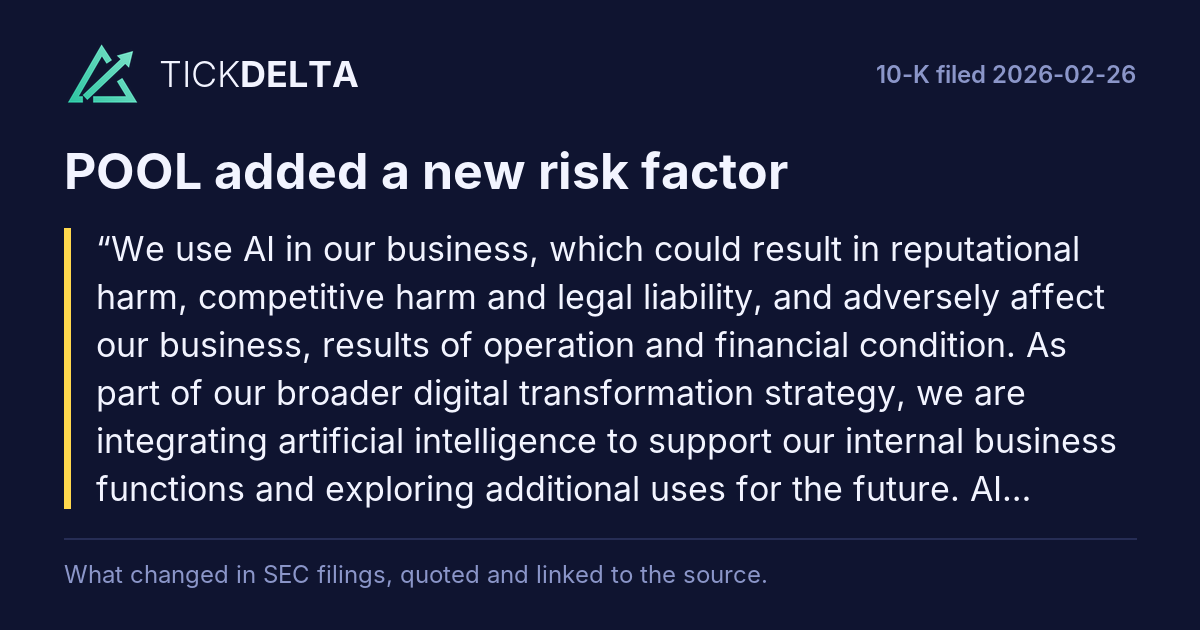
We use AI in our business, which could result in reputational harm, competitive harm and legal liability, and adversely affect our business, results of operation and financial condition.
As part of our broader digital transformation strategy, we are integrating artificial intelligence to support our internal business functions and exploring additional uses for the future. AI presents risks and challenges and may result in unintended consequences, including producing inaccurate data. AI algorithms and training methodologies may be flawed. While we aim to develop and use AI responsibly, we may be unsuccessful in identifying or resolving issues and risks before they arise. The AI-related legal and regulatory landscape is evolving and remains uncertain and may be inconsistent from jurisdiction to jurisdiction. Our obligations to comply with the evolving legal and regulatory landscape could entail significant costs or limit our ability to incorporate certain AI capabilities into our operations and products. AI-related issues, deficiencies and failures could also give rise to legal or regulatory action (including with respect to proposed legislation regulating AI in jurisdictions such as the European Union and others, and as a result of new and different applications of existing data protection, privacy, intellectual property and other laws), damage our reputation or otherwise materially harm our business.
Paragraphs in the 10-Q filed Oct 28, 2026 that were not in the one before
New in the latest 10-Q
3 paragraphs in the 10-Q filed Oct 28, 2026 with nothing like them in the 10-Q filed Jul 29, 2026 (at least half the words must differ; new numbers alone do not count). Quoted exactly, grouped by the item heading above them. This is text that changed, not a judgement of how serious it is.
Financial statements and notes
Selling and administrative expenses (operating expenses) increased 5% to $264.1 million from $251.2 million in the same period in 2025, reflecting higher performance-based compensation resulting from increased sales, increases in employee insurance and outside fees related to our strategic initiatives.
Read in the 10-Q
Selling and administrative expenses in the third quarter of 2026 increased 5% compared to the third quarter of 2025. The increase was primarily driven by higher performance-based compensation associated with increased sales, increases in employee insurance costs, and outside fees related to our strategic initiatives.
Read in the 10-Q
Net cash provided by operations increased 47% to $419.8 million in the first nine months of 2026 compared to $285.7 million in the first nine months of 2025. The difference in cash flow primarily relates to net favorable changes in working capital, particularly improved cash flows related to inventory net of a reduction in accounts payable. Our prior year operating cash flows were reduced by a $68.5 million federal tax payment from 2024 that was deferred into 2025 due to relief granted by the IRS.
Read in the 10-Q
The 10-Q's risk factors against the 10-K
Item 1A of the 10-Q filed Oct 28, 2026 against Item 1A of the 10-K filed Feb 26, 2026.
A 10-Q repeats only the risks that changed, so a 10-K paragraph that is missing from it is not counted as removed.
Added is a paragraph with nothing like it in the 10-K, Reworded a sentence that is in both with several words changed,
Quiet changes a sentence in both where one to four words changed and one is a hedge or a modal
(cut words struck through, new words highlighted).
Text on the page, not a score; each links to the filing at sec.gov.
What the 10-Q itself says about its risk factors:Our operations and financial results are subject to various risks and uncertainties, which could adversely affect our business, financial condition or future results. We urge you to carefully consider (i) the other information set forth in this report and (ii) the risk factors discussed in Part I, Item 1A of our Annual Report on Form 10-K for the year ended December 31, 2025. There have been no material changes to our risk factors from those disclosed in Part I, Item 1A of our Annual Report on Form 10-K for the year ended December 31, 2025.
Read in the 10-Q
1 paragraph in the 10-Q's Item 1A, and none of them adds, rewords or quietly edits a paragraph of the 10-K's.
Phrases used for the first time
Two-word phrases in Risk Factors of the 10-K filed Feb 26, 2026 that are in none of the 1 earlier 10-Ks stored, back to Feb 27, 2025
Where each one is used
- raise prices: We may also be unable to market and sell products if they are not competitive, including on the basis of price, quality, technical performance, ease of use, availability, delivery timing and reliability. Competitive pressures may limit our ability to maintain or raise prices, and an inability to maintain revenue or...
- regulatory landscape: As part of our broader digital transformation strategy, we are integrating artificial intelligence to support our internal business functions and exploring additional uses for the future. AI presents risks and challenges and may result in unintended consequences, including producing inaccurate data. AI algorithms...
- sustainability matters: Climate-related and other sustainability disclosures we make reflect our current plans and aspirations, and it is possible that we may not be able to achieve our desired impact, which may cause us to suffer from legal claims, reputational damage or a loss of demand for our products. Investors or other stakeholders...
Used at least twice, small words left out. Counted, not picked: a phrase can be new because the company renamed something.
What was taken out
6 paragraphs of last year's Risk Factors with nothing like them now. The longest are quoted.
Sources
Item 1A of each 10-K and 10-Q on EDGAR, quoted exactly. Each paragraph links to the filing at sec.gov.
Also
10-K change: what was reworded or cut, section by section.
Work with it
Excel workbook · CSV. Google Sheet that stays up to date: paste =IMPORTDATA("https://tickdelta.com/company/POOL/export.csv") into a cell.