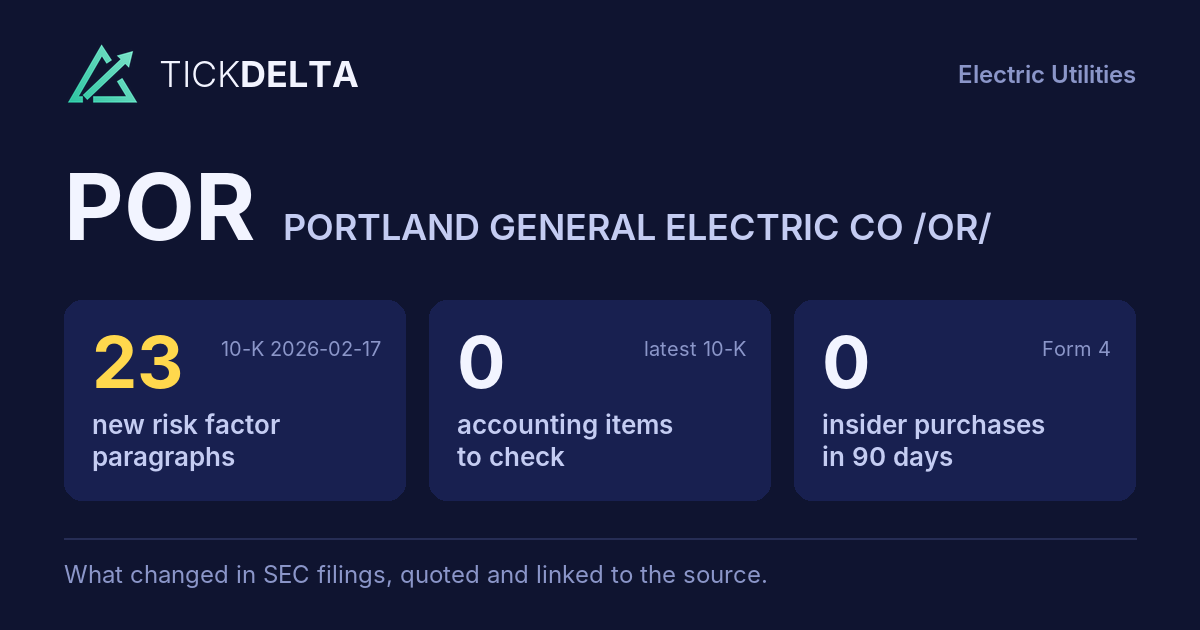
Paragraph 23 · 49% changed
Every version of it
Screener
/
SEC EDGAR
/CIK 0000784977
/10-K filed Feb 17, 2026, compared with Feb 14, 2025
/Numbers from the XBRL of the 10-Ks
NYSE
Utilities · Electric Utilities
Portland General Electric Co POR
The 10-K against last year's
282 changes: 91 added, 62 removed, 128 reworded, 1 quiet changes
10-K Feb 17, 2026 vs Feb 14, 2025
Risk Factors
17.1%
of the text changed · 8,943 words now · 23 new paragraphs, 3 gone
MD&A
36.9%
of the text changed · 18,426 words now · 68 new paragraphs, 59 gone
Legal Proceedings
32.3%
of the text changed · 1,732 words now
Accounting Policies
16.8%
of the text changed · 4,792 words now
10-K 0001193125-26-052750 (Feb 17, 2026) vs 10-K 0000784977-25-000012 (Feb 14, 2025)
Every paragraph, and how much of it changed
One bar per paragraph, in the order of the 10-K. Height and colour show the share of its words not in the closest paragraph a year earlier; the tallest bars are new paragraphs.
Risk Factors
107 paragraphs · 23 new · 29 reworded · 3 gone · 10-K Feb 17, 2026 against Feb 14, 2025
New paragraph
Reworded (5% of its words or more)
Same or nearly
Paragraph 52 · 47% changed
Every version of it
PGE owns and operates renewable generating facilities and battery storage facilities, which generate federal production tax credits (PTCs) and investment tax credits (ITCs) that PGE uses to reduce its federal tax obligations. The amount of PTCs earned depends on the level of electricity output generated and the applicable tax credit rate. A variety of operating and economic parameters, including adverse weather conditions and equipment reliability, could significantly reduce the PTCs generated by the Company’s wind facilities resulting in a material adverse impact on PGE’s financial condition and results of operations. These PTCs generate tax credit carryforwards that the Company plans to utilize in the future to reduce income tax obligations. If PGE cannot generate enough taxable income in the future to utilize all of the tax credit carryforwards before the credits expire, the Company may incur material charges to earnings. The Inflation Reduction Act of 2022 allows for the sale or transfer of renewable tax credits to other taxpayers. The Company has sold and plans to continue to sell tax credits. PGE’s inability to generate, transfer, or sell these credits could have a material impact on results of operations.
Paragraph 21 · 33% changed
Every version of it
Paragraph 20 · 31% changed
Every version of it
Long-term increases in both the number of customers and demand for energy energy, as well as the natural aging of existing infrastructure, will require continued expansion and upgrade of PGE’s generation, transmission, and distribution systems. Construction of new facilities and modifications or replacements of existing facilities could be affected by factors such as unanticipated delays and cost increases, including tariffs impacting the cost and availability of necessary equipment, supply chain disruption and cost inflation, community opposition, availability of a skilled workforce, increases in interest rates, failure of counterparties to perform under agreements, ability to build or secure transmission, and the failure to obtain, or delay in obtaining, necessary permits from state or federal agencies or tribal entities. Supply chain disruption could be exacerbated by government tariffs as well as inflation. Delays and cost increases could result in failure to complete the projects or the abandonment of capital projects,
Paragraph 91 · 30% changed
Every version of it
PGE meets its customers’ energy demand requirements based on capacity obtained from its generating facilities and third-party PPAs. The Company continuously evaluates how much capacity it will need to meet reasonably expected demands of customers and provide reasonable reserves. PGE is also required to file IRPs with the OPUC that detail the Company’s plan to meet the future energy and capacity needs of its customers through a least-cost, least-risk combination of energy generation and demand reduction, while also aggressively reducing GHG emissions from the power supply. If the capacity provided by the Company’s generating facilities and purchased power is not adequate to meet customers’ energy demands, PGE may be required to purchase more power from third parties, which may not come from non-emitting resources, invest in acquiring additional generating or battery storage facilities, or invest in extending the operating life of existing generating assets, which could increase GHG emissions. Any failure to obtain adequate capacity to meet customers’ energy demand requirements could increase its costs and negatively impact PGE’s customer satisfaction, all of which could have an adverse impact on PGE’s business and results of operations.
Paragraph 98 · 29% changed
Every version of it
PGE also owns unregulated properties that are currently or previously leased to third parties and located adjacent to PGE’s T.W. Sullivan hydro generating facility. PGE has recorded a non-utility asset retirement obligation (ARO) for this site related to assets that are no longer in service. Significant changes in estimates for this non-utility ARO due to changes in environmental laws or regulations could adversely affect PGE’s results of operations.
Paragraph 99 · 29% changed
Every version of it
Paragraph 92 · 23% changed
Every version of it
Paragraph 23 · 49% changed
Every version of it
10-K Feb 14, 2025Capital and credit market conditions could adversely affect the Company’s access to capital, cost of capital, and ability to execute its strategic plan.
10-K Feb 17, 2026
Recently imposed trade tariffs could negatively impact PGE’s financial condition, results of operations, and cash flows. While the impact of these trade tariffs is difficult to predict at this time, economic volatility, supply chain disruption, or cost increases triggered by these trade tariffs could negatively affect PGE’s ability to execute its strategic plan. Adverse capital and credit market conditions caused by the new trade tariffs could negatively affect the Company’s access to capital, cost of capital, and ability to complete capital projects.
Paragraph 52 · 47% changed
Every version of it
10-K Feb 14, 2025
PGE owns and operates renewable generating facilities and battery storage facilities, which generate federal production tax credits (PTCs) and investment tax credits (ITCs) that PGE uses to reduce its federal tax obligations. The amount of PTCs earned depends on the level of electricity output generated and the applicable tax credit rate. A variety of operating and economic parameters, including adverse weather conditions and equipment reliability, could significantly reduce the PTCs generated by the Company’s wind facilities resulting in a material adverse impact on PGE’s financial condition and results of operations. These PTCs generate tax credit carryforwards that the Company plans to utilize in the future to reduce income tax obligations. If PGE cannot generate enough taxable income in the future to utilize all of the tax credit carryforwards before the credits expire, the Company may incur material charges to earnings. The Inflation Reduction Act of 2022 allows for the sale or transfer of renewable tax credits to other taxpayers. The Company has sold and plans to continue to sell tax credits. PGE’s inability to generate, transfer, or sell these credits could have a material impact on results of operations.
10-K Feb 17, 2026
PGE owns and operates renewable generating facilities and battery storage facilities, which generate federal production tax credits (PTCs) and investment tax credits (ITCs) that PGE uses to reduce its federal tax obligations. The amount of PTCs earned depends on the level of electricity output generated and the applicable
Paragraph 21 · 33% changed
Every version of it
10-K Feb 14, 2025interest rates, failure of counterparties to perform under agreements, ability to build or secure transmission, and the failure to obtain, or delay in obtaining, necessary permits from state or federal agencies or tribal entities. Supply chain disruption could be exacerbated by government tariffs as well as inflation. Delays and cost increases could result in failure to complete the projects or the abandonment of capital projects, which could eliminate or impair PGE’s ability to recover related costs in the rate determination process. In addition, failure to complete construction projects according to specifications could result in reduced plant efficiency, equipment failure, and plant performance that falls below expected levels, which could increase operating costs.
10-K Feb 17, 2026
which could eliminate or impair PGE’s ability to recover related costs in the rate determination process. In addition, failure to complete construction projects according to specifications could result in reduced plant efficiency, equipment failure, and plant performance that falls below expected levels, which could increase operating costs.
Paragraph 20 · 31% changed
Every version of it
10-K Feb 14, 2025
Long-term increases in both the number of customers and demand for energy will require continued expansion and upgrade of PGE’s generation, transmission, and distribution systems. Construction of new facilities and modifications or replacements of existing facilities could be affected by factors such as unanticipated delays and cost increases, including supply chain disruption and cost inflation, availability of a skilled workforce, increases in
10-K Feb 17, 2026
Long-term increases in both the number of customers and demand for energy, as well as the natural aging of existing infrastructure, will require continued expansion and upgrade of PGE’s generation, transmission, and distribution systems. Construction of new facilities and modifications or replacements of existing facilities could be affected by factors such as unanticipated delays and cost increases, tariffs impacting the cost and availability of necessary equipment, supply chain disruption and cost inflation, community opposition, availability of a skilled workforce, increases in interest rates, failure of counterparties to perform under agreements, ability to build or secure transmission, and the failure to obtain, or delay in obtaining, necessary permits from state or federal agencies or tribal entities. Supply chain disruption could be exacerbated by government tariffs as well as inflation. Delays and cost increases could result in failure to complete the projects or the abandonment of capital projects,
Paragraph 91 · 30% changed
Every version of it
10-K Feb 14, 2025
PGE meets its customers’ energy demand requirements based on capacity obtained from its generating facilities and third-party PPAs. The Company continuously evaluates how much capacity it will need to meet reasonably expected demands of customers and provide reasonable reserves. PGE is also required to file IRPs with the OPUC that detail the Company’s plan to meet the future energy and capacity needs of its customers through a least-cost, least-risk combination of energy generation and demand reduction, while also aggressively reducing GHG emissions from the power supply. If the capacity provided by the Company’s generating facilities and purchased power is not adequate to meet customers’ energy demands, PGE may be required to purchase more power from third parties, which may not come from non-emitting resources, invest in acquiring additional generating or battery storage facilities, or invest in extending the operating life of existing generating assets, which could increase GHG emissions. Any failure to obtain adequate capacity to meet customers’ energy demand requirements could increase its costs and negatively impact PGE’s customer satisfaction, all of which could have an adverse impact on PGE’s business and results of operations.
10-K Feb 17, 2026
PGE meets its customers’ energy demand requirements based on capacity obtained from its generating facilities and third-party PPAs. The Company continuously evaluates how much capacity it will need to meet reasonably expected demands of customers and provide reasonable reserves. PGE is also required to file IRPs with the OPUC that detail the Company’s plan to meet the future energy and capacity needs of its customers through a least-cost, least-risk combination of energy generation and demand reduction, while also aggressively reducing GHG
Paragraph 98 · 29% changed
Every version of it
10-K Feb 14, 2025
PGE also owns unregulated properties that are currently or previously leased to third parties and located adjacent to PGE’s T.W. Sullivan hydro generating facility. PGE has recorded a non-utility asset retirement obligation (ARO) for this site related to assets that are no longer in service. Significant changes in estimates for this non-utility ARO due to changes in environmental laws or regulations could adversely affect PGE’s results of operations.
10-K Feb 17, 2026
PGE also owns unregulated properties that are currently or previously leased to third parties and located adjacent to PGE’s T.W. Sullivan hydro generating facility. PGE has recorded a non-utility asset retirement obligation
Paragraph 99 · 29% changed
Every version of it
10-K Feb 14, 2025PGE also owns unregulated properties that are currently or previously leased to third parties and located adjacent to PGE’s T.W. Sullivan hydro generating facility. PGE has recorded a non-utility asset retirement obligation (ARO) for this site related to assets that are no longer in service. Significant changes in estimates for this non-utility ARO due to changes in environmental laws or regulations could adversely affect PGE’s results of operations.
10-K Feb 17, 2026
(ARO) for this site related to assets that are no longer in service. Significant changes in estimates for this non-utility ARO due to changes in environmental laws or regulations could adversely affect PGE’s results of operations.
Paragraph 92 · 23% changed
Every version of it
10-K Feb 14, 2025PGE meets its customers’ energy demand requirements based on capacity obtained from its generating facilities and third-party PPAs. The Company continuously evaluates how much capacity it will need to meet reasonably expected demands of customers and provide reasonable reserves. PGE is also required to file IRPs with the OPUC that detail the Company’s plan to meet the future energy and capacity needs of its customers through a least-cost, least-risk combination of energy generation and demand reduction, while also aggressively reducing GHG emissions from the power supply. If the capacity provided by the Company’s generating facilities and purchased power is not adequate to meet customers’ energy demands, PGE may be required to purchase more power from third parties, which may not come from non-emitting resources, invest in acquiring additional generating or battery storage facilities, or invest in extending the operating life of existing generating assets, which could increase GHG emissions. Any failure to obtain adequate capacity to meet customers’ energy demand requirements could increase its costs and negatively impact PGE’s customer satisfaction, all of which could have an adverse impact on PGE’s business and results of operations.
10-K Feb 17, 2026
emissions from the power supply. If the capacity provided by the Company’s generating facilities and purchased power is not adequate to meet customers’ energy demands, or if customer demand increases beyond forecasts, PGE may be required to purchase more power from third parties, which may not come from non-emitting resources, invest in acquiring additional generating or battery storage facilities, or invest in extending the operating life of existing generating assets, which could increase GHG emissions. Any failure to obtain adequate capacity to meet customers’ energy demand requirements could increase its costs and negatively impact PGE’s customer satisfaction, all of which could have an adverse impact on PGE’s business and results of operations.
MD&A
280 paragraphs · 68 new · 123 reworded · 59 gone · 10-K Feb 17, 2026 against Feb 14, 2025
New paragraph
Reworded (5% of its words or more)
Same or nearly
Paragraph 118 · 50% changed
PGE continues to evaluate each of these rules to assess the impact it may have on the Company’s continuing investment in Colstrip, which could be material. PGE notes Compliance with the 2024 rules could require material upgrades at Colstrip with proposed compliance dates that a substantial number may not be achievable or require the use of legal challenges have been filed regarding these rules. These challenges, unproven technology, resulting in significant impacts to costs related to Colstrip. If upheld, or attempts not modified by the federal government to withdraw or modify EPA, the regulations, if successful, could affect the applicability to PGE 2024 MATS and Colstrip, specifically. To the extent these regulations result in increased GHG Rules would require compliance costs, the Company expects to seek recovery of those costs through the ratemaking process. as early as 2027 and 2032, respectively.
Paragraph 279 · 49% changed
Paragraph 61 · 48% changed
Paragraph 38 · 47% changed
Paragraph 267 · 46% changed
Paragraph 177 · 46% changed
Paragraph 226 · 46% changed
The Company believes its cash flow from operating activities, access to credit markets, and its credit facilities provide sufficient liquidity to support estimated future cash requirements, including the cash consideration necessary to close on the proposed Acquisition. For additional information on PGE’s regulatory assets and liabilities, the proposed acquisition, see “Regulatory Matters” “Pending Acquisition” in the Overview section in this Item 7., and Note 7, Regulatory Assets and Liabilities 21, Subsequent Events, in Notes to Consolidated Financial Statements in Item 8.—“Financial Statements and Supplementary Data.”
Paragraph 186 · 45% changed
Net income for 2024 increased $85 2025 decreased $7 million from 2023, 2024. Retail revenues increased primarily due to price changes to cover anticipated higher NVPC and general cost increases, as higher authorized by the OPUC. Wholesale revenues have decreased, driven by a decline in the average price of wholesale deliveries, although lower sales volumes also contributed to the decline. Purchased power and fuel costs were more than offset by increases in Retail revenues authorized by the OPUC in the AUT in anticipation of higher NVPC. In 2023, the opposite was true as higher Purchased power expense declined slightly, reflecting stable market conditions and fuel expenses exceeded the corresponding increases in prices resulting from the AUT. Retail revenues also increased due to an overall increase in deliveries, although that demand impact was somewhat offset by the lower average price result of the relative mix of deliveries among customer classes. Temperature variations in 2024 had a lesser impact on demand than what was experienced in 2023, although total system load increased 12% year over year, as the industrial class continued to show strength, and wholesale sales continue to increase. The Company saw a 13% increase in the average variable power cost per MWh driven primarily by higher physical power and natural gas prices due in part to severe weather events in the first quarter of 2024. Wholesale revenues increased during 2024, driven by a 40% increase in deliveries, which contributed to reducing NVPC. commodity prices. Generation, transmission and distribution expenses were up primarily due to vegetation management and major maintenance activities. The increase in slightly, while total Administrative and general expense reflects increases in various categories including compensation and benefits, customer related items, and regulatory and professional services expense. other expenses were reduced 3% from 2024. Increases in Depreciation and amortization expense, driven by higher depreciable asset balances, and Interest expense, net, due to higher long-term debt balances, were largely anticipated and largely somewhat offset in net income by increased revenues. Income tax expense was up due primarily to lower PTC benefits.
Paragraph 118 · 50% changed
10-K Feb 14, 2025
PGE continues to evaluate each of these rules to assess the impact it may have on the Company’s continuing investment in Colstrip, which could be material. PGE notes that a substantial number of legal challenges have been filed regarding these rules. These challenges, or attempts by the federal government to withdraw or modify the regulations, if successful, could affect the applicability to PGE and Colstrip, specifically. To the extent these regulations result in increased compliance costs, the Company expects to seek recovery of those costs through the ratemaking process.
10-K Feb 17, 2026
PGE continues to evaluate each of these rules to assess the impact it may have on the Company’s continuing investment in Colstrip, which could be material. Compliance with the 2024 rules could require material upgrades at Colstrip with proposed compliance dates that may not be achievable or require the use of unproven technology, resulting in significant impacts to costs related to Colstrip. If upheld, or not modified by the EPA, the 2024 MATS and GHG Rules would require compliance as early as 2027 and 2032, respectively.
Paragraph 279 · 49% changed
10-K Feb 14, 2025PGE has various unresolved legal and regulatory matters about which there is inherent uncertainty, with the ultimate outcome contingent upon several factors. Such contingencies are evaluated using the best information available. A loss contingency is accrued, and disclosed if material, when it is probable that an asset has been impaired, or a liability incurred, and the amount of the loss can be reasonably estimated. If a range of probable loss is established, the minimum amount in the range is accrued, unless some other amount within the range appears to be a better estimate. If the probable loss cannot be reasonably estimated, no accrual is recorded, but the loss contingency and the reasons to the effect that it cannot be reasonably estimated are disclosed. A loss contingency will also be disclosed when it is reasonably possible that a liability has been incurred if the estimate or range of potential loss is material. Established accruals reflect management’s assessment of inherent risks, credit worthiness, and complexities involved in the process. There can be no assurance as to the ultimate outcome of any particular contingency.
10-K Feb 17, 2026
or range of potential loss is material. Established accruals reflect management’s assessment of inherent risks, credit worthiness, and complexities involved in the process. There can be no assurance as to the ultimate outcome of any particular contingency.
Paragraph 61 · 48% changed
10-K Feb 14, 2025The agreements related to the Clearwater Wind Development and all BESS agreements represent the final procurement from the 2021 All-Source RFP. Resources required to meet the remaining 2030 need are anticipated to be procured through future acquisition processes, including, but not limited to, the 2023 All-Source RFP and future RFPs.
10-K Feb 17, 2026
These agreements represent the final procurement from the 2023 All-Source RFP. The 2023 RFP is a component of PGE’s multi-pronged procurement approach focused on customer affordability, system reliability, and decarbonization. Both the 2023 RFP reprice and the 2025 RFP disclosed below were designed to capture expiring tax credits to support customer affordability. Additional resources are anticipated to be procured through future acquisition processes, including, but not limited to, PPAs, including a bilateral all-call for PPAs, community-based renewable energy procurement, the ongoing 2025 RFP, and future RFPs.
Paragraph 38 · 47% changed
10-K Feb 14, 2025The Company exists to power the advancement of society. PGE energizes lives, strengthens communities, and fosters energy solutions that promote social, economic, and environmental progress. The Company is committed to being a clean energy leader and delivering steady growth and returns to shareholders. PGE is focused on working with customers, communities, policy makers, and other stakeholders to deliver affordable, safe, reliable electricity service to all, while increasing opportunities to deliver clean and renewable energy, reducing GHG emissions, and responding to evolving customer expectations. At the same time, the Company is building an increasingly smart, integrated, and interconnected grid that spans from residential customers to other utilities within the region. PGE is transforming all aspects of its business to empower its workforce to be even more results oriented to serve customers well. To create a clean energy future, PGE is focused on the following strategic imperatives:
10-K Feb 17, 2026
PGE's corporate strategy places customers at the center of everything the Company does. PGE supports energizing lives, strengthening communities, and driving advancement in energy to promote social, economic, and environmental progress. With a focus on affordability, the Company continuously innovates, streamlines, and manages costs to deliver exceptional experiences for its customers. The Company is committed to delivering steady growth and returns to shareholders. The Company is building an increasingly smart, integrated, and interconnected grid that spans from residential customers to other utilities within the region.
Paragraph 267 · 46% changed
10-K Feb 14, 2025On July 26, 2024, PGE entered into an equity distribution agreement under which it could sell up to $400 million of its common stock through at-the-market offering programs. In the fourth quarter the Company entered into forward sale agreements for 1,420,049 shares. In December 2024, the Company issued 1,066,549 shares pursuant to the forward sale agreements and received net proceeds of $50 million. The Company could have physically settled the remaining amount by delivering 353,500 shares in exchange for cash of $17 million as of December 31, 2024. Any proceeds from the issuances of common stock will be used for general corporate purposes and investments in renewables and non-emitting dispatchable capacity.
10-K Feb 17, 2026
PGE anticipates entering into a new at-the-market offering program in the first quarter of 2026. Any proceeds from the issuances of common stock will be used for general corporate purposes and investments in renewables and non-emitting dispatchable capacity.
Paragraph 177 · 46% changed
10-K Feb 14, 2025•For 2024, actual NVPC was below baseline NVPC by $78 million, which was outside the established deadband range. Pursuant to the PCAM and related earnings test, because PGE’s preliminary regulatory ROE was below 10.5%, there is no estimated refund to customers under the PCAM for 2024. A final determination regarding the 2024 PCAM results will be made by the OPUC through a public filing and review in 2025.
10-K Feb 17, 2026
final determination regarding the 2025 PCAM results will be made by the OPUC through a public filing and review in 2026.
Paragraph 226 · 46% changed
10-K Feb 14, 2025
For additional information on PGE’s regulatory assets and liabilities, see “Regulatory Matters” in the Overview section in this Item 7., and Note 7, Regulatory Assets and Liabilities in Notes to Consolidated Financial Statements in Item 8.—“Financial Statements and Supplementary Data.”
10-K Feb 17, 2026
The Company believes its cash flow from operating activities, access to credit markets, and its credit facilities provide sufficient liquidity to support estimated future cash requirements, including the cash consideration necessary to close on the proposed Acquisition. For additional information on the proposed acquisition, see “Pending Acquisition” in the Overview section in this Item 7., and Note 21, Subsequent Events, in Notes to Consolidated Financial Statements in Item 8.—“Financial Statements and Supplementary Data.”
Paragraph 186 · 45% changed
10-K Feb 14, 2025
Net income for 2024 increased $85 million from 2023, as higher Purchased power and fuel costs were more than offset by increases in Retail revenues authorized by the OPUC in the AUT in anticipation of higher NVPC. In 2023, the opposite was true as higher Purchased power and fuel expenses exceeded the corresponding increases in prices resulting from the AUT. Retail revenues also increased due to an overall increase in deliveries, although that demand impact was somewhat offset by the lower average price result of the relative mix of deliveries among customer classes. Temperature variations in 2024 had a lesser impact on demand than what was experienced in 2023, although total system load increased 12% year over year, as the industrial class continued to show strength, and wholesale sales continue to increase. The Company saw a 13% increase in the average variable power cost per MWh driven primarily by higher physical power and natural gas prices due in part to severe weather events in the first quarter of 2024. Wholesale revenues increased during 2024, driven by a 40% increase in deliveries, which contributed to reducing NVPC. Generation, transmission and distribution expenses were up primarily due to vegetation management and major maintenance activities. The increase in Administrative and general expense reflects increases in various categories including compensation and benefits, customer related items, and regulatory and professional services expense. Increases in Depreciation and amortization expense, driven by higher depreciable asset balances, and Interest expense, net, due to higher long-term debt balances, were anticipated and largely offset in net income by increased revenues.
10-K Feb 17, 2026
Net income for 2025 decreased $7 million from 2024. Retail revenues increased primarily due to price changes to cover anticipated higher NVPC and general cost increases, as authorized by the OPUC. Wholesale revenues have decreased, driven by a decline in the average price of wholesale deliveries, although lower sales volumes also contributed to the decline. Purchased power and fuel expense declined slightly, reflecting stable market conditions and lower commodity prices. Generation, transmission and distribution expenses were up slightly, while total Administrative and other expenses were reduced 3% from 2024. Increases in Depreciation and amortization expense, driven by higher depreciable asset balances, and Interest expense, net, due to higher long-term debt balances, were largely anticipated and somewhat offset in net income by increased revenues. Income tax expense was up due primarily to lower PTC benefits.
A paragraph is matched with the one last year that shares the most of its words; under half in common makes it new. The paragraphs shown are the 8 reworded the most in each section.
The paragraph that changed most in each section
The redline
Marked against last year's 10-K: cut words struck through, new words highlighted.
MD&A188 words changed in this paragraph; it is 45% similar to last year's version.
Renewable recovery framework—As previously authorized by the OPUC, the RAC is a primary method available to recover costs associated with renewable resources and the inclusion of prudent costs of energy storage projects associated with renewables, under certain conditions. The RAC allows PGE to recover prudently incurred costs of renewable resources through filings made each year, outside of a GRC. During 2024, General Rate Case (GRC). In 2023, the Company filed for Clearwater, which went into service in January 2024. PGE did not submit a request for recovery of any renewable resources under the RAC. In 2023, the Company filed for Clearwater, which went into service January 5, 2024. Per the OPUC's Final order in the 2025 GRC, Clearwater was excluded from the rate case as prudency is being determined in a separate proceeding, OPUC Docket UE 427. The target rate effective date for price changes for Clearwater in UE 427 is March 1, RAC during 2024 or 2025. Under the RAC, PGE will continue to defer the revenue requirement, net of NVPC benefits, from the in-service date in January 2024 until Clearwater is reflected in customer prices. As of December 31, 2024, the Company has recorded a $40 million regulatory liability, which represents the deferred revenue requirement that PGE believes is probable of recovery, net of NVPC that is probable of refund to customers under the RAC. For further information, see “Alternative Revenue Programs” in Note 2, Summary of Significant Accounting Policies and “Clearwater RAC” in Note 7, Regulatory Assets and Liabilities in the Notes to Consolidated Financial Statements in Item 8.—“Financial Statements and Supplementary Data.”
Source: Item 7, 10-K 0001193125-26-052750 vs Item 7, 10-K 0000784977-25-000012
Accounting Policies167 words changed in this paragraph; it is 56% similar to last year's version.
The Inflation Reduction Act of 2022 (IRA) was signed into law on August 16, 2022. The IRA provides an election to transfer (i.e., sell) certain tax credits to unrelated third parties in exchange for cash consideration. PGE has elected an accounting policy to account for the transfer of Federal production tax credits (PTCs) and ITCs, including discounts, within the scope of Accounting Standards Codification 740 – Income Taxes. On December 12, 2023, PGE received approval from the OPUC to transfer 2023 PTCs and record any difference between the full value and the discounted value as a deferred regulatory asset. On April 17, 2024, PGE received approval from the OPUC to transfer 2024 and 2025 PTCs and record any difference between the full value and the discounted value as a deferred regulatory asset. On December 11, 2024, PGE received approval from the OPUC to transfer 2024 ITCs and return the net proceeds from the sale to PGE customers. Proceeds from the sale of 2023 PTCs and 2024 PTCs and ITCs are reported in Tax credit sales on PGE’s consolidated statements of cash flows. PGE presents the cash proceeds are classified as an operating activity in the consolidated statements of cash flows under flows, and included in Cash paid for income taxes, net within the supplemental disclosures of cash flow information. PGE transferred tax credits, net of discounts, of $112 million and $24 million for cash proceeds in 2024 and 2023, respectively. The 2024 proceeds include $52 million from PTC sales and $60 million from ITC sales, net of discounts. Derecognition of the transferred deferred tax asset occurs when the buyer obtains control of the tax credit.
Source: Item 8, Note 2 – SUMMARY OF SIGNIFICANT ACCOUNTING POLICIES, 10-K 0001193125-26-052750 vs Item 8, Note 2 – SUMMARY OF SIGNIFICANT ACCOUNTING POLICIES, 10-K 0000784977-25-000012
Risk Factors141 words changed in this paragraph; it is 40% similar to last year's version.
PGE owns and operates renewable generating facilities and battery storage facilities, which generate federal production tax credits (PTCs) and investment tax credits (ITCs) that PGE uses to reduce its federal tax obligations. The amount of PTCs earned depends on the level of electricity output generated and the applicable tax credit rate. A variety of operating and economic parameters, including adverse weather conditions and equipment reliability, could significantly reduce the PTCs generated by the Company’s wind facilities resulting in a material adverse impact on PGE’s financial condition and results of operations. These PTCs generate tax credit carryforwards that the Company plans to utilize in the future to reduce income tax obligations. If PGE cannot generate enough taxable income in the future to utilize all of the tax credit carryforwards before the credits expire, the Company may incur material charges to earnings. The Inflation Reduction Act of 2022 allows for the sale or transfer of renewable tax credits to other taxpayers. The Company has sold and plans to continue to sell tax credits. PGE’s inability to generate, transfer, or sell these credits could have a material impact on results of operations.
Source: Item 1A, 10-K 0001193125-26-052750 vs Item 1A, 10-K 0000784977-25-000012
Legal Proceedings126 words changed in this paragraph; it is 45% similar to last year's version.
The EPA finalized the feasibility study, along with the remedial investigation, and the results provided the framework for the EPA to determine a clean-up remedy for Portland Harbor that was documented in a Record of Decision (ROD) issued in 2017. The ROD outlined the EPA’s selected remediation plan for clean-up of Portland Harbor that had an undiscounted estimated total cost of $1.7 billion, comprised of $1.2 billion related to remediation construction costs and $0.5 billion related to long-term operation and maintenance costs. Remediation construction costs were estimated to be incurred over a 13-year period, with long-term operation and maintenance costs estimated to be incurred over a 30-year period from the start of construction. Stakeholders have raised concerns that EPA’s cost estimates are understated, and PGE estimates undiscounted total remediation costs for Portland Harbor per the ROD could range from $1.9 billion to $3.5 billion. The EPA acknowledged the estimated costs are based on data that was outdated and that pre-remedial design sampling was necessary to gather updated baseline data to better refine the remedial design and estimated cost.
Source: Item 3, via Note 19 – CONTINGENCIES, 10-K 0001193125-26-052750 vs Item 3, via Note 19 – CONTINGENCIES, 10-K 0000784977-25-000012
Sentences and paragraphs added, removed or reworded
Every change, by type
Sentences and paragraphs of POR's Risk Factors and MD&A, 10-K Feb 17, 2026 against 10-K Feb 14, 2025. Each links to the text at sec.gov.
Quiet changes are sentences kept from last year with one to four words changed, at least one of them a hedge, a modal or a qualifier (may, could, will, not, significant, material…). A year or date rolling forward is not counted.
The full word list
adverse, adversely, all, although, anticipate, anticipates, any, approximately, believe, believes, can, cannot, certain, could, expect, expects, generally, however, if, intend, intends, largely, likely, many, material, materially, may, might, most, must, never, no, not, possible, primarily, probable, should, significant, significantly, some, substantial, substantially, unlikely, will, would
AddedRisk Factors
Facilities may be exposed to wildfires or cause wildfires, which could disrupt services, hinder the Company’s ability to execute its strategic plan, subject the Company to liability and litigation, adversely affect PGE’s access to capital and increase costs.
Read it in 10-K Feb 17, 2026 at sec.gov
AddedRisk Factors
able to prevent a wildfire, which could lead to potential liability if energized systems are determined to be the cause of wildfires that result in harm.
Read it in 10-K Feb 17, 2026 at sec.gov
AddedRisk Factors
The lack of legislation limiting wildfire-related liability or providing a wildfire relief fund may impact PGE’s credit rating, which could hamper the Company’s ability to attract capital and invest in the infrastructure required to meet emissions targets and customer reliability needs. PGE may face barriers to securing cost-efficient contracts if there is a perceived risk of utility financial losses related to wildfire. Business partners may be forced to increase prices to recognize the unresolved financial exposure that PGE presents as a counterparty.
Read it in 10-K Feb 17, 2026 at sec.gov
AddedRisk Factors
Capital investment and operating expenses related to this risk may not be recoverable through customer prices or insurance proceeds. PGE’s insurance coverage may not fully cover all the hazards and liabilities to which PGE is subject. Certain liabilities resulting from wildfires and other risks, may be excluded from PGE’s insurance coverage. Insurance costs in the utility industry continue to rise, and the Company may be unable to obtain insurance on acceptable terms or at all. Rising insurance costs and any losses for which PGE is not adequately insured against could have a material, adverse effect on our results of operations and financial position.
Read it in 10-K Feb 17, 2026 at sec.gov
AddedRisk Factors
Trade tariffs and related market volatility and supply chain disruptions could increase PGE’s operating costs, impair PGE’s ability to complete capital projects, and impede access to capital markets.
Read it in 10-K Feb 17, 2026 at sec.gov
AddedRisk Factors
Failure of potential data center or other large load customers to materialize as expected, or materialize and then relocate to other service areas, could result in an inability to recover the costs of certain capital investments or failure to achieve PGE’s strategic goals.
Read it in 10-K Feb 17, 2026 at sec.gov
AddedRisk Factors
PGE’s business is impacted by uncertainties associated with increased energy demand or significant accelerated growth in demand due to new data centers or other large load businesses. The Company may enter into arrangements with these or other large load customers and potential customers that require PGE to invest capital and assume credit risk related to such developments and the related generation and transmission investments before PGE receives any potential return. Existing data center or other large load customers may move outside the Company’s service area due to pricing offered by PGE, which includes cost of compliance with state policies including cost allocation policies, regulatory constraints, ease of or ability to secure independent generation, and other factors. PGE may be unable to build the infrastructure needed to support large load customers, or such construction may be subject to financing, environmental, or other permitting hurdles. If new data centers or other large load customers do not materialize as forecasted, or if existing data center or other large load customers leave the Company’s service area, PGE may not be able to realize its strategic goals and the Company may be left with stranded costs and other effects that could have material adverse impacts on its financial condition, results of operations, and cash flows.
Read it in 10-K Feb 17, 2026 at sec.gov
AddedRisk Factors
Failure to complete the Asset Purchase Acquisition (the “Acquisition”) could negatively impact the Company’s results of operations, financial condition, and the market value of its common stock and debt securities.
Read it in 10-K Feb 17, 2026 at sec.gov
Show the other 56
AddedRisk Factors
The Acquisition is contingent on conditions, including receipt of regulatory approvals, that may not be satisfied, which would result in the failure to complete the Acquisition. If the Acquisition is not completed, or if the Company is unable to secure the external financing necessary for the Acquisition, the Company’s ongoing business could be materially adversely affected, and the Company will be subject to a variety of risks potentially impacting business or financial results, including the following:
Read it in 10-K Feb 17, 2026 at sec.gov
AddedRisk Factors
•under certain circumstances, upon termination of the Agreement, the Company may be required to pay a termination fee of $35 million;
Read it in 10-K Feb 17, 2026 at sec.gov
AddedRisk Factors
•payment of costs incurred in connection with pursuing the Acquisition regardless of whether the Acquisition closes; and
Read it in 10-K Feb 17, 2026 at sec.gov
AddedRisk Factors
•the Company may experience negative reactions from customers, vendors, employees or other key stakeholders.
Read it in 10-K Feb 17, 2026 at sec.gov
RemovedRisk Factors
RemovedRisk Factors
RemovedRisk Factors
RewordedRisk Factors
Construction of new facilities and modifications or replacements of existing facilities could be affected by factors such as unanticipated delays and cost increases, including tariffs impacting the cost and availability of necessary equipment, supply chain disruption and cost inflation, community opposition, availability of a skilled workforce, increases in interest rates, failure of counterparties to perform under agreements, ability to build or secure transmission, and the failure to obtain, or delay in obtaining, necessary permits from state or federal agencies or tribal entities.
Read it in 10-K Feb 17, 2026 at sec.gov
RewordedRisk Factors
PGE may be unable to effectively implement a PSPS and de-energize its system in the event of heightened wildfire risk, or the PSPS may not be able to prevent a wildfire, which could lead to potential liability if energized systems are determined to be the cause of wildfires that result in harm.
Read it in 10-K Feb 17, 2026 at sec.gov
RewordedRisk Factors
Unfavorable wind conditions could require increased reliance on power from the Company’s thermal generating resources or power purchases in the wholesale market, both of which could have an adverse effect on results of operations.
Read it in 10-K Feb 17, 2026 at sec.gov
RewordedRisk Factors
PGE continuously seeks to maintain a robust program of security and controls, but the impact of a physical or material information technology event could have a material adverse effect on the Company’s competitive position, reputation, results of operations, financial condition and cash flows.
Read it in 10-K Feb 17, 2026 at sec.gov
RewordedRisk Factors
RewordedRisk Factors
RewordedRisk Factors
Credit rating agencies routinely evaluate the Company, and their ratings of long-term and short-term debt are based on a number of factors, including the perceived supportiveness of the regulatory environment affecting the utility operations, the Company's ability to recover costs through customer pricing, the Company's ability to effectively manage risks, the Company’s cash generating capability, level of indebtedness, overall financial strength, the status of certain capital projects, as well as factors beyond PGE’s control, such as tax reform, the state of the economy economy, and industry generally.
Read it in 10-K Feb 17, 2026 at sec.gov
RewordedRisk Factors
RewordedRisk Factors
PGE has recorded a non-utility asset retirement obligation (ARO) for this site related to assets that are no longer in service.
Read it in 10-K Feb 17, 2026 at sec.gov
RewordedRisk Factors
Long-term increases in both the number of customers and demand for energy energy, as well as the natural aging of existing infrastructure, will require continued expansion and upgrade of PGE’s generation, transmission, and distribution systems.
Read it in 10-K Feb 17, 2026 at sec.gov
RewordedRisk Factors
In response to more intense, frequent, and severe weather events, events and increasing peak loads, PGE may need to make additional investments in generation, transmission, distribution, and distribution energy storage assets to enhance reliability and resiliency.
Read it in 10-K Feb 17, 2026 at sec.gov
RewordedRisk Factors
As a general matter, PGE relies on customer prices to recover most of the costs incurred in connection with the operation of its business, including, among other things, costs related to capital projects (such as the construction of new facilities or the modification of existing facilities), the costs of compliance with legislative and regulatory requirements (including environmental laws), and the costs of damage from storms and other natural disasters. disasters, including the costs to implement wildfire mitigation plans.
Read it in 10-K Feb 17, 2026 at sec.gov
AddedMD&A
•increases to operating costs that could result from changes to trade tariffs, rising inflation and volatility in interest rates;
Read it in 10-K Feb 17, 2026 at sec.gov
AddedMD&A
•the impacts of changes in the tax code, including tax rates, minimum tax rates, adjustments made to deferred tax assets and liabilities, and changes impacting the availability of and ability to transfer tax credits;
Read it in 10-K Feb 17, 2026 at sec.gov
AddedMD&A
•impacts from legislative action limiting wildfire-related liability or providing a wildfire relief fund, such as negative effects on PGE’s credit rating, which could limit PGE’s ability to access capital on terms similar to past transactions or at all and could impact PGE’s liquidity, cash flows, and capital expenditure plans;
Read it in 10-K Feb 17, 2026 at sec.gov
AddedMD&A
•reputational damage from negative publicity, protests, fines, penalties and other negative consequences resulting in regulatory or legal actions;
Read it in 10-K Feb 17, 2026 at sec.gov
AddedMD&A
•uncertainties associated with the proposed Acquisition, including but not limited to, the expected closing of the proposed transaction and the timing thereof, the financing of the proposed transaction, strategies and plans, opportunities and anticipated future performance and capital structure, and expected accretion to earnings per share and free cash flow.
Read it in 10-K Feb 17, 2026 at sec.gov
AddedMD&A
•Decarbonize Power—make progress toward customer-driven clean energy goals by continuing to add new renewable resources and products to the Company's energy mix;
Read it in 10-K Feb 17, 2026 at sec.gov
AddedMD&A
•Electrify the Economy—power the lives of approximately two million residents in its service territory by supporting the region’s economic growth industries and capturing the benefits of new technologies while serving approximately two-thirds of Oregon’s commercial and industrial activity; and
Read it in 10-K Feb 17, 2026 at sec.gov
AddedMD&A
•Advance Performance—build a safer and more reliable grid by accelerating cost-effective grid investments and modernizing transmission.
Read it in 10-K Feb 17, 2026 at sec.gov
AddedMD&A
On February 15, 2026, PGE, through a newly formed, wholly-owned subsidiary, entered into an agreement (the “Agreement”) with PacifiCorp, an indirect subsidiary of Berkshire Hathaway Energy Company, to acquire select Washington state generation, transmission, and electric utility operations for $1.9 billion. The Acquisition would enable PGE to extend its service to approximately 140,000 Washington customers.
Read it in 10-K Feb 17, 2026 at sec.gov
AddedMD&A
Under the Agreement, if the Acquisition is completed, PGE will acquire three generation facilities: the Chehalis thermal plant (477 MW), the Goodnoe Hills wind facility (94 MW), and the Marengo I and II wind facilities (234 MW). The Acquisition would also include 4,500 miles of transmission and distribution lines, and local utility operations across approximately 2,700 square miles.
Read it in 10-K Feb 17, 2026 at sec.gov
AddedMD&A
PGE intends to manage the Washington operations as a separate company through a newly created subsidiary regulated by the Washington Utilities and Transportation Commission. PGE intends to retain current Washington employees and honor existing labor agreements. PGE corporate functions are expected to provide shared support for both Washington and Oregon companies.
Read it in 10-K Feb 17, 2026 at sec.gov
AddedMD&A
The Acquisition is designed with the goal that Washington and Oregon customers would not be impacted by costs associated with executing the acquisition and transaction financing. PGE expects the Acquisition and state and federal regulatory reviews to close in approximately twelve months following the submission of regulatory applications.
Read it in 10-K Feb 17, 2026 at sec.gov
RemovedMD&A
RemovedMD&A
RemovedMD&A
RemovedMD&A
RemovedMD&A
RemovedMD&A
RemovedMD&A
RemovedMD&A
RemovedMD&A
RemovedMD&A
RemovedMD&A
RemovedMD&A
RewordedMD&A
Change in prices as a result of the AUT, approved by the OPUC (partially offset in Purchased power and fuel) 226 Average price of energy deliveries due primarily to customer price increases 146 72 Retail energy deliveries driven by changes in customer load 20 demand 66 Year ended December 31, 2023 $ 2,447 Boardman settlement refund, net 2024 $2,815 Change in average price of amortization 8 Recovery of deferrals for 2020 Wildfire, 2021 ice storm, (offset energy deliveries due primarily to changes in Generation, Transmission and Distribution expense) and COVID-19 (offset in Retail revenues) 5 overall customer prices beyond the AUT, as approved by the OPUC 60 Clearwater RAC deferral (largely offset in Purchased power, Depreciation and amortization, (39) and Income tax expense) 37 Wildfire mitigation, offset in operating expenses and amortization 23 Colstrip annual tariff update 16 Combination of various supplemental tariffs and adjustments 2 (19) Year ended December 31, 2024 2,815 2025 3,070 Change in Total retail revenues $ 368 $255
Read it in 10-K Feb 17, 2026 at sec.gov
RewordedMD&A
RewordedMD&A
Commercial 16 10 8 60 Industrial 25 Industrial 23 19 21 9 Subtotal 41 33 27 22 24 Subtotal Retail 3,032 2,839 2,439 16 7 Alternative revenue programs, net of amortization 21 (40) 11 (464) (153) Other accrued (deferred) revenues, net 17 16 (3) (633) 6 Total retail revenues 3,070 2,815 2,447 15 9 Wholesale revenues 418 558 418 33 (25) Other operating revenues 88 67 58 16 31 Total revenues $ 3,576 $ 3,440 $ 2,923 18% 4%
Read it in 10-K Feb 17, 2026 at sec.gov
RewordedMD&A
Year ended December 31, 2023 $ 341 2024 $403 Employee compensation including stock compensation and benefits expenses 23 (4) Regulatory and Professional professional service costs 13 2 Customer related costs (18) Business transformation and bad debt expense 11 Workers’ compensation and general liability insurance 7 optimization expenses 32 Amortization of COVID-19 bad debt expense deferral 4 (13) Miscellaneous expenses 4 (10) Year ended December 31, 2024 403 2025 392 Change in Administrative and other $ 62 $(11)
Read it in 10-K Feb 17, 2026 at sec.gov
RewordedMD&A
For the year ended December 31, 2024, 2025, the $121 $109 million increase decrease related to the change in average variable power cost per MWh was primarily driven by a 7% increase an 11% decrease in the average cost for purchased power due largely to fixed capacity fees for hydro contracts in 2024, and power, offset by a 12% 3% increase in the average cost for the Company’s own generation, driven mainly by price risk management activity. generation.
Read it in 10-K Feb 17, 2026 at sec.gov
RewordedMD&A
The $194 $27 million increase related to total system load was primarily due to the change comprised of a 2% increase in mix of sources of energy with obtained from purchased power increasing 22% resulting in a $176 million increase, power, and a 5% 1% increase in energy obtained from PGE’s own generation resulting in a $18 million increase. generation.
Read it in 10-K Feb 17, 2026 at sec.gov
RewordedMD&A
The decrease was primarily attributable to $2 million in lower regulatory interest income and $2 million in lower pension non-service costs offset by $4 million higher AFUDC equity income driven by higher lower construction work-in progress balances and $4 million in 2024. business transformation and optimization expenses related to pension settlements.
Read it in 10-K Feb 17, 2026 at sec.gov
RewordedMD&A
RewordedMD&A
Purchased power and fuel 1,411 1,418 1,190 19 — Generation, transmission and distribution 450 436 374 17 3 Administrative and other 392 403 341 18 (3 Depreciation and amortization 578 496 458 8 17 Taxes other than income taxes 190 175 164 7 9 Total operating expenses 3,021 2,928 2,527 16 3 Income from operations 555 512 396 29 8 Interest expense, net * 232 211 173 22 10 Other income:
Read it in 10-K Feb 17, 2026 at sec.gov
RewordedMD&A
Income tax expense decreased $8 increased $16 million, or 18%, 43%, in 2024 2025 compared to 2023 2024 primarily driven by increased decreased PTC benefits partially offset by resulting from expiration of the 10-year PTC generation window at Tucannon near the end of 2024 and higher pre-tax income as compared to the prior year.
Read it in 10-K Feb 17, 2026 at sec.gov
RewordedMD&A
RewordedMD&A
Year ended December 31, 2023 $ 374 2024 $436 Vegetation management, inspection, wildfire mitigation, and distribution maintenance expenses 33 5 Generation facility maintenance expenses driven by major maintenance activities and increased decreased run hours 31 (15) Service restoration and storm response costs (5) 9 Business transformation and optimization expenses 5 Energy storage 4 Miscellaneous expenses 3 6 Year ended December 31, 2024 436 2025 450 Change in Generation, transmission and distribution $ 62 $14
Read it in 10-K Feb 17, 2026 at sec.gov
Quiet changesMD&A
Increases in Depreciation and amortization expense, driven by higher depreciable asset balances, and Interest expense, net, due to higher long-term debt balances, were largely anticipated and largely somewhat offset in net income by increased revenues.
Read it in 10-K Feb 17, 2026 at sec.gov
Sources
The two latest 10-Ks on EDGAR, section by section. Each change links to the text at sec.gov.
Also
New risk factors: paragraphs with nothing like them last year, quoted in full.
Work with it
Excel workbook · CSV. Google Sheet that stays up to date: paste =IMPORTDATA("https://tickdelta.com/company/POR/export.csv") into a cell.