Paragraph 13 · 50% changed
Every version of it
Screener
/
SEC EDGAR
/CIK 0001530950
/10-K filed Nov 21, 2025, compared with Nov 15, 2024
/Numbers from the XBRL of the 10-Ks
NYSE
Consumer staples · Packaged Foods
Post Holdings, Inc. POST
The 10-K against last year's
256 changes: 23 added, 58 removed, 168 reworded, 7 quiet changes
10-K Nov 21, 2025 vs Nov 15, 2024
Risk Factors
32.3%
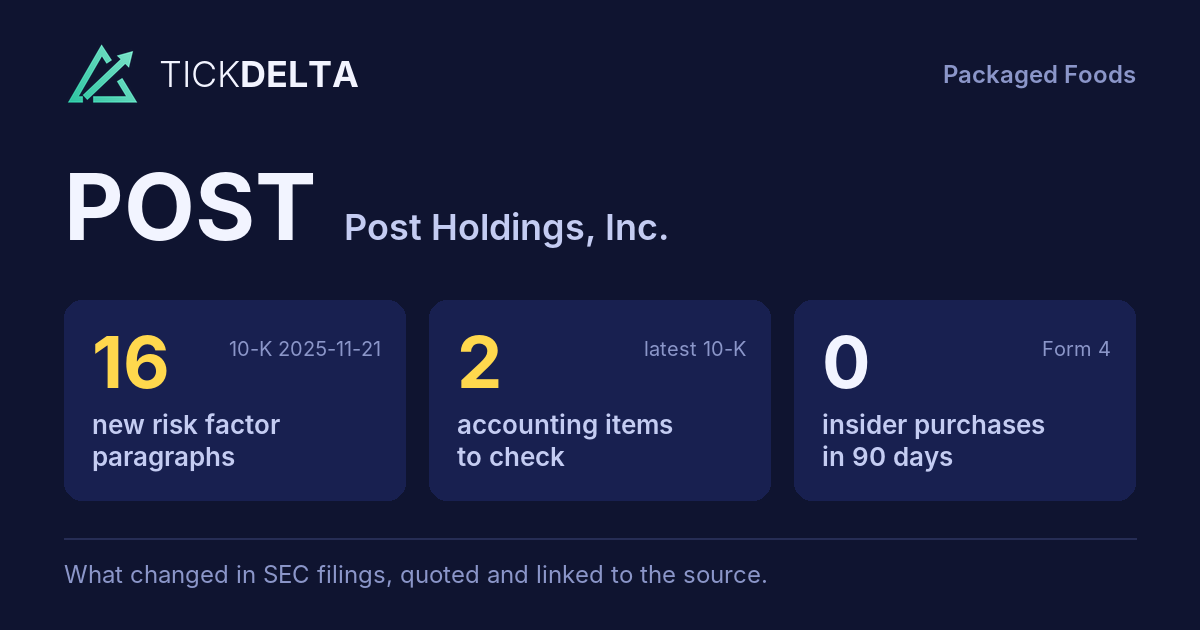
of the text changed · 17,976 words now · 16 new paragraphs, 37 gone
MD&A
31.2%
of the text changed · 7,157 words now · 7 new paragraphs, 21 gone
Legal Proceedings
1.2%
of the text changed · 494 words now
Accounting Policies
10.3%
of the text changed · 4,046 words now
10-K 0001530950-25-000260 (Nov 21, 2025) vs 10-K 0001530950-24-000365 (Nov 15, 2024)
Every paragraph, and how much of it changed
One bar per paragraph, in the order of the 10-K. Height and colour show the share of its words not in the closest paragraph a year earlier; the tallest bars are new paragraphs.
Risk Factors
182 paragraphs · 16 new · 110 reworded · 37 gone · 10-K Nov 21, 2025 against Nov 15, 2024
New paragraph
Reworded (5% of its words or more)
Same or nearly
Paragraph 83 · 50% changed
Every version of it
•we may discover previously undetected liabilities, operational or other issues, such as fraud. fraud, liabilities or contingencies that are significantly larger than we anticipated at the time of the closing of the acquisition and unforeseen expenses or delays.
Paragraph 24 · 47% changed
Every version of it
Paragraph 132 · 45% changed
Every version of it
Inflationary pressures, shortages in the labor market and increased competition requirements for skilled and talented employees have increased our labor costs, which have negatively impacted our profitability, and we expect this trend to continue into fiscal 2025, although there has been some alleviation of wage pressures. continue. Although we continue to develop and enhance opportunities for efficient work processes, including using robotic technology and other artificial intelligence capabilities, an inability to automate processes in our manufacturing and distribution facilities could result in increases in labor costs. Labor costs also include the
Paragraph 84 · 45% changed
Every version of it
Any of these factors could adversely affect our and the acquired businesses’ ability to maintain relationships with customers, suppliers, employees and other constituencies. In addition, we entered into an agreement to sell the Pasta Business to a third party, which we expect will close in the first quarter of fiscal 2026, and this proposed sale may result in additional challenges or uncertainty for the integration of 8th Avenue, such as:
Paragraph 91 · 44% changed
Every version of it
The BellRing Distribution was conditioned upon the receipt of a tax opinion from our tax advisor which concluded that the BellRing Distribution, together with certain related transactions, such as the Debt-for-Debt Exchange and the Debt-for-Equity Exchanges, qualifies as a tax-free reorganization within the meaning of Sections 368(a) and 355 of the U.S. Internal Revenue Code (the “IRC”) and is eligible for nonrecognition within the meaning of Sections 355 and 361 of the IRC. The tax opinion was based on, among other things, then-current law and certain representations and assumptions as to factual matters and certain statements and undertakings made by us and Old BellRing. Any change in the then-current applicable law, which may or may not be retroactive, or the failure of any factual representation, assumption, statement or undertaking to be true, correct and complete in all material respects, could adversely affect the conclusions reached in the tax opinion. In addition, the tax opinion is not binding on the U.S. Internal Revenue Service (the “IRS”) or the courts, and the IRS and/or the courts may not agree with the tax opinion. If the BellRing Distribution, the Debt-for-Debt Exchange or either of the Debt-for-Equity Exchanges do not qualify as tax-free transactions for any reason, we may recognize a substantial gain for U.S. federal income tax purposes, which could materially adversely affect our businesses, financial condition and cash flows.
Paragraph 143 · 44% changed
Every version of it
Paragraph 61 · 44% changed
Every version of it
The human and pet food categories in which we operate are highly competitive. Competition in our categories is based on, among other things, price, brand appeal, recognition and loyalty, taste, nutritional value, price, ingredients, sourcing practices, product quality and safety, nutritional profile, ingredients, effective promotional activities, product-related certifications, sourcing practices, product availability, variety, innovation, distribution, shelf space and product visibility, packaging, convenience, effective promotional activities convenience and the ability to identify and satisfy dynamic, emerging consumer preferences. The ability of our retail businesses to compete may be limited by an inability to secure new retailers or maintain or add shelf or retail space for our products. Retailers may not provide us sufficient, if any, shelf space, and online retailers may not provide access to, or adequate product visibility on, their platforms. Certain weight loss drugs, which may suppress a person’s appetite, may cause competition in our product categories to increase if consumers reduce purchases of certain types of foods or of food products altogether. Some of our competitors may have substantial financial, marketing and other resources and may spend more aggressively on advertising and promotional activities than we do. In addition, smaller competitors have been gaining market share in categories in which our retail businesses compete. In most of our retail categories, we have both branded and private label products, which each compete not only with widely advertised branded products, but also with products and private label products. Generally, branded products have an advantage over private label products primarily due to advertising and name recognition. However, private label products typically sell at a discount to those of branded competitors. Nevertheless, when branded competitors focus on price and promotion, private label products generally are disadvantaged because branded products have name recognition and the price differential between the private label and store brand branded products becomes less significant, which could require us or our customers to lower prices or increase the use of discounting or promotional programs for our or our customers’ private label products. Increased competition can reduce our sales due to loss of market share or the need to reduce prices to respond to competitive and customer pressures or can result in increased capital, marketing or other expenditures. Competitive and customer pressures, as well as industry supply and market demand,
Paragraph 13 · 50% changed
Every version of it
10-K Nov 15, 2024Agricultural diseases or pests could harm our businesses, financial condition, results of operations and cash flows.
10-K Nov 21, 2025
Adverse macroeconomic conditions, geopolitical events or tensions, war or armed hostilities, changes in governmental administrations or regulatory priorities or other events resulting in economic or financial market volatility or uncertainty or business disruption could harm our businesses, financial condition, results of operations and cash flows.
Paragraph 83 · 50% changed
Every version of it
10-K Nov 15, 2024
•we may discover previously undetected operational or other issues, such as fraud.
10-K Nov 21, 2025
•we may discover previously undetected liabilities, operational or other issues, such as fraud, liabilities or contingencies that are significantly larger than we anticipated at the time of the closing of the acquisition and unforeseen expenses or delays.
Paragraph 24 · 47% changed
Every version of it
10-K Nov 15, 2024Deterioration of general macroeconomic conditions could harm our businesses, financial condition, results of operations and cash flows.
10-K Nov 21, 2025
These and other impacts of such conditions and events could also heighten many of the other risks disclosed herein. The results of these and other impacts from such conditions and events are from time to time material to our businesses, financial condition, results of operations and cash flows.
Paragraph 132 · 45% changed
Every version of it
10-K Nov 15, 2024
Inflationary pressures, shortages in the labor market and increased competition for skilled and talented employees have increased our labor costs, which have negatively impacted our profitability, and we expect this trend to continue into fiscal 2025, although there has been some alleviation of wage pressures. Although we continue to develop and enhance opportunities for efficient work processes, including using robotic technology and other artificial intelligence capabilities, an inability to automate processes in our manufacturing and distribution facilities could result in increases in labor costs. Labor costs also include the
10-K Nov 21, 2025
Inflationary pressures, shortages in the labor market and increased requirements for skilled employees have increased our labor costs, which have negatively impacted our profitability, and we expect this trend to continue. Although we continue to
Paragraph 84 · 45% changed
Every version of it
10-K Nov 15, 2024
Any of these factors could adversely affect our and the acquired businesses’ ability to maintain relationships with customers, suppliers, employees and other constituencies.
10-K Nov 21, 2025
Any of these factors could adversely affect our and the acquired businesses’ ability to maintain relationships with customers, suppliers, employees and other constituencies. In addition, we entered into an agreement to sell the Pasta Business to a third party, which we expect will close in the first quarter of fiscal 2026, and this proposed sale may result in additional challenges or uncertainty for the integration of 8th Avenue, such as:
Paragraph 91 · 44% changed
Every version of it
10-K Nov 15, 2024
The BellRing Distribution was conditioned upon the receipt of a tax opinion from our tax advisor which concluded that the BellRing Distribution, together with certain related transactions, such as the Debt-for-Debt Exchange and the Debt-for-Equity Exchanges, qualifies as a tax-free reorganization within the meaning of Sections 368(a) and 355 of the U.S. Internal Revenue Code (the “IRC”) and is eligible for nonrecognition within the meaning of Sections 355 and 361 of the IRC. The tax opinion was based on, among other things, then-current law and certain representations and assumptions as to factual matters and certain statements and undertakings made by us and Old BellRing. Any change in the then-current applicable law, which may or may not be retroactive, or the failure of any factual representation, assumption, statement or undertaking to be true, correct and complete in all material respects, could adversely affect the conclusions reached in the tax opinion. In addition, the tax opinion is not binding on the U.S. Internal Revenue Service (the “IRS”) or the courts, and the IRS and/or the courts may not agree with the tax opinion. If the BellRing Distribution, the Debt-for-Debt Exchange or either of the Debt-for-Equity Exchanges do not qualify as tax-free transactions for any reason, we may recognize a substantial gain for U.S. federal income tax purposes, which could materially adversely affect our businesses, financial condition and cash flows.
10-K Nov 21, 2025
The BellRing Distribution was conditioned upon the receipt of a tax opinion from our tax advisor which concluded that the BellRing Distribution, together with certain related transactions, such as the Debt-for-Debt Exchange and the Debt-for-Equity Exchanges, qualifies as a tax-free reorganization within the meaning of Sections 368(a) and 355 of the U.S. Internal Revenue Code (the “IRC”) and is eligible for nonrecognition within the meaning of Sections 355 and 361 of the IRC. The tax opinion was
Paragraph 143 · 44% changed
Every version of it
10-K Nov 15, 2024It is possible that federal, state, local or foreign enforcement authorities might take regulatory or enforcement action, which could result in significant fines or penalties, revocations of required licenses and injunctions, as well as potential criminal sanctions. Even if we make changes to align ourselves with changing legal or regulatory requirements, we may still be subject to significant penalties if such laws and regulations are interpreted and applied in a manner inconsistent with our practices. If we are found to be significantly out of compliance with applicable laws, regulations or permits, an enforcement authority could issue a warning letter, institute enforcement actions or both, which could result in additional costs, product detentions, substantial delays in production or even a temporary shutdown in manufacturing and product sales while the non-conformances are rectified. Also, we may have to recall product or otherwise remove product from the market and temporarily cease its manufacture and distribution, which would increase our costs and reduce our revenues. Any claims, such as product liability or labeling claims, resulting from the failure to comply with applicable laws and regulations would be expensive to defend and could result in substantial damage awards against us or harm our reputation. Any of these events would negatively impact our revenues and costs of operations.
10-K Nov 21, 2025
Regulatory authorities, including federal, state, local or foreign enforcement authorities, may determine that our practices do not comply with regulatory requirements and may issue a warning letter or take regulatory or enforcement action against us, which could result in significant fines or penalties, revocations of required licenses and injunctions, potential criminal sanctions or damage to our reputation. In addition, if we or third parties in our supply chain are found to be out of compliance with applicable laws, regulations or permits, we are from time to time subject to product detentions, product recalls or other removals of products from the market, substantial delays in production or a temporary shutdown in manufacturing, distribution and product sales while the non-conformances are rectified. Any or all of these events could materially adversely impact our businesses, financial condition, results of operations or cash flows or could damage our reputation.
Paragraph 61 · 44% changed
Every version of it
10-K Nov 15, 2024
The human and pet food categories in which we operate are highly competitive. Competition in our categories is based on, among other things, brand appeal, recognition and loyalty, taste, nutritional value, price, ingredients, sourcing practices, product quality and safety, product availability, variety, innovation, distribution, shelf space and product visibility, packaging, convenience, effective promotional activities and the ability to identify and satisfy dynamic, emerging consumer preferences. The ability of our retail businesses to compete may be limited by an inability to secure new retailers or maintain or add shelf or retail space for our products. Retailers may not provide us sufficient, if any, shelf space, and online retailers may not provide access to, or adequate product visibility on, their platforms. Certain weight loss drugs, which may suppress a person’s appetite, may cause competition in our product categories to increase if consumers reduce purchases of certain types of foods or of food products altogether. Some of our competitors may have substantial financial, marketing and other resources and may spend more aggressively on advertising and promotional activities than we do. In addition, smaller competitors have been gaining market share in categories in which our retail businesses compete. In most of our categories, we compete not only with widely advertised branded products, but also with private label and store brand products. Increased competition can reduce our sales due to loss of market share or the need to reduce prices to respond to competitive and customer pressures or can result in increased capital, marketing or other expenditures. Competitive and customer pressures, as well as industry supply and market demand,
10-K Nov 21, 2025
The human and pet food categories in which we operate are highly competitive. Competition in our categories is based on, among other things, price, brand appeal, recognition and loyalty, taste, product quality and safety, nutritional profile, ingredients, effective promotional activities, product-related certifications, sourcing practices, product availability, variety, innovation, distribution, shelf space and product visibility, packaging, convenience and the ability to identify and satisfy dynamic, emerging consumer preferences. In most of our retail categories, we have both branded and private label products, which each compete with widely advertised branded products and private label products. Generally, branded products have an advantage over private label products primarily due to advertising and name recognition. However, private label products typically sell at a discount to those of branded competitors. Nevertheless, when branded competitors focus on price and promotion, private label products generally are disadvantaged because branded products have name recognition and the price differential between the private label and branded products becomes less significant, which could require us or our customers to lower prices or increase the use of discounting or promotional programs for our or our customers’ private label products.
MD&A
97 paragraphs · 7 new · 48 reworded · 21 gone · 10-K Nov 21, 2025 against Nov 15, 2024
New paragraph
Reworded (5% of its words or more)
Same or nearly
Paragraph 42 · 50% changed
Paragraph 8 · 49% changed
On December 1, 2023, March 3, 2025, we completed our acquisition of substantially all Potato Products of the assets of Perfection Pet Foods, LLC (“Perfection”), Idaho, L.L.C. (“PPI”), a manufacturer and packager of private label refrigerated and co-manufactured pet food and baked treat frozen potato products, which is reported in our Post Consumer Brands segment. Refrigerated Retail and Foodservice segments.
Paragraph 7 · 46% changed
On December July 1, 2023, 2025, we completed our acquisition of substantially all of the assets of Perfection Pet Foods, LLC (“Perfection”), preferred stock and the remaining common equity interest that we did not already own in 8th Avenue Food & Provisions, Inc. (“8th Avenue”). 8th Avenue is a manufacturer and packager distributor of branded and private label dry pasta and co-manufactured pet food private label nut butters, granola and baked treat dried fruit and nut products, which is reported in our Post Consumer Brands segment.
Paragraph 29 · 44% changed
Net sales for the Post Consumer Brands segment increased $1,076.5 decreased $85.0 million, or 35%, 2%, for the year ended September 30, 2024, 2025, when compared to the prior year. The increase in year, driven by lower pet food and cereal and granola volumes, partially offset by the inclusion of three months of 8th Avenue net sales was of $242.7 million. Pet food product sales were down $187.9 million, or 11%, driven by 9% lower volumes primarily due to distribution losses and reductions in private label and co-manufactured products, partially offset by the inclusion of two incremental months of Perfection. Cereal and granola product sales were down $97.9 million, or 4%, driven by 4% lower volumes primarily related to category declines, partially offset by the inclusion of three months of 8th Avenue. Nut butters product sales were up $75.3 million, or 72%, primarily due to the inclusion of three months of 8th Avenue. Other product sales were up $125.5 million, driven by the inclusion of seven incremental three months of Pet Food net sales of $932.8 million and ten months of Perfection net sales of $213.7 million. In addition to these impacts, average net selling prices increased primarily due to the annualization of prior year price increases taken to mitigate inflation. Volumes increased 56%, primarily driven by the inclusion of seven incremental months of Pet Food and ten months of Perfection, partially offset by volume decreases in branded and non-retail cereal. 8th Avenue.
Paragraph 82 · 41% changed
Various valuation methodologies may be used in estimating the fair value of assets acquired and liabilities assumed based on the nature of the underlying asset or liability. Inventory acquired is valued using a combination of the replacement cost and comparatives comparative sales methodologies, while property acquired is valued using a combination of the market and replacement cost new approaches. Intangible assets acquired, including customer relationships and trademarks and licensing agreements, are valued using an income-based approach. The income approach utilizes inputs that require significant assumptions for each identifiable intangible asset, including estimates regarding future revenue growth, profitability, discount rates, attrition rates, royalty rates and economic lives. Revenue growth assumptions (along with profitability assumptions) are based on historical trends and management’s expectations for future growth. Discount rates are based on a weighted-average cost of capital utilizing industry market data of similar companies. Attrition rates are estimated based on historical customer experience and analysis of comparable peer transactions. Royalty rates are determined based on profit levels, research of external royalty rates by third-party specialists and the relative importance of each trademark to our Company.
Paragraph 75 · 39% changed
Inflationary pressures can have an adverse effect on us through higher raw material, including ingredients and packaging, and energy costs. During both fiscal 2023, input cost inflation put downward pressures on our profit margins, which we largely mitigated through pricing actions across all segments, cost savings measures 2025 and hedging programs. During fiscal 2024, inflationary pressures on certain input costs eased, while other input costs continued to face inflationary pressures, and we expect this trend to continue into fiscal 2025. 2026. In addition, we anticipate that announced tariffs, and any potential future modifications or incremental tariffs, could increase supply chain challenges, commodity cost volatility and consumer and economic uncertainty due to rapid changes in global trade policies. This could impact the cost of, and consumer demand for, our products, including as a result of any potential pricing actions taken to offset increased costs. These trends could have a materially material adverse impact on our businesses in results of operations if we are unable to mitigate the future if inflation rates significantly exceed impact on our ability to continue to achieve price increases or cost savings or if such price increases significantly impact demand for our products. businesses.
Paragraph 15 · 37% changed
•outbreaks of highly pathogenic avian influenza (“HPAI”), which impacted our Foodservice and Refrigerated Retail segments. During both fiscal 2023, we incurred increased costs as a result of outbreaks, which were mitigated through management of volume needs with customers 2024 and pricing actions. During fiscal 2024, 2025, we experienced additional volatility in our egg supply due to continued HPAI outbreaks of HPAI; however, across the industry, which are expected to continue to drive volatility and may impact to our results of operations during the year ended September 30, 2024 were not material. The impact from these outbreaks, or further outbreaks in the future, into fiscal 2026. This trend could have a materially adverse impact on our results of operations if we are unable to mitigate the impact on our businesses.
Paragraph 57 · 37% changed
Paragraph 42 · 50% changed
10-K Nov 15, 2024•$645.0 million borrowed under our Revolving Credit Facility (such term refers to our Old Revolving Credit Facility prior to the Third Amendment and our New Revolving Credit Facility subsequent to the Third Amendment);
10-K Nov 21, 2025
•$500.0 million borrowed under our Revolving Credit Facility (as defined below);
Paragraph 8 · 49% changed
10-K Nov 15, 2024
On December 1, 2023, we completed our acquisition of substantially all of the assets of Perfection Pet Foods, LLC (“Perfection”), a manufacturer and packager of private label and co-manufactured pet food and baked treat products, which is reported in our Post Consumer Brands segment.
10-K Nov 21, 2025
On March 3, 2025, we completed our acquisition of Potato Products of Idaho, L.L.C. (“PPI”), a manufacturer and packager of refrigerated and frozen potato products, which is reported in our Refrigerated Retail and Foodservice segments.
Paragraph 7 · 46% changed
10-K Nov 15, 2024
On December 1, 2023, we completed our acquisition of substantially all of the assets of Perfection Pet Foods, LLC (“Perfection”), a manufacturer and packager of private label and co-manufactured pet food and baked treat products, which is reported in our Post Consumer Brands segment.
10-K Nov 21, 2025
On July 1, 2025, we completed our acquisition of all of the preferred stock and the remaining common equity interest that we did not already own in 8th Avenue Food & Provisions, Inc. (“8th Avenue”). 8th Avenue is a manufacturer and distributor of branded and private label dry pasta and private label nut butters, granola and dried fruit and nut products, which is reported in our Post Consumer Brands segment.
Paragraph 29 · 44% changed
10-K Nov 15, 2024
Net sales for the Post Consumer Brands segment increased $1,076.5 million, or 35%, for the year ended September 30, 2024, when compared to the prior year. The increase in net sales was primarily driven by the inclusion of seven incremental months of Pet Food net sales of $932.8 million and ten months of Perfection net sales of $213.7 million. In addition to these impacts, average net selling prices increased primarily due to the annualization of prior year price increases taken to mitigate inflation. Volumes increased 56%, primarily driven by the inclusion of seven incremental months of Pet Food and ten months of Perfection, partially offset by volume decreases in branded and non-retail cereal.
10-K Nov 21, 2025
Net sales for the Post Consumer Brands segment decreased $85.0 million, or 2%, for the year ended September 30, 2025, when compared to the prior year, driven by lower pet food and cereal and granola volumes, partially offset by the inclusion of three months of 8th Avenue net sales of $242.7 million. Pet food product sales were down $187.9 million, or 11%, driven by 9% lower volumes primarily due to distribution losses and reductions in private label and co-manufactured products, partially offset by the inclusion of two incremental months of Perfection. Cereal and granola product sales were down $97.9 million, or 4%, driven by 4% lower volumes primarily related to category declines, partially offset by the inclusion of three months of 8th Avenue. Nut butters product sales were up $75.3 million, or 72%, primarily due to the inclusion of three months of 8th Avenue. Other product sales were up $125.5 million, driven by the inclusion of three months of 8th Avenue.
Paragraph 82 · 41% changed
10-K Nov 15, 2024
Various valuation methodologies may be used in estimating the fair value of assets acquired and liabilities assumed based on the nature of the underlying asset or liability. Inventory acquired is valued using a combination of the replacement cost and comparatives sales methodologies, while property acquired is valued using a combination of the market and replacement cost new approaches. Intangible assets acquired, including customer relationships and trademarks and licensing agreements, are valued using an income-based approach. The income approach utilizes inputs that require significant assumptions for each identifiable intangible asset, including estimates regarding future revenue growth, profitability, discount rates, attrition rates, royalty rates and economic lives. Revenue growth assumptions (along with profitability assumptions) are based on historical trends and management’s expectations for future growth. Discount rates are based on a weighted-average cost of capital utilizing industry market data of similar companies. Attrition rates are estimated based on historical customer experience and analysis of comparable peer transactions. Royalty rates are determined based on profit levels, research of external royalty rates by third-party specialists and the relative importance of each trademark to our Company.
10-K Nov 21, 2025
Various valuation methodologies may be used in estimating the fair value of assets acquired and liabilities assumed based on the nature of the underlying asset or liability. Inventory acquired is valued using a combination of the replacement cost and comparative sales methodologies, while property acquired is valued using a combination of the market and cost approaches. Intangible assets acquired, including customer relationships and trademarks and licensing agreements, are valued using an
Paragraph 75 · 39% changed
10-K Nov 15, 2024
Inflationary pressures can have an adverse effect on us through higher raw material, including ingredients and packaging, and energy costs. During fiscal 2023, input cost inflation put downward pressures on our profit margins, which we largely mitigated through pricing actions across all segments, cost savings measures and hedging programs. During fiscal 2024, inflationary pressures on certain input costs eased, while other input costs continued to face inflationary pressures, and we expect this trend to continue into fiscal 2025. These trends could have a materially adverse impact on our businesses in the future if inflation rates significantly exceed our ability to continue to achieve price increases or cost savings or if such price increases significantly impact demand for our products.
10-K Nov 21, 2025
Inflationary pressures can have an adverse effect on us through higher raw material, including ingredients and packaging, and energy costs. During both fiscal 2025 and 2024, inflationary pressures on certain input costs eased, while other input costs continued to face inflationary pressures, and we expect this trend to continue into fiscal 2026. In addition, we anticipate that announced tariffs, and any potential future modifications or incremental tariffs, could increase supply chain challenges, commodity cost volatility and consumer and economic uncertainty due to rapid changes in global trade policies. This could impact the cost of, and consumer demand for, our products, including as a result of any potential pricing actions taken to offset increased costs. These trends could have a material adverse impact on our results of operations if we are unable to mitigate the impact on our businesses.
Paragraph 15 · 37% changed
10-K Nov 15, 2024
•outbreaks of highly pathogenic avian influenza (“HPAI”), which impacted our Foodservice and Refrigerated Retail segments. During fiscal 2023, we incurred increased costs as a result of outbreaks, which were mitigated through management of volume needs with customers and pricing actions. During fiscal 2024, we experienced additional outbreaks of HPAI; however, the impact to our results of operations during the year ended September 30, 2024 were not material. The impact from these outbreaks, or further outbreaks in the future, could have a materially adverse impact on our results of operations if we are unable to mitigate the impact on our businesses.
10-K Nov 21, 2025
•outbreaks of highly pathogenic avian influenza (“HPAI”), which impacted our Foodservice and Refrigerated Retail segments. During both fiscal 2024 and 2025, we experienced volatility in our egg supply due to continued HPAI outbreaks across the industry, which are expected to continue to drive volatility and may impact our results of operations into fiscal 2026. This trend could have a materially adverse impact on our results of operations if we are unable to mitigate the impact on our businesses.
Paragraph 57 · 37% changed
10-K Nov 15, 2024Our senior notes, other than certain of our senior notes described below, are fully and unconditionally guaranteed, jointly and severally, on a senior unsecured basis by each of our existing and subsequently acquired or organized domestic subsidiaries (other than immaterial subsidiaries, certain excluded subsidiaries and subsidiaries we designate as unrestricted subsidiaries, which include 8th Avenue and its subsidiaries). Our 6.25% senior secured notes are fully and unconditionally guaranteed, jointly and severally, on a senior secured basis, and our 6.375% senior notes are fully and unconditionally guaranteed, jointly and severally, on a senior unsecured basis, by each of our existing and subsequently acquired or organized wholly-owned domestic subsidiaries that guarantee the Credit Agreement or certain of our other indebtedness (other than immaterial subsidiaries, certain excluded subsidiaries and subsidiaries we designate as unrestricted subsidiaries, which include 8th Avenue and its subsidiaries). These guarantees are subject to release in certain circumstances.
10-K Nov 21, 2025
Credit Agreement or certain of our other indebtedness (other than immaterial subsidiaries, certain excluded subsidiaries and subsidiaries we designate as unrestricted subsidiaries). These guarantees are subject to release in certain circumstances.
A paragraph is matched with the one last year that shares the most of its words; under half in common makes it new. The paragraphs shown are the 8 reworded the most in each section.
The paragraph that changed most in each section
The redline
Marked against last year's 10-K: cut words struck through, new words highlighted.
Risk Factors384 words changed in this paragraph; it is 58% similar to last year's version.
Source: Item 1A, 10-K 0001530950-25-000260 vs Item 1A, 10-K 0001530950-24-000365
MD&A168 words changed in this paragraph; it is 44% similar to last year's version.
Net sales for the Refrigerated Retail Post Consumer Brands segment decreased $57.5 $85.0 million, or 6%, 2%, for the year ended September 30, 2024, 2025, when compared to the prior year, driven by lower average pet food and cereal and granola volumes, partially offset by the inclusion of three months of 8th Avenue net selling prices across all product categories primarily due to increased promotional spending and distribution losses in egg and cheese and other dairy products. Egg sales of $242.7 million. Pet food product sales were down $40.7 $187.9 million, or 22%, on 11% 11%, driven by 9% lower volumes and were incrementally impacted by unfavorable product mix. Cheese and other dairy product sales decreased $22.7 million, or 12%, on 11% lower volumes. Sales of side dishes increased $8.5 million, or 2%, driven by 2% higher volumes primarily due to distribution gains. Sausage losses and reductions in private label and co-manufactured products, partially offset by the inclusion of two incremental months of Perfection. Cereal and granola product sales increased $6.1 were down $97.9 million, or 4%, on 6% higher driven by 4% lower volumes primarily related to category declines, partially offset by the inclusion of three months of 8th Avenue. Nut butters product sales were up $75.3 million, or 72%, primarily due to distribution gains. Sales the inclusion of all other products three months of 8th Avenue. Other product sales were down $8.7 million up $125.5 million, driven by the exit inclusion of certain low-margin products. three months of 8th Avenue.
Source: Item 7, 10-K 0001530950-25-000260 vs Item 7, 10-K 0001530950-24-000365
Accounting Policies71 words changed in this paragraph; it is 67% similar to last year's version.
Remeasurements to the redemption value of the redeemable noncontrolling interest (“NCI”) prior to the Post Holdings Partnering Corporation redemption (see Note 5) 4) were recognized as a deemed dividend. The Company made an election to treat the portion of the deemed dividend that exceeded fair value as an adjustment to income available to common shareholders for basic and diluted earnings from continuing operations per share. In addition, dilutive net earnings from continuing operations was are adjusted for interest expense, net of tax, related to the Company’s convertible senior notes, and dilutive net earnings from discontinued operations was adjusted for the Company’s share of Old BellRing’s consolidated net earnings prior to the BellRing Spin-off, to the extent it was dilutive. Net earnings from continuing operations was utilized as the “control number” to determine whether potential shares of common stock were dilutive or anti-dilutive. notes.
Source: Item 8, Note 2 – SUMMARY OF SIGNIFICANT ACCOUNTING POLICIES, 10-K 0001530950-25-000260 vs Item 8, Note 2 – SUMMARY OF SIGNIFICANT ACCOUNTING POLICIES, 10-K 0001530950-24-000365
Legal Proceedings12 words changed in this paragraph; it is 96% similar to last year's version.
The Company is subject to various legal proceedings and actions arising in the normal course of business. In the opinion of management, based upon the information presently known, the ultimate liability, if any, arising from such pending legal proceedings, as well as from asserted legal claims and known potential legal claims which are likely to be asserted, taking into account established accruals for estimated liabilities (if any), are not expected to be material individually or in the aggregate to the consolidated financial condition, results of operations or cash flows of the Company. In addition, although it is difficult to estimate the potential financial impact of actions regarding expenditures for compliance with regulatory matters, proceedings, in the opinion of management, based upon the information currently available, the ultimate liability arising from such compliance matters regulatory proceedings is not expected to be material to the consolidated financial condition, results of operations or cash flows of the Company.
Source: Item 3, via Note 17 – COMMITMENTS AND CONTINGENCIES, 10-K 0001530950-25-000260 vs Item 3, via Note 18 – COMMITMENTS AND CONTINGENCIES, 10-K 0001530950-24-000365
Sentences and paragraphs added, removed or reworded
Every change, by type
Sentences and paragraphs of POST's Risk Factors and MD&A, 10-K Nov 21, 2025 against 10-K Nov 15, 2024. Each links to the text at sec.gov.
Quiet changes are sentences kept from last year with one to four words changed, at least one of them a hedge, a modal or a qualifier (may, could, will, not, significant, material…). A year or date rolling forward is not counted.
The full word list
adverse, adversely, all, although, anticipate, anticipates, any, approximately, believe, believes, can, cannot, certain, could, expect, expects, generally, however, if, intend, intends, largely, likely, many, material, materially, may, might, most, must, never, no, not, possible, primarily, probable, should, significant, significantly, some, substantial, substantially, unlikely, will, would
AddedRisk Factors
During recent years, we have experienced increased input and freight costs, including as a result of inflation, tariffs, labor shortages and heightened interest rates. During fiscal 2025, cost pressures on certain inputs eased, while other inputs continued to face heightened cost pressures, and we expect this trend to continue into fiscal 2026. We anticipate that announced tariffs, and any potential future modifications or incremental tariffs, could increase supply chain challenges, commodity cost volatility and consumer and economic uncertainty due to rapid changes in global trade policies. Similarly, from time to time, we experience limited supply or shortages of certain of our inputs or freight availability, which has resulted, and may in the future result, in us paying increased amounts for such inputs or freight or has impacted, and may in the future impact, our ability to produce or deliver our products. Also, in response to changing regulatory or market-driven requirements, we may need to source new inputs from third-party suppliers, which may be limited in availability or result in increased costs.
Read it in 10-K Nov 21, 2025 at sec.gov
AddedRisk Factors
We have in the past been and continue to be adversely affected by changes in macroeconomic conditions and other conditions and events resulting in economic or financial market uncertainty or business disruption, which may from time to time
Read it in 10-K Nov 21, 2025 at sec.gov
AddedRisk Factors
•increased volatility in commodity or other input costs or availability, which could include substantial cost increases or input shortages as a result of product reformulations or packaging changes;
Read it in 10-K Nov 21, 2025 at sec.gov
AddedRisk Factors
•increases in the costs of equipment or other materials necessary for our planned capital projects;
Read it in 10-K Nov 21, 2025 at sec.gov
AddedRisk Factors
•physical harm to our, our customers or third-party manufacturers’, suppliers’ or vendors’ employees or properties; and
Read it in 10-K Nov 21, 2025 at sec.gov
AddedRisk Factors
hiring, integrating and training our workforce also require significant time and expense. Additionally, in recent years, we have been undergoing various network optimization projects, which have resulted or will result in workforce reductions of selected workers. If we fail to retain the necessary employees during and because of these projects, it could have material adverse impacts on our operations.
Read it in 10-K Nov 21, 2025 at sec.gov
AddedRisk Factors
cybersecurity breach to date, nor have we had a material impact resulting from a breach of one of our Third Parties, we have had and continue to experience General Cyber Events or other events of this nature and expect them to continue.
Read it in 10-K Nov 21, 2025 at sec.gov
AddedRisk Factors
Labor strikes or work stoppages by our employees or employees of third parties in our supply chain could harm our businesses.
Read it in 10-K Nov 21, 2025 at sec.gov
Show the other 66
AddedRisk Factors
Our businesses can be adversely affected if we are unable to effectively market our existing products or effectively develop, introduce or market new products, if we are unable to establish and convey our brand and product value to consumers, if we do not have adequate or desirable shelf space or product accessibility or visibility on online platforms, if we are unable to
Read it in 10-K Nov 21, 2025 at sec.gov
AddedRisk Factors
effectively leverage technology or develop the data analytics capabilities needed to generate actionable commercial insights and appropriately act on such insights, if we are unable to develop and maintain relationships with our customers, if our competitors spend more aggressively or effectively on advertising and promotional activities than we do or if we are otherwise unable to compete effectively. Further, increased competition can reduce our sales due to loss of market share or require us to reduce prices to respond to competitive and customer pressures or can result in increased capital, marketing or other expenditures. In recent years, smaller competitors have been gaining market share in categories in which our retail businesses compete. Competitive and customer pressures, as well as industry supply and market demand, also from time to time limit our ability to increase prices, including in response to increased costs (such as those resulting from inflation or new or increased tariffs).
Read it in 10-K Nov 21, 2025 at sec.gov
AddedRisk Factors
•we may encounter challenges as a result of offering the acquired businesses’ product portfolios, including when that portfolio includes products, such as peanut butter, with greater vulnerability to contamination or other food safety concerns and heightened regulatory risks;
Read it in 10-K Nov 21, 2025 at sec.gov
AddedRisk Factors
•the proposed sale may not be completed within the anticipated time frame or at all; and
Read it in 10-K Nov 21, 2025 at sec.gov
RemovedRisk Factors
RemovedRisk Factors
RemovedRisk Factors
RemovedRisk Factors
RemovedRisk Factors
RemovedRisk Factors
RemovedRisk Factors
RemovedRisk Factors
RemovedRisk Factors
RemovedRisk Factors
RemovedRisk Factors
RemovedRisk Factors
RewordedRisk Factors
RewordedRisk Factors
The supply and price of these inputs our inputs, as well as freight, are subject to market conditions and are impacted by many factors beyond our control, including including, as applicable, inflation, new or increased tariffs (including the tariffs imposed by the U.S. on imports and exports in 2025 and any retaliatory tariffs by other countries in response thereto) or other trade restrictions, diseases affecting livestock (including HPAI outbreaks that occur periodically and swine outbreaks that occur occasionally), new or changing regulatory or market-driven requirements (including requirements that products exclude certain inputs), labor shortages, strikes or other labor unrest or other workforce disruptions, diseases affecting livestock (including HPAI outbreaks and swine outbreaks that occur from time to time), increased fuel costs, concentration of agriculture commodity suppliers through cooperatives or other consolidations, limited freight carrier availability, increased compliance costs associated with new or changing government regulations, information systems disruptions or failures (including due to cybersecurity incidents), animal feed costs, agricultural yield, increased demand, public health crises, war or armed hostilities (such as the ongoing conflicts in Ukraine and the Middle East), geopolitical events or tensions, national or international disputes, terrorism or other acts of violence, increased demand, any naturally occurring or climate change induced acute (including extreme weather and natural disasters) or chronic (including prolonged temperature and precipitation patterns) weather patterns) climatic events, fire, water stress or usage regulation, governmental programs, incentives or controls, regulations or trade and tariff policies, insects or pests, plant diseases, foreign currency exchange rates and milk price supports established by the USDA.
Read it in 10-K Nov 21, 2025 at sec.gov
RewordedRisk Factors
Further, our businesses could be adversely affected if (i) we or others in our supply chain are unable to remain effectively aligned with expectations from the media, governments, our shareholders and other stakeholders, which expectations may contradict one another, on stakeholders regarding strategy, performance and disclosure on climate environmental, sustainability and corporate responsibility matters, which expectations can vary greatly, may contradict one another and may change and other rapidly, or (ii) we or others in our supply chain are perceived to have acted irresponsibly with respect to environmental, sustainability, social and governance sustainability or corporate responsibility matters, any of which could result in reduced demand for our products products, damage to our reputation, product boycotts, market access restrictions, legal or regulatory risks, adverse impacts on our ability to raise capital or our ability to recruit or retain talent or could divert the attention of management and our employees from operating our businesses.
Read it in 10-K Nov 21, 2025 at sec.gov
RewordedRisk Factors
Changes in applicable legal or regulatory requirements, including new food safety requirements, new bans or limits on certain ingredients or packaging materials, revised labeling requirements for human or pet food (such as front of pack labeling requirements, consumer warnings for certain ingredients or substances in our products, changes to standards for health claims in human or pet food and pet food label modernization), changes in food product regulatory definitions or requirements, new or increased tariffs (such as the U.S.’s imposition of significant new tariffs on our imports and exports and other countries’ imposition of retaliatory tariffs in response during fiscal 2025), new or revised requirements for the housing of layer hens or other farm animals, new sales or media and marketing restrictions (such as new laws or regulations restricting our ability to advertise or market our products, including restrictions on specific types of television and online advertising or restrictions on certain types of promotions or in-store placements, or to advertise or market our products to certain audiences), new requirements to encourage sustainable packaging and new disclosure requirements related to climate change greenhouse gas emissions and climate-related risk disclosure or sustainability in the U.S. or elsewhere, evolving interpretations of existing legal or regulatory requirements or changes in enforcement priorities occur from time to time.
Read it in 10-K Nov 21, 2025 at sec.gov
RewordedRisk Factors
Consumer preference and behavior changes changes, which may be influenced by a number of factors (such as media, social media and regulatory activity), include dietary trends (including changes in eating habits, the use of weight-loss drugs (including those that may suppress a person’s appetite) or other factors), attention to different nutritional aspects or perceived health effects of products, products (including the nutrition profile of products or perceived health effects of ingredients or other substances used in our products or packaging materials), consumer at-home and on-the-go consumption patterns, shifts to private label or other value products, preferences for certain sales channels (including discount and eCommerce channels), concerns regarding the health effects of products, attention to sourcing practices relating to raw materials, animal welfare concerns, environmental concerns (including climate change) regarding packaging materials and manufacturing processes and attention to other environmental, social and governance aspects of our Company (including our products and operations) and of others in our supply chain.
Read it in 10-K Nov 21, 2025 at sec.gov
RewordedRisk Factors
If we are not able to complete projects designed to reduce costs and or increase operating efficiency efficiency, including network optimization projects, on time or within budget, or if the implementation of these projects does not result in the anticipated cost savings, synergies or other benefits or results in unintended consequences, such as business disruptions, distraction of management and employees employees, adverse impacts on existing relationships with customers or suppliers or reduced productivity, or if costs continue to increase as a result of factors beyond our control or we are unable to address declines in consumer demand or category declines, our businesses, strategic plans, financial condition, results of operations and cash flows may be materially adversely impacted.
Read it in 10-K Nov 21, 2025 at sec.gov
RewordedRisk Factors
RewordedRisk Factors
RewordedRisk Factors
Negative social or digital media posts or comments or negative information contained in shopping, health or product evaluation applications (whether or not valid) about us, our business practices, brands, products, ingredients, packaging, packaging materials, sponsorship or endorsement relationships, directors, employees or third-party suppliers, manufacturers, licensors or licensees, others in our supply chain or the food and beverage or pet food industries generally in the media could damage our brands and reputation.
Read it in 10-K Nov 21, 2025 at sec.gov
RewordedRisk Factors
From time to time, our major customers decide to decrease the amount of product purchased from us, including in response to shifts in consumer purchasing or traffic trends, sell another brand on an exclusive or priority basis, reduce shelf space allotted to our products, reduce the visibility of our products on their digital platforms, demand reduced pricing or change the manner of doing business with us, which adversely affects our businesses, financial condition, results of operations and cash flows.
Read it in 10-K Nov 21, 2025 at sec.gov
RewordedRisk Factors
The impact of current laws and regulations, changes in these laws or regulations or interpretations thereof or uncertainty regarding such changes or the introduction of new laws or regulations from time to time increases the costs of doing business (including increased input costs, compliance costs, capital expenditures and other financial obligations) for us or us, our customers or customers, our third-party suppliers or manufacturers, manufacturers or others in our supply chain, requires significant changes to our business operations, strategy, supply chain management and disclosures, restricts our businesses, impacts demand for our products or competition in our categories or results in negative publicity.
Read it in 10-K Nov 21, 2025 at sec.gov
RewordedRisk Factors
Quiet changesRisk Factors
When these measures are ineffective or are not implemented in a timely manner, changes in costs or the impact of other adverse macroeconomic conditions from time to time limit our ability to maintain existing margins and otherwise materially adversely impact our businesses, financial condition, results of operations and cash flows.
Read it in 10-K Nov 21, 2025 at sec.gov
Quiet changesRisk Factors
If we do not maintain favorable perceptions of our Company or brands or if we experience a loss of confidence in us or our products, our businesses, financial condition, results of operations and cash flows could be materially adversely impacted.
Read it in 10-K Nov 21, 2025 at sec.gov
Quiet changesRisk Factors
Public health crises can occur suddenly and evolve rapidly, and the severity, magnitude, duration and impact of such public health crises are uncertain and difficult to predict.
Read it in 10-K Nov 21, 2025 at sec.gov
Quiet changesRisk Factors
For instance, our Foodservice and Refrigerated Retail segments are, have been, and will continue to be, affected by changing preferences and requirements as to the housing of layer hens, as well as certain other farm animals.
Read it in 10-K Nov 21, 2025 at sec.gov
Quiet changesRisk Factors
Also, our businesses are, and we expect will continue to be, affected by changing preferences and requirements as to the environmental and social impacts of products.
Read it in 10-K Nov 21, 2025 at sec.gov
Quiet changesRisk Factors
Management reviews all indefinite-lived intangible assets for impairment on at least an annual basis or whenever events or changes in circumstances indicate that their carrying value may not be impaired. recoverable.
Read it in 10-K Nov 21, 2025 at sec.gov
Quiet changesRisk Factors
AddedMD&A
In August 2025, we entered into an agreement to sell 8th Avenue’s pasta business (the “Pasta Business”), which is expected to close in the first quarter of fiscal 2026. During the year ended September 30, 2025, the Pasta Business’s operating results were reported in our Post Consumer Brands segment and its assets and liabilities were classified as held for sale as of September 30, 2025.
Read it in 10-K Nov 21, 2025 at sec.gov
AddedMD&A
the write-off of debt issuance costs of $6.0 million and net debt premiums paid of $0.7 million, partially offset by the write-off of $4.6 million of unamortized premiums.
Read it in 10-K Nov 21, 2025 at sec.gov
AddedMD&A
On July 4, 2025, the H.R.1 tax law was enacted in the U.S. (the “H.R.1 Tax Act”). The H.R.1 Tax Act includes the permanent extension of certain expiring provisions of the Tax Cuts and Jobs Act of 2017, modifications to the international tax framework and the restoration of favorable tax treatment for certain business provisions, such as changes to the timing of certain tax deductions for qualifying depreciable assets, costs of research and development performed in the U.S. and interest expense. The H.R.1 Tax Act has multiple effective dates, beginning in calendar year 2025 and extending through calendar year 2027. The H.R.1 Tax Act did not have a material impact on our income tax expense for the year ended September 30, 2025, but did reduce cash income tax payments during fiscal 2025, and is expected to drive a reduction in cash income tax payments over the next five years.
Read it in 10-K Nov 21, 2025 at sec.gov
AddedMD&A
•$111.4 million of leaseback financial liabilities assumed as part of the 8th Avenue acquisition; and
Read it in 10-K Nov 21, 2025 at sec.gov
AddedMD&A
In addition, in August 2025, we entered into an agreement to sell the Pasta Business, which is expected to close in the first quarter of fiscal 2026. We expect to receive approximately $375.0 million in cash and transfer $78.2 million of leaseback financial liabilities (which were classified as held for sale as of September 30, 2025) as part of the transaction.
Read it in 10-K Nov 21, 2025 at sec.gov
AddedMD&A
increased costs by raising prices to our customers. However, for competitive reasons, we may not be able to pass along the full effect of increases in raw materials and other input costs as we incur them.
Read it in 10-K Nov 21, 2025 at sec.gov
AddedMD&A
between branded and private label competitors, resulting in further distribution losses and declining profitability as customers shift to private label and away from grocery into mass merchandise and value channels. The Company did not record a goodwill impairment charge during the year ended September 30, 2024, as all reporting units subjected to the quantitative test passed during fiscal 2024.
Read it in 10-K Nov 21, 2025 at sec.gov
RemovedMD&A
RemovedMD&A
RemovedMD&A
RemovedMD&A
RemovedMD&A
RemovedMD&A
RemovedMD&A
RemovedMD&A
RemovedMD&A
RemovedMD&A
RemovedMD&A
RemovedMD&A
RewordedMD&A
Year Ended September 30, 2025 2024 2023 Computed tax at federal statutory rate (21%) $99.1 $86.7 $ 93.3 $ 99.1 State income tax, net of effect on federal tax 13.7 12.9 12.2 Non-deductible compensation 8.8 7.9 7.0 Rate differential on foreign income 3.0 1.9 (0.2) Return-to-provision (1.2) 1.3 (0.1) Enacted tax law and changes in deferred tax rates 2.9 0.9 (5.8) Valuation allowances (15.5) (8.4) 1.0 Excess tax benefits for share-based payments (4.8) (5.6) (5.7) Income tax credits (3.3) (2.9) (2.4) Enhanced deduction for food donations (1.6) (1.0) (1.6) Non-deductible goodwill impairment charge 6.2 — 8.9 Gain on Basis differences attributable to equity method investment in BellRing (a) 4.7 — (1.1) Other, net (none in excess of 5% of statutory tax) 1.9 (0.4) 0.8 Income tax expense $105.1 $99.7 $ 108.7 $ 105.1
Read it in 10-K Nov 21, 2025 at sec.gov
RewordedMD&A
In addition, we paid $35.0 $709.0 million, including broker’s commissions and excise tax payments, for the repurchase of shares of our common stock, paid $5.2 million of debt issuance costs and deferred financing fees (in in connection with the issuance of our 6.375% 6.250% senior notes and 6.25% senior secured notes and entry into the Third Amendment) and $8.6 paid $4.4 million of debt premiums related to the redemption of our 5.625% senior notes and 5.75% senior notes.
Read it in 10-K Nov 21, 2025 at sec.gov
RewordedMD&A
During the year ended September 30, 2024, we recognized a net loss of $2.1 million related to the repayment of our Fourth fourth incremental term loan under our second amended and restated credit agreement (as from time to time amended, modified or supplemented, the “Credit Agreement,” and such loan the “Fourth Incremental Term Loan (as defined in “Liquidity and Capital Resources” within this section), Loan”), the redemption of our 5.75% senior notes and the partial repurchase of our 5.625% senior notes and 4.50% senior notes.
Read it in 10-K Nov 21, 2025 at sec.gov
RewordedMD&A
Net sales for the Refrigerated Retail segment decreased $57.5 $8.9 million, or 6%, 1%, for the year ended September 30, 2024, 2025, when compared to the prior year, primarily driven by lower side dish and cheese volumes and partially offset by higher average net selling prices across all product categories primarily due to increased promotional spending and distribution losses in egg and cheese and other dairy products. prices.
Read it in 10-K Nov 21, 2025 at sec.gov
RewordedMD&A
Operating profit increased $194.6 $5.8 million, or 32%, 1%, during the year ended September 30, 2024, 2025, when compared to the prior year, primarily driven by higher segment profit within our Post Consumer Brands, Weetabix Foodservice and Refrigerated Retail segments and lower general corporate expenses, segments, partially offset by lower segment profit within our Foodservice segment. Post Consumer Brands and Weetabix segments, a goodwill impairment charge of $29.8 million and higher general corporate expenses.
Read it in 10-K Nov 21, 2025 at sec.gov
RewordedMD&A
During the year ended September 30, 2024, 2025, we recognized a net loss of $2.1 $5.8 million related to the repayment of our Fourth Incremental Term Loan (as defined in “Liquidity and Capital Resources” within this section), the redemption of our 5.75% senior notes and the partial repurchase of our outstanding 5.625% senior notes and 4.50% senior notes.
Read it in 10-K Nov 21, 2025 at sec.gov
RewordedMD&A
Net sales for the Post Consumer Brands segment increased $1,076.5 decreased $85.0 million, or 35%, 2%, for the year ended September 30, 2024, 2025, when compared to the prior year. year, driven by lower pet food and cereal and granola volumes, partially offset by the inclusion of three months of 8th Avenue net sales of $242.7 million.
Read it in 10-K Nov 21, 2025 at sec.gov
RewordedMD&A
Obligations under our Credit Agreement are unconditionally guaranteed by our existing and subsequently acquired or organized subsidiaries (other than immaterial subsidiaries, certain excluded subsidiaries and subsidiaries we designate as unrestricted subsidiaries, which include 8th Avenue Food & Provisions, Inc. subsidiaries) and are secured by security interests in substantially all of our assets and the assets of our subsidiary guarantors, but excluding, in each case, real property.
Read it in 10-K Nov 21, 2025 at sec.gov
RewordedMD&A
Segment profit increased $6.7 decreased $47.3 million, or 10%, 9%, for the year ended September 30, 2024, 2025, when compared to the prior year, driven by lower manufacturing costs of $19.5 million, lower freight costs of $4.0 million and lower raw material costs of $2.6 million. year.
Read it in 10-K Nov 21, 2025 at sec.gov
RewordedMD&A
Segment profit increased $6.7 $91.6 million, or 10%, 30%, for the year ended September 30, 2024, 2025, when compared to the prior year, driven by lower manufacturing costs of $19.5 million, lower freight costs of $4.0 million and lower higher net sales, as previously discussed, partially offset by higher raw material costs of $2.6 $157.2 million.
Read it in 10-K Nov 21, 2025 at sec.gov
RewordedMD&A
Segment profit increased $6.7 $12.4 million, or 10%, 16%, for the year ended September 30, 2024, 2025, when compared to the prior year, driven by higher average net selling prices, as previously discussed, lower manufacturing warehousing costs of $19.5 million, $6.3 million and lower freight costs of $4.0 million and lower raw material costs of $2.6 $5.8 million.
Read it in 10-K Nov 21, 2025 at sec.gov
RewordedMD&A
Our 6.25% senior secured notes are fully and unconditionally guaranteed, jointly and severally, on a senior secured basis, and our 6.250% and 6.375% senior notes are fully and unconditionally guaranteed, jointly and severally, on a senior unsecured basis, by each of our existing and subsequently acquired or organized wholly-owned domestic subsidiaries that guarantee the Credit Agreement or certain of our other indebtedness (other than immaterial subsidiaries, certain excluded subsidiaries and subsidiaries we designate as unrestricted subsidiaries, which include 8th Avenue and its subsidiaries).
Read it in 10-K Nov 21, 2025 at sec.gov
Sources
The two latest 10-Ks on EDGAR, section by section. Each change links to the text at sec.gov.
Also
New risk factors: paragraphs with nothing like them last year, quoted in full.
Work with it
Excel workbook · CSV. Google Sheet that stays up to date: paste =IMPORTDATA("https://tickdelta.com/company/POST/export.csv") into a cell.