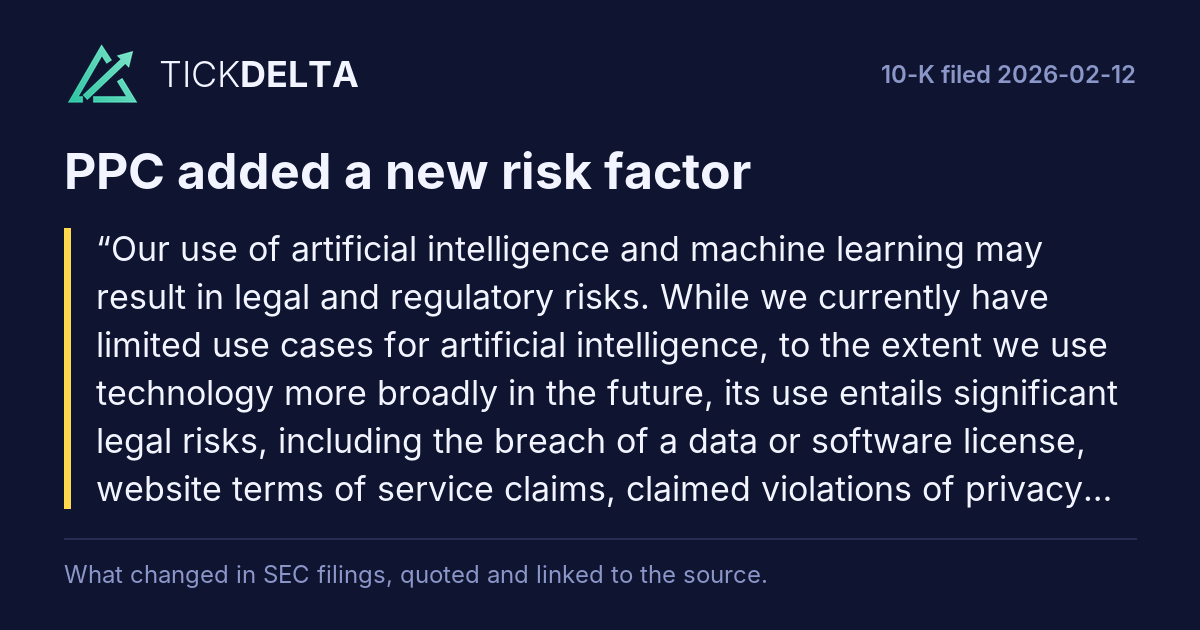
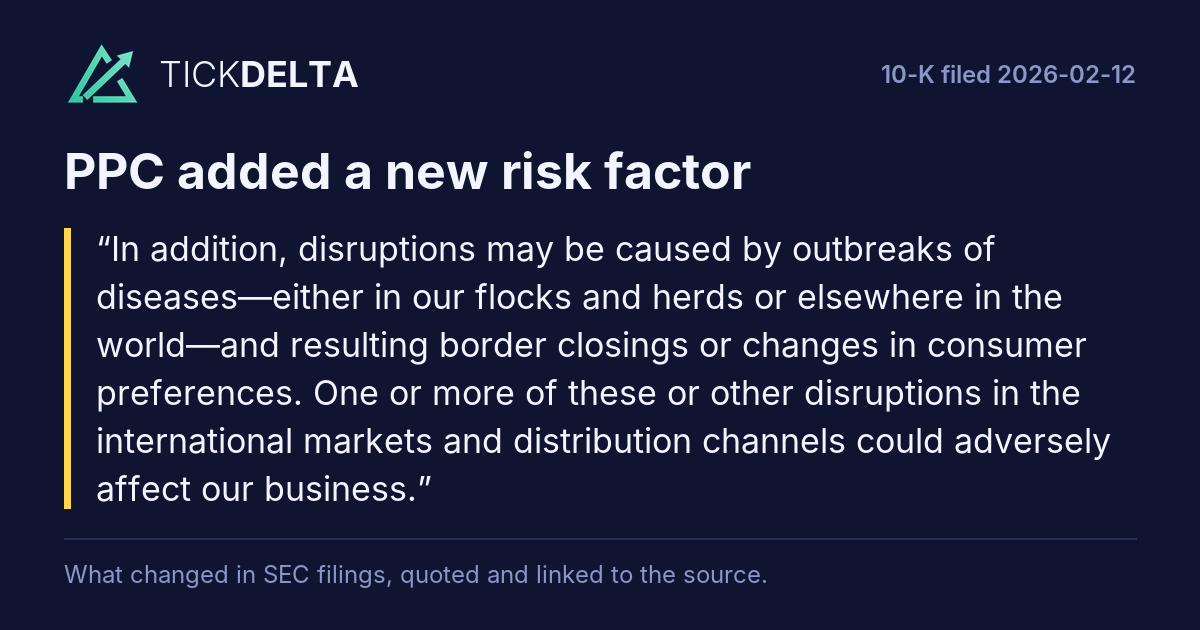
Our business continues to be subject to global inflationary pressures and broader economic uncertainty. In the U.S., inflation moderated compared to periods of elevated inflation experienced in recent years; however, labor, energy and other operating costs remain subject to market volatility. Consumer demand generally remained resilient during the third quarter of 2026, although ongoing uncertainty related to geopolitical developments, trade policies and broader economic conditions may continue to impact inflation trends and purchasing behavior.
Read in the 10-Qopen_in_new
In Europe, inflation continued to moderate during the third quarter of 2026 but remained affected by energy market volatility and broader economic conditions. Economic growth remained subdued in certain markets, and consumer spending patterns continued to reflect the effects of inflationary pressures experienced in recent periods. While inflationary conditions have improved compared to prior periods, geopolitical developments and fluctuations in energy markets continue to create uncertainty within the region.
Read in the 10-Qopen_in_new
In Mexico, inflation trends generally remained stable during the third quarter of 2026, although certain categories, including services, continued to experience inflationary pressures. Economic activity remained influenced by domestic demand, trade conditions and broader macroeconomic factors. Foreign currency exchange rates, including fluctuations in the Mexican peso relative to the U.S. dollar, may continue to impact the translation of our operating results and the competitiveness of our operations.
Read in the 10-Qopen_in_new
Geopolitical conflicts, including ongoing tensions in the Middle East and the conflict between Russia and Ukraine, continue to contribute to volatility in global commodity, energy and transportation markets. These events have resulted in and may continue to result in, disruptions to trade flows, supply chains and freight networks, as well as increased costs for certain inputs and services. While such conditions did not have a material impact on our costs during the current reporting period, prolonged or expanded hostilities could adversely affect our business, results of operations and financial condition in future periods.
Read in the 10-Qopen_in_new
Our business continues to be affected by global economic conditions, including inflationary pressures, geopolitical developments, foreign currency fluctuations, trade policy changes and overall consumer demand trends. Inflation in the U.S., Europe and Mexico moderated compared to elevated levels experienced in recent periods; however, labor, energy and other operating costs remain subject to market volatility. Additionally, changes in interest rates, foreign exchange rates and broader economic conditions may continue to impact consumer spending patterns and operating costs in the markets in which we operate.
Read in the 10-Qopen_in_new
On August 14, 2026, Pilgrim’s Europe agreed to acquire Walkers Deli & Sausage Company (Walkers) from Samworth Brothers, subject to approval by the Competition and Markets Authority (“CMA”) and employee consultation requirements in the U.K.. Walkers is a U.K. based producer of premium pork products operating four production facilities in Leicester and employing approximately 1,150 team members.
Read in the 10-Qopen_in_new
The proposed acquisition aligns with Pilgrim’s Europe strategy to expand its presence in the U.K. pork market and increase its participation in value-added product categories. The transaction is currently expected to close early in 2027, and therefore had no impact on the Company’s results of operations, financial position, or cash flows for the period presented.
Read in the 10-Qopen_in_new
On August 18, 2026, JBS submitted to the Company’s board of directors (the “Board”) a proposal to acquire the outstanding shares of the Company not already owned by JBS or its subsidiaries. JBS’s offer proposes this acquisition at a fixed exchange ratio of 2.086 JBS Class A common shares for each share of our common stock, based on the JBS and Company closing share prices on August 18, 2026 of $13.66 and $28.49, respectively (the “Proposed Transaction”). The Board has established a special committee of independent directors (the “Special Committee”) to review and evaluate the proposal. The Board will not approve the Proposed Transaction without the favorable recommendation of the Special Committee. No assurance can be given regarding whether any transaction will be entered into, approved by our Board and/or stockholders, or completed.
Read in the 10-Qopen_in_new
The third quarter of 2026 reflected continued consumer demand for chicken across both retail and foodservice channels. Amid ongoing economic pressures, including elevated fuel and food prices, inflation outpacing income growth, and subdued consumer sentiment, demand patterns became increasingly bifurcated, with value-oriented consumers remaining focused on affordability while higher-income consumers continued to support demand for premium offerings.
Read in the 10-Qopen_in_new
This dynamic had varying effects on chicken demand across categories, though overall volume growth remained positive in both retail and foodservice channels. Retail chicken volume increased 1.4% year over year, with all major retail
Read in the 10-Qopen_in_new
categories posting positive volume growth. Within fresh chicken, increased promotional activity by retailers drove solid volume gains in boneless skinless breast meat and boneless dark meat products, continuing a trend observed in recent quarters. These gains were partially offset by softer performance in other fresh chicken categories, including bone-in dark meat and wings.
Read in the 10-Qopen_in_new
Individually quick frozen chicken continued to deliver strong volume growth, supported by more favorable pricing relative to other chicken categories. In contrast, deli and frozen prepared chicken products experienced modest price increases while maintaining positive volume growth. Frozen Prepared growth is being driven by nuggets, chunks, and popcorn chicken, offsetting declines in tenders and wings. Overall, demand remained favorable across chicken categories, supported by consumers’ continued focus on value, convenience, and product quality.
Read in the 10-Qopen_in_new
In foodservice, demand trends reflected the increasingly bifurcated consumer environment. Traffic trends varied by channel, with quick-service restaurants experiencing softer traffic levels as lower-income consumers moderated discretionary spending, while full-service restaurants benefited from continued spending by higher-income consumers. Despite these dynamics, chicken volume remained positive across most foodservice subcategories, although growth moderated compared to prior periods. Full-service restaurants were the only major subcategory to experience volume declines. Continued expansion of chicken-focused menu offerings and restaurant units across foodservice channels supported overall demand for chicken.
Read in the 10-Qopen_in_new
Despite a more challenging macroeconomic environment, demand for chicken remained generally stable during the quarter. However, increased industry supply continued to pressure market prices.
Read in the 10-Qopen_in_new
While the latest World Agricultural Supply and Demand Estimates outlook has not yet incorporated the final third quarter chicken production numbers, the weaker-than-expected quarter may temper full-year production growth expectation. Pullet placements in August and September were generally in line with prior-year levels after exceeding prior-year levels for most of the year. Production growth is expected to continue moderating as producers adjust production levels to align with recent strong growing conditions resulting in lower mortality rates. Chicken demand is expected to remain favorable, supported by promotional activity and the relative value proposition of chicken compared to competing proteins. Beef supplies remain constrained, while pork production is expected to remain relatively stable, positioning chicken favorably within the protein complex.
Read in the 10-Qopen_in_new
Looking ahead, the timing and pace of supply and demand rebalancing are expected to be the primary factors influencing market conditions through year end and into 2027. Consumer spending patterns and broader macroeconomic conditions will continue to play an important role in determining the timing and extent of this rebalancing.
Read in the 10-Qopen_in_new
▪ The decrease was primarily attributable to lower domestic sales volumes due to increased intercompany transfers to Prepared Foods and the impacts of the conversion of Russellville to a Case Ready plant from a Big Bird plant, which was partially offset by increased export volumes
Read in the 10-Qopen_in_new
▪ The decrease was driven by lower domestic and export volumes compared to the prior year period
Read in the 10-Qopen_in_new
▪ The increase was primarily attributable to improved pricing across domestic and export channels
Read in the 10-Qopen_in_new
▪ The decrease was primarily driven by lower domestic and export volumes, resulting in lower production and operating costs
Read in the 10-Qopen_in_new
▪ The increase was primarily driven by higher operating costs, including increased input and utility costs, third-party services, and other operating expenses, reflecting continued inflationary pressures
Read in the 10-Qopen_in_new
▪ The decrease was primarily attributable to lower domestic sales volumes due to increased intercompany transfers to Prepared Foods and the impacts of the conversion of Russellville to a Case Ready plant from a Big Bird plant, which was partially offset by increased export volumes
Read in the 10-Qopen_in_new
▪ This increase was primarily attributable to improved pricing across domestic and export channels
Read in the 10-Qopen_in_new
▪ The decrease was driven by lower domestic and export volumes compared to the prior year period
Read in the 10-Qopen_in_new
▪ The decrease was primarily attributable to lower domestic sales volumes due to increased intercompany transfers to Prepared Foods and the impacts of the conversion of Russellville to a Case Ready plant from a Big Bird plant, which was partially offset by increased export volumes
Read in the 10-Qopen_in_new
On September 23, 2026, the Company completed a sale of €500.0 million aggregate principal amount of its 4.75% unsecured, unregistered senior notes due 2034. The proceeds of which will be used for general corporate purposes, including to fund the consideration in connection with the acquisition of Walkers Deli & Sausage Company, and to pay related costs and expenses. The issuance price of this offering was 99.866%, which created gross proceeds of €499.3 million before transaction costs. The €0.7 million discount will be amortized over the remaining life of the notes. The notes bear interest at a rate of 4.75% per annum from the date of issuance until maturity, payable annually in January, commencing January 23, 2027.
Read in the 10-Qopen_in_new
Cash Flows from Financing Activities Nine Months Ended September 27, 2026 September 28, 2025 (In millions) ────────────────────────────────────────────────────────────────────────────────────────────────────────────────────────────────────────────────────────────────────── Proceeds from revolving line of credit and long-term borrowings $ 709.3 $ — Payments on revolving line of credit, long-term borrowings and finance lease obligations (399.8) (114.8) Payments on early extinguishment of debt (14.5) (2.1) Payments of capitalized loan costs (6.5) — Payments for dividends — (1,994.3) Purchase of noncontrolling interest — (1.3) Cash provided by (used in) financing activities $ 288.5 $ (2,112.5)
Read in the 10-Qopen_in_new
Risk Factors
We have received an unsolicited proposal from our majority stockholder to acquire the shares of our common stock it does not already own. The outcome of this proposal is uncertain, may result in significant costs, and may impact the trading price and volatility of our common stock.
Read in the 10-Qopen_in_new
On August 18, 2026, our Board received an unsolicited proposal from our majority stockholder JBS (which currently beneficially owns, through its indirect wholly-owned subsidiaries, approximately 82.1% of our outstanding common stock), to acquire all outstanding shares of our common stock not already owned by JBS or its subsidiaries. For more information on the Proposed Transaction, see “Part I - Item 2 - Management’s Discussion and Analysis of Financial Condition and Results of Operations - Unsolicited Offer from JBS to Purchase Outstanding Shares of PPC Common Stock.” There can be no assurance as to whether any agreement relating to the Proposed Transaction or any similar or other transaction will be reached, or that the Proposed Transaction or any similar or other transaction will be pursued, approved by our Board and/or stockholders, or consummated, or as to its terms. The Proposed Transaction is an expression of interest only and may be withdrawn or modified at any time. The Special Committee may decline to recommend or may terminate its consideration of the Proposed Transaction, or any transaction, at any time, and any transaction remains subject to numerous factors, including market conditions, industry trends, regulatory developments, and litigation. While the Special Committee’s evaluations are underway, the primary focus of the Company’s executive management team will continue to be the effective management of the Company. We may also need to expend monetary costs, as well as the time and attention of our Board and management, in connection with the evaluation of, and response to, the Proposed Transaction. The outcome of the Proposed Transaction may contribute to fluctuations in the trading price, the market’s perception of our prospects, and trading volume of our common stock and/or subject us to litigation.
Read in the 10-Qopen_in_new
Item 6
Pursuant to Item 601(b) of Regulation S-K, the Company has omitted portions of the referenced exhibit that are (a) not material and (b) of the type of information it customarily and actually treats as private and confidential. Additionally, pursuant to Item 601(a) of Regulation S-K, the Company has omitted certain schedules that are not material.
Read in the 10-Qopen_in_new