Paragraph 19 · 43% changed
Every version of it
Screener
/
SEC EDGAR
/CIK 0000802481
/10-K filed Feb 12, 2026, compared with Feb 13, 2025
/Numbers from the XBRL of the 10-Ks
Nasdaq
Consumer staples · Meat Products
Pilgrims Pride Corp PPC
The 10-K against last year's
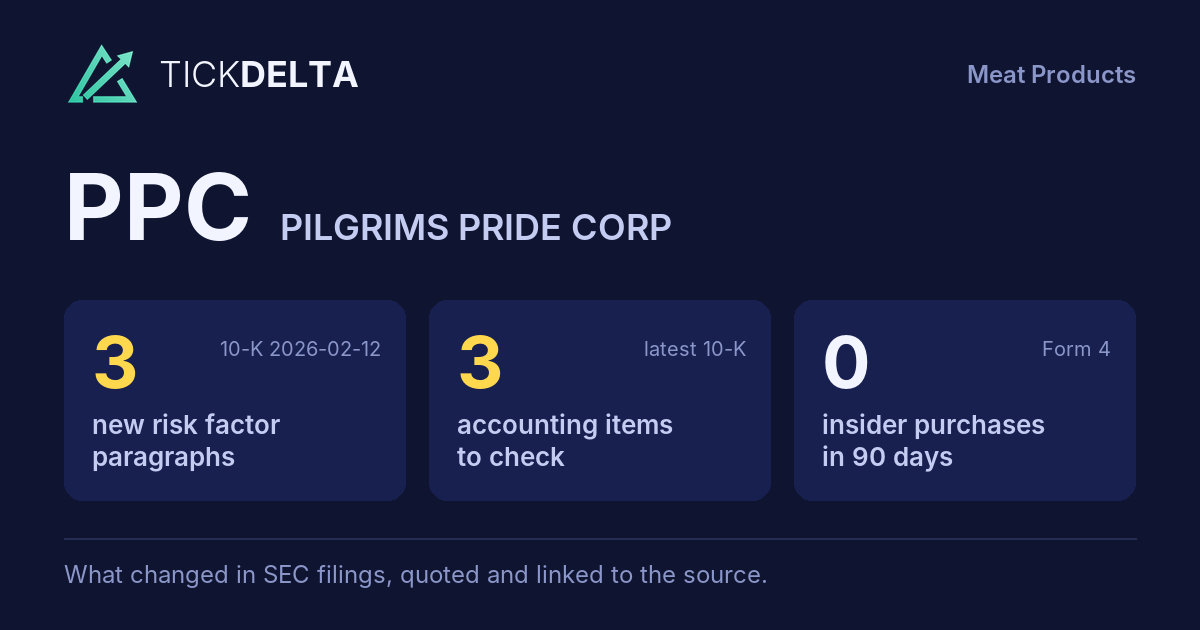
111 changes: 18 added, 18 removed, 74 reworded, 1 quiet changes
10-K Feb 12, 2026 vs Feb 13, 2025
Risk Factors
11.7%
of the text changed · 9,664 words now · 3 new paragraphs, 4 gone
MD&A
26.6%
of the text changed · 9,721 words now · 15 new paragraphs, 14 gone
Legal Proceedings
24.6%
of the text changed · 2,181 words now
Accounting Policies
12.9%
of the text changed · 6,905 words now
10-K 0000802481-26-000011 (Feb 12, 2026) vs 10-K 0000802481-25-000011 (Feb 13, 2025)
Every paragraph, and how much of it changed
One bar per paragraph, in the order of the 10-K. Height and colour show the share of its words not in the closest paragraph a year earlier; the tallest bars are new paragraphs.
Risk Factors
89 paragraphs · 3 new · 30 reworded · 4 gone · 10-K Feb 12, 2026 against Feb 13, 2025
New paragraph
Reworded (5% of its words or more)
Same or nearly
Paragraph 84 · 38% changed
Every version of it
Paragraph 73 · 33% changed
Every version of it
We have a significant amount of goodwill and identifiable intangible assets on our Consolidated Balance Sheets. Under the accounting principles generally accepted in the U.S. (“U.S. GAAP”), goodwill and other identifiable intangible assets with indefinite lives must be evaluated for impairment annually or more frequently if events indicate it is warranted. If the carrying value of our reporting units exceeds their current fair value as determined based on the discounted future cash flows of the related business, the goodwill is considered impaired and is reduced to fair value by a non-cash charge to earnings. For indefinite-lived intangible assets, an impairment loss is recognized if the carrying amount of an indefinite-lived intangible asset exceeds the estimated fair value of that intangible asset. Identified intangible assets with definite lives are tested for recoverability whenever events or changes in circumstances indicate that their carrying amount may not be recoverable. Events and conditions that could result in impairment in the value of our goodwill and other identifiable intangible assets include changes in the industry in which we operate, particularly the impact of a downturn in the global economy or the economies of geographic regions or countries in which we operate, as well as competition, adverse changes in the regulatory environment, or other factors leading to reduction in expected long-term sales or profitability.
Paragraph 83 · 32% changed
Every version of it
We face continued risks related to the ongoing Russia-Ukraine war that began in February 2022. The war’s impact on the global feed ingredient and energy markets continues to be less pronounced than during the initial onset of the ongoing war war, but there remain many risks and sanctions will likely not be limited to businesses uncertainties that operate in Russia may and Ukraine and may negatively impact other have impacted global economic markets including where we operate. markets. The impacts have included and may continue to include, but are not limited to, higher prices for commodities, such as food products, ingredients and energy products, increasing inflation in some countries, and riskier futures prices, disrupted trade and supply chains. The conflict has disrupted shipments chains, and increased pressure on the supply of grains, vegetable oils, fertilizer feed ingredients and energy products.
Paragraph 28 · 30% changed
Every version of it
Our failure to maintain our cyber-security measures and keep abreast of new and evolving threats may make our systems vulnerable. The rapid evolution and increased adoption of new technologies, such as artificial intelligence, may intensify our cybersecurity risks. The potential consequences of a material cyber-security incident include reputational damage, litigation with third parties, regulatory actions, disruption of plant operations, and increased cyber-security protection and remediation costs. We cannot assure that we will be able to prevent all of the rapidly evolving forms of increasingly sophisticated and frequent cyber-attacks. Moreover, our efforts to address network security vulnerabilities may not be successful, resulting potentially in the theft, loss, destruction, or corruption of information we store electronically, as well as unexpected interruptions, delays, or cessation of service, any of which could cause harm to our business operations. The vulnerability of our systems and our failure to identify or respond timely to cyber incidents could have an adverse effect on our operations and reputation and expose us to liability or regulatory enforcement actions.
Paragraph 57 · 28% changed
Every version of it
We also rely on an adequate supply of skilled employees at our processing and food facilities. Trained and experienced personnel in our industry are in high demand, and we and our third-party vendors have experienced high turnover and difficulty retaining employees with appropriate training and skills. This has led to, and could in the future continue to lead to, increased labor shortages costs, such as increased overtime to meet demand and increased wage rates to attract and retain employees, and could negatively affect our ability to efficiently operate our production facilities or otherwise operate at some full capacity or result in downtime of our production facilities and other locations. facilities. Several factors have had and may continue to have adverse effects on the labor force available to us and our third-party vendors, including immigration laws and government regulations, which include laws and regulations related to workers’ workers; health and safety, wage wage, and hour practices and work authorization. Labor shortages and increased While our industry generally operates with high employee turnover, any material increases in employee turnover rates within the Company and our third-party vendors have led to and or any widespread employee dissatisfaction could in the future lead to increased costs, such as increased overtime to meet demand and increased wage rates to attract and retain employees and could negatively affect our ability to efficiently operate our production facilities or otherwise operate at full capacity and could result in downtime of our production facilities. An overall or prolonged labor shortage, lack of skilled labor, increased turnover or labor inflation for any of the foregoing reasons could also have a material adverse impact effect on our operations, business, financial condition and results of operations, reputation, liquidity or cash flows. operations.
Paragraph 29 · 28% changed
Every version of it
Paragraph 56 · 27% changed
Every version of it
Loss of essential employees skilled employees, labor shortages, or a material increase in employee turnover could have a significant negative impact on our business. business and adverse effects on our profitability.
Paragraph 19 · 43% changed
Every version of it
10-K Feb 13, 2025Historically, we have targeted international markets to generate additional demand for our products. In particular, given the general preference for white chicken meat by U.S. and U.K. consumers, we have targeted international markets for the sale of certain dark chicken meat and parts, such as chicken paws. We have also targeted international markets for excess primary pork cuts and parts, such as hog heads and trotters. As part of this initiative, we have created a significant international distribution network into several markets in Mexico, the Middle East, and Asia. Our success in these markets may be impacted, and in recent periods, has been influenced by disruptions in export markets. A significant risk is disruption due to import restrictions and tariffs, other trade protection measures, and import or export licensing requirements regarding food products imposed by foreign countries. Significant political or regulatory developments in the jurisdictions in which we sell our products, such as those stemming from the presidential administration in the U.S., are difficult to predict, may create uncertainty, and could impact our business. For example, the implementation of new tariff schemes by various governments, such as those implemented by the U.S. and China in recent years, could increase the costs of our operations and ultimately increase the cost of products sold from one country into another country. In addition, disruptions may be caused by outbreaks of diseases—either in our flocks and herds or elsewhere in the world—and resulting changes in consumer preferences. One or more of these or other disruptions in the international markets and distribution channels could adversely affect our business.
10-K Feb 12, 2026
Significant political or regulatory developments in the jurisdictions in which we sell our products, such as those stemming from the presidential administration in the U.S., are difficult to predict, may create uncertainty, and could impact our business. For example, the implementation of new tariff schemes by various governments, such as those implemented by the U.S. Mexico, European countries, and China in recent years, could increase the costs of our operations and ultimately increase the cost of products sold from one country into another country, or otherwise adversely impact our operations.
Paragraph 84 · 38% changed
Every version of it
10-K Feb 13, 2025Finally, there may be increased risk of cyberattack as a result of the ongoing conflict. We have not seen any new or heightened risk of potential cyberattacks since the outbreak of the Russia-Ukraine war.
10-K Feb 12, 2026
There is also an ongoing risk of a cyber-attack as a result of the ongoing conflict, although we have not to date seen any new or heightened risk of such potential attacks.
Paragraph 73 · 33% changed
Every version of it
10-K Feb 13, 2025
We have a significant amount of goodwill and identifiable intangible assets on our Consolidated Balance Sheets. Under the accounting principles generally accepted in the U.S. (“U.S. GAAP”), goodwill and other identifiable intangible assets with indefinite lives must be evaluated for impairment annually or more frequently if events indicate it is warranted. If the carrying value of our reporting units exceeds their current fair value as determined based on the discounted future cash flows of the related business, the goodwill is considered impaired and is reduced to fair value by a non-cash charge to earnings. For indefinite-lived intangible assets, an impairment loss is recognized if the carrying amount of an indefinite-lived intangible asset exceeds the estimated fair value of that intangible asset. Identified intangible assets with definite lives are tested for recoverability whenever events or changes in circumstances indicate that their carrying amount may not be recoverable. Events and conditions that could result in impairment in the value of our goodwill and other identifiable intangible assets include changes in the industry in which we operate, particularly the impact of a downturn in the global economy or the economies of geographic regions or countries in which we operate, as well as competition, adverse changes in the regulatory environment, or other factors leading to reduction in expected long-term sales or profitability.
10-K Feb 12, 2026
We have a significant amount of goodwill and identifiable intangible assets on our Consolidated Balance Sheets. Under the accounting principles generally accepted in the U.S. (“U.S. GAAP”), goodwill and other identifiable intangible assets with indefinite lives must be evaluated for impairment annually or more frequently if events indicate it is warranted. If the carrying value of our reporting units exceeds their current fair value as determined based on the discounted future cash flows of
Paragraph 83 · 32% changed
Every version of it
10-K Feb 13, 2025
We face risks related to the ongoing Russia-Ukraine war that began in February 2022. The impact of the ongoing war and sanctions will likely not be limited to businesses that operate in Russia and Ukraine and may negatively impact other global economic markets including where we operate. The impacts have included and may continue to include, but are not limited to, higher prices for commodities, such as food products, ingredients and energy products, increasing inflation in some countries, and disrupted trade and supply chains. The conflict has disrupted shipments of grains, vegetable oils, fertilizer and energy products.
10-K Feb 12, 2026
We face continued risks related to the ongoing Russia-Ukraine war that began in February 2022. The war’s impact on the global feed ingredient and energy markets continues to be less pronounced than during the initial onset of the war, but there remain many risks and uncertainties that may and have impacted global markets. The impacts have included and may continue to include, but are not limited to, higher prices for commodities, such as food products, ingredients and energy products, increasing inflation in some countries, riskier futures prices, disrupted trade and supply chains, and increased pressure on the supply of feed ingredients and energy products.
Paragraph 28 · 30% changed
Every version of it
10-K Feb 13, 2025
Our failure to maintain our cyber-security measures and keep abreast of new and evolving threats may make our systems vulnerable. The rapid evolution and increased adoption of new technologies, such as artificial intelligence, may intensify our cybersecurity risks. The potential consequences of a material cyber-security incident include reputational damage, litigation with third parties, regulatory actions, disruption of plant operations, and increased cyber-security protection and remediation costs. We cannot assure that we will be able to prevent all of the rapidly evolving forms of increasingly sophisticated and frequent cyber-attacks. Moreover, our efforts to address network security vulnerabilities may not be successful, resulting potentially in the theft, loss, destruction, or corruption of information we store electronically, as well as unexpected interruptions, delays, or cessation of service, any of which could cause harm to our business operations. The vulnerability of our systems and our failure to identify or respond timely to cyber incidents could have an adverse effect on our operations and reputation and expose us to liability or regulatory enforcement actions.
10-K Feb 12, 2026
Our failure to maintain our cyber-security measures and keep abreast of new and evolving threats may make our systems vulnerable. The rapid evolution and increased adoption of new technologies, such as artificial intelligence, may intensify our cybersecurity risks. The potential consequences of a material cyber-security incident include reputational damage, litigation with third parties, regulatory actions, disruption of plant operations, and increased cyber-security protection and remediation costs. We cannot assure that we will be able to prevent all of the rapidly evolving forms of increasingly
Paragraph 57 · 28% changed
Every version of it
10-K Feb 13, 2025
We and our third-party vendors have experienced increased labor shortages at some of our production facilities and other locations. Several factors have had and may continue to have adverse effects on the labor force available to us and our third-party vendors, including government regulations, which include laws and regulations related to workers’ health and safety, wage and hour practices and work authorization. Labor shortages and increased turnover rates within the Company and our third-party vendors have led to and could in the future lead to increased costs, such as increased overtime to meet demand and increased wage rates to attract and retain employees and could negatively affect our ability to efficiently operate our production facilities or otherwise operate at full capacity and could result in downtime of our production facilities. An overall or prolonged labor shortage, lack of skilled labor, increased turnover or labor inflation for any of the foregoing reasons could have a material adverse impact on our operations, results of operations, reputation, liquidity or cash flows.
10-K Feb 12, 2026
We also rely on an adequate supply of skilled employees at our processing and food facilities. Trained and experienced personnel in our industry are in high demand, and we and our third-party vendors have experienced high turnover and difficulty retaining employees with appropriate training and skills. This has led to, and could in the future continue to lead to, increased costs, such as increased overtime to meet demand and increased wage rates to attract and retain employees, and could negatively affect our ability to efficiently operate our production facilities or otherwise operate at full capacity or result in downtime of our production facilities. Several factors have had and may continue to have adverse effects on the labor force available to us and our third-party vendors, including immigration laws and government regulations, which include laws and regulations related to workers; health and safety, wage, and hour practices and work authorization. While our industry generally operates with high employee turnover, any material increases in employee turnover rates or any widespread employee dissatisfaction could also have a material adverse effect on our business, financial condition and results of operations.
Paragraph 29 · 28% changed
Every version of it
10-K Feb 13, 2025Our failure to maintain our cyber-security measures and keep abreast of new and evolving threats may make our systems vulnerable. The rapid evolution and increased adoption of new technologies, such as artificial intelligence, may intensify our cybersecurity risks. The potential consequences of a material cyber-security incident include reputational damage, litigation with third parties, regulatory actions, disruption of plant operations, and increased cyber-security protection and remediation costs. We cannot assure that we will be able to prevent all of the rapidly evolving forms of increasingly sophisticated and frequent cyber-attacks. Moreover, our efforts to address network security vulnerabilities may not be successful, resulting potentially in the theft, loss, destruction, or corruption of information we store electronically, as well as unexpected interruptions, delays, or cessation of service, any of which could cause harm to our business operations. The vulnerability of our systems and our failure to identify or respond timely to cyber incidents could have an adverse effect on our operations and reputation and expose us to liability or regulatory enforcement actions.
10-K Feb 12, 2026
sophisticated and frequent cyber-attacks. Moreover, our efforts to address network security vulnerabilities may not be successful, resulting potentially in the theft, loss, destruction, or corruption of information we store electronically, as well as unexpected interruptions, delays, or cessation of service, any of which could cause harm to our business operations. The vulnerability of our systems and our failure to identify or respond timely to cyber incidents could have an adverse effect on our operations and reputation and expose us to liability or regulatory enforcement actions.
Paragraph 56 · 27% changed
Every version of it
10-K Feb 13, 2025
Loss of essential employees or material increase in employee turnover could have a significant negative impact on our business.
10-K Feb 12, 2026
Loss of skilled employees, labor shortages, or a material increase in employee turnover could have a significant negative impact on our business and adverse effects on our profitability.
MD&A
125 paragraphs · 15 new · 65 reworded · 14 gone · 10-K Feb 12, 2026 against Feb 13, 2025
New paragraph
Reworded (5% of its words or more)
Same or nearly
Paragraph 64 · 44% changed
Payments for dividends during 2025 are related to the special cash dividends that were paid in April and September 2025. Payments on revolving line of credit, long-term borrowings borrowings, and finance lease obligations and payments on early extinguishment of debt during 2024 2025, are primarily related to open market repurchases of outstanding senior notes. The proceeds from contribution repurchase of capital under the Tax Sharing Agreement with JBS USA Holdings during 2024 were an allocation made during tax year 2023 noncontrolling interest represents cash paid in exchange for payment equity of historical tax adjustments. Payments on early extinguishment of debt during 2024 are transaction fees related to the bond repurchases. a subsidiary that was previously owned by a noncontrolling interest partner.
Paragraph 87 · 44% changed
Generally, we perform an evaluation of whether any lower of cost or net realizable value adjustments are required at the country level based on a number of factors, including: (1) pools of related inventory, (2) product continuation or discontinuation, (3) estimated market selling prices and (4) expected distribution channels. If actual market conditions or other factors are less favorable than those projected by management, additional inventory adjustments may be required. We also record valuation adjustments, when necessary, for estimated obsolescence at or equal to the difference between the cost of inventory and the estimated market value based upon known conditions affecting inventory obsolescence, including significantly aged products, discontinued product lines, or damaged or obsolete products.
Paragraph 110 · 42% changed
Our acquisition accounting methodology contains uncertainties because it requires management to make assumptions and to apply judgment to estimate the fair value of acquired assets and liabilities. Management estimates the fair value of assets and liabilities based upon quoted market prices, the carrying value of the acquired assets and widely accepted valuation techniques, including discounted cash flows and market multiple analyses. Unanticipated events or circumstances may occur which could affect the accuracy of our fair value estimates, including changes in assumptions regarding industry economic factors and business strategies. If actual results are materially different than the assumptions used to determine fair value of the assets and liabilities acquired through a business combination, it is possible that adjustments to the carrying values of such assets and liabilities will have an impact on our net earnings.
Paragraph 63 · 42% changed
Year Ended Cash Flows from Financing Activities December 28, 2025 December 29, 2024 (In millions) Payments for dividends $ (1,994.3) $ — Payments on revolving line of credit, long-term borrowings borrowings, and finance lease obligations during 2024 are primarily related to open market repurchases (115.2) (152.1) Payments on early extinguishment of outstanding senior notes. The proceeds debt (2.1) (0.2) Purchase of noncontrolling interest (1.3) — Proceeds from contribution of capital under the Tax Sharing Agreement with JBS USA Holdings during 2024 were an allocation made during tax year 2023 for payment of historical tax adjustments. Payments on early extinguishment of debt during 2024 are transaction fees related to the bond repurchases. — 1.4 Cash used in financing activities $ (2,113.0) $ (150.9)
Paragraph 59 · 38% changed
The change in income taxes, which includes income taxes receivable, income taxes payable, deferred tax assets, deferred tax liabilities, reserves for uncertain tax positions positions, and the tax components within accumulated other comprehensive loss, represented a $109.4 million source of cash in 2024. This change resulted primarily from the timing of estimated tax payments and higher profitability in 2024 which increased our income tax payables and reduced income tax receivable. The change in income taxes, which includes income taxes receivables, income taxes payable, deferred tax assets, deferred tax liabilities, reserves for uncertain tax positions and the tax components within accumulated other comprehensive loss, represented a $8.9 million use of cash in 2023. This change resulted primarily from the timing of estimated tax payments and lower profitability in 2023.
Paragraph 14 · 33% changed
During 2024, 2025, the U.K. chicken market saw an increase prices remained elevated compared to 2024 levels, yet stable, reflecting a balance between strong domestic consumption, increased domestic production, and easing input cost pressures. Supply increased in 2025 due to higher average live weights and higher slaughter numbers, but pricing remained firm due to increased labor costs due to the national living wages change in April 2024. and animal welfare costs. Through customer contracts and additional negotiations, we have offset the majority of these cost increases. Partially offsetting the labor and animal welfare costs was an easing of feed costs in 2025 relative to 2024. Due to increased competition with the U.K. egg market, there has been continues to be an increase in costs to retain growers, while feed costs have decreased throughout the year. growers. We continue to focus on managing costs, including labor and yield efficiencies, agricultural performance and increasing operational efficiencies through investments in capital projects.
Paragraph 76 · 33% changed
Starting in the 2024 calendar year, the Pillar II rules came into effect in several jurisdictions, impacting multinational companies operating in these markets. However, during the first three years of implementation, transitional rules (Safe Harbor) have been introduced to simplify the calculation of the effective tax rate per jurisdiction, facilitating the adaptation of multinational groups to the new requirements. As the Group operates in multiple jurisdictions where the global minimum tax is effective, including France, Ireland, Luxembourg, Malta, the Netherlands, and the United Kingdom, the Company carried out the assessment procedures to analyze the potential impacts arising from these regulations. Based on the analyses conducted to date, no material tax exposure has been identified as a result of the application of this tax.
Paragraph 36 · 31% changed
Europe Reportable Segment. SG&A expense incurred by the Europe operations during 2024 2025 decreased $3.6 $9.6 million, or 1.8%, 4.8%, from SG&A expense incurred by the Europe operations during 2023 2024 primarily due to decreased labor and employee-related costs. costs as a result of the restructuring initiatives consolidating backoffice support. The decreased labor costs were partially offset by an increase from the unfavorable impact of foreign currency translation.
Paragraph 64 · 44% changed
10-K Feb 13, 2025
Payments on revolving line of credit, long-term borrowings and finance lease obligations during 2024 are primarily related to open market repurchases of outstanding senior notes. The proceeds from contribution of capital under the Tax Sharing Agreement with JBS USA Holdings during 2024 were an allocation made during tax year 2023 for payment of historical tax adjustments. Payments on early extinguishment of debt during 2024 are transaction fees related to the bond repurchases.
10-K Feb 12, 2026
Payments for dividends during 2025 are related to the special cash dividends that were paid in April and September 2025. Payments on revolving line of credit, long-term borrowings, and finance lease obligations and payments on early extinguishment of debt during 2025, are primarily related to open market repurchases of outstanding senior notes. The repurchase of noncontrolling interest represents cash paid in exchange for equity of a subsidiary that was previously owned by a noncontrolling interest partner.
Paragraph 87 · 44% changed
10-K Feb 13, 2025
Generally, we perform an evaluation of whether any lower of cost or net realizable value adjustments are required at the country level based on a number of factors, including: (1) pools of related inventory, (2) product continuation or discontinuation, (3) estimated market selling prices and (4) expected distribution channels. If actual market conditions or other factors are less favorable than those projected by management, additional inventory adjustments may be required. We also record valuation adjustments, when necessary, for estimated obsolescence at or equal to the difference between the cost of inventory and the estimated market value based upon known conditions affecting inventory obsolescence, including significantly aged products, discontinued product lines, or damaged or obsolete products.
10-K Feb 12, 2026
Generally, we perform an evaluation of whether any lower of cost or net realizable value adjustments are required at the country level based on a number of factors, including: (1) pools of related inventory, (2) product continuation or
Paragraph 110 · 42% changed
10-K Feb 13, 2025
Our acquisition accounting methodology contains uncertainties because it requires management to make assumptions and to apply judgment to estimate the fair value of acquired assets and liabilities. Management estimates the fair value of assets and liabilities based upon quoted market prices, the carrying value of the acquired assets and widely accepted valuation techniques, including discounted cash flows and market multiple analyses. Unanticipated events or circumstances may occur which could affect the accuracy of our fair value estimates, including changes in assumptions regarding industry economic factors and business strategies. If actual results are materially different than the assumptions used to determine fair value of the assets and liabilities acquired through a business combination, it is possible that adjustments to the carrying values of such assets and liabilities will have an impact on our net earnings.
10-K Feb 12, 2026
Our acquisition accounting methodology contains uncertainties because it requires management to make assumptions and to apply judgment to estimate the fair value of acquired assets and liabilities. Management estimates the fair value of assets and liabilities based upon quoted market prices, the carrying value of the acquired assets and widely accepted valuation
Paragraph 63 · 42% changed
10-K Feb 13, 2025
Payments on revolving line of credit, long-term borrowings and finance lease obligations during 2024 are primarily related to open market repurchases of outstanding senior notes. The proceeds from contribution of capital under the Tax Sharing Agreement with JBS USA Holdings during 2024 were an allocation made during tax year 2023 for payment of historical tax adjustments. Payments on early extinguishment of debt during 2024 are transaction fees related to the bond repurchases.
10-K Feb 12, 2026
Year Ended Cash Flows from Financing Activities December 28, 2025 December 29, 2024 (In millions) Payments for dividends $ (1,994.3) $ — Payments on revolving line of credit, long-term borrowings, and finance lease obligations (115.2) (152.1) Payments on early extinguishment of debt (2.1) (0.2) Purchase of noncontrolling interest (1.3) — Proceeds from contribution of capital under Tax Sharing Agreement with JBS USA Holdings — 1.4 Cash used in financing activities $ (2,113.0) $ (150.9)
Paragraph 59 · 38% changed
10-K Feb 13, 2025
The change in income taxes, which includes income taxes receivable, income taxes payable, deferred tax assets, deferred tax liabilities, reserves for uncertain tax positions and the tax components within accumulated other comprehensive loss, represented a $109.4 million source of cash in 2024. This change resulted primarily from the timing of estimated tax payments and higher profitability in 2024 which increased our income tax payables and reduced income tax receivable. The change in income taxes, which includes income taxes receivables, income taxes payable, deferred tax assets, deferred tax liabilities, reserves for uncertain tax positions and the tax components within accumulated other comprehensive loss, represented a $8.9 million use of cash in 2023. This change resulted primarily from the timing of estimated tax payments and lower profitability in 2023.
10-K Feb 12, 2026
The change in income taxes, which includes income taxes receivable, income taxes payable, deferred tax assets, deferred tax liabilities, reserves for uncertain tax positions, and the tax components within accumulated other comprehensive
Paragraph 14 · 33% changed
10-K Feb 13, 2025
During 2024, the U.K. chicken market saw an increase in labor costs due to the national living wages change in April 2024. Through customer contracts and additional negotiations, we have offset the majority of these cost increases. Due to increased competition with the U.K. egg market, there has been an increase in costs to retain growers, while feed costs have decreased throughout the year. We continue to focus on managing costs, including labor and yield efficiencies, agricultural performance and increasing operational efficiencies through investments in capital projects.
10-K Feb 12, 2026
During 2025, the U.K. chicken market prices remained elevated compared to 2024 levels, yet stable, reflecting a balance between strong domestic consumption, increased domestic production, and easing input cost pressures. Supply increased in 2025 due to higher average live weights and higher slaughter numbers, but pricing remained firm due to increased labor costs and animal welfare costs. Through customer contracts and additional negotiations, we have offset the majority of these cost increases. Partially offsetting the labor and animal welfare costs was an easing of feed costs in 2025 relative to 2024. Due to increased competition with the U.K. egg market, there continues to be an increase in costs to retain growers. We continue to focus on managing costs, including labor and yield efficiencies, agricultural performance and increasing operational efficiencies through investments in capital projects.
Paragraph 76 · 33% changed
10-K Feb 13, 2025
Starting in the 2024 calendar year, the Pillar II rules came into effect in several jurisdictions, impacting multinational companies operating in these markets. However, during the first three years of implementation, transitional rules (Safe Harbor) have been introduced to simplify the calculation of the effective tax rate per jurisdiction, facilitating the adaptation of multinational groups to the new requirements.
10-K Feb 12, 2026
Starting in the 2024 calendar year, the Pillar II rules came into effect in several jurisdictions, impacting multinational companies operating in these markets. However, during the first three years of implementation, transitional rules (Safe Harbor) have been introduced to simplify the calculation of the effective tax rate per jurisdiction, facilitating the adaptation of multinational groups to the new requirements. As the Group operates in multiple jurisdictions where the global minimum tax is effective, including France, Ireland, Luxembourg, Malta, the Netherlands, and the United Kingdom, the Company carried out the assessment procedures to analyze the potential impacts arising from these regulations. Based on the analyses conducted to date, no material tax exposure has been identified as a result of the application of this tax.
Paragraph 36 · 31% changed
10-K Feb 13, 2025
Europe Reportable Segment. SG&A expense incurred by the Europe operations during 2024 decreased $3.6 million, or 1.8%, from SG&A expense incurred by the Europe operations during 2023 primarily due to decreased labor and employee-related costs.
10-K Feb 12, 2026
Europe Reportable Segment. SG&A expense incurred by the Europe operations during 2025 decreased $9.6 million, or 4.8%, from SG&A expense incurred by the Europe operations during 2024 primarily due to decreased labor and employee-related costs as a result of the restructuring initiatives consolidating backoffice support. The decreased labor costs were partially offset by an increase from the unfavorable impact of foreign currency translation.
A paragraph is matched with the one last year that shares the most of its words; under half in common makes it new. The paragraphs shown are the 8 reworded the most in each section.
The paragraph that changed most in each section
The redline
Marked against last year's 10-K: cut words struck through, new words highlighted.
Legal Proceedings225 words changed in this paragraph; it is 44% similar to last year's version.
On May 12, 2022, the SAT issued tax assessments against Pilgrim’s Pride, S. de R.L. de C.V. and Provemex Holdings, LLC in connection with PPC’s acquisition of Tyson de México. Additionally, the seller in this acquisition also received an assessment from the SAT related to the sale of its indirect equity interest of Tyson de México. The transaction agreement related to such acquisition contains certain mutual indemnification provisions, and both seller and buyer provided notice of indemnification claims to the other party. In response to the indemnification claims, on November 14, 2025, in a strategic effort to mitigate risk and in exchange for monetary compensation, PPC settled the indemnification claims and entered into an agreement with the seller in which PPC agreed to assume all tax liabilities in connection with the seller’s assessment, assume defense of such assessment, and waive all potential indemnification claims against the seller. In response to the underlying substantive assessments by the SAT, the Mexican subsidiaries of PPC filed a petition to nullify these assessments. The District Court issued a judgement judgment on January 20, 2025, in which the court now claims that the seller (a Tyson entity) owed tax due to the indirect transfer of Mexican assets in connection with the sale, and that PPC or its subsidiaries should have withheld such taxes, but also noted that only one of taxes. The Collegiate (appellate) Court (the “Collegiate Court”) issued a decision on February 7, 2025 remanding the assessments will proceed. PPC will appeal and will continue to defend this matter. The amount under appeal for the remaining assessment is approximately $269.5 million. No expense has been recorded for this amount at this time, and PPC have submitted an indemnification claim notice pursuant dispute to the definitive agreement to acquire Tyson de México. There can be no assurances as to whether the indemnification claim will be successful or in what amounts.
Source: Item 3, via Note 21 – COMMITMENTS AND CONTINGENCIES, 10-K 0000802481-26-000011 vs Item 3, via Note 21 – COMMITMENTS AND CONTINGENCIES, 10-K 0000802481-25-000011
Risk Factors176 words changed in this paragraph; it is 38% similar to last year's version.
We also rely on an adequate supply of skilled employees at our processing and food facilities. Trained and experienced personnel in our industry are in high demand, and we and our third-party vendors have experienced high turnover and difficulty retaining employees with appropriate training and skills. We cannot predict whether we will be able This has led to, and could in the future continue to attract, motivate lead to, increased costs, such as increased overtime to meet demand and maintain an adequate skilled workforce necessary increased wage rates to attract and retain employees, and could negatively affect our ability to efficiently operate our existing production facilities or otherwise operate at full capacity or result in downtime of our production facilities. Several factors have had and future facilities efficiently, or that may continue to have adverse effects on the labor expenses will not increase as a result of a shortage in the supply of skilled personnel, thereby adversely impacting force available to us and our financial performance. third-party vendors, including immigration laws and government regulations, which include laws and regulations related to workers; health and safety, wage, and hour practices and work authorization. While our industry generally operates with high employee turnover, any material increases in employee turnover rates or any widespread employee dissatisfaction could also have a material adverse effect on our business, financial condition and results of operations.
Source: Item 1A, 10-K 0000802481-26-000011 vs Item 1A, 10-K 0000802481-25-000011
MD&A166 words changed in this paragraph; it is 30% similar to last year's version.
Source: Item 7, 10-K 0000802481-26-000011 vs Item 7, 10-K 0000802481-25-000011
Accounting Policies122 words changed in this paragraph; it is 71% similar to last year's version.
On August 22, 2024, November 7, 2025, the Company closed an industrial revenue bond transaction with the Douglas-Coffee County Industrial Authority d/b/a Douglas-Coffee Walker County Development Authority (the “County”) “Authority”) in order to receive a five-year real ten-year property tax abatement incentive on the Company’s newly constructed Douglas, Georgia protein conversion facility. production facility in Walker County currently under development. Pursuant to this transaction, the County Authority issued an industrial development revenue bond for $130.0 in the amount of $460.5 million principal amount (subject to drawdowns as construction progresses) to the Company and then used the proceeds of the bond issuance in order to purchase acquire legal title to the land and for the facility from the Company. The County Authority then leased the facility land back to the Company under a finance lease, the terms of which provide for the payment of rent in an amount equal to that of bond the debt service costs. The owed by the Authority on the bonds. Title to buildings to be constructed and equipment to be acquired will also be acquired by the Authority and leased to the Company through this program. At this time, only the related land and building are is recorded as assets an asset in Property, plant, and equipment, net on the Company’s Condensed Consolidated Balance Sheet. The Company has the legal right to set-off and intends to set-off the corresponding lease and bond debt service payments, therefore the Company has netted the finance lease obligation with the bond asset. As such, no amount for our obligation under the finance lease or the corresponding industrial revenue bond asset are reflected in our Consolidated Balance Sheet.
Source: Item 8, Note 1 – BUSINESS AND SUMMARY OF SIGNIFICANT ACCOUNTING POLICIES, 10-K 0000802481-26-000011 vs Item 8, Note 1 – BUSINESS AND SUMMARY OF SIGNIFICANT ACCOUNTING POLICIES, 10-K 0000802481-25-000011
Sentences and paragraphs added, removed or reworded
Every change, by type
Sentences and paragraphs of PPC's Risk Factors and MD&A, 10-K Feb 12, 2026 against 10-K Feb 13, 2025. Each links to the text at sec.gov.
Quiet changes are sentences kept from last year with one to four words changed, at least one of them a hedge, a modal or a qualifier (may, could, will, not, significant, material…). A year or date rolling forward is not counted.
The full word list
adverse, adversely, all, although, anticipate, anticipates, any, approximately, believe, believes, can, cannot, certain, could, expect, expects, generally, however, if, intend, intends, largely, likely, many, material, materially, may, might, most, must, never, no, not, possible, primarily, probable, should, significant, significantly, some, substantial, substantially, unlikely, will, would
AddedRisk Factors
In addition, disruptions may be caused by outbreaks of diseases—either in our flocks and herds or elsewhere in the world—and resulting border closings or changes in consumer preferences. One or more of these or other disruptions in the international markets and distribution channels could adversely affect our business.
Read it in 10-K Feb 12, 2026 at sec.gov
AddedRisk Factors
Our use of artificial intelligence and machine learning may result in legal and regulatory risks.
Read it in 10-K Feb 12, 2026 at sec.gov
AddedRisk Factors
While we currently have limited use cases for artificial intelligence, to the extent we use technology more broadly in the future, its use entails significant legal risks, including the breach of a data or software license, website terms of service claims, claimed violations of privacy rights or other tort claims. The regulatory landscape surrounding artificial intelligence is also evolving, and expanded use of machine learning technologies may become subject to regulation under new laws or new applications of existing laws. Compliance with these regulations may increase costs, and violations of these laws and regulations could result in fines and penalties, criminal sanctions against us, our officers or our employees, prohibitions on the conduct of our business, and damage to our reputation.
Read it in 10-K Feb 12, 2026 at sec.gov
RemovedRisk Factors
RemovedRisk Factors
RemovedRisk Factors
RemovedRisk Factors
RewordedRisk Factors
Show the other 48
RewordedRisk Factors
RewordedRisk Factors
For example, HPAI H5 has been detected in a number of states in the U.S. predominantly in poultry flocks but also more recently in dairy cattle, wild birds and mammals, as well as in farm workers directly exposed to infected animals.
Read it in 10-K Feb 12, 2026 at sec.gov
RewordedRisk Factors
For example, the implementation of new tariff schemes by various governments, such as those implemented by the U.S. and China in recent years, could increase the costs of our operations and ultimately increase the cost of products sold from one country into another country.
Read it in 10-K Feb 12, 2026 at sec.gov
RewordedRisk Factors
If the carrying value of our reporting units exceeds their current fair value as determined based on the discounted future cash flows of the related business, the goodwill is considered impaired and is reduced to fair value by a non-cash charge to earnings.
Read it in 10-K Feb 12, 2026 at sec.gov
RewordedRisk Factors
The impacts have included and may continue to include, but are not limited to, higher prices for commodities, such as food products, ingredients and energy products, increasing inflation in some countries, and riskier futures prices, disrupted trade and supply chains. chains, and increased pressure on the supply of feed ingredients and energy products.
Read it in 10-K Feb 12, 2026 at sec.gov
RewordedRisk Factors
Loss of essential employees skilled employees, labor shortages, or a material increase in employee turnover could have a significant negative impact on our business. business and adverse effects on our profitability.
Read it in 10-K Feb 12, 2026 at sec.gov
RewordedRisk Factors
In the Mexico retail and foodservice markets, where product differentiation has traditionally been limited, product quality and price have been the most critical competitive factors.
Read it in 10-K Feb 12, 2026 at sec.gov
RewordedRisk Factors
Media campaigns related to food production; production, regulatory and customer focus on environmental, social and governance responsibility; sustainability, and recent increased focus and attention by the U.S. government on market dynamics in and other facets of the meat processing industry could expose us to additional costs or risks.
Read it in 10-K Feb 12, 2026 at sec.gov
RewordedRisk Factors
This increased attention on environmental, social, sustainability practices and governance practices other facets of the meatpacking industry could cause us to incur additional compliance costs, divert management attention from operating our business, impair our access to capital among certain investors, and subject us to litigation risk for disclosures we make and practices we adopt regarding these issues.
Read it in 10-K Feb 12, 2026 at sec.gov
RewordedRisk Factors
RewordedRisk Factors
If we are unable to attract, hire or retain key team members or a highly skilled and diverse global workforce, members, it could have a negative impact on our business, financial condition or results of operations.
Read it in 10-K Feb 12, 2026 at sec.gov
AddedMD&A
Our business is subject to global inflationary trends. U.S. consumer price index inflation rose 2.7% in the twelve months ended December 2025. The fluctuations were driven by policy changes, supply chain dynamics, and consumer spending behavior. U.K. consumer price index inflation rose 3.6% in the twelve months ended December 2025, driven by increases in alcohol and tobacco and transportation costs, as well as smaller increases in food and restaurant prices. The E.U. region saw a slight decrease in the year-over-year inflation rate to 2.0% for the twelve months ended December 2025, primarily driven by decreased energy prices, offset by rising food prices. The Russia-Ukraine war's impact on the global feed ingredient and energy markets continues to be less pronounced than during the initial onset of the war, but there remain many risks and uncertainties that may impact global markets. Mexico consumer price index inflation declined to 3.7% in the twelve months ended December 2025 partially driven by decreases in fresh agricultural prices and energy, partially offset by increases in services, such as restaurants and food services, as well as, prepared food prices and food, beverages, and tobacco prices.
Read it in 10-K Feb 12, 2026 at sec.gov
AddedMD&A
The British pound strengthened against the U.S. dollar during 2025. The Mexican peso weakened against the U.S. dollar during 2025, but future trends will be impacted by economic uncertainties in Mexico and with their primary trading partners, such as the U.S.
Read it in 10-K Feb 12, 2026 at sec.gov
AddedMD&A
We are monitoring changes in tariffs and trade policies both in the U.S. and throughout other countries where we operate and do business. Changes to these policies may impact our export sales and international operations. Our U.S. business is primarily characterized with inputs being made in country and our products being sold in country, demonstrated by our export sales from the U.S. accounting for less than 3% of our total net sales. The impact of trade policy changes is uncertain and evolving; however, we do not anticipate material impacts to our results of operations. We will continue to monitor potential impacts and take mitigation actions as necessary.
Read it in 10-K Feb 12, 2026 at sec.gov
AddedMD&A
During 2025, the global prices of corn, soybean, and wheat decreased modestly relative to 2024 prices, reflecting an increase in production and elevated stocks. Demand for these grains increased in 2025 compared to 2024 levels, however supply outpaced demand resulting in slightly lower prices and higher ending stocks.
Read it in 10-K Feb 12, 2026 at sec.gov
AddedMD&A
During 2025, U.S. commodity market prices for chicken products moderated slightly compared to elevated levels in 2024, reflecting a combination of factors, such as increased broiler production, improved supply chain stability, and normalization of consumer demand following inflation-driven protein substitution in prior periods. The USDA’s January 2026 World Agriculture Supply and Demand Estimate (“WASDE”) report indicates broiler production growth in 2025, supported by increased placements and improved feed conversion ratios, which increased available supply relative to demand. The incremental supply reduced pricing pressure seen in 2024, when supply was tighter and feed costs were slightly elevated.
Read it in 10-K Feb 12, 2026 at sec.gov
AddedMD&A
Commodity prices for chicken in Mexico in 2025 averaged above prior-year prices, driven by strong consumer demand and the viability of chicken as the most affordable animal protein option. While Mexico’s poultry production increased in 2025 relative to 2024 levels, demand outpaced supply. Feed costs decreased in 2025 relative to 2024, but these cost savings were partially offset by increases in supply chain and labor costs.
Read it in 10-K Feb 12, 2026 at sec.gov
AddedMD&A
U.K. market prices for pork products in 2025 remained elevated relative to historical averages, continuing an upward trend from 2022, despite higher production volumes and easing of market pressures from EU price movements. Production increases in 2025 were driven by heavier carcass weights and higher slaughter numbers, while breeding herd constraints and increased exports limited oversupply in the U.K.
Read it in 10-K Feb 12, 2026 at sec.gov
AddedMD&A
30.0% by 2030 from our 2019 baseline. To that end, we have invested in a variety of equipment, implemented operating procedures, and enhanced reporting systems to identify opportunities and drive further emission reduction opportunities.
Read it in 10-K Feb 12, 2026 at sec.gov
AddedMD&A
On March 13, 2025, the Company declared a special dividend of $6.30 per share, to stockholders of record as of April 3, 2025. On April 17, 2025, the Company paid that special dividend from retained earnings of approximately $1.5 billion. The Company used cash on hand to fund the special cash dividend.
Read it in 10-K Feb 12, 2026 at sec.gov
AddedMD&A
On July 30, 2025, the Company declared a special dividend of $2.10 per share, to stockholders of record as of August 20, 2025. The Company paid that special dividend from retained earnings of approximately $500.0 million on September 3, 2025. The Company used cash on hand to fund the special cash dividend.
Read it in 10-K Feb 12, 2026 at sec.gov
AddedMD&A
On October 30, 2025, we entered into an unsecured credit agreement (the “Mexico Bajio Credit Facility”) with Banco del Bajio as lender. The loan commitment under the Mexico Bajio Credit Facility is Mex$1.5 billion and can be borrowed on a revolving basis. Outstanding borrowings under the Mexico Bajio Credit Facility accrue interest at a rate equal to TIIE plus 1.41%. The Mexico Bajio Credit Facility will be used for general corporate and working capital purposes. The Mexico Bajio Credit Facility will mature on October 30, 2028.
Read it in 10-K Feb 12, 2026 at sec.gov
AddedMD&A
On December 18, 2025, we extended an unsecured credit agreement (the “Mexico BBVA Credit Facility”) with BBVA as lender. The loan commitment under the Mexico BBVA Credit Facility is Mex$1.3 billion and can be borrowed on a revolving basis. Outstanding borrowings under the Mexico BBVA Credit Facility accrue interest at a rate equal to TIIE plus 1.35%. The Mexico BBVA Credit Facility will be used for general corporate and working capital purposes. The Mexico BBVA Credit Facility will mature on December 18, 2030.
Read it in 10-K Feb 12, 2026 at sec.gov
RemovedMD&A
RemovedMD&A
RemovedMD&A
RemovedMD&A
RemovedMD&A
RemovedMD&A
RemovedMD&A
RemovedMD&A
RemovedMD&A
RemovedMD&A
RemovedMD&A
RemovedMD&A
RewordedMD&A
RewordedMD&A
RewordedMD&A
Mexico sales generated in 2024 decreased $19.5 2025 increased $8.3 million, or 0.9%, 0.4%, from sales generated in 2023 2024 primarily because of the unfavorable impact of foreign currency translation of $62.0 million, or 2.8 percentage points, partially offset by from an increase in net sales per pound and an increase in sales volume of $39.3 $68.7 million, or 1.8 3.3 percentage points, and $3.2 $46.1 million, or 0.1 2.2 percentage points, respectively.
Read it in 10-K Feb 12, 2026 at sec.gov
RewordedMD&A
Cost of sales incurred by the Mexico operations during 2024 decreased $85.1 2025 increased $64.1 million, or 4.5%, 3.5%, from cost of sales incurred by the Mexico operations during 2023 2024 primarily because of the favorable impact of foreign currency remeasurement and a decrease an increase in cost per pound sold and an increase in sales volume of $53.6 $119.2 million, or 2.8 6.4 percentage points, and $34.3 $39.8 million, or 1.8 2.2 percentage points, respectively.
Read it in 10-K Feb 12, 2026 at sec.gov
RewordedMD&A
The decrease increase in net interest expense resulted primarily from an increase a decrease in interest income earned on higher lower cash balances, a decrease an increase from early extinguishment of debt, and debt from a gain recognized in the prior year, partially offset by a decrease in interest expense on outstanding borrowings due to decreased debt repurchases reducing the outstanding borrowings.
Read it in 10-K Feb 12, 2026 at sec.gov
RewordedMD&A
Selling, general and administrative (“SG&A”) expense incurred by the U.S. operations during 2024 2025 increased $167.5 $9.6 million, or 59.1%, 2.1%, from SG&A expense incurred by the U.S. operations during 2023 2024 primarily from increases in incentive compensation costs, marketing costs, and professional fees, such as legal defense costs, partially offset by a decrease in litigation settlement costs and incentive compensation costs.
Read it in 10-K Feb 12, 2026 at sec.gov
RewordedMD&A
Net noncash expense items included $433.6 million of depreciation and amortization, deferred income tax expense of $4.8 million, asset impairment of $28.6 million, stock-based compensation expense of $14.9 million, gain on early extinguishment of debt recognized as a component of interest expense of $11.2 million, loan cost amortization of $5.0 million, accretion of bond discount of $2.5 million, and a $1.8 million gain on property disposals.
Read it in 10-K Feb 12, 2026 at sec.gov
RewordedMD&A
Net sales for 2024 2025 increased $516.1 million, $0.6 billion, or 3.0%, 3.5%, from $17.4 billion generated in 2023 to $17.9 billion generated in 2024. 2024 to $18.5 billion generated in 2025.
Read it in 10-K Feb 12, 2026 at sec.gov
RewordedMD&A
Year Ended Cash Flows from Investing Activities December 28, 2025 December 29, 2024 December 31, 2023 (In millions) Acquisitions of property, plant and equipment $ (711.1) $ (476.2) $ (543.8) Proceeds from insurance recoveries — 20.7 Proceeds from property disposals 5.6 15.4 19.8 Cash used in investing activities $ (705.5) $ (460.8) $ (503.4)
Read it in 10-K Feb 12, 2026 at sec.gov
RewordedMD&A
These decreases increases were partially offset by the unfavorable impact a decrease in cost per pound sold of foreign currency translation of $140.1 $51.2 million, or 2.9 1.1 percentage points.
Read it in 10-K Feb 12, 2026 at sec.gov
RewordedMD&A
Credit Facility(a) 850.0 — 825.8 846.0 Mexico BBVA Credit Facility(b) 54.6 71.2 — 54.6 71.2 Mexico Bajio Credit Facility(c) 83.8 — 83.8 Europe Credit Facility(c) 188.6 Facility(d) 202.5 — 188.6 202.5
Read it in 10-K Feb 12, 2026 at sec.gov
RewordedMD&A
We account for a contract, which may be verbal or written, when it is approved and committed by both parties, the rights of the parties are identified along with payment terms, the contract has commercial substance and collectability is probable.
Read it in 10-K Feb 12, 2026 at sec.gov
Quiet changesMD&A
These assets will be were split between an amount transferred to our qualifying 401(k) retirement plan and an amount reverted to the Company less applicable excise taxes in Q1 2025.
Read it in 10-K Feb 12, 2026 at sec.gov
Sources
The two latest 10-Ks on EDGAR, section by section. Each change links to the text at sec.gov.
Also
New risk factors: paragraphs with nothing like them last year, quoted in full.
Work with it
Excel workbook · CSV. Google Sheet that stays up to date: paste =IMPORTDATA("https://tickdelta.com/company/PPC/export.csv") into a cell.