Paragraphs with nothing like them in last year's 10-K
Quoted exactly
7 paragraphs in Risk Factors of the 10-K filed Feb 26, 2026
with nothing like them in the 10-K filed Feb 26, 2025. Quoted exactly.
Paragraphs that were only edited are under 10-K change.
other things, oil, NGL and natural gas prices; actual drilling results; the availability of drilling rigs and other services and equipment; and regulatory, technological and competitive developments.
We may be unable to compete effectively with larger companies, which may adversely affect our results of operations and financial condition.
The oil and natural gas industry is intensely competitive, and we compete with other companies that have greater resources than us, particularly following recent consolidation within the industry. Many of our larger competitors not only drill for and produce oil and natural gas, but they also engage in refining operations and market petroleum and other products on a regional, national or worldwide basis. Our competitors may be able to pay more for oil and natural gas properties, and evaluate, bid for and purchase a greater number of properties than our financial or human resources permit. In addition, these companies may have a greater ability to continue drilling activities during periods of low oil and natural gas prices, to contract for drilling equipment, to secure trained personnel, and to absorb the burden of present and future federal, state, local and other laws and regulations. Competition has been strong in hiring experienced personnel, particularly in the engineering and technical, accounting and financial reporting, tax and land departments, and acquiring resources and other materials in markets experiencing shortages. In addition, competition is strong for attractive oil and natural gas properties, oil and natural gas companies, and drilling rights. Our inability to compete effectively with our competitors could have a material and adverse impact on our business activities, financial condition and results of operations.
These restrictions may be suspended when our debt instruments are assigned an investment grade rating (Baa3 or better by Moody’s Investors Service, Inc. or BBB- or better by S&P Global Ratings or Fitch Ratings Inc., or two out of three, as applicable). However, there can be no assurance that we will be able to achieve such ratings.
In response to findings that emissions of carbon dioxide, methane and other GHGs present an endangerment to public health and the environment, the EPA has adopted regulations pursuant to the CAA that, among other things, require PSD preconstruction and Title V operating permits for GHG emissions from certain large stationary sources, mandate monitoring and annual reporting of GHG emissions, and impose new standards for reducing methane emissions from oil and gas operations by limiting venting and flaring and implementing leak detection and repair programs. Federal policy towards GHG emissions, and regulation thereunder, has varied significantly between the past several Presidential administrations. The current Trump administration has expressed a policy preference of limiting or rescinding regulations concerning GHG emissions and, in February 2026, promulgated a final rule repealing the EPA’s 2009 “Endangerment Finding” and its motor vehicle GHG emission performance
standards. This rescission of the “Endangerment Finding” eliminates the basis for EPA’s authority under the CAA for most of its regulations concerning GHGs. However, whether or how such policies and the EPA’s recission of its “Endangerment Finding” will be implemented and if they will survive any potential legal challenges, or whether future administrations or Congress may pursue new GHG emissions regulation, cannot be predicted at this time.
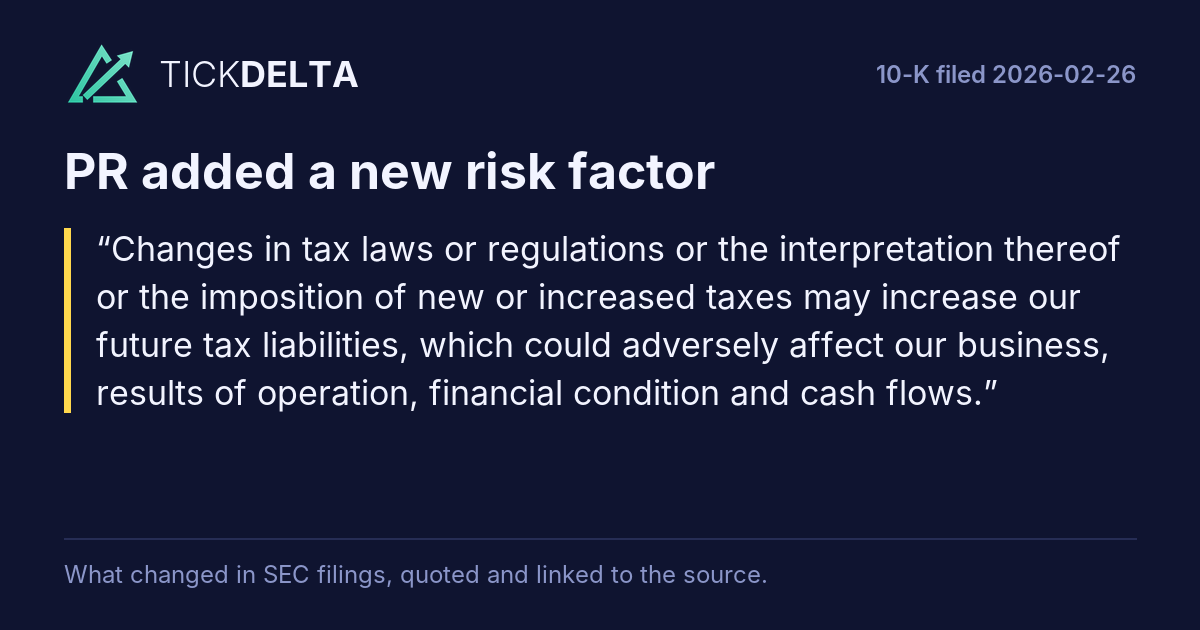
Changes in tax laws or regulations or the interpretation thereof or the imposition of new or increased taxes may increase our future tax liabilities, which could adversely affect our business, results of operation, financial condition and cash flows.
Paragraphs in the 10-Q filed Nov 5, 2026 that were not in the one before
New in the latest 10-Q
17 paragraphs in the 10-Q filed Nov 5, 2026 with nothing like
them in the 10-Q filed Aug 6, 2026 (at least half the words must differ; new numbers alone do not count).
Quoted exactly, grouped by the item heading above them. This is text that changed, not a judgement of how serious it is.
Financial statements and notes
Adjustments to reconcile net income to net cash provided by operating activities:
Read in the 10-Qopen_in_new
Net increase (decrease) in cash, cash equivalents and restricted cash (58,657) (367,538)
Read in the 10-Qopen_in_new
Nine Months Ended September 30, 2026 2025 ────────────────────────────────────────────────────────────────────────────────────────────────────────────────────────────────────────────────────────────────── Supplemental cash flow information Cash paid for interest $ 237,699 $ 264,326 Cash paid (refunded) for income taxes 5,066 (589) Supplemental non-cash activity Equity issued to redeem Convertible Senior Notes — 430,021 Accrued capital expenditures included in accounts payable and accrued expenses 373,748 272,662 Asset retirement obligations incurred and acquired, including revisions to estimates 23,527 12,955 Dividends payable 14,158 12,529
Read in the 10-Qopen_in_new
In August 2026, OpCo established a commercial paper program that permits the Company to issue unsecured, short-term promissory notes (“Commercial Paper”) up to a maximum aggregate principal amount of $ 2.0 billion outstanding at any time. The maturities of the Commercial Paper may vary but may not exceed 364 days from the date of issuance. Interest rates on the Commercial Paper are established at issuance in line with then-current conditions in the U.S. commercial paper market, with individual notes priced either at a discount to par or at par value.
Read in the 10-Qopen_in_new
The Credit Agreement and its $ 3.0 billion unsecured revolving capacity serve as a liquidity backstop for the Commercial Paper, and the Company intends to keep unused capacity under the Credit Agreement at least equal to its outstanding Commercial Paper. As of September 30, 2026, the Company had $ 393.0 million of Commercial Paper outstanding maturing in October 2026 with a weighted average interest rate of 4.4 %. The outstanding Commercial Paper is classified as Current debt on the Company’s consolidated balance sheets.
Read in the 10-Qopen_in_new
Show the other 12
Market risk
Natural gas basis differential swaps - Waha(1) October 2026 - December 2026 12,604,000 137,000 $(1.21)
Read in the 10-Qopen_in_new
Financial statements and notes
noncontrolling interest. Refer to the consolidated statements of shareholders’ equity for a summary of the activity attributable to the noncontrolling interest during the periods presented.
Read in the 10-Qopen_in_new
During the nine months ended September 30, 2025, the Company issued 30.6 million shares of Class A Common Stock in connection with the redemption of its 3.25 % senior unsecured convertible notes due 2028 (the “Convertible Senior Notes”).
Read in the 10-Qopen_in_new
In August 2026, we established a commercial paper program that permits us to issue unsecured, short-term promissory notes (“Commercial Paper”) up to a maximum aggregate principal amount of $2.0 billion outstanding at any time. Maturities of Commercial Paper are short-term in nature and interest rates are established at issuance in line with then-current conditions in the U.S. commercial paper market, with individual notes priced either at a discount to par or at par value. This program provides us with an additional source of short-term financing and generally allows us to borrow at lower interest rates than our revolving credit facility.
Read in the 10-Qopen_in_new
Three Months Ended September 30, 2026 Compared to Three Months Ended September 30, 2025
Read in the 10-Qopen_in_new
During the three months ended September 30, 2025, we recognized a $264.3 million loss on extinguishment of debt related to the redemption of our 3.25% senior unsecured convertible notes due 2028 (the “Convertible Senior Notes”). This loss was determined based on the difference between the value of our Class A Common Stock issued and cash paid for the redemption and the carrying amount of the Convertible Senior Notes less professional fees incurred in connection with the redemption. The 2025 loss was greater than other debt redemptions as the Convertible Senior Notes were redeemed mainly by issuing Class A Common Stock, which had risen significantly in value since the Convertible Senior Notes were issued in 2021.
Read in the 10-Qopen_in_new
Nine Months Ended September 30, 2026 Compared to Nine Months Ended September 30, 2025
Read in the 10-Qopen_in_new
Gain (Loss) on Extinguishment of Debt. During the nine months ended September 30, 2026, we recognized a $6.7 million gain on extinguishment of debt related to the redemptions of our 2027 Senior Notes and 2031 Senior Notes, which reflected the difference between the applicable redemption prices and the carrying value of the notes, including the associated unamortized debt premiums.
Read in the 10-Qopen_in_new
During the nine months ended September 30, 2025, we recognized a $270.1 million loss on extinguishment of debt primarily related to the redemption of our Convertible Senior Notes. This loss was determined based on the difference between the value of our Class A Common Stock issued and cash paid for the redemption and the carrying amount of the Convertible Senior Notes less professional fees incurred in connection with the redemption. The loss was greater than other debt redemptions as the Convertible Senior Notes were redeemed mainly by issuing Class A Common Stock, which had risen significantly in value since the Convertible Senior Notes were issued in 2021.
Read in the 10-Qopen_in_new
In August 2026, we established a commercial paper program that allows us to issue unsecured notes of up to 364 days, with up to $2.0 billion outstanding at any time. As of September 30, 2026, we had $393.0 million of Commercial Paper outstanding with a weighted average interest rate of 4.4%, all maturing in October 2026. The Credit Agreement serves as a liquidity backstop for the program.
Read in the 10-Qopen_in_new
Market risk
Natural gas basis differential swaps - Waha(1) October 2026 - December 2026 12,604,000 137,000 $(1.21)
Read in the 10-Qopen_in_new
Item 6
10.3#* Form of Restricted Stock Unit Agreement under the Permian Resources Corporation 2023 Long Term Incentive Plan.
Read in the 10-Qopen_in_new
The 10-Q's risk factors against the 10-K
Item 1A of the 10-Q filed Nov 5, 2026 against Item 1A of the 10-K filed Feb 26, 2026.
A 10-Q repeats only the risks that changed, so a 10-K paragraph that is missing from it is not counted as removed.
Added is a paragraph with nothing like it in the 10-K, Reworded a sentence that is in both with several words changed,
Quiet changes a sentence in both where one to four words changed and one is a hedge or a modal
(cut words struck through, new words highlighted).
Text on the page, not a score; each links to the filing at sec.gov.
Added10-Q Nov 5, 2026 vs 10-K Feb 26, 2026
In addition to the other information set forth in this Quarterly Report, you should carefully consider the risk factors and other cautionary statements described under the heading “Item 1A. Risk Factors” included in our 2025 Annual Report and the risk factors and other cautionary statements contained in our other SEC filings. Additional risks and uncertainties not currently known to us or that we currently deem to be immaterial also may materially adversely affect our business, financial condition or future results. There have been no material changes in our risk factors from those described in our 2025 Annual Report or our SEC filings.
Read it in the 10-Q at sec.govopen_in_new
Phrases used for the first time
Two-word phrases in Risk Factors of the 10-K filed Feb 26, 2026 that are in none of the 1 earlier 10-Ks stored, back to Feb 26, 2025
oil ngls ×17oil ngl ×7endangerment finding ×3trade restrictions ×2operational technology ×2compete effectively ×2presidential administrations ×2regulations concerning ×2increased taxes ×2tax liabilities ×2
Where each one is used
- oil ngls: Commodity prices are volatile, and a sustained period of low commodity prices for oil, NGLs and natural gas could adversely affect our business, financial condition and results of operations.
- oil ngl: Commodity prices are volatile, and a sustained period of low commodity prices for oil, NGLs and natural gas could adversely affect our business, financial condition and results of operations.
- endangerment finding: In response to findings that emissions of carbon dioxide, methane and other GHGs present an endangerment to public health and the environment, the EPA has adopted regulations pursuant to the CAA that, among other things, require PSD preconstruction and Title V operating permits for GHG emissions from certain large...
- trade restrictions: tariffs or other trade restrictions imposed by the United States on imported goods from countries where these goods are produced. We cannot predict whether these conditions will exist in the future and, if so, what their timing and duration will be. Such shortages or cost increases could delay or cause us to incur...
- operational technology: We are heavily dependent on our information and operational technology systems and other digital technologies.
- compete effectively: We may be unable to compete effectively with larger companies, which may adversely affect our results of operations and financial condition.
- presidential administrations: In response to findings that emissions of carbon dioxide, methane and other GHGs present an endangerment to public health and the environment, the EPA has adopted regulations pursuant to the CAA that, among other things, require PSD preconstruction and Title V operating permits for GHG emissions from certain large...
- regulations concerning: In response to findings that emissions of carbon dioxide, methane and other GHGs present an endangerment to public health and the environment, the EPA has adopted regulations pursuant to the CAA that, among other things, require PSD preconstruction and Title V operating permits for GHG emissions from certain large...
The 10-K at sec.govopen_in_new
Used at least twice, small words left out. Counted, not picked: a phrase can be new because the company renamed something.
In response to findings that emissions of carbon dioxide, methane and other GHGs present an endangerment to public health and the environment, the EPA has adopted regulations pursuant to the CAA that, among other things, require PSD preconstruction and Title V operating permits for GHG emissions from certain large stationary sources, mandate monitoring and annual reporting of GHG emissions, and impose new standards for reducing methane emissions from oil and gas operations by limiting venting and flaring and implementing leak detection and repair programs. The IRA also imposes the...
In the 10-K filed Feb 26, 2025open_in_new
Certain statements or initiatives with respect to ESG matters that we may pursue or assert are increasingly subject to heightened scrutiny from the public and governmental authorities, as well as other parties. For example, the SEC has recently taken enforcement action against companies for ESG-related misconduct, including alleged “greenwashing,” (i.e., the process of conveying misleading information or making false claims that overstate potential ESG benefits). Certain regulators, such as the SEC and various state agencies, as well as nongovernmental organizations and other private...
In the 10-K filed Feb 26, 2025open_in_new
In addition to administrative and policy risks, operations on federal lands also face litigation risks. Ongoing litigation related to the federal oil and gas leasing program may impact our federal oil and gas leases, which in turn could impact our results of operations. For example, a June 2022 settlement approved by a federal district court in Washington, D.C., obligated the BLM to redo its environment reports under NEPA for all oil and gas leases sold between 2015 and 2020, including leases in New Mexico. The settlement stemmed from a 2016 lawsuit alleging that the BLM was not properly...
In the 10-K filed Feb 26, 2025open_in_new
In addition, organizations that provide information to investors on corporate governance and related matters have developed ratings processes for evaluating companies on their approach to ESG matters. Such ratings are used by some investors to inform their investment and voting decisions. While such ratings do not impact all investors’ investment or voting decisions, unfavorable ESG ratings and recent activism directed at shifting funding away from companies with energy-related assets could lead to increased negative investor sentiment toward us and to the diversion of investment to other...
In the 10-K filed Feb 26, 2025open_in_new
Sources
Item 1A of each 10-K and 10-Q on EDGAR, quoted exactly. Each paragraph links to the filing at sec.gov.
Also
10-K change: what was reworded or cut, section by section.
Work with it
Excel workbook · CSV. Google Sheet that stays up to date: paste =IMPORTDATA("https://tickdelta.com/company/PR/export.csv") into a cell.