PERDOCEO EDUCATION Corp PRDO
New risk paragraphs, branching off last year
Each branch is a paragraph in Risk Factors with nothing like it in the 10-K filed Feb 18, 2025. A box jumps to the paragraph as filed, below.
Paragraphs with nothing like them in last year's 10-K
37 paragraphs in Risk Factors of the 10-K filed Feb 19, 2026 with nothing like them in the 10-K filed Feb 18, 2025. Quoted exactly. Paragraphs that were only edited are under 10-K change.
In July 2025, President Trump signed into law a reconciliation bill, H.R. 1 (P.L. 1119-21), sometimes referred to as the One Big Beautiful Bill Act (the “Reconciliation Act”), that made broad changes to many areas of federal spending. The Reconciliation Act includes a number of changes to federal student aid programs under the HEA, including eliminating Grad PLUS loans for new graduate and professional students, imposing new annual and lifetime borrowing limits across multiple loan programs, establishing an earnings-based accountability requirement for federal loans that applies equally to all higher education institutions, and adopting new loan repayment options. The changes generally take effect beginning July 1, 2026, and apply prospectively to new borrowers, however some of the changes require regulations to be promulgated by the Department.
Federal accountability regulations governing eligibility for Title IV student financial aid impose program-level accountability standards and disclosure obligations that could result in required warnings to students, limitations, or loss of federal aid eligibility, or required program closures. These requirements include: the existing Gainful Employment (“GE”) rule, which applies only to proprietary institutions and to certain non-degree programs at other institutions; a statutory earnings premium measure that applies to
all degree programs at all institutions; and a proposed revision to the GE rule that would apply the statutory earnings premium as the sole GE measure. Collectively, these requirements could materially and adversely affect programs offered by AIUS, CTU and USAHS, and our enrollments, revenues, operating results and growth prospects.
The Reconciliation Act established an earnings premium measure that applies to all degree programs at all institutions that participate in the Direct Loan Program. Through the Accountability in Higher Education and Access through Demand-driven Workforce Pell (“AHEAD”) rulemaking, the Department has proposed regulations to implement that statutory earnings premium measure and to harmonize the existing GE framework with that statutory earnings premium measure, including by eliminating the current debt-to-earnings metric. Under the proposal, covered programs at participating institutions would be evaluated under an earnings-premium measure that compares program-level median earnings to statutory benchmarks, rather than under the existing GE rule’s dual metrics applicable to proprietary institutions. Programs that repeatedly fail the statutory measure or the new GE requirements would lose eligibility to participate in the Direct Loan Program, but, unlike the current GE rule, this failure would not generally by itself terminate Pell Grant eligibility.
To implement the statutory approach, the Department’s proposal would: (i) eliminate the debt-to-earnings metric in the GE rule; (ii) establish earnings premium thresholds based on reference to statutory benchmarks; and (iii) narrow institutional reporting obligations to data needed to calculate the earnings-premium measure and produce required net-price disclosures. In addition, the proposal would shorten the period of ineligibility for programs that fail the earnings-premium measure from three years to two years and revise required student warning requirements to track statutory notice language. Finally, the Department would expand its administrative capability authority for institutions with persistent low-earning program outcomes. An institution would be deemed administratively incapable if, in two of three consecutive award years, at least half of its Title IV aid recipients or Title IV funds are tied to programs that fail applicable earnings thresholds, resulting in provisional certification and Title IV ineligibility for the affected programs.
These proposals have not yet been implemented through final regulations and may be revised, delayed or not adopted. We continue to evaluate the potential impact of the new earnings-premium requirement and to monitor the ongoing rulemaking process. Given the complexity of the statutory and regulatory framework, the absence of final implementing regulations, and limited visibility into the underlying earnings data used to calculate the applicable metrics, we are unable to predict the timing or ultimate impact of these requirements on our business. Any failure to comply with applicable accountability requirements, including the existing GE rule or a final earnings premium rule, or an expansion of accountability standards, disclosure obligations, or adverse program-level determinations, could result in limitations or loss of Title IV eligibility and materially and adversely affect our student enrollments, profitability, business viability, financial condition and results of operations.
Our institutions, like all proprietary institutions of higher education, are subject to the “90-10 Rule” under the HEA. Under this rule, a proprietary institution will be ineligible to participate in Title IV Programs for at least two fiscal years if, for any two consecutive fiscal years, it derives more than 90% of its cash basis revenue, as defined in the rule, from federal funds, including Title IV Program funds or other qualifying federal funding sources, including tuition assistance programs offered by the U.S. Department of Defense (military tuition assistance) and U.S. Department of Veterans Affairs (veterans education benefits).
We have limited ability to control the amount of Title IV Program funds, military or veteran education benefits, or other federal funds sought by or awarded to our students. Additionally, the lack of visibility into federal fund sources that students utilize, the timing of the identification of the federal fund sources applicable to the 90-10 Rule, and the lack of clarity regarding the definition of federal funds make it difficult to predict future compliance with the 90-10 Rule. Although we have implemented various measures intended to reduce the percentage of our institutions’ cash basis revenue attributable to federal funding sources, including efforts to
diversify the sources of our revenue, these measures may not be sufficient to ensure our compliance with the 90-10 Rule in the future. We may be required to modify our business operations, including reducing investments in prospective student outreach, recruitment, and enrollment growth in order to preserve Title IV eligibility for our existing students.
Show the other 9
Our business is subject to extensive federal, state, and accreditor regulatory requirements that change frequently, are subject to differing interpretations, and may be applied retroactively or differently over time. Regulatory interpretations may also shift as a result of changes in presidential administrations or agency leadership. As a result, compliance obligations applicable to our institutions may become more complex, burdensome, or costly, and may require material changes to our operations.
In recent years, the Department has adopted or revised numerous regulations affecting Title IV participation, including the Financial Value Transparency and Gainful Employment Rule, financial responsibility, administrative capability, the 90-10 Rule, distance education and certification regulations. Depending on the rule, these regulations became effective, or are scheduled to become effective, on July 1 of 2023, 2024 or 2026.
In July 2025, President Trump signed into law the Reconciliation Act, which made broad changes to federal spending, including significant amendments to federal student programs under the HEA. Among other things, the Act eliminates and replaces Grad PLUS loans for new graduate and professional students, imposes new annual and lifetime borrowing limits across multiple loan programs, establishing a new earnings-based eligibility requirement for federal student loans that applies equally to all higher education institutions, and adopts new loan repayment options. The changes generally take effect beginning July 1, 2026, and apply prospectively to new borrowers. Some of the changes are the subject of current rulemaking by the Department. For more information, see Item 1, “Business – Student Financial Aid and Related Federal Regulation” for more information on changes to federal student aid programs We anticipate that a number of other regulatory changes may be forthcoming. We have been operating with dramatic shifts in regulatory approaches across different presidential administrations, resulting in a significant number of regulations being adopted, subsequently rescinded, or revised, then re-adopted.
The HEA governs the federal government’s support of postsecondary education and requires periodic reauthorization by Congress, which last occurred in 2008. The reauthorization of the HEA historically has resulted in significant changes to program requirements and institutional participation in Title IV Programs. Additionally, funding levels for student financial assistance programs are determined annually through the appropriations process and may be affected by broader federal budgetary or policy priorities. See Item 1, “Business—Student Financial Aid and Related Federal Regulation—Legislative Action and Recent Department Regulatory Initiatives,” for more information about the reauthorization of the HEA.
burdens and operational complexity related to our business. See Item 1, “Business - Accreditation, State Regulation and Other Compliance Matters - State Regulation,” for more information about state regulation and SARA.
"Business - Student Financial Aid and Related Federal Regulation - Eligibility and Certification by the Department," for more information.
Recent changes to federal student loan programs that reduce annual, aggregate, and lifetime borrowing limits may limit students’ ability to finance their education and materially reduce enrollments.
The Reconciliation Act made significant changes to federal student loan programs under the HEA, including imposing new annual, aggregate, and lifetime borrowing limits across multiple loan programs and eliminating or restricting certain loan options previously available to graduate and professional students. Many of these changes are scheduled to take effect beginning July 1, 2026, and generally apply prospectively to new borrowers, subject to further implementation through Department regulations.
These changes may materially reduce the amount of Title IV Program loan funding available to students seeking to enroll in, continue, or complete their educational programs. Students who are unable to access sufficient federal loan funds may be required to rely more heavily on personal savings, private loans, employer assistance, or other sources of financing, which may be unavailable, more expensive, or less predictable. As a result, some prospective students may choose not to enroll, delay enrollment, enroll part-time, select shorter or lower-cost programs, or discontinue their studies before completion.
Reduced borrowing capacity may have a disproportionate impact on students enrolled in longer-duration, higher-cost, in-person or graduate-level programs, as well as on students with limited financial resources. In addition, uncertainty regarding the availability of federal loan funding, evolving regulatory guidance, or changes in borrower eligibility may negatively affect student decision-making and demand for our programs.
Any sustained reduction in students’ ability or willingness to finance their education through federal loan programs could materially reduce student enrollments, persistence and completion rates, increase price sensitivity, and adversely affect our revenue, operating results, and growth prospects. We cannot predict the extent to which these loan program changes, individually or in combination with other regulatory developments, will affect student behavior or our institutions’ enrollment trends.
See Item 1, "Business - Legislative Action and Recent Department Regulatory Initiatives – 2025 Negotiated Rulemakings,” for more information.
Elevated cohort default rates could result in operational restrictions or loss of Title IV eligibility and materially adversely affect our business.
Our institutions’ eligibility to participate in Title IV student financial aid programs is subject to cohort default rate (“CDR”) requirements, which measure the percentage of former students who default on federally funded student loans during a three-year measurement period after entering repayment. If an institution’s three-year CDR exceeds specified thresholds, it may be required to delay loan disbursements, implement default prevention measures, or, in more severe cases, lose eligibility to participate in Title IV Programs.
Federal student loan repayment was suspended for an extended period beginning in 2020, during which defaults could not occur, resulting in historically low cohort default rates for affected repayment cohorts. In September 2025, the Department released official three-year cohort default rates for the 2022 cohort, which were 0% for each of our academic institutions. However, repayment resumed in October 2023, accompanied by a temporary repayment “on-ramp,” evolving income-driven repayment options, and significant operational challenges affecting federal loan servicers, including borrower communication issues and limited outreach to delinquent borrowers. The combined effects of the resumption of repayment, servicer disruptions, changes to repayment plans, litigation affecting repayment options, and borrower behavior following extended relief periods create uncertainty regarding future repayment performance. The Department has cautioned that default rates across the higher education sector may increase as temporary relief measures expire, and recent data indicate that repayment performance for loans re-entering repayment has been weaker than historical norms.
As a result, our cohort default rates beginning with the 2024 cohort may increase significantly from historically low levels until repayment behavior and servicing conditions stabilize. Any sustained increase in cohort default rates could subject our institutions to additional oversight, operational restrictions, or loss of Title IV eligibility and could materially and adversely affect our student enrollments, financial condition, results of operations, and business prospects.
claims, or actions are unfavorable to us, we may be required to pay monetary damages or be subject to fines, operational limitations, loss of federal funding, injunctions, undertakings, additional oversight, and reporting, or other civil or criminal penalties.
A portion of our student population relies on education-related benefits provided through employer-sponsored tuition assistance programs and programs administered for military members and veterans, including benefits offered through the U.S. Department of Defense and the U.S. Department of Veterans Affairs. Participation in these programs is subject to separate eligibility requirements, oversight, and compliance obligations that are distinct from, and in some cases in addition to, the requirements applicable to Title IV student financial aid programs.
If our institutions were to lose eligibility, experience delays in approval, or become subject to limitations or adverse determinations affecting participation in any employer-sponsored, military, or veterans’ education benefit programs, students’ ability to utilize these benefits could be reduced or eliminated. Such outcomes could result from regulatory changes, compliance findings, changes in program policies, or determinations by the administering agencies. Any reduction in access to these benefits could materially reduce student enrollments and revenue and adversely affect our operating results. In addition, adverse determinations, or heightened oversight in connection with these programs could result in increased compliance costs, operational restrictions, reputational harm, or other adverse consequences for our business.
Our use of artificial intelligence may subject us to increased compliance obligations and legal risk.
We use and are working to further incorporate AI technologies into our operations to increase efficiencies. We expect our use of AI to help reach prospective students, grow our business and benefit our current students, but it is not certain that we will realize our desired or anticipated benefits. The rise of, and strict adherence to, robocall mitigation regulations and consumer-driven call-blocking technology has severely impacted legitimate outreach, resulting in high rates of legitimate calls being flagged as "Spam Risk" or "Scam Likely." These, along with required, explicit, and often mandatory disclosures, significantly reduce the ability of our academic institutions to connect with prospective students. Call-blocking apps and carrier-level filters that block or label "Spam Risk," "Scam
Likely," or "Telemarketer," make call recipients significantly less likely to answer, even if they are expecting a call. These technologies may adversely impact our ability to engage with prospective students, which would have a material adverse effect on our ability to grow our business, our results of operations and financial condition.
The presence of AI increases our legal risk due to the increasing scope of AI regulation in various jurisdictions as AI regulation is a top focus of regulators in the United States and abroad. Compliance with these AI regulations increases our cost of compliance and may result in legal exposure in the event of noncompliance. Additionally, our development, training and use of AI may require additional investments and/or increase the cost of our offerings, which could impact our financial condition. Furthermore, the use of AI may result in incidents that compromise the confidentiality of data (including personal data). Any such incidents related to our use of AI could harm our business, financial condition and reputation. AI also raises ethical issues and, if our use of AI becomes controversial, we may be subjected to brand or reputational harm.
The complexity of many AI models makes it challenging to understand why they are generating particular outputs. This limited transparency increases the challenges associated with assessing the proper operation of AI models, understanding and monitoring the capabilities of AI models, reducing erroneous output, eliminating bias and complying with regulations that require documentation or explanation of the basis on which decisions are made.
In addition, as AI becomes increasingly prevalent in our operations, we will have increased risk of disputes over the ownership or use of AI-generated content, as well as the risk of inadvertently infringing on third-party intellectual property rights. The intellectual property landscape for AI is evolving, and new laws, regulations or interpretations may create further uncertainty or increase the likelihood of such claims. If such claims arise, they could result in costly litigation, licensing fees, or limitations on our ability to use certain AI technologies, any of which could adversely affect our business, financial condition and results of operations. Furthermore, if the content, analyses or recommendations that AI applications assist in producing are or are alleged to be deficient, inaccurate, or biased, or infringe third-party intellectual property rights, we may be subject to private lawsuits, regulatory scrutiny or reputational harm, and our business and financial condition may be adversely affected.
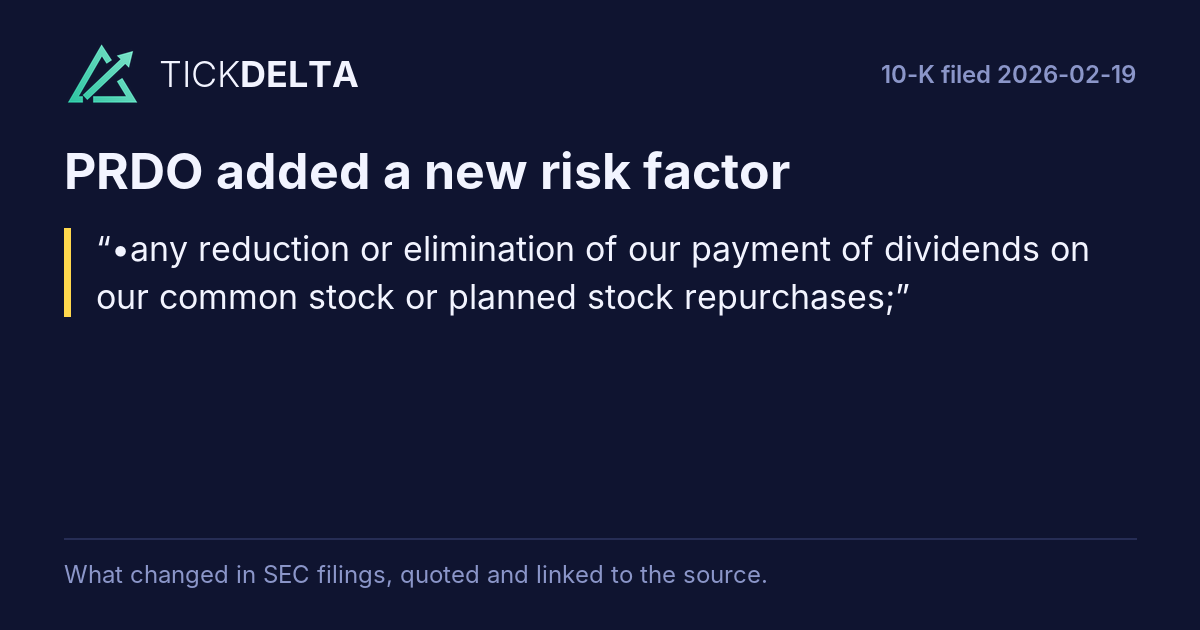
•any reduction or elimination of our payment of dividends on our common stock or planned stock repurchases;
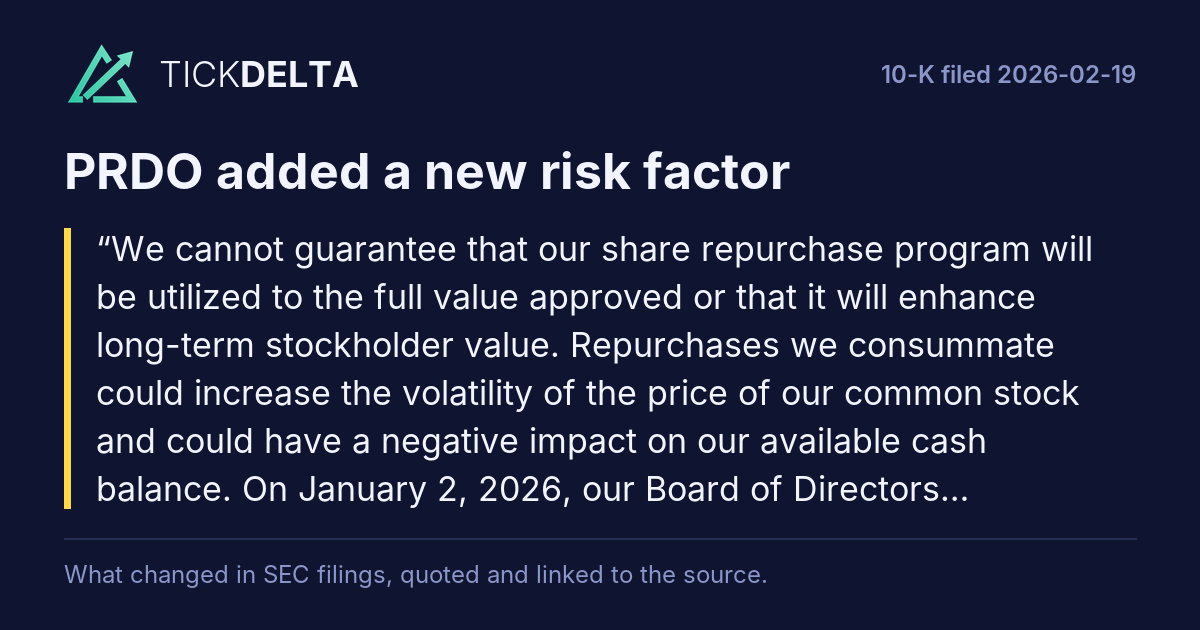
We cannot guarantee that our share repurchase program will be utilized to the full value approved or that it will enhance long-term stockholder value. Repurchases we consummate could increase the volatility of the price of our common stock and could have a negative impact on our available cash balance.
On January 2, 2026, our Board of Directors authorized a share repurchase program pursuant to which we may repurchase up to $100.0 million of our common stock through June 30, 2027. As of February 19, 2026, no repurchases have been made under this share repurchase program. The manner, timing, and amount of any share repurchases may fluctuate and will be determined by us based on a variety of factors, including the market price of our common stock, our priorities for the use of cash to support our business operations and plans, general business and market conditions, tax laws, and alternative investment opportunities. The share repurchase program authorization does not obligate us to acquire any specific number or dollar value of shares. Further, our share repurchases could have an impact on our share trading prices, increase the volatility of the price of our common stock, or reduce our available cash balance. Our share repurchase program may be modified, suspended, or terminated at any time, which may result in a decrease in the trading price of our common stock. Even if our share repurchase program is fully implemented, it may not enhance long-term stockholder value.
Paragraphs in the 10-Q filed Nov 5, 2026 that were not in the one before
New in the latest 10-Q
10 paragraphs in the 10-Q filed Nov 5, 2026 with nothing like them in the 10-Q filed Aug 6, 2026 (at least half the words must differ; new numbers alone do not count). Quoted exactly, grouped by the item heading above them. This is text that changed, not a judgement of how serious it is.
10-Q
CASH, CASH EQUIVALENTS AND RESTRICTED CASH, beginning of the period 132,280 131,753
Read in the 10-Q
CASH, CASH EQUIVALENTS AND RESTRICTED CASH, end of the period $ 188,850 $ 180,779
Read in the 10-Q
8. PENDING BUSINESS ACQUISITION Agreement to acquire South University On September 14, 2026, Perdoceo Education Corporation signed a definitive agreement (the “Purchase Agreement”) to acquire 100% of the membership interests of South University Savannah, LLC ("South" or "South University"). The Company expects to complete the acquisition as early as April 2027, subject to satisfaction of conditions contained in the Purchase Agreement, including, among others, (a) receipt of certain third party consents, including from applicable educational regulatory agencies, (b) expiration or termination of any applicable waiting period under the Hart-Scott-Rodino Antitrust Improvements Act of 1976, (c) the absence of injunctions or other legal restraints prohibiting the transactions contemplated by the Purchase Agreement, (d) the accuracy of the parties’ respective representations and warranties in the Purchase Agreement and (e) compliance by the parties with their respective pre-closing covenants in the Purchase Agreement. Under the terms of the Purchase Agreement, the initial cash payment of $150 million due on the closing date of the transaction will be subject to adjustment for cash, net working capital, and certain agreed upon debt-like items, in each case based on South’s balance sheet as of the beginning of April 2027, and indebtedness and seller transaction expenses outstanding at closing. The Company is also expected to pay: (i) an additional $18 million in deferred cash consideration paid out in installments over 24 months following closing of the transaction; and (ii) dependent upon achievement of certain milestones, up to $56 million in earn-out cash payments tied to specified EBITDA thresholds for fiscal years 2027, 2028 and 2029. The purchase price and the deferred consideration and earn-out payments, if any, are expected to be funded fully using the Company’s available cash balances.
Read in the 10-Q
The foregoing description of the Purchase Agreement and the transactions contemplated thereby does not purport to be complete, and is qualified in its entirety by, the full text of the Purchase Agreement, a copy of which was filed as an exhibit to the Company’s Form 8-K, filed on September 14, 2026. Please refer to that Form 8-K for additional information, including other material terms and conditions related to the pending acquisition.
Read in the 10-Q
We receive from time-to-time requests from state attorneys general, federal and state government agencies and accreditors relating to our institutions, to specific complaints they have received from students or former students or to student loan forgiveness
Read in the 10-Q
Show the other 5
University of St. Augustine for Health Sciences (USAHS) is dedicated to offering graduate education opportunities in health sciences to a diverse range of students. USAHS focuses on developing professional healthcare practitioners through innovative and personalized classroom, clinical, and distance education opportunities. USAHS offers graduate degrees in health sciences, primarily in physical therapy, occupational therapy, speech-language therapy and nursing, along with continuing education programs and prepares professionals to serve and provide quality medical care to communities across the country. Students pursue their degrees through a network of campuses and through its online programs. As of September 30, 2026, students enrolled at USAHS represented approximately 10% of our total enrollments.
Read in the 10-Q
We evaluate segment performance based on operating results. Specifically, our CODM analyzes segment revenue and operating expenses which are directly attributable to the cost to serve and educate prospective students, when making decisions to allocate resources based on segment performance. Adjustments to reconcile segment results to consolidated results are included under the caption “Corporate and Other,” which primarily includes unallocated corporate activity. Substantially all revenue earned by our reporting segments are generated in the United States of America (“U.S.”) and segment and total assets are substantially held in the
Read in the 10-Q
For the Quarter Ended September 30, For the Year to Date Ended September 30, 2026 % of 2025 % of 2026 vs 2025 % Change 2026 % of 2025 % of 2026 vs 2025 % Change
Read in the 10-Q
Lease liabilities - finance: The decrease is primarily due to scheduled payments on finance leases nearing the end of their lease terms.
Read in the 10-Q
Accumulated other comprehensive (loss) income: The change in accumulated other comprehensive (loss) income is primarily due to an increase in unrealized losses for short-term available-for-sale-investments.
Read in the 10-Q
The 10-Q's risk factors against the 10-K
Item 1A of the 10-Q filed Nov 5, 2026 against Item 1A of the 10-K filed Feb 19, 2026.
A 10-Q repeats only the risks that changed, so a 10-K paragraph that is missing from it is not counted as removed.
Added is a paragraph with nothing like it in the 10-K, Reworded a sentence that is in both with several words changed,
Quiet changes a sentence in both where one to four words changed and one is a hedge or a modal
(cut words struck through, new words highlighted).
Text on the page, not a score; each links to the filing at sec.gov.
What the 10-Q itself says about its risk factors:In addition to the information set forth in this Quarterly Report on Form 10-Q, the reader should carefully consider the factors discussed in Part I, Item 1A “Risk Factors,” in the Company’s Annual Report on Form 10-K for the year ended December 31, 2025, which was filed with the Securities and Exchange Commission on February 19, 2026.
Read in the 10-Q
1 paragraph in the 10-Q's Item 1A, and none of them adds, rewords or quietly edits a paragraph of the 10-K's.
Phrases used for the first time
Two-word phrases in Risk Factors of the 10-K filed Feb 19, 2026 that are in none of the 1 earlier 10-Ks stored, back to Feb 18, 2025
Where each one is used
- loan programs: In July 2025, President Trump signed into law a reconciliation bill, H.R. 1 (P.L. 1119-21), sometimes referred to as the One Big Beautiful Bill Act (the “Reconciliation Act”), that made broad changes to many areas of federal spending. The Reconciliation Act includes a number of changes to federal student aid...
- cohort default: Elevated cohort default rates could result in operational restrictions or loss of Title IV eligibility and materially adversely affect our business.
- default rates: Elevated cohort default rates could result in operational restrictions or loss of Title IV eligibility and materially adversely affect our business.
- reconciliation act: In July 2025, President Trump signed into law a reconciliation bill, H.R. 1 (P.L. 1119-21), sometimes referred to as the One Big Beautiful Bill Act (the “Reconciliation Act”), that made broad changes to many areas of federal spending. The Reconciliation Act includes a number of changes to federal student aid...
- share repurchase: We cannot guarantee that our share repurchase program will be utilized to the full value approved or that it will enhance long-term stockholder value. Repurchases we consummate could increase the volatility of the price of our common stock and could have a negative impact on our available cash balance.
- repurchase program: We cannot guarantee that our share repurchase program will be utilized to the full value approved or that it will enhance long-term stockholder value. Repurchases we consummate could increase the volatility of the price of our common stock and could have a negative impact on our available cash balance.
- student aid: In July 2025, President Trump signed into law a reconciliation bill, H.R. 1 (P.L. 1119-21), sometimes referred to as the One Big Beautiful Bill Act (the “Reconciliation Act”), that made broad changes to many areas of federal spending. The Reconciliation Act includes a number of changes to federal student aid...
- lifetime borrowing: In July 2025, President Trump signed into law a reconciliation bill, H.R. 1 (P.L. 1119-21), sometimes referred to as the One Big Beautiful Bill Act (the “Reconciliation Act”), that made broad changes to many areas of federal spending. The Reconciliation Act includes a number of changes to federal student aid...
Used at least twice, small words left out. Counted, not picked: a phrase can be new because the company renamed something.
What was taken out
10 paragraphs of last year's Risk Factors with nothing like them now. The longest are quoted.
Sources
Item 1A of each 10-K and 10-Q on EDGAR, quoted exactly. Each paragraph links to the filing at sec.gov.
Also
10-K change: what was reworded or cut, section by section.
Work with it
Excel workbook · CSV. Google Sheet that stays up to date: paste =IMPORTDATA("https://tickdelta.com/company/PRDO/export.csv") into a cell.