Paragraph 7 · 47% changed
Every version of it
Screener
/
SEC EDGAR
/CIK 0001046568
/10-K filed Feb 19, 2026, compared with Feb 18, 2025
/Numbers from the XBRL of the 10-Ks
Nasdaq
Consumer discretionary · Educational Services
PERDOCEO EDUCATION Corp PRDO
The 10-K against last year's
192 changes: 53 added, 25 removed, 111 reworded, 3 quiet changes
10-K Feb 19, 2026 vs Feb 18, 2025
Risk Factors
30.1%
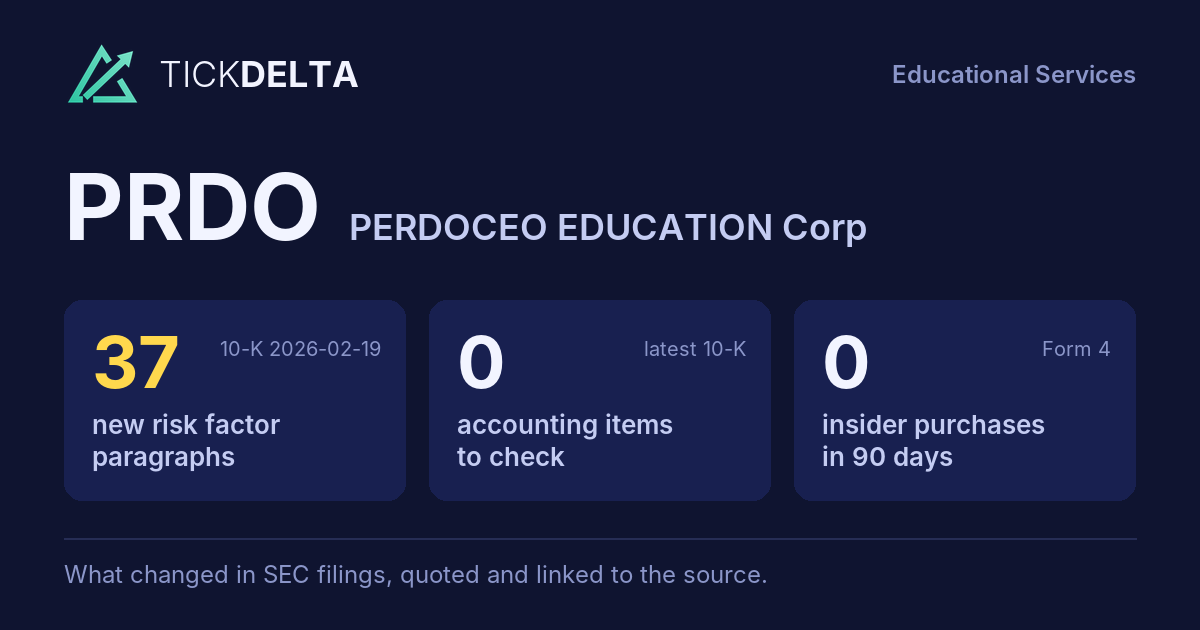
of the text changed · 13,410 words now · 37 new paragraphs, 10 gone
MD&A
38.1%
of the text changed · 6,674 words now · 16 new paragraphs, 15 gone
Legal Proceedings
32.7%
of the text changed · 1,031 words now
10-K 0001193125-26-059331 (Feb 19, 2026) vs 10-K 0000950170-25-022187 (Feb 18, 2025) Not compared: Accounting Policies.
Every paragraph, and how much of it changed
One bar per paragraph, in the order of the 10-K. Height and colour show the share of its words not in the closest paragraph a year earlier; the tallest bars are new paragraphs.
Risk Factors
155 paragraphs · 37 new · 87 reworded · 10 gone · 10-K Feb 19, 2026 against Feb 18, 2025
New paragraph
Reworded (5% of its words or more)
Same or nearly
Paragraph 95 · 47% changed
Every version of it
Paragraph 20 · 44% changed
Every version of it
Paragraph 87 · 41% changed
Every version of it
Some of our competitors are more widely known and are perceived to have more established reputations than our institutions. In addition, some of our competitors are subject to fewer regulatory burdens on enrollment and financial aid processes, which may enable them to compete more effectively for potential students. In particular, several of our publicly traded for-profit competitors have converted or are attempting to convert to a structure where a for-profit service company provides services to a non-profit educational institution, which reduces the impact of certain regulations on their operations, such as the 90-10 Rule and GE.
Paragraph 13 · 40% changed
Every version of it
Paragraph 40 · 40% changed
Every version of it
We cannot predict the impact various effect that current or future borrower defense to repayment and loan discharge regulations will have on student enrollments, the volume of claims submitted by borrowers for loan discharge (including closed school discharge), discharge claims), the number or amount of claims for loan discharge the Department approves, the amount of discharged loans extent to which the Department asserts we have repayment liability for, may seek to recover discharged loan amounts from us, our future financial responsibility as determined by the Department, or any sanctions sanctions, conditions, or other enforcement actions that may be taken or imposed by the Department might take against our institutions based on loans discharged, all including any requirement to post a letter of which credit. Any such developments could be require significant cash outlays, increase compliance costs, constrain capital resources, and materially adverse to and adversely affect our business. business, financial condition, results of operations, and future growth.
Paragraph 39 · 39% changed
Every version of it
Paragraph 42 · 39% changed
Every version of it
Paragraph 7 · 47% changed
Every version of it
10-K Feb 18, 2025See Item 1, “Business – Student Financial Aid and Related Federal Regulation – Compliance with Federal Regulatory Standards and Effect of Federal Regulatory Violations - ‘90-10 Rule,'” for more information about the 90-10 Rule and the measures we have implemented to improve our compliance.
10-K Feb 19, 2026
For more information, see Item 1, “Business – Student Financial Aid and Related Federal Regulation” for more information on changes to federal student aid programs.
Paragraph 95 · 47% changed
Every version of it
10-K Feb 18, 2025Additionally, levels of U.S. federal government spending are difficult to predict and subject to significant risk. Considerable uncertainty exists regarding how future budget and program decisions will unfold, including the spending priorities of the new U.S. presidential administration and Congress and what challenges budget reductions will present for us and our industry generally. For example, the Department of Government Efficiency (“DOGE”) was announced to reform federal government processes and reduce expenditures. The Office of Management and Budget (“OMB”) published Memorandum M-25-13 on January 29, 2025 which temporarily paused all activities related to obligation or disbursement of all federal financial assistance. The Executive Order did not impact funds provided to individual students, such as Federal Pell Grants and Direct Loans. While Memorandum M-25-13 was rescinded on February 3, 2025 following litigation challenging it, the administration has stated that it still pursuing a spending freeze. We are unable to predict if there will be budget reduction initiatives that would impact student federal financial assistance available to our students and, if so, the extent of those reductions.
10-K Feb 19, 2026
In July 2025, Congress passed, and President Trump signed into law the Reconciliation Act, which that made broad changes to many areas of federal spending. The Act includes a number of changes to federal student aid programs under the HEA, including eliminating and replacing Grad PLUS loans for new graduate and professional students, imposing new annual and lifetime borrowing limits across multiple loan programs, establishing an earnings-based eligibility requirement for federal loans that applies equally to all higher education institutions, and adopting new loan repayment options. The changes generally take effect beginning July 1, 2026, and apply prospectively to new borrowers. See Item 1, “Business – Student Financial Aid and Related Federal Regulation” for more information on changes to federal student aid programs. Levels of U.S. federal government spending are difficult to predict and subject to significant risk. Considerable uncertainty exists regarding how future budget and program decisions will unfold, including the spending priorities of the presidential administration and Congress and what challenges budget reductions will present for us and our industry generally. We are unable to predict if there will be additional budget reduction initiatives that would impact student federal financial assistance available to our students and, if so, the extent of those reductions.
Paragraph 20 · 44% changed
Every version of it
10-K Feb 18, 2025Under revised regulations effective for calendar year 2023, any of our institutions may lose eligibility to participate in Title IV Programs if, on modified cash basis accounting, the percentage of the cash receipts derived from federal funding programs for two consecutive fiscal years is greater than 90%. The Department specified the sources of federal funding to be included in the 90-10 Rule in mid-December 2022, well after a substantial majority of students for the upcoming 2023 calendar year, a majority of those students which were in the process of continuing through their program, had already enrolled and elected financing for upcoming classes. Federal funding now includes tuition assistance under the Title IV program as well as tuition assistance benefits provided to members of the military and veterans as well as a significant number of other federal programs supporting higher education and training. Under this modified 90-10 Rule, an institution that derives more than 90% of its cash receipts from federal funding sources for any fiscal year will be placed on provisional participation status for its next two fiscal years and is required to issue notices to existing students about the potential loss of Title IV funding. The issuance of any required notice could deter prospective students from enrolling at our institutions and current students from continuing in their programs. We have substantially no control over the amount of Title IV student loans and grants, military or veteran education benefits, or other federal education assistance funds sought by or awarded to our students and given the significant existing student populations at our institutions when these rules were adopted, the 90-10 Rule operates retroactively to capture the significant federal funding those students were already utilizing and entitled to.
10-K Feb 19, 2026
An institution that derives more than 90% of its cash receipts from qualifying federal funding sources for any fiscal year will be placed on provisional participation status for its next two fiscal years and must provide notices to existing students about the potential loss of Title IV funding. If the institution violates the 90-10 Rule for two consecutive fiscal years and becomes ineligible to participate in Title IV Programs, but continues to disburse Title IV Program funds, the Department would require the repayment of all Title IV Program funds received by it after the effective date of the loss of eligibility. The issuance of any required notice could deter prospective students from enrolling at our institutions and current students from continuing in their programs.
Paragraph 87 · 41% changed
Every version of it
10-K Feb 18, 2025
Some of our competitors are more widely known and have more established reputations than our institutions. In addition, some of our competitors are subject to fewer regulatory burdens on enrollment and financial aid processes, which may enable them to compete more effectively for potential students. In particular, several of our publicly traded for-profit competitors have converted or are attempting to convert to a structure where a for-profit service company provides services to a non-profit educational institution, which reduces the impact of certain regulations on their operations, such as the 90-10 Rule and GE.
10-K Feb 19, 2026
Some of our competitors are more widely known and are perceived to have more established reputations than our institutions. In addition, some of our competitors are subject to fewer regulatory burdens on enrollment and financial aid processes, which may
Paragraph 13 · 40% changed
Every version of it
10-K Feb 18, 2025See Item 1, “Business – Student Financial Aid and Related Federal Regulation – Compliance with Federal Regulatory Standards and Effect of Federal Regulatory Violations - ‘90-10 Rule,'” for more information about the 90-10 Rule and the measures we have implemented to improve our compliance.
10-K Feb 19, 2026
For a discussion of the Department’s October 2023 GE and Financial Value Transparency (“FVT”) regulations, see Item 1, “Business - Student Financial Aid and Related Federal Regulation - Compliance with Federal Regulatory Standards and Effect of Federal Regulatory Violations - Gainful Employment and Financial Value Transparency.”
Paragraph 40 · 40% changed
Every version of it
10-K Feb 18, 2025
We cannot predict the impact various defense to repayment regulations will have on student enrollments, the volume of claims for loan discharge (including closed school discharge), the amount of claims for loan discharge the Department approves, the amount of discharged loans the Department asserts we have repayment liability for, our future financial responsibility as determined by the Department, or any sanctions or other actions the Department might take against our institutions based on loans discharged, all of which could be materially adverse to our business.
10-K Feb 19, 2026
We cannot predict the effect that current or future borrower defense and loan discharge regulations will have on student enrollments, the volume of claims submitted by borrowers for loan discharge (including closed school discharge claims), the number or amount of claims for loan discharge the Department approves, the extent to which the Department may seek to recover discharged loan amounts from us, our future financial responsibility as determined by the Department, or any sanctions, conditions, or enforcement actions that may be taken or imposed by the Department against our institutions based on loans discharged, including any requirement to post a letter of credit. Any such developments could require significant cash outlays, increase compliance costs, constrain capital resources, and materially and adversely affect our business, financial condition, results of operations, and future growth.
Paragraph 39 · 39% changed
Every version of it
10-K Feb 18, 2025“Borrower defense to repayment” regulations, including closed school loan discharges, may subject us to significant repayment liability to the Department for discharged federal student loans and posting of substantial letters of credit that may limit our ability to make investments in our business which could negatively impact our future growth.
10-K Feb 19, 2026
Federal “borrower defense to repayment” regulations, including closed school loan discharge provisions, permit the discharge of certain federal student loans under specified circumstances and may result in the assertion of repayment liability against institutions for discharged amounts. In addition, these regulations may require institutions to post letters of credit or other forms of financial protection, which could restrict liquidity and limit our ability to make investments in our business.
Paragraph 42 · 39% changed
Every version of it
10-K Feb 18, 2025An institution must be accredited by an accrediting agency recognized by the Department in order to participate in Title IV Programs. See Item 1, “Business – Accreditation, Jurisdictional Authorizations and Other Compliance Matters – Institutional Accreditation.” The failure to comply with accreditation standards subjects an institution to additional oversight and reporting requirements, accreditation proceedings such as a show-cause directive, an action to defer or deny action related to an institution's application for a new grant of accreditation, an action to suspend an institution's accreditation or a program's approval, or other negative actions. Future inquiries or actions by state or federal agencies could negatively impact our accreditation status. If our institutions or programs are subject to accreditation actions or are placed on probationary or other negative accreditation status, we may experience adverse publicity, impaired ability to attract and retain students and substantial expense to obtain unqualified accreditation status. The inability to obtain reaccreditation following periodic reviews or any final loss of institutional accreditation after exhaustion of the administrative agency processes would result in a loss of Title IV Program funds for the affected institution and its students. In addition, if an accrediting body of our institutions loses recognition by the Department, that institution could lose its ability to participate in Title IV Programs. See Item 1, "Business - Student Financial Aid and Related Federal Regulation - Eligibility and Certification by the Department," for more information.
10-K Feb 19, 2026
Our institutions must maintain institutional accreditation from an accrediting agency recognized by the Department in order to participate in Title IV Programs. See Item 1, “Business – Accreditation, Jurisdictional Authorizations and Other Compliance Matters – Institutional Accreditation.” Failure to comply with applicable accreditation standards may subject an institution to additional oversight and reporting requirements, adverse accreditation actions, including show-cause directives, probation, deferral or denial of accreditation actions, suspension or loss of an institution's accreditation or a program's approval, or other negative actions. Future inquiries or actions by state or federal agencies could negatively impact our accreditation status.
MD&A
102 paragraphs · 16 new · 52 reworded · 15 gone · 10-K Feb 19, 2026 against Feb 18, 2025
New paragraph
Reworded (5% of its words or more)
Same or nearly
Paragraph 40 · 49% changed
Paragraph 20 · 48% changed
Paragraph 52 · 48% changed
USAHS. Revenue for the current year was approximately $10.0 million starting from the acquisition date of December 2, 2024. USAHS reported an $157.6 million, with operating loss income of approximately $2.6 million $3.2 million. Operating income for the fourth quarter partially driven by current year includes $30.3 million of depreciation and amortization expense associated with acquired tangible and intangible assets. assets, as well as finance leases, as compared to $2.5 million in the prior year.
Paragraph 50 · 47% changed
AIUS. Revenue for the current year decreased slightly by 11.1% 0.4% or $26.8 $0.9 million as compared to the prior year. This decline was driven by a lag impact through the first three quarters of 2024 from the operational changes made during the latter half of 2023. AIUS' total Total student enrollments increased by 11.8% as of 11.2% at December 31, 2024 2025 as compared to December 31, 2023. This increase was primarily 2024 due to an extra session start in December 2025, which will positively impact revenue into 2026. The slight decrease in revenue is driven by Trident University, as the return to normalized operating levels starting in late 2023, which contributed to increasing student enrollments throughout 2024. recent government shutdown disparately impacted this institution.
Paragraph 48 · 46% changed
Paragraph 32 · 46% changed
Paragraph 30 · 45% changed
Educational services and facilities expense for the current year decreased increased by 7.3% 63.4% or $9.5 $76.7 million as compared to the prior year, supported by improvements in both academics and student year. The increase was primarily due to a full year of expenses related costs and occupancy expenses, to the USAHS acquisition as compared to only one month of such expenses in the prior year. Excluding the impact of USAHS, expenses increased slightly, primarily driven by increased academic expenses at CTU to support the growth in total student enrollments.
Paragraph 68 · 44% changed
Paragraph 40 · 49% changed
10-K Feb 18, 2025Admissions expense decreased by 10.5% or $9.6 million as compared to the prior year. The current year improvement was primarily driven by decreased expenses within both CTU and AIUS as a result of operational changes made during the prior year.
10-K Feb 19, 2026
Depreciation and amortization expense increased by 184.2% or $27.0 million as compared to the prior year. This increase was primarily driven by amortization associated with intangible assets at USAHS as well as increased depreciation expense for assets within USAHS, including a failed sale lease-back transaction.
Paragraph 20 · 48% changed
10-K Feb 18, 2025AIUS. Revenue for the current year decreased by 11.1% or $26.8 million as compared to the prior year. This decline was driven by a lag impact through the first three quarters of 2024 from the operational changes made during the latter half of 2023. AIUS' total student enrollments increased by 11.8% as of December 31, 2024 as compared to December 31, 2023. This increase was primarily driven by the return to normalized operating levels starting in late 2023, which contributed to increasing student enrollments throughout 2024.
10-K Feb 19, 2026
Revenue for the current year increased by 24.2% or $164.8 million as compared to the prior year, primarily due to an increase of $147.5 million of revenue from the USAHS acquisition which was completed in December 2024 and therefore did not have comparable results in the prior year. CTU also contributed to the increase in revenue due to growth in total student enrollments driven by strong student retention and engagement trends along with increased prospective student interest, while AIUS remained relatively flat as compared to the prior year.
Paragraph 52 · 48% changed
10-K Feb 18, 2025
USAHS. Revenue for the current year was approximately $10.0 million starting from the acquisition date of December 2, 2024. USAHS reported an operating loss of approximately $2.6 million for the fourth quarter partially driven by amortization expense associated with acquired intangible assets.
10-K Feb 19, 2026
USAHS. Revenue for the current year was approximately $157.6 million, with operating income of approximately $3.2 million. Operating income for the current year includes $30.3 million of depreciation and amortization expense associated with acquired tangible and intangible assets, as well as finance leases, as compared to $2.5 million in the prior year.
Paragraph 50 · 47% changed
10-K Feb 18, 2025
AIUS. Revenue for the current year decreased by 11.1% or $26.8 million as compared to the prior year. This decline was driven by a lag impact through the first three quarters of 2024 from the operational changes made during the latter half of 2023. AIUS' total student enrollments increased by 11.8% as of December 31, 2024 as compared to December 31, 2023. This increase was primarily driven by the return to normalized operating levels starting in late 2023, which contributed to increasing student enrollments throughout 2024.
10-K Feb 19, 2026
AIUS. Revenue for the current year decreased slightly by 0.4% or $0.9 million as compared to the prior year. Total student enrollments increased by 11.2% at December 31, 2025 as compared to December 31, 2024 due to an extra session start in December 2025, which will positively impact revenue into 2026. The slight decrease in revenue is driven by Trident University, as the recent government shutdown disparately impacted this institution.
Paragraph 48 · 46% changed
10-K Feb 18, 2025Total student enrollments increased 20.0% at December 31, 2024 as compared to December 31, 2023, with both CTU and AIUS contributing to this increase, along with the USAHS acquisition. CTU's total student enrollments increased 8.1% as compared to the prior year end, driven by student enrollment growth within our corporate engagement programs as well as continued improvement in prospective student interest levels, student retention and student engagement. Total student enrollments increased 11.8% at AIUS for the current year end as compared to the prior year end as AIUS' total student enrollment comparability had continued to improve through the current year since reverting to normalized levels of operations at the end of 2023.
10-K Feb 19, 2026
CTU. Revenue for the current year increased by 4.1% or $18.2 million as compared to the prior year. The increase was driven by total student enrollment growth of 6.6% at December 31, 2025 as compared to December 31, 2024. CTU's total student enrollment growth was supported by high levels of student retention and engagement, growth in the corporate student program and higher levels of prospective student interest.
Paragraph 32 · 46% changed
10-K Feb 18, 2025Admissions expense decreased by 10.5% or $9.6 million as compared to the prior year. The current year improvement was primarily driven by decreased expenses within both CTU and AIUS as a result of operational changes made during the prior year.
10-K Feb 19, 2026
The general and administrative expense for the current year increased by 12.0% or $43.9 million as compared to the prior year. The increase was primarily due to a full year of expenses related to the USAHS acquisition as compared to only one month of such expenses in the prior year. Excluding the impact of USAHS, expenses increased by 1.3% or $4.9 million, primarily driven by higher expenses at CTU to support the growth in total student enrollments for the current year as compared to the prior year.
Paragraph 30 · 45% changed
10-K Feb 18, 2025
Educational services and facilities expense for the current year decreased by 7.3% or $9.5 million as compared to the prior year, supported by improvements in both academics and student related costs and occupancy expenses, compared to the prior year.
10-K Feb 19, 2026
Educational services and facilities expense for the current year increased by 63.4% or $76.7 million as compared to the prior year. The increase was primarily due to a full year of expenses related to the USAHS acquisition as compared to only one month of such expenses in the prior year. Excluding the impact of USAHS, expenses increased slightly, primarily driven by increased academic expenses at CTU to support the growth in total student enrollments.
Paragraph 68 · 44% changed
10-K Feb 18, 2025We account for income taxes in accordance with FASB ASC Topic 740 – Income Taxes. Topic 740 requires the recognition of deferred income tax assets and liabilities based upon the income tax consequences of temporary differences between financial reporting and income tax reporting by applying enacted statutory income tax rates applicable to future years to differences between the financial statement carrying amounts and the income tax basis of existing assets and liabilities. Topic 740 also requires that deferred income tax assets be reduced by a valuation allowance if it is more likely than not that some portion of the deferred income tax asset will not be realized.
10-K Feb 19, 2026
income tax assets be reduced by a valuation allowance if it is more likely than not that some portion of the deferred income tax asset will not be realized.
A paragraph is matched with the one last year that shares the most of its words; under half in common makes it new. The paragraphs shown are the 8 reworded the most in each section.
The paragraph that changed most in each section
The redline
Marked against last year's 10-K: cut words struck through, new words highlighted.
Risk Factors278 words changed in this paragraph; it is 36% similar to last year's version.
Source: Item 1A, 10-K 0001193125-26-059331 vs Item 1A, 10-K 0000950170-25-022187
MD&A164 words changed in this paragraph; it is 30% similar to last year's version.
Source: Item 7, 10-K 0001193125-26-059331 vs Item 7, 10-K 0000950170-25-022187
Legal Proceedings135 words changed in this paragraph; it is 78% similar to last year's version.
United States of America, ex rel. Fiorisce LLC v. Perdoceo Education Corporation, Corporation and Colorado Technical University, Inc. and American InterContinental University, Inc. On July 19, 2023, we became aware of an amended a complaint originally filed in the U.S. District Court for the District of Colorado on February 25, 2021 and thereafter amended on May 19, 2023. 2023 and on May 19, 2025. The original complaint was filed under seal on February 25, 2021 by a former employee of Colorado Technical University through a limited liability company, on behalf of herself, any other interested parties affiliated with the LLC and the federal government. On July 18, 2023, the district court ordered the complaint unsealed and we were notified that the U.S. Department of Justice ("DOJ") had declined to intervene in the action on February 3, 2023. The company Company had previously received a Civil Investigative Demand ("CID") related to this complaint on April 8, 2022 from the DOJ and had been cooperating with the DOJ in its review. After the federal government declined to intervene in this case, the relator Relator elected to pursue the litigation on behalf of the federal government. If she the Relator is successful, she it would receive a portion of the federal government’s recovery. The second amended complaint alleges violations of the False Claims Act related to the company’s Company’s compliance with federal financial aid credit hour requirements in connection with its use of its learning management system. Relator claims that defendants’ conduct caused the government to make payments of federal funds to defendants which the government would not have made if not but for defendants’ alleged violation of the law. Relator seeks treble damages plus civil penalties and attorneys’ fees. On January 4, 2024, the Court granted a motion to dismiss with respect to Perdoceo Education Corporation and American InterContinental University, Inc. which removes them as defendants in the case. The Court’s dismissal was “without prejudice”, which allows the relator in the case the opportunity to amend and refile a further amended complaint with respect to those two parties. The Relator has filed a motion, which is pending before the Court, that seeks permission to file a further amended complaint with respect to only Perdoceo Education Corporation.
Source: Item 3, via Note 11 – CONTINGENCIES, 10-K 0001193125-26-059331 vs Item 3, via Note 12 – CONTINGENCIES, 10-K 0000950170-25-022187
Sentences and paragraphs added, removed or reworded
Every change, by type
Sentences and paragraphs of PRDO's Risk Factors and MD&A, 10-K Feb 19, 2026 against 10-K Feb 18, 2025. Each links to the text at sec.gov.
Quiet changes are sentences kept from last year with one to four words changed, at least one of them a hedge, a modal or a qualifier (may, could, will, not, significant, material…). A year or date rolling forward is not counted.
The full word list
adverse, adversely, all, although, anticipate, anticipates, any, approximately, believe, believes, can, cannot, certain, could, expect, expects, generally, however, if, intend, intends, largely, likely, many, material, materially, may, might, most, must, never, no, not, possible, primarily, probable, should, significant, significantly, some, substantial, substantially, unlikely, will, would
AddedRisk Factors
In July 2025, President Trump signed into law a reconciliation bill, H.R. 1 (P.L. 1119-21), sometimes referred to as the One Big Beautiful Bill Act (the “Reconciliation Act”), that made broad changes to many areas of federal spending. The Reconciliation Act includes a number of changes to federal student aid programs under the HEA, including eliminating Grad PLUS loans for new graduate and professional students, imposing new annual and lifetime borrowing limits across multiple loan programs, establishing an earnings-based accountability requirement for federal loans that applies equally to all higher education institutions, and adopting new loan repayment options. The changes generally take effect beginning July 1, 2026, and apply prospectively to new borrowers, however some of the changes require regulations to be promulgated by the Department.
Read it in 10-K Feb 19, 2026 at sec.gov
AddedRisk Factors
Federal accountability regulations governing eligibility for Title IV student financial aid impose program-level accountability standards and disclosure obligations that could result in required warnings to students, limitations, or loss of federal aid eligibility, or required program closures. These requirements include: the existing Gainful Employment (“GE”) rule, which applies only to proprietary institutions and to certain non-degree programs at other institutions; a statutory earnings premium measure that applies to
Read it in 10-K Feb 19, 2026 at sec.gov
AddedRisk Factors
all degree programs at all institutions; and a proposed revision to the GE rule that would apply the statutory earnings premium as the sole GE measure. Collectively, these requirements could materially and adversely affect programs offered by AIUS, CTU and USAHS, and our enrollments, revenues, operating results and growth prospects.
Read it in 10-K Feb 19, 2026 at sec.gov
AddedRisk Factors
The Reconciliation Act established an earnings premium measure that applies to all degree programs at all institutions that participate in the Direct Loan Program. Through the Accountability in Higher Education and Access through Demand-driven Workforce Pell (“AHEAD”) rulemaking, the Department has proposed regulations to implement that statutory earnings premium measure and to harmonize the existing GE framework with that statutory earnings premium measure, including by eliminating the current debt-to-earnings metric. Under the proposal, covered programs at participating institutions would be evaluated under an earnings-premium measure that compares program-level median earnings to statutory benchmarks, rather than under the existing GE rule’s dual metrics applicable to proprietary institutions. Programs that repeatedly fail the statutory measure or the new GE requirements would lose eligibility to participate in the Direct Loan Program, but, unlike the current GE rule, this failure would not generally by itself terminate Pell Grant eligibility.
Read it in 10-K Feb 19, 2026 at sec.gov
AddedRisk Factors
To implement the statutory approach, the Department’s proposal would: (i) eliminate the debt-to-earnings metric in the GE rule; (ii) establish earnings premium thresholds based on reference to statutory benchmarks; and (iii) narrow institutional reporting obligations to data needed to calculate the earnings-premium measure and produce required net-price disclosures. In addition, the proposal would shorten the period of ineligibility for programs that fail the earnings-premium measure from three years to two years and revise required student warning requirements to track statutory notice language. Finally, the Department would expand its administrative capability authority for institutions with persistent low-earning program outcomes. An institution would be deemed administratively incapable if, in two of three consecutive award years, at least half of its Title IV aid recipients or Title IV funds are tied to programs that fail applicable earnings thresholds, resulting in provisional certification and Title IV ineligibility for the affected programs.
Read it in 10-K Feb 19, 2026 at sec.gov
AddedRisk Factors
These proposals have not yet been implemented through final regulations and may be revised, delayed or not adopted. We continue to evaluate the potential impact of the new earnings-premium requirement and to monitor the ongoing rulemaking process. Given the complexity of the statutory and regulatory framework, the absence of final implementing regulations, and limited visibility into the underlying earnings data used to calculate the applicable metrics, we are unable to predict the timing or ultimate impact of these requirements on our business. Any failure to comply with applicable accountability requirements, including the existing GE rule or a final earnings premium rule, or an expansion of accountability standards, disclosure obligations, or adverse program-level determinations, could result in limitations or loss of Title IV eligibility and materially and adversely affect our student enrollments, profitability, business viability, financial condition and results of operations.
Read it in 10-K Feb 19, 2026 at sec.gov
AddedRisk Factors
Our institutions, like all proprietary institutions of higher education, are subject to the “90-10 Rule” under the HEA. Under this rule, a proprietary institution will be ineligible to participate in Title IV Programs for at least two fiscal years if, for any two consecutive fiscal years, it derives more than 90% of its cash basis revenue, as defined in the rule, from federal funds, including Title IV Program funds or other qualifying federal funding sources, including tuition assistance programs offered by the U.S. Department of Defense (military tuition assistance) and U.S. Department of Veterans Affairs (veterans education benefits).
Read it in 10-K Feb 19, 2026 at sec.gov
AddedRisk Factors
We have limited ability to control the amount of Title IV Program funds, military or veteran education benefits, or other federal funds sought by or awarded to our students. Additionally, the lack of visibility into federal fund sources that students utilize, the timing of the identification of the federal fund sources applicable to the 90-10 Rule, and the lack of clarity regarding the definition of federal funds make it difficult to predict future compliance with the 90-10 Rule. Although we have implemented various measures intended to reduce the percentage of our institutions’ cash basis revenue attributable to federal funding sources, including efforts to
Read it in 10-K Feb 19, 2026 at sec.gov
Show the other 65
AddedRisk Factors
diversify the sources of our revenue, these measures may not be sufficient to ensure our compliance with the 90-10 Rule in the future. We may be required to modify our business operations, including reducing investments in prospective student outreach, recruitment, and enrollment growth in order to preserve Title IV eligibility for our existing students.
Read it in 10-K Feb 19, 2026 at sec.gov
AddedRisk Factors
Our business is subject to extensive federal, state, and accreditor regulatory requirements that change frequently, are subject to differing interpretations, and may be applied retroactively or differently over time. Regulatory interpretations may also shift as a result of changes in presidential administrations or agency leadership. As a result, compliance obligations applicable to our institutions may become more complex, burdensome, or costly, and may require material changes to our operations.
Read it in 10-K Feb 19, 2026 at sec.gov
AddedRisk Factors
In recent years, the Department has adopted or revised numerous regulations affecting Title IV participation, including the Financial Value Transparency and Gainful Employment Rule, financial responsibility, administrative capability, the 90-10 Rule, distance education and certification regulations. Depending on the rule, these regulations became effective, or are scheduled to become effective, on July 1 of 2023, 2024 or 2026.
Read it in 10-K Feb 19, 2026 at sec.gov
AddedRisk Factors
In July 2025, President Trump signed into law the Reconciliation Act, which made broad changes to federal spending, including significant amendments to federal student programs under the HEA. Among other things, the Act eliminates and replaces Grad PLUS loans for new graduate and professional students, imposes new annual and lifetime borrowing limits across multiple loan programs, establishing a new earnings-based eligibility requirement for federal student loans that applies equally to all higher education institutions, and adopts new loan repayment options. The changes generally take effect beginning July 1, 2026, and apply prospectively to new borrowers. Some of the changes are the subject of current rulemaking by the Department. For more information, see Item 1, “Business – Student Financial Aid and Related Federal Regulation” for more information on changes to federal student aid programs We anticipate that a number of other regulatory changes may be forthcoming. We have been operating with dramatic shifts in regulatory approaches across different presidential administrations, resulting in a significant number of regulations being adopted, subsequently rescinded, or revised, then re-adopted.
Read it in 10-K Feb 19, 2026 at sec.gov
RemovedRisk Factors
RemovedRisk Factors
RemovedRisk Factors
RemovedRisk Factors
RemovedRisk Factors
RemovedRisk Factors
RemovedRisk Factors
RemovedRisk Factors
RemovedRisk Factors
RemovedRisk Factors
RewordedRisk Factors
We cannot predict the impact various effect that current or future borrower defense to repayment and loan discharge regulations will have on student enrollments, the volume of claims submitted by borrowers for loan discharge (including closed school discharge), discharge claims), the number or amount of claims for loan discharge the Department approves, the amount of discharged loans extent to which the Department asserts we have repayment liability for, may seek to recover discharged loan amounts from us, our future financial responsibility as determined by the Department, or any sanctions sanctions, conditions, or other enforcement actions that may be taken or imposed by the Department might take against our institutions based on loans discharged, all including any requirement to post a letter of which could be materially adverse to our business. credit.
Read it in 10-K Feb 19, 2026 at sec.gov
RewordedRisk Factors
RewordedRisk Factors
RewordedRisk Factors
RewordedRisk Factors
See Item 1, “Business – Student Financial Aid and Related Federal Regulation – -- Compliance with Federal Regulatory Standards and Effect of Federal Regulatory Violations - ‘90-10 Rule,'” Gainful Employment and Financial Value Transparency,” above, for more additional information about regarding the 90-10 Rule statutory and the measures we have implemented regulatory changes to improve our compliance. federal accountability standards and related timelines.
Read it in 10-K Feb 19, 2026 at sec.gov
RewordedRisk Factors
RewordedRisk Factors
See Item 1, “Business – Student Financial Aid and Related Federal Regulation – Compliance with Federal Regulatory Standards and Effect of Federal Regulatory Violations - ‘90-10 Rule,'” for more information about the 90-10 Rule and the measures we have implemented to improve our compliance. – Student Loan Cohort Default Rates.”
Read it in 10-K Feb 19, 2026 at sec.gov
RewordedRisk Factors
As a result, any legislative or regulatory action that significantly reduces Title IV Program funding or the ability of our students institutions to participate, or that places significant additional burdens on or eliminates our ability to participate, would materially reduce the number of students who enroll at our institutions, our revenue and our profitability, and we would be unable to continue our business as it currently is conducted. conducted, which would have a material adverse effect on our revenues, cash flows and results of operations.
Read it in 10-K Feb 19, 2026 at sec.gov
RewordedRisk Factors
Financial Responsibility,” “Compliance “Business – Student Financial Aid and Related Federal Regulation -- Compliance with Federal Regulatory Standards and Effect of Federal Regulatory Violations,” “Negotiated “Business – Student Financial Aid and Related Federal Regulation -- Negotiated Rulemaking:
Read it in 10-K Feb 19, 2026 at sec.gov
RewordedRisk Factors
See Item 1, “Business – Student Financial Aid and Related Federal Regulation – Compliance with Federal Regulatory Standards and Effect of Federal Regulatory Violations - ‘90-10 Rule,'” – Fraudulent Applications for more information about the 90-10 Rule Enrollment and the measures we have implemented to improve our compliance. Financial Aid.”
Read it in 10-K Feb 19, 2026 at sec.gov
RewordedRisk Factors
Our agreement with the FTC may lead to unexpected impacts on our student enrollments or higher than anticipated expenses, a failure to comply may lead to additional enforcement actions and continued scrutiny may result in additional costs or new enforcement actions. expenses.
Read it in 10-K Feb 19, 2026 at sec.gov
RewordedRisk Factors
If any of our institutions or programs are were to be subject to negative accreditation actions or are placed on probationary or other negative accreditation status, we may could experience adverse publicity, impaired ability to attract and retain students students, increased compliance costs, and substantial expense to obtain unqualified accreditation status. restore good standing.
Read it in 10-K Feb 19, 2026 at sec.gov
Quiet changesRisk Factors
Our institutions could lose their eligibility to participate in federal student financial aid programs, face significant limitations on their ability to serve new or former students or have other limitations placed upon them if the percentage of their revenues derived from certain federal programs is too high.
Read it in 10-K Feb 19, 2026 at sec.gov
Quiet changesRisk Factors
These actions may could reduce our student enrollments and profitability or limit our ability to maintain or grow our business.
Read it in 10-K Feb 19, 2026 at sec.gov
AddedMD&A
During the year ended December 31, 2025 ("current year"), our academic institutions remained focused on enhancing student experiences and academic outcomes while aligning their academic programs with the current demands of the workforce. Student retention continued to trend near multi-year highs and we made purposeful investments in marketing and admissions to efficiently serve the prospective student interest our academic institutions experienced.
Read it in 10-K Feb 19, 2026 at sec.gov
AddedMD&A
Strategic investments in technology have been strong contributors to enrollment growth across all three of our academic institutions, as it gives our students, faculty and support staff the enhanced resources to support enrollment processes, student experiences and academic outcomes. Additionally, we are continuing to refine our overall marketing, advising, and admissions investments with a focus on optimizing the effectiveness of our student enrollment and support processes. This approach is designed to further enhance student retention and engagement while maintaining a disciplined cost structure.
Read it in 10-K Feb 19, 2026 at sec.gov
AddedMD&A
Through our corporate student programs, we provide accredited degree opportunities to employees of our partner organizations, supporting their career advancement while helping corporate partners strengthen employee development and retention. We continue to make strategic investments in technology and talent to expand these programs.
Read it in 10-K Feb 19, 2026 at sec.gov
AddedMD&A
We expect the strong levels of student retention and student engagement we experienced over the past year, as well as the prospective student interest experienced, to continue into 2026. As a result, full year adjusted operating income is expected to be higher for 2026 as compared to 2025, primarily driven by expected total student enrollment and revenue growth.
Read it in 10-K Feb 19, 2026 at sec.gov
AddedMD&A
Adjusted operating income and adjusted earnings per diluted share for the years ended December 31, 2025 and 2024 is presented below (dollars in thousands, except per share amounts):
Read it in 10-K Feb 19, 2026 at sec.gov
AddedMD&A
Academics and student-related costs increased by 54.2%, or $60.8 million, and occupancy-related costs increased by 183.7%, or $15.9 million, respectively, as compared to the prior year. These increases were primarily attributable to a full year of expenses related to USAHS in the current year, as compared to only one month of such expenses in the prior year period.
Read it in 10-K Feb 19, 2026 at sec.gov
AddedMD&A
Administrative expense for the current year increased by 19.3% or $29.0 million as compared to the prior year. The increase was primarily attributable to a full year of administrative expenses related to the USAHS acquisition in the current year, as compared to only one month of such expenses in the prior year. Excluding the impact of USAHS, administrative expenses would have increased as compared to the prior year, primarily due to non-recurring personnel investments in the current year period.
Read it in 10-K Feb 19, 2026 at sec.gov
AddedMD&A
The effective income tax rate for the current year was 26.3% compared to 26.7% for the prior year. The decrease in the effective income tax rate was primarily due a reduction in nondeductible compensation.
Read it in 10-K Feb 19, 2026 at sec.gov
AddedMD&A
(1)The prior year operating results for CTU and AIUS were recast to reflect the transition of Hippo Education from CTU to AIUS.
Read it in 10-K Feb 19, 2026 at sec.gov
AddedMD&A
(2)USAHS includes results of operations beginning on the acquisition date of December 2, 2024. Operating income (loss) for the current year includes $30.3 million of depreciation and amortization expense associated with acquired tangible and intangible assets, as well as finance leases, as compared to $2.5 million in the prior year.
Read it in 10-K Feb 19, 2026 at sec.gov
AddedMD&A
Assumptions and judgment: Revenue recognition includes assumptions and significant judgments including determination of the appropriate portfolios to assess for meeting the criteria to recognize revenue under ASC Topic 606 as well as the assessment of
Read it in 10-K Feb 19, 2026 at sec.gov
AddedMD&A
On January 2, 2026, the Board of Directors of the Company approved a new common stock repurchase program, authorizing the Company to repurchase up to $100.0 million of its outstanding common stock on the open market. This new stock repurchase program, which expires on June 30, 2027, replaces the previous $75.0 million stock repurchase program, which was described above. The stock repurchase program may be modified, suspended or discontinued at any time in the Company's discretion without prior notice, and does not commit the Company to repurchase shares of its common stock.
Read it in 10-K Feb 19, 2026 at sec.gov
RemovedMD&A
RemovedMD&A
RemovedMD&A
RemovedMD&A
RemovedMD&A
RemovedMD&A
RemovedMD&A
RemovedMD&A
RemovedMD&A
RemovedMD&A
RemovedMD&A
RemovedMD&A
RewordedMD&A
RewordedMD&A
RewordedMD&A
CTU's total student enrollments increased 8.1% 6.6% as compared to the prior year end, driven supported by student enrollment growth within our corporate engagement programs as well as continued improvement in prospective student interest levels, high levels of student retention and engagement, growth within the corporate student engagement. program and strong levels of prospective student interest.
Read it in 10-K Feb 19, 2026 at sec.gov
RewordedMD&A
Amortization for acquired intangible assets 0.26 0.09 0.11 Legal fee expense related to certain matters (1) 0.05 0.11 Gain on sale of intangible assets (2) - (0.32) Total pre-tax adjustments 0.14 (0.10) 0.26 0.09 Tax effect of adjustments (3) (0.04) 0.02 (1) (0.07) (0.02) Total adjustments after tax 0.10 (0.08) 0.19 0.07 Adjusted Earnings Per Diluted Share $ 2.29 2.61 $ 2.10 2.26
Read it in 10-K Feb 19, 2026 at sec.gov
RewordedMD&A
During the year ended December 31, 2024, 2025, we repurchased 0.4 4.1 million shares of our common stock for approximately $6.8 $120.8 million at an average price of $17.60 $29.17 per share as compared to 0.5 million shares of common stock repurchased for $8.3 million at an average price of $15.38 per share for the year ended December 31, 2023. share.
Read it in 10-K Feb 19, 2026 at sec.gov
RewordedMD&A
During the year ended December 31, 2024, 2025, we repurchased 0.4 4.1 million shares of our common stock for approximately $6.8 $120.8 million at an average price of $17.60 $29.17 per share as compared to 0.5 million shares of common stock repurchased for $8.3 million at an average price of $15.38 per share for the year ended December 31, 2023. share.
Read it in 10-K Feb 19, 2026 at sec.gov
RewordedMD&A
Purchases and sales of available-for-sale investments resulted in a net cash outflow of $47.0 million for the year ended December 31, 2025 as compared to a net cash inflow of $34.6 million for the year ended December 31, 2024 as compared to a net cash outflow of $76.1 million for the year ended December 31, 2023. 2024.
Read it in 10-K Feb 19, 2026 at sec.gov
RewordedMD&A
During the year ended December 31, 2024, we repurchased 0.4 million shares of our common stock for approximately $6.8 million at an average price of $17.60 per share as compared to 0.5 million shares of common stock repurchased for $8.3 million at an average price of $15.38 per share for the year ended December 31, 2023. share.
Read it in 10-K Feb 19, 2026 at sec.gov
RewordedMD&A
RewordedMD&A
For the Year Ended December 31, Adjusted Operating Income 2025 2024 2023 Operating income $ 196,000 $ 174,253 $ 150,446 Depreciation and amortization 41,627 14,645 16,887 Legal fee expense related to certain matters (1) 3,309 7,579 Adjusted Operating Income $ 192,207 237,627 $ 174,912 188,898 For the Year Ended December 31, Adjusted Earnings Per Diluted Share 2025 2024 2023 Reported Earnings Per Diluted Share $ 2.42 $ 2.19 $ 2.18 Pre-tax adjustments included in operating expenses:
Read it in 10-K Feb 19, 2026 at sec.gov
RewordedMD&A
Current year operating income for AIUS decreased increased by 20.1% 9.8% or $9.1 $3.2 million as compared to the prior year, driven by lower operating expenses as compared to the revenue decline mentioned above which was only partially offset with decreased operating expenses. prior year.
Read it in 10-K Feb 19, 2026 at sec.gov
RewordedMD&A
The decrease increase in total cash, cash equivalents, restricted cash and short-term investments is primarily due to payments associated with a business acquisition and dividend payments, which were mostly increased operating income, partially offset with cash from operations. payments for share repurchases and dividends.
Read it in 10-K Feb 19, 2026 at sec.gov
Quiet changesMD&A
The timing of purchases and the number of shares repurchased under the program will be is determined by the Company’s management and will depend on a variety of factors including stock price, trading volume and other general market and economic conditions, its assessment of alternative uses of capital, regulatory requirements and other factors.
Read it in 10-K Feb 19, 2026 at sec.gov
Sources
The two latest 10-Ks on EDGAR, section by section. Each change links to the text at sec.gov.
Also
New risk factors: paragraphs with nothing like them last year, quoted in full.
Work with it
Excel workbook · CSV. Google Sheet that stays up to date: paste =IMPORTDATA("https://tickdelta.com/company/PRDO/export.csv") into a cell.