Form 10-K for the fiscal year ended November 30, 2023
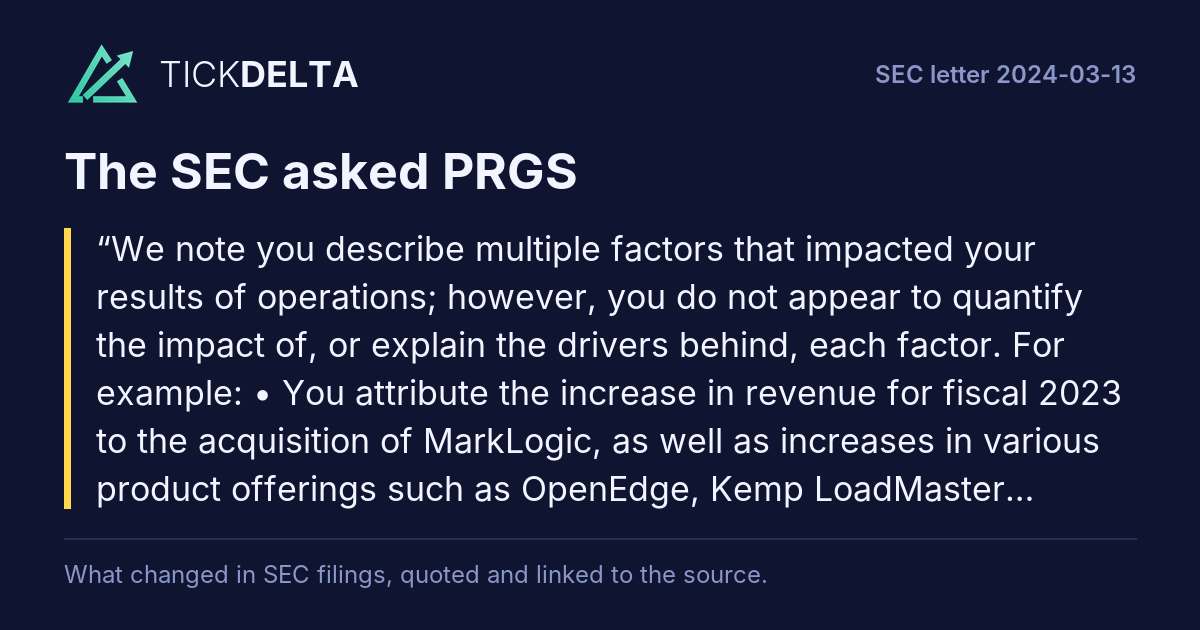
We note you describe multiple factors that impacted your results of operations; however, you do not appear to quantify the impact of, or explain the drivers behind, each factor. For example: • You attribute the increase in revenue for fiscal 2023 to the acquisition of MarkLogic, as well as increases in various product offerings such as OpenEdge, Kemp LoadMaster, Sitefinity, Ipswitch, DevTools, Corticon, and Chef.Rest of the question
• You state that the increase in maintenance revenue was primarily due to the acquisition of MarkLogic, as well as an increase in maintenance revenue from OpenEdge, Chef, and DevTools product offerings, which was partially offset by a decrease in Kemp LoadMaster maintenance revenue. • You attribute the increase in professional services revenue to MarkLogic, which was partially offset by a decrease in professional services revenue of Chef. Please revise throughout to quantify each material factor, including any offsetting factors that contributed to your results of operations, including a quantified discussion for each of the acquisitions or product offerings that contributed to such change. In addition, you should refrain from using qualitative terms such as "primarily" in lieu of providing specific quantitative disclosure. Refer to Item 303(b) of Regulation S-K.
The Company respectfully acknowledges the Staff’s comment and advises the Staff that except for recent acquisitions (revenue for the period is disclosed in our Business Combinations footnote), fluctuations in our revenue attributable to individual products are generally not material to the Company as a whole.Read in the replyRest of the answer
The Company provides a qualitative discussion of individual products to help investors and other readers get a general understanding of our product offerings and allow them to compare our product portfolio to those of competitors, but these references were not intended to distinguish products based on economic contributions. In future filings, the Company will quantify the material factors that contributed to our results of operations as appropriate. For example, in our latest Form 10-Q for the quarter ended February 29,
2024, filed with the SEC on April 8, 2024, we quantified the impact MarkLogic had on revenues for the quarter given the fact that such impact was material following the acquisition. We also mentioned OpenEdge as having contributed to our growth, however, OpenEdge, as compared to prior periods, did not have a material impact on our results of operations for the quarter. As also shown in response to comment 4 below, historical changes in revenue for individual products have not resulted in a material impact to our results of operations on a comparative basis.
First report after the company's reply of Apr 15, 2024: 10-Q filed Jul 8, 2024 ↗, against the 10-Q filed Oct 10, 2023 ↗.
Tickdelta does not hold the text of both reports, so they are not compared here.
Please address the following as it relates to your measure of annual recurring revenue (ARR) and revise your disclosures as necessary: • Clarify what is meant by "monthly recurring revenue from committed contractual amounts," which you use to determine monthly recurring revenue (MRR).Rest of the question
In this regard, tell us whether the committed contractual amount includes any portion of the contract value that has been allocated to the software license and recognized as revenue up-front at the point in time when control was transferred. • Explain what is meant by "additional usage" used in determining MRR and how you determined it is appropriate to annualize such usage. • Revise your discussion of ARR to describe further how ARR differs from GAAP revenue and specifically address the timing of revenue recognition related to the license performance obligation, if applicable.
The Company respectfully acknowledges the Staff’s comment and advises the Staff that to better align this performance metric with how management uses it in measuring the Company’s performance, it will change the definition of ARR to “Annualized Recurring Revenue” fromRead in the reply
“Annual Recurring Revenue” and revise related discussion in its future filings.
· Clarify what is meant by "monthly recurring revenue from committed contractual amounts," which you use to determine monthly recurring revenue (MRR).Rest of the answer
In this regard, tell us whether the committed contractual amount includes any portion of the contract value that has been allocated to the software license and recognized as revenue up-front at the point in time when control was transferred.
Response: ARR reflects the annualized value of multi-year contracts and contracts with terms less than one year by dividing the contract value of each contract by the number of months in the contractual term to arrive at (MRR) and then multiplying that value by 12 to arrive at ARR. Therefore "monthly recurring revenue from committed contractual amounts," represents a calculation the Company uses which allows it to derive the annualized value of each contract. As shown below, in our updated definition to be included in future filings, we will omit “committed” from the definition.
Revenue from term-based license and on-premises subscription arrangements include a portion of the arrangement consideration that is allocated to the software license that is recognized up-front at the point in time control is transferred under ASC 606 revenue recognition principles. ARR for these arrangements is calculated as described above and includes that portion of contract value that has been allocated to the software license and recognized as revenue up-front.
· Explain what is meant by "additional usage" used in determining MRR and how you determined it is appropriate to annualize such usage.
Response: The Company has a small subset of customers which contractually report monthly usage that the Company annualizes at the end of a reporting period by multiplying by 12. The ARR from “additional usage” is immaterial as it is less than 1/10th of 1% of total ARR.
In future filings, the Company will remove reference to “additional usage,” if it continues to remain immaterial, and will disclose a revised definition of ARR as detailed in the response below.
· Revise your discussion of ARR to describe further how ARR differs from
GAAP revenue and specifically address the timing of revenue recognition related to the license performance obligation, if applicable.
Response: Please see the discussion above and note the Company’s revised definition of ARR is as follows (bold text represents new language, strikethrough represents deleted language):
Annualized Recurring Revenue (“ARR”)
We are providing an disclose
ARR as a performance metric to help investors better understand and assess the performance of our business because our mix of revenue generated from recurring sources currently represents the substantial majority of our revenues and is expected to continue in the future has increased in recent years. We define ARR as the annualized recurring revenue of term-based contracts from all customers at a point in time. ARR represents the annualized contract value for all active and contractually binding term-based contracts at the end of a period. ARR includes revenue from maintenance, software upgrade rights, public cloud, and on-premises subscription-based transactions and managed services. ARR mitigates fluctuations in revenue due to seasonality, contract term and the sales mix of subscriptions for term-based licenses and SaaS. Management uses ARR to understand customer trends and the overall health of the Company’s business, helping it to formulate strategic business decisions.
We define ARR as the annual recurring revenue of term-based contracts from all customers at a point in time. We calculate ARR by taking monthly recurring revenue, or MRR, and multiplying it by 12. MRR for each month is calculated by aggregating, for all customers during that month, monthly revenue from committed contractual amounts, additional usage and monthly subscriptions. ARR reflects the annualized value of multi-year contracts and contracts with terms less than one year by dividing the total contract value of each contract by the number of months in the term and then multiplying by 12. Annualizing contracts with terms less than one-year results in amounts being included in our ARR that are in excess of the total contract value for those contracts at the end of the reporting period. The assumption is that these short-term contracts will renew in alignment with a customer’s other contracts or will renew at the end of their current term. The Company’s historic experience demonstrates that short-term contracts are typically renewed in a similar manner to its annual and multi-year contracts.
subscription arrangements include a portion of the arrangement consideration that is allocated to the software license that is recognized up-front at the point in time control is transferred under ASC 606 revenue recognition principles. ARR for these arrangements is calculated as described above. The assumption is that the total contract value, inclusive of revenue recognized as software license, will be renewed at the end of the contract term.
The calculation is done at constant currency using the current year budgeted exchange rates for all periods presented.
ARR is not calculated in accordance with defined in GAAP and is not derived from a GAAP measure. Rather, ARR generally aligns to billings (as opposed to
GAAP revenue which aligns to the transfer of control of each performance obligation). ARR does not have any standardized meaning and is therefore unlikely to be comparable to similarly titled measures presented by other companies. ARR should be viewed independently of revenue and deferred revenue and is not intended to be combined with or to replace either of those items. ARR is not a forecast and the active contracts at the end of a reporting period used in calculating ARR may or may not be extended or renewed by our customers.
First report after the company's reply of Apr 15, 2024: 10-Q filed Jul 8, 2024 ↗, against the 10-Q filed Oct 10, 2023 ↗.
Tickdelta does not hold the text of both reports, so they are not compared here.
In an effort to provide additional context to assist investors in understanding your definition of "MOVEit Vulnerability," please revise to explain what is meant by "zero-day vulnerability."
The Company respectfully acknowledges the Staff’s comment and advises the Staff that in future filings it will explain what is meant by a “zero-day vulnerability” by way of the following discussion, which the Company believes is consistent with the market definition:Read in the reply
A “zero-day vulnerability” is a vulnerability that has been publicly disclosed (e.g., by an independent researcher or threat actor) before the software vendor has an opportunity to patch it.
Financial Statements and Supplementary Data
Notes to Consolidated Financial Statements
Note 18.Rest of the answer
Business Segments and International Operations,
First report after the company's reply of Apr 15, 2024: 10-Q filed Jul 8, 2024 ↗, against the 10-Q filed Oct 10, 2023 ↗.
Tickdelta does not hold the text of both reports, so they are not compared here.
We note your qualitative discussion both here and in the earnings call transcripts regarding the impact of your various product offerings on revenues and certain operating metrics. Please tell us how you considered the guidance in ASC 280-10-50-40 to provide revenue by each product or service or similar product or services.Rest of the question
In your response, provide us with a breakdown of revenue for each of the products identified on pages 4 and 5.
The Company respectfully acknowledges the Staff’s comment and advises the Staff that it considers and follows the provisions of ASC 280-10-50-40, “Information about Products and Services” (“ASC 280-10-50-40”), when preparing its financial statements. ASC 280-10-50-40 states that a public entity shall report the revenues from external customers for each product and service or each group of similar products and services unless it is impracticable to do so.Read in the replyRest of the answer
The Company believes that the segment aggregation characteristics specified in ASC 280-10-50-11 provide relevant guidance in determining whether products and services are similar. The Company also considers the revenue disaggregation guidance in ASC 606-10-55-90 in determining what qualitative and quantitative information should be disclosed so that financial statement users can understand the nature, amount, timing, and uncertainty of revenue and cash flows generated from its contracts with customers.
The Company provides software and related maintenance and services that enable organizations to develop and deploy their mission-critical applications and experiences, as well as effectively manage their data platforms, cloud and IT infrastructure. We have a suite of software products, including approximately
12 different product brands. In considering the disclosure requirements of ASC 280-10-50-40, the Company concluded the Company’s products are operationally and economically similar in terms of the nature of the products, the production process, how they are sold and distributed, the type and class of customers, and the applicable regulatory requirements. In arriving at this determination, the Company engaged in an analysis of several factors, including, but not limited to, the following:
· Nature of the Products:
Similar products generally have similar purposes or end users and may have similar types of risks and opportunities for growth. The Company’s products are all sold within the software infrastructure sector to IT managers or developers. The products are marketed globally, both directly to end users and indirectly to independent software vendors (ISVs), original equipment manufacturers (OEMs), and system integrators. Management considers the growth opportunities for the Company’s products to be similar due to the mature nature of all of our product offerings.
· Nature of the Production Process:
To assess whether the Company’s products have similar production processes, the Company considered the following attributes: (i) sharing of common or interchangeable production or sales facilities, labor force, or service group and (ii) similar levels of labor or capital.
All of the Company’s products are software products that are designed to support developing, deploying, and managing high-impact business applications, digital experiences, and business systems. All products share a common lifecycle of development, test/secure, and deployment. Further, all of our products are supported by teams comprised of: (i) Product Team: product managers, product marketing managers, developers, and architects; (ii) Sales/Marketing team: digital marketers, demand generation, field marketers, inside and outside sales, and sales engineers; and (iii) Support/Services: technical support and professional services. Management encourages the sharing of resources and where appropriate, the Company’s teams share best practices. The Company also shares certain functionality across products. Finally, the Company’s product teams use a variety of standard tools, programming languages, database, repository, testing, security, requirements planning and tracking, which are generally consistent across the products.
· Sales and Distribution:
The Company’s software products are supported by a combination of direct sales and partner sales, including distributors. Each of the Company’s products is supported by a website augmented with integrated digital marketing efforts.
· Type and Class of Customers:
have similar customers, the following attributes were considered: (i) similar marketing and promotional efforts, common or interchangeable sales forces, average spending per customer, and customer demographics, such as average age and income; (ii) combination of retail and wholesale operations; (iii) the region or geography in which the products are services are marketed; and (iv) the industry the customer is in.
The Company uses a common set of Marketing
Technology systems to manage the sales and marketing process across its products. The Company also shares and uses a similar set of marketing and sales activity that includes digital and in-person events. Many of the products are supported with both inside and outside sales and the Company shares a similar approach to managing the prospect/customer pipeline to ensure optimal customer conversion.
The Company has a mix of customers across its products in vertical industries that include B2B, B2C, and B2B2C businesses and all of the products have a global footprint, with the majority of the Company’s revenue coming from the Americas and Northern European markets. The Company also considered the fact that some of its products are sold directly, while others are sold indirectly through ISVs and OEMs. Irrespective of channel, our enterprise software products are sold to customers and used in the development, deployment, and management of business applications. Whether we sell direct to a developer or to a development organization within an ISV or OEM, the use of our products is similar.
Based on the above considerations, among others, the Company’s products have similar customers.
· Regulatory Requirements:
The nature of the regulatory environment is generally similar for all of our products.
Based on the Company’s analysis, including the factors described above, the Company concluded that all of its products are sufficiently similar such that additional disclosure is not required by ASC 280-10-50-40. We further believe that the information that is provided in accordance with the guidance in ASC 606-10-55-90 relating to the timing of revenue recognition by type (i.e. License, Maintenance and Service) and geography in Note 14 to the Financial
Statements obviates the need for additional product line revenue.
The Company provides a qualitative discussion of products in Part I, Item 1. Business, Part II, Item 7. Management’s Discussion and Analysis of Financial Condition and Results of Operations, and on earnings calls to help investors and other readers get a general understanding of our product offerings and allow them to compare our product portfolio to those of competitors, but these references were not intended to distinguish products based on economic characteristics. The objectives and basic principles of segment reporting outlined in ASC 280 are intended to help financial statement users better understand an entity’s different types of business activities, the different economic environments in which it operates, its performance, and its prospects for future net cash flows. The Company believes its products are so similar that presenting the information separately would not significantly add to an investor’s understanding of the future prospects of the Company.
Based on the above considerations, including the existing disclosures provided in Note 14 to the consolidated financial statements, the Company respectfully advises the Staff that it does not believe any additional disclosures by product type are necessary. The Company will continue to evaluate its analysis in connection with its periodic reporting.
The following is a breakdown of revenue for each of the products identified on pages 4 and 5 of the Company’s Form 10-K for the fiscal year ended November 30, 2023:
First report after the company's reply of Apr 15, 2024: 10-Q filed Jul 8, 2024 ↗, against the 10-Q filed Oct 10, 2023 ↗.
Tickdelta does not hold the text of both reports, so they are not compared here.
We note from your response to prior comment 2 that you include contracts with terms of less than one-year in your ARR calculations based on the assumption that such shortterms contracts will renew. You also state that the short-term contracts "typically" renew in a manner similar to annual and multi-year contracts.Rest of the question
Please clarify what is meant by "typically" renew and tell us the percentage of revenue and/or ARR related to short-term contracts for each period presented. Also, tell us and revise your next Form 10-Q filing to disclose the renewal rates for such contracts to add context to inclusion of short-term contracts in your ARR calculations.
The Company respectfully acknowledges the Staff’s comment and advises the Staff that contracts with a term of less than one year represent new licenses purchased by current customers whose existing annual and multi-year contracts are not yet up for renewal. These new licenses are intentionally structured with a term of less than one year to align the contract renewal date of the new license with the contract renewal date of the existing contract.Read in the replyRest of the answer
At the time of renewal, these new licenses will renew with the same term as the existing contracts being renewed, such that both set of contracts are “co-termed.”
In practice, we generally do not sell licenses with a term of less than one year unless a customer is purchasing additional licenses under an existing contract and wishes to co-term the additional licenses with the existing contract at time of renewal. Given this practice, the reference to “typically” means that the renewal rate for contracts with a term of less than one year is the same or better than the renewal rate of our annual and multi-year contracts. In our future filings, we will remove the reference to “typically” and revise our disclosure to describe the process of renewal for these co-termed contracts. The percentage of contracts with a term of less than one year has historically represented between
1% - 2% of total ARR and revenue for any given period. Other than Net Revenue Retention rate, we have not, and do not, intend to disclose renewal rates as we believe that ARR is the performance metric indicative of the health of our business.
Please note the Company’s revised definition of ARR is as follows (bold text represents new language, strikethrough represents deleted language, underline represents language edits since our response dated April 15, 2024):
Annualized Recurring Revenue (“ARR”)
We are providing an disclose
ARR as a performance metric to help investors better understand and assess the performance of our business because our mix of revenue generated from recurring sources currently represents the substantial majority of our revenues and is expected to continue in the future has increased in recent years. We define ARR as the annualized recurring revenue of all active and contractually binding term-based contracts from all customers at a point in time. ARR represents the annualized contract value for all active and contractually binding term-based contracts at the end of a period.
ARR includes revenue from maintenance, software upgrade rights, public cloud, and on-premises subscription-based transactions and managed services. ARR mitigates fluctuations in revenue due to seasonality, contract term and the sales mix of subscriptions for term-based licenses and SaaS. Management uses ARR to understand customer trends and the overall health of the Company’s business, helping it to formulate strategic business decisions.
We define ARR as the annual recurring revenue of term-based contracts from all customers at a point in time. We calculate ARR by taking monthly recurring revenue, or MRR, and multiplying it by 12. MRR for each month is calculated by aggregating, for all customers during that month, monthly revenue from committed contractual amounts, additional usage and monthly subscriptions. ARR reflects We calculate the annualized value of annual and multi-year contracts, and contracts with terms less than one year, by dividing the total contract value of each contract by the number of months in the term and then multiplying by 12. Annualizing contracts with terms less than one-year results in amounts being included in our ARR that are in excess of the total contract value for those contracts at the end of the reporting period. We generally do not sell contracts with a term of less than one year unless a customer is purchasing additional licenses under an existing annual or multi-year contract. The expectation assumption is that at the time of renewal, contracts with a term less than one year will renew with the same term as the existing contracts being renewed, such that both contracts are co-termed. Historically contracts with a term of less than one year typically renew at rates equal to or better than in a similar manner to annual or multi-year contracts.
Revenue from term-based license and on-premises subscription arrangements include a portion of the arrangement consideration that is allocated to the software license that is recognized up-front at the point in time control is transferred under ASC 606 revenue recognition principles. ARR for these arrangements is calculated as described above. The expectation assumption is that the total contract value, inclusive of revenue recognized as software license, will be renewed at the end of the contract term.
The calculation is done at constant currency using the current year budgeted exchange rates for all periods presented.
ARR is not calculated in accordance with defined in GAAP and is not derived from a GAAP measure. Rather, ARR generally aligns to billings (as opposed to
GAAP revenue which aligns to the transfer of control of each performance obligation). ARR does not have any standardized meaning and is therefore unlikely to be comparable to similarly titled measures presented by other companies. ARR should be viewed independently of revenue and deferred revenue and is not intended to be combined with or to replace either of those items. ARR is not a forecast and the active contracts at the end of a reporting period used in calculating ARR may or may not be extended or renewed by our customers.
First report after the company's reply of May 28, 2024: 10-Q filed Jul 8, 2024 ↗, against the 10-Q filed Oct 10, 2023 ↗.
Tickdelta does not hold the text of both reports, so they are not compared here.
We note your response to prior comment 4. Please expand on your analysis supporting your conclusion that each of your product brands are similar for the purpose of providing disclosures pursuant to ASC 280-10-50-40. As part of your response, ensure you address the following: • Describe each product in detail and discuss their similarities and differences.Rest of the question
For example, explain how MOVEit, a managed file transfer software for managing and controlling the movement of sensitive files is similar to Semaphore, a semantic AI platform that transforms data into meaningful insights, or how OpenEdge, an application development platform for business-critical applications needing high performance, high availability and flexible deployment options is similar to WhatsUp Gold, a network infrastructure monitoring software that provides visibility into all network devices, servers, virtual machines, cloud and wireless environments to find and fix network problems. • Describe the role that each of your products plays in enabling organizations to develop and deploy mission-critical applications and manage data platforms, cloud and IT infrastructure. • You include various products on your website in groups that have Executive Vice Presidents (EVP) and General Managers (GM) assigned to them (e.g., Data Platform, Digital Experience and Infrastructure Management & Operations) and other products in groups that do not (e.g., Data Connectivity and Secure File Transfer). Explain each of these groups, why you grouped products in this manner and how you considered them in your analysis of similarity. • Tell us whether the CODM receives profitability information at a lower level than consolidated results, such as for the groupings that line up with the EVPs and GMs, other groupings, or for individual products (e.g., OpenEdge). • Clarify whether all products are marketed directly to end-users and indirectly to both ISVs and OEMs. To the extent certain products are sold, for example, only through ISVs while others are sold only directly to end-users, explain how that factored into your analysis. In this regard, you state some products are sold directly while others are sold indirectly to ISVs and OEMs. • Clarify how customers are similar or different for each product line. In this regard, explain what is meant by your reference to a "mix of customers across products in vertical industries." Provide us with a breakdown of customer type and industry for each product offering. To the extent that a given product has multiple types of customers and/or industries, quantify the portion of revenue derived from each type of customer or industry.
The Company respectfully acknowledges the Staff’s comment and has provided a detailed description of each of our products in response to the second bullet of the Staff’s comment. We advise the Staff that all our products are similar in that they are all used in the software development lifecycle (see Illustration 1 below) by software developers and IT professionals, our end customers, to (i) develop applications and websitesRead in the reply
(referred hereinto as “Development Software”), (ii) deploy those applications and websites as needed (“referred hereinto as “Deployment Software”) and (iii) manage thoseRest of the answer
applications and websites safely and securely (referred hereinto as “Management
Software”). Development Software, Deployment Software, and Management Software each represent an aspect of the same software development lifecycle methodology.
Our executive leadership manages our business through the lens of this development lifecycle which is also embodied in our mission statement as being a trusted provider of the best products to develop, deploy and manage high impact applications. Please refer to our “Mission” brochure found on our website at https://www.progress.com/company.
Illustration 1: Software Development
Lifecycle
In addition to addressing a similar and connected set of use cases, our products have similar end-users, share similar risks and opportunities for growth, are sold through similar direct and indirect sales channels, and are subject to similar regulatory environments. Table 1 below outlines each of our products on a comparative basis.
[***]
Table 1:
· Describe the role that each of your products plays in enabling organizations to develop and deploy mission-critical applications and manage data platforms, cloud and IT infrastructure.
Response: The Company respectfully acknowledges the Staff’s comment and in response thereof, has described below each of our products and the role that it plays in enabling organizations to develop and deploy mission-critical applications and manage data platforms, cloud and IT infrastructure.
Development Software
The Company’s Development Software is used to develop applications and digital experiences that serve a wide range of business needs. Applications store, organize, modify, search, access, and move data and content. They also analyze data and content, automate workflows, apply business rules and policies to transactions, and provide engaging user experiences among other functions. Software Developers and IT professionals use the Company’s products to meet these needs as follows:
OpenEdge – Software used to develop and run mission-critical applications, includes an integrated relational database, a programming language and programming tools.
MarkLogic and Semaphore – Software used to develop and run mission-critical applications that use complex unstructured data, includes a multi-model database, search and semantic AI capabilities that provide context and make sense of complex data including the reduction of hallucinations in large language model generated responses.
DataDirect – Software that is typically embedded in enterprise applications and is used by those applications to connect to any number of data sources including relational databases,
NoSQL, Big Data and SaaS data sources.
Corticon – Software embedded in an application or digital experience that is used to develop and run rules-based logic used in applications.
Developer Tools - Software used to develop web and mobile user interfaces of an application.
Sitefinity – Software used to develop and run digital experiences, including the management of content in websites, portals and applications.
MOVEit – Software used to securely transfer files (which are a form of “data”).
Deployment Software
Modern applications are very complex. They include many components, including front-end applications, back-end applications, data and content management systems, etc. In addition, they run on complex infrastructures including mobile devices, PCs, and servers which could be on-prem, or in the cloud, or both. During the development process, IT organizations spend significant resources to test the applications and the infrastructure they run on, to ensure that they meet the functional requirements, perform well, and meet security and compliance needs. Once tested, these applications must be deployed across on-prem and cloud environments in a controlled and consistent manner. Due to the complexity and scale, automated deployment is essential for speed, reducing labor costs, and to ensure consistency and compliance.
Chef – Software used to automate the deployment and configuration of any number of managed environments so that an application can be deployed in a consistent and compliant manner.
Management Software
Infrastructure Management – Once applications are deployed to managed environments, developers and IT professionals continually monitor and manage them, the data they use and the infrastructure they run on to ensure availability, optimal performance and security. The Company’s infrastructure management products that help development teams and IT professionals manage these environments in a secure and compliant way and include:
WhatsUp Gold – Software used to monitor the network supporting the applications.
LoadMaster – Software used to load balance applications across back-end servers to ensure application performance, availability.
Flowmon – Software that detects threats and anomalies and provides access to insights on network and application performance.
· You include various products on your website in groups that have Executive
Vice Presidents (EVP) and General Managers (GM) assigned to them (e.g., Data Platform, Digital Experience and Infrastructure Management
& Operations) and other products in groups that do not (e.g., Data Connectivity and Secure File Transfer). Explain each of these groups, why you grouped products in this manner and how you considered them in your analysis of similarity.
Response: The Company respectfully acknowledges the Staff’s comment and advises the Staff that we group our products on our website so our customers easily identify the products that are relevant to their requirements. The website grouping of our products is also driven by the way we market our products; however, such groupings do not represent a differentiation amongst products that is meaningful to management or users of financial statements.
Table 2:
· Tell us whether the CODM receives profitability information at a lower level than consolidated results, such as for the groupings that line up with the EVPs and GMs, other groupings, or for individual products
(e.g., OpenEdge).
Response: The Company respectfully advises the Staff that the CODM does not receive profitability information at a lower level than consolidated results.
· Clarify whether all products are marketed directly to end-users and indirectly to both ISVs and OEMs. To the extent certain products are sold, for example, only through ISVs while others are sold only directly to end-users, explain how that factored into your analysis. In this regard, you state some products are sold directly while others are sold indirectly to ISVs and OEMs.
Response: The Company respectfully acknowledges the Staff’s comment and advises the Staff that, as indicated in the table presented in response to the second bullet point of Staff’s comment, all of our products are marketed to end-users both directly and indirectly through partners, such as independent software vendors (“ISVs”), original equipment manufacturers (“OEMs”), system integrators, value added resellers
(“VARs”), and distributors. The end-users of our products are software developers and IT professionals, and regardless of method of distribution, all our products are sold to these end-users. As a business, we do not give preference to a particular distribution method, and instead focus on our customers’ preferred sales channel.
Since it is the end-user and not the product that dictates how a product is sold and marketed, any differences amongst the sales channels do not translate into differences among our products. As such, we consider this approach to be another factor in the similarity of our products because our sales and marketing methods are consistent and interchangeable across our product portfolio. As indicated above, substantially all of our products are sold direct and through various indirect channels. Further, management does not receive product specific information relating to channel, as that information is not meaningful in how we make decisions or measure our performance.
While certain products have higher direct sales as a percentage of the product’s overall sales compared to other sales channels, we offer every product through a combination of direct and indirect sales channels. We provide flexible license options across our products to remove purchase or entry barriers to our customers, which drives the following actions: (i) use of both direct and indirect sales channels to meet our customers’ preferences regarding licensing, support and professional services requirements; and (ii) an OEM model for organizations that are looking to embed capabilities within a broader solution.
Our marketing personnel conduct a variety of marketing engagement programs designed to create demand for our products, enhance the market readiness of our products, raise the general awareness of our products, generate leads for the sales organization and promote our products. These programs include public relations, industry analyst relations, digital/web marketing, demand generation, participation in trade shows, industry conferences, regional user events, and production of sales and marketing literature.
Our marketing efforts focus on driving traffic to our websites, generating high quality sales leads and building visibility for our corporate and product brands. Our sales efforts then focus on converting these leads into paying customers. Sales personnel are responsible for developing new direct end-user accounts, recruiting new indirect partners and new independent distributors, managing existing partner relationships and servicing existing customers.
We use our inside sales teams to enhance our direct sales efforts and to generate new business and follow-on business from existing customers.
· Clarify how customers are similar or different for each product line.
In this regard, explain what is meant by your reference to a “mix of customers across products in vertical industries.” Provide us with a breakdown of customer type and industry for each product offering. To the extent that a given product has multiple types of customers and/or industries, quantify the portion of revenue derived from each type of customer or industry.
Response: The Company respectfully acknowledges the Staff’s comment and advises the Staff that customers are similar for each product line insofar as they need solutions to help develop applications and websites, deploy those applications and websites where and how they chose, and manage those applications and websites safely and securely. Because software development has penetrated many industries, our solutions are likewise applicable in a variety of industries.
In measuring the Company’s performance, management mainly focuses on ARR and revenue. As noted in the third bullet of the Staff’s comment above, the internal grouping of our products is mainly driven by where in the software development lifecycle the product sits, management capacity, and other organizational factors, and not by specific industry, channel, or product. A “mix of customers across products in vertical industries” is in reference to our focus on software developers and IT professionals that meet our product use cases to develop and manage software applications.
Software developers and IT professionals are the end-users of our software applications, regardless of what industry they are in or their preferred method of acquiring our products. Since we do not focus our efforts on particular industries and we view purchasers of our products as one homogeneous pool of end-users, regardless of whether they are an IT professional or software developer, we do not maintain a breakdown of data by industry or customer for each product. As a result, the requested information is not readily available.
First report after the company's reply of May 28, 2024: 10-Q filed Jul 8, 2024 ↗, against the 10-Q filed Oct 10, 2023 ↗.
Tickdelta does not hold the text of both reports, so they are not compared here.
Also in this review: request for more time, Mar 15, 2024, request for more time, May 16, 2024, closing letter, 2024-06-10