Form 10-K for the year ended December 31, 2023
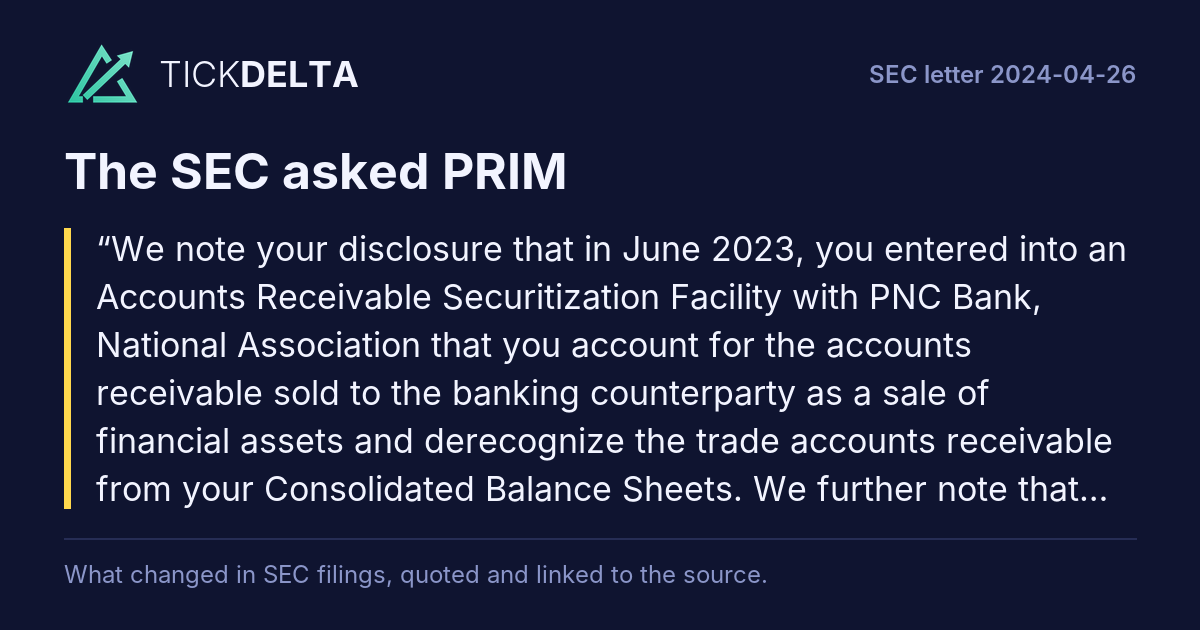
We note your disclosure that in June 2023, you entered into an Accounts Receivable Securitization Facility with PNC Bank, National Association that you account for the accounts receivable sold to the banking counterparty as a sale of financial assets and derecognize the trade accounts receivable from your Consolidated Balance Sheets.Rest of the question
We further note that you have no continuing involvement in the transferred accounts receivable, other than collection and administrative responsibilities. Given the Company's continued collection and administrative responsibilities, please further clarify whether the Company determined whether it had any servicing obligation that would result in the Company having to recognize a servicing asset or liability. Refer to ASC 860-10-25-1
In the second quarter of 2023, the Company entered into an Accounts Receivable Securitization Facility (the “Facility”) with PNC Bank, National Association (“PNC”) to improve cash flows from trade accounts receivable. The Facility has a one-year term, and the maximum purchase commitment by PNC is $100.0 million, at any one time.Read in the reply
Under the Facility, certain of the Company’s designated subsidiaries may sell their trade accounts receivable as they are originated to a wholly owned bankruptcy remote Special Purpose Entity (“SPE”) created specifically for this purpose.Rest of the answer
The Company controls and, therefore, consolidates the SPE in its consolidated financial statements. The SPE transfers ownership and control of qualifying accounts receivable to PNC up to the maximum purchase commitment. The Company and its related subsidiaries have no continuing involvement in the transferred accounts receivable, other than collection and administrative responsibilities, and, once sold, the accounts receivable are no longer available to satisfy the Company’s creditors or those of its related subsidiaries. The Facility did not provide for explicit compensation to the Company for servicing the sold accounts receivable.
The Company considered whether recognition of a servicing asset or liability was required under ASC 860-50, “Servicing Assets and Liabilities”, for the servicing rights retained upon the sale of accounts receivable to PNC. ASC 860-50-25-1(a)(3) states that an entity shall recognize a servicing asset or servicing liability each time it undertakes an obligation to service a financial asset by entering into a servicing contract if a servicer’s transfer of a participating interest in an entire financial asset meets the requirements for sale accounting, and in which circumstance the transferor shall recognize a servicing asset or a servicing liability only related to the participating interest sold. ASC 860-50-55-25 further states that “transferors sometimes agree to take on servicing responsibilities when the future benefits of servicing are not expected to adequately compensate them for performing that servicing. In that circumstance, the result is a servicing liability rather than a servicing asset.” As the Facility did not provide for explicit compensation to the Company for servicing the sold accounts receivable, the Company noted that a servicing liability would have been recognized. However, the Company concluded that given the short-term nature of the accounts receivable and the maximum purchase commitment of the facility, the value of any related servicing liability would be immaterial. As a result, the Company did not record a servicing liability.
Note 13 – Reportable Segments, page F-32:
First report after the company's reply of May 9, 2024: 10-Q filed Aug 6, 2024 ↗, against the 10-Q filed Nov 8, 2023 ↗.
Tickdelta does not hold the text of both reports, so they are not compared here.
We note that you changed your reportable segments during the first quarter of 2023. Please tell us whether the change in reportable segments impacted your existing reporting units prior to this change. If so, please tell us whether you performed an interim goodwill impairment test related to the existing reporting units before the change. If not, explain why not. Refer to ASC 350-20-35-3C(f) and 350-20-35-45.
In the first quarter of 2023, the Company realigned its reportable segments in connection with a realignment of the Company’s internal organization and management structure. In connection with the segment realignment, the Company also performed an evaluation of its existing reporting units. As part of this evaluation, we referred to ASC 350-20-35-35, which requires that two or more components of an operating segment that have similar economic characteristics be aggregated into a single reporting unit.Read in the replyRest of the answer
Specifically, the Company analyzed the aggregation criteria under ASC 280-10-50-11 (as referenced in ASC 350-20-35-35) to determine if two or more reporting units could be aggregated into one reporting unit. Based on the evaluation, the Company determined it could aggregate two of its previously identified reporting units into one reporting unit with the other two reporting units remaining the same. As a result, the number of the Company’s reporting units was reduced from four to three. In accordance with the guidance in ASC 350-20-35, the Company performed an interim impairment assessment for any impairment indicators related to its existing four reporting units before the change.
The Company performs its annual goodwill impairment testing as of October 1 of each year. On October 1, 2022, the Company performed a full quantitative goodwill impairment assessment of its four reporting units in accordance with ASC 350-20-35, which resulted in the fair value of all reporting units exceeding their carrying value by a substantial amount. The change in reporting units occurred on January 1, 2023, which was only three months after the Company’s annual goodwill impairment assessment. Therefore, the Company performed an interim qualitative goodwill impairment assessment in conjunction with the change in reportable segments and noted there were no material changes to the quantitative assessment performed on October 1, 2022. Additionally, the quantitative goodwill impairment test was performed at a level that was equal to or lower than the new reporting unit structure. As the fair value of the four reporting units under the old structure exceeded their carrying value by a substantial amount, it was determined the fair value of the three reporting units under the new structure would also exceed their carrying values. As a result, the Company concluded goodwill impairment did not exist upon making the change in reporting units.
First report after the company's reply of May 9, 2024: 10-Q filed Aug 6, 2024 ↗, against the 10-Q filed Nov 8, 2023 ↗.
Tickdelta does not hold the text of both reports, so they are not compared here.
Also in this review: closing letter, 2024-05-21