tickdelta
Sign in

Tickdelta is free for now. Sign up and get Pro free

← Screener

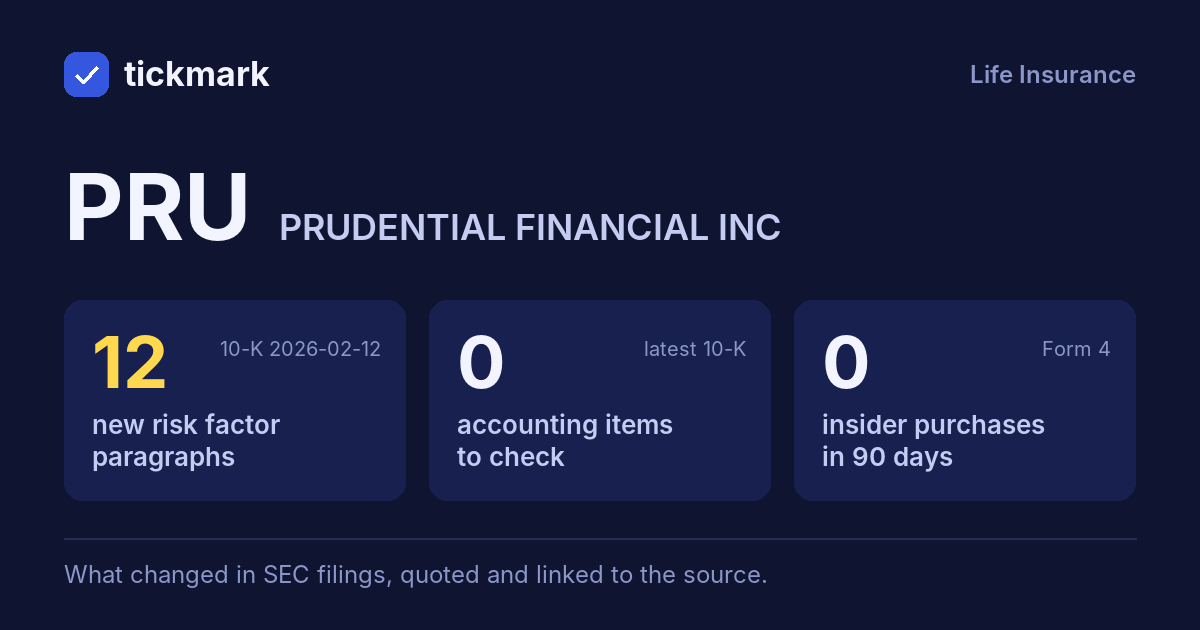
PRUPrudential Financial

Financials · Life Insurance · NYSE
Compare with peers → Embed
The 10-K against last year's

483 changes: 122 added, 88 removed, 269 reworded, 4 quiet changes

10-K Feb 12, 2026 vs Feb 13, 2025
Risk FactorsRedline ↓
15.4%
of the text changed · 10,777 words now
23.6%
of the text changed · 39,714 words now
Legal ProceedingsRedline ↓
28.8%
of the text changed · 4,360 words now
Accounting PoliciesRedline ↓
15.4%
of the text changed · 13,480 words now

10-K 0001137774-26-000048 (2026-02-12) vs 10-K 0001137774-25-000044 (2025-02-13)

The redline

The paragraph that changed most in each section

Marked against last year's 10-K: cut words struck through, new words highlighted and underlined.

MD&A 238 words changed in this paragraph; it is 45% similar to last year's version.
We have In December 2025, the Company entered into agreements an agreement with an external counterparties providing counterparty that allows for the issuance by PICA of up to $500 million in principal amount of surplus notes by our captive reinsurers in return for the receipt a corresponding amount of credit-linked notes (“Credit-Linked Note Structures”). Under the agreements, the captive receives in exchange for the surplus notes one or more credit-linked notes issued by a special-purpose affiliate wholly owned subsidiary of the Company with an aggregate Company. As of December 31, 2025, $287 million in principal amount equal of these surplus notes and credit-linked notes were outstanding. The PICA surplus notes are subordinated to policyholder obligations, and the payment of principal and interest on the surplus notes outstanding. The captive can only be made with prior insurance regulatory approval. PICA holds the these credit-linked notes as assets supporting Regulation XXX or Guideline AXXX non-economic reserves, as applicable. The captive statutory requirements and can redeem the principal amount of the outstanding credit-linked notes for cash upon the occurrence of, and in an amount necessary to remedy, a of specified liquidity stress event events affecting the captive. PICA. Under the agreements, the external counterparties have counterparty has agreed to fund any such payments under the these credit-linked notes in return for the receipt of fees. To date, no such payments under the these credit-linked notes have been required. Under these transactions, because valid rights of set-off exist, interest and principal payments on the The surplus notes and on the credit-linked notes eliminate upon consolidation and are settled on a net basis, and the surplus notes are not reflected in the Company’s total consolidated borrowings on a net basis. As a result of reinsurance transactions executed with Somerset Re and Wilton Re, we have eliminated Credit-Linked Note Structures supporting Guideline AXXX for our remaining business. In November, we restructured a series of internal captive reinsurance arrangements resulting in the consolidation of Credit-Linked Note Structures supporting Regulation XXX. financial statements.

Source: Item 7, 10-K 0001137774-26-000048 vs Item 7, 10-K 0001137774-25-000044

Risk Factors 170 words changed in this paragraph; it is 70% similar to last year's version.
The development and adoption of artificial intelligence ("AI"), AI, including generative artificial intelligence (“Generative AI”), AI and agentic AI, and its use and anticipated use by us or by third parties on whom we rely, may increase the operational risks discussed above or create new operational risks that we are not currently anticipating. AI technologies offer potential benefits in areas such as customer service personalization and process automation, and we expect to use AI and Generative AI to help deliver products and services and support critical functions. We also expect third parties on whom we rely to do the same. There are significant risks involved in developing and deploying AI and there can be no assurance that the usage of AI will enhance our products or services or be beneficial to our business, including our efficiency or profitability. AI and Generative AI may be misused by us or by such third parties, and that risk is or the models or datasets on which the models are trained may be flawed or otherwise may function in an unexpected manner. Such risks are increased by the relative newness of the technology, the speed at which it is being adopted, and the lack of developing and evolving laws, regulations or standards governing its use. Such misuse See “Business — Regulation — Artificial Intelligence” for a discussion of the applicable laws and regulations relating to the use of AI. Misuse of AI or external data, failure to comply with regulatory requirements, or conflicting interpretations of requirements could expose the Company us to legal or regulatory risk, subject us to adverse regulatory examinations or audits, damage customer relationships or cause reputational harm. Further, our ability to continue to develop and efficiently deploy AI technologies depends on access to specific third-party equipment and other physical infrastructure, such as processing hardware and network capacity, as to which we cannot control the availability or pricing, especially in a highly competitive environment. Our competitors may also adopt AI more quickly or more effectively than we do, which could cause competitive harm. Because AI technology is so new, some of the potential risks of AI are currently unknowable; however, specific risks relating to AI could include, among others:

Source: Item 1A, 10-K 0001137774-26-000048 vs Item 1A, 10-K 0001137774-25-000044

Legal Proceedings 164 words changed in this paragraph; it is 77% similar to last year's version.
In November 2019, a putative class action complaint entitled Cho v. The Prudential Insurance Company of America, et. al., was filed in the United States District Court for the District of New Jersey. The Complaint purports to be brought on behalf of participants in the Prudential Employee Savings Plan (the “Plan”) and (i) alleges that defendants failed to fulfill their fiduciary obligations under the Employee Retirement Income Security Act of 1974, in the administration, management and operation of the Plan, including engaging in prohibited transactions; and (ii) seeks declaratory, injunctive and equitable relief, and unspecified damages including interest, attorneys’ fees and costs. In January 2020, defendants filed a motion to dismiss the complaint. In September 2020, plaintiff filed an amended complaint and added as individual defendants certain PFI officers and current and former members of the Company’s Administrative Committee and Investment Oversight Committee. In December 2020, defendants filed a motion to dismiss the amended complaint. In September 2021, the court granted defendants’ motion to dismiss the amended complaint without prejudice. In October 2021, plaintiff filed a second amended complaint asserting claims against defendants under the Employee Retirement Income Security Act of 1974 for breach of fiduciary duty, prohibited transactions and failure to monitor fiduciaries. The second amended complaint seeks declaratory, injunctive and equitable relief, unspecified damages, attorneys’ fees and costs. In December 2021, defendants filed a motion to dismiss the second amended complaint. In August 2022, the court: (i) dismissed, with prejudice, the breach of the fiduciary duty of loyalty and prohibited transaction claims based on the inclusion of Prudential-affiliated funds in the Plan’s investment options; (ii) dismissed, without prejudice, the breach of fiduciary duty claims based on certain alleged underperforming Plan funds; and (iii) denied the motion to dismiss plaintiffs’ claims for breach of the fiduciary duties of prudence and to monitor other fiduciaries, based on alleged delays in removing other alleged underperforming funds. In September 2022, plaintiff filed a third amended complaint asserting claims for breach of duty of prudence and to monitor fiduciaries, and in October 2022, defendants filed their answer to the third amended complaint. In May 2023, plaintiff filed a motion for class certification. In August 2023, the court issued an Order granting plaintiff’s class certification motion. In January 2024, by an October 2023 court Order, defendants submitted to plaintiffs their summary judgment brief. In December 2024, the court issued an order granting Prudential’s motion for summary judgment. In January 2025, plaintiff filed a Notice of Appeal to the Third Circuit. In January 2026, the Third Circuit Court of Appeals affirmed the District Court's order granting defendant’s summary judgment motion.

Source: Item 3, via Note 25 – COMMITMENTS AND CONTINGENT LIABILITIES, 10-K 0001137774-26-000048 vs Item 3, via Note 25 – COMMITMENTS AND CONTINGENT LIABILITIES, 10-K 0001137774-25-000044

Accounting Policies 153 words changed in this paragraph; it is 62% similar to last year's version.
The Company’s liability for future policy benefits also includes net liabilities for guaranteed benefits related to certain long-duration life contracts, such as no-lapse guarantee contract features (Additional Insurance Reserves or “AIR” liability), for which a liability is established when associated assessments are recognized (which include investment margin on policyholders’ account balances deposited to fixed and indexed funds and all policy charges including charges for administration, mortality, expense, surrender and other charges). This liability is established using current best estimate assumptions and is based on the ratio of the present value of total expected excess payments (i.e., payments in excess of account value) over the life of the contract divided by the present value of total expected assessments (i.e., benefit ratio). Any The liability equals the current benefit ratio multiplied by cumulative assessments recognized to date, plus interest, less cumulative excess payments to date. The liability does not necessarily reflect the full policyholder obligation the Company expects to pay at the conclusion of the contract since a portion of that excess payment would be funded by assessments received in the future and would be recognized in the liability at that time. The reserves are subject to adjustments based on annual reviews of assumptions and quarterly adjustments for experience as described below, including market performance. These adjustments reflect the impact on the benefit ratio of using actual historical experience from the issuance date to this liability related the balance sheet date plus updated estimates of future experience. The updated benefit ratio is then applied to net unrealized gains (losses) on securities classified as available-for-sale are included in AOCI. all prior periods’ assessments to derive an adjustment to the

Source: Item 8, Note 2 – SIGNIFICANT ACCOUNTING POLICIES AND PRONOUNCEMENTS, 10-K 0001137774-26-000048 vs Item 8, Note 2 – SIGNIFICANT ACCOUNTING POLICIES AND PRONOUNCEMENTS, 10-K 0001137774-25-000044

Every change, by type

Sentences and paragraphs added, removed or reworded

Sentences and paragraphs of PRU's Risk Factors and MD&A, 10-K 2026-02-12 against 10-K 2025-02-13. Each links to the text at sec.gov.

AddedRisk Factors
liabilities and reestablish or strengthen reserves and capital, which could reduce capital flexibility. The magnitude of the losses (e.g., replacement costs) will depend on current market conditions, the complexity of the transaction, and the time required to restructure or replace the transaction. Losses will likely be higher under stressed conditions.

Read it in 10-K 2026-02-12 at sec.gov ↗

AddedRisk Factors
Our ability to reprice products is limited and may not compensate for deviations from our expected insurance assumptions. Although some of our products permit us to increase premiums or adjust other charges and credits during the life

Read it in 10-K 2026-02-12 at sec.gov ↗

AddedRisk Factors
The potential adverse impacts to our business, results of operations, financial condition or liquidity due to such operational risks include, among others, the following:

Read it in 10-K 2026-02-12 at sec.gov ↗

AddedRisk Factors
•Costs and security risks associated with maintaining, upgrading, or replacing our information technology, including legacy systems, could exceed our expectations or we may be required to dedicate additional resources to these activities.

Read it in 10-K 2026-02-12 at sec.gov ↗

AddedRisk Factors
•Planned system upgrades may not be successful or operate as intended, may take longer than anticipated, may exceed their budget, or create or exacerbate previously unknown security vulnerabilities.

Read it in 10-K 2026-02-12 at sec.gov ↗

AddedRisk Factors
The risks identified above could be exacerbated by agentic AI, which, acting without supervision, could take actions harmful to the Company or our customers.

Read it in 10-K 2026-02-12 at sec.gov ↗

AddedRisk Factors
have insufficient recourse against such third parties from which such breaches originate. We have experienced cybersecurity events resulting in, among other things, the compromise of personal and confidential information, including sensitive health information, of our employees, customers and other stakeholders.

Read it in 10-K 2026-02-12 at sec.gov ↗

Show the other 16
AddedRisk Factors
Furthermore, there has been increased scrutiny as well as enacted and proposed additional laws and regulations, including from state regulators, regarding the use of personal and confidential information. These laws and regulations are increasing in complexity and number, change frequently, and may be subject to interpretation by different regulators and courts. See “Business—Regulation—Privacy and Cybersecurity Regulation” for a discussion of the applicable laws and regulations (including those requiring notice, disclosure or remediation) relating to cybersecurity events.

Read it in 10-K 2026-02-12 at sec.gov ↗

AddedRisk Factors
business and be subject to regulatory action, penalties or damages. Our business may also be harmed if captive/affiliate distributors engage in inappropriate conduct in connection with the sale of third-party products.

Read it in 10-K 2026-02-12 at sec.gov ↗

AddedRisk Factors
Our ability to successfully execute on strategic transactions is subject to risks. We have in the past considered and continue to consider a range of strategic transactions, which could include acquisitions, joint venture, divestitures, spin-offs, reinsurance and other corporate transactions. Our strategy for long-term growth, productivity and profitability depends, in part, on our ability to successfully execute on and realize the expected benefits from these types of transactions. Any of these types of transactions could be material, be difficult to implement, disrupt our business, or change our business profile, focus or strategy significantly.

Read it in 10-K 2026-02-12 at sec.gov ↗

AddedRisk Factors
•Current Market Conditions. The imposition of tariffs and retaliatory actions could result in, among other things, rising interest rates, significant equity market declines, stagnant economic growth and high inflation, which could adversely impact our liquidity and capital positions, cash flows, results of operations, and financial position. For example, the combination of stagnant economic growth and high inflation would increase investment risk, including the underperformance of investments in more leveraged companies or companies exposed to weaker consumers. Also, the statutory capital of certain of our insurance subsidiaries could be negatively affected by such things as increased reserve requirements, which could be caused by equity market declines, and asymmetrical and non-economic statutory accounting impacts from rising rates.

Read it in 10-K 2026-02-12 at sec.gov ↗

AddedMD&A
The purpose of this Management’s Discussion and Analysis of Financial Condition and Results of Operations is to provide readers with a foundational understanding of our Company, our consolidated financial statements, and the significant internal and external drivers of our results. The discussion of financial results within is focused on adjusted operating income, which is the Company’s segment-level measure of performance, and provides readers with period-over-period analysis of operating results and significant drivers. In addition to discussing our detailed segment results of operations, we have also provided supplemental information that we believe assists with a greater understanding of our overall financial results.

Read it in 10-K 2026-02-12 at sec.gov ↗

AddedMD&A
•“Executive Summary” provides an overview of the Company and its operations, along with recent significant events that have impacted our organizational structure or financial results. This section also provides management’s outlook for each respective business segment.

Read it in 10-K 2026-02-12 at sec.gov ↗

AddedMD&A
•“External and Economic Factors” discusses industry trends, including the economic environment and demographics for each of our businesses, and includes a discussion of how the impact of potential changes in either interest rates or foreign currency exchange rates may impact our overall operations and financial position.

Read it in 10-K 2026-02-12 at sec.gov ↗

AddedMD&A
•“Liquidity and Capital Resources” provides information about our liquidity and capital positions, including any significant actions that have impacted, or are expected to impact, these positions. Information is also provided on our insurance companies’ regulatory capital requirements, the sources and uses of our holding company’s cash, and additional information about financing activities of the Company.

Read it in 10-K 2026-02-12 at sec.gov ↗

AddedMD&A
•“General Account Investments” provides information about the investment objectives, strategies and overall portfolio composition of the general account that supports the liabilities of our insurance companies. Investment results are presented separately for our U.S.-based and Japanese-based operations, our Closed Block division, and our Funds Withheld portfolios, which support liabilities relating to reinsurance agreements where the economic benefits and associated investment risk ultimately inure to the reinsurer. This section should be read in conjunction with Note 3 to the Consolidated Financial Statements.

Read it in 10-K 2026-02-12 at sec.gov ↗

AddedMD&A
•“Valuation of Assets and Liabilities” provides additional breakout of the fair value of assets and liabilities for Prudential Financial Inc., excluding those held in the Closed Block division and Funds Withheld portfolios, and separately for the Closed Block division and Funds Withheld portfolios. This section should be read in conjunction with Note 6 to the Consolidated Financial Statements.

Read it in 10-K 2026-02-12 at sec.gov ↗

AddedMD&A
•“Income Taxes” provides information about our effective tax rate and unrecognized tax benefits. This section should be read in conjunction with Note 17 to the Consolidated Financial Statements.

Read it in 10-K 2026-02-12 at sec.gov ↗

AddedMD&A
•“Risk Management” provides detail about our risk governance structure and the framework for evaluating the risks across the Company. This section should be read in conjunction with “Item 1A. Risk Factors.”

Read it in 10-K 2026-02-12 at sec.gov ↗

AddedMD&A
Effective in the first quarter of 2025, consistent with changes to the Company’s internal management structure, our International Businesses are reflected as a single operating and reportable segment, which is how the chief operating decision maker (“CODM”) now assesses its performance and allocates resources. Prior to the first quarter of 2025, our International Businesses consisted of the Life Planner and Gibraltar Life and Other operating segments, each of which was a reportable segment under U.S. GAAP. The change has been applied retrospectively and did not have any impact on the Company’s Consolidated Financial Statements contained herein or to any previously issued financial statements.

Read it in 10-K 2026-02-12 at sec.gov ↗

AddedMD&A
In February 2026, in conjunction with our previously announced internal investigation into employee misconduct in Japan, we voluntarily suspended new sales activity at Prudential of Japan for a 90-day period, commencing February 9, 2026. See “—Litigation and Regulatory Matters—Regulatory” within Note 25 to the Consolidated Financial Statements and “Results of Operations by Segment—International Businesses” below for additional information.

Read it in 10-K 2026-02-12 at sec.gov ↗

AddedMD&A
We feel confident about our prospects for the future based on the foundation of our integrated and complementary businesses. We are focused on evolving our strategy to transform our market-leading businesses to become a higher growth, more capital efficient company. We plan to continue investing in growth businesses and markets around the world, delivering industry-leading customer and client experiences, and creating the next generation of financial solutions. The businesses drive our company’s performance, value and growth, and are organized around the markets we serve with solutions in investing, insurance, and retirement security.

Read it in 10-K 2026-02-12 at sec.gov ↗
Next Related parties →