tickdelta
Sign in

Tickdelta is free for now. Sign up and get Pro free

← Screener

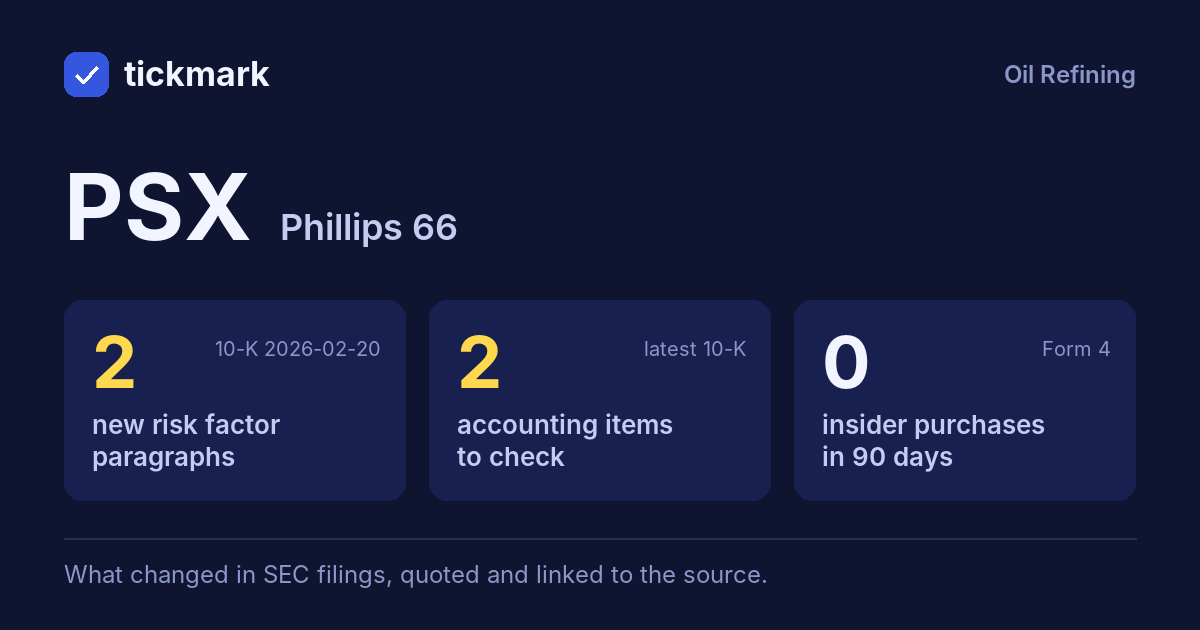
PSXPhillips 66

Energy · Oil Refining · NYSE
Employees
12,600
Headquarters
Houston, TX
Next results
around Feb 3, 2027
Compare with peers → Embed

When the SEC's staff reviews a filing, it writes to the company with numbered questions, and the company answers each one in a letter. SEC publishes the exchange once the review is over, at least 20 business days later. Below: what the staff asked PSX, and the company's answer to each question, quoted from the letters. A question is not an accusation; most reviews end with the company adding detail to its next filing.

Phillips 66 · PREC14A filed March 4, 2025 · Filed by Elliott Investment Management L.P. et al. · File No. 001-35349

2025-03-13 to 2025-04-03 · 4 questions · 2 letters from the SEC, 1 from the company
No closing letter
SEC letter of 2025-03-13 ↗ no reply letter on EDGAR (the company may have answered in an amended filing)
Questions and Answers Relating to This Proxy Solicitation, page 7
SEC asked (1)
Please reconcile the disclosure regarding "ABSTAIN" votes on page 10 with the disclosure regarding the effect of abstentions on pages 11, 39, and 41. Reasons for the Solicitation, page 21
PSX answered

No reply letter found.

Questions and Answers Relating to This Proxy Solicitation, page 7
SEC asked (2)
Please provide corresponding disclosure for footnotes 1 and 2 that appear in the table at the top of page 22.
PSX answered

No reply letter found.

Questions and Answers Relating to This Proxy Solicitation, page 7
SEC asked (3)
In footnote 2 to the graphic that appears at the top of page 24, we note the reference to "slide 49 in the appendix." It is unclear what this relates to. Please revise, or advise. Proposal No. 1, Election of Directors, page 28 We note the following disclosure on page 28: "We intend to provide the required notice to the Company pursuant to the Universal Proxy Rules, including Rule 14a4.
Rest of the question

19(a)(1) under the Securities Exchange Act of 1934, as amended (the 'Exchange Act'), and intend to solicit the holders of Common Stock representing at least 67% of the voting power of Common Stock entitled to vote on the election of directors in support of director nominees other than the Company’s nominees." Please advise as to why this is phrased as an intention, particularly in light of the fact that, via the statements made in your preliminary proxy statement, it appears that you may have satisfied the notice requirement set out in Rule 14a-19(a)(1). In addition, please define "Universal Proxy Rules," or revise so as not to use a capitalized term. Proposal No. 5, Advisory Vote on Annual Election Policy, page 42 5. Please revise your disclosure in this section to address the legal risk the Company may face if it attempts to adopt the annual election policy, which appears potentially to run counter to the Company's Charter and Bylaws, in particular the following Charter provision: "[t]he affirmative vote of shares representing not less than 80% of the votes entitled to be cast by the Voting Stock shall be required to alter, amend or adopt any provision inconsistent with or repeal … Article FIFTH [i.e., the article that requires the staggered board]” (emphasis added). 6. We note that the proposal seeks adoption of a policy that would "require" incumbent directors to deliver to the Board a letter of resignation. However, your disclosure also includes the following statement, which would appear to conflict with the foregoing: "If a director with a term not set to expire at the next annual meeting does not deliver a resignation in accordance with the policy, they would not be subject to election at the next annual meeting and would continue to serve on the Board until their term expires and their successor is duly elected, or their earlier resignation or removal." Please revise, or advise. General 7. On the proxy card, for the first proposal, please provide space for the Company Nominees, even if the identities of such nominees are not known or fully known at this time.

PSX answered

No reply letter found.

SEC asked
We note the disclosure on page 25 that receipt of Elliott's "formal" nomination notice occurred on February 13, 2025. Please also disclose, if true, that such notice was received by email on the previous day. We note the following disclosure on page 26: "On March 14, 2025, the Nominating and Governance Committee convened a special meeting via videoconference to discuss potential director candidates for
Rest of the question

recommendation to the Board to fill the four Class I seats up for election at the upcoming Annual Meeting, including to fill the vacancies created by Mr. Adams’ and Ms. Ramos’ decision not to stand for reelection." We also note the following disclosure in the Company's Form 8-K of February 18, 2025: "Effective immediately after the Annual Meeting, the size of the Company’s Board will be reduced from 14 to 12 directors." The first statement appears to imply that a decision had been made not to reduce the size of the Board from 14 to 12, contrary to what had been announced publicly on February 18. Please 2. revise the disclosure to clarify, or advise.

PSX answered
The Company respectfully acknowledges the Staff’s comment and, in response to the Staff’s comment, the Company proposes to revise the disclosure on page 25 of the Preliminary Proxy Statement as follows (with additions in bold underline):

“After 5:00 p.m., Eastern Time, on February 12, 2025, Elliott emailed an electronic copy of the

2025 Nomination Notice (as defined below) to Ms. Sutherland. Likely due to the file size of the attachment and the inclusion of an erroneous email address for Ms. Sutherland, the email was quarantined and did not arrive in Ms.
Rest of the answer

Sutherland’s main inbox.

After noon,

Eastern Time, on February 13, 2025, Elliott emailed Ms. Sutherland again to convey that IT issues had prevented certain signatures from being included in that prior email, and that Elliott was re-delivering an electronic copy and also delivering a physical copy of the corrected notice to the Company’s headquarters on February 13. That day, the Company received both physical and electronic copies of a formal notice (the “2025 Nomination Notice”) from Elliott of its intent to nominate director candidates to stand for election to the Company’s Board at the Annual Meeting and intent to submit the Elliott
Read in the reply ↗

Form S-4

2021-12-20 to 2022-01-31 · 1 question · 1 letter from the SEC, 2 from the company
No closing letter
SEC asked
Please confirm your understanding that we will not be in a position to accelerate the effectiveness of your registration statement until our comments relating to your Form 10- K for the fiscal year ended December 31, 2020 have been resolved.
PSX answered
In response to the

Staff’s comment, the Company confirms its understanding that the effectiveness of the Registration Statement will not be accelerated prior to the resolution of the Staff’s comments relating to the Company’s Form 10-K for the fiscal year ended December 31, 2020. Read in the reply ↗

Also in this review: company letter, 2022-01-31

Form 10-K for the Year Ended December 31, 2020

2021-09-22 to 2022-01-13 · 9 questions · 2 letters from the SEC, 2 from the company
Review closed 2022-01-13
ClimateResults discussion (MD&A)Legal and contingencies
SEC asked (1)
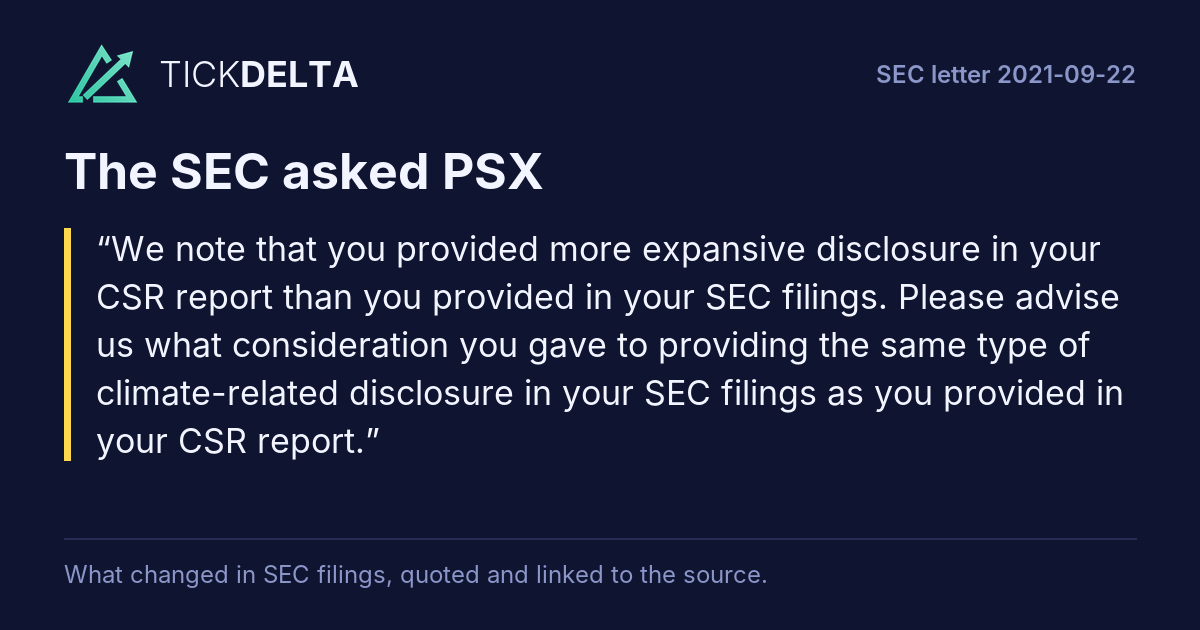
We note that you provided more expansive disclosure in your CSR report than you provided in your SEC filings. Please advise us what consideration you gave to providing the same type of climate-related disclosure in your SEC filings as you provided in your CSR report.
PSX answered
We periodically provide our stakeholders with information on various topics in reports and presentations that are publicly available on our website. In response to requests by certain stakeholders, we have supplementally disclosed additional climate-related information in our stand-alone Sustainability Report, which is approximately 68 pages in length.
Rest of the answer

Our Sustainability Report provides a single, convenient location for stakeholders to review (i) certain material environmental, social and governance (ESG) information that is included in both the Sustainability Report and our SEC filings and (ii) additional supplemental information that is of interest to certain stakeholders but not required in our SEC filings. The supplemental information is not information required by Regulation S-K, nor is it necessary to make any of the statements included in our SEC filings not misleading. We considered voluntarily including certain of the supplemental information in our SEC filings; however, we believed including this additional information would make our SEC filings unnecessarily longer and more difficult to read.

We believe that our SEC filings adequately and appropriately inform investors as to material information about our business, strategy, and financial results, including climate-related information. As discussed in response to other comments in this letter, we have disclosed climate-related information about our business, strategy, and financial results, including the risk of an investment in our Company, in the 2020 Form 10-K.

Read in the reply ↗
SEC asked (2)
If material, please discuss with greater specificity the indirect consequences of climaterelated regulation or business trends such as the increased demand for goods that result in lower emissions or are related to alternative energy sources and strategic opportunities that may arise for your company as a result of climate change.
PSX answered
We respectfully note that we have disclosed the material consequences that climate-related regulation and business trends may have on our Company, and we believe those disclosures provide sufficient specificity for investors. These disclosures can be found in the Risk Factors and Management’s Discussion and Analysis of Financial Condition and Results of Operations (MD&A) sections of the 2020 Form 10-K.

Specifically, we describe the potential for increased costs and decreased demand for our products as a result of climate change in the Risk Factors section of the 2020 Form 10-K under the
Rest of the answer

sub-heading “Regulatory and Environmental, Climate and Weather Risks.” These risks include the following, each of which is discussed with specificity therein:

•We expect to continue to incur substantial capital expenditures and operating costs as a result of our compliance with existing and future environmental laws and regulations;

•The adoption of climate change legislation or regulation could result in increased operating costs and reduced demand for the refined petroleum products we produce;

•Compliance with the EPA’s Renewable Fuel Standard (RFS) could adversely affect our financial results; and

•Societal, technological, political and scientific developments around emissions and fuel efficiency may decrease demand for transportation fuels.

We also disclosed in the MD&A of the 2020 Form 10-K information regarding environmental regulations that we believe are reasonably likely to have a material effect on the Company’s financial condition or results of operations. Specifically, we disclosed the most significant international and federal environmental laws and regulations to which we are subject and described the impact they have and can have on our business under “Contingencies —Environmental.” For example, we disclosed that the Energy Independence and Security Act of 2007 requires fuel producers and importers to provide additional renewable fuels for transportation motor fuels and stipulates a mix of various types and noted that we may experience a decrease in demand for refined petroleum products due to the regulatory program as currently promulgated. We also disclosed, under “—Climate Change,” information about legislation focusing on greenhouse gas (GHG) emissions reduction, and precursors for possible regulation, that already have affected or could affect our operations. Please see pages 61 through 65 of the 2020 Form 10-K.

We also believe that there are strategic opportunities for us as a result of climate change. In the MD&A section of the 2020 Form 10-K, we disclosed the formation of our Emerging Energy organization, which is focused on lower-carbon opportunities within our portfolio, as well as commercializing emerging energy technologies. As this organization continues its work, and as strategic opportunities are identified, we intend to disclose any such material opportunities in our future filings.

We confirm that in future filings, we will continue to disclose information concerning climate-related regulation and business trends, if material.

Read in the reply ↗
SEC asked (3)
Quantify any material weather-related damages to your property or operations.
PSX answered
Weather-related damages to our property were not material during the years covered in the 2020 Form 10-K. For the year ended December 31, 2020, we incurred before-tax costs to repair damage sustained from weather-related events of approximately $50 million. For the years ended December 31, 2019 and 2018, we incurred before-tax costs to repair damage from weather-related events of less than $5 million per year.

With respect to weather-related impacts to our results of operations, we respectfully note that the impact of weather-related events is already disclosed in our SEC filings.
Rest of the answer

For example, in the MD&A section of our Form 10-Q for the quarter ended September 30, 2020 and the 2020 Form 10-K, we disclosed that lower production by our Refining segment in 2020 was partially attributable to impacts from hurricanes in the Gulf Coast.

We confirm that in future filings, we will continue to disclose the impact of any weather-related damages to our property or operations, if material.

Read in the reply ↗
SEC asked (4)
If material, disclose any weather-related impacts on the cost or availability of insurance.
PSX answered
We have not experienced material weather-related impacts on the availability or the cost of the insurance coverage we have historically maintained; for example, insurance premiums paid for property damage coverage were less than $50 million per year in each of the years ended December 31, 2020, 2019 and 2018. Read in the reply ↗
SEC asked (5)
Disclose with specificity the material effects of transition risks related to climate change that may affect your business, financial condition, and results of operations, such as market trends that may alter business opportunities, credit risks, or technological changes.
PSX answered
As discussed in response to the Staff’s comment No. 2, above, we disclosed in the Risk Factors section of the 2020 Form 10-K climate-related risks that we currently face and that we could face in the future as a result of those changes. Our Risk Factors disclosure includes the risks associated with legislation and regulation, consumer demand, societal sentiment and technology related to the energy transition.
Rest of the answer

The disclosure also discusses the material adverse effects on our financial condition, results of operations and cash flows that may be caused by reductions in the amount of motor fuels we produce, increased production costs that we are not able to pass along to customers, the diminished ability of refined petroleum products to compete with renewable fuels, and overall reduced demand for our products, among other factors.

As also discussed in response to comment No. 2, above, in the MD&A section of the 2020 Form 10-K, we provided disclosures about climate-related regulation, including transition risk. In that section, we disclosed that the effects of existing and potential future regulations can include significant increases in our costs, reduced demand for fossil energy derived products, impacts to the cost and availability of capital, increased exposure to litigation, and increased demand for less carbon-intensive energy sources.

We confirm that in future filings, we will continue to disclose with specificity the effects of the risks posed by the transition to a lower-carbon economy, if material.

Read in the reply ↗
SEC asked (6)
Disclose any material litigation risks related to climate change and the potential impact to the company.
PSX answered
We currently are not a party to any pending legal proceedings related to climate change that require disclosure under Item 103 of Regulation S-K. Additionally, there are no contingencies relating to climate change that require disclosure under U.S. generally accepted accounting principles, such as ASC 450, Contingencies, that have not been disclosed in our SEC filings.

We currently disclose in the 2020 Form 10-K that compliance with climate related laws and regulations can increase our exposure to litigation.
Rest of the answer

We confirm that in future filings, when material and where appropriate, we will include additional disclosures about litigation risks related to climate change and the potential impact to the Company.

Read in the reply ↗
SEC asked (7)
If applicable and material, provide disclosure about any purchase or sale of carbon credits or offsets and any material effects on your business, financial condition, and results of operations.
PSX answered
We purchase credits in the open market to satisfy obligations under various environmental compliance programs. Governmental regulations in certain jurisdictions require us to blend a certain percentage of biofuels into the motor fuels we produce, primarily the Renewable Fuels Standard in the United States. To the extent we are unable to blend biofuels at the required percentages, we are required to purchase biofuel credits to meet our obligations.
Rest of the answer

We also purchase emissions credits to comply with governmental regulations concerning various GHG emissions programs, including cap-and-trade and low carbon fuel standard programs. For the years ended December 31, 2020, 2019 and 2018, we incurred expenses associated with our obligations to purchase biofuel credits under the various environmental compliance programs for our wholly owned businesses of $961 million, $764 million and $741 million, respectively. These amounts are reflected in the “Purchased crude oil and products” line on our consolidated statement of operations.

We concluded that the above amounts did not require separate disclosure in the 2020 Form 10-K because they were not material. These expenses represented approximately 1.7%, 0.8% and 0.8% of the total costs included in the “Purchased crude oil and products” line item for the years ended December 31, 2020, 2019 and 2018, respectively. In addition, the cost to comply with certain programs, such as GHG emissions programs, is generally recovered from customers, which mitigates the overall financial impact to the Company of complying with these programs.

Finally, we periodically sell biofuel credits to mitigate our overall cost of complying with environmental programs. However, the sales of credits are not material. For the years ended December 31, 2020, 2019 and 2018, we received proceeds from the sale of these credits of $209 million, $97 million and $98 million, respectively.

We confirm that in future filings, we will provide disclosure of purchases and sales of carbon credits that have an effect on our business, financial condition and results of operations, if material.

If you have any additional questions or comments, please contact the undersigned.

Read in the reply ↗
Response Letter Dated October 15, 2021 · Form 10-K for Fiscal Year Ended December 31, 2020
SEC asked (1)
Your response to prior comment 4 states, in part, that you have not experienced material weather-related impacts on the availability the insurance coverage you have historically maintained. Please provide us with additional support for this statement.
PSX answered
Historically, the most significant weather-related events for our business have been named windstorms, primarily hurricanes. Our named windstorm coverage is obtained through a mutual insurance company in which the insureds are shareholders. Our insurance coverage through the mutual insurer has not changed since we became a publicly traded company in 2012. We do not purchase incremental named windstorm coverage in the commercial market; therefore, our property damage coverage has not been materially impacted by these weather-related events.
Rest of the answer

The risk to our business from not having incremental named windstorm insurance coverage is covered in the Risk Factors section of our 2020 Form 10-K where we disclose that we do not insure against all potential losses and only maintain insurance coverage in amounts we believe to be prudent against many, but not all, potential liabilities.

Read in the reply ↗
In its next report

First report after the company's reply of 2021-11-17: 10-K filed 2022-02-18 ↗, against the 10-K filed 2021-02-24 ↗.

Tickdelta does not hold the text of both reports, so they are not compared here.

Response Letter Dated October 15, 2021 · Form 10-K for Fiscal Year Ended December 31, 2020
SEC asked (2)
We note from your response to prior comment 6 that your compliance with climate-related laws and regulations can increase your exposure to litigation. Please tell us how you considered providing disclosure addressing the risks associated with the possibility of climate change related litigation, including litigation not solely related to compliance with climate-related laws and regulations, and its potential impact.
PSX answered
In considering disclosures of the risk of climate-related litigation, we considered the merits of litigation that has already been brought and the likelihood of additional litigation that could reasonably be expected to have a material adverse effect on the Company. Given the expectation of continued legal, political and shareholder pressure on companies, including us, relating to climate-related matters, we intend to include the following additional Risk Factor under the subheading “Regulatory and Environmental, Climate and Weather Risks” in our future filings:

Continuing political and
Rest of the answer

social concerns about the issues of climate change may result in changes to our business and significant expenditures, including litigation-related expenses.

Increasing attention to global climate change has resulted in increased investor attention and an increased risk of public and private litigation, which could increase our costs or otherwise adversely affect our business. For example, shareholder activism has recently been increasing in our industry, and shareholders may attempt to effect changes to our business or governance, whether by shareholder proposals, public campaigns, proxy solicitations or otherwise. Additionally, cities, counties, and other governmental entities in several states in the U.S. began filing lawsuits against energy companies in 2017, including Phillips 66. The lawsuits seek damages allegedly associated with climate change, and the plaintiffs are seeking unspecified damages and abatement under various tort theories. Similar lawsuits may be filed in other jurisdictions. We believe these lawsuits are an inappropriate vehicle to address the challenges associated with climate change and will vigorously defend against them for lacking factual and legal merit. The ultimate outcome and impact to us of any such litigation cannot be predicted with certainty, and we could incur substantial legal costs associated with defending these and similar lawsuits in the future. Additionally, any of these risks could result in unexpected costs, negative sentiments about our company, disruptions in our operations, increases to our operating expenses and reduced demand for our products, which in turn could have an adverse effect on our business, financial condition and results of operations.

If you have any additional questions or comments, please contact the undersigned.

Read in the reply ↗
In its next report

First report after the company's reply of 2021-11-17: 10-K filed 2022-02-18 ↗, against the 10-K filed 2021-02-24 ↗.

Tickdelta does not hold the text of both reports, so they are not compared here.

Also in this review: request for more time, 2021-09-30, closing letter, 2022-01-13

Form 10-K for the Year Ended December 31, 2020

2021-05-06 to 2021-06-16 · 2 questions · 1 letter from the SEC, 1 from the company
Review closed 2021-06-16
Results discussion (MD&A)SegmentsNon-GAAP measuresIncome taxes
Results of Operations · Segment Results, page 41
SEC asked (1)
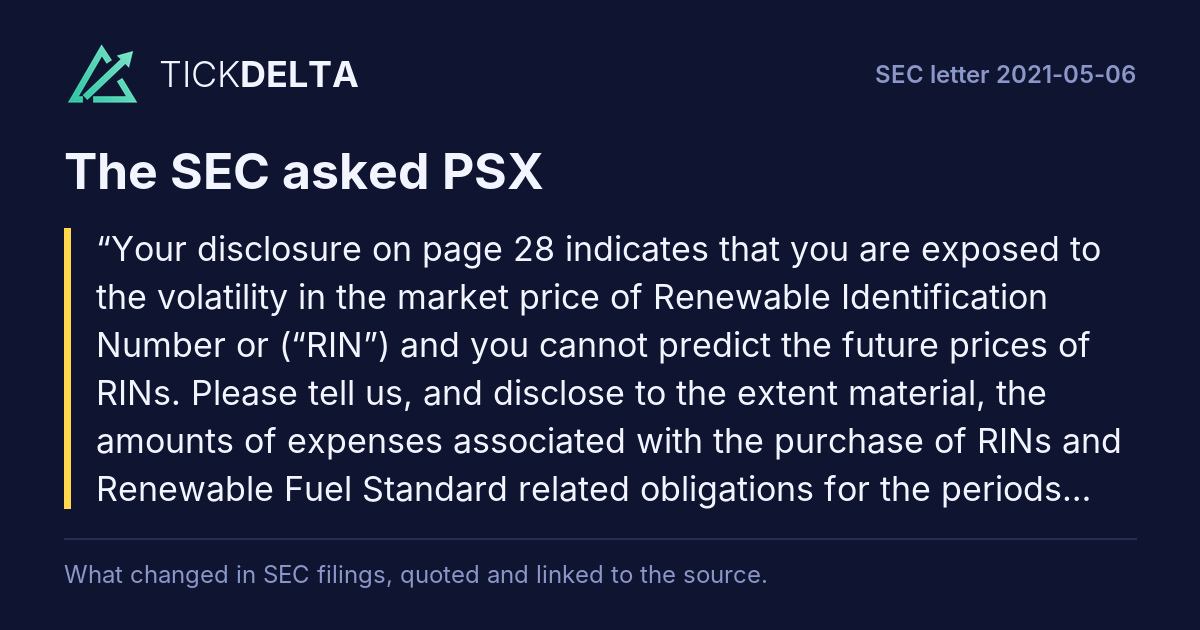
Your disclosure on page 28 indicates that you are exposed to the volatility in the market price of Renewable Identification Number or (“RIN”) and you cannot predict the future prices of RINs. Please tell us, and disclose to the extent material, the amounts of expenses associated with the purchase of RINs and Renewable Fuel Standard related obligations for the periods presented and explain the fluctuations between
Rest of the question

periods.

PSX answered
We are required to purchase RINs in the open market to satisfy the portion of our obligation under the Renewable Fuel Standard (RFS) that is not fulfilled by blending renewable fuels into the motor fuels we produce. We incurred expenses associated with our obligation to purchase RINs in the open market to comply with the RFS for our wholly owned refineries of $342 million, $111 million and $182 million for the years ended December 31, 2020, 2019 and 2018, respectively. These expenses are included in the “Purchased crude oil and products” line item on our consolidated statement of operations.
Rest of the answer

Our jointly owned refineries also incurred expenses associated with the purchase of RINs in the open market, of which our share was $133 million, $74 million and $102 million for the years ended December 31, 2020, 2019 and 2018, respectively. These expenses are included in the “Equity in earnings of affiliates” line item on our consolidated statement of operations.

For wholly owned refineries, the increase in these expenses in 2020, compared with 2019, was primarily due to higher weighted average RIN prices and reduced blending activities, partially offset by lower production. The decrease in these expenses in 2019, compared with 2018, was primarily due to lower weighted average RIN prices, partially offset by higher production and reduced blending activities. In addition, the lower expense in 2019 reflects the benefit of retroactive small refinery exemptions granted to one of our refineries.

For jointly owned refineries, the increase in these expenses in 2020, compared with 2019, was primarily due to higher weighted average RIN prices, partially offset by lower production. The decrease in these expenses in 2019, compared with 2018, was primarily due to lower weighted average RIN prices, partially offset by higher production.

We acknowledge the Staff’s comment and we will include a disclosure similar to the following in our future Form 10-K filings in Management’s Discussion and Analysis of Financial Condition and Results of Operations. In addition, we will explain fluctuations in the disclosed amounts between periods if these fluctuations have a material impact on a financial statement line item.

We are required to purchase RINs in the open market to satisfy the portion of our obligation under the Renewable Fuel Standard (RFS) that is not fulfilled by blending renewable fuels into the motor fuels we produce. For the years ended December 31, 2020, 2019 and 2018, we incurred expenses of $342 million, $111 million and $182 million, respectively, associated with our obligation to purchase RINs in the open market to comply with the RFS for our wholly owned refineries. These expenses are included in the “Purchased crude oil and products” line item on our consolidated statement of operations. Our jointly owned refineries also incurred expenses associated with the purchase of RINs in the open market, of which our share was $133 million, $74 million and $102 million for the years ended December 31, 2020, 2019 and 2018, respectively. These expenses are included in the “Equity in earnings of affiliates” line item on our consolidated statement of operations. The amount of these expenses and fluctuations between periods is primarily driven by the market price of RINs, refinery production and blending activities.

Read in the reply ↗
In its next report

First report after the company's reply of 2021-06-04: 10-Q filed 2021-08-03 ↗, against the 10-Q filed 2021-04-30 ↗.

Tickdelta does not hold the text of both reports, so they are not compared here.

Item 7. Management's Discussion and Analysis of Financial Condition and Results of Operations · Non-GAAP Reconciliations, page 70
SEC asked (2)
We note you disclose and discuss realized refining margins and realized marketing fuel margins as non-GAAP financial measures and that you reconcile these non-GAAP financial measures to income (loss) before income taxes.
Rest of the question

Please tell us why you have reconciled to income (loss) before income taxes as opposed to a fully burdened gross profit, which appears to represent the most directly comparable GAAP financial measure. Refer to Item 10(e)(1)(i)(B) of Regulation S-K.

PSX answered
We note that Question 104.03 of the Staff’s Compliance & Disclosure Interpretations on the use of non-GAAP financial measures highlights that segment measures that are adjusted to include amounts excluded from, or to exclude amounts included in, the measure reported to the chief operating decision maker (CODM) are considered non-GAAP financial measures and subject to Item 10(e) of Regulation S-K.
Rest of the answer

Based on this guidance, we concluded that “realized refining margins” and “realized marketing fuel margins” are non-GAAP measures for purposes of reporting segment performance as they include adjustments to our measure of segment profit disclosed in our financial statements. We then evaluated the most directly comparable GAAP measure to which we should reconcile “realized refining margins” and “realized marketing fuel margins” to comply with Item 10(e)(1)(i)(B) of Regulation S-K. As part of this evaluation, we considered the adopting release of Item 10(e), Exchange Act Release No. 47226, in which the Staff noted that “it is most appropriate to provide registrants with the flexibility to best make the determination as to which is the most directly comparable GAAP financial measure calculated and presented in accordance with GAAP.” We believe the most directly comparable GAAP financial measure, in accordance with Item 10(e)(1)(i)(B) of Regulation S-K and the Staff’s interpretive guidance, at the segment level is segment “income (loss) before income taxes,” because this is the financial measure our CODM uses to allocate resources to and assess performance of our operating segments and the segment profit measure we are required to disclose in accordance with ASC 280, Segment Reporting.

In addition, we note that ASC 280 does not require a determination or calculation of fully burdened segment gross profit unless it is the segment measure used by the CODM to allocate resources and assess performance. Further, we note that reconciling these non-GAAP financial measures to a fully burdened gross profit would require us to calculate, report and maintain a segment performance measure that our CODM does not currently utilize to allocate resources and assess performance.

If you have any additional questions or comments, please contact the undersigned.

Read in the reply ↗
In its next report

First report after the company's reply of 2021-06-04: 10-Q filed 2021-08-03 ↗, against the 10-Q filed 2021-04-30 ↗.

Tickdelta does not hold the text of both reports, so they are not compared here.

Also in this review: request for more time, 2021-05-13, closing letter, 2021-06-16

Form 10-K

2017-09-14 to 2017-11-07 · 2 questions · 2 letters from the SEC, 2 from the company
Review closed 2017-11-07
Results discussion (MD&A)Non-GAAP measuresSegmentsRevenue
Results of Operations, page 33
SEC asked
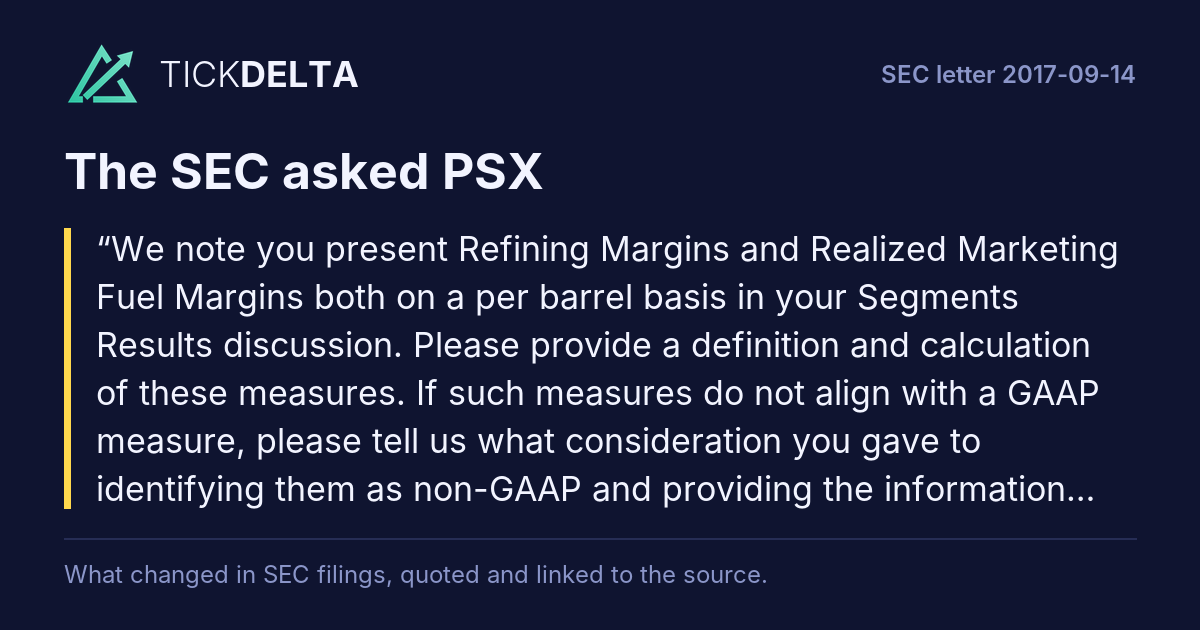
We note you present Refining Margins and Realized Marketing Fuel Margins both on a per barrel basis in your Segments Results discussion. Please provide a definition and calculation of these measures. If such measures do not align with a GAAP measure, please tell us what consideration you gave to identifying them as non-GAAP and providing the information set forth in Item 10(e) of Regulation S-K.
PSX answered
Set forth below are the definitions and calculations of the two statistical measures requested by the Staff.

Realized Marketing Fuel Margins Per Barrel

Realized marketing fuel margins per barrel measure the difference between a) sales and other operating revenues and associated other income derived from the sale of fuels in our Marketing and Specialties segment and b) purchase costs of those fuels.
Rest of the answer

These margins are then converted to a per-barrel basis by dividing the dollar value of marketing fuel margins by sales volumes measured on a barrel basis.

For the supplemental information of the Staff, the table below illustrates the calculation for the year ended December 31, 2016:

Millions of Dollars

Except as Indicated

Marketing Fuel Margin

U.S.

International

Year Ended December 31, 2016

Sales and other operating revenues

$

42,076

6,319

Plus (Less):

Purchased crude oil and products

(40,927

)

(5,887

Realized marketing fuel margin

1,149

432

Total fuel sales volumes (thousands of barrels)

699,111

106,574

Realized marketing fuel margin per barrel (dollars per barrel)

1.64

4.05

As illustrated above, we believe our realized marketing fuel margin per barrel calculation is a GAAP-based financial measure, as the revenues and purchase costs utilized in the calculation were derived in accordance with GAAP. To allow for greater transparency in the disclosure, in future filings we will provide a narrative explanation of how this measure is defined and calculated.

Refining Margins Per Barrel

Refining margins measure the difference between a) sales and other operating revenues and associated other income derived from the sale of petroleum products manufactured at our refineries and b) purchase costs of feedstocks, primarily crude oil, used to produce the petroleum products. These margins are then converted to a per-barrel basis by dividing the dollar value of refining margins by total refinery processed inputs measured on a barrel basis. Our definition of realized refining margin is intended to be comparable with industry refining margins, which are known as “crack spreads.” As discussed on page 32 of our 2016 Form 10-K, industry crack spreads measure the difference between market prices for refined petroleum products and crude oil. By calculating our realized refining margins on a similar basis as industry crack spreads, we are able to provide investors with a useful measure of how well we performed relative to benchmark industry margins.

We perform our realized refining margin per barrel calculation for each of our ten wholly owned refineries, as well as our three joint-venture refineries. These amounts are presented by geographic region and in total for our worldwide operations on a weighted-average-throughput basis.

For the supplemental information of the Staff, the table below illustrates the calculation for our worldwide operations for the year ended December 31, 2016:

Refining Margin

Worldwide

52,068

Other income

(47,103

Refining margin

4,969

Proportional share of refining margins contributed by equity affiliates

755

Special items

(32

Realized refining margin

5,692

Total processed inputs (thousands of barrels)*

814,113

Realized refining margin per barrel (dollars per barrel)

6.99

* Includes our proportional share of processed inputs of equity affiliates.

As noted above, we incorporate the realized refining margins of our joint-venture refineries that we account for using the equity method of accounting by taking our proportional share of the joint-venture refinery’s realized margin and processed inputs. These amounts are calculated on a basis consistent with our wholly owned refineries. We believe it is necessary to present a refining margin inclusive of our share of the refining margins of joint-venture refineries for investors to understand our performance, as these joint ventures are an integral part of our refining operations, with our share of their refining crude oil throughput capacity representing 14 percent of our total worldwide capacity. In addition, we adjust revenues or purchase costs if they are impacted by items that are not representative of the underlying operating performance of a period. We refer to these as “special items,” and they include such items as lower-of-cost-or-market inventory adjustments and certain legal settlements.

The adjustments for special items and for our proportional share of the joint-venture refineries render the refining margins per barrel a non-GAAP measure. However, during the three-year period presented in the 2016 Form 10-K, the impact of these adjustments on the worldwide refining margin per barrel was not material, ranging from 1 percent to 3 percent in each year presented. After reconsidering our presentation in light of the Staff’s comment, we plan to present, on a prospective basis beginning with the third-quarter 2017 Form 10-Q, a definition of refining margin per barrel, as well as both a GAAP and non-GAAP calculation of our realized refining margins, accompanied by the reconciliations and disclosures required by Item 10(e) of Regulation S-K, regardless of the materiality of such non-GAAP adjustments.

If you have any additional questions or comments, please contact the undersigned.

Read in the reply ↗
In its next report

First report after the company's reply of 2017-09-22: 10-Q filed 2017-10-27 ↗, against the 10-Q filed 2017-08-01 ↗.

Tickdelta does not hold the text of both reports, so they are not compared here.

Results of Operations, page 33
SEC asked
We have read your response to prior comment one in which you provide details of how marketing fuel margin, refining margin and realized refining margin are calculated on a per barrel basis. Further, we note on a prospective basis you intend to include a definition and calculation for each of these measures in your filings.
Rest of the question

Please include details of how the amounts used in the calculations are derived from your financial statements and related note disclosures. In addition, please indicate these margin measures are not comparable to GAAP gross margin or gross profit as you subtract some but not all of the expenses that comprise a complete cost of sales measure from revenue in your calculations.

PSX answered
We acknowledge the Staff’s comment and, in future filings, will reconcile our marketing and refining margins per barrel to the nearest GAAP measure – “net income attributable to Phillips 66 per barrel” for each respective measure. This reconciliation will be accompanied by the disclosures required by Item 10(e) of Regulation S-K.

Using 2016 as an example, we propose to include the following reconciliations and expanded disclosures in our upcoming Form 10-Q and Form 10-K filings in regards to our marketing and refining margins per barrel:

Realized Marketing Fuel Margins Per Barrel

The
Rest of the answer

following table presents our realized marketing fuel margin per barrel. Realized marketing fuel margins measure the difference between a) sales and other operating revenues derived from the sale of fuels in our Marketing and Specialties segment and b) purchase costs of those fuels. These margins are converted to a per-barrel basis by dividing them by sales volumes measured on a barrel basis. Marketing fuel margin per barrel demonstrates the value uplift our marketing operations provide by optimizing the placement and ultimate sale of our refineries’ fuel production.

Within the Marketing and Specialties segment, the GAAP performance measure most directly comparable to marketing fuel margin per barrel is the marketing business’ “net income attributable to Phillips 66 per barrel.” Marketing fuel margin per barrel excludes items that are typically included in gross margin, such as depreciation and operating expenses, and other items used to determine net income, such as general and administrative expenses and income taxes. Because marketing fuel margin per barrel excludes these items, and because marketing fuel margin per barrel may be defined differently by other companies in our industry, it has limitations as an analytical tool.

Dollars Per Barrel

2016

Net Income Attributable to Phillips 66

U.S.

$

0.74

International

2.21

Realized Marketing Fuel Margins

1.64

4.05

Non-GAAP Reconciliations

Millions of Dollars

Year Ended December 31, 2016

Net income attributable to Phillips 66

519

235

Plus (Minus):

Provision for income taxes

285

Taxes other than income taxes

5,187

8,132

Depreciation and amortization

Selling, general and administrative expenses

708

259

Equity in earnings of affiliates

(4

)

(75

Other operating revenues*

(5,558

(8,157

Other segment (income) expenses, net

—

Marketing margins

1,149

477

Less: Margin for non-fuel related sales

(45

Realized marketing fuel margins

432

Total fuel sales volumes (thousands of barrels)

699,111

106,574

Net income attributable to Phillips 66 per barrel (dollars per barrel)

Realized marketing fuel margins (dollars per barrel)

* Primarily excise taxes and other non-fuel revenues.

Refining Margins Per Barrel

The following table presents our realized refining margin per barrel. Realized refining margins measure the difference between a) sales and other operating revenues derived from the sale of petroleum products manufactured at our refineries and b) purchase costs of feedstocks, primarily crude oil, used to produce the petroleum products. The margins are adjusted to include our proportional share of our joint venture refineries’ realized margins, as calculated above, as well as to exclude those items that are not representative of the underlying operating performance of a period, which we call “special items.” The realized refining margins are converted to a per-barrel basis by dividing them by total refinery processed inputs (primarily crude oil) measured on a barrel basis, including our share of inputs processed by our joint venture refineries. Our realized refining margin per barrel is intended to be comparable with industry refining margins, which are known as “crack spreads.” As discussed in “Business Environment,” industry crack spreads measure the difference between market prices for refined petroleum products and crude oil. Realized refining margin per barrel calculated on a similar basis as industry crack spreads provides a useful measure of how well we performed relative to benchmark industry margins.

The GAAP performance measure most directly comparable to refining margin per barrel is the Refining segment’s “net income attributable to Phillips 66 per barrel.” Refining margin per barrel excludes items that are typically included in a manufacturer’s gross margin, such as depreciation and operating expenses, and other items used to determine net income, such as general and administrative expenses and income taxes. It also includes our proportional share of joint venture refineries’ realized margins and excludes special items. Because refining margin per barrel is calculated in this manner, and because refining margin per barrel may be defined differently by other companies in our industry, it has limitations as an analytical tool.

Atlantic Basin/Europe

0.93

Gulf Coast

0.18

Central Corridor

2.38

West Coast

(0.92

Worldwide

0.51

Realized Refining Margins

6.26

5.49

8.70

9.15

6.99

Net income (loss) attributable to Phillips 66

204

234

(116

374

Provision (benefit) for income taxes

(17

133

(72

253

Depreciation, amortization and impairments

200

106

230

770

195

Operating expenses

817

1,234

465

979

3,495

(50

(122

(164

(11

(6

(2

(16

Proportional share of refining gross margins contributed by equity affiliates

705

756

Special items:

Pending claims and settlements

(70

Certain tax impacts

(32

Recognition of deferred logistics commitments

Railcar lease residual value deficiencies and related costs

Realized refining margins

1,381

1,556

1,599

1,156

5,692

Total processed inputs (thousands of barrels)

220,519

283,574

98,217

126,329

728,639

Adjusted total processed inputs (thousands of barrels)*

183,691

814,113

Net income (loss) attributable to Phillips 66 per barrel (dollars per barrel)**

Realized refining margins (dollars per barrel)***

* Adjusted total processed inputs include our proportional share of processed inputs of equity affiliates.

** Net income (loss) attributable to Phillips 66 divided by total processed inputs.

*** Realized refining margin divided by adjusted total processed inputs.

Read in the reply ↗
In its next report

First report after the company's reply of 2017-10-23: 10-Q filed 2017-10-27 ↗, against the 10-Q filed 2017-08-01 ↗.

Tickdelta does not hold the text of both reports, so they are not compared here.

Also in this review: closing letter, 2017-11-07

2 other letters: notices that a filing will not be reviewed, requests to declare a registration effective, and the like
  • 2023-03-30 · PSX: letter to the SEC · Phillips 66 · Registration Statement on Form · S-4 · Filed February 22, 2023 · File...
  • 2023-03-02 · SEC: will not review the filing · Phillips 66 Company · Registration Statement on Form S-4 · Filed February 22, 2023 ·...

From the SEC's correspondence on EDGAR: staff letters (form UPLOAD) and company letters (form CORRESP), 23 letters filed since 2017-09-14. Questions and answers are matched by their numbers; topics come from words in each question. The reports are compared word for word (same form, before the first SEC letter against the first report after the company's reply). No AI.

Work on PSX in a spreadsheet: Excel workbook (a sheet per section, ten years by column, charts, links to the filings) · CSV. For a Google Sheet that stays up to date, paste =IMPORTDATA("https://tickdelta.com/company/PSX/export.csv") into a cell.