Form 10-K for the Year Ended December 31, 2020
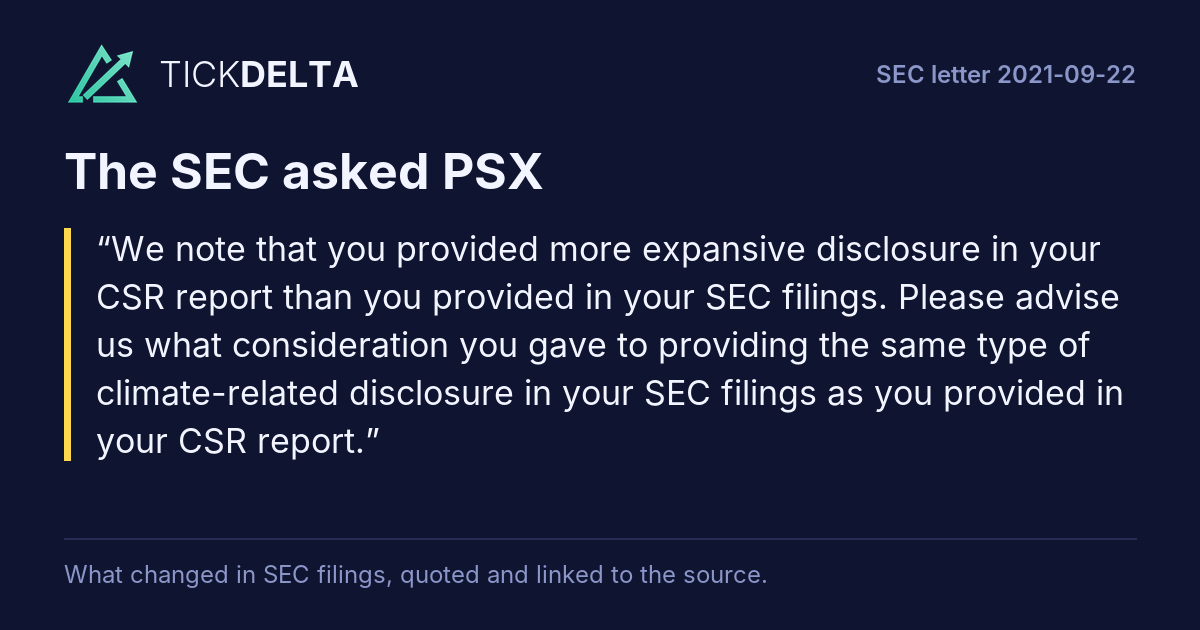
We note that you provided more expansive disclosure in your CSR report than you provided in your SEC filings. Please advise us what consideration you gave to providing the same type of climate-related disclosure in your SEC filings as you provided in your CSR report.
We periodically provide our stakeholders with information on various topics in reports and presentations that are publicly available on our website. In response to requests by certain stakeholders, we have supplementally disclosed additional climate-related information in our stand-alone Sustainability Report, which is approximately 68 pages in length.Read in the reply ↗Rest of the answer
Our Sustainability Report provides a single, convenient location for stakeholders to review (i) certain material environmental, social and governance (ESG) information that is included in both the Sustainability Report and our SEC filings and (ii) additional supplemental information that is of interest to certain stakeholders but not required in our SEC filings. The supplemental information is not information required by Regulation S-K, nor is it necessary to make any of the statements included in our SEC filings not misleading. We considered voluntarily including certain of the supplemental information in our SEC filings; however, we believed including this additional information would make our SEC filings unnecessarily longer and more difficult to read.
We believe that our SEC filings adequately and appropriately inform investors as to material information about our business, strategy, and financial results, including climate-related information. As discussed in response to other comments in this letter, we have disclosed climate-related information about our business, strategy, and financial results, including the risk of an investment in our Company, in the 2020 Form 10-K.
If material, please discuss with greater specificity the indirect consequences of climaterelated regulation or business trends such as the increased demand for goods that result in lower emissions or are related to alternative energy sources and strategic opportunities that may arise for your company as a result of climate change.
We respectfully note that we have disclosed the material consequences that climate-related regulation and business trends may have on our Company, and we believe those disclosures provide sufficient specificity for investors. These disclosures can be found in the Risk Factors and Management’s Discussion and Analysis of Financial Condition and Results of Operations (MD&A) sections of the 2020 Form 10-K.
Specifically, we describe the potential for increased costs and decreased demand for our products as a result of climate change in the Risk Factors section of the 2020 Form 10-K under theRead in the reply ↗Rest of the answer
sub-heading “Regulatory and Environmental, Climate and Weather Risks.” These risks include the following, each of which is discussed with specificity therein:
•We expect to continue to incur substantial capital expenditures and operating costs as a result of our compliance with existing and future environmental laws and regulations;
•The adoption of climate change legislation or regulation could result in increased operating costs and reduced demand for the refined petroleum products we produce;
•Compliance with the EPA’s Renewable Fuel Standard (RFS) could adversely affect our financial results; and
•Societal, technological, political and scientific developments around emissions and fuel efficiency may decrease demand for transportation fuels.
We also disclosed in the MD&A of the 2020 Form 10-K information regarding environmental regulations that we believe are reasonably likely to have a material effect on the Company’s financial condition or results of operations. Specifically, we disclosed the most significant international and federal environmental laws and regulations to which we are subject and described the impact they have and can have on our business under “Contingencies —Environmental.” For example, we disclosed that the Energy Independence and Security Act of 2007 requires fuel producers and importers to provide additional renewable fuels for transportation motor fuels and stipulates a mix of various types and noted that we may experience a decrease in demand for refined petroleum products due to the regulatory program as currently promulgated. We also disclosed, under “—Climate Change,” information about legislation focusing on greenhouse gas (GHG) emissions reduction, and precursors for possible regulation, that already have affected or could affect our operations. Please see pages 61 through 65 of the 2020 Form 10-K.
We also believe that there are strategic opportunities for us as a result of climate change. In the MD&A section of the 2020 Form 10-K, we disclosed the formation of our Emerging Energy organization, which is focused on lower-carbon opportunities within our portfolio, as well as commercializing emerging energy technologies. As this organization continues its work, and as strategic opportunities are identified, we intend to disclose any such material opportunities in our future filings.
We confirm that in future filings, we will continue to disclose information concerning climate-related regulation and business trends, if material.
Quantify any material weather-related damages to your property or operations.
Weather-related damages to our property were not material during the years covered in the 2020 Form 10-K. For the year ended December 31, 2020, we incurred before-tax costs to repair damage sustained from weather-related events of approximately $50 million. For the years ended December 31, 2019 and 2018, we incurred before-tax costs to repair damage from weather-related events of less than $5 million per year.
With respect to weather-related impacts to our results of operations, we respectfully note that the impact of weather-related events is already disclosed in our SEC filings.Read in the reply ↗Rest of the answer
For example, in the MD&A section of our Form 10-Q for the quarter ended September 30, 2020 and the 2020 Form 10-K, we disclosed that lower production by our Refining segment in 2020 was partially attributable to impacts from hurricanes in the Gulf Coast.
We confirm that in future filings, we will continue to disclose the impact of any weather-related damages to our property or operations, if material.
If material, disclose any weather-related impacts on the cost or availability of insurance.
We have not experienced material weather-related impacts on the availability or the cost of the insurance coverage we have historically maintained; for example, insurance premiums paid for property damage coverage were less than $50 million per year in each of the years ended December 31, 2020, 2019 and 2018. Read in the reply ↗
Disclose with specificity the material effects of transition risks related to climate change that may affect your business, financial condition, and results of operations, such as market trends that may alter business opportunities, credit risks, or technological changes.
As discussed in response to the Staff’s comment No. 2, above, we disclosed in the Risk Factors section of the 2020 Form 10-K climate-related risks that we currently face and that we could face in the future as a result of those changes. Our Risk Factors disclosure includes the risks associated with legislation and regulation, consumer demand, societal sentiment and technology related to the energy transition.Read in the reply ↗Rest of the answer
The disclosure also discusses the material adverse effects on our financial condition, results of operations and cash flows that may be caused by reductions in the amount of motor fuels we produce, increased production costs that we are not able to pass along to customers, the diminished ability of refined petroleum products to compete with renewable fuels, and overall reduced demand for our products, among other factors.
As also discussed in response to comment No. 2, above, in the MD&A section of the 2020 Form 10-K, we provided disclosures about climate-related regulation, including transition risk. In that section, we disclosed that the effects of existing and potential future regulations can include significant increases in our costs, reduced demand for fossil energy derived products, impacts to the cost and availability of capital, increased exposure to litigation, and increased demand for less carbon-intensive energy sources.
We confirm that in future filings, we will continue to disclose with specificity the effects of the risks posed by the transition to a lower-carbon economy, if material.
Disclose any material litigation risks related to climate change and the potential impact to the company.
We currently are not a party to any pending legal proceedings related to climate change that require disclosure under Item 103 of Regulation S-K. Additionally, there are no contingencies relating to climate change that require disclosure under U.S. generally accepted accounting principles, such as ASC 450, Contingencies, that have not been disclosed in our SEC filings.
We currently disclose in the 2020 Form 10-K that compliance with climate related laws and regulations can increase our exposure to litigation.Read in the reply ↗Rest of the answer
We confirm that in future filings, when material and where appropriate, we will include additional disclosures about litigation risks related to climate change and the potential impact to the Company.
If applicable and material, provide disclosure about any purchase or sale of carbon credits or offsets and any material effects on your business, financial condition, and results of operations.
We purchase credits in the open market to satisfy obligations under various environmental compliance programs. Governmental regulations in certain jurisdictions require us to blend a certain percentage of biofuels into the motor fuels we produce, primarily the Renewable Fuels Standard in the United States. To the extent we are unable to blend biofuels at the required percentages, we are required to purchase biofuel credits to meet our obligations.Read in the reply ↗Rest of the answer
We also purchase emissions credits to comply with governmental regulations concerning various GHG emissions programs, including cap-and-trade and low carbon fuel standard programs. For the years ended December 31, 2020, 2019 and 2018, we incurred expenses associated with our obligations to purchase biofuel credits under the various environmental compliance programs for our wholly owned businesses of $961 million, $764 million and $741 million, respectively. These amounts are reflected in the “Purchased crude oil and products” line on our consolidated statement of operations.
We concluded that the above amounts did not require separate disclosure in the 2020 Form 10-K because they were not material. These expenses represented approximately 1.7%, 0.8% and 0.8% of the total costs included in the “Purchased crude oil and products” line item for the years ended December 31, 2020, 2019 and 2018, respectively. In addition, the cost to comply with certain programs, such as GHG emissions programs, is generally recovered from customers, which mitigates the overall financial impact to the Company of complying with these programs.
Finally, we periodically sell biofuel credits to mitigate our overall cost of complying with environmental programs. However, the sales of credits are not material. For the years ended December 31, 2020, 2019 and 2018, we received proceeds from the sale of these credits of $209 million, $97 million and $98 million, respectively.
We confirm that in future filings, we will provide disclosure of purchases and sales of carbon credits that have an effect on our business, financial condition and results of operations, if material.
If you have any additional questions or comments, please contact the undersigned.
Your response to prior comment 4 states, in part, that you have not experienced material weather-related impacts on the availability the insurance coverage you have historically maintained. Please provide us with additional support for this statement.
Historically, the most significant weather-related events for our business have been named windstorms, primarily hurricanes. Our named windstorm coverage is obtained through a mutual insurance company in which the insureds are shareholders. Our insurance coverage through the mutual insurer has not changed since we became a publicly traded company in 2012. We do not purchase incremental named windstorm coverage in the commercial market; therefore, our property damage coverage has not been materially impacted by these weather-related events.Read in the reply ↗Rest of the answer
The risk to our business from not having incremental named windstorm insurance coverage is covered in the Risk Factors section of our 2020 Form 10-K where we disclose that we do not insure against all potential losses and only maintain insurance coverage in amounts we believe to be prudent against many, but not all, potential liabilities.
First report after the company's reply of 2021-11-17: 10-K filed 2022-02-18 ↗, against the 10-K filed 2021-02-24 ↗.
Tickdelta does not hold the text of both reports, so they are not compared here.
We note from your response to prior comment 6 that your compliance with climate-related laws and regulations can increase your exposure to litigation. Please tell us how you considered providing disclosure addressing the risks associated with the possibility of climate change related litigation, including litigation not solely related to compliance with climate-related laws and regulations, and its potential impact.
In considering disclosures of the risk of climate-related litigation, we considered the merits of litigation that has already been brought and the likelihood of additional litigation that could reasonably be expected to have a material adverse effect on the Company. Given the expectation of continued legal, political and shareholder pressure on companies, including us, relating to climate-related matters, we intend to include the following additional Risk Factor under the subheading “Regulatory and Environmental, Climate and Weather Risks” in our future filings:
Continuing political andRead in the reply ↗Rest of the answer
social concerns about the issues of climate change may result in changes to our business and significant expenditures, including litigation-related expenses.
Increasing attention to global climate change has resulted in increased investor attention and an increased risk of public and private litigation, which could increase our costs or otherwise adversely affect our business. For example, shareholder activism has recently been increasing in our industry, and shareholders may attempt to effect changes to our business or governance, whether by shareholder proposals, public campaigns, proxy solicitations or otherwise. Additionally, cities, counties, and other governmental entities in several states in the U.S. began filing lawsuits against energy companies in 2017, including Phillips 66. The lawsuits seek damages allegedly associated with climate change, and the plaintiffs are seeking unspecified damages and abatement under various tort theories. Similar lawsuits may be filed in other jurisdictions. We believe these lawsuits are an inappropriate vehicle to address the challenges associated with climate change and will vigorously defend against them for lacking factual and legal merit. The ultimate outcome and impact to us of any such litigation cannot be predicted with certainty, and we could incur substantial legal costs associated with defending these and similar lawsuits in the future. Additionally, any of these risks could result in unexpected costs, negative sentiments about our company, disruptions in our operations, increases to our operating expenses and reduced demand for our products, which in turn could have an adverse effect on our business, financial condition and results of operations.
If you have any additional questions or comments, please contact the undersigned.
First report after the company's reply of 2021-11-17: 10-K filed 2022-02-18 ↗, against the 10-K filed 2021-02-24 ↗.
Tickdelta does not hold the text of both reports, so they are not compared here.
Also in this review: request for more time, 2021-09-30, closing letter, 2022-01-13