Form 10-K for the Fiscal Year Ended September 30, 2016
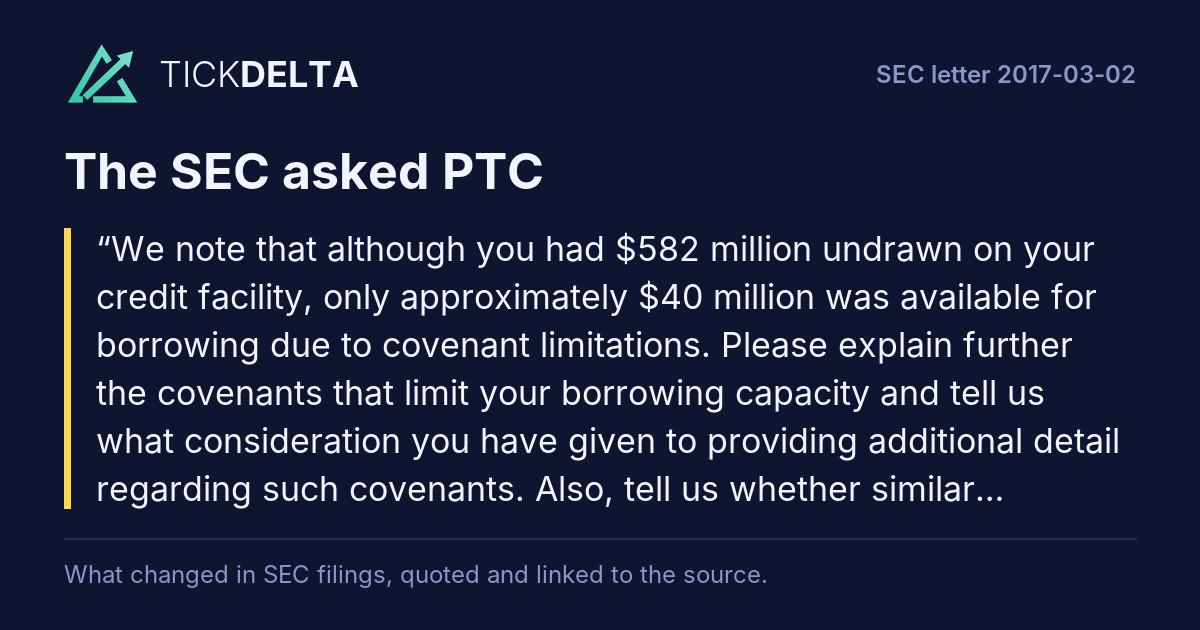
We note that although you had $582 million undrawn on your credit facility, only approximately $40 million was available for borrowing due to covenant limitations. Please explain further the covenants that limit your borrowing capacity and tell us what consideration you have given to providing additional detail regarding such covenants.Rest of the question
Also, tell us whether similar limitations existed at December 31, 2016 and your consideration to include a discussion of available credit, if limited in your Form 10-Q disclosures. Refer to Item 303(a)(1) of Regulation S-K and Section IV.C of SEC Release 33-8350.
The covenants that limit our borrowing capacity under the credit facility consist of a Total Leverage Ratio, a Fixed Charge Coverage
Ratio and a Senior Secured Leverage Ratio, which are described on page 37 of the 2016 Form 10-K and on page 40 of the
Q1FY17 Form 10-Q. Each of these ratios relies on
“consolidated trailing four quarters EBITDA”
(“Consolidated EBITDA”) and the Total Leverage Ratio has had the greatest effect on our borrowing capacity.Read in the reply ↗Rest of the answer
This ratio limited our borrowing capacity under the credit facility as of the end of fiscal 2016 and similarly limited our borrowing capacity as of the end of the quarter ended December 31, 2016. Our borrowing capacity under the credit facility has been limited due to the fact that our earnings have been adversely impacted as we transition to subscription licensing from a perpetual license and support model. This transition and its impact on revenue, operating margin and EPS are discussed under
“Future Expectations,
Strategies and Risks – Subscription” on page 16 of the 2016 Form 10-K and on page 25 of the
Q1FY17 Form 10-Q. The decrease in revenue and earnings reduces
Consolidated EBITDA for the purposes of the financial covenants.
We expect our borrowing capacity under the credit facility will continue to be limited due to our subscription transition.
Accordingly, while we believe the covenants and their effect on our borrowing capacity are clearly described in our periodic filings, as required by Item 303(a)(1) of Regulation S-K and SEC
Release 33-8350, and that, because we disclose both the required ratios and the results of our calculations under the ratios, additional detail about those covenants would not enhance the quality of the disclosure we provide to investors, in future periodic filings, we will also include a summary of the factors that constrain our borrowing capacity along with the actual borrowing capacity, which we will disclose if limited under our covenants. An example of such disclosure is set forth on
Appendix A.
We do not believe additional discussion of available credit is required by Section IV.C of SEC Release 33-8350 as we believe we have sufficient access to additional credit and capital given our cash flow and business performance. We also believe we have sufficient working capital, notwithstanding any limits on our ability to borrow under the credit facility from time to time, given that we use the credit facility primarily for acquisitions and share repurchases, rather than operating liquidity.
First report after the company's reply of 2017-03-16: 10-Q filed 2017-05-11 ↗, against the 10-Q filed 2017-02-09 ↗.
Tickdelta does not hold the text of both reports, so they are not compared here.
Your subscription revenue line item appears to include both product (i.e., term licenses) and service arrangements (i.e., cloud services). Also, your cost of software revenue includes the cost of support services, subscription service arrangements, subscription product arrangements and perpetual license revenues.Rest of the question
Please tell how you considered Rule 5-03(b)(1) and (2) of Regulation S-X to separately present product and service revenues and their related costs on the face of your consolidated statement of operations.
Historically, revenue from cloud arrangements has not represented a material component of our revenue. In Fiscal 2016, 2015 and 2014, hosting and SAAS (collectively, “cloud”) represented 4%, 3% and
1%, respectively, of our consolidated revenue. Because cloud revenue is not more than 10% of our total revenue, we have combined it with other recurring revenue amounts as allowed by the introduction to Rule 5-03(b) of Regulation S-X.Read in the reply ↗Rest of the answer
We will continue to monitor such arrangements and, if cloud revenue becomes a material component of our consolidated revenue in the future, we will separately disclose cloud revenue in our Consolidated Financial
Statements and MD&A.
Our cost of software revenue includes costs related to our support, subscription, perpetual license offerings, and cloud, including salaries, benefits, computer equipment and facility costs associated with providing support, royalties paid to third parties for technology embedded in or licensed with our software products, and amortization of intangible assets associated with acquired products. These costs are incurred in support of all of our software products. Further, our costs are substantially similar across our product lines and our gross margin for our software products is greater than 80%. Accordingly, we do not feel that reporting gross margin by the different lines of business would provide additional material information to investors.
First report after the company's reply of 2017-03-16: 10-Q filed 2017-05-11 ↗, against the 10-Q filed 2017-02-09 ↗.
Tickdelta does not hold the text of both reports, so they are not compared here.
Also, please consider renaming the “total recurring software revenue” and “total software revenue” line items to more appropriately reflect the inclusion of both software and service revenues in these amounts.
In future filings, we will rename the income statement line items to
“subscription and cloud”, “total recurring software and cloud” and “total software and cloud revenue” to make it clear that such amounts include our cloud offerings. Read in the reply ↗
First report after the company's reply of 2017-03-16: 10-Q filed 2017-05-11 ↗, against the 10-Q filed 2017-02-09 ↗.
Tickdelta does not hold the text of both reports, so they are not compared here.
We note that VSOE of fair value for subscription-based licenses is established through use of a substantive renewal clause within the customer contract, and VSOE for cloud service arrangements accounted for under ASC 985-605 is established through a substantive stated renewal rate or stated contract overage rate.Rest of the question
Please clarify the elements in a typical multiple-element arrangement for your subscription and cloud service arrangements. Also, tell us how you determined that the contractually stated renewal provisions were substantive and tell us what percentage of your customers have actually renewed at such rates.
A typical multiple-element arrangement includes subscriptions and renewal support of a customers’ existing perpetual licenses, or subscriptions and cloud services. A multiple-element arrangement for a subscription or cloud service arrangement may also include perpetual licenses, consulting and/or training.
ASC
985-605-55-58 provides that if a contractually stated renewal rate and term are substantive, it provides VSOE for an element in a multiple element arrangement.Read in the reply ↗Rest of the answer
To determine whether contractually-stated renewal rates for subscriptions and cloud services are substantive, we consider if the discount provided from list price results in a commercially reasonable profit, whether customers are renewing at the stated renewal rates and how the renewal rate compares to our historical pricing. Of the subscription and cloud services contracts that have been renewed,
98% of subscriptions and 100% of cloud services renewed at the stated contractual renewal rates. To evaluate the rates, we also consider our pricing of stand-alone support and discounts from list price. The support services that we provide for a perpetual license are the same as for a subscription offering. The annual renewal rate that we charge for a subscription typically exceeds what we charge for annual support on a stand-alone basis.
Additionally, we monitor discounts from list price. The average discounts from list price provided for subscriptions have been lower than the discounts from list price that we historically provided for perpetual licenses. Further, not all customers renew, which is an indication that the renewal rates are economically substantive to their decision.
When considering whether the renewal term is substantive, we consider the length of the initial term in the contract as compared to the renewal term. Typically, subscriptions and cloud services have an initial term of one to three years with the right to renew for one year periods beyond the committed term, in many cases in perpetuity. The renewal period is substantive relative to the initial term and the initial term is relatively short compared to the economic life of the subscription as customers typically use our software for more than five years.
First report after the company's reply of 2017-03-16: 10-Q filed 2017-05-11 ↗, against the 10-Q filed 2017-02-09 ↗.
Tickdelta does not hold the text of both reports, so they are not compared here.
Tell us how you considered the disclosure requirements of ASC 420-10-50-1(d) to disclose the total amount of restructuring charges expected to be incurred, the amount incurred for each period presented, and the cumulative amount incurred to date for each of your reportable segments.
restructuring actions are driven by business realignments and expense reduction initiatives established on a total company basis.
Expense reduction targets (primarily headcount-related) and resulting restructuring costs are established by functional cost area (e.g., sales and marketing, research and development, general and administrative) and not by reportable segment.Read in the reply ↗Rest of the answer
We disclose the amount of restructuring charges expected to be incurred, the amount incurred for each period presented, and the cumulative amount incurred to date in total; we do not disclose such amounts by reportable segments as contemplated in ASC 420-10-50-1(d) because we do not internally report and track restructuring charges by reportable segment. Further, for purposes of evaluating segment performance, we do not allocate restructuring charges to our reportable segments nor do we view restructuring charges by segment as material to investors’ understanding of our segment results and profitability. In Note O. Segment Information, we disclose the following regarding restructuring charges
“Additionally, the segment profit does not include stock-based compensation, amortization of intangible assets, restructuring charges and certain other identified costs that we do not allocate to the segments for purposes of evaluating their operational performance.”
First report after the company's reply of 2017-03-16: 10-Q filed 2017-05-11 ↗, against the 10-Q filed 2017-02-09 ↗.
Tickdelta does not hold the text of both reports, so they are not compared here.
We note your response to prior comment 2. It remains unclear how you determined that combining the cost of both product and services (i.e., support) in cost of software revenue on the face of your consolidated statement of operations complies with Rule 5-03(b)(2) of Regulation S-X. Please explain further and clarify how you determined that similar margins are achieved for all products and services.Rest of the question
Also, tell us how you considered applying a reasonable allocation methodology to separately reflect the direct cost of both product and service revenues for purposes of complying with this Rule.
Prior to 2016, revenue from subscription contracts was immaterial and was classified with license revenue (subscription revenue comprised only 5% and 2% of total revenue in 2015 and 2014, respectively.) In
2016, we began a strategic initiative to expand adoption of our subscription license offerings by our customers.Read in the reply ↗Rest of the answer
Accordingly, in order to provide investors with a clear view of our results and the change in our business model, and because we expected subscription revenue to become an increasingly larger percentage of our revenue, we began reporting subscription revenue as a separate line item in our income statement. At the time that we made that change, we assessed how we should report our cost of revenue and, specifically, whether we should report product costs and service costs separately. As part of that assessment, we considered the nature of the costs and how we internally measure and track the costs. We also considered what was meaningful to our investors relative to providing costs for our software solutions.
A substantial portion of our software costs are indirect costs incurred in support of multiple products and services. For example, approximately 90% of our support costs are related to costs incurred in support of both license and subscription products, including compensation and benefits and facilities and information technology-related costs. The same group of individuals provide support for both license and subscription products and we do not track nor report these costs separately by product or service, as we do not manage our business in this manner. We concluded that allocating all of these costs to different revenue streams would not provide meaningful information to investors because it would result in similar margins for support, license and subscription revenue. Historical margins for the software service elements
(support) and software product elements (license) were similar. In the Statement of Operations and in Management’s Discussion and Analysis of our Annual Report on Form 10-K for the year ended
September 30, 2015, we reported “license and subscription” gross margins of 85%, 88% and 89% for 2015,
2014 and 2013, respectively, and support gross margin of 88% for each of 2015, 2014 and 2013.
We do report cost of professional services revenue separately from cost of software revenue as the margins related to our professional services, which ranged from 12% to 14% in the three years ended
September 30, 2016, are significantly lower than those for our software solutions.
As our business evolves, we will continue to assess our presentation of product and service revenue and costs in our income statement, and make changes in the future, if necessary, to ensure that we provide useful information to our investors and continue to comply with
Rule 5-03 of Regulation S-X.
First report after the company's reply of 2017-04-20: 10-Q filed 2017-05-11 ↗, against the 10-Q filed 2017-02-09 ↗.
Tickdelta does not hold the text of both reports, so they are not compared here.
In your response to prior comment 1 you provide the historical gross margins for “license and subscription” and “support” to explain why you believe it is appropriate to combine all costs, excluding professional services, into one cost of revenue line item.Rest of the question
While we understand that you no longer include such a breakdown in your consolidated statements of operations, please provide us with similar gross margin information for fiscal 2016 and to date in fiscal 2017. In this regard, we note that the license and subscription margins decreased from 88% in fiscal 2014 to 85% in fiscal 2015. If there are further reductions in such margins, please explain the reasons for such change. For example, to the extent that the margins for your subscription products are impacting the software margins, please revise to include a discussion of such impact in MD&A. Also, while you state that the same group of individuals provides support for both license and subscription products, tell us whether you are able to apply a reasonable methodology to separately reflect the costs of these revenue streams to the extent that the margins differ significantly.
License and subscription gross margins were approximately 76% in 2016 and
78% to date in 2017. Support gross margins were approximately 87% in 2016 and 85% to date in 2017. These margins are based on costs as internally reported and do not include an allocation of support costs to subscription.
and subscription margins decreased in 2016 and to date in 2017, compared to 2015, due to a higher mix of subscription sales, which has caused perpetual license revenue to decrease as customers move from perpetual licenses to subscription licenses.Read in the reply ↗Rest of the answer
(As reported, perpetual license revenue decreased 39% in 2016 compared to 2015 and decreased 29% in the first six months of 2017 compared to the first six months of 2016.) We have discussed this effect, and the fact that margins and earnings have decreased and will continue to decrease as a result of the subscription transition, in our 2016
Annual Report on Form 10-K and our 2017 Quarterly Reports on
Form 10-Q.
We disclosed the following in MD&A on page 16 of our 2016
Annual Report (and we made similar disclosures on page 25 of each of our Quarterly Reports for the first and second quarters of fiscal 2017 ended December 31, 2016 and April 1, 2017, respectively):
“Subscription
Historically, the majority of our software licenses were sold as perpetual licenses, under which customers own the software license and revenue is recognized at the time of sale. We began offering subscription licensing for our core Solutions Group products in 2015 and expanded our subscription program in 2016. Under a subscription, customers pay a periodic fee to license our software and access technical support over a specified period of time. As part of our expanded subscription program, we also launched a program for our existing customers to convert their support contracts to subscription contracts. A number of customers converted their support contracts to subscriptions in 2016, and we expect there will be continued opportunities to convert existing support contracts to subscription contracts in 2017 and beyond due to the renewal cycles of certain of those contracts.
2016, 56% of our bookings were sold as subscriptions, compared to
17% in 2015. We expect that in 2017 a significant majority of our license and subscription bookings could be subscription. The transition to a subscription licensing model has had, and will continue to have, an adverse impact on revenue, operating margin and EPS growth relative to periods in which we primarily sold perpetual licenses, until the transition of our customer base to subscription is completed.” have also disclosed the effect of the decline in perpetual license revenue on gross margin in MD&A in our filings for 2016 and
2017 to date, as follows:
“Gross margin as a percentage of total revenue in 2016 compared to 2015 reflects lower software margins due to lower perpetual license revenue.”
(Page 20 of our 2016 Form 10-K)
“Gross margin as a percentage of total revenue in the first quarter of 2017 compared to the first quarter of 2016 reflects lower perpetual license
(Page 30 of our First Quarter 2017 Form 10-Q) margin as a percentage of total revenue in the second quarter and first six months of 2017 compared to the second quarter and first six months of 2016 reflects lower perpetual license revenue and an increase in cloud services revenue, which has lower margins than perpetual license, subscription and support
(Page 31 of our Second Quarter 2017 Form 10-Q)
We have also disclosed in MD&A the reasons for material changes in cost of software revenue. For example, we made the disclosures set forth below in our recent filings.
“In the first quarter 2017, compared to the first quarter of 2016, total compensation, benefit costs and travel costs increased $4.2 million (21%) primarily as a result of more headcount supporting our cloud services business.”
(Page 31 of our First Quarter 2017 Form 10-Q) the second quarter and first six months of 2017 compared to the second quarter and first six months of 2016, total compensation, benefit costs and travel expenses increased 20% ($4.0 million) and
20% ($8.2 million), respectively, primarily as a result of more headcount supporting our cloud services business.”
(Page 32 of our Second Quarter 2017 Form 10-Q)
For future filings, we will develop a reasonable allocation methodology to allocate a portion of support costs to the cost of license and subscription and will report cost of license and subscription revenue and cost of support revenue, and the associated margins, separately. We will continue to discuss the reasons for changes in our margins and costs in MD&A.
First report after the company's reply of 2017-05-22: 10-Q filed 2017-08-08 ↗, against the 10-Q filed 2017-02-09 ↗.
Tickdelta does not hold the text of both reports, so they are not compared here.
We note that prior to fiscal 2016, you separately presented cost of support revenue in your statement of operations. Considering the related service revenues are greater than 10% of total revenue and as the cost of revenue information appears to be readily available, please revise to separately present the related cost of support revenue in your consolidated statement of operations.Rest of the question
We refer you to Item 5-03(b) of Regulation S-X.
As discussed above in our response to your first comment, in future filings we will present cost of support revenue separately from cost of license and subscription revenue in our consolidated statement of operations. Read in the reply ↗
First report after the company's reply of 2017-05-22: 10-Q filed 2017-08-08 ↗, against the 10-Q filed 2017-02-09 ↗.
Tickdelta does not hold the text of both reports, so they are not compared here.
You state in your response to prior comment 1that in future filings you will report cost of license and subscription and cost of support revenue and the associated margins separately. Please tell us whether you are able to apply a reasonable methodology to also separately report the cost of perpetual license from the cost of subscription revenues and their associated margins, which appear to differ based on yourRest of the question
response and the disclosures you highlighted in MD&A.
As we agreed with you, given the inherent complexity in developing a methodology to allocate (i) cost of support and (ii) cost of license and subscription, respectively, between perpetual license and subscription, and the fact that we have not completed our analysis for the purposes of ASC 606, we will report
Cost of Support and
Cost of License and
Subscription on the income statement through our adoption of
ASC 606 in our fiscal year 2019 (the fiscal year ending
September 30, 2019). Cost of
Support and
Subscription will be reported consistent with our internal reporting.Read in the reply ↗Rest of the answer
Accordingly, Cost of
Support will include the cost of supporting both perpetual licenses and subscription, and Cost of License and Subscription will include the cost of perpetual licenses and subscription licenses.
We will include appropriate disclosure in both the Notes to the Financial Statements and in MD&A to explain what is in each of these cost lines as they are not directly comparable to the reported revenue lines. We will also continue to disclose in
MD&A information about the significant components of those costs and significant changes and trends in margins and costs.
When we adopt ASC 606 in fiscal 2019, we will report services and product revenues and costs separately and align our costs with our revenue lines (including applying reasonable cost allocations to the extent necessary).
First report after the company's reply of 2017-06-27: 10-Q filed 2017-08-08 ↗, against the 10-Q filed 2017-02-09 ↗.
Tickdelta does not hold the text of both reports, so they are not compared here.
Also in this review: closing letter, 2017-06-30