Paragraph 193 · 49% changed
Every version of it
Screener
/
SEC EDGAR
/CIK 0000889900
/10-K filed Feb 10, 2026, compared with Feb 11, 2025
/Numbers from the XBRL of the 10-Ks
Nasdaq
Energy · Drilling Oil & Gas Wells
Patterson UTI Energy Inc PTEN
The 10-K against last year's
135 changes: 32 added, 25 removed, 76 reworded, 2 quiet changes
10-K Feb 10, 2026 vs Feb 11, 2025
Risk Factors
14.4%
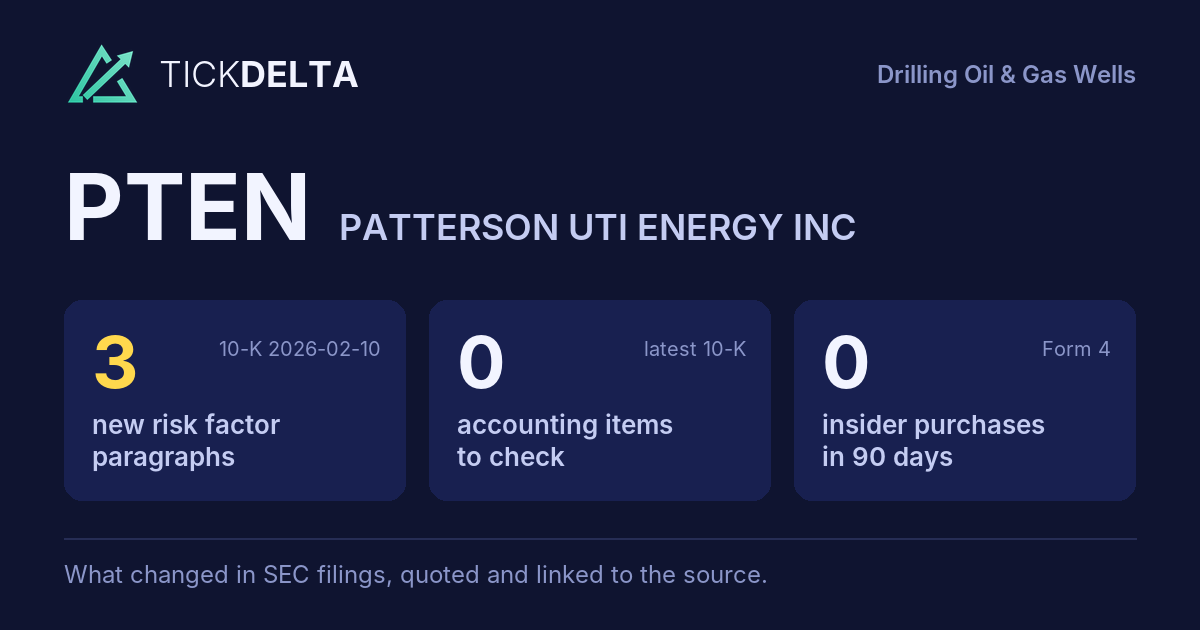
of the text changed · 14,057 words now · 3 new paragraphs, 6 gone
MD&A
23.8%
of the text changed · 9,634 words now · 29 new paragraphs, 19 gone
Legal Proceedings
26.1%
of the text changed · 449 words now
Accounting Policies
22.1%
of the text changed · 2,488 words now
10-K 0000889900-26-000013 (Feb 10, 2026) vs 10-K 0000889900-25-000034 (Feb 11, 2025)
Every paragraph, and how much of it changed
One bar per paragraph, in the order of the 10-K. Height and colour show the share of its words not in the closest paragraph a year earlier; the tallest bars are new paragraphs.
Risk Factors
193 paragraphs · 3 new · 67 reworded · 6 gone · 10-K Feb 10, 2026 against Feb 11, 2025
New paragraph
Reworded (5% of its words or more)
Same or nearly
Paragraph 2 · 43% changed
Every version of it
Paragraph 168 · 42% changed
Every version of it
Paragraph 78 · 42% changed
Every version of it
to perform services in such areas. The loss or consolidation of key customers employees, the failure to attract and retain qualified personnel and the increase in labor costs could have a material adverse effect on our business, financial condition condition, cash flows and results of operations.
Paragraph 70 · 40% changed
Every version of it
Paragraph 121 · 40% changed
Every version of it
The physical and regulatory effects of climate change could have a negative impact on our operations, our customers’ operations and the overall demand for our customers’ products and, accordingly, our services. There is an increasing In recent years, GHG emissions and climate change issues have been a focus of local, state, regional, national and international regulatory bodies on GHG emissions and climate change issues. Legislation to regulate GHG emissions has periodically been introduced in the U.S. Congress, and there has been a subject of wide-ranging policy debate, both in the United States and internationally, regarding the internationally. Initiatives that would impact of these gases our industry and possible means for their regulation. These efforts regulate GHG emissions have included consideration of cap-and-trade programs, carbon taxes, GHG reporting, tracking programs, attestation requirements and regulations that directly limit GHG emissions from certain sources. Some of the proposals would require industries to meet If new or more stringent new standards are enacted that would require substantial reductions in carbon emissions. Those and/or GHG emissions, such reductions could be costly and difficult to implement. In addition to such legislative efforts, implement in the EPA has determined that GHG emissions present a danger to public health and the environment and has adopted regulations that, among other things, establish construction and operating permit reviews for GHG emissions from certain large stationary sources, require the monitoring and annual reporting of GHG emissions from certain oil and natural gas system sources, implement CAA emission standards directing sector. Additionally, in the absence of federal actions targeting GHG emissions and associated impacts, states and local governments may increasingly attempt to step in to pass more stringent regulations that may impact our and our customers’ operating costs and demand for services. Further, international focus on and efforts aimed at reducing GHG emissions and to address climate change may impact our operations. Several states and geographic regions in the United States have also adopted legislation and regulations to reduce emissions of GHGs, including cap and trade regimes and commitments to contribute to meeting certain emissions reduction of methane emissions from certain new, goals.
Paragraph 50 · 39% changed
Every version of it
Concerns regarding global economic conditions, energy costs, geopolitical issues, supply chain disruptions, public health crises or global pandemics, inflation and the availability and cost of credit have contributed, and may in the future contribute, to increased economic uncertainty. Demand for energy and for oil and natural gas end products is highly sensitive to economic conditions; as a result, global economic conditions, indications that economic growth is slowing and volatility in commodity prices may cause our customers to reduce or curtail their drilling and well completion programs, which could result in a decrease in demand for our services. In addition, uncertainty in the capital markets, whether due to global economic conditions, low commodity prices or otherwise, may result in reduced access to, or an inability to obtain, financing by us, our customers and our suppliers and result in reduced demand for our services. An economic slowdown or recession in the United States or in any other country that significantly affects the supply of or demand for oil or natural gas could negatively impact our operations and therefore adversely affect our results. Furthermore, these factors may result in certain of our customers experiencing an inability or unwillingness to pay suppliers, including us. The global economic environment in the past has experienced significant deterioration in a relatively short period, such as a result of the COVID-19 pandemic or the ongoing armed conflicts between Russia and Ukraine and in the Middle East, and there is no assurance that the global economic environment, or expectations for the global economic environment, will not quickly deteriorate again due to one or more factors, including as a result of actual or perceived threats to geopolitical stability, changes in production from OPEC, its members and other oil-producing nations, or governmental actions or restrictions in response to events such as a global pandemic. A deterioration in the global economic environment could have a material adverse effect on our business, financial condition, cash flows and results of operations.
Paragraph 48 · 38% changed
Every version of it
All of these factors are beyond our control. Commodity prices have historically been volatile, volatile but have been were relatively range-bound since from the end of 2022. 2022 through the first quarter of 2025. The current demand for equipment and services remains impacted by macro conditions, including commodity prices, geopolitical environment, changes to international tariffs and trade policies, inflationary pressures, economic conditions in the United States and elsewhere, as well as customer consolidation and focus by exploration and production companies and service companies on capital returns. During the second quarter of 2025, global economic conditions deteriorated, in part, because of enacted and proposed trade policies and tariffs by the United States and other governments, as well as uncertainty regarding potential future changes to global trade policies and tariffs. Additionally, during the second quarter of 2025, OPEC+ countries began phasing out voluntary crude oil production cuts, leading to an increase in global supply. These developments, combined with rising geopolitical tensions—particularly in the Middle East—heightened uncertainty in global energy markets, which contributed to a decline in our share price, lowered average crude oil futures prices and increased uncertainty regarding the future economic environment in which we operate. During the second half of 2025, global economic conditions and the global energy market remained uncertain, with ongoing effects from trade policy uncertainty, the phase-out of voluntary crude oil production cuts by OPEC+ countries and downward pressure on crude oil futures prices. While the full effects are yet to be determined, prolonged trade tensions and sustained lower crude oil futures prices could adversely affect our future outlook on activity and profitability. Oil prices averaged $70.73 $59.62 per barrel in the fourth quarter of 2024 2025 and closed at $73.52 $61.60 per barrel on February 3, 2025. 2, 2026. Natural gas prices (based on the Henry Hub Spot Market Price) averaged $2.45 $3.73 per MMBtu in the fourth quarter of 2024 2025 and closed at $3.30 $4.40 per MMBtu on February 3, 2025. 2, 2026.
Paragraph 193 · 49% changed
Every version of it
10-K Feb 11, 2025Our bylaws provide that, to the fullest extent permitted by law, the Court of Chancery of the State of Delaware (or, if the Court of Chancery does not have, or declines to accept, jurisdiction, another state court or a federal court located within the State of Delaware) is the exclusive forum for any claims, including claims in the right of Patterson-UTI: (a) that are based upon a violation of a duty by a current or former director, officer, employee or stockholder in such capacity, or (b) as to which the General Corporation Law of the State of Delaware confers jurisdiction upon the Court of Chancery. This provision would not apply to suits brought to enforce a duty or liability created by the Exchange Act or any other claim for which the U.S. federal courts have exclusive jurisdiction. Our bylaws further provide that the sole and exclusive forum for any complaint asserting a cause of action arising under the Securities Act, to the fullest extent permitted by law, shall be the federal district courts of the United States. The enforceability of similar exclusive federal forum provisions in other companies’ organizational documents has been challenged in legal proceedings, and while the Delaware Supreme Court has ruled that this type of exclusive federal forum provision is facially valid under Delaware law, there is uncertainty as to whether other courts would enforce such provisions and that investors cannot waive compliance with the federal securities laws and the rules and regulations thereunder. These exclusive forum provisions may limit a stockholder’s ability to bring a claim in a judicial forum that it finds favorable for disputes with us or our directors, officers or other employees, which may discourage such lawsuits against us and our directors, officers and other employees. Alternatively, if a court were to find either exclusive forum provision in our bylaws to be inapplicable or unenforceable in an action, we may incur additional costs associated with resolving such action in other jurisdictions, which could have a material adverse effect on our business, financial condition, and results of operations.
10-K Feb 10, 2026
forum that it finds favorable for disputes with us or our directors, officers or other employees, which may discourage such lawsuits against us and our directors, officers and other employees. Alternatively, if a court were to find either exclusive forum provision in our bylaws to be inapplicable or unenforceable in an action, we may incur additional costs associated with resolving such action in other jurisdictions, which could have a material adverse effect on our business, financial condition and results of operations.
Paragraph 2 · 43% changed
Every version of it
10-K Feb 11, 2025You should consider each of the following factors as well as the other information in this Report in evaluating our business and our prospects. Additional risks and uncertainties not presently known to us or that we currently consider immaterial may also impair our business operations. If any of the following risks actually occur, our business, financial condition, cash flows and results of operations could be harmed. You should also refer to the other information set forth in this Report, including our consolidated financial statements and the related notes.
10-K Feb 10, 2026
could be harmed. You should also refer to the other information set forth in this Report, including our consolidated financial statements and the related notes.
Paragraph 168 · 42% changed
Every version of it
10-K Feb 11, 2025Our ability to make scheduled payments on or to refinance our debt obligations depends on our financial and operating performance, including the ability of our subsidiaries to generate sufficient cash flows, which is subject to prevailing economic and competitive conditions and to certain financial, business and other factors beyond our control. We cannot assure you that we will maintain a level of cash flows from operating activities sufficient to permit us to pay the principal, premium, if any, and interest on our indebtedness.
10-K Feb 10, 2026
maintain a level of cash flows from operating activities sufficient to permit us to pay the principal, premium, if any, and interest on our indebtedness.
Paragraph 78 · 42% changed
Every version of it
10-K Feb 11, 2025
The loss or consolidation of key customers could have a material adverse effect on our financial condition and results of operations.
10-K Feb 10, 2026
to perform services in such areas. The loss of key employees, the failure to attract and retain qualified personnel and the increase in labor costs could have a material adverse effect on our business, financial condition, cash flows and results of operations.
Paragraph 70 · 40% changed
Every version of it
10-K Feb 11, 2025Fixed-term drilling contracts customarily provide for termination at the election of the customer, with an early termination payment to us if a contract is terminated prior to the expiration of the fixed term. However, in certain circumstances, for example, destruction of a drilling rig that is not replaced within a specified period of time, our bankruptcy, or a breach of our contract obligations, the customer may not be obligated to make an early termination payment to us. Additionally, during depressed market conditions or otherwise, customers may be unable to satisfy their contractual obligations or may seek to terminate, suspend or renegotiate or otherwise fail to honor their contractual obligations, including as a result of their bankruptcy. In addition, we may not be able to perform under these contracts due to events beyond our control, and our customers may seek to terminate or renegotiate our contracts for various reasons, including those described above. As a result, we may be unable to realize all of our current contract drilling backlog. In addition, the termination, suspension or renegotiation of fixed-term contracts without the receipt of early termination payments could have a material adverse effect on our business, financial condition, cash flows and results of operations.
10-K Feb 10, 2026
for various reasons, including those described above. As a result, we may be unable to realize all of our contract drilling backlog. In addition, the termination, suspension or renegotiation of fixed-term contracts without the receipt of early termination payments could have a material adverse effect on our business, financial condition, cash flows and results of operations.
Paragraph 121 · 40% changed
Every version of it
10-K Feb 11, 2025
The physical and regulatory effects of climate change could have a negative impact on our operations, our customers’ operations and the overall demand for our customers’ products and, accordingly, our services. There is an increasing focus of local, state, regional, national and international regulatory bodies on GHG emissions and climate change issues. Legislation to regulate GHG emissions has periodically been introduced in the U.S. Congress, and there has been a wide-ranging policy debate, both in the United States and internationally, regarding the impact of these gases and possible means for their regulation. These efforts have included consideration of cap-and-trade programs, carbon taxes, GHG reporting, tracking programs, attestation requirements and regulations that directly limit GHG emissions from certain sources. Some of the proposals would require industries to meet stringent new standards that would require substantial reductions in carbon emissions. Those reductions could be costly and difficult to implement. In addition to such legislative efforts, the EPA has determined that GHG emissions present a danger to public health and the environment and has adopted regulations that, among other things, establish construction and operating permit reviews for GHG emissions from certain large stationary sources, require the monitoring and annual reporting of GHG emissions from certain oil and natural gas system sources, implement CAA emission standards directing the reduction of methane emissions from certain new,
10-K Feb 10, 2026
The physical and regulatory effects of climate change could have a negative impact on our operations, our customers’ operations and the overall demand for our customers’ products and, accordingly, our services. In recent years, GHG emissions and climate change issues have been a focus of local, state, regional, national and international regulatory bodies and the subject of wide-ranging policy debate, both in the United States and internationally. Initiatives that would impact our industry and regulate GHG emissions have included cap-and-trade programs, carbon taxes, GHG reporting, tracking programs, attestation requirements and regulations that directly limit GHG emissions from certain sources. If new or more stringent standards are enacted that would require substantial reductions in carbon and/or GHG emissions, such reductions could be costly and difficult to implement in the oil and natural gas sector. Additionally, in the absence of federal actions targeting GHG emissions and associated impacts, states and local governments may increasingly attempt to step in to pass more stringent regulations that may impact our and our customers’ operating costs and demand for services. Further, international focus on and efforts aimed at reducing GHG emissions and to address climate change may impact our operations. Several states and geographic regions in the United States have also adopted legislation and regulations to reduce emissions of GHGs, including cap and trade regimes and commitments to contribute to meeting certain emissions reduction goals.
Paragraph 50 · 39% changed
Every version of it
10-K Feb 11, 2025
Concerns regarding global economic conditions, energy costs, geopolitical issues, supply chain disruptions, public health crises or global pandemics, inflation and the availability and cost of credit have contributed, and may in the future contribute, to increased economic uncertainty. Demand for energy and for oil and natural gas end products is highly sensitive to economic conditions; as a result, global economic conditions, indications that economic growth is slowing and volatility in commodity prices may cause our customers to reduce or curtail their drilling and well completion programs, which could result in a decrease in demand for our services. In addition, uncertainty in the capital markets, whether due to global economic conditions, low commodity prices or otherwise, may result in reduced access to, or an inability to obtain, financing by us, our customers and our suppliers and result in reduced demand for our services. An economic slowdown or recession in the United States or in any other country that significantly affects the supply of or demand for oil or natural gas could negatively impact our operations and therefore adversely affect our results. Furthermore, these factors may result in certain of our customers experiencing an inability or unwillingness to pay suppliers, including us. The global economic environment in the past has experienced significant deterioration in a relatively short period, such as a result of the COVID-19 pandemic or the ongoing armed conflicts between Russia and Ukraine and in the Middle East, and there is no assurance that the global economic environment, or expectations for the global economic environment, will not quickly deteriorate again due to one or more factors, including as a result of actual or perceived threats to geopolitical stability, changes in production from OPEC, its members and other oil-producing nations, or governmental actions or restrictions in response to events such as a global pandemic. A deterioration in the global economic environment could have a material adverse effect on our business, financial condition, cash flows and results of operations.
10-K Feb 10, 2026
Concerns regarding global economic conditions, energy costs, geopolitical issues, supply chain disruptions, public health crises or global pandemics, inflation and the availability and cost of credit have contributed, and may in the future contribute, to increased economic uncertainty. Demand for energy and for oil and natural gas end products is highly sensitive to economic conditions; as a result, global economic conditions, indications that economic growth is slowing and volatility in commodity prices may cause our customers to reduce or curtail their drilling and well completion programs, which could result in a decrease in demand for our services. In addition, uncertainty in the capital markets, whether due to global economic conditions, low commodity prices or
Paragraph 48 · 38% changed
Every version of it
10-K Feb 11, 2025
All of these factors are beyond our control. Commodity prices have historically been volatile, but have been relatively range-bound since the end of 2022. The current demand for equipment and services remains impacted by macro conditions, including commodity prices, geopolitical environment, inflationary pressures, economic conditions in the United States and elsewhere, as well as customer consolidation and focus by exploration and production companies and service companies on capital returns. Oil prices averaged $70.73 per barrel in the fourth quarter of 2024 and closed at $73.52 per barrel on February 3, 2025. Natural gas prices (based on the Henry Hub Spot Market Price) averaged $2.45 per MMBtu in the fourth quarter of 2024 and closed at $3.30 per MMBtu on February 3, 2025.
10-K Feb 10, 2026
All of these factors are beyond our control. Commodity prices have historically been volatile but were relatively range-bound from the end of 2022 through the first quarter of 2025. The current demand for equipment and services remains impacted by macro conditions, including commodity prices, geopolitical environment, changes to international tariffs and trade policies, inflationary pressures, economic conditions in the United States and elsewhere, as well as customer consolidation and focus by exploration and production companies and service companies on capital returns. During the second quarter of 2025, global economic conditions deteriorated, in part, because of enacted and proposed trade policies and tariffs by the United States and other governments, as well as uncertainty regarding potential future changes to global trade policies and tariffs. Additionally, during the second quarter of 2025, OPEC+ countries began phasing out voluntary crude oil production cuts, leading to an increase in global supply. These developments, combined with rising geopolitical tensions—particularly in the Middle East—heightened uncertainty in global energy markets, which contributed to a decline in our share price, lowered average crude oil futures prices and increased uncertainty regarding the future economic environment in which we operate. During the second half of 2025, global economic conditions and the global energy market remained uncertain, with ongoing effects from trade policy uncertainty, the phase-out of voluntary crude oil production cuts by OPEC+ countries and downward pressure on crude oil futures prices. While the full effects are yet to be determined, prolonged trade tensions and sustained lower crude oil futures prices could adversely affect our future outlook on activity and profitability. Oil prices averaged $59.62 per barrel in the fourth quarter of 2025 and closed at $61.60 per barrel on February 2, 2026. Natural gas prices (based on the Henry Hub Spot Market Price) averaged $3.73 per MMBtu in the fourth quarter of 2025 and closed at $4.40 per MMBtu on February 2, 2026.
MD&A
126 paragraphs · 29 new · 44 reworded · 19 gone · 10-K Feb 10, 2026 against Feb 11, 2025
New paragraph
Reworded (5% of its words or more)
Same or nearly
Paragraph 58 · 48% changed
Paragraph 9 · 48% changed
Recent Developments in Market Conditions and Outlook — Commodity prices have historically been volatile but have been were relatively range-bound since from the end of 2022. 2022 through the first quarter of 2025. The current demand for equipment and services remains impacted by macro conditions, including commodity prices, geopolitical environment, changes to international tariffs and trade policies, inflationary pressures, economic conditions in the United States and elsewhere, as well as customer consolidation and focus by exploration and production companies and service companies on capital returns. During the second quarter of 2025, global economic conditions deteriorated, in part, because of enacted and proposed trade policies and tariffs by the United States and other governments, as well as uncertainty regarding potential future changes to global trade policies and tariffs. Additionally, during the second quarter of 2025, OPEC+ countries began phasing out voluntary crude oil production cuts, leading to an increase in global supply. These developments, combined with rising geopolitical tensions- particularly in the Middle East- heightened uncertainty in global energy markets, which contributed to a decline in our share price, lowered average crude oil futures prices and increased uncertainty regarding the future economic environment in which we operate. During the second half of 2025, global economic conditions and the global energy market remained uncertain, with ongoing effects from trade policy uncertainty, the phase-out of voluntary crude oil production cuts by OPEC+ countries, and downward pressure on crude oil futures prices. While the full effects are yet to be determined, prolonged trade tensions and sustained lower crude oil futures prices could adversely affect our future outlook on activity and profitability.
Paragraph 111 · 43% changed
The forecast for the completion cementing services reporting unit assumed lower activity in 2025 2026 compared to estimated average activity levels for full year 2024 2025 and increases in estimated activity of 2% to 8% beginning in 2026 through 2029. moderate growth estimates thereafter. Those estimates were based on future drilling rig and pressure pumping fleet count forecasts during the third second quarter of 2024 2025 and estimated market share. Additionally, Based on the forecast reflected results of the expectation that industry-wide pricing pressure will persist within goodwill impairment test, the completions market and continue to compress adjusted gross profit. These factors negatively impacted the estimated fair value of the cementing services reporting unit. unit exceeded its carrying value with a substantial cushion. Accordingly, no impairment was recorded in the second quarter of 2025.
Paragraph 100 · 41% changed
Paragraph 109 · 37% changed
Paragraph 104 · 36% changed
While we believe the full effects of recent market developments are yet to be determined, prolonged trade tensions and sustained lower crude oil futures prices could adversely affect our judgments future outlook on activity and assumptions are reasonable, geopolitical instability, global profitability. If these conditions persist or regional decreases in the demand of our services and products, deteriorate further, or if other unforeseen macroeconomic considerations conditions emerge, they could negatively impact the expected cash flows used in our recoverability tests on for our asset groups. Such changes could result in impairment charges in the future, which could be material to our results of operations and financial statements as a whole.
Paragraph 103 · 35% changed
Paragraph 112 · 35% changed
The forecast for the drilling products reporting unit assumed continued lower activity during 2025 relative to 2024, with growth domestically as well as estimates thereafter. The increases in estimated activity assumed growth in both domestic and international markets. Those growth estimates were based on drilling rig count forecasts and estimated market share. Geopolitical instability in regions in which we expect to maintain and grow market share, an unfavorable legal proceeding outcome, a global decrease in the demand of drilling products, products or other unforeseen macroeconomic considerations could negatively impact the key assumptions used in our goodwill assessment for our drilling products reporting unit. Based on the results of the goodwill impairment test, the fair value of the drilling products reporting unit exceeded its carrying value by approximately 8%. Accordingly, no impairment was recorded in the second quarter of 2025.
Paragraph 58 · 48% changed
10-K Feb 11, 2025Selling, general and administrative expense increased primarily due to the reorganization of acquired Ulterra and NexTier support personnel to corporate following the NexTier merger and the Ulterra acquisition.
10-K Feb 10, 2026
Depreciation expense increased due to the enhancement of our main corporate office, primarily arising from office consolidation following the NexTier merger and the completion of our digital performance center.
Paragraph 9 · 48% changed
10-K Feb 11, 2025
Recent Developments in Market Conditions and Outlook — Commodity prices have historically been volatile but have been relatively range-bound since the end of 2022. The current demand for equipment and services remains impacted by macro conditions, including commodity prices, geopolitical environment, inflationary pressures, economic conditions in the United States and elsewhere, as well as customer consolidation and focus by exploration and production companies and service companies on capital returns.
10-K Feb 10, 2026
Recent Developments in Market Conditions and Outlook — Commodity prices have historically been volatile but were relatively range-bound from the end of 2022 through the first quarter of 2025. The current demand for equipment and services remains impacted by macro conditions, including commodity prices, geopolitical environment, changes to international tariffs and trade policies, inflationary pressures, economic conditions in the United States and elsewhere, as well as customer consolidation and focus by exploration and production companies and service companies on capital returns. During the second quarter of 2025, global economic conditions deteriorated, in part, because of enacted and proposed trade policies and tariffs by the United States and other governments, as well as uncertainty regarding potential future changes to global trade policies and tariffs. Additionally, during the second quarter of 2025, OPEC+ countries began phasing out voluntary crude oil production cuts, leading to an increase in global supply. These developments, combined with rising geopolitical tensions- particularly in the Middle East- heightened uncertainty in global energy markets, which contributed to a decline in our share price, lowered average crude oil futures prices and increased uncertainty regarding the future economic environment in which we operate. During the second half of 2025, global economic conditions and the global energy market remained uncertain, with ongoing effects from trade policy uncertainty, the phase-out of voluntary crude oil production cuts by OPEC+ countries, and downward pressure on crude oil futures prices. While the full effects are yet to be determined, prolonged trade tensions and sustained lower crude oil futures prices could adversely affect our future outlook on activity and profitability.
Paragraph 111 · 43% changed
10-K Feb 11, 2025
The forecast for the completion services reporting unit assumed lower activity in 2025 compared to average activity levels for full year 2024 and increases in estimated activity of 2% to 8% beginning in 2026 through 2029. Those estimates were based on future drilling rig and pressure pumping fleet count forecasts during the third quarter of 2024 and estimated market share. Additionally, the forecast reflected the expectation that industry-wide pricing pressure will persist within the completions market and continue to compress adjusted gross profit. These factors negatively impacted the estimated value of the reporting unit.
10-K Feb 10, 2026
The forecast for the cementing services reporting unit assumed lower activity in 2026 compared to estimated average activity for full year 2025 and moderate growth estimates thereafter. Those estimates were based on future drilling rig count forecasts during the second quarter of 2025 and estimated market share. Based on the results of the goodwill impairment test, the fair value of the cementing services reporting unit exceeded its carrying value with a substantial cushion. Accordingly, no impairment was recorded in the second quarter of 2025.
Paragraph 100 · 41% changed
10-K Feb 11, 2025Negative market indicators such as lower industry-wide drilling rig and pressure pumping fleet count forecasts, increased volatility and pricing declines in the pressure pumping market, and continued efficiency gains and technology advancements reducing operating days have led to our reduced outlook for activity. During the third quarter of 2024, we viewed the reduction in activity forecasts combined with the recent decline in the market price of our common stock as a triggering event that warranted a quantitative assessment for goodwill impairment.
10-K Feb 10, 2026
During the second quarter of 2025, negative market indicators such as lower industry-wide drilling rig and pressure pumping fleet count forecasts, increased volatility and margin compression for certain of our asset groups led to our reduced outlook for activity. The
Paragraph 109 · 37% changed
10-K Feb 11, 2025Negative market indicators such as lower industry-wide drilling rig and pressure pumping fleet count forecasts, increased volatility and pricing declines in the pressure pumping market, and continued efficiency gains and technology advancements reducing operating days have led to our reduced outlook for activity. During the third quarter of 2024, we viewed the reduction in activity forecasts combined with the recent decline in the market price of our common stock as a triggering event that warranted a quantitative assessment for goodwill impairment.
10-K Feb 10, 2026
During the second quarter of 2025, we viewed the reduction in activity forecasts combined with the decline in the market price of our common stock as a triggering event that warranted a quantitative assessment for goodwill impairment.
Paragraph 104 · 36% changed
10-K Feb 11, 2025
While we believe our judgments and assumptions are reasonable, geopolitical instability, global or regional decreases in the demand of our services and products, or other unforeseen macroeconomic considerations could negatively impact the expected cash flows used in our recoverability tests on our asset groups. Such changes could result in impairment charges in the future, which could be material to our results of operations and financial statements as a whole.
10-K Feb 10, 2026
While the full effects of recent market developments are yet to be determined, prolonged trade tensions and sustained lower crude oil futures prices could adversely affect our future outlook on activity and profitability. If these conditions persist or deteriorate further, or if other unforeseen macroeconomic conditions emerge, they could negatively impact the expected cash flows used in our recoverability tests for our asset groups. Such changes could result in impairment charges in the future, which could be material to our results of operations and financial statements as a whole.
Paragraph 103 · 35% changed
10-K Feb 11, 2025We estimated the fair value of the drilling products and the completion services reporting units using the income approach. Under this approach, we used a discounted cash flow model, which utilized present values of cash flows to estimate fair value. Forecasted cash flows reflected known market conditions in the third quarter of 2024 and management’s anticipated business outlook for each reporting unit. Future cash flows were projected based on estimates of revenue growth rates, gross profit, selling, general and administrative expense, changes in working capital, and capital expenditures. The terminal period used within the discounted cash flow model for each reporting unit consisted of a 1% growth estimate. Future cash flows were then discounted using a market-participant, risk-adjusted weighted average cost of capital of 10.25% for the drilling products reporting unit and 10.75% for the completion services reporting unit. Financial and credit market volatility directly impacts our fair value measurement through the weighted average cost of capital used to determine a discount rate. During times of volatility, significant judgment must be applied to determine whether credit market changes are a short-term or long-term trend.
10-K Feb 10, 2026
The recoverability test for our Latin American contract drilling asset group during the second quarter of 2025 indicated that estimated undiscounted cash flows did not exceed its carrying value. Accordingly, we performed an impairment test and estimated the fair value of the asset group using the income approach. Under this approach, we used a discounted cash flow model, which utilized present values of cash flows to estimate fair value. Forecasted cash flows reflected known market conditions in the second quarter of 2025 and management’s anticipated business outlook for the asset group. Future cash flows were projected based on estimates of revenue, gross profit, selling, general and administrative expense, changes in working capital, and capital expenditures. Future cash flows were then discounted using a market-participant, risk-adjusted weighted average cost of capital. Based on the results of the analysis performed, we recorded a $27.8 million impairment charge to Latin American drilling equipment during the second quarter of 2025 in our drilling services segment.
Paragraph 112 · 35% changed
10-K Feb 11, 2025
The forecast for the drilling products reporting unit assumed continued growth domestically as well as in international markets. Geopolitical instability in regions in which we expect to maintain and grow market share, a global decrease in the demand of drilling products, or other unforeseen macroeconomic considerations could negatively impact the key assumptions used in our goodwill assessment for our drilling products reporting unit.
10-K Feb 10, 2026
The forecast for the drilling products reporting unit assumed lower activity during 2025 relative to 2024, with growth estimates thereafter. The increases in estimated activity assumed growth in both domestic and international markets. Those growth estimates were based on drilling rig count forecasts and estimated market share. Geopolitical instability in regions in which we expect to maintain and grow market share, an unfavorable legal proceeding outcome, a global decrease in the demand of drilling products or other unforeseen macroeconomic considerations could negatively impact the key assumptions used in our goodwill assessment for our drilling products reporting unit. Based on the results of the goodwill impairment test, the fair value of the drilling products reporting unit exceeded its carrying value by approximately 8%. Accordingly, no impairment was recorded in the second quarter of 2025.
A paragraph is matched with the one last year that shares the most of its words; under half in common makes it new. The paragraphs shown are the 8 reworded the most in each section.
The paragraph that changed most in each section
The redline
Marked against last year's 10-K: cut words struck through, new words highlighted.
Risk Factors290 words changed in this paragraph; it is 35% similar to last year's version.
Although we utilize various procedures and controls to mitigate our exposure to or limit the effects of the risks described above, cybersecurity attacks and other cyber events are evolving and unpredictable. In addition, there has been an increase in state-sponsored cyberattacks, which are often conducted by capable, well-funded groups. The rapid evolution and increased adoption of artificial intelligence (“AI”) technologies amplifies these concerns. There can be no assurance that As threat actors adopt and deploy AI tools, the procedures speed and controls that we implement, or that sophistication of cyber threats and privacy risks may increase across our third party service providers implement, will be sufficient to protect our people, systems, information or other property. Moreover, we have no control over the information technology systems environment and those of our customers, suppliers, vendors and others with which suppliers. As we and our systems may connect and communicate. As a result, the occurrence of a cyber incident could go unnoticed for a period of time. Even when an attack has been detected, it is not always immediately apparent what the full nature and scope of any potential harm may be, or how best service providers begin to remediate it. We self-insure most of our cybersecurity risks, and any such incident could have a material adverse effect on our business, financial condition, cash flows and results of operations. As cyber incidents continue to evolve, we integrate AI-enabled tools, those tools may be required targeted or misused in ways that compromise data or enable harmful outputs. Additionally, AI outputs may be inaccurate, biased or unreliable, which could result in legal, regulatory or reputational harm. Misuse could create compliance or reputational risks and lead to incur additional costs legal exposure. Third parties may allege copyright infringement, intellectual property violations or misappropriation related to continue outputs. In addition, the legal and regulatory landscape governing the development and use of AI is rapidly evolving and remains uncertain, and new or changing laws, regulations or enforcement approaches could increase compliance costs, restrict the use or functionality of AI-enabled tools, or expose us to modify regulatory scrutiny, litigation or enhance our protective measures or to investigate or remediate the effects of cyber incidents. other liability.
Source: Item 1A, 10-K 0000889900-26-000013 vs Item 1A, 10-K 0000889900-25-000034
Accounting Policies209 words changed in this paragraph; it is 37% similar to last year's version.
Lease expense for operating leases is recognized on a straight-line basis over the lease term. For finance leases, we amortize the right-of-use ROU asset is amortized on a straight-line basis over the earlier of the useful life of the right-of-use underlying asset or the end of the lease term and record this amortization recorded in depreciation and amortization expense in the consolidated statements of operations. If available, we use the rate implicit in the lease at commencement date to discount the lease payments. If the implicit rate is not available, we use our incremental borrowing rate based on the information available at the commencement date in the determination of the present value of future lease payments. The lease term may include the option to extend or terminate the lease when it is reasonably certain that we will exercise the option. By our policy election, right-of-use assets and lease Lease liabilities with an initial term of one year or less are not recognized adjusted for leasing arrangements, and non-lease and lease components are treated as a single lease component instead of bifurcating those components. For finance leases where we have determined we are reasonably certain to exercise a purchase option to acquire the underlying asset, we amortize the right-of-use asset over the lease term and record this amortization in “Depreciation, depletion, amortization and impairment” in the consolidated statements of operations. We adjust the lease liability to reflect lease payments made during the period and interest incurred on the lease liability using the effective interest method. The incurred method, with interest expense is recorded in “Interest expense” in the consolidated statements of operations.
Source: 10-K text, Note 1 – Description of Business and Summary of Significant Accounting Policies, 10-K 0000889900-26-000013 vs 10-K text, Note 1 – Description of Business and Summary of Significant Accounting Policies, 10-K 0000889900-25-000034
MD&A204 words changed in this paragraph; it is 56% similar to last year's version.
Our revenues, profitability and cash flows are highly dependent upon prevailing prices for oil and natural gas and gas, expectations about future prices, and upon our customers’ ability to access, and willingness to deploy, capital to fund their operating and capital expenditures. Commodity prices have historically been volatile, but have been were relatively range-bound since from the end of 2022. 2022 through the first quarter of 2025. The current demand for equipment and services remains impacted by macro conditions, including commodity prices, geopolitical environment, changes to international tariffs and trade policies, inflationary pressures, economic conditions in the United States and elsewhere, as well as customer consolidation and focus by exploration and production companies and service companies on capital returns. During the second quarter of 2025, global economic conditions deteriorated, in part, because of enacted and proposed trade policies and tariffs by the United States and other governments, as well as uncertainty regarding potential future changes to global trade policies and tariffs. Additionally, during the second quarter of 2025, OPEC+ countries began phasing out voluntary crude oil production cuts, leading to an increase in global supply. These developments, combined with rising geopolitical tensions— particularly in the Middle East— heightened uncertainty in global energy markets, which contributed to a decline in our share price, lowered average crude oil futures prices and increased uncertainty regarding the future economic environment in which we operate. During the second half of 2025, global economic conditions and the global energy market remained uncertain, with ongoing effects from trade policy uncertainty, the phase-out of voluntary crude oil production cuts by OPEC+ countries, and downward pressure on crude oil futures prices. While the full effects are yet to be determined, prolonged trade tensions and sustained lower crude oil futures prices could adversely affect our future outlook on activity and profitability. Oil prices averaged $70.73 $59.62 per barrel in the fourth quarter of 2024. 2025. Natural gas prices (based on the Henry Hub Spot Market Price) averaged $2.45 $3.73 per MMBtu in the fourth quarter of 2024. 2025.
Source: Item 7, 10-K 0000889900-26-000013 vs Item 7, 10-K 0000889900-25-000034
Legal Proceedings44 words changed in this paragraph; it is 86% similar to last year's version.
On February 27, 2023, Ulterra filed a plea to the jurisdiction, and subject thereto, an answer, affirmative defenses and counterclaims. Ulterra’s counterclaims include: (i) declaratory judgments of non-infringement of U.S. Pat. No. 7,568,534 and the ’752 patent; (ii) a declaratory judgment of no royalties after Oct. 22, 2021; (iii) a declaratory judgment that certain other identified patents are expired and therefore not infringed after Oct. 22, 2021; and (iv) a declaratory judgment of no breach of contract. On the same day, Ulterra filed a notice of removal in federal court for the Southern District of Texas, Houston Division (SDTX 4:23-cv-00730), as well as a corresponding notice in Texas state court. NOV moved to dismiss and remand the case back to state court. On February 17, 2024, the Court denied NOV’s motion. On March 19, 2024, Ulterra moved for judgment on the pleadings regarding its declaratory judgment that certain other identified patents are expired and therefore not infringed after October 22, 2021. On February 13, 2025, the motion was granted in part and denied in part.
Source: Item 3, 10-K 0000889900-26-000013 vs Item 3, 10-K 0000889900-25-000034
Sentences and paragraphs added, removed or reworded
Every change, by type
Sentences and paragraphs of PTEN's Risk Factors and MD&A, 10-K Feb 10, 2026 against 10-K Feb 11, 2025. Each links to the text at sec.gov.
Quiet changes are sentences kept from last year with one to four words changed, at least one of them a hedge, a modal or a qualifier (may, could, will, not, significant, material…). A year or date rolling forward is not counted.
The full word list
adverse, adversely, all, although, anticipate, anticipates, any, approximately, believe, believes, can, cannot, certain, could, expect, expects, generally, however, if, intend, intends, largely, likely, many, material, materially, may, might, most, must, never, no, not, possible, primarily, probable, should, significant, significantly, some, substantial, substantially, unlikely, will, would
AddedRisk Factors
Although we utilize various procedures and controls to mitigate our exposure to or limit the effects of the risks described above, cybersecurity attacks and other cyber events are evolving and unpredictable. In addition, there has been an increase in state-sponsored cyberattacks, which are often conducted by capable, well-funded groups. The rapid evolution and increased adoption of artificial intelligence (“AI”) technologies amplifies these concerns. As threat actors adopt and deploy AI tools, the speed and sophistication of cyber threats and privacy risks may increase across our environment and those of our customers, vendors and suppliers. As we and our service providers begin to integrate AI-enabled tools, those tools may be targeted or misused in ways that compromise data or enable harmful outputs. Additionally, AI outputs may be inaccurate, biased or unreliable, which could result in legal, regulatory or reputational harm. Misuse could create compliance or reputational risks and lead to legal exposure. Third parties may allege copyright infringement, intellectual property violations or misappropriation related to outputs. In addition, the legal and regulatory landscape governing the development and use of AI is rapidly evolving and remains uncertain, and new or changing laws, regulations or enforcement approaches could increase compliance costs, restrict the use or functionality of AI-enabled tools, or expose us to regulatory scrutiny, litigation or other liability.
Read it in 10-K Feb 10, 2026 at sec.gov
AddedRisk Factors
Sustainability Report from time to time, disclosures may be subject to increased scrutiny and may not satisfy the requirements of all stakeholders or their requirements may not be made known to us. We may continue to face pressure regarding our ESG practices and disclosures.
Read it in 10-K Feb 10, 2026 at sec.gov
AddedRisk Factors
The trading price of our common stock may be volatile. Securities markets worldwide experience significant price and volume
Read it in 10-K Feb 10, 2026 at sec.gov
RemovedRisk Factors
RemovedRisk Factors
RemovedRisk Factors
RemovedRisk Factors
RemovedRisk Factors
Show the other 51
RemovedRisk Factors
RewordedRisk Factors
Additional legislation and/or regulations have been adopted or are being considered at the state and local level that could impose further chemical disclosure or other regulatory requirements (such as prohibitions on hydraulic fracturing operations in certain areas) and/or attempt to impose bans and other limitations on hydraulic fracturing operations via time, place, place and manner restrictions) restrictions that could affect our operations, and it is possible that these state and local efforts may increase in the absence of federal actions and/or in light of federal regulatory uncertainty. operations.
Read it in 10-K Feb 10, 2026 at sec.gov
RewordedRisk Factors
These exclusive forum provisions may limit a stockholder’s ability to bring a claim in a judicial forum that it finds favorable for disputes with us or our directors, officers or other employees, which may discourage such lawsuits against us and our directors, officers and other employees.
Read it in 10-K Feb 10, 2026 at sec.gov
RewordedRisk Factors
A ratings downgrade could adversely impact our ability in the future to access debt markets, increase the cost of future debt, impact the terms of future amendments to our senior unsecured credit facility facility, require us to comply with covenants in our debt agreements as a condition to making restricted payments, including payment of dividends and repurchases of our common stock, and potentially require us to post letters of credit for certain obligations.
Read it in 10-K Feb 10, 2026 at sec.gov
RewordedRisk Factors
In addition, uncertainty in the capital markets, whether due to global economic conditions, low commodity prices or otherwise, may result in reduced access to, or an inability to obtain, financing by us, our customers and our suppliers and result in reduced demand for our services.
Read it in 10-K Feb 10, 2026 at sec.gov
RewordedRisk Factors
As of December 31, 2024, 2025, our contract drilling backlog in the United States for future revenues under term contracts, which we define as contracts with a duration of six months or more, was approximately $291 million, as compared to approximately $426 million. million, approximately $700 million and approximately $830 million, as of December 31, 2024, 2023 and 2022, respectively.
Read it in 10-K Feb 10, 2026 at sec.gov
RewordedRisk Factors
RewordedRisk Factors
The loss or consolidation of key customers employees, the failure to attract and retain qualified personnel and the increase in labor costs could have a material adverse effect on our business, financial condition condition, cash flows and results of operations.
Read it in 10-K Feb 10, 2026 at sec.gov
RewordedRisk Factors
While we generally seek to obtain indemnities or insurance for liabilities arising from events occurring before such acquisitions, we may be unable to do so, and any indemnities or insurance we do obtain will be limited in amount and duration, and indemnities may be held to be unenforceable or the seller may not be able to indemnify us. duration.
Read it in 10-K Feb 10, 2026 at sec.gov
RewordedRisk Factors
For example, we recognized impairment charges of $32.4 million, $3.8 million, million and $7.0 million in 2025, 2024 and $4.5 million in 2024, 2023 and 2022, 2023, respectively.
Read it in 10-K Feb 10, 2026 at sec.gov
RewordedRisk Factors
Commodity prices have historically been volatile, volatile but have been were relatively range-bound since from the end of 2022. 2022 through the first quarter of 2025.
Read it in 10-K Feb 10, 2026 at sec.gov
RewordedRisk Factors
As of December 31, 2024, 2025, we had approximately $1.5 $1.4 billion of gross U.S. federal net operating losses, approximately $58.7 $60.0 million of gross Canadian net operating losses and approximately $910 $889 million of post-apportionment U.S. state net operating losses as of December 31, 2024, losses, before valuation allowances.
Read it in 10-K Feb 10, 2026 at sec.gov
RewordedRisk Factors
The ERP system is designed to accurately maintain our financial records, enhance operational functionality and provide timely information to our management team related to the operation of our integrated business.
Read it in 10-K Feb 10, 2026 at sec.gov
Quiet changesRisk Factors
If any of the following risks actually occur, our business, financial condition, cash flows and results of operations could be harmed.
Read it in 10-K Feb 10, 2026 at sec.gov
Quiet changesRisk Factors
In addition, environmental laws and regulations in the places that we operate impose a variety of requirements on “responsible parties” related to the prevention of spills and liability for damages from any such spills.
Read it in 10-K Feb 10, 2026 at sec.gov
AddedMD&A
We are also advancing our Vertex™ fully automated, closed-loop completions process, a component of our proprietary digital completions management platform, eos™, which offers our customers the opportunity for greater operational efficiency, lower costs, and improved performance, while laying the foundation for integrating AI-driven reservoir technologies.
Read it in 10-K Feb 10, 2026 at sec.gov
AddedMD&A
In our completion services segment, activity and pricing for the fourth quarter of 2025 were steady compared to the previous quarter. We expect activity to decline slightly in the first quarter due to impacts from first quarter winter weather.
Read it in 10-K Feb 10, 2026 at sec.gov
AddedMD&A
In our drilling products segment, U.S. and Canadian activity remains strong. International revenue was down slightly in the fourth quarter of 2025 compared to the third quarter of 2025 due to lower-than-expected sales in the Middle East, although we delivered revenue growth in several key markets, including Latin America and Asia-Pacific. We expect slightly lower U.S. revenue in the first quarter in this segment due to lower activity, which we expect will be offset by an increase in activity and revenue from our International business.
Read it in 10-K Feb 10, 2026 at sec.gov
AddedMD&A
Total revenues declined in line with fewer operating days in our contract drilling business. The decrease was partially offset by a $30 million increase in directional drilling revenue driven by higher activity and job counts.
Read it in 10-K Feb 10, 2026 at sec.gov
AddedMD&A
Direct operating costs decreased due to cost control initiatives and lower activity, although not at the same rate as operating days primarily due to fixed cost leverage. This decrease was partially offset by a $23 million increase in directional drilling operating costs from higher activity.
Read it in 10-K Feb 10, 2026 at sec.gov
AddedMD&A
Capital expenditures decreased primarily due to a reduced capital expenditure budget as well as lower maintenance capital expenditures due to fewer operating days.
Read it in 10-K Feb 10, 2026 at sec.gov
AddedMD&A
Completion services revenues and direct operating costs decreased primarily due to our fracturing operations. Revenues and direct operating costs from our fracturing operations decreased by approximately $306 million and $184 million, or 12% and 8%, respectively. Total pumping hours from our fracturing operations were relatively flat year over year, with most of the decline driven by lower service and materials pricing. Other completion services revenue decreased $34 million mainly due to lower service pricing for our wireline and power solutions operations and a decline in activity for our wireline and cementing operations.
Read it in 10-K Feb 10, 2026 at sec.gov
AddedMD&A
Direct operating costs declined due to lower labor costs and improved maintenance efficiencies. This decline was partially offset by an $11 million increase in power solutions operating expenses driven by higher commodity costs.
Read it in 10-K Feb 10, 2026 at sec.gov
AddedMD&A
Depreciation, amortization and impairment expense decreased primarily due to fewer capital additions placed in service relative to asset retirements between the periods.
Read it in 10-K Feb 10, 2026 at sec.gov
AddedMD&A
Other operating expense (income), net reflected a legal accrual that was partially offset by a favorable contract settlement, whereas other operating income in 2024 was due to gain on legal settlements.
Read it in 10-K Feb 10, 2026 at sec.gov
AddedMD&A
We reduced capital expenditures in response to changing macroeconomic conditions between the periods.
Read it in 10-K Feb 10, 2026 at sec.gov
AddedMD&A
The $7.9 million decline in total revenue was primarily driven by reduced activity in Saudi Arabia and a lower U.S. rig count, which together contributed to a $14.1 million decrease. The decrease was partially offset by higher revenues from our Canadian operations where we gained market share, particularly during the second half of 2025, and improved pricing despite a reduction in Canadian rig count.
Read it in 10-K Feb 10, 2026 at sec.gov
RemovedMD&A
RemovedMD&A
RemovedMD&A
RemovedMD&A
RemovedMD&A
RemovedMD&A
RemovedMD&A
RemovedMD&A
RemovedMD&A
RemovedMD&A
RemovedMD&A
RemovedMD&A
RewordedMD&A
Year Ended December 31, Corporate 2025 2024 2023 % Change (Dollars in thousands) Selling, general and administrative $165,900 $173,710 $116,852 48.7 (4.5 Merger and integration expense $1,016 $33,037 $98,077 (66.3 (96.9 Depreciation $8,375 $5,667 $7,170 (21.0 47.8 Other operating (income) expense, expense (income), net $7,370 $7,084 $(15,503) (145.7 4.0 Interest income $(5,729) $(6,122) (6.4 $6,649 $5,729 16.1 Interest expense, net of amount capitalized $71,963 $52,870 36.1 $(70,508) $(71,963) (2.0 Other (income) expense $975 $(1,898) (151.4 income (expense) $1,698 $(975) NA Capital expenditures $8,609 $9,890 $16,947 (41.6 (13.0
Read it in 10-K Feb 10, 2026 at sec.gov
RewordedMD&A
Year Ended December 31, Completion Services (1) 2025 2024 2023 % Change (Dollars in thousands) Revenues $ 2,892,247 $ 3,232,785 $ 2,017,440 60.2 (10.5 Direct operating costs 2,461,539 2,658,170 1,567,940 69.5 (7.4 Adjusted gross profit (2) (1) 430,708 574,615 449,500 27.8 (25.0 Selling, general and administrative 39,816 41,557 26,050 59.5 (4.2 Depreciation, amortization and impairment 463,599 564,155 283,230 99.2 (17.8 Impairment of goodwill — 885,240 — NA Other operating income, expense (income), net 6,700 (17,792) — NA Operating income (loss) $ (79,407) $ (898,545) $ 140,220 (740.8 (91.2 Capital expenditures $ 271,528 $ 320,329 $ 214,746 49.2 (15.2
Read it in 10-K Feb 10, 2026 at sec.gov
RewordedMD&A
Year Ended December 31, Other (1) 2025 2024 2023 % Change (Dollars in thousands) Revenues $ 33,028 $ 65,665 $ 74,578 (12.0) (49.7) Direct operating costs 21,599 41,001 42,624 (3.8 (47.3 Adjusted gross profit (1) (2) 11,429 24,664 31,954 (22.8) (53.7) Selling, general and administrative 110 708 888 (20.3 (84.5 Depreciation, depletion, amortization and impairment 13,226 24,043 28,237 (14.9 (45.0 Operating income (loss) $ (1,907) $ (87) $ 2,829 (103.1 2092.0 Capital expenditures $ 10,954 $ 21,813 $ 24,645 (11.5) (49.8)
Read it in 10-K Feb 10, 2026 at sec.gov
RewordedMD&A
RewordedMD&A
RewordedMD&A
Our outstanding long-term debt at December 31, 2024 2025 was $1.2 billion and consisted of $483 million of our 2028 Notes, 3.95% Senior Notes due 2028, $345 million of our 5.15% Senior Notes due 2029 Notes, and $400 million of our 2033 7.15% Senior Notes and $6.4 million of Equipment Loans. due 2033.
Read it in 10-K Feb 10, 2026 at sec.gov
RewordedMD&A
The forecast for the completion cementing services reporting unit assumed lower activity in 2025 2026 compared to estimated average activity levels for full year 2024 2025 and increases in estimated activity of 2% to 8% beginning in 2026 through 2029. moderate growth estimates thereafter.
Read it in 10-K Feb 10, 2026 at sec.gov
RewordedMD&A
To address evolving customer preferences demand for emissions-reducing equipment, lower-emission and more cost efficient operations, we have invested in continue to expand our portfolio of natural gas-powered equipment, solutions, including electric, direct drive, and dual fuel pumps, to replace legacy diesel completion services equipment.
Read it in 10-K Feb 10, 2026 at sec.gov
RewordedMD&A
A decline in demand for oil and natural gas, prolonged low oil or natural gas prices, expectations of decreases in oil and natural gas prices or a reduction in the ability of our customers to access capital would likely result in reduced capital expenditures by our customers and decreased demand for our services, which could have a material adverse effect on our operating results, financial condition and cash flows.
Read it in 10-K Feb 10, 2026 at sec.gov
RewordedMD&A
As of December 31, 2024, 2025, we had approximately $453 $554 million in working capital, including $239 million cash, cash equivalents of cash and cash equivalents, $419 million, and approximately $613 $495 million available under the Prior our Credit Agreement.
Read it in 10-K Feb 10, 2026 at sec.gov
RewordedMD&A
Based on our current outlook for activity, we expect our capital expenditures for 2025 2026 to be approximately $600 million. $500 million on a gross basis and less than $500 million, net of asset sales.
Read it in 10-K Feb 10, 2026 at sec.gov
RewordedMD&A
Based on our current outlook for activity, we expect our capital expenditures for 2025 2026 to be approximately $600 million. $500 million on a gross basis and less than $500 million, net of asset sales.
Read it in 10-K Feb 10, 2026 at sec.gov
Sources
The two latest 10-Ks on EDGAR, section by section. Each change links to the text at sec.gov.
Also
New risk factors: paragraphs with nothing like them last year, quoted in full.
Work with it
Excel workbook · CSV. Google Sheet that stays up to date: paste =IMPORTDATA("https://tickdelta.com/company/PTEN/export.csv") into a cell.