Screener / SEC EDGAR /CIK 0001377121 /10-K filed Feb 25, 2026, compared with Feb 21, 2025 /Numbers from the XBRL of the 10-Ks
Nasdaq Health care · Pharmaceuticals

Protagonist Therapeutics, Inc PTGX

Compare with peers Embed
New in the 10-K 19 paragraphs with nothing like them in the 10-K filed Feb 21, 2025 New in the 10-Q 22 paragraphs not in the 10-Q filed Aug 5, 2026 10-Q against the 10-K 1 risk factor paragraphs and sentences added or reworded

New risk paragraphs, branching off last year

Each branch is a paragraph in Risk Factors with nothing like it in the 10-K filed Feb 21, 2025. A box jumps to the paragraph as filed, below.

19 new

Paragraphs with nothing like them in last year's 10-K

Quoted exactly

19 paragraphs in Risk Factors of the 10-K filed Feb 25, 2026 with nothing like them in the 10-K filed Feb 21, 2025. Quoted exactly. Paragraphs that were only edited are under 10-K change.

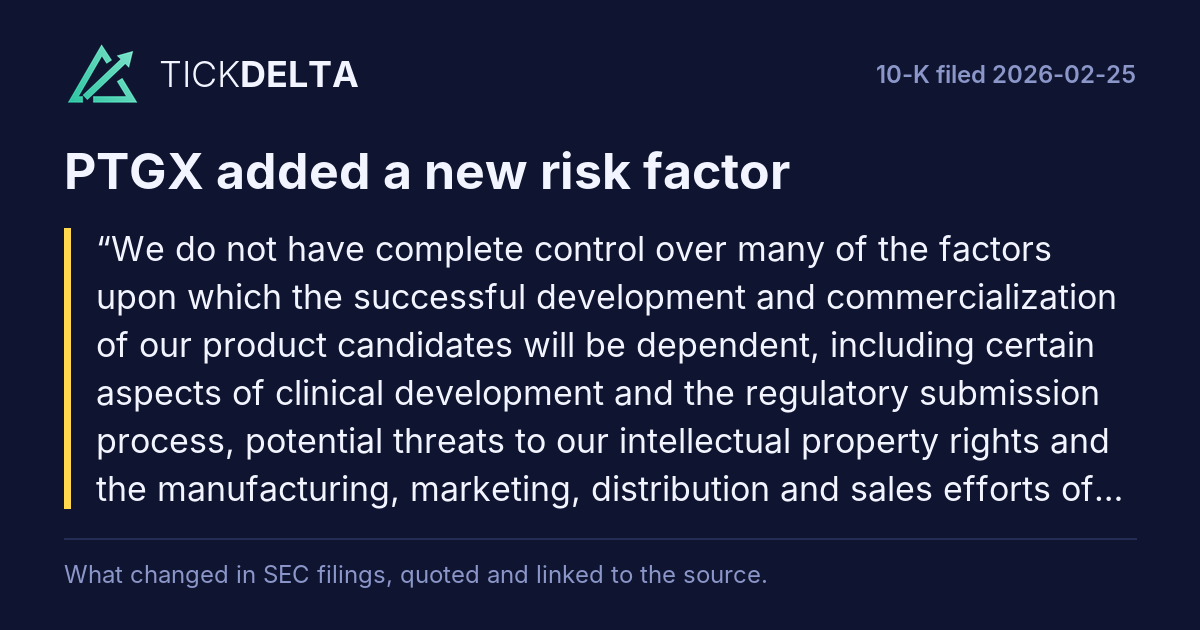
We do not have complete control over many of the factors upon which the successful development and commercialization of our product candidates will be dependent, including certain aspects of clinical development and the regulatory submission process, potential threats to our intellectual property rights and the manufacturing, marketing, distribution and sales efforts of our collaborators. For product candidates that are licensed to third parties, including Icotyde and rusfertide, we generally will not have discretion over marketing decisions. If we or our collaborators do not receive marketing approvals for our product candidates, we may not be able to continue our operations.

Read in the 10-K

company, many of which are outside of our control, and past results, including operating or financial results, should not be relied on as an indication of future results.

Read in the 10-K

JNJ filed an NDA with the FDA in July 2025 and sought regulatory approval with additional global regulatory authorities thereafter for Icotyde in moderate-to-severe plaque psoriasis, and Takeda submitted an NDA for rusfertide for the treatment of PV in December 2025. There can be no guarantee that the FDA or other regulatory authorities will ultimately approve these products. For instance, the FDA could, where applicable, refuse to file our or our collaborators applications, require additional clinical or non-clinical data, request further analyses, conduct an advisory committee review, identify deficiencies following facility inspections, or issue a Complete Response Letter. Moreover, results acceptable to support approval in one jurisdiction may be deemed inadequate by another regulatory authority to support regulatory approval in another jurisdiction. To the extent that the results of the trials are not satisfactory to the FDA or comparable foreign regulatory authorities for support of a marketing application, we may be required to expend significant resources, which may not be available to us, to conduct additional trials in support of potential approval of our product candidates. Even if regulatory approval is secured for a product candidate, the terms of such approval may limit the scope and use of the specific product candidate, which may also limit its commercial potential.

Read in the 10-K

To achieve profitability, we must, either directly or through collaboration relationships, meet certain milestones, successfully develop and obtain regulatory approval for one or more product candidates and effectively manufacture, market and sell any drugs we successfully develop. Even if we or our collaborators successfully commercialize product candidates that receive regulatory approval, we may not be able to realize revenues at a level that would allow us to achieve or sustain profitability. Accordingly, we may never generate significant revenue and, even if we do generate significant revenue, we may never achieve consistent profitability.

Read in the 10-K

Potential business combinations or other strategic transactions may disrupt our business or divert management’s attention.

From time to time in the ordinary course of business, we explore potential business combination transactions or other strategic transactions or collaborations with third parties. The consummation and performance of any such future transactions or collaborations will involve risks, such as diversion of managerial resources from day-to-day operations, exposure to litigation from the counterparties to any such transaction, other third parties or our stockholders, misjudgment with respect to the value, higher than expected transaction costs or an inability to successfully consummate any such transaction or collaboration. As a result of these risks, we may not be able to achieve the expected benefits of any such transaction or collaboration or deliver the value thereof to our stockholders. If we are unsuccessful in consummating any such transaction or collaboration, we may be required to reevaluate our business only after we have incurred substantial expenses and devoted significant management time and resources.

Read in the 10-K
Show the other 8

and it is possible that none of our existing product candidates or any product candidates we have in development or may seek to develop in the future will ever obtain regulatory approval.

Read in the 10-K

Disruptions at the FDA and other government agencies could negatively affect the review of our regulatory submissions, which could negatively impact our business.

The ability of the FDA to review and approve regulatory submissions can be affected by a variety of factors, including statutory, regulatory and policy changes, inadequate government budget funding levels or a reduction in the FDA’s workforce and its ability to hire and retain key personnel, disruptions caused by government shutdowns, public health crises, the FDA’s ability to accept the payment of user fees, and other events that may otherwise affect the FDA’s ability to perform routine functions. There have been mass layoffs of federal employees since the start of the current presidential administration in January 2025, the full impact of which is unclear at this time. Such disruptions could significantly impact the ability of the FDA or other regulatory authorities to timely review and process our regulatory submissions, which could have a material adverse effect on our business. For example, during the U.S. government shut down in October 2025, the FDA was not able to accept applications for new drugs, generics, biologics, biosimilars or medical devices that require payment of a user fee. In addition, the presidential administration has made and is expected to continue to make changes in the leadership of various U.S. federal regulatory agencies and changes to U.S. federal government policy that have led to, in some cases, legal challenges and uncertainty around the funding, functioning and policy priorities of the U.S. federal regulatory agencies, including the FDA.

We are unable to predict the extent to which the presidential administration may impose or seek to impose leadership or policy changes at the FDA or changes to rules and policies impacting our business and operations. It is unclear how these executive actions or other potential actions by the federal government will impact the FDA or other regulatory authorities that oversee our business. Government proposals to reduce or eliminate budgetary deficits may include reduced allocations to the FDA and other related government agencies. These budgetary pressures may reduce the FDA’s ability to perform its responsibilities, which could result in delays in our clinical trial timelines. If a significant reduction in the FDA’s workforce occurs or the FDA’s budget is significantly reduced, it could significantly impact the ability of the FDA to timely review and process our regulatory submissions or take other actions critical to the development or approval of our product candidates, and any delay in the acceptance, review or approval of our investigational new drug applications, clinical trial applications, marketing applications, facility inspections or lot-release/testing activities, could delay or increase the cost of our clinical trials and product launches, if any, which could have a material adverse effect on our business.

Read in the 10-K

nations and to facilitate direct-to-consumer purchasing programs. The HHS subsequently issued guidance indicating the MFN target price is the lowest price paid in an Organization for Economic Co-operation and Development country with a GDP per capita of at least 60% of the U.S. GDP per capita. It is currently unclear whether and to what extent these measures will be implemented and what impact any such implementation would have on our business. Further, there can be no assurance that the current administration or future administrations will not pursue different or additional measures that could impact drug pricing in the United States. Political, economic and regulatory developments may further complicate developments in healthcare systems and pharmaceutical drug pricing. These developments could, for example, impact our potential licensing agreements as commercial and collaborative partners may also consider the impact of these pressures on their licensing strategies.

Read in the 10-K

We cannot be sure that, if our clinical trials for any of our product candidates are successfully completed, we or our collaborators will be able to submit an NDA to the FDA or that any NDA we or our collaborators submit will be approved by the FDA in a timely manner, if at all. In July 2025, Johnson & Johnson filed an NDA with the FDA for the approval of Icotyde for the treatment of adults and pediatric patients 12 years of age and older with moderate-to-severe plaque psoriasis and in January 2026, we and Takeda filed an NDA with the FDA for the approval of rusfertide for the treatment of adults with PV.

Read in the 10-K

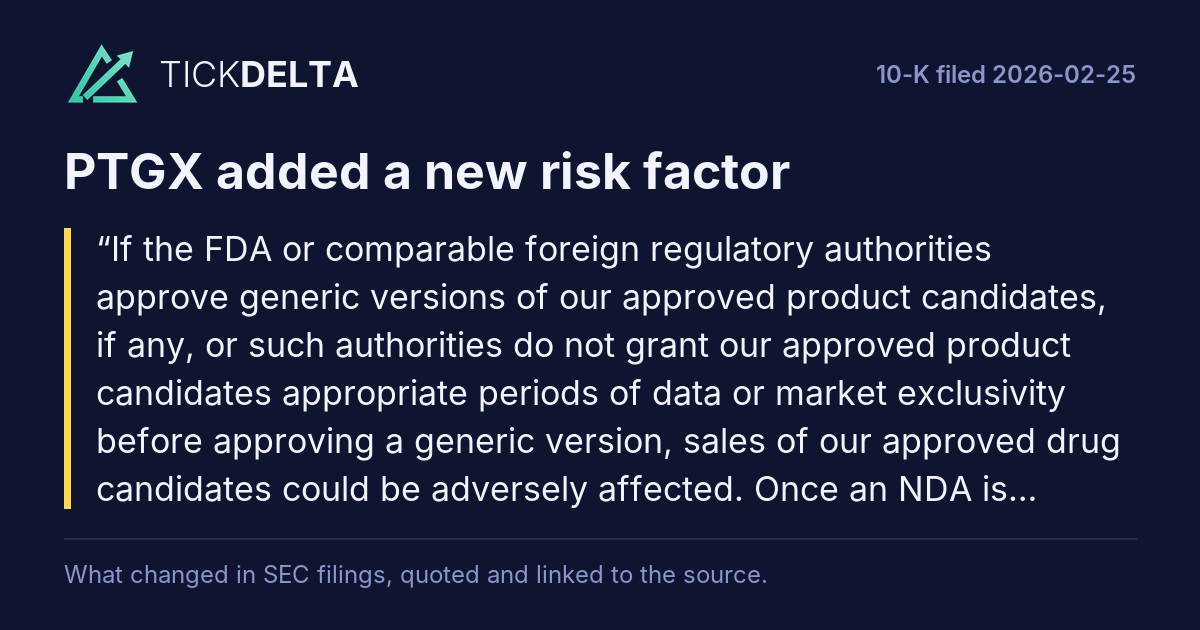
If the FDA or comparable foreign regulatory authorities approve generic versions of our approved product candidates, if any, or such authorities do not grant our approved product candidates appropriate periods of data or market exclusivity before approving a generic version, sales of our approved drug candidates could be adversely affected.

Once an NDA is approved, the drug covered thereby becomes a “reference-listed drug” in the FDA’s publication, “Approved Drug Products with Therapeutic Equivalence Evaluations.” Manufacturers may seek marketing approval of generic versions of reference-listed drugs through submission of Abbreviated New Drug Applications (“ANDAs”) in the United States. Generic drugs may be significantly less costly to bring to market than the reference-listed drug and companies that produce generic drugs are generally able to offer them at lower prices. Thus, following the introduction of a generic drug, a significant percentage of the sales of any branded product or reference-listed drug is typically lost to the generic drug.

The FDA may not approve an ANDA or a 505(b)(2) NDA for a generic drug until any applicable period of non-patent exclusivity for the reference-listed drug has expired. The FDCA provides a period of five years of non-patent exclusivity for a new drug containing a new chemical entity. During the exclusivity period, the FDA may not accept for review an ANDA or a 505(b)(2) NDA submitted by another company for another version of such product candidate where the applicant does not own or have a legal right of reference to all the data required for approval. However, an application may be submitted after four years if it contains a certification of patent invalidity or non-infringement. The FDCA also provides three years of marketing exclusivity for an NDA, 505(b)(2) NDA or supplement to an approved NDA if new clinical investigations, other than bioavailability studies, that were conducted or sponsored by the applicant are deemed by the FDA to be essential to the approval of the application, for example, for new indications, dosages or strengths of an existing product candidate. This three-year exclusivity covers only the conditions associated with the new clinical investigations and does not prohibit the FDA from approving ANDAs for product candidates containing the original active agent for other conditions of use. Five-year and three-year exclusivity will not delay the submission or approval of a full NDA. However, an applicant submitting a full NDA would be required to conduct or obtain a right of reference to all of the nonclinical studies and adequate and well-controlled clinical trials necessary to demonstrate safety and effectiveness. Manufacturers may seek to launch generic drugs following the expiration of the marketing exclusivity period, even if we still have patent protection for such drugs.

Competition that our product candidates, such as Icotyde and rusfertide, if approved, may face from generic drugs could materially and adversely impact our future revenue, profitability and cash flows and substantially limit our ability to obtain a return on the investments we have made in those products. Our future revenues, profitability and cash flows could also be materially and adversely affected and our ability to obtain a return on the investments we have made in our approved product candidates, if any, may be substantially limited if those drug candidates are not afforded the appropriate periods of non-patent exclusivity.

Read in the 10-K

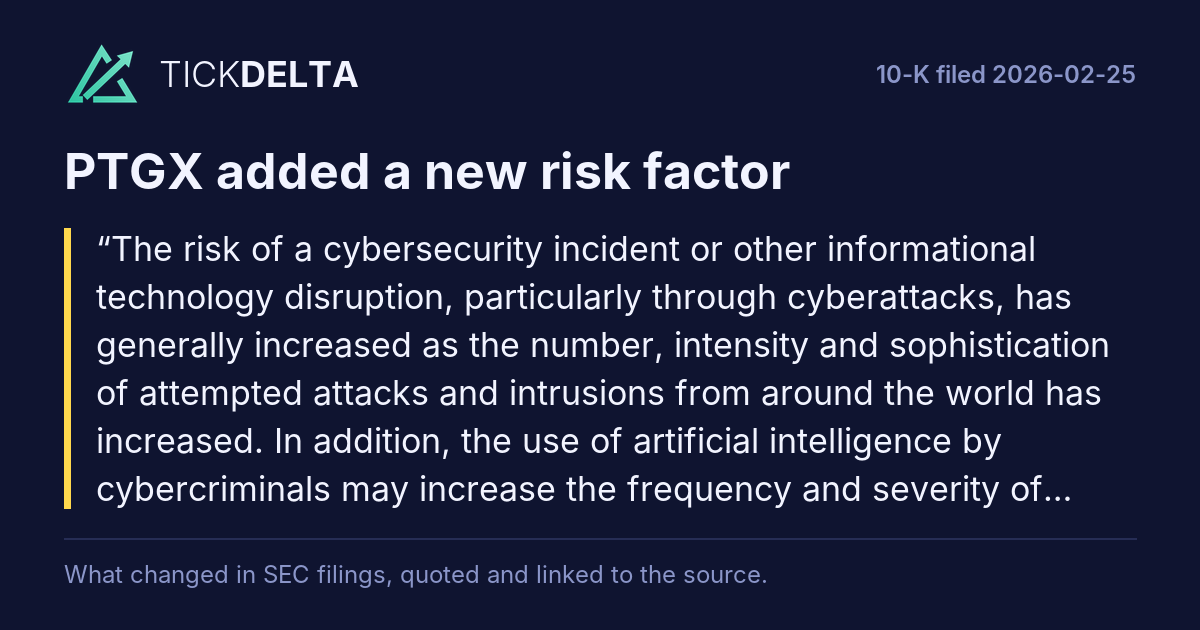
The risk of a cybersecurity incident or other informational technology disruption, particularly through cyberattacks, has generally increased as the number, intensity and sophistication of attempted attacks and intrusions from around the world has increased. In addition, the use of artificial intelligence by cybercriminals may increase the frequency and severity of cybersecurity attacks, including against us or the third parties on which we rely. Cybersecurity attacks and breaches may be difficult to detect and any delay in identifying them may increase the harm caused, and it may take considerable time for us to investigate and evaluate the full impact of cyberattacks, particularly for sophisticated attacks, which may inhibit our ability to provide prompt, full, and reliable information about cybersecurity incidents to our customers, regulators, and the public. If we are unable to prevent such cybersecurity incidents or privacy violations or implement satisfactory remedial measures, our operations could be disrupted, and we may suffer loss of reputation, financial loss and other regulatory penalties. Although we maintain liability insurance for cybersecurity incidents, such insurance may not be sufficient in type or amount to cover us against all claims related to cybersecurity incidents, breaches, and other related incidents.

Read in the 10-K

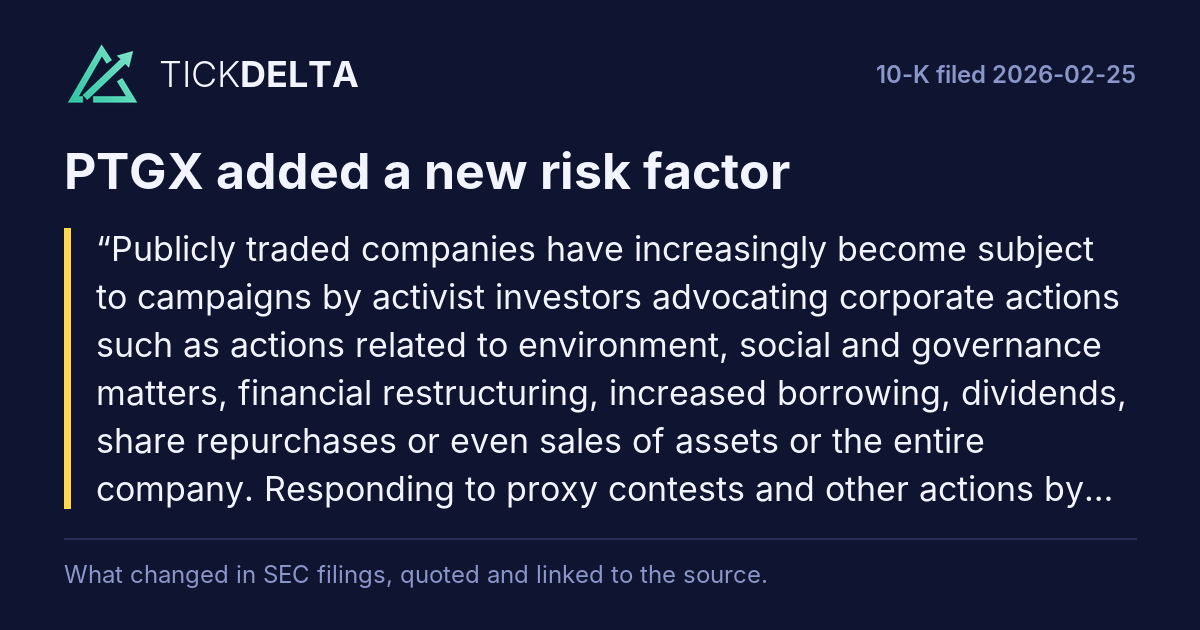
Publicly traded companies have increasingly become subject to campaigns by activist investors advocating corporate actions such as actions related to environment, social and governance matters, financial restructuring, increased borrowing, dividends, share repurchases or even sales of assets or the entire company. Responding to proxy contests and other actions by such activist investors or others in the future could be costly and time consuming, disrupt our operations and divert the attention of our board of directors and senior management from the pursuit of our business strategies, which could adversely affect our results of operations and financial condition.

Read in the 10-K

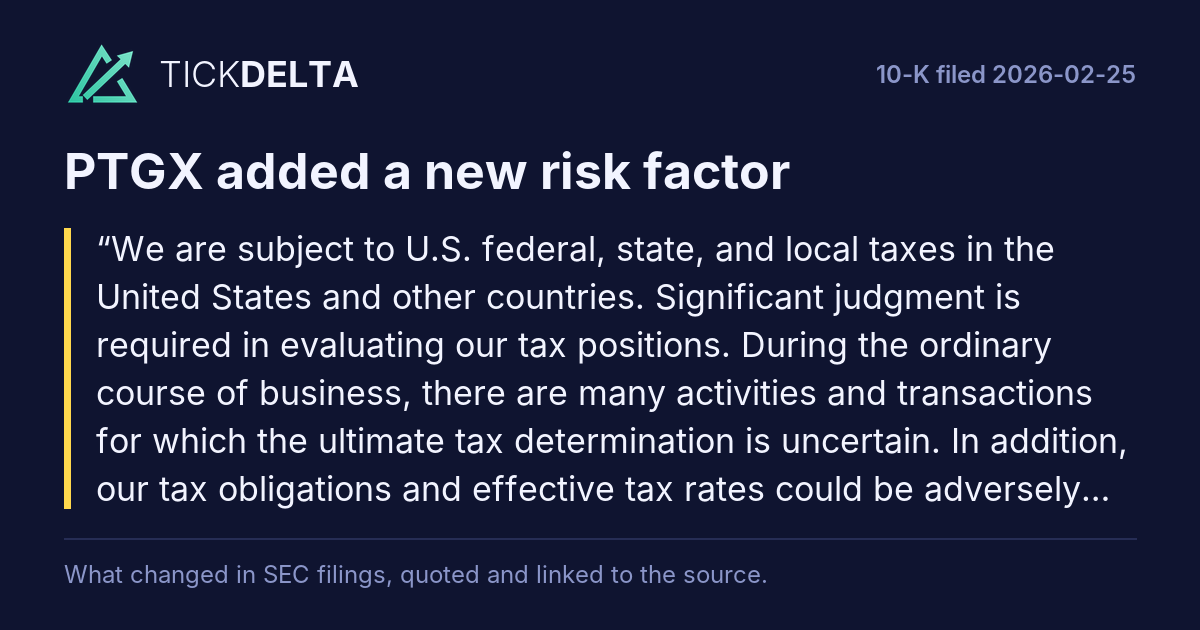
We are subject to U.S. federal, state, and local taxes in the United States and other countries. Significant judgment is required in evaluating our tax positions. During the ordinary course of business, there are many activities and transactions for which the ultimate tax determination is uncertain. In addition, our tax obligations and effective tax rates could be adversely affected by changes in the relevant tax, accounting and other laws, regulations, principles and interpretations and the prudence and feasibility of possible tax planning strategies. We continue to monitor new tax legislation, such as the One Big Beautiful Bil Act, enacted in 2025, which permits the expensing of certain research and development expenditures in the United States incurred in tax years beginning in 2025, or other developments since significant changes in tax legislation, or in the interpretation of existing legislation, could materially and adversely affect our financial condition and operating results.
Read in the 10-K

Paragraphs in the 10-Q filed Nov 6, 2026 that were not in the one before

New in the latest 10-Q

22 paragraphs in the 10-Q filed Nov 6, 2026 with nothing like them in the 10-Q filed Aug 5, 2026 (at least half the words must differ; new numbers alone do not count). Quoted exactly, grouped by the item heading above them. This is text that changed, not a judgement of how serious it is.

Financial statements and notes

Pursuant to the Takeda Collaboration Agreement, the Company and Takeda agreed to jointly develop and commercialize MIMRYLO and potentially other specified second-generation injectable hepcidin mimetic compounds

Read in the 10-Q

For the three and nine months ended September 30, 2026, the Company recognized $1.8 million and $8.0 million of revenue, respectively, that was included in the deferred revenue balance at the beginning of the period. None of the costs to obtain or fulfill the contracts were capitalized. Note 4. Fair Value Measurements

Read in the 10-Q

Financial assets and liabilities are recorded at fair value. The accounting guidance for fair value provides a framework for measuring fair value, clarifies the definition of fair value and expands disclosures regarding fair value measurements. Fair value is defined as the price that would be received to sell an asset or paid to transfer a liability (an exit price) in an orderly transaction between market participants at the reporting date. The accounting guidance

Read in the 10-Q

Other current assets as of September 30, 2026 included $5.0 million in proceeds from option exercises not yet received.

Read in the 10-Q

On September 8, 2026, the Company announced that its board of directors authorized a share repurchase program under which the Company may repurchase up to $300.0 million of its outstanding common stock (the “Repurchase Program”). The Repurchase Program has no fixed expiration, does not obligate the Company to repurchase any specific number of shares and may be modified, suspended or discontinued at any time without prior notice. Under the Repurchase Program, stock repurchases may be made from time to time in open market or through privately negotiated transactions, including transactions pursuant to a trading plan adopted in accordance with Rule 10b5-1 under

Read in the 10-Q
Show the other 17

The following table sets forth the computation of basic and diluted net income (loss) per share (in thousands, except share and per share data):

Read in the 10-Q

In October 2026 JNJ submitted an abstract accepted for presentation at the American College of Rheumatology Convergence 2026 outlining Week 24 results from a Phase 3, randomized, double-blind, placebo-controlled study evaluating icotrokinra in biologic-naïve participants with active psoriatic arthritis. The publicly released abstract reported that in biologic-naïve patients with active psoriatic arthritis, once-daily ICOTYDE 200 mg demonstrated both joint and skin improvements versus placebo at Week 16, with 400 mg showing no additional benefit beyond the 200 mg dose. Continued improvements were observed through Week 24 for both joint and skin responses. Adverse event profiles were comparable across groups with no new safety signals identified.

Read in the 10-Q

In November 2026, JNJ disclosed the following results from the Phase 3 ICONIC-ASCEND study evaluating ICOTYDE in adult and pediatric patients 12 years of age and older with moderate-to-severe plaque psoriasis versus placebo and ustekinumab:

Read in the 10-Q

ICOTYDE met both co-primary endpoints, with 70% of adults and adolescents with moderate-to-severe plaque psoriasis achieving clear or almost clear skin (IGA 0/1) and 55% achieving PASI 90 versus placebo at Week 16.

Read in the 10-Q

Results showed ICOTYDE achieved non-inferiority to ustekinumab, with numerically higher skin clearance rates in both systemic-naive and biologic-experienced plaque psoriasis patients, though statistical superiority was not demonstrated. ICOTYDE delivered consistent skin clearance against a comparator that performed at a level well above what has been seen historically.

Read in the 10-Q

ICOTYDE delivered a 17-point improvement in complete skin clearance (PASI 100) versus ustekinumab in systemic-naïve patients at Week 28 (48% versus 31%).

Read in the 10-Q

ICOTYDE® Potential Development Milestones ICOTYDE® Potential Sales Milestones 2nd indication NDA filing acceptance $25 Million Calendar Year Net Sales Sales Milestone Receipt of marketing approval $45 Million $1 Billion $70 Million 3rd Indication NDA filing acceptance $35 Million $2 Billion $95 Million Receipt of marketing approval $50 Million $3 Billion $160 Million Total Potential Development Milestones $155 Million $5 Billion $100 Million Total Potential Sales Milestones $425 Million

Read in the 10-Q

MIMRYLO™ Selected Upcoming Potential Development Milestones MIMRYLO™ Potential Sales Milestones PV First regulatory approval in three European countries $15 Million Calendar Year Net Sales Sales Milestone First regulatory approval in Japan $10 Million $250 Million $25 Million Total Upcoming Potential Development Milestones $25 Million $500 Million $50 Million $1.0 Billion $100 Million $1.5 Billion $150 Million $2.0 Billion $200 Million $2.5 Billion $250 Million Total Potential Sales Milestones $775 Million

Read in the 10-Q

Cost of revenue represents costs incurred pursuant to a collaboration agreement entered into in June 2012 and a related arbitration resolution agreement entered into in August 2021 between us and Zealand Pharma A/S (“Zealand”). We are obligated to pay Zealand certain milestone and royalty payments for MIMRYLO. These payments are recorded as cost of revenue in the period in which they are incurred. As of September 30, 2026, remaining potential payments under the agreement include: (i) up to $1.65 million in development milestone payments; (ii) a 1% royalty on worldwide net sales of MIMRYLO; and (iii) sales milestone payments on achievement of specified annual net sales amounts in specified geographies.

Read in the 10-Q

For the three months ended September 30, 2026, we recorded cost of revenue of $1.1 million for a milestone payment due to Zealand upon the FDA’s approval and the commercial launch of MIMRYLO. No expense was recorded for cost of revenue for the three months ended September 30, 2025.

Read in the 10-Q

Research and development expenses increased $1.3 million, as detailed in the table below:

Read in the 10-Q

For the nine months ended September 30, 2026, we recorded cost of revenue of $1.1 million for a milestone payment due to Zealand upon the FDA’s approval and the commercial launch of MIMRYLO. No expense was recorded for cost of revenue for the nine months ended September 30, 2025.

Read in the 10-Q

Research and development expenses increased $17.1 million, as detailed in the table below:

Read in the 10-Q

On September 8, 2026, we announced that our board of directors authorized a stock repurchase program under which the Company may repurchase up to $300.0 million of its outstanding common stock (the “Repurchase Program”). The Repurchase Program has no fixed expiration, does not obligate us to repurchase any specific number of shares and may be modified, suspended or discontinued at any time without prior notice. We intend to fund repurchases from our cash, cash equivalents and marketable securities, as well as royalties and other payments received under our collaboration arrangements with Takeda related to MIMRYLO and JNJ related to ICOTYDE. The timing and amount of any repurchases will depend on market conditions, alternative capital deployment opportunities and other factors. During the three months ended September 30, 2026, we repurchased 40,560 shares of our common stock under the Repurchase Program for an aggregate purchase price of $5.8 million, which are held as Treasury shares. As of September 30, 2026, $294.2 million remained available and authorized for repurchase under the Repurchase Program.

Read in the 10-Q

Share sales and buybacks

The following table summarizes our stock repurchase activity for the three months ended September 30, 2026:

Read in the 10-Q

Approximate Dollar Value of Total Number of Shares Average Price Paid Total Number of Shares Purchased as Shares that May Yet Be Purchased Period Purchased Per Share (1) Part of Publicly Announced Program (2) Under the Program (2) (in millions) July 1 - 31, 2026 — $ — — $ August 1 - 31, 2026 — $ — — $ September 1 - 30, 2026 40,560 $ 142.77 40,560 $ 294.21 Total 40,560 40,560

Read in the 10-Q

(2) On September 8, 2026, we announced that our board of directors authorized a $300.0 million stock repurchase program. The repurchase program has no fixed expiration, does not obligate us to repurchase any specific number of shares and may be modified, suspended or discontinued at any time without prior notice. Under the repurchase program, stock repurchases may be made from time to time in open market or through privately negotiated transactions, including transactions pursuant to a tradin...

Read in the 10-Q

The 10-Q's risk factors against the 10-K

Item 1A of the 10-Q filed Nov 6, 2026 against Item 1A of the 10-K filed Feb 25, 2026. A 10-Q repeats only the risks that changed, so a 10-K paragraph that is missing from it is not counted as removed. Added is a paragraph with nothing like it in the 10-K, Reworded a sentence that is in both with several words changed, Quiet changes a sentence in both where one to four words changed and one is a hedge or a modal (cut words struck through, new words highlighted). Text on the page, not a score; each links to the filing at sec.gov.

Added10-Q Nov 6, 2026 vs 10-K Feb 25, 2026
Our business, results of operations and financial condition are subject to various risks. These risks are described elsewhere in this Quarterly Report on Form 10-Q and in our other filings with the SEC, including our Annual Report on Form 10-K for the year ended December 31, 2025 and our Quarterly Report on Form 10-Q for the quarter ended June 30, 2026. Except as set forth in our Quarterly Report on Form 10-Q for the quarter ended June 30, 2026, there have been no material changes from the risk factors identified in the Company’s Annual Report on Form 10-K for the year ended December 31, 2025.

Read it in the 10-Q at sec.gov

Phrases used for the first time

Two-word phrases in Risk Factors of the 10-K filed Feb 25, 2026 that are in none of the 1 earlier 10-Ks stored, back to Feb 21, 2025

reference-listed drug ×4generic drugs ×4either directly ×3royalty payments ×3fda’s ability ×3presidential administration ×3new drug ×3generic drug ×3non-patent exclusivity ×3cybersecurity attacks ×3particular indication ×2moderate-to-severe plaque ×2plaque psoriasis ×2facility inspections ×2commercialize icotyde ×2strategic transactions ×2
Where each one is used
  • reference-listed drug: Once an NDA is approved, the drug covered thereby becomes a “reference-listed drug” in the FDA’s publication, “Approved Drug Products with Therapeutic Equivalence Evaluations.” Manufacturers may seek marketing approval of generic versions of reference-listed drugs through submission of Abbreviated New Drug...
  • generic drugs: Once an NDA is approved, the drug covered thereby becomes a “reference-listed drug” in the FDA’s publication, “Approved Drug Products with Therapeutic Equivalence Evaluations.” Manufacturers may seek marketing approval of generic versions of reference-listed drugs through submission of Abbreviated New Drug...
  • either directly: To achieve profitability, we must, either directly or through collaboration relationships, meet certain milestones, successfully develop and obtain regulatory approval for one or more product candidates and effectively manufacture, market and sell any drugs we successfully develop. Even if we or our collaborators...
  • royalty payments: Our operations have consumed substantial amounts of cash since inception. Developing pharmaceutical product candidates, including conducting pre-clinical studies and clinical trials, is expensive. We may require additional future capital in order to complete clinical development and, if we are successful, to...
  • fda’s ability: The ability of the FDA to review and approve regulatory submissions can be affected by a variety of factors, including statutory, regulatory and policy changes, inadequate government budget funding levels or a reduction in the FDA’s workforce and its ability to hire and retain key personnel, disruptions caused by...
  • presidential administration: The ability of the FDA to review and approve regulatory submissions can be affected by a variety of factors, including statutory, regulatory and policy changes, inadequate government budget funding levels or a reduction in the FDA’s workforce and its ability to hire and retain key personnel, disruptions caused by...
  • new drug: The ability of the FDA to review and approve regulatory submissions can be affected by a variety of factors, including statutory, regulatory and policy changes, inadequate government budget funding levels or a reduction in the FDA’s workforce and its ability to hire and retain key personnel, disruptions caused by...
  • generic drug: Once an NDA is approved, the drug covered thereby becomes a “reference-listed drug” in the FDA’s publication, “Approved Drug Products with Therapeutic Equivalence Evaluations.” Manufacturers may seek marketing approval of generic versions of reference-listed drugs through submission of Abbreviated New Drug...

The 10-K at sec.gov

Used at least twice, small words left out. Counted, not picked: a phrase can be new because the company renamed something.

What was taken out

5 paragraphs of last year's Risk Factors with nothing like them now. The longest are quoted.

Across all companies
Under the terms of the Takeda Collaboration Agreement, Takeda may terminate the agreement for convenience in its entirety or as to a major region by providing advance written notice following the earliest of (i) the receipt of Phase 3 data with respect to the VERIFY clinical trial, (ii) the third anniversary of the effective date of the agreement or (iii) the occurrence of certain specified adverse events related to the clinical development of rusfertide.
In the 10-K filed Feb 21, 2025
financial reporting, investors may lose confidence in the accuracy and completeness of our financial reports, the market price of our stock could decline and we could be subject to sanctions or investigations by Nasdaq, the SEC, or other regulatory authorities, which would require additional financial and management resources.
In the 10-K filed Feb 21, 2025
developments may further complicate developments in healthcare systems and pharmaceutical drug pricing. These developments could, for example, impact our potential licensing agreements as commercial and collaborative partners may also consider the impact of these pressures on their licensing strategies.
In the 10-K filed Feb 21, 2025
around the world has increased. If we are unable to prevent such cybersecurity incidents or privacy violations or implement satisfactory remedial measures, our operations could be disrupted, and we may suffer loss of reputation, financial loss and other regulatory penalties.
In the 10-K filed Feb 21, 2025

Sources

Item 1A of each 10-K and 10-Q on EDGAR, quoted exactly. Each paragraph links to the filing at sec.gov.

Also

10-K change: what was reworded or cut, section by section.

Work with it

Excel workbook · CSV. Google Sheet that stays up to date: paste =IMPORTDATA("https://tickdelta.com/company/PTGX/export.csv") into a cell.

Next:10-K change
Esc

Type a ticker such as AAPL, a name, an investor such as Buffett, or a topic such as tariffs. ↑ ↓ to move, Enter to open.