Screener / SEC EDGAR /CIK 0000078239 /10-K filed Mar 31, 2026, compared with Apr 1, 2025 /Numbers from the XBRL of the 10-Ks
NYSE Consumer discretionary · Apparel

PVH Corp. PVH

Compare with peers Embed
The 10-K against last year's

197 changes: 46 added, 21 removed, 128 reworded, 2 quiet changes

10-K Mar 31, 2026 vs Apr 1, 2025

10-K 0000078239-26-000021 (Mar 31, 2026) vs 10-K 0000078239-25-000018 (Apr 1, 2025)

Every paragraph, and how much of it changed

One bar per paragraph, in the order of the 10-K. Height and colour show the share of its words not in the closest paragraph a year earlier; the tallest bars are new paragraphs.

Risk Factors

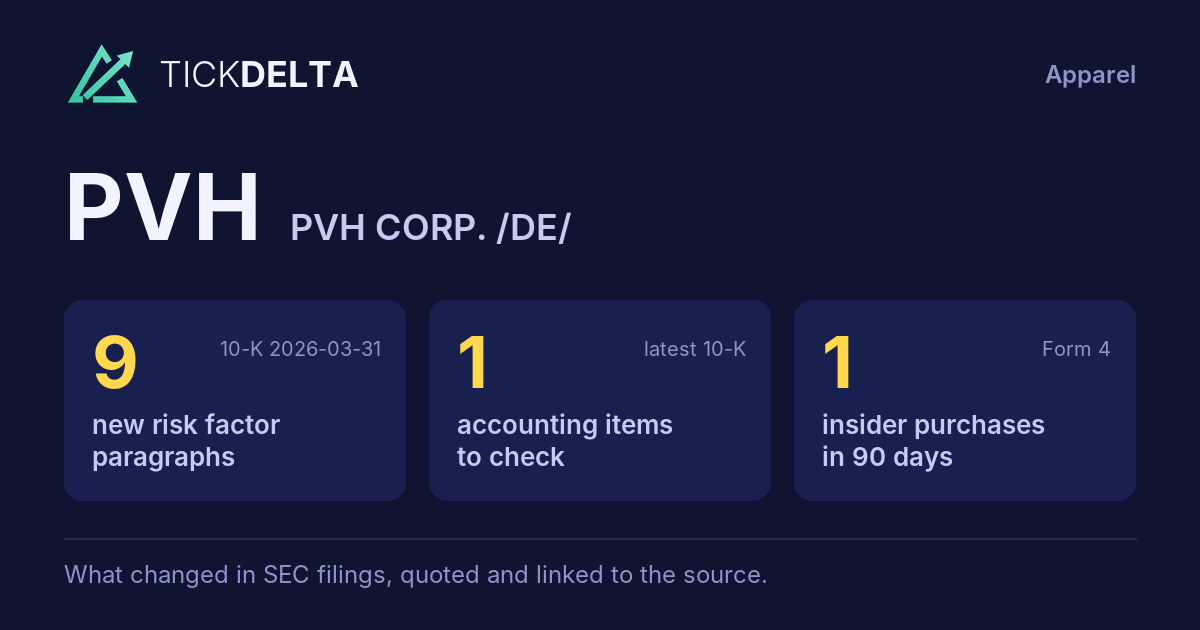
138 paragraphs · 9 new · 48 reworded · 4 gone · 10-K Mar 31, 2026 against Apr 1, 2025
New paragraph Reworded (5% of its words or more) Same or nearly
Paragraph 71 · 41% changed Every version of it
We have announced plans, and in the future may pursue further opportunities, to increase direct management that we will allow certain of our licenses for our Calvin Klein and TOMMY HILFIGER brands through takebacks to expire in order to increase our management and oversight of the licensed businesses. Currently, we are We may in the process of bringing in house future acquire licensed businesses or allow other licensed rights to expire for the same or similar reasons. We have been directly operating a significant portion of the businesses for the Calvin Klein and TOMMY HILFIGER product categories currently previously licensed to G-III in the United States and Canada Canada, and we intend to G-III continue to directly operate a significant portion of these businesses as the license agreements expire over time, expire, through 2027. 2026, with the remainder being re-licensed to other third parties.
Paragraph 65 · 39% changed Every version of it
Our business is susceptible to risks associated by some parties with climate change and environmental degradation, including potential disruptions to our supply chain and impacts on the availability and costs of raw materials. Extreme heat as well as increased frequency and severity of adverse weather events (such as storms and floods) due to climate change could cause increased incidence of disruption to the production and distribution of our products, an adverse impact on consumer demand and spending, and/or more frequent store closures and/or lost sales as customers prioritize basic needs. Our supply chain is also exposed to risks associated with water, including drought and water scarcity, which could impact raw materials sourcing, manufacturing processes, and workers and communities. In addition, evolving climate-related legislation and disclosure requirements, and the potential for more, coupled with carbon taxes and fluctuating costs of sourcing renewable energy, may also increase our compliance costs. Certain of our wholesale customers have also begun to establish sourcing requirements related to sustainability. As a result, we have received requests for sustainability related information about our products and, in some cases, customers have required that certain of our products include sustainable materials or packaging, which may result in higher raw material and production costs. Our inability to comply with these and other sustainability requirements in the future could adversely affect sales of and demand for our products. Further, certain online sellers of our products have begun to identify to consumers and help consumers limit purchases to product the sellers identify as being more sustainable. Our failure to offer products that meet these sustainability standards could result in decreased demand for our products and lost sales.
Paragraph 23 · 36% changed Every version of it
We have embarked and may continue to embark on a multi-year initiative to simplify our operating model by centralizing certain processes and improving systems and automation initiatives to drive more efficient and cost-effective ways of working across the organization, through four main pillars: (i) delivering a single global technology stack, (ii) redesigning such as our global distribution network, (iii) reengineering the operating model in Europe, and (iv) streamlining and optimizing our support functions globally (referred to as “Growth Growth Driver 5 Actions”). Actions and 2022 cost savings initiative described in Note 17, “Exit Activity Costs,” in the Notes to Consolidated Financial Statements included in Item 8 of this report. Our ability to realize anticipated benefits and cost savings from this initiative these initiatives are subject to many estimates and assumptions, which may change during implementation and execution. In addition, there can be no assurance regarding the timing of or extent to which we will realize the anticipated cost savings, if at all. savings. We may also face disruptions to our business or operations as we execute on the initiative. initiatives.
Paragraph 34 · 33% changed Every version of it
Our apparel, footwear and accessories are produced by and purchased or procured from independent manufacturers in over approximately 30 countries, with most being located in Asia. Although no single supplier or country is or is expected to become critical to our production needs, any of the following could materially and adversely affect our ability to produce or deliver our products and, as a result, have a material adverse effect on our business, financial condition and results of operations:
Paragraph 72 · 33% changed Every version of it
The integration of previously licensed businesses may be complex, costly and time-consuming. We may have difficulty, or may not succeed, in growing or even maintaining the businesses compared to prior performance, integrating the businesses into our operations, hiring qualified employees needed to operate the businesses, or otherwise managing the previously licensed businesses. Furthermore, we may incur higher than expected costs to bring previously licensed businesses in house and/or to operate these businesses. As such, license takebacks may not achieve the intended benefits to our overall growth strategy, our brands and results of operations, and our overall profitability may decline to the extent we are unable to operate these businesses at the same level of earnings that we realized when they were licensed businesses.
Paragraph 125 · 32% changed Every version of it
Our trademarks and other intellectual property rights are important to our success and our competitive position. We are susceptible to others imitating our products and infringing on our intellectual property rights, as the TOMMY HILFIGER and Calvin Klein brands enjoy significant worldwide consumer recognition and the generally premium pricing of products under the brands creates incentive for counterfeiters and infringers. Imitation or counterfeiting of our products or infringement of our intellectual property rights could diminish the value of our brands or otherwise adversely affect our revenue. We cannot assure you that the actions we take to establish and protect our trademarks and other intellectual property rights will be adequate to prevent imitation by others. We cannot assure you that other third parties will not seek to invalidate our trademarks or block sales of our products as a violation of their own trademarks and intellectual property rights. In addition, we cannot assure you that others will not assert rights in, or ownership of, trademarks and other intellectual property rights of ours or in marks that are similar to ours or that we will be able to successfully resolve these types of conflicts to our satisfaction. In some cases, there may be trademark owners who have prior rights to our marks because the laws of certain foreign countries may not protect intellectual property rights to the same extent as do the laws of the United States. In other cases, there may be holders who have prior rights to similar trademarks. We have in the past been and currently are involved in proceedings relating to marks similar to some of ours or a company’s claim of prior rights to some of our trademarks.
Paragraph 86 · 31% changed Every version of it
•effectively utilizing data and technology technology, including the successful utilization of artificial intelligence, to achieve and exploit the foregoing.
Paragraph 35 · 30% changed Every version of it
Our apparel, footwear and accessories are produced by and purchased or procured from independent manufacturers in over 30 countries, with most being located in Asia. Although no single supplier or country is or is expected to become critical to our production needs, any of the following could materially and adversely affect our ability to produce or deliver our products and, as a result, have a material adverse effect on our business, financial condition and results of operations:

MD&A

192 paragraphs · 37 new · 103 reworded · 17 gone · 10-K Mar 31, 2026 against Apr 1, 2025
New paragraph Reworded (5% of its words or more) Same or nearly
Paragraph 38 · 50% changed
The increase in revenue of $194 million, or 2% in 2023 ◦Owned and operated retail stores – Revenue was flat compared to 2022 included (i) 2024, including a 1% benefit from 3% positive foreign currency impact. Excluding the 53rd week in 2023 and (ii) a 1% positive impact of foreign currency translation, revenue declined in Americas and APAC, with EMEA revenue flat compared to the following revenue changes in our segments: prior year period.
Paragraph 70 · 50% changed
Income tax expense was Our income before interest and taxes were as follows:2024 2023 2022 (Dollars follows:(Dollars in millions) 2025 2024 2023 Income tax expense before interest and taxes $ 107 231 $ 177 772 $ 188 Income tax as a 929 % of pre-tax income 15.2 total revenue 2.6 % 21.1 8.9 % 48.4 10.1 %
Paragraph 72 · 50% changed
SG&A expenses •EMEA – Income before interest and taxes in 2024 were $4.411 billion, 2025 was $749 million, or 51.0% 17.5% of total revenue, compared to $4.543 billion, $728 million, or 49.3% 17.9% of total revenue in 2023. 2024. The $132 million 40 basis point decrease was driven by a decrease in SG&A expenses was primarily driven by cost efficiencies across the business as we continue to take a disciplined approach to managing expenses. The 170 basis point increase in SG&A as a percentage of revenue was primarily driven by (i) the impact of a change in the revenue mix between our direct-to-consumer distribution channel and our wholesale distribution channel as compared to 2023, as our direct-to-consumer distribution channel was a larger proportion of our total revenue in 2024 than in 2023 and carries higher gross margin. SG&A expenses as a percentage of total revenue, (ii) revenue were flat compared to the impact prior year period as savings resulting from the Growth Driver 5 Actions were offset by the deleveraging of expenses resulting from the decline decrease in revenue in 2024, (iii) costs incurred in connection with excluding the Mr. Hilfiger amendment, and (iv) restructuring costs incurred in connection with the Growth Driver 5 Actions. These increases were partially offset by the favorable impact of (i) the 2022 costs savings initiative and (ii) cost efficiencies across the business as we continue to take a disciplined approach to managing expenses. foreign currency translation.
Paragraph 79 · 49% changed
SG&A expenses •EMEA – Income before interest and taxes in 2024 were $4.411 billion, was $728 million, or 51.0% 17.9% of total revenue, compared to $4.543 billion, $837 million, or 49.3% 19.4% of total revenue in 2023. The $132 million 150 basis point decrease in SG&A expenses was primarily driven by cost efficiencies across the business as we continue to take a disciplined approach to managing expenses. The 170 basis point an increase in SG&A as a percentage of revenue was primarily driven by (i) the impact of a change in the revenue mix between our direct-to-consumer distribution channel and our wholesale distribution channel as compared to 2023, as our direct-to-consumer distribution channel was a larger proportion of our total revenue in 2024 than in 2023 and carries higher SG&A expenses as a percentage of total revenue, (ii) the impact from revenue due primarily to the deleveraging of expenses resulting from the decline decrease in revenue in 2024, (iii) costs incurred in connection with the Mr. Hilfiger amendment, and (iv) restructuring costs incurred in connection with the Growth Driver 5 Actions. These increases were revenue, partially offset by the favorable impact of (i) the 2022 costs savings initiative and (ii) cost efficiencies across the business as we continue to take a disciplined approach to managing expenses. an increase in gross margin.
Paragraph 186 · 49% changed
We also determined the macroeconomic and geopolitical conditions that occurred during the first quarter of 2025 and resulting impacts discussed above were also a triggering event that prompted the need to perform interim impairment testing of our other indefinite-lived intangible assets as of the end of the first quarter of 2025. For the 2024 TOMMY HILFIGER and Calvin Klein tradenames and the reacquired perpetual license rights for TOMMY HILFIGER in India, we elected to first assess qualitative factors to determine whether it was more likely than not that the fair value of any asset was less than its carrying amount. For these assets, no impairment was identified as a result of our annual indefinite-lived intangible assets impairment test performed as of the beginning of the third quarter of 2024, we elected to bypass the qualitative assessment and proceeded directly to the quantitative asset impairment test for all indefinite-lived intangible assets, using a discounted cash flow method to estimate fair value. We determined that 2024 and the fair values for all of these indefinite-lived intangible assets substantially exceeded their carrying amounts and, therefore, the assets were not impaired. amounts. The indefinite-lived intangible asset with the least excess fair value had an estimated fair value that exceeded its carrying amount by 19%. approximately 93% as of the date of our 2024 annual test. Considering this and other factors, we determined qualitatively that it was not more likely than not that the fair values of these indefinite-lived intangible assets were less than their carrying amounts and concluded that a quantitative impairment test was not required.
Paragraph 122 · 49% changed
We had outstanding €525 The April 25 facility terminated by its terms during the second quarter of 2025 as a result of our issuance of the $500 million principal amount of 3 5/8% 5 1/2% senior notes due July 15, 2024. We redeemed these notes on April 25, 2024 utilizing the net proceeds from the issuance of the €525 million principal amount of 4 1/8% senior notes due July 16, 2029 together with other available funds, as June 13, 2030 discussed below. The April 4 facility terminated by its terms on February 4, 2026. We recorded an immaterial amount of debt extinguishment costs had not drawn on these facilities prior to write-off previously capitalized debt issuance costs associated with these notes during the first quarter of 2024. their terminations.
Paragraph 181 · 48% changed
The Tommy Hilfiger International reporting unit had an estimated fair value that exceeded its carrying amount of $2,875 million by approximately 10%. The carrying amount of goodwill allocated to this reporting unit as of the date of the test was $1,556 million. The fair value of the Tommy Hilfiger International reporting unit units for goodwill impairment testing was determined using an income approach. The income approach was based on discounted projected future (debt-free) cash flows. flows for each reporting unit. The discount rate rates applied to these cash flows was were based on the weighted average cost of capital for the each reporting unit, which takes market participant assumptions into consideration. Estimated future operating cash flows were discounted at consideration, inclusive of a rate of 13% risk premium for each reporting unit to account for the relative risks of the estimated future additional risk and uncertainty perceived by market participants related to each reporting unit’s cash flows. Holding all other assumptions constant, a 100 basis point change in the annual revenue growth rate assumption for this business would result in a change flows due to the estimated fair value of the reporting unit of approximately $161 million. Likewise, a 100 basis point change in the weighted average cost of capital would result in a change to the estimated fair value of the reporting unit of approximately $281 million. While the Tommy Hilfiger International reporting unit was not determined to be impaired, it may be at risk of future impairment if the related business does not perform as projected, or if market factors utilized in the impairment analysis deteriorate, including an unfavorable change in the long-term growth rate or the weighted average cost of capital. macroeconomic and geopolitical factors.
Paragraph 45 · 48% changed
Our •Tommy Hilfiger – Revenue decreased 5% in 2024 revenue through our direct-to-consumer distribution channel decreased 2% compared to 2023, including a 1% decline from the 53rd week in 2023 and a 1% negative foreign currency impact. Revenue in our owned and operated stores decreased 1%, including a 1% negative foreign currency impact. Sales through our directly operated digital commerce businesses decreased 7%, The decrease in revenue was driven by a revenue decline in Europe, including a 1% negative foreign currency impact, primarily due to our planned strategic reduction of sales in Europe to drive overall higher quality of sales in the region. Our region, which weighed more heavily on Tommy Hilfiger revenue through our wholesale distribution channel decreased 10%, primarily due to (i) a 5% reduction resulting from given the Heritage Brands intimates transaction and (ii) size of the planned strategic reduction of sales business in Europe to drive overall higher quality of sales in the region. The impact in 2024 of foreign currency translation on our wholesale distribution channel revenue was not significant. Europe.

A paragraph is matched with the one last year that shares the most of its words; under half in common makes it new. The paragraphs shown are the 8 reworded the most in each section.

The paragraph that changed most in each section

The redline

Marked against last year's 10-K: cut words struck through, new words highlighted.

Risk Factors276 words changed in this paragraph; it is 31% similar to last year's version.
There continues to be uncertainty in the current global trade environment due to recent changes in, and proposals and declared intentions to change trade policy, including trade restrictions, the negotiation, renegotiation or termination of trade agreements, and the imposition of new tariffs or increases in existing tariffs on imports into the affected countries. Tariffs Recent legal and other changes in policy developments have further increased uncertainty. In February 2026, the U.S. Supreme Court ruled that many of the tariffs imposed by the U.S. federal government were unconstitutional. In response to that decision, the U.S. President issued an executive order imposing tariffs pursuant to Section 122 of the Trade Act of 1974 for 150 days, effective on February 24, 2026. There is significant uncertainty regarding further trade policy have triggered actions, including whether further additional tariffs or other retaliatory actions may be imposed, modified, or suspended, and in the past, are currently triggering amount and could continue to trigger retaliatory actions by affected countries, including through the use timing of counter tariffs and other measures, which could result in a higher cost or restrictions on the importation of the products we sell. We continuously look for alternative sourcing options, but we may not be able to shift timely, if at all, production from a country when new or increased duties, tariffs, taxes or other charges are imposed. In addition, higher costs in sourcing from other countries, including because others in the industry are looking to move production for the same reason, may make the move price-prohibitive. We may not be able to pass the entire cost increase resulting from tariffs, duties, taxes or other expenses onto consumers or could choose not to. Any increase in prices to consumers could have an adverse impact on our direct sales to consumers, as well as sales by our wholesale customers and our licensees. Any adverse impact on such sales or increase in our cost of goods sold could have a material adverse effect on our business and results of operations. tariff refunds.

Source: Item 1A, 10-K 0000078239-26-000021 vs Item 1A, 10-K 0000078239-25-000018

MD&A272 words changed in this paragraph; it is 36% similar to last year's version.
The Tommy Hilfiger International reporting unit For the reacquired perpetual license rights in Australia, we elected to bypass the qualitative assessment and proceeded directly to the quantitative impairment test. As a result of this quantitative interim impairment testing, we recorded $54 million of noncash impairment charges during the first quarter of 2025 to write down the license rights, which had an estimated fair value that exceeded its a carrying amount of $2,875 million by approximately 10%. The carrying amount of goodwill allocated $191 million, to this reporting unit as of the date of the test was $1,556 million. The a fair value of the Tommy Hilfiger International $137 million. The $54 million of impairment charges was included in goodwill and other intangible asset impairments in our Consolidated Statement of Operations and included in restructuring and other items for segment data reporting unit purposes. The impairment was determined using an income approach based on discounted projected future (debt-free) cash flows. The primarily due to a significant increase in discount rate applied to these cash flows was based on the weighted average cost of capital for the reporting unit, which takes market participant assumptions into consideration. Estimated future operating cash flows were discounted at a rate of 13% to account for the relative risks of the estimated future cash flows. rates. Holding all other assumptions constant, a 100 basis point change in the annual revenue growth rate assumption for this of the Australia business would result in a change to the estimated fair value of the reporting unit license rights of approximately $161 $22 million. Likewise, a 100 basis point change in the weighted average cost of capital would result in a change to the estimated fair value of the reporting unit license rights of approximately $281 $25 million. While the Tommy Hilfiger International reporting unit was not determined to be impaired, it may be at risk of future impairment if the related business does not perform as projected, or if market factors utilized in the impairment analysis deteriorate, including an unfavorable change in the long-term growth rate or the weighted average cost of capital.

Source: Item 7, 10-K 0000078239-26-000021 vs Item 7, 10-K 0000078239-25-000018

Accounting Policies138 words changed in this paragraph; it is 32% similar to last year's version.
The FASB issued in November 2023 July 2025 ASU 2023-07, Segment Reporting 2025-05, Financial Instruments - Credit Losses (Topic 280): Improvements to Reportable Segment Disclosures. 326): Measurement of Credit Losses for Accounts Receivable and Contract Assets. The guidance requires disclosure on an annual provides a practical expedient that can be elected to be applied to accounts receivable and interim basis contract assets, which allows entities to assume that current conditions as of incremental segment information, primarily to enhance disclosures about significant segment expenses. the balance sheet date do not change for the remaining life of the assets when estimating expected credit losses for such assets. The Company adopted will adopt the update on a retrospective basis guidance prospectively beginning with its 2024 annual first quarter 2026 consolidated financial statements. The adoption did of the update is not expected to have any a material impact on the Company’s consolidated financial statements as the guidance only pertains to financial statement footnote disclosures. Please see Note 19, “Segment Data,” for the Company’s disclosures pertaining to this update. statements.

Source: 10-K text, Note 1 – SUMMARY OF SIGNIFICANT ACCOUNTING POLICIES, 10-K 0000078239-26-000021 vs 10-K text, Note 1 – SUMMARY OF SIGNIFICANT ACCOUNTING POLICIES, 10-K 0000078239-25-000018

Legal Proceedings1 words changed in this paragraph; it is 100% similar to last year's version.
In September 2024, MOFCOM announced that it had initiated an investigation into our business under the UEL Provisions upon the suspicion that we (i) suspended normal transactions with Chinese entities or individuals, (ii) adopted discriminatory measures against products produced in or made from raw materials or component parts from China’s Xinjiang Uyghur Autonomous Region, and (iii) violated normal market trading principles. In October 2024, we submitted a written response to MOFCOM and, in December 2024, we submitted a supplemental response. In January 2025, MOFCOM issued a preliminary finding that PVH Corp. had violated normal market trading principles and in February 2025, it announced its determination and placed PVH Corp. on the UEL. We do not know if or when MOFCOM will implement any measures as a result of the listing or what they will be if any are imposed. According to the UEL Provisions, potential measures could include monetary fines, restrictions or prohibitions on engaging in import and export activities related to China or making investments in China, entry denial of our relevant personnel into China, restrictions or revocation of work permits, stay or residence status of our relevant personnel in China, or other measures. No measures have been imposed on us at this time. The practical impact of any such restrictions or prohibitions could include our inability to produce goods in China for sale elsewhere, our inability to sell goods on a wholesale or retail basis in China, or our inability to make investments in China. Please see our risk factor “China’s Ministry of Commerce (“MOFCOM”) conducted an investigation into our business which resulted in PVH Corp. being placed on the List of Unreliable Entities (“UEL”) and could result in fines or restrictions on our ability to do business in China, which could have a material adverse effect on our revenue and results of operations” in Item 1A. Risk Factors for additional information.

Source: Item 3, 10-K 0000078239-26-000021 vs Item 3, 10-K 0000078239-25-000018

Sentences and paragraphs added, removed or reworded

Every change, by type

Sentences and paragraphs of PVH's Risk Factors and MD&A, 10-K Mar 31, 2026 against 10-K Apr 1, 2025. Each links to the text at sec.gov.

Quiet changes are sentences kept from last year with one to four words changed, at least one of them a hedge, a modal or a qualifier (may, could, will, not, significant, material…). A year or date rolling forward is not counted.

The full word list

adverse, adversely, all, although, anticipate, anticipates, any, approximately, believe, believes, can, cannot, certain, could, expect, expects, generally, however, if, intend, intends, largely, likely, many, material, materially, may, might, most, must, never, no, not, possible, primarily, probable, should, significant, significantly, some, substantial, substantially, unlikely, will, would

AddedRisk Factors
We cannot currently predict the duration or impact of any measures that may ultimately be imposed. The imposition and enforcement of measures against us could have a material adverse effect on our revenue and results of operations.
Read it in 10-K Mar 31, 2026 at sec.gov
AddedRisk Factors
There continues to be uncertainty in the current global trade environment due to recent changes in, and proposals and declared intentions to change trade policy, including trade restrictions, the negotiation, renegotiation or termination of trade agreements, and the imposition of new tariffs or increases in existing tariffs on imports into the affected countries. Recent legal and policy developments have further increased uncertainty. In February 2026, the U.S. Supreme Court ruled that many of the tariffs imposed by the U.S. federal government were unconstitutional. In response to that decision, the U.S. President issued an executive order imposing tariffs pursuant to Section 122 of the Trade Act of 1974 for 150 days, effective on February 24, 2026. There is significant uncertainty regarding further trade policy actions, including whether further additional tariffs or other retaliatory actions may be imposed, modified, or suspended, and in the amount and timing of tariff refunds.
Read it in 10-K Mar 31, 2026 at sec.gov
AddedRisk Factors
Tariffs and other changes in trade policy have triggered in the past, are currently triggering and could continue to trigger retaliatory actions by affected countries, including through the use of counter tariffs and other measures, which could
Read it in 10-K Mar 31, 2026 at sec.gov
AddedRisk Factors
We previously had a material weakness in our internal controls and if we have additional material weaknesses in the future, there could be an adverse impact on our ability to accurately report our financial results, we could fail to meet our reporting obligations, be subject to litigation and investigation, and lose investor confidence, resulting in an adverse impact to our stock price.
Read it in 10-K Mar 31, 2026 at sec.gov
AddedRisk Factors
We recently announced a partnership with OpenAI to integrate an enterprise ChatGPT platform throughout various aspects of our operations for which there can be no assurance that we will be fully successful in our utilization of artificial intelligence. The growing integration of artificial intelligence into business systems and processes both by us and our business partners poses data exposure, privacy, legal, operational and other risks that could adversely affect us and our business. Additionally, malicious actors are using artificial intelligence to carry out more sophisticated social engineering attacks, increasing the potential for harm.
Read it in 10-K Mar 31, 2026 at sec.gov
Show the other 55
AddedRisk Factors
We require third party providers who have access to our systems or receive personally identifiable information or other confidential data to take effective measures to protect data, but have no control over their efforts and are limited in our ability to
Read it in 10-K Mar 31, 2026 at sec.gov
RemovedRisk Factors
There is a focus from certain consumers, investors, our associates and other stakeholders on ESG matters, which has led to increased pressure to expand our disclosures, ensure labor and other sustainability standards within our value chain, make and establish corporate responsibility goals, and take actions to meet them, which could expose us to regulatory, legal, market,
Read it in 10-K Apr 1, 2025 at sec.gov
RemovedRisk Factors
We identified a material weakness in our internal control related to ineffective information technology general controls (“ITGCs”) which, if not remediated appropriately or timely, could result in loss of investor confidence and adversely impact our stock price.
Read it in 10-K Apr 1, 2025 at sec.gov
RemovedRisk Factors
continue to use foreign currency forward contracts to mitigate the cash flow or market risks associated with these inventory transactions, but we are unable to eliminate these risks entirely.
Read it in 10-K Apr 1, 2025 at sec.gov
RemovedRisk Factors
raises concerns about data exposure and privacy risks. Additionally, malicious actors are using artificial intelligence to carry out more sophisticated social engineering attacks, increasing the potential for harm.
Read it in 10-K Apr 1, 2025 at sec.gov
RewordedRisk Factors
Currently, we are in the process of bringing in house We have been directly operating a significant portion of the businesses for the Calvin Klein and TOMMY HILFIGER product categories currently previously licensed to G-III in the United States and Canada Canada, and we intend to G-III continue to directly operate a significant portion of these businesses as the license agreements expire over time, expire, through 2027. 2026, with the remainder being re-licensed to other third parties.
Read it in 10-K Mar 31, 2026 at sec.gov
RewordedRisk Factors
Economic conditions in the past have adversely affected, and in the future may adversely affect, our business, our customers and licensees and their businesses, and our financing and contractual arrangements, as a result of, among other factors, pandemics, inflationary pressures and other macroeconomic pressures, high such as tariffs imposed and threatened in 2025 and 2026 on goods imported into the United States, elevated interest rates, recession fears, the risk of recession, the war in Ukraine and the Israel-Hamas war, conflict in the Middle East and the attacks on commercial shipping vessels its broader macroeconomic implications, and disruptions that have been occurring in the Red Sea.
Read it in 10-K Mar 31, 2026 at sec.gov
RewordedRisk Factors
Volatility in the availability and prices for commodities and raw materials we use in our products (such as cotton) and inflationary and other macroeconomic pressures, including, for example, the increased air freight costs we experienced beginning in the second half of 2021 and into 2022 and the increased costs of labor, labor and raw materials and ocean freight we experienced in 2022 and the first half of 2023, 2023 and the new and additional tariffs on goods imported into the United States that took effect beginning in the second quarter of 2025, have resulted in increased pricing pressures and, in turn, pressure on our margins.
Read it in 10-K Mar 31, 2026 at sec.gov
RewordedRisk Factors
Our ability to carry out our growth strategy successfully may be affected by, among other things, our ability to enhance our relationships with existing customers to obtain additional selling space or add additional product lines, our ability to develop new relationships with retailers, economic the ability of our new licensees to maintain and improve upon prior sales levels of licensed product categories, competitive conditions, changes in consumer shopping and spending patterns (including due to economic conditions or price increases caused by shortages, increases in duties or tariffs, or other factors), and changes in consumer tastes and style trends.
Read it in 10-K Mar 31, 2026 at sec.gov
RewordedRisk Factors
War, such as the current war in Ukraine Conflicts and the Israel-Hamas war, wars, or the perceived threat of war, also could result in (and, in the case of the war in Ukraine and the Israel-Hamas war, conflict in the Middle East has resulted in and the Israel-Hamas war did result in) closed stores (both those (those operated by us and and/or by our business partners), and reduced consumer traffic and purchasing.
Read it in 10-K Mar 31, 2026 at sec.gov
RewordedRisk Factors
The emergence of legislation and regulation regarding marketing of goods, business practices, and public reporting and disclosures related to issues under the ESG umbrella, corporate responsibility umbrella in various jurisdictions, including but not limited to, the European Union’s Corporate Sustainability Reporting Directive Union, the United Kingdom, Canada, Australia and Corporate Sustainability Due Diligence Directive, various U.S.-state-level regulations, could also lead to risks associated with non-compliance.
Read it in 10-K Mar 31, 2026 at sec.gov
RewordedRisk Factors
Any of these types of actions could result in a further decrease in the number of stores to which we can sell, to which we want to sell or which want to carry our products, and there can be no assurance that these sales can be fully offset by sales through digital channels.
Read it in 10-K Mar 31, 2026 at sec.gov
RewordedRisk Factors
In addition, evolving climate-related legislation and disclosure requirements, and the potential for more, coupled with carbon taxes and fluctuating costs of sourcing renewable energy, may also increase our compliance costs. costs and operational complexity, including implementation of new information technology systems and the development of controls and processes to ensure completeness and accuracy of the reported data.
Read it in 10-K Mar 31, 2026 at sec.gov
RewordedRisk Factors
However, in the future, we may not be able to implement price increases that fully mitigate the impact of any higher costs that may occur and Further, any such price increases could have an adverse impact on consumer demand for our products.
Read it in 10-K Mar 31, 2026 at sec.gov
RewordedRisk Factors
We had outstanding as of February 2, 2025 1, 2026 an aggregate principal amount of $2.099 $2.316 billion of indebtedness, of which $500 senior unsecured term loans (€408 million outstanding as of the end of 2025) and senior unsecured notes (€600 million principal amount) are coming due in 2025. 2027.
Read it in 10-K Mar 31, 2026 at sec.gov
RewordedRisk Factors
We have $500 senior unsecured term loans (€408 million in outstanding as of the end of 2025) and senior unsecured notes (€600.0 million principal amount) coming due in July 2025 2027 that will need to be paid or refinanced.
Read it in 10-K Mar 31, 2026 at sec.gov
RewordedRisk Factors
Controls and Procedures of this We reported in our Annual Report on Form 10-K, management identified 10-K as of February 2, 2025, a material weakness in internal control related to ineffective ITGCs information technology general controls in the area of user access management over our enterprise resource planning system and the related systems in our Europe, the Middle East and Africa region.
Read it in 10-K Mar 31, 2026 at sec.gov
Quiet changesRisk Factors
Our apparel, footwear and accessories are produced by and purchased or procured from independent manufacturers in over approximately 30 countries, with most being located in Asia.
Read it in 10-K Mar 31, 2026 at sec.gov
AddedMD&A
The conflict in the Middle East, which began in March 2026, has resulted in increased fuel and oil costs, the strengthening of the United States dollar against other currencies, in particular the euro, and volatility in world financial markets. These and other factors may lead to broader macroeconomic implications that could have a significant impact on our business including a decline in consumer spending and inventory availability. The length, scope and intensity of the conflict is unknown. As a result, there is significant uncertainty regarding the extent to which the conflict and its broader macroeconomic implications will impact our business, financial condition and results of operations in 2026.
Read it in 10-K Mar 31, 2026 at sec.gov
AddedMD&A
Inflation and other macroeconomic pressures, such as tariffs (discussed further below), elevated interest rates and the risk of recession, continue to create a complex and challenging retail environment globally, particularly in North America. Macroeconomic factors have had and may continue to have a negative impact on consumer demand for apparel and related products globally.
Read it in 10-K Mar 31, 2026 at sec.gov
AddedMD&A
Beginning in the first quarter of 2025, the United States government announced additional tariffs on goods imported into the United States, with incremental tariffs on products imported from most countries and economic unions, and the potential for further increases and revisions or terminations to existing trade agreements. In response, some countries and economic unions announced retaliatory tariffs on United States exports and other trade restrictions. In February 2026, the U.S. Supreme Court ruled that many of the tariffs imposed by the U.S. federal government were unconstitutional. In response to that decision, the U.S. President issued an executive order imposing tariffs pursuant to Section 122 of the Trade Act of 1974 for 150 days, effective on February 24, 2026. The outlook on further trade policy actions is unclear, including whether further additional tariffs or other retaliatory actions may be imposed, modified, or suspended. These actions have led to significant volatility and uncertainty in global markets. We continue to analyze the impact of incremental tariffs on our business and are taking steps to mitigate our tariff exposure to the extent possible. Mitigation strategies have included, and may continue to more significantly include further sourcing optimization, negotiations with our vendors, internal efficiencies to drive cost savings, optimizing our discount strategies and pricing actions.
Read it in 10-K Mar 31, 2026 at sec.gov
AddedMD&A
The increased tariffs for goods entering the United States had a net negative impact on our full year 2025 gross profit, including a gross impact of approximately $69 million and a partially offsetting impact from mitigation actions which began in the third quarter and more significantly took effect in the fourth quarter. Our outlook assumes a 15% tariff rate on goods
Read it in 10-K Mar 31, 2026 at sec.gov
AddedMD&A
coming into the U.S. effective February 24, 2026 and assumes that U.S. inventory receipts prior to that include the tariff rates that were in place for each applicable country prior to the Supreme Court ruling. We currently expect an estimated net negative impact on our full year 2026 gross profit, including a gross impact of approximately $195 million and a partially offsetting impact from planned mitigation actions. However, the duration, magnitude and scope of any additional tariffs are difficult to predict, along with the extent (if any) to which we will be able to offset the impact through our mitigation efforts. In addition, there is significant uncertainty as to the amount and timing of tariff refunds, and as such, our outlook does not assume refunds for tariffs previously paid.
Read it in 10-K Mar 31, 2026 at sec.gov
AddedMD&A
Effective February 3, 2025, the first day of 2025, we changed our reportable segments to be region-focused to align with changes in our business and organizational structure. We operate our business through the following reportable segments: (i) EMEA, (ii) Americas, (iii) APAC, and (iv) Licensing. Our historical segment results have been recast to reflect the new organizational structure. Our reportable segments include the brand businesses we operate under our TOMMY HILFIGER and Calvin Klein trademarks, which we own, and Van Heusen, Nike and other trademarks, which we license for certain product categories. References to brand names are to registered and common law trademarks owned by us or licensed to us by third parties and identified by italicizing the brand name. Please see Note 20, “Segment Data,” in the Notes to Consolidated Financial Statements included in Item 8 of this report for further discussion of our reportable segments.
Read it in 10-K Mar 31, 2026 at sec.gov
AddedMD&A
•APAC – Revenue decreased $60 million, or 4%, compared to 2024, including an approximately 2% decline resulting from the timing of Lunar New Year, which occurred in the first and fourth quarters of 2024 but did not occur at all in 2025. The decrease in revenue reflected declines in both the direct-to-consumer and wholesale businesses. The impact of foreign currency translation on our APAC segment was not significant.
Read it in 10-K Mar 31, 2026 at sec.gov
AddedMD&A
◦Owned and operated digital commerce – Revenue increased 4% compared to 2024, including a 3% positive foreign currency impact. Excluding the impact of foreign currency translation, growth in Americas and APAC was partially offset by a decline in EMEA.
Read it in 10-K Mar 31, 2026 at sec.gov
RemovedMD&A
The Israel-Hamas war, which began in October 2023, did not have a material impact on our business in 2023 and 2024 and is not expected to have a material impact on our business in 2025. Less than 1% of our revenue in 2024 was generated in Israel, and less than 2% of our revenue in 2024 was generated in the Middle East, including Israel.
Read it in 10-K Apr 1, 2025 at sec.gov
RemovedMD&A
Attacks on commercial shipping vessels in the Red Sea that began in the fourth quarter of 2023 have led to disruption and instability in global supply chains, which have resulted in shipment delays that are impacting, and could continue to impact, our inventory and sales volume. Shipping delays have also resulted in, and may continue to result in, increased freight costs, for reasons including the need to rely on more expensive shipping routes and shipping methods (such as air freight). Such impacts did not have a material impact on our business in 2023 and 2024 and are not expected to have a material impact on our business in 2025.
Read it in 10-K Apr 1, 2025 at sec.gov
RemovedMD&A
As a result of the war in Ukraine, we announced in March 2022 that we were temporarily closing stores and pausing commercial activities in Russia and Belarus. In the second quarter of 2022, we made the decision to exit from our Russia business, including the closure of our retail stores in Russia and the cessation of our wholesale operations in Russia and Belarus. Additionally, while we have no direct operations in Ukraine, virtually all of our wholesale customers and franchisees in Ukraine were impacted, which resulted in a reduction in shipments to these customers. We recorded net pre-tax costs of $43 million in 2022 in connection with our decision to exit from the Russia business, consisting of (i) $44 million of noncash asset impairments, (ii) $5 million of contract termination and other costs and (iii) $2 million of severance, partially offset by (iv) an $8 million gain related to the early termination of certain store lease agreements in Russia. Please see Note 16, “Exit Activity Costs,” in the Notes to Consolidated Financial Statements included in Item 8 of this report for further discussion.
Read it in 10-K Apr 1, 2025 at sec.gov
RemovedMD&A
Inflationary pressures negatively impacted our revenue and earnings in 2022 and 2023 and, to a lesser extent, in 2024. These impacts included (i) increased product costs in 2022 and for the first half of 2023, (ii) increased labor costs across all years and (iii) beginning late in the second quarter of 2022, a slowdown in consumer demand for apparel and related products, as consumers have reduced discretionary spending and certain wholesale customers have taken a more cautious approach, particularly in North America beginning in the first half of 2023 and in Europe beginning in the second half of 2023. We implemented price increases in certain regions and for certain product categories beginning in the first quarter of 2022, and more extensively in the second half of 2022, to mitigate the higher costs. We expect inflationary pressures will continue to negatively impact us in 2025, particularly in North America where the consumer environment remains challenging.
Read it in 10-K Apr 1, 2025 at sec.gov
RemovedMD&A
Through the end of 2024, we managed our operations through our operating divisions, which are presented as the following reportable segments: (i) Tommy Hilfiger North America; (ii) Tommy Hilfiger International; (iii) Calvin Klein North America; (iv) Calvin Klein International; and (v) Heritage Brands Wholesale. Our discussion and disclosures within this report reflect these reportable segments. As discussed in Part I, Item I of this report under the heading “Reportable Segments,” we changed our reportable segments effective February 3, 2025, the first day of 2025. Our new reportable segments are: (i) Americas, (ii) Europe, the Middle East and Africa, (iii) Asia-Pacific, and (iv) Licensing. The new reportable segments reflect the way the Company is currently being managed and for which separate financial information is available and evaluated regularly by the CODM in deciding how to allocate resources and assess performance. Our historical segment reporting will be recast in future filings to reflect the new organizational structure.
Read it in 10-K Apr 1, 2025 at sec.gov
RemovedMD&A
The following table shows our revenue mix between net sales and royalty, advertising and other revenue, as well as our gross margin for 2024, 2023 and 2022:2024 2023 2022 Components of revenue: Net sales 94.8% 94.9% 94.7% Royalty, advertising and other revenue 5.2 5.1 5.3 Total 100.0% 100.0% 100.0% Gross margin 59.4% 58.2% 56.8%
Read it in 10-K Apr 1, 2025 at sec.gov
RemovedMD&A
We currently expect that gross margin in 2025 will decrease by approximately 100 basis points compared to 2024 primarily as a result of (i) the approximately 50 basis point decline expected in connection with the transition of certain product categories previously licensed to G-III into our directly operated wholesale business, as revenue through our wholesale distribution channel carries lower gross margins and (ii) the impact of a change in the revenue mix between our International and North America segments as compared to 2024, as our North America segments’ revenue is expected to be a larger proportion of total revenue in 2025 than in 2024 and these segments carry lower gross margins.
Read it in 10-K Apr 1, 2025 at sec.gov
RemovedMD&A
We intend to enter into ASR agreements in April 2025 to repurchase $500 million of shares of our common stock. The ASR agreements will be included under our current $5 billion stock repurchase authorization approved by the Board of Directors. We intend to fund the ASR agreements with cash on hand and additional borrowings.
Read it in 10-K Apr 1, 2025 at sec.gov
RemovedMD&A
On December 9, 2022 (the “Closing Date”), we entered into senior unsecured credit facilities (the “2022 facilities”), the proceeds of which, along with cash on hand, were used to repay all of the outstanding borrowings under the 2019 facilities (as defined below), as well as the related debt issuance costs.
Read it in 10-K Apr 1, 2025 at sec.gov
RemovedMD&A
Our annual goodwill impairment test for 2024 yielded estimated fair values in excess of the carrying amounts for all of our reporting units with assigned goodwill and therefore no impairment of goodwill was identified.
Read it in 10-K Apr 1, 2025 at sec.gov
RewordedMD&A
The following table summarizes our statements of operations in 2024, 2023 and 2022:2024 2023 2022 (Dollars in millions) Net sales 2025 2024 2023 Revenue $ 8,203 8,950 $ 8,752 8,653 $ 8,545 Royalty revenue 361 368 372 Advertising and other revenue 89 98 107 Total revenue 8,653 9,218 9,024 Gross profit 5,149 5,143 5,363 5,123 % of total revenue 57.5 % 59.4 % 58.2 % 56.8 % SG&A expenses 4,492 4,411 4,543 4,377 % of total revenue 50.2 % 51.0 % 49.3 % 48.5 % Goodwill impairment and other intangible asset impairments 480 — — 417 Non-service related pension and postretirement income (cost) income 9 (27) 47 92 Other gain — 20 15 — Equity in net income of unconsolidated affiliates 45 48 46 50 Income before interest and taxes 231 772 929 471 Interest expense 94 90 99 90 Interest income 15 23 11 7 Income before taxes 151 706 841 388 Income tax expense 126 107 177 188 Net income $ 25 $ 599 $ 664 $ 200
Read it in 10-K Mar 31, 2026 at sec.gov
RewordedMD&A
The change in cash and cash equivalents included the impact of (i) approximately $500 cash generated from our operations, (ii) $561 million of paid in connection with ASR agreements and open market purchases to repurchase common stock repurchases under the our stock repurchase program (please see section entitled “Acquisition of Treasury Shares” below for further discussion), (ii) $553 (iii) the redemption of $500 million principal amount of 4 5/8% senior notes due 2025 and (iv) $494 million of net proceeds from the issuance of €525 $500 million principal amount of 4 1/8% 5 1/2% senior notes due 2029 and (iii) the $562 million redemption of €525 million principal amount of 3 5/8% senior notes due 2024. 2030.
Read it in 10-K Mar 31, 2026 at sec.gov
RewordedMD&A
Our 2022 effective income tax rate included for 2025 was 83.3% primarily due to the impact of the $417 $480 million pre-tax noncash goodwill and other intangible asset impairment charge charges that were recorded in 2022, during the first quarter of 2025, which was were non-deductible for tax purposes and factored into our annualized effective income tax rate, and resulted in an a 60.8% increase to our effective income tax rate of 22.3%. rate.
Read it in 10-K Mar 31, 2026 at sec.gov
RewordedMD&A
For the 2024 2025 annual goodwill impairment test performed as of the beginning of the third quarter of 2024, 2025, we elected to bypass the assess qualitative assessment and proceeded directly factors first to the quantitative impairment test using a discounted cash flow method to estimate determine whether it was more likely than not that the fair value of our each reporting units. unit with allocated goodwill was less than its carrying amount.
Read it in 10-K Mar 31, 2026 at sec.gov
RewordedMD&A
During 2024, 2023 2025, we additionally purchased 0.8 million shares (all prior to the execution of the ASR agreements) and 2022, during 2024 and 2023, we purchased 4.7 million shares, 5.7 million shares and 6.2 5.7 million shares, respectively, of our common stock under the program in open market transactions for $61 million, $501 million (excluding excise taxes of $5 million), and $550 million (excluding excise taxes of $5 million) and $399 million, respectively.
Read it in 10-K Mar 31, 2026 at sec.gov
RewordedMD&A
In 2024, 2025, we recognized unfavorable favorable foreign currency translation adjustments of $173 $403 million within other comprehensive income (loss) income principally driven by a strengthening weakening of the United States dollar since February 4, 2024 2, 2025 against the euro of 4%, certain currencies in the Asia-Pacific region (primarily the Australian dollar of 5% and the Korean won of 9%), the Mexican peso of 17% and the Brazilian real of 15%. 14%.
Read it in 10-K Mar 31, 2026 at sec.gov
RewordedMD&A
We intend to allocate During the first quarter of 2025, we completed the allocation of an amount equal to 100% of the net proceeds of the offering to finance or refinance new or existing sustainable materials, which qualify as environmental Eligible Projects (as defined in the our prospectus relating to the notes offering) focused mainly on the use of sustainable materials and packaging and circularity. offering).
Read it in 10-K Mar 31, 2026 at sec.gov
RewordedMD&A
The discount rate rates applied to these cash flows was were based on the weighted average cost of capital for the each reporting unit, which takes market participant assumptions into consideration. consideration, inclusive of a risk premium for each reporting unit to account for the additional risk and uncertainty perceived by market participants related to each reporting unit’s cash flows due to macroeconomic and geopolitical factors.
Read it in 10-K Mar 31, 2026 at sec.gov
RewordedMD&A
Sales through our directly operated digital commerce businesses decreased 7%, including a 1% negative Excluding the impact of foreign currency impact, translation, the decrease in revenue was driven by declines in both the direct-to-consumer and wholesale businesses, primarily due to our a planned strategic reduction of sales in Europe EMEA to drive overall higher quality of sales in the region.
Read it in 10-K Mar 31, 2026 at sec.gov
RewordedMD&A
If market conditions were to change, including as a result of inflationary pressures globally, supply chain disruptions, the conflict in the Middle East and the war in Ukraine and the Israel-Hamas war global trade policies (including tariffs) and their broader macroeconomic implications, as well as the impact of inflation and other macroeconomic factors, it is possible that the required level of inventory reserves would need to be adjusted.
Read it in 10-K Mar 31, 2026 at sec.gov
RewordedMD&A
We also had outstanding $500 million of 4 5/8% senior unsecured notes due July 10, 2025, $622 $711 million of 3 1/8% senior unsecured euro notes due December 15, 2027 and $544 2027, $622 million of 4 1/8% senior unsecured euro notes due July 16, 2029. 2029 and $500 million of 5 1/2% senior unsecured notes due June 13, 2030.
Read it in 10-K Mar 31, 2026 at sec.gov
RewordedMD&A
We currently expect that SG&A expenses as a percentage of revenue in 2025 2026 will decrease compared to 2025 primarily due to an approximately 200 100 basis points compared to 2024. decrease resulting from the non-recurrence of restructuring costs incurred in 2025 in connection with the Growth Driver 5 actions.
Read it in 10-K Mar 31, 2026 at sec.gov

Sources

The two latest 10-Ks on EDGAR, section by section. Each change links to the text at sec.gov.

Also

New risk factors: paragraphs with nothing like them last year, quoted in full.

Work with it

Excel workbook · CSV. Google Sheet that stays up to date: paste =IMPORTDATA("https://tickdelta.com/company/PVH/export.csv") into a cell.

Next:Related parties
Esc

Type a ticker such as AAPL, a name, an investor such as Buffett, or a topic such as tariffs. ↑ ↓ to move, Enter to open.