tickdelta
Sign in

Tickdelta is free for now. Sign up and get Pro free

← Screener

PWRQuanta Services

Industrials · Electrical Contractors · NYSE
Compare with peers → Embed

When the SEC's staff reviews a filing, it writes to the company with numbered questions, and the company answers each one in a letter. SEC publishes the exchange once the review is over, at least 20 business days later. Below: what the staff asked PWR, and the company's answer to each question, quoted from the letters. A question is not an accusation; most reviews end with the company adding detail to its next filing.

Form 10-K for the fiscal year ended December 31, 2025

2026-04-15 to 2026-05-06 · 1 question · 1 letter from the SEC, 2 from the company
Review closed 2026-05-06
Revenue
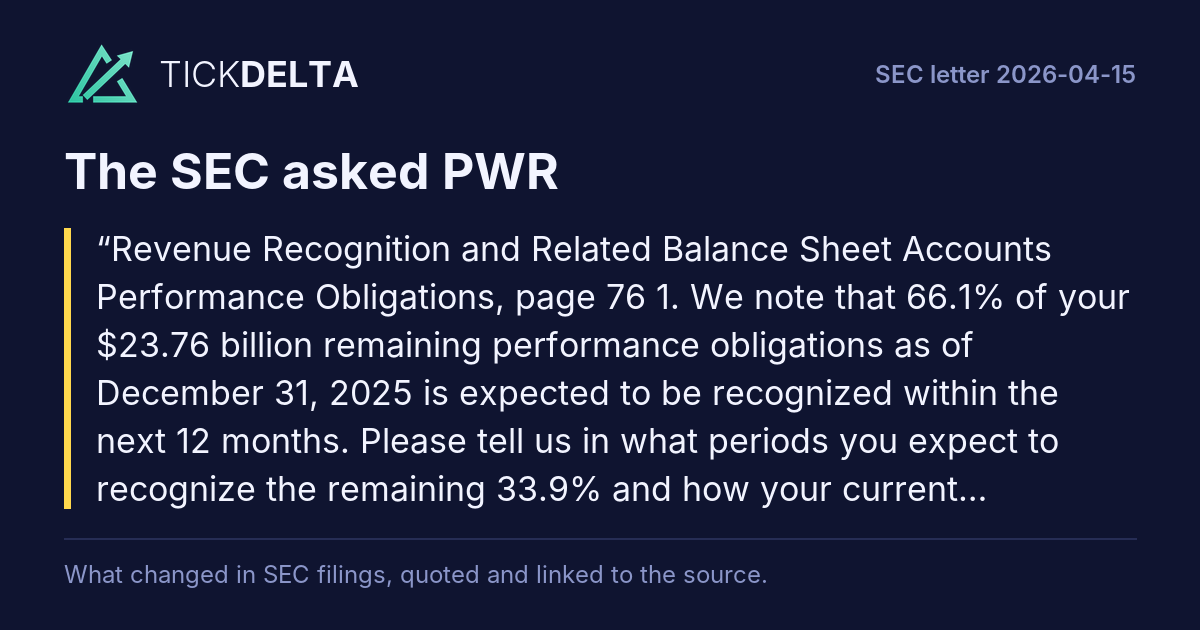
SEC asked
Revenue Recognition and Related Balance Sheet Accounts Performance Obligations, page 76 1. We note that 66.1% of your $23.76 billion remaining performance obligations as of December 31, 2025 is expected to be recognized within the next 12 months. Please tell us in what periods you expect to recognize the remaining 33.9% and how your current disclosures reflect the appropriate time bands for your arrangements.
Rest of the question

In that regard, please tell us how you considered disclosure around revenue expected to be recognized within 1 year, 2 years, etc. Refer to ASC 606-10-50-13(b).

PWR answered
The Company respectfully acknowledges the Staff’s comment. The Company believes its current disclosure approach is consistent with

Accounting Standards Codification (“ASC”) 606-10-50-13(b), which permits an entity to explain the timing of revenue recognition either on a quantitative basis using time bands or through qualitative information.

As of December 31, 2025, the

Company’s total remaining performance obligations (“RPOs”) were approximately $23.76 billion, of which the Company estimated (i) approximately 66% was expected to be recognized as revenue within the next 12 months,

(ii) the
Rest of the answer

substantial majority of the remaining RPOs was expected to be recognized as revenue within the following 24 months, and (iii) the balance was expected to be recognized as revenue thereafter. The Company’s disclosure on page

50 of the Form 10-K includes the aggregate RPO balance, as well as the percentage expected to be recognized in the following 12-month period, which captures the significant portion of the RPO and what the Company believes to be the quantitatively pertinent time band. The Company also provides a qualitative description of the approach and judgements considered when estimating the timing of revenue recognition for the RPOs on page 50 of the Form 10-K.

Substantially all of the Company’s contracts are long-term construction contracts satisfied over time, and the forecast of when RPOs are expected to be recognized as revenues is subject to meaningful variability arising from, among other items, project accelerations; project cancellations or delays that can be caused by commercial issues, regulatory requirements, natural disasters, emergencies, adverse weather conditions and other factors; and final acceptance of change orders by customers. Given these factors, the timing associated with estimates for discrete year-by-year time bands beyond the first 12 months is less certain. The Company believes its disclosure is directly analogous to the construction scenario in Example 43 of the revenue standard, in which the FASB expressly contemplates qualitative disclosure where the timing of recognition is uncertain. See ASC 606-10-55-306 through 55-307. The Company also notes that the 12-month quantification time band is consistent with the basis on which it provides financial guidance, which is similarly more difficult to estimate beyond that period.

The Company acknowledges the Staff’s comment, and taking into consideration the factors impacting estimates noted above, the Company intends to include in future filings, beginning with our Quarterly Report on Form 10-Q for the quarterly period ended March 31, 2026, filed with the Commission on April 30, 2026 (the “Form 10-Q”), the following: (i) a quantitative time band for the estimated recognition of RPOs within 12 months from the period end; (ii) the time band in which the substantial majority of the remaining RPOs are expected to be recognized (which for the current period, is the following 24 months); (iii) the time band in which the balance of the remaining RPOs are expected to be recognized; and (iv) additional qualitative discussion regarding the uncertainty inherent in the timing of revenue recognition of RPOs in construction contracts, which reiterates what is included on page 50 of the Form 10-K

The following disclosure is included on page 12 of the Form

10-Q:

“As of March 31, 2026 and December 31, 2025, Quanta’s remaining performance obligations were approximately $26.24 billion and $23.76 billion, of which (i) approximately 69% and 66% are expected to be recognized as revenue within the 12 months following March 31, 2026 and December 31,

2025, (ii) a substantial majority of the remaining balance is expected to be recognized within each of the following 24 months, and (iii) the balance is expected to be recognized thereafter. Estimates of the timing of revenue recognition of remaining performance obligations are subject to change based on, among other things, project accelerations; project cancellations or delays, including but not limited to those caused by commercial issues, regulatory requirements, natural disasters, emergencies and adverse weather conditions; and final acceptance of change orders by customers. These factors can cause revenues to be realized in periods and at levels that are different than originally projected.”

Read in the reply ↗

Also in this review: company letter, 2026-04-17, closing letter, 2026-05-06

Schedule 14A

2022-08-31 to 2022-10-06 · 3 questions · 1 letter from the SEC, 1 from the company
Review closed 2022-10-06
Controls
Definitive Proxy Statement on Schedule 14A filed on April 14, 2022 · General
SEC asked (1)
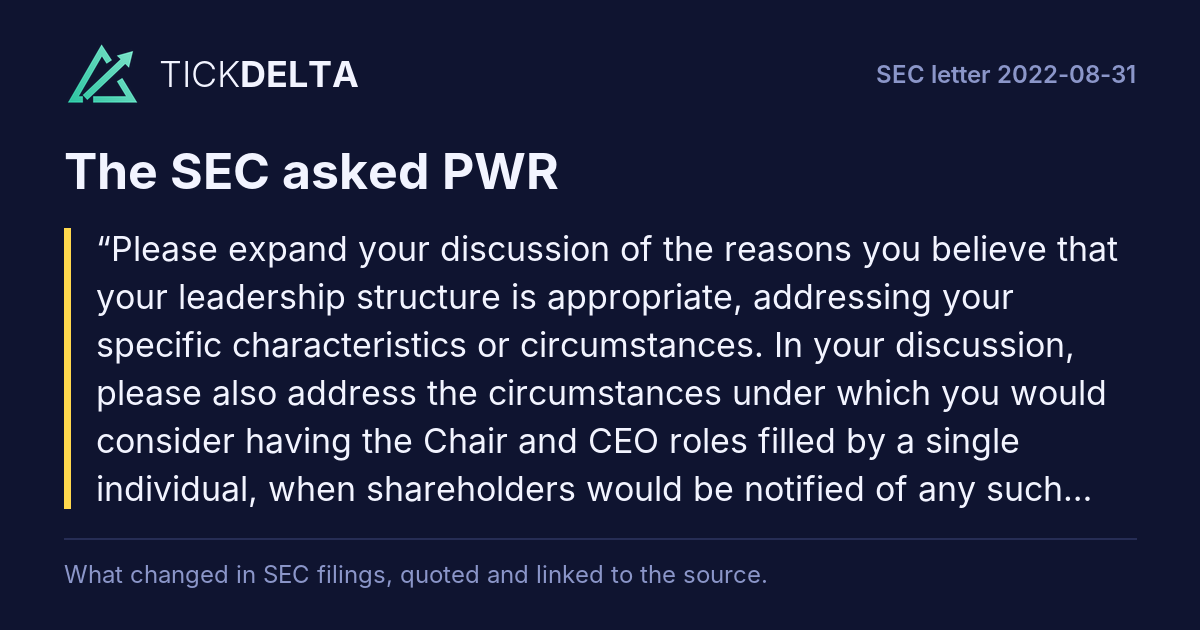
Please expand your discussion of the reasons you believe that your leadership structure is appropriate, addressing your specific characteristics or circumstances. In your discussion, please also address the circumstances under which you would consider having the Chair and CEO roles filled by a single individual, when shareholders would be notified of any such change, and whether you will seek prior input from
Rest of the question

shareholders.

PWR answered
Response: The Company respectfully acknowledges the Staff’s comment and confirms that the Company will revise the corporate governance disclosures in Future Proxy Statements to expand on the Board’s administration of its risk oversight function, including the reasons why the Board elected to retain direct oversight for certain risks, the timeframe for risk evaluation and application of different oversight standards, the role of outside advisors and experts and the Company’s management in identifying potential threats and risks, the reporting structure for the Chief Compliance Officer and the connection between the risk oversight process and our disclosure controls and procedures. One letter for all the questions, without numbered answers. Read the reply ↗
Definitive Proxy Statement on Schedule 14A filed on April 14, 2022 · General
SEC asked (2)
Please expand upon the role that your Chairman of the Board plays in the leadership of the board. For example, please enhance your disclosure to address whether or not your Chairman of the Board may: • represent the board in communications with shareholders and other stakeholders; • require board consideration of, and/or override your CEO on, any risk matters; or • provide input on design of the board itself.
PWR answered

See the reply above.

Definitive Proxy Statement on Schedule 14A filed on April 14, 2022 · General
SEC asked (3)
Please expand upon how your board administers its risk oversight function. For example, please disclose: • why your board elected to retain direct oversight responsibility for certain risks rather than assign oversight to a board committee; • the timeframe over which you evaluate risks (e.g., short-term, intermediate-term, or long-term) and how you apply different oversight standards based upon the immediacy of the
Rest of the question

risk assessed; • whether you consult with outside advisors and experts to anticipate future threats and trends, and how often you re-assess your risk environment; • how the board interacts with management to address existing risks and identify significant emerging risks; • to whom your Chief Compliance Officer reports; and • how your risk oversight process aligns with your disclosure controls and procedures.

PWR answered

See the reply above.

Also in this review: closing letter, 2022-10-06

Form 10-K for the year ended December 31, 2020

2021-05-04 to 2021-06-21 · 3 questions · 2 letters from the SEC, 2 from the company
Review closed 2021-06-21
Income taxesNon-GAAP measures
EBITDA and Adjusted EBITDA, page 47
SEC asked (1)
We note that EBITDA includes adjustments for the equity in (earnings) losses of nonintegral unconsolidated affiliates and interest, taxes, depreciation and amortization of integral unconsolidated entities. Tell us what consideration you gave to Question 103.01 of the Non-GAAP Financial Measures C&DIs when determining that these adjustments were appropriate to arrive at a measure labeled EBITDA.
Rest of the question

Please also advise us how the $9,994 equity in losses of unconsolidated affiliates has been recorded in your financial statements, as the amount does not reconcile to the discussion of Other income (expense), net found on page 44. 10. Income Taxes, page 98

PWR answered
•

Tell us what consideration you gave to Question 103.01 of the Non-GAAP

Financial Measures C&DIs when determining that these adjustments were appropriate to arrive at a measure labeled EBITDA.

The Company notes the Staff’s comment and will no longer calculate and present EBITDA to reflect an adjustment for equity in (earnings) losses of non-integral unconsolidated affiliates in future filings that include an EBITDA measure, beginning with our Quarterly Report on Form 10-Q for the quarterly period ended March 31, 2021, filed with the Commission on May 7, 2021 (the “Form 10-Q”).
Rest of the answer

The adjustment for equity in (earnings) losses of non-integral unconsolidated affiliates will now be reflected in our calculation of adjusted EBITDA. Set forth below is the Company’s reconciliation of EBITDA and adjusted EBITDA included on page 59 of the

Form 10-Q, which reflects the revised presentation.

Non-GAAP

Reconciliations

EBITDA and Adjusted EBITDA

The following table shows dollars in thousands.

Three Months Ended

March 31,

2021

2020

Net income attributable to common stock (GAAP as reported)

$

89,761

38,686

Interest expense

12,475

14,006

Interest income

(117

)

(759

Provision for income taxes

13,724

16,160

Depreciation expense

62,107

54,410

Amortization of intangible assets

21,355

17,908

Income taxes and depreciation included in equity in earnings of integral unconsolidated affiliates

1,501

—

EBITDA (a)

200,806

140,411

Non-cash stock-based compensation

18,687

14,912

Acquisition and integration costs

1,761

1,883

Equity in (earnings) losses of non-integral unconsolidated

(685

2,683

Change in fair value of contingent consideration liabilities

(363

2,758

Adjusted EBITDA

220,206

162,647

(a)

The calculation of EBITDA for the three months ended March 31, 2020 has been amended to conform to the current period’s calculation of EBITDA.

With respect to integral unconsolidated affiliates, the Company determined, after consideration of the facts and circumstances, that certain of its unconsolidated affiliates are operationally integral to its consolidated operations. As such, the results associated with these unconsolidated affiliates have been included as a component of Operating income within the Company’s Consolidated Statements of Operations, beginning in the second quarter of 2020 and upon the commencement of certain affiliate operations. In light of the operational nature of these unconsolidated affiliates, which are integral to our core operations, the Company has identified and included the income taxes and depreciation associated with the integral unconsolidated affiliates as an adjustment within our calculation of EBITDA in the same manner as our consolidated operations.

Please also advise us how the $9,994 equity in losses of unconsolidated affiliates has been recorded in your financial statements, as the amount does not reconcile to the discussion of Other income (expense), net found on page 44.

The $10.0 million of equity in losses of non-integral unconsolidated affiliates is included as a component of Other income (expense), net within the Company’s Consolidated Statements of Operations. The Company’s discussion and analysis of the results included within Other income (expense), net addressed $8.7 million of impairments, which were a component of the $10.0 million of equity in losses of non-integral unconsolidated affiliates. The remaining activity of $1.3 million within equity in losses of non-integral unconsolidated affiliates during the year ended December 31, 2020 was not considered material to describe the changes within Other income (expense), net during the period, and therefore was not included in the discussion and analysis found on page 44 of the Form 10-K.

10. Income Taxes, page 98

Read in the reply ↗
In its next report

First report after the company's reply of 2021-05-17: 10-Q filed 2021-08-06 ↗, against the 10-Q filed 2020-11-02 ↗.

Tickdelta does not hold the text of both reports, so they are not compared here.

EBITDA and Adjusted EBITDA, page 47
SEC asked (2)
We note that your valuation allowance decreased $60.9 million from December 31, 2019 to December 31, 2020. Given that your effective tax rate reconciliation indicates that the change in the valuation allowance impacted the reconciliation by approximately $31.1 million please please provide us with an understanding of the differences impacting both schedules.
Rest of the question

Furthermore, we note your disclosure that $45.1 million of the $60.9 million decrease in the valuation allowance related to certain foreign tax credits. Given that your foreign tax credits decreased by only $4.4 million, please further explain the facts and circumstances that led to the $45.1 million decrease in the valuation allowance related to the foreign tax credits. We remind you that the company and its management are responsible for the accuracy and adequacy of their disclosures, notwithstanding any review, comments, action or absence of action by the staff.

PWR answered
Given that your effective tax rate reconciliation indicates that the change in the valuation allowance impacted the reconciliation by approximately $31.1 million please provide us with an understanding of the differences impacting both schedules.

The $60.9 million decrease in valuation allowance from December 31, 2019 to

December 31, 2020 is composed of the following items (in millions):

Valuation Allowance as of December 31, 2019

104.2 a. Increase related to certain new deferred tax assets generated in 2020

14.0 b.
Rest of the answer

Decrease related to updated information regarding certain foreign tax credits

(45.1 c. Decrease related to removal of certain loss carryforwards

(29.4 d. Currency revaluation of prior year valuation allowances

(0.4

Valuation Allowance as of December 31, 2020

43.3

In the table above, Item (a) relates predominantly to state and foreign net operating losses generated during 2020 that the Company assessed would more likely than not be unrealizable based on operations in the specific jurisdictions in which such losses were generated. Item (b) relates to the reversal of the valuation allowance for certain foreign tax credits. During the quarter ended December 31, 2020, certain new facts and positive evidence became available, and in management’s view it is now more likely than not that such foreign tax credits will be realized. The changes in the valuation allowance from December 31, 2019 arising from Items (a) and (b) account for the $31.1 million reduction in valuation allowance on deferred tax assets included in the table reconciling the effective tax rate on page

100 of the Form 10-K.

In the table above, Item (c) relates to certain loss carryforwards that are no longer available for use, which are primarily associated with the termination of a telecommunications project in Peru and the disposition of certain other operations. The deferred tax assets, and the related valuation allowance, for losses generated by specific entities conducting these operations were reversed in the Company’s Consolidated Balance Sheets as of December 31, 2020. As such, the disclosure on page 100 of the Form

10-K, which reflects the deferred tax assets and the valuation allowance, did not include the $29.4 million of certain loss carryforwards. Additionally, the reversals of both the deferred tax assets and the related valuation allowance are not reflected in the valuation allowance included in the effective tax rate reconciliation on page 100 of the Form 10-K because the reversals were equal and offsetting in the provision for income taxes for the year ended December 31, 2020.

Furthermore, we note your disclosure that $45.1 million of the $60.9 million decrease in the valuation allowance related to certain foreign tax credits. Given that your foreign tax credits decreased by only $4.4 million, please further explain the facts and circumstances that led to the $45.1 million decrease in the valuation allowance related to the foreign tax credits.

The Company regularly evaluates valuation allowances established for deferred tax assets for which future realization is uncertain pursuant to Accounting Standards Codification (“ASC”)

740-10-30-16 and ASC

740-10-30-17. The Company considers projected future taxable income and tax planning strategies in making this evaluation as permitted by ASC 740-10-30-18 through ASC 740-10-30-20. During the quarter ended December 31, 2020, the Company completed a financial restructuring. After considering the impact of the financial restructuring on forecasted foreign source income, the Company concluded that as of December 31, 2020, based on the weight of all available evidence, the Company would more likely than not realize the benefit of its deferred tax assets for certain foreign tax credit carryforwards. As a result, the related $45.1 million valuation allowance was reversed during the quarter ended December 31, 2020. The estimated utilization of such foreign tax credits in the Company’s U.S. federal income tax return for the year ended December 31, 2020 was $4.4 million, which resulted in a decrease in the deferred tax asset for such foreign tax credits in the table of deferred tax assets and liabilities on page 100 of the Form 10-K. The remaining balance of these tax credits will remain in the table of deferred tax assets and liabilities until they are utilized on a tax return.

Read in the reply ↗
In its next report

First report after the company's reply of 2021-05-17: 10-Q filed 2021-08-06 ↗, against the 10-Q filed 2020-11-02 ↗.

Tickdelta does not hold the text of both reports, so they are not compared here.

SEC asked
Income Taxes, page 98 1. We note your response to comment 2. In future filings, please ensure your disclosures clearly disclose any material changes impacting your valuation allowance including the facts and circumstances that drove those changes.
Rest of the question

To the extent material differences exist between your income tax rate reconciliation and the overall change in the valuation allowance, your disclosures should highlight such material changes including the reasons for such changes.

PWR answered
The Company acknowledges the Staff’s comment and in future filings will disclose any material changes impacting our valuation allowance, including the facts and circumstances that drove such material changes. The Company will also ensure that in future filings disclosure is provided to highlight and explain any material differences between the Company’s income tax rate reconciliation and the overall change in the Company’s valuation allowance. Read in the reply ↗

Also in this review: closing letter, 2021-06-21

Form 10-K for the year ended December 31, 2019

2020-05-05 to 2020-08-20 · 2 questions · 2 letters from the SEC, 2 from the company
Review closed 2020-08-20
Legal and contingenciesRevenue
Notes to Consolidated Financial Statements
SEC asked
Commitments and Contingencies Peru Project Dispute, page 104 1. We note your disclosure that you have a net receivable of approximately $120 million, which includes approximately $87 million that PRONATEL collected through exercise of the advanced payment bonds. In light of the dispute, please tell us how you determined it was appropriate to record a net receivable of $120 million from PRONATEL.
Rest of the question

Within your response, please reference the authoritative accounting literature management relied upon.

PWR answered
Enclosed with this letter please find information (the “Supplemental Information”) containing the Company’s response with respect to certain information requested by the Staff. Pursuant to Rule 418 under the Securities Act of 1933, as amended, and Rule 12b-4 under the Securities Exchange Act of 1934, as amended, the Company is requesting that such Supplemental Information be returned to it or destroyed upon completion of your review and that, pending its return or destruction, it be withheld from release.
Rest of the answer

The Company further requests that the Freedom of Information Act officer of the Commission accord such Supplemental Information (but not, for the avoidance of doubt, the responses set forth in this letter) confidential treatment under the rules of the Commission.

Background

As disclosed in the Form

10-K, in 2015, Redes Andinas de Comunicaciones S.R.L. (“Redes”), a majority-owned subsidiary of the Company, entered into two separate contracts (the “Contracts”) with an agency of the Peruvian Ministry of Transportation and Communications (“MTC”), currently Programa Nacional de Telecomunicaciones, as successor to Fondo de Inversion en Telecomunicaciones (collectively, “PRONATEL”), pursuant to which Redes agreed to design, construct, operate, and maintain certain telecommunication networks in three rural regions of Peru (the “Projects”). At the beginning of the Projects, PRONATEL made advance payments to Redes totaling approximately $87 million, which were secured by two on-demand advance payment bonds (the “Advance Payment Bonds”) in the aggregate amount of approximately $87 million posted by Redes to guarantee the proper use of the advance payments in the execution of the Projects. Redes also provided two on-demand performance bonds (the “Performance Bonds”) in the aggregate amount of $25 million to secure the performance of its obligations under the Contracts.

During execution of the Projects, numerous challenges and delays were experienced, primarily related to issues the Company believes were outside the control of and not attributable to Redes, as well as various delays the Company believes were attributable to PRONATEL. In response to certain challenges and delays, multiple schedule extensions were requested by Redes and granted by

PRONATEL. However, prior to termination of the Contracts, additional schedule extension requests due to further delays the Company believes were not attributable to Redes were not granted by PRONATEL, and PRONATEL ultimately claimed Redes was in default under the Contracts and terminated the Contracts for alleged cause in April 2019 prior to Redes’ completion of construction of the Projects. In May 2019, PRONATEL exercised the Advance Payment Bonds and Performance Bonds in full and indicated its intention to claim damages, including a verbal allegation of liquidated damages of approximately $45 million. Pursuant to the Company’s bonding arrangement, the Company was required to reimburse its bond surety for the aggregate approximately $112 million paid by the bond surety to PRONATEL upon exercise of the Advance Payment Bonds and Performance Bonds. As a result, Redes subsequently filed for arbitration with the Court of International Arbitration of the

International Chamber of Commerce against PRONATEL and the MTC, claiming (i) wrongful termination of the Contracts; (ii) wrongful execution of the Advance Payment Bonds and Performance Bonds; and (iii) lack of entitlement by PRONATEL and the MTC to liquidated damages. Redes is further seeking compensation for all damages arising from PRONATEL’s actions, including but not limited to (i) repayment of the amounts collected by PRONATEL under the

Advance Payment Bonds and Performance Bonds; (ii) payment of amounts owed for work completed by Redes under the Contracts; (iii) lost income in connection with Redes’ future operation and maintenance of the networks pursuant to the

Contracts and (iv) other related costs and damages to Redes as a result of the improper termination of the Contracts.

Performance under the Contracts commenced in early 2016 with the Contracts being accounted for pursuant to Accounting Standards

Codification (“ASC”) 605-35, Revenue Recognition – Construction-type and production-type contracts, using the percentage-of-completion accounting method. Additionally, pursuant to ASC 605-25, Multiple-element arrangements, the accounting for the Contracts was divided between the construction (including design) and the operation and maintenance (“O&M”) work scope deliverables, and the total estimated consideration was allocated between the construction and O&M elements using the relative selling price method in accordance with ASC 605-25-30.

Effective January 1, 2018, the Company adopted ASC 606, Revenue from Contracts with Customers, and concluded that it was appropriate to continue to recognize revenue over time as performance under the Contracts progressed and that the previously determined units of accounting for the construction and O&M scopes of work also met the definition of separate performance obligations under ASC 606-10-25-19, as each scope of work was determined to be distinct. Accordingly, there were no substantive changes to the contract accounting as a result of the implementation of ASC 606.

During the construction execution period, billings under the Contracts included the initial advance billings of approximately $87 million and an additional $13 million of milestone billings. As a result of the advance billings, the Projects were initially in a contract liability position, as billings were in excess of revenues recognized. Please see Part A of the Supplemental

Information. Due to the Contracts terminations and exercise of the approximately $87 million of Advance Payment Bonds and $25 million of Performance Bonds, Redes is pursuing, through arbitration, claims against PRONATEL. However, because of the inherent uncertainty involved in arbitration proceedings and recovery of amounts owed, there can be no assurance that Redes will prevail on those claims or in defense of liquidated damages claims or any other claims that may be asserted by PRONATEL.

As a result, during the year ended December 31, 2019, the Company recorded a charge to earnings of $79.2 million, which included a reduction of previously recognized earnings on the Projects, a reserve against a portion of the project costs incurred through the Contracts terminations date, an accrual for a portion of the alleged liquidated damages, and the estimated costs to complete the turnover of the Projects to PRONATEL and close out the Projects. Please see Part B of the Supplemental

Information.

The following sections provide the basis for the

Company’s conclusions and the authoritative accounting literature relied upon by the Company.

Advance Payment Bonds Receivable

As referenced above, the Advance Payment Bonds were posted to guarantee the proper use of the advance payments in the execution of the

Projects, and therefore were to be exercised by PRONATEL only if it was determined that Redes did not use the advance payments for their intended purpose, in which case Redes would be obligated to return that portion of the advance payments not properly used. At the time of the Contracts terminations and exercise of the Advance Payment Bonds, Redes had incurred substantially more than the advance payment amounts in the execution of the Projects, and the Company believes Redes had used the advance payment amounts for their intended purpose. Accordingly, the Company believes that the amounts received by PRONATEL through the exercise of the Advance Payment Bonds were improper and not in accordance with the contractual terms.

Upon PRONATEL’s exercise of the Advance Payment Bonds and the

Company’s disbursement of cash to reimburse its bond surety for payments to PRONATEL upon such exercise, the Company evaluated whether the cash disbursement of approximately $87 million should be recognized as an asset or as a project expense or loss. Based on the terms of the Advance Payment Bonds and because the Company believed Redes properly used the advance payments, in connection with the preparation of its financial statements, the Company concluded that Redes has rights under the Contracts to be repaid the advance payment amounts, and therefore that the disbursement should appropriately be accounted for as an asset. The Company also assessed the Advance Payment Bonds receivable for potential impairment and collectability. The Company relied on the following accounting guidance for its conclusion:

FASB Statement of Financial Accounting Concepts No. 6 – Elements of Financial Statements

Definitions of elements – Assets

25. Assets are probable* future economic benefits obtained or controlled by a particular entity as a result of past transactions or events.

* Probable is used with its usual general meaning, rather than in a specific accounting or technical sense (such as that in FASB Statement

No. 5, Accounting for Contingencies, par. 3), and refers to that which can reasonably be expected or believed on the basis of available evidence or logic but is neither certain nor proved.

The Company also noted and relied on ASC 310-10-35-2, Impairment of Loans and Receivables, which references the loss contingency model within ASC 450 when evaluating receivables for potential impairment as follows:

Impairment of Loans and Receivables - Subtopic 450-20 provides the basic guidance for recognition of impairment losses for all receivables (except those receivables specifically addressed by other Topics, such as debt securities).

ASC 450-20-25, Loss Contingencies – Recognition

General Rule

25-1 When a loss contingency exists, the likelihood that the future event or events will confirm the loss or impairment of an asset or the incurrence of a liability can range from probable to remote. As indicated in the definition of contingency, the term loss is used for convenience to include many charges against income that are commonly referred to as expenses and others that are commonly referred to as losses. The Contingencies Topic uses the terms probable, reasonably possible, and remote to identify three areas within that range.

25-2 An estimated loss from a loss contingency shall be accrued by a charge to income if both of the following conditions are met:

a. Information available before the financial statements are issued or are available to be issued (as discussed in Section 855-10-25) indicates that it is probable that an asset had been impaired or a liability had been incurred at the date of the financial statements. Date of the financial statements means the end of the most recent accounting period for which financial statements are being presented. It is implicit in this condition that it must be probable that one or more future events will occur confirming the fact of the loss.

b. The amount of loss can be reasonably estimated.

The purpose of those conditions is to require accrual of losses when they are reasonably estimable and relate to the current or a prior period.

As referenced above and as described further in the Form 10-K, Redes has filed for arbitration and, as a result, if the parties do not reach settlement outside of the arbitration proceedings, then the expected recovery of the Advance Payment Bonds receivable will be through the arbitration process. Accordingly, the Company evaluated the probability of recovery through arbitration. Please see Part C of the Supplemental Information. In connection with the preparation of its financial statements, the Company concluded that recovery of the Advance Payment Bonds receivable in arbitration was probable.

Additionally, the Company evaluated the potential collectability of the Advance Payment Bonds receivable from PRONATEL upon a favorable arbitration ruling and concluded no reserve amount was deemed to be probable.

Residual Contract Asset

As disclosed in the Form 10-K, at the time the Contracts were terminated, Redes had incurred costs of approximately $157 million in the construction of the Projects and had received approximately $100 million of payments (inclusive of the advance payments of approximately $87 million) from PRONATEL. Please see

Part D of the Supplemental Information.

Upon termination of the

Contacts, the Company referenced the provisions of ASC 606 in evaluating its residual contract asset position. Specifically, due to the dispute situation between Redes and PRONATEL, the Company relied on ASC 606 Example 9 – Unapproved

Change in Scope and Price which refers to the variable consideration model and the need to constrain estimates of variable consideration as follows:

Example 9—Unapproved Change in Scope and Price

55-134 An entity enters into a contract with a customer to construct a building on customer-owned land. The contract states that the customer will provide the entity with access to the land within 30 days of contract inception. However, the entity was not provided access until 120 days after contract inception because of storm damage to the site that occurred after contract inception. The contract specifically identifies any delay (including force majeure) in the entity’s access to customer-owned land as an event that entitles the entity to compensation that is equal to actual costs incurred as a direct result of the delay. The entity is able to demonstrate that the specific direct costs were incurred as a result of the delay in accordance with the terms of the contract and prepares a claim. The customer initially disagreed with the entity’s claim.

55-135 The entity assesses the legal basis of the claim and determines, on the basis of the underlying contractual terms, that it has enforceable rights. Consequently, it accounts for the claim as a contract modification in accordance with paragraphs 606-10-25-10 through 25-13. The modification does not result in any additional goods and services being provided to the customer. In addition, all of the remaining goods and services after the modification are not distinct and form part of a single performance obligation. Consequently, the entity accounts for the modification in accordance with paragraph 606-10-25-13(b) by updating the transaction price and the measure of progress toward complete satisfaction of the performance obligation. The entity considers the constraint on estimates of variable consideration in paragraphs 606-10-32-11 through 32-13 when estimating the transaction price.

Variable Consideration

32-5 If the consideration promised in a contract includes a variable amount, an entity shall estimate the amount of consideration to which the entity will be entitled in exchange for transferring the promised goods or services to a customer.

Constraining Estimates of Variable Consideration

32-11 An entity shall include in the transaction price some or all of an amount of variable consideration estimated in accordance with paragraph 606-10-32-8 only to the extent that it is probable that a significant reversal in the amount of cumulative revenue recognized will not occur when the uncertainty associated with the variable consideration is subsequently resolved.

32-12 In assessing whether it is probable that a significant reversal in the amount of cumulative revenue recognized will not occur once the uncertainty related to the variable consideration is subsequently resolved, an entity shall consider both the likelihood and the magnitude of the revenue reversal. Factors that could increase the likelihood or the magnitude of a revenue reversal include, but are not limited to, any of the following:

a. The amount of consideration is highly susceptible to factors outside the entity’s influence. Those factors may include volatility in a market, the judgment or actions of third parties, weather conditions, and a high risk of obsolescence of the promised good or service.

b. The uncertainty about the amount of consideration is not expected to be resolved for a long period of time.

c. The entity’s experience (or other evidence) with similar types of contracts is limited, or that experience (or other evidence) has limited predictive value.

d. The entity has a practice of either offering a broad range of price concessions or changing the payment terms and conditions of similar contracts in similar circumstances.

e. The contract has a large number and broad range of possible consideration amounts.

To assess and reach a conclusion with respect to the residual contract asset, as referenced in ASC 606 Example 9 above, the Company first assessed the legal basis of the claim and determined on the basis of the underlying Contracts that Redes has enforceable rights against PRONATEL. The Contracts provide that upon termination a reconciliation of costs between Redes and PRONATEL is to be performed, with an equitable true-up payment between the parties. However, any amount recoverable by Redes is limited to the amounts expended by Redes under the Contracts that correspond to its performance thereunder (i.e., the percentage of completion of the project) in the implementation of the Projects.

Please see Part E of the Supplemental Information.

Analysis of Overall Positions of the Parties

The Company also considered and believes its position is supported by the fact that upon completion of the physical transfer of the telecommunications networks (as completed at the time of the Contracts terminations) to PRONATEL, which is required upon termination of the Contracts and the process for which is underway, PRONATEL will (i) possess the telecommunications networks (as completed at the time of the Contracts terminations), for which it originally contracted to pay in excess of $150 million, and (ii) be in a $12 million positive cash position, having collected $112 million through exercise of the Advance Payment Bonds and the Performance Bonds and having made only $100 million in payments to Redes. As a result, the Company believes Redes is entitled to recover, and Redes is pursuing claims for, substantially more than the $120 million net receivable the Company has recognized.

Read in the reply ↗
Notes to Consolidated Financial Statements
SEC asked
Commitments and Contingencies Peru Project Dispute, page 104 1. We note your discussion of the background. Please address the following regarding the two separate contracts with PRONATEL. • Please summarize for us the material terms of the contracts with PRONATEL.
Rest of the question

Your response should address, but not be limited to, your rights and obligations, description of the termination provisions and the nature of enforceable right to payment upon termination, what constitutes delay or default and the operation of the contract in a delay or default, and ownership and control of the network during the design and construction phase. • Please summarize the nature of the challenges and delays for which relief was provided, summarize the challenges, delays and events that led to termination and tell us the status of the contracts at termination. • Please describe the contract provisions related to liquidated damages and tell us how the amount of liquidated damages will be determined. In addition, tell us if this is a matter specified by contract and whether it is pending the results of arbitration. • Please tell us how the amount of equitable true-up will be determined. In addition, tell us if this is a matter that is pending the results of arbitration. 2. We note your discussion of the background. Please address the following regarding the advance payment bonds and performance bonds: • Please summarize the parties to and material terms of the advance payment bonds and performance bonds. Your response should address, but not be limited to, the exercise provision of the bonds and your obligation to reimburse the surety. • It appears that you determined exercise of the advance payment and performance bonds trigger a right under the two separate contracts between Redes and PRONATEL. Please tell us the terms of the bonds or contracts that support that conclusion. 3. With respect to the contract asset that existed at termination: • Please tell us how you considered the impact from the termination of the contract on your determination that the asset continues to be a contract asset after termination. For example, if future performance was a condition of the contract asset and such performance is precluded by contract termination, tell us what contract provision supports the existence of an asset upon termination, in what amount, and to what extent did contract termination change the character of the asset. Within your response, reference the authoritative accounting literature that management relied upon. • Please tell us why you believe the contract modification guidance in ASC 606 example 9 is applicable to a contract termination. 4. Please provide a more fulsome accounting analysis, with citation to authoritative literature and applicable contract terms, to support your accounting for the $112 million the Company paid to the surety. Please address in your analysis, but do not limit it to, the following: • The journal entries you used to record the settlement of the Company’s contract liability to the surety and, if not recognized in the statement of operations, the authoritative literature that supports this determination. • The on demand nature of the bonds and whether your right to payment from PRONATEL, which you indicate is triggered by your payment to the surety, is contingent or alternatively required by law or contract. • That the bonds secured the performance of the Company of its obligations to provide goods and services under its contracts with PRONATEL. • The timing of contract termination (April 2019) relative to the timing of the Company’s incurrence of a liability to the surety (May 2019). • The authoritative guidance supporting your accounting and the consideration you gave to the applicability of (1) ASC 606, including, but not limited to, its requirements for contract combination, variable consideration, and consideration payable to a customer, (2) ASC 450-30, and (3) ASC 450-20, including the additional sources of guidance in ASC 410-30-35-9 and SAB Topic 5Y related to claims for loss recoveries that are subject to litigation.. • The possible alternative accounting treatments you considered and rejected and the reasons why. 5. Please clarify for us the components of the $120 million net receivable that is reflected on your balance sheet and the journal entries you booked to recognize it. 6. Please clarify for us the components of the $79.2 million charge on your 2019 income statement. In addition, with respect to the $48.8 million reduction in revenue, tell us your basis in U.S. GAAP for the reversal of revenue. In this regard, tell us how this reversal of revenue as well as the other components of the charge are consistent with your assertion that you have enforceable rights against PRONATEL.
PWR answered
United States Securities and Exchange Commission

Page

Background

As disclosed in the Form 10-K, in 2015 Redes Andinas de Comunicaciones S.R.L.

(“Redes”), a majority-owned subsidiary of the Company, entered into two separate but substantially identical contracts (the “Contracts”) with an agency of the Peruvian Ministry of Transportation and Communications, currently Programa Nacional de Telecomunicaciones, as successor to Fondo de Inversion en Telecomunicaciones (collectively, “PRONATEL”), pursuant to which Redes agreed to design, construct, operate, and maintain telecommunication networks
Rest of the answer

in certain adjacent rural regions of Peru (the “Projects”).

The Projects were large in scale and scope and included two types of networks in each region: Access Networks and Transportation Networks, covering approximately 2,000 km in the Piura-Tumbes region and approximately 2,200 km in the Cajamarca region. The Contracts provided Redes would design and build the Access Networks that would connect approximately 1,150 towns in the regions and provide internet access to approximately 2,300 government locations (such as schools, health institutions and police stations) in the regions. After the construction period, Redes would operate and maintain the Access Networks for a period of ten years, with an additional right to market and sell data capacity and internet service to the public. The Contracts also provided that Redes would design and build the Transportation Networks to connect the Access Networks to the fiber optic telecommunication backbone in Peru.

The Contracts also required Redes to obtain the following surety bonds in favor of PRONATEL: (i) advance payment bonds, in the aggregate amount of approximately $87 million, to secure the correct use of advance payments made by PRONATEL (the

“Advance Payment Bonds”); and (ii) performance bonds, in the aggregate amount of approximately $25 million, to secure the correct and timely performance of the Contracts ( the “Performance Bonds” and, together with the Advance Payment Bonds, the “Bonds”). The Bonds were issued by an intermediary financial institution, Chubb Seguros Peru S.A. (“Chubb”), in favor of PRONATEL. In addition, in the event of a termination of the Contracts, Redes was contractually required to transfer the networks, as completed at the time of termination, to PRONATEL, and the parties were required to perform a reconciliation of balances (i.e., a reconciliation of amounts owed), which, pursuant to Peruvian law, would provide a right to restitution of the value of the performed obligations at the date of termination (the “Performed Value”). Redes began the required transfer process soon after termination of the Contracts by PRONATEL and, due to the complexity of the Projects, continues to diligently work toward the completion of the transfer process.

Rule 83 Confidential Treatment Requested by Quanta Services, Inc.; request Number 1

[***]

•

Please summarize for us the material terms of the contracts with PRONATEL. Your response should address, but not be limited to, your rights and obligations, description of the termination provisions and the nature of enforceable right to payment upon termination, what constitutes delay or default and the operation of the contract in a delay or default, and ownership and control of the network during the design and construction phase.

Please see Exhibit A and Exhibit B for a summary of certain terms of the Contracts. Each Contract has substantially the same terms and conditions, except for the amounts of the contract consideration. As the term and construction schedule for each Contract largely coincided, the networks were constructed concurrently.

Rule 83 Confidential Treatment Requested by Quanta Services, Inc.; request Number 2

Please summarize the nature of the challenges and delays for which relief was provided, summarize the challenges, delays and events that led to termination and tell us the status of the contracts at termination.

The Projects experienced numerous challenges and delays during the construction period, and Redes obtained several extensions for weather-related issues, permitting delays (including environmental permitting and other permits and easements) and the inability to acquire certain required parcels of land (due to factors such as local opposition to the Projects and legal complications with acquiring clear title). Pursuant to the terms of the Contracts, delays not attributable to Redes would result in an extension of applicable deadlines. Throughout the construction period, Redes worked closely with PRONATEL, which was aware of the challenges and granted numerous extensions pursuant to the terms of the Contracts.

Rule 83 Confidential

Treatment Requested by Quanta Services, Inc.; request Number 3

Please describe the contract provisions related to liquidated damages and tell us how the amount of liquidated damages will be determined. In addition, tell us if this is a matter specified by contract and whether it is pending the results of arbitration.

As set forth in further detail in Exhibit A, Section 18 of the

Contracts provides for liquidated damages for various aspects of the Projects that vary based on whether the Projects are in the construction period or the operation period. Relevant to the current dispute are liquidated damages provisions related to lack of performance of certain activities and non-compliance with applicable deadlines during the construction period.

The manner in which the amount of liquidated damages is calculated varies, as there are different types of penalties. Certain liquidated damages arise upon the occurrence of a specific event and have a fixed amount per event. Others arise upon a delay in the schedule, and thus are calculated depending on the length of the delay (i.e., a fixed amount set per period, including on a per day basis).

According to the terms of the Contracts, PRONATEL may deduct the amount of liquidated damages that have been incurred from future payments under the Contracts. If the pending payments are not sufficient to cover such liquidated damages, Redes must pay any additional amount to PRONATEL within 15 days after receipt of a written notice from PRONATEL. PRONATEL has a right to call the Performance Bonds pursuant to the terms of the Contracts if Redes does not pay such additional liquidated damages within 15 days after receiving written notice of such amounts owed.

Rule 83 Confidential Treatment Requested by Quanta Services, Inc.; request Number 4

Please tell us how the amount of equitable true-up will be determined. In addition, tell us if this is a matter that is pending the results of arbitration.

Rule 83 Confidential Treatment Requested by Quanta Services, Inc.; request Number 5

2. We note your discussion of the background. Please address the following regarding the advance payment bonds and performance bonds:

Please summarize the parties to and material terms of the advance payment bonds and performance bonds. Your response should address, but not be limited to, the exercise provision of the bonds and your obligation to reimburse the surety.

The Advance Payment Bonds were issued by Chubb in favor of PRONATEL at the request of Redes, in the aggregate amount of approximately

$87 million. The stated purpose of the Advance Payment Bonds was to “secure the correct and timely use of the first disbursement” under the Contracts.

Similarly, the Performance Bonds were issued by Chubb in favor of PRONATEL at the request of Redes, in the aggregate amount of approximately

$25 million. The stated purpose of the Performance Bonds was to “secure the correct and timely performance of each and every obligation” under the Contracts.

The Bonds were separate instruments issued by Chubb in favor of PRONATEL. Consistent with customary business practices for long-term, large-scale construction projects in non-U.S. jurisdictions, the Bonds were unconditional, irrevocable and automatically enforceable, and PRONATEL needed only to send a written notice to Chubb in order to call the Bonds. Upon receipt of such written notice, Chubb was required to make a payment to PRONATEL within 24 hours under the terms of the Bonds and without regard to the terms of the Contracts.

While the Contracts govern certain actions related to the Bonds, Chubb was not a party to or subject to the terms of the Contracts. In other words, a dispute between Redes and PRONATEL with respect to the terms of the Contracts did not affect Chubb’s obligation to make the required payment under the Bonds. However, the Company believes that PRONATEL improperly called the Bonds in violation of the terms of the Contracts and has submitted claims to this effect in the arbitration proceedings.

The Company’s obligation to reimburse Chubb is included in the Company’s global underwriting, continuing indemnity and security agreement. Pursuant to that agreement, certain sureties (including the parent company of Chubb) have agreed to procure and issue bonds on behalf of the Company and its subsidiaries for the benefit of third-party customers, and the Company has agreed to reimburse those sureties for amounts disbursed upon exercise and payment of bonds issued. As such, upon Chubb’s payment of the Bond proceeds to PRONATEL, the Company was required to reimburse Chubb for the amounts paid.

It appears that you determined exercise of the advance payment and performance bonds trigger a right under the two separate contracts between Redes and PRONATEL. Please tell us the terms of the bonds or contracts that support that conclusion.

The purpose of the Advance Payment Bonds according to the terms of the Contracts is to secure the correct use of the advance payments provided to Redes in connection with construction of the Projects. Thus, in order for PRONATEL to properly call the Advance Payment Bonds, it must be determined that Redes did not use the advance payments in accordance with the Contracts.

In the termination provisions of the Contracts, the reconciliation process grants Redes the right to provide evidence of the expenditures of the funds. Section 20 of the Contracts specifically states, as translated, that “in all cases of termination of the Contracts a reconciliation of balances will be conducted up to the date of termination.” PRONATEL has not provided Redes with written notice of any alleged breach of its obligation to correctly use the advance payments, has not afforded Redes an opportunity to provide evidence of the correct use of the funds and did not permit Redes to make payment for any amounts not used correctly. Again, pursuant to the terms of the Contracts, PRONATEL is only entitled to call the Advance Payment Bonds with respect to any alleged portion of the advance payments not correctly used in accordance with the Contracts.

The fact that the Bonds were payable on demand by Chubb does not affect PRONATEL’s obligation to Redes to only call such Bonds as permitted pursuant to the terms of the Contracts. Although Chubb was obligated under the terms of the Bonds to fund the Bond proceeds upon exercise, PRONATEL was in breach of the Contracts by so exercising the

Bonds.

The Performance Bonds were called by PRONATEL upon termination of the Contracts for alleged delay. Pursuant to the terms of the

Contracts, as summarized in Exhibit A, the Performance Bonds could be exercised by PRONATEL to assess impacts and related costs, including alleged liquidated damages, to PRONATEL in the event of non-performance by Redes. While PRONATEL has verbally alleged Redes has breached contractual obligations, it has not specified any liquidated damages in writing as required by the Contracts.

Rule 83 Confidential Treatment Requested by Quanta Services, Inc.; request Number 6

3. With respect to the contract asset that existed at termination:

Please tell us how you considered the impact from the termination of the contract on your determination that the asset continues to be a contract asset after termination. For example, if future performance was a condition of the contract asset and such performance is precluded by contract termination, tell us what contract provision supports the existence of an asset upon termination, in what amount, and to what extent did contract termination change the character of the asset. Within your response, reference the authoritative accounting literature that management relied upon.

Rule 83 Confidential Treatment Requested by Quanta Services, Inc.; request Number 7

Please tell us why you believe the contract modification guidance in ASC 606 example 9 is applicable to a contract termination.

Rule 83 Confidential Treatment Requested by Quanta Services, Inc.; request Number 8

4. Please provide a more fulsome accounting analysis, with citation to authoritative literature and applicable contract terms, to support your accounting for the $112 million the Company paid to the surety. Please address in your analysis, but do not limit it to, the following:

The journal entries you used to record the settlement of the Company’s contract liability to the surety and, if not recognized in the statement of operations, the authoritative literature that supports this determination.

The on demand nature of the bonds and whether your right to payment from PRONATEL, which you indicate is triggered by your payment to the surety, is contingent or alternatively required by law or contract.

That the bonds secured the performance of the Company of its obligations to provide goods and services under its contracts with PRONATEL.

As described further above in the Company’s response to the second question, subsequent to PRONATEL’s termination of the Contracts, PRONATEL exercised the Advance Payment Bonds, which secured Redes’ use of the advance payments for their intended purposes, and the Performance Bonds, which secured the Company’s performance under the Contracts, collecting approximately $112 million in total. Pursuant to its arrangement with Chubb, as surety, the Company was obligated to reimburse Chubb for amounts disbursed in the event that PRONATEL exercised the

Rule 83 Confidential Treatment Requested by Quanta Services, Inc.; request Number 9

The timing of contract termination (April 2019) relative to the timing of the Company’s incurrence of a liability to the surety (May 2019).

Termination of the Contracts did not immediately result in exercise of the

Performance Bonds and Advance Payment Bonds. The final notice of termination was dated April 24, 2019, and the Company was informed by Chubb of PRONATEL’s exercise of the Performance Bonds and Advance Payment Bonds on May 2, 2019 and

May 9, 2019, respectively.

The authoritative guidance supporting your accounting and the consideration you gave to the applicability of

(1) ASC 606, including, but not limited to, its requirements for contract combination, variable consideration, and consideration payable to a customer, (2) ASC 450-30, and (3) ASC 450-20, including the additional sources of guidance in ASC 410-30-35-9 and SAB Topic 5Y related to claims for loss recoveries that are subject to litigation.

The possible alternative accounting treatments you considered and rejected and the reasons why.

Rule 83 Confidential Treatment Requested by Quanta Services, Inc.; request Number 10

5. Please clarify for us the components of the $120 million net receivable that is reflected on your balance sheet and the journal entries you booked to recognize it.

Rule 83 Confidential Treatment Requested by

Quanta Services, Inc.; request Number 11

6. Please clarify for us the components of the $79.2 million charge on your 2019 income statement. In addition, with respect to the $48.8 million reduction in revenue, tell us your basis in U.S. GAAP for the reversal of revenue. In this regard, tell us how this reversal of revenue as well as the other components of the charge are consistent with your assertion that you have enforceable rights against PRONATEL.
Read in the reply ↗

Also in this review: closing letter, 2020-08-20

Form 10-K for the year ended December 31, 2015

2016-04-28 to 2016-07-13 · 5 questions · 2 letters from the SEC, 2 from the company
Review closed 2016-07-13
RevenueResults discussion (MD&A)Liquidity and cashSegmentsDebtNon-GAAP measures
Management’s Discussion and Analysis of Financial Condition and Results of Operations, page · Results of Operations, page 42
SEC asked (1)
Please revise future filings to more fully explain the specific facts and circumstances that resulted in declines in revenues and gross profit margin. Please expand your current disclosures to address: the reasons for reduced customer spending and delays in project timing in your electric power segment; how you determine if revenue declines are due to general industry conditions as opposed to a reduction in your
Rest of the question

market share; the percent of revenues related to large electric transmission projects during each period; and the additional factors beyond contract losses that resulted in the significantly lower gross profit margin.

PWR answered
The Company advises the Staff that it will include in future filings disclosure addressing the reasons for reduced customer spending and project delays to the extent such information is

U.S. Securities and Exchange Commission

Page material and reasonably available to support reliable disclosure. For example, the Company included the following disclosure with respect to regulatory challenges causing reduced customer spending and project delays in its Quarterly Report on Form 10-Q for the three months ended March 31, 2016 (the “Form 10-Q”) (emphasis added):

Revenues decreased $147.6 million,
Rest of the answer

or 7.9%, to $1.71 billion for the three months ended March 31,

2016. This decrease is primarily attributable to a decrease in revenues from oil and gas infrastructure services due to fluctuations in project timing primarily as a result of regulatory delays on certain larger pipeline projects associated with access and environmental permits from government agencies and, to a lesser extent, from reduced demand for services due to lower oil prices and their impact on customer spending. Also contributing to the decrease in revenues was lower electric power infrastructure services revenues resulting from reduced customer spending on large electric transmission projects as customers in this industry face heightened regulatory and environmental requirements from state and federal agencies and more stringent permitting processes with various regional system operators. This increased regulatory environment has impacted the timing of existing projects and delayed the development of other necessary infrastructure projects, which had a corresponding negative impact on the level of demand for our services.

how you determine if revenue declines are due to general industry conditions as opposed to a reduction in your market share;

Response:

The Company advises the Staff that management makes such distinctions based on knowledge of general industry trends, including the projects being awarded industry-wide, and knowledge of the Company’s overall project portfolio, customer feedback and resource deployment, and the projects awarded to the Company. The Company also compares its level of activity, including revenue growth or decline, against those of industry peers to determine if changes in revenue are consistent with industry trends. For example, management believes that the Company’s decline in consolidated revenues of approximately 7.9% for the first quarter of 2016 is comparable to the Company’s industry peers, as a majority of the Company’s peers also reported comparable revenue declines in the first quarter of 2016. In addition, the Company monitors commentary by its peers and industry publications about market dynamics and outlook to determine if they are identifying trends that differ from what Quanta is experiencing.

the percent of revenues related to large electric transmission projects during each period; and

Response:

The Company notes that it sometimes references “large electric transmission projects” and similar descriptions in its

MD&A disclosure. This discussion is supplemental and qualitative in nature, and is provided in an effort to enhance the quantitative disclosure. Perhaps the most significant example of this disclosure is the paragraph captioned “Larger versus smaller transmission projects” in the “Understanding Margins” section of MD&A on page 43 of the

Form 10-Q. This disclosure is intended to provide users with an understanding of how the Company’s margins can be affected by changes in the mix of revenues from larger versus smaller projects as a general concept and as a basis of reference in MD&A for factors impacting customer spending and Quanta’s results of operations for the period. For example, the Company notes in MD&A that “larger projects typically yield opportunities for higher margins as [the Company assumes] a greater degree of performance risk and allow for a higher degree of utilization of [the Company’s] resources for longer construction timeframes.”

Although Quanta believes this disclosure can add to investors’ understanding of the business, the Company advises the

Staff that “larger projects” and similar descriptions are relative terms, which include a multitude of qualitative considerations, and management has not historically defined specific parameters regarding such terms or quantitative metrics with respect thereto as part of managing the Company’s business. Additionally, such terms do not lend themselves to precise, quantitative categorization; instead, the “larger” versus “smaller” distinctions are based on management’s general knowledge of its project portfolio, customer feedback, resource deployment, industry trends and other specific project knowledge. Management has used such terms to highlight to investors differences in risk or margin opportunity profiles when it describes certain projects that may have longer terms or other qualitative characteristics such as higher voltage capacities, larger diameter throughput capacities, increased construction or design complexities, more difficult terrain requirements or longer distance requirements. These and other types of qualitative characteristics, which can lead to higher margin opportunities, may vary by project and are inherently difficult to distill into a repeatable set of criteria that can be applied across the Company’s business to produce a reliable quantitative metric that is meaningful for comparisons over a multi-year basis.

Even if the Company were able to use an objective, revenue-based measure to delineate “large” projects, such an approach would raise difficult categorization issues, such as those raised by including the impact of substantial change orders to contract values on initially smaller, lower margin projects, excluding relatively simple and competitively bid projects that initially exceed the threshold value and including larger contracts that have a high percentage of value attributable to materials (for which little or no margin is attributable) or a high percentage of work subcontracted to third parties (thereby transferring risk and related margin opportunities to third parties). Management believes that such distinctions would ultimately require an arbitrary cut–off for reporting the difference between larger and smaller projects, which may lead to similar projects with similar attributes being categorized differently. Therefore, the reporting of revenues based on the “larger/smaller” project metric may cloud, rather than illuminate, investor understanding of the

Company’s business and results of operations.

The Company further advises the Staff that its financial systems and processes are not designed to reliably categorize projects for quantitative disclosure on a sub-segment basis. The Company’s financial systems and processes enable management to review individual projects; however, reliable categorizations of projects based on specific sub-segment attributes such as “electric transmission” or “larger electric transmission” are not available. Further, the percent of revenue attributable to such projects is not used by management to evaluate or manage the business, and as a result the Company has not implemented financial systems or disclosure controls and procedures necessary to enable reliable, precise quantification at the sub-segment level for disclosure purposes.

the additional factors beyond contract losses that resulted in the significantly lower gross profit margin.

Response:

The Company respectfully advises the Staff that it has historically presented disclosure of consolidated gross profit and gross margin in MD&A in a manner that both provides a discussion of the significant directional drivers of the business and includes additional detail on the underlying components of these changes in the segment results to the extent material. For example, in the Results of Operations for the Electric Power Infrastructure Services segment of the Company’s Annual Report on Form 10-K for the year ended December 31, 2015 (the “Form 10-K”), the Company provided the following discussion of additional factors beyond contract losses that resulted in lower gross margin (emphasis added):

Operating income decreased $100.7 million, or 21.7%, to $362.3 million for the year ended

December 31, 2015. Operating income as a percentage of segment revenues decreased to 7.3% for the year ended December 31, 2015 from 8.7% for the year ended December 31, 2014. These decreases were primarily due to a decrease in revenues from large electric transmission projects mentioned above, which typically yield higher margins, and a corresponding increase in lower margin revenues from smaller scale transmission work. This change in revenue mix also resulted in increased inefficiencies associated with transitioning between smaller projects that are not experienced during continuous production on larger projects, as well as certain large transmission resources being underutilized during the year ended

December 31, 2015. In addition, operating income and operating income as a percentage of segment revenues decreased in 2015 due to the negative impact of approximately $66 million in aggregate losses recorded during the year ended

December 31, 2015 on two projects due to increased costs associated with performance and site related factors that adversely impacted production. These projects include a power plant project in Alaska expected to be complete in mid-2016 and an electric transmission project in Canada that was substantially completed during the third quarter of 2015. Also contributing to the decreases was the negative impact on production for various projects due to heavy snowfall and other unfavorable weather conditions in certain areas of Canada and the northern United States during the first three months of 2015 and a property and equipment impairment of $6.6 million related to certain international renewable energy services operations. Additionally, lower emergency restoration services revenues impacted margins since such services typically yield higher margins. Operating income and margins during 2014 were negatively impacted by the $102.5 million charge to provision for long-term contract receivable associated with an electric power infrastructure services project completed in 2012 described above.

The Company acknowledges the Staff’s comment and, in future filings, will continue to include narrative discussion related to the underlying reasons for material changes in gross margin to the extent available.

Read in the reply ↗
In its next report

First report after the company's reply of 2016-05-26: 10-Q filed 2016-08-08 ↗, against the 10-Q filed 2015-11-06 ↗.

Tickdelta does not hold the text of both reports, so they are not compared here.

Management’s Discussion and Analysis of Financial Condition and Results of Operations, page · Results of Operations, page 42
SEC asked (2)
For contracts for which you recorded losses during 2015, please tell us and revise future filings to address:  How losses are estimated and the specific facts and circumstances that lead to them;  The total contract value and percent complete;  If applicable, the specific facts and circumstances that resulted in additional losses beyond initial loss estimates;  The current status of loss contracts and the range
Rest of the question

of reasonably possible additional losses, if applicable; and  The nature and magnitude of other contracts for which material contract losses are reasonably possible.

PWR answered
The Company advises the Staff that it views the process for the development of loss project estimates as inherent to, and the same as, the project cost estimation process applied across all of Quanta’s customer contracts, which is more fully described in

Note 2 of the Notes to Consolidated Financial Statements in the Form 10-K, at pages 98-99, and reproduced below:

The cost estimation process is based on professional knowledge and experience of our engineers, project managers and financial professionals.
Rest of the answer

Changes in job performance, job conditions and final contract settlements are factors that influence management’s assessment of total contract value and the total estimated costs to complete those contracts and therefore, our profit recognition. Changes in these factors may result in revisions to costs and income, and their effects are recognized in the period in which the revisions are determined. These factors are routinely evaluated on a project by project basis throughout the project term, and the impact of corresponding revisions in management’s estimates of contract value, contract cost and contract profit are recorded as necessary in the period in which the revisions are determined.

Provisions for losses on uncompleted contracts are made in the period in which such losses are determined to be probable and the amount can be reasonably estimated. If actual results significantly differ from our estimates used for revenue recognition and claim assessments, our financial condition and results of operations could be materially impacted.

Considering the Staff’s comments and in order to more fully disclose how losses are estimated and the specific facts and circumstances that can lead to them, the Company notes that in future filings it will expand the revenue recognition accounting policy disclosure by incorporating the following language, which was previously included in Item 1A. Risk Factors in the Form 10-K, into the discussion referenced above and the related discussion included in MD&A:

Actual revenues and project costs can vary, sometimes substantially, from previous estimates due to changes in a variety of factors including unforeseen circumstances not included in our cost estimates or covered by our contract for which we cannot obtain adequate compensation, including concealed or unknown environmental conditions; changes in the cost of equipment, commodities, materials or labor; unanticipated costs or claims due to customer-caused delays, customer failure to provide required materials or equipment, errors in engineering, specifications or designs, project modifications, or contract termination and our inability to obtain reimbursement for such costs or recover on such claims;

weather conditions; and quality issues requiring rework or replacement. These factors, along with other risks inherent in performing fixed price contracts may cause actual revenues and gross profits for a project to differ from previous estimates and could result in reduced profitability or losses on projects.

… and the specific facts and circumstances that lead to [the losses];

The total contract value and percent complete;

If applicable, the specific facts and circumstances that resulted in additional losses beyond initial loss estimates;

The current status of loss contracts …

Response:

advises the Staff that, with respect to the $73 million of project losses recorded during the year ended December 31, 2015 and referenced in the Form 10-K at page 43, such project losses resulted from unforeseen project costs that were not included within previous cost estimates. The increased costs were driven (i) with respect to an electric transmission project in Canada, primarily by extreme weather conditions during the first quarter of 2015 and forest fires during the second quarter of 2015; (ii) with respect to a directional drilling project in Canada, by extreme weather conditions and changing customer requirements during the second quarter of 2015; and (iii) with respect to a power plant construction project in Alaska, by design issues associated with subcontracted engineering services and local workforce performance issues during the second and fourth quarters of 2015. At December 31, 2015, the two projects in Canada were 100% complete with a combined contract value of $266.6 million. Also, at such date, the power plant construction project in Alaska was 82% complete and had a contract value of $209.7 million.

The Company advises the Staff that in future filings it will include such disclosure to the extent material. For example, the

Company included the following disclosure in Note 1 of the Notes to Condensed Consolidated Financial Statements in the Form 10-Q at page 7 with respect to the power plant construction project in

Alaska discussed above (which was the only project of the three discussed above that was ongoing during the quarter):

During the three months ended March 31, 2016, Quanta experienced engineering and performance issues during the testing and pre-commissioning phase of an ongoing power plant construction project in Alaska, which resulted in additional construction costs. As of March 31, 2016, Quanta had revised its estimate of the total costs necessary to complete this project, which resulted in the recognition of a project loss of $21.3 million during the period. At March 31, 2016, this project had a contract value of $201 million and was approximately 91% complete. This project is expected to be substantially complete in the third quarter of 2016. As this project continues through the final construction and commissioning phases, it is reasonably possible that additional performance issues or other unforeseen circumstances could occur and result in the recognition of additional losses.

… and the range of reasonably possible additional losses, if applicable; and

The nature and magnitude of other contracts for which material contract losses are reasonably possible.

Response:

A range of reasonable possible additional losses with respect to the Alaska contract discussed above was not, as of the date of filing, reasonably estimable because factors that may lead to possible losses were not quantifiable. The Company will further enhance its disclosure in future filings, to the extent applicable, to disclose that such range is not estimable. For example, the disclosure in Note 1 of the Notes to Condensed Consolidated Financial Statements in the Form 10-Q at page 7 discussed above would be revised as follows (marked to show changes from the Form 10-Q):

As this project continues through the final construction and commissioning phases, it is reasonably possible that additional performance issues or other unforeseen circumstances could occur and result in the recognition of additional losses on this project; however, such amounts cannot currently be estimated.

The Company further advises that, in future filings, it will disclose the current status of loss contracts and the range of reasonably possible additional losses, to the extent applicable and estimable. The Company notes that it discloses risks related to revenue, cost and profitability on fixed-priced contracts in Item 1A.

Risk Factors in the Form 10-K at pages 13-14 under the captions “Our use of fixed price contracts could adversely affect our business, financial condition, results of operations and cash flows.” Management believes that this risk factor, along with other relevant disclosures in the Form 10-K, provide the reader with an understanding of the reasonable possibility of losses on projects that are inherent to the contracting industry.

Read in the reply ↗
In its next report

First report after the company's reply of 2016-05-26: 10-Q filed 2016-08-08 ↗, against the 10-Q filed 2015-11-06 ↗.

Tickdelta does not hold the text of both reports, so they are not compared here.

Liquidity and Capital Resources, page 48 · Contractual Obligations, page 55
SEC asked (3)
Please revise future filings to include estimated interest payments related to long-term debt. Consolidated Financial Statements 2. Summary of Significant Accounting Policies, Revenue Recognition, page 98
PWR answered
The Company advises the Staff that it will revise its future filings to include disclosure of the amount of estimated annual interest payments on the Company’s revolving credit facility to which the Company would be contractually committed if the principal balance and interest rate at period end were to remain unchanged for the remainder of the term of the facility.

For example, the contractual obligations table in the Form 10-Q would be revised as follows (marked to show changes from the Form 10-Q):

Total

Remainder of 2016

2017

2018

2019

2020

Thereafter

Long-term debt - principal
Rest of the answer

(1)

$

403,042

450

2,365

2,558

—

397,669

Long-term debt - cash interest (1) (2)

Operating lease obligations

241,860

67,909

63,400

47,881

28,750

16,043

17,877

Capital lease and related interests obligations (23)

5,385

1,321

1,717

1,461

886

Equipment purchase commitments

8,768

Capital commitment related to investments in unconsolidated affiliates (34)

66,736

9,377

32,997

24,362

725,878

87,890

100,501

51,900

53,998

413,712

(1)

Amounts are recorded in our March 31, 2016 condensed consolidated balance sheet and include $397.7 million of outstanding revolving loans under our credit facility, which bear interest at variable market rates. Assuming the principal amount outstanding at March 31, 2016 remained outstanding and the interest rate in effect at

March 31, 2016 remained the same, the annual cash interest expense with respect to the facility would be $[•] million, which interest would be payable for the remainder of the term of the facility which matures in December

2020.

(2)

Amounts relate to cash interest expenses on long-term debt other than the credit facility.

(23)

Principal amounts of lease obligations are recorded in our March 31, 2016 condensed consolidated balance sheet.

(34)

A return of capital from unconsolidated affiliates of approximately $43.5 million is anticipated in August

2017 and is not included in these amounts. As of March 31, 2016, we had made aggregate contributions to this unconsolidated affiliate of $6.7 million and had received $2.3 million as a return of capital.

Read in the reply ↗
In its next report

First report after the company's reply of 2016-05-26: 10-Q filed 2016-08-08 ↗, against the 10-Q filed 2015-11-06 ↗.

Tickdelta does not hold the text of both reports, so they are not compared here.

Liquidity and Capital Resources, page 48 · Contractual Obligations, page 55
SEC asked (4)
We note your disclosure that operating results for the years ended December 31, 2015 and 2014 were “impacted by less than 5% as a result of changes in contract estimates related to projects that were in progress at December 31, 2014 and 2013.” However, we also note that you recorded $73 million in contract losses during the year ended December 31, 2015.
Rest of the question

Please explain to us how you determine changes in contract estimates required to be disclosed and how you determine their impact on your operating results. It is not clear to us if or how the contract losses you recorded were considered in your change in estimate disclosures. If contract losses were not considered in your change in estimate disclosures, please tell us why.

PWR answered
advises the Staff that management determines whether or not operating results were impacted by more than 5% as a result of aggregate changes in contract estimates based on an evaluation of all contracts that were in progress during the assessment period and accounted for under the percentage of completion method of accounting. As of December 31, 2015, this contract population included several thousand projects with a combined contract value of approximately $8 billion.
Rest of the answer

Although this population included the three projects that contributed $73 million of losses during the year, it also included all other projects, which ranged from a high number of individually significant projects to an even higher number of individually insignificant projects that were significant in the aggregate. As most projects are typically impacted by some degree of change in estimation from period to period, there is typically a normal distribution of changes that offset across the thousands of projects within this population.

As of December 31, 2015, the aggregate positive changes in contract estimates largely offset the aggregate negative changes in contract estimates. Specifically, Quanta’s gross profit for the year ended December 31, 2015 was negatively impacted by approximately 0.3% as a result of changes in contract estimates related to all projects that were in progress at December 31, 2014. In addition, the combined gross margin on all percentage of completion projects that were in progress at December 31, 2014 was 14.0%, as compared to 13.8% for those projects as of December 31, 2015.

When the Company’s operating results are meaningfully impacted from changes in estimates that are greater than 5% in the aggregate, management evaluates the directional impact of the change (i.e., either increasing or decreasing profits during the current period) and analyzes the contributing impact of all projects to identify whether the cause of the significant change is due to changes in estimates on individual projects or due to a general trend across a large number of projects. For example, the following disclosure was included the Company’s

Quarterly Report on Form 10-Q for the three months ended March 31, 2015 at page 13:

Quanta’s operating results for the three months ended March 31, 2015 were positively impacted by approximately 8.9% as a result of changes in contract estimates related to projects that were in progress at December 31, 2014, primarily associated with an electric power infrastructure services project that experienced effective contract execution and a reduction in estimated total project costs as the project progressed from mid-construction to near completion during the three months ended

March 31, 2015.

In future filings, management will continue to disclose whether the Company’s results for the period were significantly impacted as a result of changes in estimates and items materially impacting the Company’s consolidated results of operations, financial position or cash flows, as required by GAAP. Management considered the

Staff’s comment while preparing comparable disclosures in the Form 10-Q at page 14 as follows:

during the testing and pre-commissioning phase of an ongoing power plant construction project in Alaska, which resulted in additional construction costs. As of March 31, 2016, Quanta had revised its estimate of the total costs necessary to complete this project, which resulted in the recognition of a project loss of $21.3 million during the period. At March 31, 2016, this project had a contract value of $201 million and was approximately 91% complete. This project is expected to be substantially complete in the third quarter of 2016. As this project continues through the final construction and commissioning phases, it is reasonably possible that additional performance issues or other unforeseen circumstances could occur and

Including the impact of the loss on the power plant construction project in Alaska, Quanta’s operating results for the three months ended March 31, 2016 were impacted by less than 5% as a result of aggregate changes in contract estimates related to projects that were in progress at December 31, 2015. Quanta’s operating results for the three months ended March 31, 2015 were positively impacted by approximately 9.4% as a result of aggregate changes in contract estimates related to projects that were in progress at December 31, 2014, primarily associated with an electric power infrastructure services project that experienced effective contract execution and a reduction in estimated total project costs as the project progressed from mid-construction to near completion during the three months ended March 31, 2015.

Please note that the referenced impact of 9.4% is different than the amount originally disclosed in the Company’s Quarterly Report on Form 10-Q for the three months ended March 31, 2015 because of the impact of certain discontinued operations that were reported in 2015.

*****

Quanta Services, Inc. acknowledges that:

the company is responsible for the adequacy and accuracy of the disclosure in the filing;

Staff comments or changes to disclosure in response to Staff comments do not foreclose the Commission from taking any action with respect to the filing; and the company may not assert Staff comments as a defense in any proceeding initiated by the Commission or any person under the federal securities laws of the United States.

Read in the reply ↗
In its next report

First report after the company's reply of 2016-05-26: 10-Q filed 2016-08-08 ↗, against the 10-Q filed 2015-11-06 ↗.

Tickdelta does not hold the text of both reports, so they are not compared here.

Consolidated Financial Statements
SEC asked
Summary of Significant Accounting Policies, Revenue Recognition, page 98 1. We note your response to prior comment 4 from our letter dated April 28, 2016. To the extent that material positive and negative changes in estimates offset each other in a period, please revise future filings to separately quantify and disclose their impact.
Rest of the question

In addition, we note in MD&A you attribute declines in gross profit margins during the year ended December 31, 2015 to $73 million in contract losses you recorded during the period; however, we note no disclosures that indicate the contract losses were offset by positive changes in estimates on other contracts that you recorded during the same period. Please revise MD&A in future filings to separately disclose and discuss the impact of material positive and negative changes in estimates during each period presented. Form 8-K filed on May 5, 2016 2. It appears to us you may not adequately explain why each non-GAAP financial measure you present is useful to investors and may not explain or properly present the tax effects of adjustments to your non-GAAP financial measures which may be inconsistent with the updated Compliance and Disclosure Interpretations issued on May 17, 2016. Please review this guidance when preparing your next earnings release.

PWR answered
The Company confirms to the Staff that in future filings it will separately disclose and discuss the impact of offsetting positive and negative changes in estimates that are material, when considering quantitative and qualitative materiality factors, within its financial statement footnotes and MD&A.

U.S. Securities and Exchange Commission

Page

Form 8-K filed on May 5, 2016

2.
Rest of the answer

It appears to us you may not adequately explain why each non-GAAP financial measure you present is useful to investors and may not explain or properly present the tax effects of adjustments to your non-GAAP financial measures which may be inconsistent with the updated Compliance and Disclosure Interpretations issued on May 17, 2016. Please review this guidance when preparing your next earnings release.

Response:

The Company advises the Staff that it will review the updated Compliance and Disclosure Interpretations issued on May 17, 2016 and incorporate the guidance as appropriate in its future earnings releases.

*****

Quanta Services, Inc. acknowledges that:

• the company is responsible for the adequacy and accuracy of the disclosure in the filing;

Staff comments or changes to disclosure in response to Staff comments do not foreclose the Commission from taking any action with respect to the filing; and the company may not assert Staff comments as a defense in any proceeding initiated by the Commission or any person under the federal securities laws of the United States.

Read in the reply ↗
In its next report

First report after the company's reply of 2016-07-11: 10-Q filed 2016-08-08 ↗, against the 10-Q filed 2015-11-06 ↗.

Tickdelta does not hold the text of both reports, so they are not compared here.

Also in this review: request for more time, 2016-05-02, closing letter, 2016-07-13

Form 10-K for the year ended December 31, 2013

2014-06-03 to 2014-08-18 · 5 questions · 2 letters from the SEC, 2 from the company
Review closed 2014-08-18
Executive payRevenueSegmentsResults discussion (MD&A)Legal and contingenciesLiquidity and cash
Management’s Discussion and Analysis of Financial Condition and Results of Operations, page · Segment Results, page 47
SEC asked (1)
We note that you do not quantify the impact of the various factors that affected your revenues from period to period. For example, on page 47, you state that the Electrical Power and Infrastructure Services revenues were negatively impacted by lower revenues related to renewable energy projects, but you do not quantify the impact.
Rest of the question

Similarly, you do not quantify the impact of the increase in pipeline projects in the Oil and Gas Infrastructure Services segment. These are just examples. In future filings please quantify the effects of such factors and also discuss whether you believe these factors are the result of a trend, and, if so, whether you expect it to continue and how it may impact your financial condition and results of operations. Please also discuss the impact of individual material projects, as appropriate. See Item 303 of Regulation S-K and SEC Release No. 33-8350. Please supplementally show us what your revised disclosure will look like in future filings.

PWR answered
The Company advises the Staff that it will include quantitative disclosure in its future filings relating to factors affecting revenues from period to period to the extent information is reasonably available to support precise, reliable quantitative disclosures.

The Company advises the Staff that its financial information systems and processes have been designed to provide reliable quantitative disclosure at the reporting segment level, which is the level at which the enterprise is managed.
Rest of the answer

Although the Company’s financial information systems provide management the ability to review individual projects, supplemental data categorizing projects into various customer or project attributes within segments (e.g., projects related to unconventional shale plays or renewable energy) is not regularly reviewed or scrutinized by management, is not subject to the specific requirements of disclosure controls and procedures, and accordingly in substantially all cases is not sufficiently reliable to enable precise quantification for disclosure purposes. Even when management can identify one or more specific projects having common attributes, the Company generally cannot categorize projects into sub-segment attributes to derive specific and precise segment-wide or Company-wide results with the certainty it expects for its filings with the Commission due to the absence of disclosure controls and procedures for such categorizations. Providing precise and reliable quantitative disclosure with respect to a multitude of sub-categories within each of the Company’s segments would require substantial time and effort on the part of management to design and implement processes and controls around such information, which information is not ultimately needed or used to manage the Company’s business.

The Company acknowledges the Staff’s request to quantify the impact of the increase in pipeline projects in the Oil and Gas Infrastructure Services segment relating to unconventional shale development and the impact of the decrease in Electric Power Infrastructure Services segment revenues related to renewable energy projects. The Company notes that it has included in the discussion referenced by the Staff supplemental qualitative and directional discussion with respect to such sub-segment categories as part of its comprehensive disclosure based on management’s knowledge of customer feedback, resource deployment, industry trends and specific project knowledge. The Company respectfully submits, however, that quantifiable data with respect to these sub-segment categories is not used by senior management to conduct the Company’s business and has not historically been captured within the Company’s financial information systems in a fashion that would support precise, reliable quantitative disclosures. For example, with respect to renewable energy projects, management is able to identify specific projects that have experienced a decline in revenue from period to period. Coupled with management’s understanding of industry trends and circumstances, such as the change in tax incentives with respect to renewable projects generally, the Company believes it is helpful to an investor’s understanding of its results of operations to provide qualitative and directional disclosure with respect to such period to period changes. However, the Company’s disclosure controls and procedures do not operate and are not reviewed in a way that supports identifying all projects that may be categorized as renewable energy, and therefore the Company is not able to provide precise, reliable quantitative disclosure at this sub-category level.

Page

In response to the Staff’s request that the Company also discuss whether it believes these factors are the result of a trend and, if so, whether such trends are expected to continue and how such trends may impact the Company’s financial condition and results of operations, the Company advises the Staff that such discussion is provided as part of management’s forward-looking disclosures in the Outlook section of Management’s Discussion and Analysis of Financial Condition and Results of Operations, beginning on page 66 of the Form 10-K for the year ended

December 31, 2013 and page 55 of the Form 10-Q for the quarter ended March 31, 2014.

The Company confirms to the Staff that, to the extent the status of individual contracts or events would materially impact a financial statement user’s understanding of the Company’s consolidated or segment revenues, it will include relevant disclosure in future filings similar to the revised disclosure above. The Company advises the Staff, however, that historically the Company has had few customers that accounted for more than 10% of the Company’s revenues within a period, and revenues from such customers were typically derived from multiple separate and distinct contracts or projects.

For the reasons discussed above, the Company respectfully submits that the revised disclosure requested by the Staff as supplemental information would not be appropriate.

Read in the reply ↗
In its next report

First report after the company's reply of 2014-06-30: 10-Q filed 2014-08-08 ↗, against the 10-Q filed 2014-05-08 ↗.

Tickdelta does not hold the text of both reports, so they are not compared here.

Compensation Discussion and Analysis, page 24 · 2013 Grants of Plan-Based Awards Table, page 51
SEC asked (2)
We note that the information disclosed under the heading “Estimated Possible Payments Under Equity Incentive Plan Awards” in the Grants of Plan-Based Awards table does not match the disclosure on page 36 regarding the Supplemental Incentive Plan. For example, the target payout for each of the named executive officers is significantly higher on page 36 than what is disclosed as the target payout on page 51.
Rest of the question

In addition, the grant date fair value of the awards made under the Supplemental Incentive Plan as disclosed in the Grants of Plan-Based Awards Table is higher than the maximum payout listed. Please advise as to the inconsistencies in the disclosure. In addition, in future filings, please discuss the reasons for any significant increases in SIP Target Incentive awards year-over-year, such as that that occurred from 2012 to 2013.

PWR answered
The Company advises the Staff that the discrepancies between the target incentive amounts reflected on pages 36 and 51 of the Definitive Proxy

Statement filed April 10, 2014 (“2014 Proxy Statement”) are attributable to such disclosures referencing target incentive amounts for different performance years. As required by Item 402(b) of Regulation S-K, the Compensation

Discussion and Analysis (“CD&A”) in the 2014 Proxy Statement generally focus on compensation earned, paid and awarded in fiscal year 2013.
Rest of the answer

However, for equity-based compensation, consistent with the Staff’s guidance beginning on page 23 of SEC Release No. 33-9089, the 2013 compensation tables in the 2014 Proxy Statement reflect compensation granted during fiscal year 2013.

Generally, equity-based awards granted to the Company’s named executive officers (“NEOs”) during fiscal year 2013 were in payment of incentive amounts earned during the 2012 performance year pursuant to the 2012 Supplemental Incentive Plan (the “2012 SIP”), and as disclosed in FN (2) of the 2013 Grants of Plan-Based Awards Table on page 51 of the 2014

Proxy Statement, the amounts shown under the “Estimated Possible Payments Under Equity Incentive Plan Awards” heading reflect the threshold, target and maximum incentive amounts that could have been granted during fiscal year 2013 pursuant to the 2012 SIP. These incentive amounts were also disclosed in the CD&A on page 33 of Quanta’s Definitive Proxy Statement filed April 12, 2013 (the “2013 Proxy Statement”).

In contrast, the CD&A in Quanta’s 2014 Proxy Statement disclosed, beginning on page 36, the threshold, target and maximum incentive amounts that could have been earned during the 2013 performance year, as well as detailed disclosure about the performance levels achieved and the resulting incentive amounts actually earned during the 2013 performance year. Any equity-based awards associated with these incentive amounts will appear in the 2014 Grants of Plan-Based Awards Table in Quanta’s proxy statement covering the 2014 fiscal year.

In addition, the grant date fair value of the awards made under the Supplemental Incentive Plan as disclosed in the Grants of Plan-Based Awards Table is higher than the maximum payout listed. Please advise as to the inconsistencies in the disclosure.

Response:

The Company respectfully advises the Staff that two factors contributed to the grant date fair value of the RSU awards granted being greater than the maximum incentive amounts that could have been earned, as disclosed in the 2013 Grants of Plan-Based Awards Table. The first factor is the adjustment applied to equity-based awards granted pursuant to the 2012 SIP. As disclosed in the 2013

Proxy Statement, Quanta’s Compensation Committee applied a 110% multiplier to all incentive amounts earned under the 2012 SIP that were paid with an equity-based award rather than cash, which was intended to offset the risk and liquidity discounts of equity-based awards relative to cash awards. The equity-based awards granted to NEOs during fiscal year 2013 were increased by this multiplier. Please see page 34 of the 2013 Proxy Statement, along with FN (a) to the ROE Component

Table on page 34 of the 2013 Proxy Statement and FN (a) to the Strategic Goal Component Table on page 36 of the 2013 Proxy Statement.

The second contributing factor is the difference between (1) the value assigned to the underlying common stock for purposes of calculating of the number of RSUs required to satisfy the incentive amounts earned by each NEO, and (2) the value assigned to the underlying common stock for purposes of reporting the grant date fair value of the RSU awards pursuant to ASC 718-20. As disclosed in FN (4) to the 2013 Grants of Plan-Based Awards Table on page 51 of the 2014 Proxy Statement, the Company’s calculation of the number of RSUs awarded to each NEO is based on the average closing price of the Company’s common stock for the 20 consecutive trading days immediately preceding the date of grant, whereas the aggregate grant date fair value required to be reported for those same awards pursuant to ASC

718-20 is based on the closing price of the Company’s common stock on the date of the grant. The Company notes that when the incentive amount earned by an NEO is calculated based on a payout percentage at or near the maximum incentive amount, due to strong Company performance, and the grant date closing price exceeds the 20-day average closing price, the grant date fair value of the RSU award may be greater than the maximum incentive amount that could have been earned.

As an illustration of the above factors, the grant date fair value of the RSUs granted to James F. O’Neil III on March 8, 2013 was calculated as follows: Mr. O’Neil’s total incentive amount earned, as determined under the 2012 SIP, was $2,655,000, comprised of his ROE Component ($1,800,000) and his Strategic Goal Component ($855,000), as disclosed on pages 34-36 of the 2013 Proxy Statement. Because the incentive amount earned by Mr. O’Neil was satisfied with an equity-based award, the 110% multiplier was applied, thereby increasing Mr. O’Neil’s total incentive amount earned to

$2,920,500. The number of RSUs granted to Mr. O’Neil was then calculated by dividing Mr. O’Neil’s total incentive amount earned by the 20-day average closing price of the Company’s common stock prior to the grant date

($28.57), resulting in Mr. O’Neil being granted 102,223 RSUs on March 8, 2013. The grant date fair value of those RSUs was then calculated based on the closing price of Quanta’s common stock on the date of grant ($29.49) for an aggregate grant date fair value of $3,014,556.

Additionally, as indicated on page 40 of the 2013 Proxy Statement and page 33 of the 2014

Proxy Statement, the Company advises the Staff that for the 2013 performance year Quanta’s Compensation Committee has eliminated the 110% multiplier formerly used to adjust equity-based awards to their cash award equivalent. To the extent that any such multiplier is utilized in the future, the Company will provide appropriate disclosure.

In addition, in future filings, please discuss the reasons for any significant increases in SIP Target Incentive awards year-over-year, such as that occurred from 2012 to 2013.

Response:

The Company advises the Staff that, to the extent there are significant year-over-year increases in target incentive levels in the future, the Company will include a discussion of the reasons for such increases in future filings.

Read in the reply ↗
In its next report

First report after the company's reply of 2014-06-30: 10-Q filed 2014-08-08 ↗, against the 10-Q filed 2014-05-08 ↗.

Tickdelta does not hold the text of both reports, so they are not compared here.

Note 10 – Commitments and Contingencies, page 26 · Collective Bargaining Agreements, page 31
SEC asked (3)
We note the disclosures you provide regarding the partial withdrawal liability you recorded related to the Central States Plan, including the fact that you increased your estimated withdrawal liability during the period ended March 31, 2014.
Rest of the question

Since you disclose revised withdrawal estimates provided by the Central States Plan but did not disclose the additional amount you accrued, the amount of reasonable possible additional loss is not clear. Please revise future to filings to clarify the amount of the reasonable possible additional loss as required by ASC 450-20-50.

PWR answered
The Company advises the Staff that it will clarify in its future filings the reasonable possible additional loss or range of loss with respect to the withdrawal liability. The Company further advises the Staff that the range of loss as of March 31, 2014 was up to $55.4 million, which is the high end of the estimated range communicated to the Company by the Central States Plan as disclosed on page 33 of the Quarterly Report on Form 10-Q for the quarter ended March 31, 2014. Read in the reply ↗
In its next report

First report after the company's reply of 2014-06-30: 10-Q filed 2014-08-08 ↗, against the 10-Q filed 2014-05-08 ↗.

Tickdelta does not hold the text of both reports, so they are not compared here.

Liquidity and Capital Resources, page 46 · Sources and Uses of Cash, page 46
SEC asked (4)
Please expand your disclosures in future annual and quarterly filings to more fully discuss the reasons for material changes in working capital items, including explaining the specific reasons for changes in accounts receivable, costs and estimated earnings in excess of billings on uncompleted contracts, accounts payable, and billings in excess of costs and estimated earnings on uncompleted contracts.
Rest of the question

Also, based on the significance of accounts receivable, it appears to us you should revise future annual and quarterly filings to disclose, and discuss the reasons for material changes in, days sales outstanding. Refer to Section 501.13.b.1 of the SEC Codification of Financial Reporting Policies.

PWR answered
The

Company advises the Staff that in future filings, to the extent that there are changes in working capital items which are material and relevant to an understanding of changes in working capital, we will expand our disclosures to more fully discuss the reasons for such changes.

We respectfully note to the Staff that as disclosed in the Company’s quarterly and annual filings, cash flow from operations is primarily influenced by the working capital needs associated with the various services that Quanta provides and can vary due to numerous factors including, but not limited to, the timing
Rest of the answer

and volume of work performed as well as the timing of contracted receipts and disbursements related to construction activity. Accordingly, it is not unusual to experience significant variation in the components of working capital from period to period, primarily within accounts receivable, costs and estimated earnings in excess of billings on uncompleted contracts, accounts payable, and billings in excess of costs and estimated earnings on uncompleted contracts. Although it is possible to add disclosure explaining these types of variations at each reporting date, the Company respectfully submits that a discussion of changes in working capital in the aggregate provides a more meaningful and relevant discussion of the Company’s business than disclosure of variations on a line-by-line basis, which may at times be of limited or no additional usefulness to an understanding of the Company’s overall sources and uses of cash during a period. However, Quanta notes to the

Staff that to the extent a significant event occurs that creates unique fluctuations in an account which is outside of the normal trend or activity, a discussion of such event will be disclosed.

Additionally, in order to provide further clarification of these interrelationships relating to the Company’s sources and uses of cash, the Company proposes adding the following disclosure in its Liquidity and Capital Resources discussion:

Cash flow from operations is primarily influenced by demand for our services and operating margins but can also be influenced by working capital needs associated with the various types of services that we provide. In particular, working capital needs may increase when we commence large volumes of work under circumstances where project costs, primarily associated with labor, equipment and subcontractors, are required to be paid before the receivables resulting from the work performed are billed and collected.

Accordingly, changes within working capital in accounts receivable, costs and estimated earnings in excess of billings on uncompleted contracts, and billings in excess of costs and estimated earnings on uncompleted contracts are normally related and are typically affected on a collective basis by changes in revenue due to both changes in timing and volume of work performed and variability in the timing of customer billings and payments. Additionally, working capital needs are generally higher during the summer and fall months due to increased demand for our services when favorable weather conditions exist in many of the regions in which we operate. Conversely, working capital assets are typically converted to cash during the winter months. These seasonal trends can be offset by changes in the timing of projects which can be impacted by project delays or accelerations and other economic factors that may affect customer spending.

In future filings, Quanta will disclose days sales outstanding and discuss the reasons for material changes therein to the extent necessary to facilitate a user’s understanding of the Company’s financial results. The following example disclosure is provided supplementally for illustrative purposes (marked to show changes from the Form 10-Q):

Operating activities used net cash of $60.5 million during the three months ended March 31, 2014 as compared to providing $44.1 million during the three months ended March 31, 2013. The decrease in cash flows for operating activities was primarily a result of increased working capital requirements during the three months ended March 31, 2014 as compared to the three months ended March 31, 2013 associated with the ramp up on certain electric power transmission projects, as well as weather related delays in part of North America and the timing of project close-outs that affected the achievement of certain billing milestones. These increased working capital needs also negatively impacted our days sales outstanding, which was 80 days at March 31, 2014 as compared to 72 days at December 31, 2013 and 77 days at March 31, 2013.

*****

Quanta Services, Inc. acknowledges that:

the company is responsible for the adequacy and accuracy of the disclosure in the filing;

Staff comments or changes to disclosure in response to Staff comments do not foreclose the Commission from taking any action with respect to the filing; and the company may not assert Staff comments as a defense in any proceeding initiated by the Commission or any person under the federal securities laws of the United States.

Read in the reply ↗
In its next report

First report after the company's reply of 2014-06-30: 10-Q filed 2014-08-08 ↗, against the 10-Q filed 2014-05-08 ↗.

Tickdelta does not hold the text of both reports, so they are not compared here.

Compensation Discussion and Analysis, page 24 · 2013 Grants of Plan-Based Awards Table, page 51
SEC asked
We note your response to comment two of our letter dated June 3, 2014. Because the compensation committee established the performance conditions for awards under your 2013 Supplemental Incentive Plan in 2013, communicated such performance conditions to the named executive officers in 2013, and all company decisions necessary to determine the amount of the award were made in 2013, it continues to appear to us that
Rest of the question

the grant date of such awards is 2013 and the 2013 Grants of Plan-Based Awards Table should reflect such awards. Please see Question 119.23 of the Compliance and Disclosure Interpretations for Regulation S-K and Instruction 8 to Item 402(d) of Regulation S-K. Please tell us why you believe that the awards made under the 2013 Supplemental Incentive Plan were not granted in 2013 despite the performance conditions being established and met in 2013. In the alternative, please provide us with an example of what your revised disclosure would have looked like for this past fiscal year.

PWR answered
The Company notes that Instruction 8 to Item 402(d) provides that the grant date for an equity award is determined pursuant to FASB ASC

Topic 718 (“ASC 718”). ASC 718 provides that an “employer becomes contingently obligated on the grant date to issue equity instruments or transfer assets to an employee who renders the requisite service.” ASC 718-10-55-82 further provides that the “grant date will be the date that an employee begins to benefit from, or be adversely affected by, subsequent changes in the price of the employee’s equity shares.”

With respect to the 2013 Supplemental Incentive
Rest of the answer

Plan awards in question, no award was made until 2014. During 2013, the named executive officers had no rights in these possible awards, despite the Company having informed the executives of their respective target amounts and the performance criteria to be used in determining the value of awards ultimately granted under the 2013

Supplemental Incentive Plan. As a result, the Company was not at any point during 2013 contingently obligated to make any awards to the named executive officers under the 2013 Supplemental Incentive Plan even if all performance criteria established with respect thereto were met during 2013. With respect to the awards granted to the named executive officers in March 2014, the compensation committee exercised complete discretion in determining not just whether performance criteria were met, but more fundamentally whether any awards were granted at such time, and the amount of such awards (regardless of whether the performance criteria established under the 2013 Supplemental Incentive Plan were achieved). Such performance criteria were used by the compensation committee only as a guidepost in ultimately determining the amount of equity awards to be granted to the named executive officers, and the compensation committee could have determined to grant more or fewer awards than would otherwise be calculated based on the achieved performance criteria.

The Company further notes that it includes in its compensation disclosure the performance criteria established with respect to its supplemental incentive plans, not because such criteria are terms of an award, but rather because such criteria is a component of how the Company determines the amount of awards granted to its named executive officer’s compensation, as required by Regulation S-K Item 402(b)(1)(v).

*****

Quanta Services, Inc. acknowledges that:

• the Company is responsible for the adequacy and accuracy of the disclosure in the filing;

Staff comments or changes to disclosure in response to Staff comments do not foreclose the Commission from taking any action with respect to the filing; and the Company may not assert Staff comments as a defense in any proceeding initiated by the Commission or any person under the federal securities laws of the United States.

Read in the reply ↗
In its next report

First report after the company's reply of 2014-08-01: 10-Q filed 2014-08-08 ↗, against the 10-Q filed 2014-05-08 ↗.

Tickdelta does not hold the text of both reports, so they are not compared here.

Also in this review: request for more time, 2014-06-13, closing letter, 2014-08-18

Form 10-K for the year ended December 31, 2012

2013-04-26 to 2013-06-28 · 14 questions · 1 letter from the SEC, 1 from the company
Review closed 2013-06-28
RevenueSegmentsResults discussion (MD&A)ChinaCritical estimatesGoodwill and impairmentPensionsLegal and contingencies
General
SEC asked (1)
Where a comment below requests additional disclosures or other revisions in future filings, please show us your proposed revisions in your supplemental response. Please include the revisions in future filings, including interim filings, if applicable.
PWR answered
Where a comment below requests that additional disclosures or other revisions be made, we have included a draft of such additional disclosures or other revisions, to the extent applicable, within our responses. We will also include such additional disclosures or other revisions in our future filings, including interim filings, if applicable, consistent with the responses outlined below. Read in the reply ↗
Business · Backlog, page 7
SEC asked (2)
We note that backlog is not a measure defined by generally accepted accounting principles and that your methodology for determining backlog may not be comparable to the methodologies used by other companies. In future filings, beginning with your next quarterly report, please provide the following expanded disclosures regarding backlog:  An enhanced discussion of how your backlog is calculated, including what it
Rest of the question

includes and what it excludes in regard to the following to the extent applicable, firm orders, extensions/add-ons, pass-through costs, funded/unfunded amounts, and VIE/joint venture contracts versus company contracts. Specifically disclose the amount of backlog related to your estimates for MSAs and renewal options.  If relevant, discuss any material changes in the methodology used to determine backlog in each period.  To allow better insight into changes in your backlog from period to period, provide a roll-forward of your backlog. The roll-forward should include current period beginning and ending balances, current period additions, cancellations, and amounts recognized in revenue, as well as any other major categories relevant to your facts and circumstances.  To the extent any of your backlog is not moving forward, quantify and discuss such amounts.  If material, disclose the amount of backlog related to uncompleted projects in which a loss provision is recorded.  Address and discuss expected margins and margin trends in your backlog.  Provide a breakdown of backlog by service line and/or contract type.

PWR answered
The Company acknowledges the Staff’s comment and advises the Staff that in future filings the Company intends to provide an enhanced discussion of its calculation of backlog. The following is a draft of the Company’s planned disclosure:

Backlog

Backlog is not a term recognized under United States generally accepted accounting principles; however, it is a common measurement used in our industry.
Rest of the answer

Our methodology for determining backlog may not be comparable to the methodologies used by other companies.

Our backlog represents the amount of consolidated revenue that we expect to realize from future work under construction contracts and long-term maintenance contracts, or master service agreements (MSAs). These estimates include revenues from the remaining portion of firm orders not yet completed and on which work has not yet begun, as well as revenues from change orders, renewal options, and funded and unfunded portions of government contracts to the extent that they are reasonably expected to occur. For purposes of calculating backlog, we include 100% of estimated revenues attributable to consolidated joint ventures and VIEs. The following tables present our total backlog by reportable segment as of and

, along with an estimate of the backlog amounts expected to be realized within 12 months of each balance sheet date (in thousands):

[table]

Revenue estimates included in our backlog can be subject to change as a result of project accelerations, cancellations or delays due to various factors, including but not limited to commercial issues, regulatory requirements and adverse weather. These factors can also cause revenue amounts to be realized in periods and at levels different than originally projected. Generally, our customers are not contractually committed to specific volumes of services under our MSAs, and while we did not experience any material cancellations during the current period, most of our contracts may be terminated, typically upon 30 to 90 days notice, even if we are not in default under the contract. We determine the estimated amount of backlog for work under MSAs by using recurring historical trends inherent in current MSAs, factoring in seasonal demand and projected customer needs based upon ongoing communications with the customer. In addition, many of our MSAs, as well as contracts for fiber optic licensing, are subject to renewal options. As of

, MSAs accounted for approximately % and %, respectively, of our estimated total backlog. There can be no assurance as to our customers’ requirements or that our estimates are accurate.

The Company advises the Staff that as of December 31, 2012 and 2011, MSAs accounted for approximately 45% and 43%, respectively, of the Company’s total backlog. The Company further advises the Staff that pass-through costs generally are not included in the Company’s backlog estimates and that revenues associated with such costs, as well as from unfunded portions of government contracts, are not material.

If relevant, discuss any material changes in the methodology used to determine backlog in each period.

Response:

The Company acknowledges the

Staff’s comment and advises the Staff that, to the extent there are material changes in the Company’s methodology for determining backlog in the future, the Company will disclose such changes in its future filings.

To allow better insight into changes in your backlog from period to period, provide a roll-forward of your backlog. The roll-forward should include current period beginning and ending balances, current period additions, cancellations, and amounts recognized in revenue, as well as any other major categories relevant to your facts and circumstances.

Response:

The Company advises the Staff that it uses a “ground up” methodology for calculating backlog as of each reporting date. For each quarter the Company determines, on a contract-by-contract basis, as of the date of determination, the total amount of revenue expected to be realized from work to be performed in the future on uncompleted contracts. Because it is not the Company’s practice to determine backlog by adjusting the prior period estimate for additions, cancellations, recognized amounts and other circumstances, management does not track or evaluate the amount of backlog revenue added from one period to the next, the amount of revenue recognized during a period that was previously reported in backlog or the amount of previously reported backlog that was cancelled during a period. The Company respectfully submits that, as a result of this “ground up” methodology, the data required to provide the requested backlog roll-forward information is not readily available, as the

Company’s information systems and financial control procedures are not designed to capture or provide the necessary underlying information. Additionally, the Company does not interpret Item 101(c)(1)(viii) of Regulation S-K to require registrants to provide a roll-forward of backlog and the Company is not aware of any Staff guidance indicating such a requirement.

To the extent any of your backlog is not moving forward, quantify and discuss such amounts.

Response:

that, as a result of the “ground up” methodology discussed above, if a contract included in prior-period backlog were no longer expected to move forward and contribute to the Company’s expected future revenues, that contract would no longer be included in backlog. The Company further advises the Staff that to the extent that the Company becomes aware of material developments affecting the realization of backlog as a result of cancellations, the Company will provide appropriate disclosure with respect to such developments as part of its backlog discussion.

If material, disclose the amount of backlog related to uncompleted projects in which a loss provision is recorded.

Response:

The Company acknowledges the Staff’s comment and advises the Staff that, to the extent material, the Company will disclose in future filings the amount of backlog related to uncompleted projects in which a loss provision is recorded. As of December 31, 2012, the amount of backlog related to uncompleted projects in which a loss provision was recorded was not material.

Address and discuss expected margins and margin trends in your backlog.

Response:

Staff’s comment and respectfully notes that backlog is calculated based on the amount of gross revenue expected to be realized from its contracts. The Company regularly discloses general margin trends expected in its business, which statements apply equally to backlog. Please see “Management’s Discussion and Analysis of Financial Condition and Results of Operations—Outlook” on pages 62-66 of the Form 10-K.

Provide a breakdown of backlog by service line and/or contract type.

Response:

As stated in the proposed revised backlog disclosure above, in future filings the Company intends to provide a breakdown of backlog by contract type (MSAs vs. non-MSAs). In response to the Staff’s request for additional disclosure of backlog by service line, the Company respectfully refers the Staff to the Company’s response to Comment 14 below.

Read in the reply ↗
Management’s Discussion and Analysis of Financial Condition and Results of Operations, page · Results of Operations, page 41
SEC asked (3)
Please revise MD&A in future annual and quarterly filings to address the following:  Quantify the factors you identify as impacting consolidated and segment revenues from period to period and more fully explain the reasons for increases and decreases in the number and size of projects. Disclose the number of projects and the average size of projects during each period and more fully explain the reasons for changes.
Rest of the question

 To the extent material, consider disclosing and discussing the impact and status of significant projects.  More fully explain the reasons for contract losses, including the facts and circumstances that lead to the losses, the amount of loss you recorded, the current status of loss projects (including the percent complete and the remaining amounts in backlog), the expected timeframe for completion, and the amount of any reasonably possible additional losses.  During the most recent year, we noted a higher increase in total accounts receivable and costs and estimated earnings in excess of billings on uncompleted contracts relative to the increase in revenues. Please disclose and discuss the factors that lead to such changes relative to the change in revenues and consider disclosing and discussing changes in days outstanding and/or your cash conversion cycle during each period presented.  During the most recent year, we noted a significant increase in claims and change orders. Please disclose and discuss the principle items included in such amounts, including: the specific nature, segment impacted; your basis for determining amounts are probable and estimable; current status, and the expected timeframe for resolution.

PWR answered
The Company notes that, as disclosed in the Form 10-K, revenues increased year over year primarily due to an increase in the number and size of electric and natural gas transmission projects as a result of overall increases in capital spending by its customers. The quantitative impact of the increase in each segment is discussed in the segment-specific discussions under “Results of Operations” beginning on page 41 of the Form 10-K.
Rest of the answer

For a discussion of the reasons for the changes in capital spending of the Company’s customers, see “Management’s Discussion and Analysis of Financial Condition and Results of Operations—Outlook.”

The Company currently has several thousand contracts with hundreds of customers covering a disparate range of service offerings spanning different industries. The Company’s historical disclosure with respect to increases or decreases in the “number and size of projects” was intended to provide directional, qualitative commentary with respect to changes in customer spending patterns. Specific quantitative measures with regard to the number and size of projects were not provided due to the underlying lack of comparability for such metrics from one period to the next. The Company notes that the absolute number of projects ongoing during a period may increase while overall revenues during the same period may decrease, or vice versa. Similarly, the average size of projects, which is a mathematical function of those two values, may fluctuate in a manner not correlated with movements in revenue, gross margin or net income. The Company respectfully submits that quantitative disclosure of the number or average size of projects during a period would not provide further clarification of the Company’s financial or operating performance.

The Company confirms to the Staff that, to the extent the status of individual contracts or projects would materially impact a financial statement user’s understanding of the Company’s consolidated or segment revenues, it will include relevant disclosure in future filings.

More fully explain the reasons for contract losses, including the facts and circumstances that lead to the losses, the amount of loss you recorded, the current status of loss projects (including the percent complete and the remaining amounts in backlog), the expected timeframe for completion, and the amount of any reasonably possible additional losses.

Response:

The Company acknowledges the Staff’s comment and advises the Staff that, to the extent the Company has loss contracts in the future that materially impact the Company’s financial condition or results of operations, it will provide disclosure with respect to such loss contracts, including the facts and circumstances that led to the losses, the amount of loss recorded, the current status

(including the percent complete and the remaining amounts in backlog), the expected timeframe for completion and, to the extent required by ASC 450, the amount of any reasonably possible additional losses.

During the most recent year, we noted a higher increase in total accounts receivable and costs and estimated earnings in excess of billings on uncompleted contracts relative to the increase in revenues. Please disclose and discuss the factors that lead to such changes relative to the change in revenues and consider disclosing and discussing changes in days outstanding and/or your cash conversion cycle during each period presented.

Response:

The Company advises the Staff that consolidated revenues for the year ended December 31, 2012 increased $1.73 billion, or 41.2%, to $5.92 billion as compared to revenues of $4.19 billion for the year ended December 31, 2011. Combined accounts receivable and costs and estimated earnings in excess of billings on uncompleted contracts at December 31, 2012 increased $0.52 billion, or

45.2%, to $1.67 billion as compared to $1.15 billion at December 31, 2011. Revenues for the year ended December 31, 2011 increased $1.18 billion, or 39.2%, as compared to revenues of $3.63 billion for the year ended December 31, 2010.

Combined accounts receivable and costs and estimated earnings in excess of billings on uncompleted contracts at December 31, 2011 increased $0.33 billion, or 40.7%, from approximately $0.81 billion at December 31, 2010.

The foregoing data demonstrates close correlation between the substantial growth rates from 2010 to 2012 in the Company’s revenues and the related combined accounts receivable and costs and estimated earnings in excess of billings on uncompleted contracts balances. The Company agrees with the Staff that a correlation of such activity to the Company’s cash conversion cycle provides a degree of further clarification with respect to the above described operating activity, and as disclosed on page 48 of the Form 10-K, the Company’s discussion of liquidity and capital resources included commentary regarding the decrease in operating cash flow from continuing operations for 2012 as compared to 2011 and 2010 being primarily due to increased working capital requirements in 2012 as a result of the increase in the amount of work ongoing during the 2012 period, partially offset by overall improved operating results.

The slightly higher increase in 2012 in combined accounts receivable and costs and estimated earnings in excess of billings on uncompleted contracts as compared to revenues was primarily attributable to a single customer, as described in the response to the next comment. In response to the Staff’s current comment, in future filings the

Company will present the following revised disclosure (marked to show changes to the Form 10-K) regarding the material factors that could lead to changes in combined accounts receivable and estimated earnings in excess of billings on uncompleted contracts relative to changes in revenue:

Operating Activities

Cash flow from operations is primarily influenced by demand for our services, and operating margins, and the type of services we provide, but can also be influenced by working capital needs, in particular on larger projects, due to the timing of collection of receivables and the settlement of payables and other obligations. associated with the various types of services that we provide. In particular, working capital needs may increase when we commence large volumes of work under circumstances where project costs primarily associated with labor, equipment and subcontractors are required to be paid before the receivables resulting from work performed are billed or collected. Working capital needs are generally higher during the summer and fall months due to increased demand for our services when favorable weather conditions exist in many of the regions in which we operate. Conversely, working capital assets are typically converted to cash during the winter months; however,. These seasonal trends can be impactedoffset by changes in the timing of major projects which can be impacted by project delays or accelerations and other economic factors that may affect customer spending.

Further, in future filings the Company will consider disclosing and discussing, to the extent material, changes in days outstanding and/or its cash conversion cycle during the periods presented.

During the most recent year, we noted a significant increase in claims and change orders. Please disclose and discuss the principle items included in such amounts, including: the specific nature, segment impacted; your basis for determining amounts are probable and estimable; current status, and the expected timeframe for resolution.

Response:

that the balance of recognized change orders and claims was impacted primarily by one project that experienced significant customer-caused delays during the early part of the construction phase in the fourth quarter of 2011, and which was later accelerated by the customer during the first and second quarters of 2012, resulting in a significant change order. Revenues associated with this change order were accrued and recognized as a component of costs and estimated earnings in excess of billings on uncompleted contracts pursuant to our standard revenue recognition processes under GAAP, which includes an assessment that the amount recognized has been earned and is probable of realization. This revenue recognition process is more fully described on pages 56 and 89 of the Form 10-K.

The Company further notes that this matter is disclosed on pages 54 and 118 of the Form

10-K, referencing a single customer accounting for approximately 11% of the Company’s consolidated billed and accrued accounts receivable as of December 31, 2012, and further noting that substantially all of the balance for such customer related to one contract and was comprised primarily of certain contract change orders for which the customer acceptance process was ongoing. The increase in claims and change orders disclosed on page 56 of the Form 10-K was primarily attributable to the outstanding balance with this customer.

To the extent such circumstances continue or are otherwise relevant in future filings, the Company will provide the following supplemental disclosure regarding this customer:

The balance of recognized change orders and claims was impacted by one project that incurred delays during the early part of the construction phase and was later accelerated by the customer, resulting in a significant change order. Revenues associated with this change order were accrued and recognized as a component of costs and estimated earnings in excess of billings on uncompleted contracts. The contract with this customer was for electric power infrastructure services, and was reported in Quanta’s Electric Power Infrastructure Services segment. The Company is actively engaged in substantive meetings with this customer to complete the final approval process, and management currently expects this process to be completed within the next twelve months.

Read in the reply ↗
In its next report

First report after the company's reply of 2013-05-31: 10-Q filed 2013-08-09 ↗.

No earlier 10-Q before the SEC's letter is in Tickdelta, so there is nothing to compare with.

Critical Accounting Policies · Self-Insurance, page 57
SEC asked (4)
Please revise future filings to disclose the amounts expensed during each period presented.
PWR answered
that the self-insurance amounts expensed with respect to the following periods were as follows (in thousands):

Three Months

Ended

March 31, 2012

June 30, 2012

September 30, 2012

December 31, 2012

$15,889

$20,574

$22,157

$27,263

The Company respectfully submits to the Staff that, as these amounts represent less than 2% of the Company’s consolidated quarterly revenues, disclosure of such amounts in future filings would not be material or useful to investors. Read in the reply ↗
Valuation of Goodwill, page 57
SEC asked (5)
Please revise future filings to address the following:  Clarify the number of reporting units you have and test for impairment and clarify how your reporting units relate to your reportable segments,  Clarify which, if any, of your reporting units are evaluated on a qualitative basis, and  Clarify the nature of and reasons for the operating unit reorganizations, disclosed in Note 6 on page 99.
PWR answered
The Company acknowledges the Staff’s comment and advises the Staff that, in future filings, the Company intends to add the following supplemental disclosure:

Valuation of Goodwill. We have recorded goodwill in connection with our historical acquisitions of companies. Upon acquisition, these companies have been either combined into one of Quanta’s existing operating units or managed on a stand-alone basis as an individual operating unit.
Rest of the answer

Goodwill recorded in connection with these acquisitions is subject to an annual assessment for impairment, which we perform at the operating unit level for each operating unit that carries a balance of goodwill. Each of our operating units is organized into one of three internal divisions: our Electric Power Division, our

Natural Gas and Pipeline Division and our Fiber Optic Licensing and Other Division. As most of the companies acquired by Quanta provide multiple types of services for multiple types of customers, these divisional designations are based on the predominant type of work performed by each operating unit at the point in time the divisional designation is made. Goodwill is required to be measured for impairment at the operating segment level or one level below the operating segment level for which discrete financial information is available, and we have determined that our individual operating units represent our reporting units for the purpose of assessing goodwill impairments.

Clarify which, if any, of your reporting units are evaluated on a qualitative basis, and

Response:

that a two-step fair value-based impairment test was performed for all of its reporting units during the fourth quarter of 2012, and that no reporting unit was evaluated on a qualitative basis. In future filings, the Company will disclose if any reporting units were evaluated on a qualitative basis.

Clarify the nature of and reasons for the operating unit reorganizations, disclosed in Note 6 on page 99.

Response:

As noted in the Staff’s comment, the Company engaged in operating unit reorganizations in 2011 and 2012. With respect to the nature of and reasons for the 2011 reorganizations, the Company refers the Staff to the Company’s response to Comment 1 in its letter to the

Staff dated May 11, 2012.

With respect to the 2012 reorganizations, the Company advises the Staff that management decided to reorganize two separate and unrelated operating units out of the Company’s Fiber Optic Licensing and Other Division in order to improve the productivity of certain operations and more effectively accomplish management’s overall strategic plan for the

Company. One operating unit was reorganized into the Electric Power Division and the other operating unit was reorganized into the Natural Gas and Pipeline Division. Based on the Company’s strategic plan, management determined that that these operating units’ performance could be improved and contributions from their operations to the Company as a whole could potentially be increased by assigning their business lines into comparable or synergistic operations in other divisions. The reorganization was also expected to result in reductions in redundant administrative costs, reassignments of strategic customer relationships and progress toward management’s business development strategies. During the period prior to the 2012 reorganizations and also in connection with the Company’s 2011 goodwill impairment test, there were no goodwill impairment indicators noted.

The 2012 reorganizations resulted in an increase in goodwill of the Natural Gas and Pipeline Division and the Electric Power Division with a corresponding reduction in the reported goodwill balance of the Company’s Fiber Optic Licensing and

Other Division.

Read in the reply ↗
In its next report

First report after the company's reply of 2013-05-31: 10-Q filed 2013-08-09 ↗.

No earlier 10-Q before the SEC's letter is in Tickdelta, so there is nothing to compare with.

Consolidated Financial Statements · Report of Independent Registered Public Accounting Firm, page 74
SEC asked (6)
It is not clear to us why the current auditors’ report does not refer to the consolidated statements of comprehensive income. Please advise or revise.
PWR answered
The Company advises the Staff that a reference to the consolidated statements of comprehensive income was inadvertently omitted from the auditor’s report included in the Form 10-K. The Company has filed an amendment to the Form 10-K in order to file a corrected auditor’s report. Read in the reply ↗
In its next report

First report after the company's reply of 2013-05-31: 10-Q filed 2013-08-09 ↗.

No earlier 10-Q before the SEC's letter is in Tickdelta, so there is nothing to compare with.

Note 2. Summary of Significant Accounting Policies, page 82
SEC asked (7)
If applicable, please revise future filings to disclose the amount of progress payments netted against contract costs as well as the amount of advances that are payments on account of work in progress as of each balance sheet date. Refer to ASC 910-20-50-1(b), Rule 5-02.6(d)(iii) of Regulation S-X, and ASC 910-405-50-2.
PWR answered
The Company advises the Staff that it does not believe that this comment is applicable to the Company’s accounting for construction contracts, as the cited authoritative literature is in reference to netting of customer payments against the value of contract costs that have been deferred onto a company’s balance sheet, and the Company has not entered into the types of contracts that require this method of accounting. Read in the reply ↗
In its next report

First report after the company's reply of 2013-05-31: 10-Q filed 2013-08-09 ↗.

No earlier 10-Q before the SEC's letter is in Tickdelta, so there is nothing to compare with.

Note 2. Summary of Significant Accounting Policies, page 82
SEC asked (8)
Please revise future filings to disclose the nature and status of the principle items included in claims and change orders. Refer to Rule 5-02.3(c)(3) of Regulation S-X, ASC 910-310-50-1, and ASC 910-20-50-1a.
PWR answered
The Company acknowledges the Staff’s comment and refers the Staff to the Company’s response to Comment 3 regarding the nature and status of the principal item included in claims and change orders for the year ended December 31, 2012. The Company advises the Staff that the Company will revise future filings to disclose the nature and status of the principal items included in claims and change orders. Read in the reply ↗
In its next report

First report after the company's reply of 2013-05-31: 10-Q filed 2013-08-09 ↗.

No earlier 10-Q before the SEC's letter is in Tickdelta, so there is nothing to compare with.

Note 2. Summary of Significant Accounting Policies, page 82
SEC asked (9)
Please revise future filings to disclose your policy for and amounts of pre-contract costs deferred, if material. Refer to ASC 910-340-50-1.
PWR answered
The Company advises the Staff that the Company does not currently defer pre-contract costs in anticipation of future sales or as a result of unapproved change orders. To the extent that the Company defers material pre-contract costs in the future, the Company will revise its future filings to disclose its policy for and amounts of such costs. Read in the reply ↗
In its next report

First report after the company's reply of 2013-05-31: 10-Q filed 2013-08-09 ↗.

No earlier 10-Q before the SEC's letter is in Tickdelta, so there is nothing to compare with.

Note 2. Summary of Significant Accounting Policies, page 82
SEC asked (10)
Please revise future filings to disclose the effects of material revisions in contract estimates. Refer to ASC 605-35-50-9.
PWR answered
that the Company will disclose in future filings changes in estimates that materially impact the Company’s consolidated results of operations, financial position or cash flows, as required by GAAP. Read in the reply ↗
In its next report

First report after the company's reply of 2013-05-31: 10-Q filed 2013-08-09 ↗.

No earlier 10-Q before the SEC's letter is in Tickdelta, so there is nothing to compare with.

Note 2. Summary of Significant Accounting Policies, page 82
SEC asked (11)
In regard to the change in your ownership interest in HEP, please tell us the amount of any gain or loss you recorded and explain how the amount was determined.
PWR answered
The Company advises the Staff that the change in the Company’s ownership interest in HEP during 2012 was the result of an equity offering by HEP whereby the Company and other third parties purchased additional interests in HEP at an accreted share price. The Company did not purchase a sufficient amount of additional interests in HEP to maintain a consistent ownership percentage, and therefore the Company’s ownership interest in HEP was diluted during the period.
Rest of the answer

In accordance with ASC 323-10-40-1, this share issuance by the investee entity was accounted for as if Quanta, as the investor, had sold a proportionate share of its investment. The corresponding amount of gain or loss as a result of this transaction was de minimis.

that, based on the terms of the profit and loss allocation provisions under the governing documents for HEP, and in accordance with the guidance set forth under ASC 970-323-35-16 through 35-17, the Company applies the hypothetical liquidation method to the period-end book value of HEP for purposes of determining its equity in the entity’s earnings during a given reporting period. The dilution of the Company’s ownership interest in HEP resulted in a smaller liquidation percentage right being applied to a larger book value, which had an effectively neutral effect on the carrying value of the Company’s historical cost basis in this investment.

Read in the reply ↗
In its next report

First report after the company's reply of 2013-05-31: 10-Q filed 2013-08-09 ↗.

No earlier 10-Q before the SEC's letter is in Tickdelta, so there is nothing to compare with.

Note 13. Employee Benefit Plans, page 112
SEC asked (12)
Please more fully explain to us the specific factors resulting in your inability to estimate additional funds you may be required to contribute to under-funded multi-employer pension plans.
PWR answered
The Company advises the Staff that it undertakes a quarterly review process during which all potential loss contingencies of the Company are analyzed, taking into account the guidance of ASC 450. During this process, management considers whether an estimate of the possible loss or range of loss with respect to a potential loss contingency can be established, or whether a reasonable estimate cannot be made.

As the Company previously advised the Staff in its response to Comment 6 of the Staff’s letter dated March 27, 2012, the Company’s obligation to contribute additional funds to such plans
Rest of the answer

will not be based on past levels of work or past contributions. Rather, the Company’s obligation would depend on future levels of work and/or future contribution obligations (or surcharges payable) to the applicable pension plan and the provisions of applicable collective bargaining agreements. In order to estimate potential future contributions, management would need to determine:

a specific amount of, and pricing for, future work performed by the Company, which would require predictions regarding as yet uncontracted work, future levels of customer spending and industry and macroeconomic conditions;

the number of employees to be used with respect to such future work, which would depend on the scope and type of work, as well as specific customer requirements;

whether such future work would require the use of union employees, which, in addition to the scope and type of work and customer demands, would depend on the geographic location of the work; and the terms of applicable collective bargaining agreements, which may be unknown depending on the dates such agreements expire.

Because the foregoing items are indeterminate, the Company has determined that any additional funds the Company may be required to contribute to under-funded multi-employer pension plans are not reasonably estimable.

Read in the reply ↗
In its next report

First report after the company's reply of 2013-05-31: 10-Q filed 2013-08-09 ↗.

No earlier 10-Q before the SEC's letter is in Tickdelta, so there is nothing to compare with.

Note 15. Commitments and Contingencies, page 114
SEC asked (13)
If applicable, please revise future filings to disclose the amount of liquidating damages you may be subject to, including the amount accrued at each balance sheet date and the amount or range of reasonably possible additional losses.
PWR answered
The Company acknowledges the Staff’s comment and advises the Staff that it is not currently subject to probable and reasonably estimable, or reasonably possible, losses resulting from liquidating damages provisions in its contracts. The Company advises the Staff that, to the extent that the Company is subject to probable and reasonably estimable, or reasonably possible, and material losses with respect to liquidating damages in the future, the Company will provide appropriate disclosure with respect to such losses in accordance with the guidance of ASC 450.

Note 16. Read in the reply ↗
In its next report

First report after the company's reply of 2013-05-31: 10-Q filed 2013-08-09 ↗.

No earlier 10-Q before the SEC's letter is in Tickdelta, so there is nothing to compare with.

Note 16. Segment Information, page 122
SEC asked (14)
Please revise future filings to disclose revenues by service line. Refer to ASC 280-10-50- 40. We note your references to various service lines, particularly in the Electric Power segment.
PWR answered
The Company advises the Staff that it believes its current disclosure of revenues by segment satisfies the disclosure requirements in ASC 280-10-50-40, which provides as follows (emphasis added):

A public entity shall report the revenues from external customers for each product and service or each group of similar products and services unless it is impracticable to do so. The amounts of revenues reported shall be based on the financial information used to produce the public entity’s general-purpose financial statements.
Rest of the answer

If providing the information is impracticable, that fact shall be disclosed.

The Company believes that its reportable segments represent its service lines. The Company’s business activities and internal reporting structure are not organized on the basis of particular service lines or groupings of potentially related service lines; rather, they are organized by our three internal divisions based upon legal entity and management reporting structure. This divisional structure provides the underlying financial information that is utilized to produce the Company’s general purpose financial statements. To meet the

Company’s segment reporting requirements, data is supplementally analyzed to identify and categorize individual customer work that is not aligned with the operating unit’s divisional designation. This segment designation process is based primarily on the broad end user markets that the Company serves. The Company’s internal control processes and information technology systems are designed to support the production of financial information used to produce the Company’s general purpose financial statements and reporting segment results of operations. The Company’s internal control processes and information technology systems have not been designed to report service activities at a level of detail beyond our reportable segments.

Further, the Company believes that the foregoing conclusion is consistent with ASC 280-10-50-38, which provides in part:

Some public entities’ business activities are not organized on the basis of differences in related products and services or differences in geographic areas of operations. That is, a public entity’s segments may report revenues from a broad range of essentially different products and services, or more than one of its reportable segments may provide essentially the same products and services. . . . Information required by paragraphs ASC 280-10-50-40 through 42 need be provided only if it is not provided as part of the reportable operating segment information required by this Subtopic.

Based on the above guidance, management believes that the requirements of ASC 280-10-50-40 have been met by the Company as result of (i) the Company’s service lines being represented by its reportable segments, and (ii) the fact that the Company’s internal controls and information technology environment are not designed to support the production of further detailed information.

*****

Quanta Services, Inc. acknowledges that:

the company is responsible for the adequacy and accuracy of the disclosure in the filing;

Staff comments or changes to disclosure in response to Staff comments do not foreclose the Commission from taking any action with respect to the filing; and the company may not assert Staff comments as a defense in any proceeding initiated by the Commission or any person under the federal securities laws of the United States.

Read in the reply ↗
In its next report

First report after the company's reply of 2013-05-31: 10-Q filed 2013-08-09 ↗.

No earlier 10-Q before the SEC's letter is in Tickdelta, so there is nothing to compare with.

Also in this review: closing letter, 2013-06-28

From the SEC's correspondence on EDGAR: staff letters (form UPLOAD) and company letters (form CORRESP), 32 letters filed since 2013-04-26. Questions and answers are matched by their numbers; topics come from words in each question. The reports are compared word for word (same form, before the first SEC letter against the first report after the company's reply). No AI.

Next in Owners and insiders Insider trades →

Work on PWR in a spreadsheet: Excel workbook (a sheet per section, ten years by column, charts, links to the filings) · CSV. For a Google Sheet that stays up to date, paste =IMPORTDATA("https://tickdelta.com/company/PWR/export.csv") into a cell.