Paragraph 20 · 48% changed
Every version of it
Screener
/
SEC EDGAR
/CIK 0000901491
/10-K filed Feb 26, 2026, compared with Feb 27, 2025
/Numbers from the XBRL of the 10-Ks
Nasdaq
Consumer discretionary · Restaurants
Papa Johns International Inc PZZA
The 10-K against last year's
183 changes: 42 added, 35 removed, 102 reworded, 4 quiet changes
10-K Feb 26, 2026 vs Feb 27, 2025
Risk Factors
17.7%
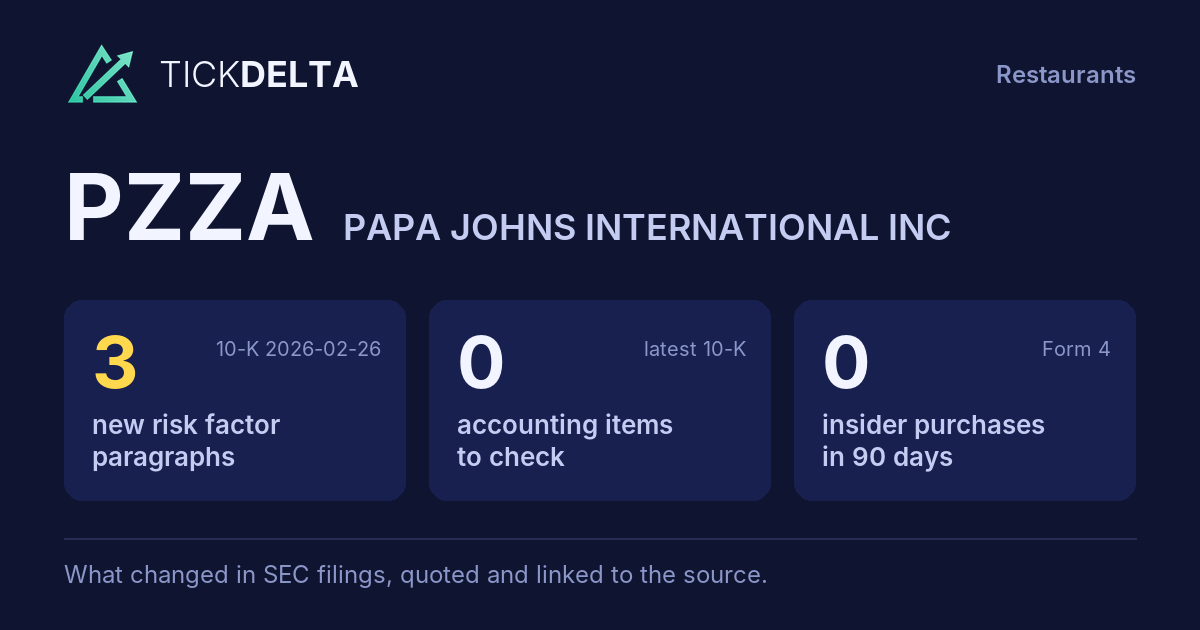
of the text changed · 11,244 words now · 3 new paragraphs, 2 gone
MD&A
41.5%
of the text changed · 10,843 words now · 39 new paragraphs, 33 gone
Legal Proceedings
28.6%
of the text changed · 494 words now
Accounting Policies
28.2%
of the text changed · 4,872 words now
10-K 0001628280-26-011965 (Feb 26, 2026) vs 10-K 0001628280-25-008427 (Feb 27, 2025)
Every paragraph, and how much of it changed
One bar per paragraph, in the order of the 10-K. Height and colour show the share of its words not in the closest paragraph a year earlier; the tallest bars are new paragraphs.
Risk Factors
120 paragraphs · 3 new · 53 reworded · 2 gone · 10-K Feb 26, 2026 against Feb 27, 2025
New paragraph
Reworded (5% of its words or more)
Same or nearly
Paragraph 35 · 46% changed
Every version of it
We are also subject to the risk of negative publicity associated with shareholder proposals, campaigns, and other forms of shareholder activism, including publicity related to the Company’s actions regarding the environment, animal welfare, responsible sourcing, and other corporate responsibility topics. Despite our best efforts relating to corporate responsibility policies, initiatives and reporting, media reports and social media campaigns can create a negative opinion or perception of the Company’s efforts. Such media reports and negative publicity could impact customer or investor perception of our Company or industry and can have a material adverse effect on our financial results.
Paragraph 24 · 43% changed
Every version of it
Paragraph 22 · 40% changed
Every version of it
Paragraph 53 · 38% changed
Every version of it
Paragraph 109 · 36% changed
Every version of it
Part of our technology infrastructure, such as our Domestic domestic point-of-sale system, is specifically designed for us and our operational systems. systems, and we may not be able to find a suitable replacement or be able to successfully upgrade this critical technology. Infrastructure upgrades or prolonged and widespread technological difficulties related to our technology infrastructure may occur and may result in unexpected costs, delays or efficiencies. Significant portions of our technology infrastructure, particularly in our digital ordering solutions, are provided by third parties, and the performance of these systems is largely beyond our control. Occasionally, we have experienced or could experience temporary disruptions in our business due to third-party systems failing to adequately perform. Failure to manage future failures of these systems could harm our business and the satisfaction of our customers. Such third-party systems could be disrupted through a variety of means, such as system failure, contractual dispute, or a cybersecurity incident. While we may be entitled to damages if our third-party service providers fail to satisfy their obligations us us, any award may be insufficient to cover out damages, or we may be unable to recover such award. In addition, we may not have or be able to obtain adequate protection or insurance to mitigate the risks of these events or compensate for losses related to these events, which could damage our business and reputation and be expensive and difficult to remedy or repair.
Paragraph 37 · 30% changed
Every version of it
Paragraph 6 · 30% changed
Every version of it
In addition to competition with our larger competitors, we face competition from local quick service pizza delivery restaurants and new other competitors such as fast casual pizza concepts. We also face competitive pressures from an array of food delivery concepts and aggregators delivering for quick service QSR or dine in restaurants, using new newer delivery technologies or delivering for competitors who previously did not have delivery capabilities, some of which may have more effective marketing or delivery service capabilities. The emergence or continued growth of these new competitors, whether in the pizza QSR Pizza category or in the food service industry generally, broader food-service industry, may make it difficult harder for us to maintain or increase our grow market share and could negatively impact our sales, profit margins, royalties, and our system-wide restaurant operations. An increased percentage of orders delivered through third-party aggregator services may also reduce the profitability of these orders compared with those placed through our owned channels. We also face increasing competition from other home delivery services and grocery stores that offer an increasing variety of prepped or prepared meals in response to consumer demand. In addition, if our competitors respond more effectively to changes in consumer preferences or increase their market share, it could have a negative effect on our business. As a result, our sales can be directly and negatively impacted by actions of our competitors, the emergence or growth of new competitors, consumer sentiment or other factors outside our control.
Paragraph 20 · 48% changed
Every version of it
10-K Feb 27, 2025Sales made by our franchisees in international markets and certain loans we previously provided to such franchisees are denominated in their local currencies, and fluctuations in the U.S. dollar occur relative to the local currencies. Accordingly, changes in currency exchange rates will cause our revenues, investment income and operating results to fluctuate. We have not historically hedged our exposure to foreign currency fluctuations. Our International revenues and earnings may be adversely impacted as the U.S. dollar rises against foreign currencies because the local currency will translate into fewer U.S. dollars. Additionally, the value of certain assets or loans denominated in local currencies may deteriorate. Other items denominated in U.S. dollars, including product imports or loans, may also become more expensive, putting pressure on franchisees’ cash flows. Our International and Canadian franchisees may also be impacted by tariffs or currency restrictions imposed by governmental authorities, which could impact their ability to pay for supplies and/or royalties in compliance with their franchise agreement. We have experienced situations with franchisees being subject to currency restrictions and unable pay royalties in U.S. dollars.
10-K Feb 26, 2026
Our International and Canadian franchisees may also be impacted by tariffs or currency restrictions imposed by governmental authorities, which could impact their ability to pay for supplies and/or royalties in compliance with their franchise agreement. In addition, increased tariffs on imports to the United States from Canada and Mexico or other international markets, and any similar or retaliatory tariffs or trade policies, could disrupt and increase the costs of our supply chains and those of our master franchisees in relation to certain products that we and they source internationally. We have also experienced situations with franchisees being subject to currency restrictions and unable pay royalties in U.S. dollars.
Paragraph 35 · 46% changed
Every version of it
10-K Feb 27, 2025
We are also subject to the risk of negative publicity associated with shareholder proposals, campaigns, and activism, including publicity related to the environment, animal welfare, responsible sourcing, and other corporate responsibility topics. Despite our best efforts relating to corporate responsibility policies, initiatives and reporting, media reports and social media campaigns can create a negative opinion or perception of the Company’s efforts. Such media reports and negative publicity could impact customer or investor perception of our Company or industry and can have a material adverse effect on our financial results.
10-K Feb 26, 2026
We are also subject to the risk of negative publicity associated with shareholder proposals, campaigns, and other forms of shareholder activism, including publicity related to the Company’s actions regarding the environment, animal welfare,
Paragraph 24 · 43% changed
Every version of it
10-K Feb 27, 2025We are also subject to ongoing risks and uncertainties associated with the UK’s withdrawal from the European Union (referred to as “Brexit”), including implications for the free flow of labor and goods in the UK and the European Union and other financial, legal, tax and trade implications.
10-K Feb 26, 2026
to keep restaurants in the UK from closing, particularly if current economic conditions worsen, or our franchisees may not be able to repay their loans, pay royalties, and/or make rent payments under sub-leases with us. The Company is unable to predict the future macroeconomic environment in the UK or the extent to which our remaining corporate and franchised restaurants will continue to be impacted. There may also be future risks and uncertainties associated with the UK’s withdrawal from the European Union (referred to as “Brexit”), including implications for the free flow of labor and goods in the UK and the European Union and other financial, legal, tax and trade implications.
Paragraph 22 · 40% changed
Every version of it
10-K Feb 27, 2025Our business, financial condition and results of operations have been and could continue to be adversely affected by business conditions in the United Kingdom. There are approximately 450 Papa Johns restaurants located in the UK, and we also operate an International QC Center in the UK. In addition, the Company’s UK subsidiary also holds the master leases for nearly all of the corporate and franchise restaurant locations, which exposes us to rent liability. During the last three years, our business in the UK was subject to adverse macroeconomic conditions, including inflation, elevated interest rates, the energy crisis, slowing economic growth, and volatile exchange rates, which resulted in negative comparable sales and a challenging operating environment for our franchisees. These challenges also impacted the financial condition of our UK franchisees. As we continue to navigate this challenging economic environment, we are investing in capabilities to improve our operations and have worked to re-position the franchise base to further strengthen our business in the UK by exiting poorly performing franchisees and permanently closing certain restaurants. In 2024, we also divested and closed a number of Company-owned restaurants in the UK that were incurring operating losses, in an effort to re-position the market. We currently operate only 13 Company-owned restaurants in the market. If our efforts to re-position the franchise base or improve the profitability of our remaining Company-owned restaurants are unsuccessful, we might need to find new operators for certain unprofitable restaurants and/or close additional unprofitable locations in the future, which would require certain lease and/or loan impairments, and could adversely impact the Company’s financial condition and results of operations in the respective region. In addition, the Company previously provided financial support to certain franchisees in the UK, including in the form of marketing support and loans. This franchisee support may not be sufficient to keep restaurants in the UK from closing, particularly if current economic conditions worsen, or our franchisees may not be able to repay their loans, pay royalties, and/or make rent payments under sub-leases with us. The Company is unable to predict the duration or the extent of the macroeconomic environment in the UK or the extent to which our remaining corporate and franchised restaurants will continue to be impacted.
10-K Feb 26, 2026
There are approximately 450 Papa Johns restaurants located in the UK, and we also operate an International QC Center in the UK. As discussed further in “Item 7 - Management’s Discussion and Analysis of Financial Condition and Results of Operations - Recent Developments and Trends - International Transformation Plan”, in connection with our turnaround efforts in certain international markets, including the UK, we initiated international transformation initiatives in December 2023 (the “International Transformation Plan”). The International Transformation Plan was designed in part to invest in capabilities to improve our UK operations and to re-position the franchise base to further strengthen our business in the UK by exiting poorly performing franchisees and permanently closing certain restaurants. In 2024, we also divested and closed a number of Company-owned restaurants in the UK that were incurring operating losses, in an effort to re-position the market, and currently operate only 13 Company-owned restaurants in the market. The International Transformation Plan was completed in the fourth quarter of 2025. If our continuing efforts to re-position the franchise base or improve the profitability of our remaining Company-owned restaurants are unsuccessful, we might need to find new operators for certain unprofitable restaurants and/or close additional unprofitable locations in the future, which would require certain lease and/or loan impairments, and could adversely impact the Company’s financial condition and results of operations in the respective region.
Paragraph 53 · 38% changed
Every version of it
10-K Feb 27, 2025We rely heavily on information systems, including digital ordering solutions, through which a majority of our Domestic sales originate. We also rely heavily on point-of-sale processing in our Company-owned and franchised restaurants for data collection and payment systems for the collection of cash, credit and debit card transactions, and other processes and procedures. Our ability to efficiently and effectively manage our business depends on the reliability and capacity of these technology systems. In addition, we anticipate that consumers will continue to have more options to place orders digitally, both domestically and internationally. We plan to increase investment spending to continue to invest in enhancing and improving the functionality and features of our information technology systems. However, we cannot ensure that our initiatives will be beneficial to the extent, or within the timeframes, expected or that the estimated improvements will be realized as anticipated or at all. Our failure to adequately invest in new technology and adapt to technological developments and industry trends, particularly our digital ordering capabilities, could result in a loss of customers and related market share. Notwithstanding adequate investment in new technology, our marketing and technology initiatives may not be successful in improving our comparable sales results. Additionally, we are in an environment where the technology life cycle is short and consumer technology demands are high, which requires continued reinvestment in technology that will increase the cost of doing business and will increase the risk that our technology may not be customer-centric or could become obsolete, inefficient or otherwise incompatible with other systems.
10-K Feb 26, 2026
realized as anticipated or at all. Our failure to invest effectively in new technology, upgrade our technology systems, and adapt to technological developments and industry trends, particularly our digital ordering capabilities, could result in a loss of customers and related market share. In 2025, we released our new customer mobile app across the Android and iOS platforms. We also released a modernized website with enhanced mobile web experience. While we are monitoring performance across these platforms, we believe that the rollout of our new omnichannel platforms will lead to a more streamlined ordering journey and simplify the overall experience for our customers. We anticipate completing the full rollout of our new omnichannel platform and retirement of legacy platforms by the end of 2026. There is no guarantee that the rollout and retirement will be completed on the anticipated timeline, or at all, or that the new omnichannel platform will realize the expected benefits. We also plan to replace and upgrade our point-of-sale system over the next few years. Notwithstanding effective investment in new technology, our marketing and technology initiatives, including the omnichannel platform, may not be successful in improving our comparable sales results. Additionally, we are in an environment where the technology life cycle is short and consumer technology demands are high, which requires continued reinvestment in technology that will increase the cost of doing business and will increase the risk that our technology may not be customer-centric or could become obsolete, inefficient or otherwise incompatible with other systems.
Paragraph 109 · 36% changed
Every version of it
10-K Feb 27, 2025
Part of our technology infrastructure, such as our Domestic point-of-sale system, is specifically designed for us and our operational systems. Infrastructure upgrades or prolonged and widespread technological difficulties related to our technology infrastructure may occur and may result in unexpected costs, delays or efficiencies. Significant portions of our technology infrastructure, particularly in our digital ordering solutions, are provided by third parties, and the performance of these systems is largely beyond our control. Occasionally, we have experienced or could experience temporary disruptions in our business due to third-party systems failing to adequately perform. Failure to manage future failures of these systems could harm our business and the satisfaction of our customers. Such third-party systems could be disrupted through a variety of means, such as system failure, contractual dispute, or a cybersecurity incident. While we may be entitled to damages if our third-party service providers fail to satisfy their obligations us us, any award may be insufficient to cover out damages, or we may be unable to recover such award. In addition, we may not have or be able to obtain adequate protection or insurance to mitigate the risks of these events or compensate for losses related to these events, which could damage our business and reputation and be expensive and difficult to remedy or repair.
10-K Feb 26, 2026
Part of our technology infrastructure, such as our domestic point-of-sale system, is specifically designed for us and our operational systems, and we may not be able to find a suitable replacement or be able to successfully upgrade this critical technology. Infrastructure upgrades or prolonged and widespread technological difficulties related to our technology infrastructure may occur and may result in unexpected costs, delays or efficiencies. Significant portions of our technology infrastructure, particularly in our digital ordering solutions, are provided by third parties, and the performance of these systems is largely beyond our control. Occasionally, we have experienced or could experience temporary disruptions in our
Paragraph 37 · 30% changed
Every version of it
10-K Feb 27, 2025responsibility initiatives or goals, or if we fail to achieve progress with respect to our goals on a timely basis, or at all, our reputation, brand, appeal to investors, employee retention, business, financial performance and growth could be adversely affected.
10-K Feb 26, 2026
In addition, we could be criticized for the scope or nature of our Company goals or performance. If our Company goals or performance fails to meet investor, customer, consumer, employee or other stakeholders’ evolving expectations and standards, are incomplete or inaccurate, or certain groups or customers disagree with our management initiatives or goals, or if we fail to achieve progress with respect to our goals on a timely basis, or at all, our reputation, brand, appeal to investors, employee retention, business, financial performance and growth could be adversely affected.
Paragraph 6 · 30% changed
Every version of it
10-K Feb 27, 2025
In addition to competition with our larger competitors, we face competition from local quick service pizza delivery restaurants and new competitors such as fast casual pizza concepts. We also face competitive pressures from an array of food delivery concepts and aggregators delivering for quick service or dine in restaurants, using new delivery technologies or delivering for competitors who previously did not have delivery capabilities, some of which may have more effective marketing or delivery service capabilities. The emergence or growth of these competitors, in the pizza category or in the food service industry generally, may make it difficult for us to maintain or increase our market share and could negatively impact our sales, profit margins, royalties, and our system-wide restaurant operations. An increased percentage of orders delivered through third-party aggregator services may also reduce the profitability of these orders compared with those placed through our owned channels. We also face increasing competition from other home delivery services and grocery stores that offer an increasing variety of prepped or prepared meals in response to consumer demand. In addition, if our competitors respond more effectively to changes in consumer preferences or increase their market share, it could have a negative effect on our business. As a result, our sales can be directly and negatively impacted by actions of our competitors, the emergence or growth of new competitors, consumer sentiment or other factors outside our control.
10-K Feb 26, 2026
In addition to competition with our larger competitors, we face competition from local quick service pizza delivery restaurants and other competitors such as fast casual pizza concepts. We also face competitive pressures from an array of food delivery concepts and aggregators delivering for QSR or dine in restaurants, using newer delivery technologies or delivering for competitors who previously did not have delivery capabilities, some of which may have more effective marketing or delivery service capabilities. The emergence or continued growth of new competitors, whether in the QSR Pizza category or the broader food-service industry, may make it harder for us to maintain or grow market share and could negatively impact our sales, profit margins, royalties, and our system-wide restaurant operations. An increased percentage
MD&A
159 paragraphs · 39 new · 58 reworded · 33 gone · 10-K Feb 26, 2026 against Feb 27, 2025
New paragraph
Reworded (5% of its words or more)
Same or nearly
Paragraph 57 · 50% changed
Paragraph 60 · 49% changed
Paragraph 75 · 47% changed
Paragraph 14 · 47% changed
Paragraph 49 · 46% changed
Advertising funds revenue, which includes the operations of PJMF, local marketing funds funds, and International marketing funds, increased $7.1 million $2.4 million, or 4.5% 1.5%, in 2024. Beginning with 2025. The increase was primarily due to global system-wide restaurant sales growth of 1.1% as well as increases in the PJMF contribution percentage that took effect in the second quarter of 2024, PJMF increased its 2024 and increases to contribution percentage, while local marketing was made optional. The change percentages in mix to our marketing contributions, along with more franchised locations during 2024, increased Advertising funds revenue in 2024 by approximately $10.1 million. certain International markets. This was partially offset by national marketing fund rebates offered to franchisees and a 3.5% decline decrease in North America franchised comparable sales. local marketing spend in 2025.
Paragraph 71 · 45% changed
Domestic Company-owned restaurant sales, which include sales from both Domestic and International Company-owned restaurants, restaurants decreased $36.2 million, or 4.8% for the year ended December 29, 2024 $15.3 million as compared to the prior year. The benefit of the 53rd week of operations in 2023 was approximately $15 million. Excluding the impact of the additional week in 2023, Company-owned restaurant sales would have decreased approximately $21 million. This decrease was year, primarily due to a 3.3% decrease in comparable sales sales, higher food costs, and the prior period benefit of 4.9% for approximately $5 million related to changes in our Domestic Company-owned restaurants that Papa Rewards program, as discussed above. The decrease was partially offset by approximately $5 million lower local advertising costs in 2025 and the impact of additional deferred revenue recognized refranchising 15 restaurants during 2024 related to lowering the redemption thresholds for our Papa Rewards program, which allowed consumers to redeem rewards more quickly. Additionally, Domestic equivalent units grew 3.4% for the year ended December 29, third quarter of 2024.
Paragraph 82 · 44% changed
The effective income tax rate was 33.6% for 2025 and 26.2% for 2024 and 20.1% for 2023. 2024. The higher effective rate in 2024 2025 was primarily due to impairment charges related to the International Transformation Plan, which resulted in unrecognized tax losses lower pretax book income and prevented the Company from generating foreign tax credits. Additionally, higher foreign withholding taxes and a larger tax shortfall from stock option exercises and the generated by vesting of restricted shares in 2024 contributed to the higher rate. during 2025.
Paragraph 106 · 43% changed
Total cash used in investing activities was $21.5 million in 2025 compared to $17.3 million in 2024 compared to $75.1 million in 2023, a decrease of $57.8 million. The decrease in 2024. Net cash used in investing activities was during 2025 primarily due to cash proceeds reflects $74.4 million of $46.7 million from the sale of two Domestic QC Centers, lower capital expenditures, which includes $9.7 million of additional capital expenditures related to natural disasters, partially offset by $6.3 million of related insurance proceeds. These were partially offset by $34.5 million of proceeds received in the 2025 refranchising transaction and a $3.7 $6.4 million increase in net of repayments received on notes issued to franchisees. We also received a $2.3 million investment distribution related to our deferred compensation plan during the year ended December 29, 2024.
Paragraph 57 · 50% changed
10-K Feb 27, 2025advertising costs related to Company-owned restaurants, and insurance expense. Cost of sales was $1.48 billion in 2024, a decrease of $80.0 million, or 5.1%, from the prior year. The impact of the 53rd week of operations in 2023 was approximately $31 million. Excluding the impact of the additional week, Cost of sales would have decreased by approximately $49 million. The decrease in cost of sales primarily relates to lower volumes within our North America commissary segment as year-over-year comparable transactions were down approximately 3% for our franchisees. In addition, Cost of sales were lower in our Domestic Company-owned restaurants segment primarily relating to lower food and labor costs as comparable transactions were down approximately 4.5% year-over-year and advertising expense decreased as reduced local marketing reserves and lower spend in the first half of 2024 more than offset incremental marketing spend in the second half of 2024.
10-K Feb 26, 2026
The decrease in cost of sales primarily relates to lower volumes for our Domestic Company-owned restaurants and International Company-owned restaurants as a result of the Domestic refranchising transactions and the 2024 UK restaurant closures and refranchising transactions. The decreases were also due to lower local advertising costs for our Domestic Company-owned restaurants, partially offset by higher food costs for our Domestic Company-owned restaurants and higher volumes for our Domestic QC Centers compared to the prior year.
Paragraph 60 · 49% changed
10-K Feb 27, 2025Operating income was $156.7 million for the year ended December 29, 2024 compared to $147.1 million for the prior year, an increase of $9.6 million. Adjusted operating income was $148.2 million for the year ended December 29, 2024 compared to $157.0 million for the prior year, a decrease of $8.8 million. The 53rd week contributed approximately $8 million to operating and adjusted operating income in 2023. The changes in operating income and adjusted operating income compared to the prior year were primarily due to the following:
10-K Feb 26, 2026
(a) Administrative and other general expenses, net increased by $41.9 million to $240.9 million for the year ended December 28, 2025 compared to the prior year. The increase was primarily due to incremental marketing investments of $21.2 million, an increase in management incentive compensation of $13.8 million, and expenses resulting from our biannual franchise operating conference held in the first quarter of 2025.
Paragraph 75 · 47% changed
10-K Feb 27, 2025(a) See “Non-GAAP Measures” below for a detail of the adjustments in each year and for a reconciliation to the most comparable U.S. GAAP measure.
10-K Feb 26, 2026
4-wall EBITDA and 4-wall EBITDA margin are non-GAAP measures used to evaluate the performance of our Domestic Company-owned restaurants. See “Non-GAAP Measures” for the definition of 4-wall EBITDA and 4-wall EBITDA margin as well as a reconciliation to the most comparable U.S. GAAP measures.
Paragraph 14 · 47% changed
10-K Feb 27, 2025•Development strategy: Development is a key long-term growth driver as we believe there is significant opportunity to offer our quality product to more customers globally and domestically. In 2024, we expanded our global footprint by 2.1%, with 124 net new units comprised of 81 net unit openings in North America and 43 net unit openings in International markets.
10-K Feb 26, 2026
Development strategy: Development is a key long-term growth driver as we believe there is significant opportunity to offer our quality products to more customers globally and domestically. Our near-term development plan in North America includes focused development within our priority markets and on improving the quality and profitability of our restaurant portfolio, with fewer new restaurant openings expected in 2026. To aid our franchisees in pursuing profitable growth in conjunction with the supply chain and restaurant optimization initiatives described above, we are offering royalty incentives for new restaurants opening in 2026, which we believe will add scale in key markets and attract growth-driven franchisees.
Paragraph 49 · 46% changed
10-K Feb 27, 2025
Advertising funds revenue, which includes the operations of PJMF, local marketing funds and International marketing funds, increased $7.1 million or 4.5% in 2024. Beginning with the second quarter of 2024, PJMF increased its contribution percentage, while local marketing was made optional. The change in mix to our marketing contributions, along with more franchised locations during 2024, increased Advertising funds revenue in 2024 by approximately $10.1 million. This was partially offset by a 3.5% decline in North America franchised comparable sales.
10-K Feb 26, 2026
Advertising funds revenue, which includes the operations of PJMF, local marketing funds, and International marketing funds, increased $2.4 million, or 1.5%, in 2025. The increase was primarily due to global system-wide restaurant sales growth of 1.1% as well as increases in the PJMF contribution percentage that took effect in the second quarter of 2024 and increases to contribution percentages in certain International markets. This was partially offset by national marketing fund rebates offered to franchisees and a decrease in local marketing spend in 2025.
Paragraph 71 · 45% changed
10-K Feb 27, 2025
Company-owned restaurant sales, which include sales from both Domestic and International Company-owned restaurants, decreased $36.2 million, or 4.8% for the year ended December 29, 2024 compared to the prior year. The benefit of the 53rd week of operations in 2023 was approximately $15 million. Excluding the impact of the additional week in 2023, Company-owned restaurant sales would have decreased approximately $21 million. This decrease was primarily due to a decrease in comparable sales of 4.9% for our Domestic Company-owned restaurants that was partially offset by approximately $5 million of additional deferred revenue recognized during 2024 related to lowering the redemption thresholds for our Papa Rewards program, which allowed consumers to redeem rewards more quickly. Additionally, Domestic equivalent units grew 3.4% for the year ended December 29, 2024.
10-K Feb 26, 2026
Domestic Company-owned restaurants decreased $15.3 million as compared to the prior year, primarily due to a 3.3% decrease in comparable sales, higher food costs, and the prior period benefit of approximately $5 million related to changes in our Papa Rewards program, as discussed above. The decrease was partially offset by lower local advertising costs in 2025 and the impact of refranchising 15 restaurants during the third quarter of 2024.
Paragraph 82 · 44% changed
10-K Feb 27, 2025
The effective income tax rate was 26.2% for 2024 and 20.1% for 2023. The higher effective rate in 2024 was primarily due to impairment charges related to the International Transformation Plan, which resulted in unrecognized tax losses and prevented the Company from generating foreign tax credits. Additionally, higher foreign withholding taxes and a tax shortfall from stock option exercises and the vesting of restricted shares in 2024 contributed to the higher rate.
10-K Feb 26, 2026
The effective income tax rate was 33.6% for 2025 and 26.2% for 2024. The higher effective rate in 2025 was primarily due to lower pretax book income and larger tax shortfall generated by vesting of restricted shares during 2025.
Paragraph 106 · 43% changed
10-K Feb 27, 2025
Total cash used in investing activities was $17.3 million in 2024 compared to $75.1 million in 2023, a decrease of $57.8 million. The decrease in cash used in investing activities was primarily due to cash proceeds of $46.7 million from the sale of two Domestic QC Centers, lower capital expenditures, and a $3.7 million increase in net repayments received on notes to franchisees. We also received a $2.3 million investment distribution related to our deferred compensation plan during the year ended December 29, 2024.
10-K Feb 26, 2026
Total cash used in investing activities was $21.5 million in 2025 compared to $17.3 million in 2024. Net cash used in investing activities during 2025 primarily reflects $74.4 million of capital expenditures, which includes $9.7 million of additional capital expenditures related to natural disasters, partially offset by $6.3 million of related insurance proceeds. These were partially offset by $34.5 million of proceeds received in the 2025 refranchising transaction and $6.4 million of repayments received on notes issued to franchisees.
A paragraph is matched with the one last year that shares the most of its words; under half in common makes it new. The paragraphs shown are the 8 reworded the most in each section.
The paragraph that changed most in each section
The redline
Marked against last year's 10-K: cut words struck through, new words highlighted.
Risk Factors302 words changed in this paragraph; it is 72% similar to last year's version.
We are subject to a number of privacy and data protection laws and regulations. We collect and retain large volumes of internal and customer data, including credit card data and other personally identifiable information of our employees and customers housed in the various information systems we use. Constantly changing information security threats, particularly persistent cybersecurity threats, pose risks to the security of our systems and networks, and the confidentiality, availability and integrity of our data and the availability and integrity of our critical business functions. Threats could include the theft of our intellectual property, trade secrets, personally identifiable information, or sensitive financial information. As techniques used in cyber-attacks evolve, including but not limited to the potential use of artificial intelligence in such attacks, we may not be able to timely detect threats or anticipate and implement adequate security measures. The integrity and protection of the customer, employee, franchisee and Company data are critical to us. Our information technology systems and databases, and those provided by our third-party vendors, including international vendors, have been and will continue to be subject to computer viruses, malware attacks, unauthorized user attempts, social engineering (e.g. phishing) and denial of service and other unintentional intrusions or malicious cyber-attacks. We have instituted controls, including cybersecurity governance controls that are intended to protect our information systems, our point-of-sale systems, our information technology systems and networks. We have designed our cybersecurity program to adhere to payment card industry data security standards and we limit third party access for vendors that require access to our restaurant networks. However, we cannot control or prevent every cybersecurity risk. The failure to prevent fraud or cybersecurity incidents or to adequately invest in data security could harm our business and revenues due to the reputational damage to our brand. Such an incident could also result in litigation, regulatory actions, investigations, or penalties, increased regulatory scrutiny, a delay in our ability to report financial results, and other significant costs to us and have a material adverse effect on our financial results. These costs could be significant and well in excess of, or not covered by, our cyber insurance coverage. Also, as cyber-attacks increase in frequency and magnitude, we may be unable to obtain cybersecurity insurance coverage in amounts and on terms we view as adequate for our business in the future. Significant costs could be required to investigate security incidents, remedy cybersecurity issues, recover lost data, prevent future cybersecurity incidents and adapt systems and practices to react to the changing cyber environment. These may include costs associated with notifying affected individuals and regulators, assessing and implementing additional security technologies, training, personnel, and experts. These costs, which could be material, could adversely impact our results of operations in the period in which they are incurred, including by requiring significant attention from management or the Board or interfering with the pursuit of other important business strategies and initiatives, and may not meaningfully limit the success of future cyber-attacks or cybersecurity incidents. Media or other reports of existing or perceived security vulnerabilities in our systems or those of our third-party vendors can also adversely impact our brand and reputation and materially impact our business. The interpretation and application of cybersecurity and data protection laws and regulations are often uncertain and evolving. As a result, there can be no assurance that our security measures will be deemed adequate, appropriate, or reasonable by a regulator or court. Moreover, even security measures that are deemed appropriate, reasonable, and/or in accordance with applicable legal requirements may be unable to protect our information technology systems upon which we rely. Additionally, the techniques and sophistication used to conduct cyber-attacks and compromise information technology systems, as well as the sources and targets of these attacks, change frequently and are often not recognized until such attacks are launched or have been in place for a period of time. The rapid evolution and increased adoption of artificial intelligence technologies may also heighten our cybersecurity risks by making cyber-attacks more difficult to detect, contain, and mitigate. The rapid evolution and increased adoption of artificial intelligence technologies may also heighten our cybersecurity risks by making cyber-attacks more difficult to detect, contain, and mitigate.
Source: Item 1A, 10-K 0001628280-26-011965 vs Item 1A, 10-K 0001628280-25-008427
MD&A242 words changed in this paragraph; it is 33% similar to last year's version.
Source: Item 7, 10-K 0001628280-26-011965 vs Item 7, 10-K 0001628280-25-008427
Accounting Policies186 words changed in this paragraph; it is 52% similar to last year's version.
Source: Item 8, Note 2 – Significant Accounting Policies, 10-K 0001628280-26-011965 vs Item 8, Note 2 – Significant Accounting Policies, 10-K 0001628280-25-008427
Legal Proceedings134 words changed in this paragraph; it is 59% similar to last year's version.
In re Papa John’s Employee & Franchise Employee Antitrust Litigation is a putative class action filed in December 2018 in the United States District Court for the Western District of Kentucky. The suit alleges that the “no-poaching” provision previously contained in the Company’s franchise agreement constituted an unlawful agreement or conspiracy in restraint of trade and commerce in violation of Section 1 of the Sherman Antitrust Act. On April 14, 2022, the parties reached a settlement in principle to resolve the case. Pursuant to the terms of the proposed settlement, in exchange for the Company’s payment of a total aggregate settlement amount of $5.0 million and other non-monetary consideration, all claims in the action will be dismissed, the litigation will be terminated, and the Company will receive a release. The settlement amount was recorded in General and administrative expenses in the Consolidated Statements of Operations in 2022. The District Court granted preliminary approval of the proposed settlement on August 2, 2025, and the Company made an initial payment of $2.5 million on September 5, 2025 towards the settlement with $2.5 million remaining accrued within Accrued expenses and other current liabilities in the Consolidated Balance Sheets as of December 28, 2025. The proposed settlement contains certain customary contingencies and is subject to final approval by the District Court. The Company continues to deny any liability or wrongdoing in this matter.
Source: Item 3, via Note 18 – Litigation, Commitments and Contingencies, 10-K 0001628280-26-011965 vs Item 3, via Note 19 – Litigation, Commitments and Contingencies, 10-K 0001628280-25-008427
Sentences and paragraphs added, removed or reworded
Every change, by type
Sentences and paragraphs of PZZA's Risk Factors and MD&A, 10-K Feb 26, 2026 against 10-K Feb 27, 2025. Each links to the text at sec.gov.
Quiet changes are sentences kept from last year with one to four words changed, at least one of them a hedge, a modal or a qualifier (may, could, will, not, significant, material…). A year or date rolling forward is not counted.
The full word list
adverse, adversely, all, although, anticipate, anticipates, any, approximately, believe, believes, can, cannot, certain, could, expect, expects, generally, however, if, intend, intends, largely, likely, many, material, materially, may, might, most, must, never, no, not, possible, primarily, probable, should, significant, significantly, some, substantial, substantially, unlikely, will, would
AddedRisk Factors
In addition, the Company’s UK subsidiary also holds the master leases for nearly all of the corporate and franchise restaurant locations, which exposes us to rent liability. The Company previously provided financial support to certain franchisees in the UK, including in the form of marketing support and loans. This franchisee support may not be sufficient
Read it in 10-K Feb 26, 2026 at sec.gov
AddedRisk Factors
by higher claims experience, hurting both their operating results and/or limiting their ability to maintain adequate insurance coverage at a reasonable cost.
Read it in 10-K Feb 26, 2026 at sec.gov
AddedRisk Factors
our customers and counterparties, and impairment of long-lived assets, the carrying value of goodwill or other indefinite-lived intangible assets.
Read it in 10-K Feb 26, 2026 at sec.gov
RemovedRisk Factors
RemovedRisk Factors
RewordedRisk Factors
RewordedRisk Factors
Compliance with new or additional Domestic and International government data protection laws or regulations, including but not limited to the European Union General Data Protection Regulation (“EU GDPR”), the UK GDPR and DPA 2018, as amended, the Canada Personal Information Protection and Electronic Documents Act (“PIPEDA”), Act, the California Consumer Privacy Act (“CCPA”), The California Privacy Rights Act (“CPRA”), the Colorado Privacy Act (“CPA”), the Connecticut Data Privacy Act (“CTDPA”), the Utah Consumer Privacy Act (“UCPA”), the Virginia Consumer Data Protection Act (“VCDPA”), Act, as amended, and several other data privacy and biometric laws passed or enacted by U.S. states, states or other countries, which could increase costs for compliance.
Read it in 10-K Feb 26, 2026 at sec.gov
RewordedRisk Factors
Our outstanding debt as of December 29, 2024 28, 2025 was $746.7 $722.3 million, which was comprised of $400.0 million outstanding under our 3.875% senior notes due in 2029 (the “Notes”) “Notes”), as well as $200.0 million under our senior secured term loan (the “Term Loan”) and $346.7 $122.3 million under our revolving credit facility (the “PJI Revolving Facility”) that forms a part of our amended Second Amended and restated credit agreement Restated Credit Agreement dated as of March 26, 2025 (the “Credit Agreement”).
Read it in 10-K Feb 26, 2026 at sec.gov
Show the other 49
RewordedRisk Factors
We have incurred and expect to continue to incur certain non-recurring corporate reorganization costs, including the ongoing restructuring and transformation of our international business, business in connection with the International Transformation Plan, which was completed in the fourth quarter of 2025, and the Enterprise Transformation Plan, and these expenses have impacted and could continue to adversely impact our results of operations during the relevant period, reduce our cash position and/or result in an impairment risk related to these assets.
Read it in 10-K Feb 26, 2026 at sec.gov
RewordedRisk Factors
The implementation and use of artificial intelligence technologies also present various risks and uncertainties, and the deficiencies failure to incorporate artificial intelligence technologies into our business as successfully as our competitors could adversely impact us, as could any deficiencies, unreliability or other failures of artificial intelligence systems systems, which could subject us to competitive harm, regulatory action, legal and financial liability and brand or reputational harm.
Read it in 10-K Feb 26, 2026 at sec.gov
RewordedRisk Factors
Part of our technology infrastructure, such as our Domestic domestic point-of-sale system, is specifically designed for us and our operational systems. systems, and we may not be able to find a suitable replacement or be able to successfully upgrade this critical technology.
Read it in 10-K Feb 26, 2026 at sec.gov
RewordedRisk Factors
RewordedRisk Factors
We estimate loss reserves based on historical trends, actuarial assumptions and other data available to us, but we may not be able to accurately estimate reserves. actual results could differ significantly from the estimates under different assumptions or conditions.
Read it in 10-K Feb 26, 2026 at sec.gov
RewordedRisk Factors
Our success also increasingly depends on the willingness and ability of our franchisees to remain aligned with us on current and future operating, promotional and marketing plans. plans, including favorable support of our Domestic system to approve certain marketing initiatives, products, and national promotions.
Read it in 10-K Feb 26, 2026 at sec.gov
RewordedRisk Factors
The emergence or continued growth of these new competitors, whether in the pizza QSR Pizza category or in the food service industry generally, broader food-service industry, may make it difficult harder for us to maintain or increase our grow market share and could negatively impact our sales, profit margins, royalties, and our system-wide restaurant operations.
Read it in 10-K Feb 26, 2026 at sec.gov
RewordedRisk Factors
These risks also include the increased pressure to make or eliminate commitments or additional goals which could expose us and our franchisees to market, operational, execution and reputational costs or risks.
Read it in 10-K Feb 26, 2026 at sec.gov
RewordedRisk Factors
The Company has no company-owned Company-owned restaurants in Russia or Ukraine and has previously suspended corporate support for the market and its master franchisee in Russia, which operates and supplies all franchised Papa Johns restaurants there. Russia.
Read it in 10-K Feb 26, 2026 at sec.gov
Quiet changesRisk Factors
Our success increasingly significantly relies on the financial success and cooperation of our franchisees, yet we have limited influence over their operations.
Read it in 10-K Feb 26, 2026 at sec.gov
Quiet changesRisk Factors
We may not be able to effectively execute our national or local marketing plans, particularly if we experienced experience lower sales that would result in reduced levels of marketing funds.
Read it in 10-K Feb 26, 2026 at sec.gov
Quiet changesRisk Factors
Accordingly, our profitability increasingly significantly depends upon royalty revenues from franchisees.
Read it in 10-K Feb 26, 2026 at sec.gov
Quiet changesRisk Factors
Failure to comply with any of the covenants in our existing or any future financing agreements could result in a default under those agreements and under other agreements containing cross-default or cross-acceleration provisions, and could increase the costs or availability of credit for us.
Read it in 10-K Feb 26, 2026 at sec.gov
AddedMD&A
In discussions of our business, “Domestic” is defined as within the contiguous United States, “North America” includes Domestic and Canada, and “International” includes the rest of the world other than North America.
Read it in 10-K Feb 26, 2026 at sec.gov
AddedMD&A
Marketing strategy: We continued investments in our messaging to showcase our BETTER INGREDIENTS. BETTER PIZZA® platform by highlighting our six simple ingredients, fresh, never frozen original dough and the craftsmanship behind the products we serve, which we believe are key differentiators of our brand. We also sharpened our value perception with limited-time promotional offers while continuing to emphasize our Papa Pairings mix and match platform. We plan to maintain a compelling value proposition while staying true to our premium positioning and layering in exciting menu innovation to expand our addressable market and strengthen our barbell strategy. We spent an incremental $21 million in marketing investments throughout 2025 compared with 2024, including investments in our customer relationship management platform and our loyalty program. This incremental investment aided in ensuring a strong presence nationally as well as in key regional and local markets while leveraging our data to create more personalized offers for our customers.
Read it in 10-K Feb 26, 2026 at sec.gov
AddedMD&A
Digital and loyalty strategy: Most of our sales occur through digital channels, and we are investing in our technology infrastructure to deliver a more seamless experience across our owned channels, better connect with customers, and support greater efficiency across our operations. In 2025, we introduced our new omnichannel platform, releasing new mobile apps across both Android and iOS platforms as well as our refreshed website and mobile web experience. We believe that the rollout of our new omnichannel platform will lead to a more streamlined ordering journey and simplify the overall experience for our customers. We may incur an additional $5 million to $10 million of accelerated depreciation expense related to the potential replacement and retirement of related technology assets currently in service as this project continues.
Read it in 10-K Feb 26, 2026 at sec.gov
AddedMD&A
We also recently announced plans to begin a multi-year initiative to transition to a new point-of-sale system across all U.S. Company-owned and franchised restaurants that, if successful, could replace our existing point-of-sale system. At the time we determine that our legacy point-of-sale system will be replaced, these legacy technology assets may require adjustments to their useful lives to best reflect remaining technology utilization and become subject to future accelerated depreciation, which could have a material impact on our depreciation expenses.
Read it in 10-K Feb 26, 2026 at sec.gov
AddedMD&A
Transforming our cost structure: In 2025, we initiated a comprehensive review of our expense structure. In connection with this review, in December 2025 our Board of Directors approved the first phase of a new business transformation program (the “Enterprise Transformation Plan”), with the goal of creating capacity to invest in our next phase of growth by reducing non-consumer-facing spending and optimizing our restaurant portfolio to improve unit economics. The initiation of the first phase, designed to reduce overhead duplication and non-consumer-facing spending, resulted in restructuring charges of $7.7 million incurred during the fourth quarter of 2025 and primarily consisted of employee severance costs related to reducing our corporate workforce as well as professional services fees. In February 2026, our Board of Directors approved the second phase of the Enterprise Transformation Plan, which focuses on optimizing our restaurant portfolio and improving restaurant-level profitability. We currently estimate that we will incur restructuring charges of approximately $24 million to $31 million related to actions approved thus far, inclusive of the $7.7 million recognized during 2025 and the remainder of which we expect will be recognized during 2026 and 2027. We believe that these initiatives will improve systemwide health and facilitate future growth, and we have identified at least $25 million of savings, exclusive of marketing spend, to be captured across fiscal years 2026 and 2027.
Read it in 10-K Feb 26, 2026 at sec.gov
AddedMD&A
The implementation of the Enterprise Transformation Plan remains ongoing and may result in additional restructuring charges, although the amounts and nature of future expenses are currently not estimable as no specific actions necessitating additional expenses have been determined or approved by our Board of Directors. These actions are expected to include elevated levels of restaurant closures in North America during 2026 and 2027, as we focus on improving the health of our restaurant portfolio by closing underperforming restaurants that lack a path to sustainable financial improvement, allowing our franchisees to invest resources in their remaining restaurants to accelerate growth.
Read it in 10-K Feb 26, 2026 at sec.gov
AddedMD&A
Optimizing our supply chain: We are also finalizing our previously announced internal review of our North American supply chain and have identified productivity initiatives that we believe will optimize our commissary business in an effort to reduce the overall cost to serve across all of our Domestic Company-owned and franchised restaurants, without impacting our commitment to product quality. We expect to achieve at least $60 million in North America systemwide supply chain savings over the next two years, equating to meaningful restaurant-level margin improvement with approximately $20 million to $25 million of the savings to be recognized by the end of 2026.
Read it in 10-K Feb 26, 2026 at sec.gov
AddedMD&A
Accelerating our refranchising program: We also achieved a key milestone in the acceleration of our Domestic refranchising program, completing the refranchising of 85 restaurants during the fourth quarter of 2025. Refranchising is a strategic action that we plan to continue to pursue across our Company-owned restaurants as it provides developing franchisees opportunities to expand their businesses and strengthens the long-term health of Papa Johns while providing additional means to reinvest into our transformation initiatives.
Read it in 10-K Feb 26, 2026 at sec.gov
AddedMD&A
We completed our previously announced international transformation initiatives (the “International Transformation Plan”) during the fourth quarter of 2025 and incurred total restructuring related costs of $34.4 million over the entire duration of the program, approximately $20 million of which were cash expenditures. Comparable sales for our International business increased by 5.0% during the year ended December 28, 2025, which we believe is attributable to the International Transformation Plan and the operational improvement resulting from its implementation.
Read it in 10-K Feb 26, 2026 at sec.gov
AddedMD&A
We recorded total impairment losses of $8.6 million in 2025, consisting of property and equipment and lease asset impairment, related primarily to damages to our QC Centers in Grand Prairie, Texas and Louisville, Kentucky caused by tornadoes as well as restructuring activities under our International Transformation Plan and Enterprise Transformation Plan. Of these amounts, we recorded an anticipated insurance recovery for $6.4 million as we believe such losses are probable of recovery under our insurance policy. We recorded impairment losses of $11.7 million in 2024, primarily consisting of property and equipment and lease asset impairment, related to the closure of 43 UK Company-owned restaurants and 30 UK franchised restaurants as well as five UK Company-owned restaurants where the carrying value of the asset group was not deemed to be recoverable. We also incurred impairment losses of $5.5 million during 2024 in connection with the refranchising of 15 Domestic Company-owned restaurants.
Read it in 10-K Feb 26, 2026 at sec.gov
AddedMD&A
•On November 24, 2025, the Company completed the refranchising of 85 Domestic Company-owned restaurants previously owned and operated by Colonel’s Limited, LLC, a consolidated joint venture (the “2025 refranchising transaction”). Additionally, the Company refranchised 15 Domestic Company-owned restaurants on September 30, 2024 (collectively referred to with the 2025 refranchising transaction as the “Domestic refranchising transactions”). See “Note 21. Divestitures” of the “Notes to Consolidated Financial Statements” for additional information on these transactions.
Read it in 10-K Feb 26, 2026 at sec.gov
AddedMD&A
(a) Segment cost of sales include stock-based compensation expenses and other adjustments that are excluded from our segment results, which are presented on an adjusted basis (see “Note 22. Segment Information” of the “Notes to Consolidated Financial Statements”).
Read it in 10-K Feb 26, 2026 at sec.gov
RemovedMD&A
RemovedMD&A
RemovedMD&A
RemovedMD&A
RemovedMD&A
RemovedMD&A
RemovedMD&A
RemovedMD&A
RemovedMD&A
RemovedMD&A
RemovedMD&A
RemovedMD&A
RewordedMD&A
Year Ended (In thousands, except per share amounts) December 28, 2025 December 29, 2024 December 31, 2023 Operating income Net Income $ 156,704 32,117 $ 147,142 84,197 Income tax expense 16,261 29,929 Net interest expense 40,769 42,578 Depreciation and amortization 92,245 69,407 Stock-based compensation expense 14,980 9,590 Gain on refranchising transaction, net and sale of QC Center properties (a) (17,053) (41,289) — International restructuring Restructuring costs (b) 27,273 2,178 UK repositioning and acquisition-related 13,780 27,363 Other costs (c) 8,012 5,495 Adjusted EBITDA $ 201,111 $ 227,270 Segment adjusted EBITDA - Domestic Company-owned restaurants $ 28,371 $ 43,659 General & Administrative - Domestic Company-owned restaurants 40,705 38,448 Training Costs - Domestic Company-owned restaurants (f) — 4,243 Other costs (d) 5,495 3,462 Adjusted operating income 148,183 157,025 3,194 4-wall EBITDA (g) $ 69,076 $ 85,301 Segment revenue - Domestic Company-owned restaurants $ 662,523 $ 692,736 4-wall EBITDA margin (g) 10.4 % 12.3 % Net income attributable to common shareholders $ 29,569 $ 83,320 $ 82,098 Gain on refranchising transaction, net and sale of QC Center properties (a) (16,028) (41,289) — International restructuring Restructuring costs (b) 12,593 27,273 2,178 UK repositioning and acquisition-related Accelerated software depreciation (d) 18,380 — Other costs (c) — 4,243 Other costs (d) 8,012 5,495 3,462 Tax effect of adjustments (e) (5,326) 1,934 (2,234) Adjusted net income attributable to common shareholders (f) $ 47,200 $ 76,733 89,747 Diluted earnings per common share $ 0.90 $ 2.54 $ 2.48 Gain on sale of refranchising transaction, net and QC Center properties (a) (0.49) (1.25) — International restructuring Restructuring costs (b) 0.38 0.82 0.07 UK repositioning and acquisition-related Accelerated software depreciation (d) 0.56 — Other costs (c) — 0.13 Other costs (d) 0.24 0.17 0.10 Tax effect of adjustments (e) (0.16) 0.06 (0.07) Adjusted diluted earnings per common share (f) $ 1.43 $ 2.34 $ 2.71
Read it in 10-K Feb 26, 2026 at sec.gov
RewordedMD&A
(Dollars in thousands) Year Ended December 28, 2025 December 29, 2024 December 31, 2023 Administrative and other general expenses, net expenses (a) $ 240,935 $ 199,036 $ 198,200 Gain on refranchising transaction, net and sale of QC Center properties (a) (b) (17,053) (41,289) — International restructuring Restructuring costs (b) (c) 12,593 27,273 2,178 Other costs (c) (d) 7,807 5,495 3,462 UK re-positioning and acquisition-related costs (d) — 4,243 General and administrative expenses $ 244,282 $ 190,515 $ 208,083
Read it in 10-K Feb 26, 2026 at sec.gov
RewordedMD&A
Such forward-looking statements include or may relate to projections or guidance concerning business performance, revenue, earnings, cash flow, earnings per share, share repurchases, depreciation and amortization, interest expenses, tax rates, system-wide sales, transformation plans, adjusted EBITDA, 4-wall EBITDA, the current economic environment, industry trends, consumer behavior and preferences, commodity and labor costs, currency fluctuations, profit margins, supply chain operating margin, net unit growth, unit level performance, capital expenditures, restaurant and franchise development, restaurant acquisitions, restaurant closures, labor shortages, labor cost increases, changes in management, inflation, royalty relief, franchisee support and incentives, the effectiveness of our menu innovations and other business initiatives, investments in product product, investments in digital and digital technology innovation, marketing efforts and investments, liquidity, compliance with debt covenants, impairments, strategic decisions and actions, changes to our national marketing fund, changes to our commissary model, dividends, effective tax rates, regulatory changes and impacts, repositioning impacts of the UK market, International restructuring plans, including timing of completion, expected benefits and costs, International consumer demand, tariffs, insurance recoveries for damages related to natural disasters, adoption of new accounting standards, and other financial and operational measures.
Read it in 10-K Feb 26, 2026 at sec.gov
RewordedMD&A
Beginning of period 2,356 2,322 Opened 198 234 Closed (112) (83) Sold — (118) Refranchised 61 1 End of period 2,503 2,356 Opened 183 198 Closed (139) (112) Refranchised — 61 End of period 2,547 2,503 Total restaurants – end of period 6,083 6,030 5,906 Full year net restaurant growth 53 124 208
Read it in 10-K Feb 26, 2026 at sec.gov
RewordedMD&A
RewordedMD&A
RewordedMD&A
RewordedMD&A
RewordedMD&A
Our primary sources of liquidity and capital resources are cash flows from operations and borrowings under the PJI revolving credit facility (the “PJI Revolving Facility. Facility”) that forms a part of our Second Amended and Restated Credit Agreement dated as of March 26, 2025 (the “Credit Agreement”).
Read it in 10-K Feb 26, 2026 at sec.gov
RewordedMD&A
Diluted earnings per common share was $0.90 for the year ended December 28, 2025 compared to $2.54 for the year ended December 29, 2024 compared to $2.48 for the year ended December 31, 2023, 2024, representing an increase a decrease of $0.06. $1.64.
Read it in 10-K Feb 26, 2026 at sec.gov
RewordedMD&A
RewordedMD&A
Excluding the impact of the UK franchisee acquisitions, the additional week, restaurant changes and excluding foreign currency fluctuations, International franchise restaurant sales would have increased $41.4 million or 3.6% 7.6% to $1.27 billion for the year ended December 29, 2024. 28, 2025 compared to the prior year.
Read it in 10-K Feb 26, 2026 at sec.gov
Sources
The two latest 10-Ks on EDGAR, section by section. Each change links to the text at sec.gov.
Also
New risk factors: paragraphs with nothing like them last year, quoted in full.
Work with it
Excel workbook · CSV. Google Sheet that stays up to date: paste =IMPORTDATA("https://tickdelta.com/company/PZZA/export.csv") into a cell.