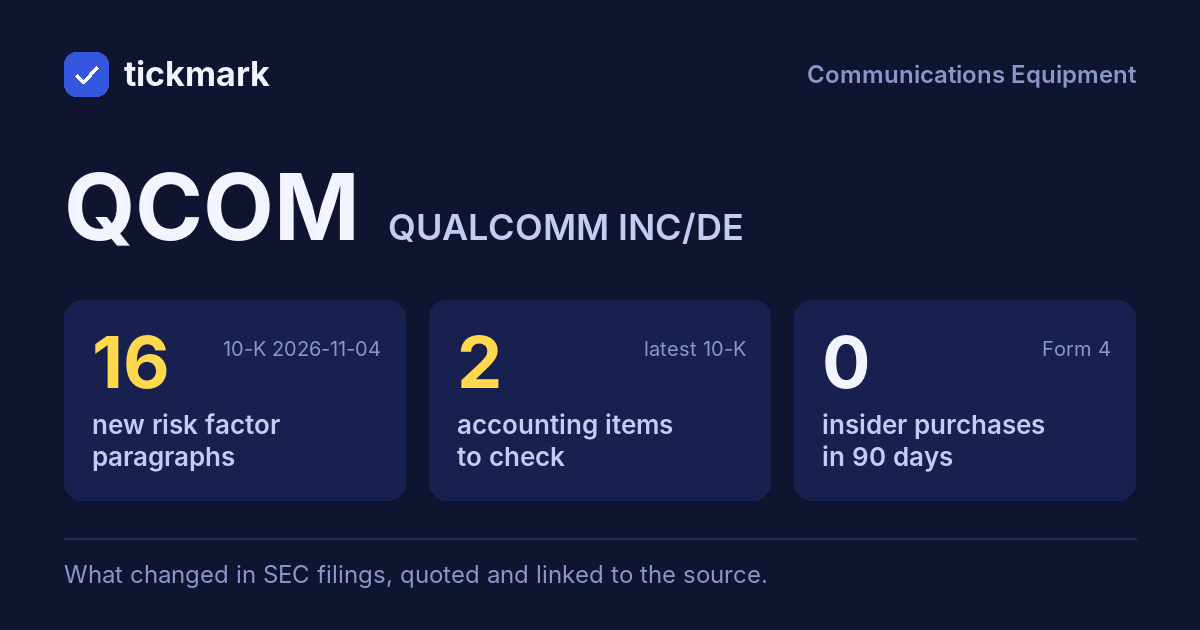
10-K 0000804328-26-000128 (2026-11-04) vs 10-K 0000804328-25-000085 (2025-11-05)
| Section | Compared text | Words now | Changed |
|---|
| Risk Factors | Item 1A | 19,308 |
17.5% |
| MD&A | Item 7 | 4,327 |
33.1% |
| Legal Proceedings | Item 3, via Note 7 – Commitments and Contingencies | 1,803 |
13.9% |
| Accounting Policies | 10-K text, Note 1 – Significant Accounting Policies | 5,888 |
2.3% |
The redline: what was cut and what was added
In each section, the paragraph that changed most, marked against last year's 10-K:
cut words struck through, new words highlighted and underlined.
Risk Factors 275 words changed in this paragraph; it is 32% similar to last year's version.
We Although we expect to derive an increasing portion of our revenues from areas outside of mobile handsets, such as automotive, IoT and data center, we continue to derive a significant portion of our revenues from a small number of mobile handset customers and licensees, and particularly from their sale of premium-tier handset devices, and we expect this trend to continue devices. Device share in the foreseeable future. The mobile industry is experiencing and may continue to experience concentration of device share among a few companies, industry, particularly at the premium tier, contributing to this trend. Certain is concentrated among a few companies, including Apple, Samsung and certain Chinese original equipment manufacturers (OEMs) (OEMs), many of whom are or have increased and may continue to increase their device share in China and in certain regions outside the past been our largest customers. This concentration means that the loss of China, and we derive any one of our key mobile handset customers, or a significant portion reduction in purchases from any such customer, whether due to such customer’s use of their own integrated circuit products (i.e., vertical integration) or our competitors’ integrated circuit products, government restrictions, a decline in global, regional or local economic conditions, a decline in consumer demand or any other reason, would have a significant negative impact on our business. For example, Apple has historically purchased our modem products for use in its devices and has historically been one of our revenues from largest customers, but we expect that Apple will primarily use its own internally developed modem products, rather than our products, in its devices going forward. This will have a small number significant negative impact on our QCT revenues, results of these OEMs operations and cash flows, and our ability to offset that impact depends on the timing and magnitude of growth in our non-handset revenues, including in automotive, IoT and data center, which may not occur as well. anticipated. See also “Notes to Consolidated Financial Statements, Note 2. Composition of Certain Financial Statement Items - Concentrations.”
Source: Item 1A, 10-K 0000804328-26-000128 vs Item 1A, 10-K 0000804328-25-000085
MD&A 192 words changed in this paragraph; it is 35% similar to last year's version.
Beginning Deferred tax assets represent amounts available to reduce income taxes payable on taxable income in fiscal 2023 and through fiscal 2025, for federal income tax purposes, we were required future years. We record a valuation allowance to capitalize and amortize domestic research and development expenditures over five years (such expenditures were previously deducted as incurred). Our cash flows from operations were adversely affected due to significantly higher cash tax payments. However, since the resulting reduce deferred tax asset was established at assets to the statutory rate amount that is more likely than not to be realized. Factors considered in this determination include assessing the adequacy of 21% (rather than future expected taxable income from all sources, including reversal of taxable temporary differences, forecasted operating earnings and available tax planning strategies, and considering that most of our income is taxed in the current effective tax rate U.S., of 13% after considering the FDII deduction), capitalization favorably affected our total provision which a significant portion qualifies for income taxes and results of operations. With the enactment of OBBB, such impacts on our cash flows and tax provision are not expected to continue beginning in fiscal 2026. preferential treatment as FDDEI. Changes in future taxable income (including less of our income qualifying for preferential treatment as FDDEI), tax laws (including changes to the CAMT rules) and other factors may change our determination regarding whether we will be able to realize our deferred tax assets.
Source: Item 7, 10-K 0000804328-26-000128 vs Item 7, 10-K 0000804328-25-000085
Legal Proceedings 165 words changed in this paragraph; it is 63% similar to last year's version.
On April 18, 2024, we filed a separate complaint (captioned complaint, captioned QUALCOMM Incorporated v. Arm Ltd.) against Holdings plc f/k/a Arm Ltd., in the United States District Court for the District of Delaware. The complaint alleges that Arm has breached the Qualcomm ALA by failing to provide certain deliverables that Arm is obligated to provide. The complaint seeks an order that Arm comply with its contractual obligations, damages, and additional relief. On December 16, 2024, we filed a First Amended Complaint alleging additional causes of action based on Arm improperly seeking to terminate the Qualcomm ALA and improperly publicizing that it was seeking to terminate the Qualcomm ALA. On June 3, 2025, we filed a Second Amended Complaint to add a claim that Arm has breached the Qualcomm TLA by failing to provide license offers at commercially reasonable prices and terms. On January 8, 2026, we filed a substantially identical complaint against Arm Ltd., which was subsequently consolidated with the Arm Holdings plc complaint. On March 30, 2026, our complaint against Arm Ltd. was amended to include an additional claim for breach of the Qualcomm ALA based on Arm’s failure to negotiate certain license terms in good faith. A trial was held beginning on October 5, 2026, and on October 13, 2026, the jury found that (i) Arm breached the Qualcomm ALA by failing to provide certain deliverables, (ii) Arm improperly interfered with Qualcomm’s economic relationship with a customer and (iii) Arm did not breach the Qualcomm TLA as we alleged. The court also held bench trial proceedings on certain of the claims, defenses and potential remedies that will be determined by the court in the first instance. The court has moved to dismiss our amended complaint. Trial is scheduled to begin not yet issued its decision on March 9, 2026. the bench trial issues.
Source: Item 3, via Note 7 – Commitments and Contingencies, 10-K 0000804328-26-000128 vs Item 3, via Note 7 – Commitments and Contingencies, 10-K 0000804328-25-000085
Accounting Policies 30 words changed in this paragraph; it is 82% similar to last year's version.
We are a global technology leader, helping to bring intelligent computing everywhere through the development and commercialization of foundational technologies, including on-device advanced artificial intelligence (AI), high-performance and low-power computing and advanced wireless leading connectivity. Our platforms help power intelligent devices that people products and businesses rely on every day services used around the world, across industries and applications from handsets to other areas, including automotive and automotive, the internet of things (IoT). (IoT) and data center. We derive revenues principally from sales of integrated circuit products and through the licensing of our intellectual property, including patents and other rights.
Source: 10-K text, Note 1 – Significant Accounting Policies, 10-K 0000804328-26-000128 vs 10-K text, Note 1 – Significant Accounting Policies, 10-K 0000804328-25-000085
Every change, by type
Sentences and paragraphs of QCOM's Risk Factors and MD&A, 10-K 2026-11-04 against 10-K 2025-11-05.
Each links to the text at sec.gov.
Quiet changes are sentences kept from last year with one to four words changed, at least one of them a hedge, a modal or a qualifier
(may, could, will, not, significant, material…). A year or date rolling forward is not counted.
The full word list
adverse, adversely, all, although, anticipate, anticipates, any, approximately, believe, believes, can, cannot, certain, could, expect, expects, generally, however, if, intend, intends, largely, likely, many, material, materially, may, might, most, must, never, no, not, possible, primarily, probable, should, significant, significantly, some, substantial, substantially, unlikely, will, would
AddedRisk Factors
•Our increasing focus on artificial intelligence (AI), including on-device AI, agentic AI and AI infrastructure, may not result in the anticipated benefits and could expose us to additional competitive, regulatory, intellectual property and operational risks.
Read it in 10-K 2026-11-04 at sec.gov ↗
AddedRisk Factors
Although we expect to derive an increasing portion of our revenues from areas outside of mobile handsets, such as automotive, IoT and data center, we continue to derive a significant portion of our revenues from a small number of mobile handset customers and licensees, and particularly from their sale of premium-tier handset devices. Device share in the mobile industry, particularly at the premium tier, is concentrated among a few companies, including Apple, Samsung and certain Chinese original equipment manufacturers (OEMs), many of whom are or have in the past been our largest customers. This concentration means that the loss of any one of our key mobile handset customers, or a significant reduction in purchases from any such customer, whether due to such customer’s use of their own integrated circuit products (i.e., vertical integration) or our competitors’ integrated circuit products, government restrictions, a decline in global, regional or local economic conditions, a decline in consumer demand or any other reason, would have a significant negative impact on our business. For example, Apple has historically purchased our modem products for use in its devices and has historically been one of our largest customers, but we expect that Apple will primarily use its own internally developed modem products, rather than our products, in its devices going forward. This will have a significant negative impact on our QCT revenues, results of operations and cash flows, and our ability to offset that impact depends on the timing and magnitude of growth in our non-handset revenues, including in automotive, IoT and data center, which may not occur as anticipated. See also “Notes to Consolidated Financial Statements, Note 2. Composition of Certain Financial Statement Items - Concentrations.”
Read it in 10-K 2026-11-04 at sec.gov ↗
AddedRisk Factors
Further, as we seek to grow and diversify our business in areas such as automotive, IoT and data center, we may also
Read it in 10-K 2026-11-04 at sec.gov ↗
AddedRisk Factors
derive a significant portion of revenues in such areas from a limited number of customers, hyperscalers, automakers or other industry participants.
Read it in 10-K 2026-11-04 at sec.gov ↗
AddedRisk Factors
For example, the automotive industry is subject to long design-in time frames, long product life cycles and a high degree of regulatory, safety and other requirements (including, in some cases, customer requirements to meet certain sustainability, climate or other environmental or social-related targets), necessitating suppliers to the industry to comply with stringent qualification processes, very low defect rates and high reliability standards. The data center industry is characterized by a limited number of large hyperscalers and cloud service providers, long qualification and deployment cycles, demanding performance, power efficiency, reliability, security and software requirements, and substantial ecosystem and infrastructure dependencies. Many of our current and potential competitors have longer operating histories in this industry, more established customer relationships, broader software and developer ecosystems, greater experience supporting large-scale data center deployments and, in some cases, existing installed bases or vertically integrated platform offerings.
Read it in 10-K 2026-11-04 at sec.gov ↗
AddedRisk Factors
Our increasing focus on artificial intelligence (AI), including on-device AI, agentic AI and AI infrastructure, may not result in the anticipated benefits and could expose us to additional competitive, regulatory, intellectual property and operational risks.
Read it in 10-K 2026-11-04 at sec.gov ↗
AddedRisk Factors
AI technologies, including machine learning, generative AI, agentic AI and other data driven computational techniques, are increasingly important to our strategy across mobile, automotive, IoT, data center and other industries and applications, and we are investing significant engineering, research and development and other resources to integrate AI capabilities into our integrated circuit products, software platforms and system solutions. These investments are subject to a high degree of uncertainty and may not generate operating income or contribute to future results of operations or cash flows that meet our expectations, on the timeline we anticipate or at all.
Read it in 10-K 2026-11-04 at sec.gov ↗
AddedRisk Factors
The successful adoption and monetization of AI-enabled products depends on numerous factors beyond our control, including consumer demand, the willingness of customers to pay for AI-enabled functionality, the development of compelling AI use cases, competition from alternative architectures or cloud-based solutions, and the extent to which our customers develop or deploy proprietary AI technologies through vertical integration. If AI workloads shift toward competing platforms or architectures that do not rely on our products, or if end-user demand for AI-enabled products or functionality does not materialize as anticipated, our revenues, margins and results of operations could be negatively impacted.
Read it in 10-K 2026-11-04 at sec.gov ↗
AddedRisk Factors
AI technologies also may expose us to legal, regulatory, cybersecurity, privacy, intellectual property, operational and reputational risks. AI algorithms, models or training methodologies may be flawed, and datasets or outputs may be inaccurate, insufficient, biased, misleading or otherwise controversial. Our use of AI tools in our internal operations, or the use of AI-enabled products, tools or technologies by our customers, developers, vendors or other third parties, may result in inadvertent disclosure or misuse of confidential, proprietary, personal or competitively sensitive information, reliance on inaccurate or flawed outputs, cybersecurity or privacy incidents, claims of infringement or misuse of data, regulatory scrutiny, litigation or use that is inconsistent with our expectations, policies, controls or applicable laws and regulations.
Read it in 10-K 2026-11-04 at sec.gov ↗
AddedRisk Factors
If any of these risks materialize, our AI-related investments may not achieve the anticipated benefits, and our business, results of operations, cash flows and financial condition could be materially adversely affected.
Read it in 10-K 2026-11-04 at sec.gov ↗
AddedRisk Factors
In addition, we license for use in our products certain technologies and intellectual property from Arm, such as the Arm instruction set architecture. Arm has recently become a supplier of integrated circuit products, putting itself in direct competition with its licensees. As a result, our ability to obtain a license to Arm’s latest technologies and intellectual property, including on acceptable terms and time frames, has been and may continue to be impacted. If we are unable to obtain an acceptable license, our ability to compete effectively would be harmed and we could experience significant impacts to our future products and business.
Read it in 10-K 2026-11-04 at sec.gov ↗
AddedRisk Factors
Our manufacturing operations depend on securing raw materials, equipment and other supplies in adequate quality and quantity in a timely manner from multiple suppliers, and in some cases, we rely on a limited number of suppliers, including in some cases sole suppliers, particularly in Asia. There may be cases where supplies of raw materials, equipment and other products are interrupted or limited by natural disaster, geopolitical conflict, accident or some other event affecting a supplier
Read it in 10-K 2026-11-04 at sec.gov ↗
RemovedRisk Factors
We derive a significant portion of our revenues from a small number of customers and licensees, and particularly from their sale of premium-tier handset devices, and we expect this trend to continue in the foreseeable future. The mobile industry is experiencing and may continue to experience concentration of device share among a few companies, particularly at the premium tier, contributing to this trend. Certain Chinese original equipment manufacturers (OEMs) have increased and may continue to increase their device share in China and in certain regions outside of China, and we derive a significant portion of our revenues from a small number of these OEMs as well. See also “Notes to Consolidated Financial Statements, Note 2. Composition of Certain Financial Statement Items - Concentrations.”
Read it in 10-K 2025-11-05 at sec.gov ↗
RemovedRisk Factors
Further, while we derive a portion of our revenues from areas outside of mobile handsets, e.g., from industries such as automotive and IoT, certain product categories within those industries may in themselves be subject to high levels of customer concentration.
Read it in 10-K 2025-11-05 at sec.gov ↗
RemovedRisk Factors
We derive a significant portion of our revenues from Chinese OEMs, and from non-Chinese OEMs that utilize our products in devices they sell into China, which has the largest number of smartphone users in the world. We also source certain critical integrated circuit products from Chinese suppliers.
Read it in 10-K 2025-11-05 at sec.gov ↗
RemovedRisk Factors
For example, the automotive industry is subject to long design-in time frames, long product life cycles and a high degree of regulatory and safety requirements, necessitating suppliers to the industry to comply with stringent qualification processes, very low defect rates and high reliability standards, all of which results in significant barriers to entry and increased costs. Additionally, certain customers have adopted, and other customers may adopt, policies that require us to achieve certain sustainability, climate or other environmental, social and governance (ESG)-related targets, such as our 2040 net-zero global GHG emissions commitment and our interim GHG emissions reduction goals. If we fail to achieve ESG-related targets that meet our customers’ requirements or expectations, these customers may not purchase products or services from us.
Read it in 10-K 2025-11-05 at sec.gov ↗
RemovedRisk Factors
If we were required to reduce the royalty rates in our patent license agreements, our revenues, earnings and cash flows would be negatively impacted absent a sufficient increase in the volume of sales of devices upon which royalties are paid. Similarly, if we were required to reduce the base on which our royalties are calculated (e.g., license at the chipset level rather than at the device level), our revenues, earnings and cash flows would be negatively impacted unless there was a sufficient increase in the volume of sales of devices upon which royalties are paid or we were able to increase our royalty rates to offset the decrease in revenues resulting from such lower royalty base.
Read it in 10-K 2025-11-05 at sec.gov ↗
RemovedRisk Factors
on devices); access to capacity in the supply chain; and value-added features that drive selling prices and consumer demand for new devices.
Read it in 10-K 2025-11-05 at sec.gov ↗
RemovedRisk Factors
and OEMs in certain geographic regions (such as China); longer operating histories in industries and applications beyond mobile handsets (such as automotive, IoT and data center), including more established and/or stronger customer, vendor, distributor or other channel relationships in such industries; and a more established presence in certain regions.
Read it in 10-K 2025-11-05 at sec.gov ↗
RemovedRisk Factors
We have engaged in litigation and arbitration in the past and may need to further litigate or arbitrate in the future to enforce our contract and/or intellectual property rights, protect our trade secrets or determine the validity and scope of
Read it in 10-K 2025-11-05 at sec.gov ↗
RemovedRisk Factors
Further changes in the tax laws of foreign jurisdictions could arise as a result of the base erosion and profit shifting (BEPS) project that was undertaken by the Organization for Economic Co-operation and Development (OECD). The OECD, representing a coalition of member countries, has made certain changes, including the Pillar Two framework, which imposes a minimum tax of 15% in each taxing jurisdiction. The OECD is contemplating additional changes to numerous long-standing tax principles. These changes, if and as adopted by countries, may increase tax uncertainty and may adversely affect our provision for income taxes, results of operations and cash flows.
Read it in 10-K 2025-11-05 at sec.gov ↗
RewordedRisk Factors
See also the Risk Factors titled “Our business may suffer as a result of adverse rulings in governmental investigations or proceedings or other legal proceedings,” “Changes in our patent licensing practices, whether due to governmental investigations, legal challenges or otherwise, could adversely impact our business and results of operations,” “A significant portion of our business is concentrated in China, and the risks of such concentration are exacerbated by U.S./China trade and national security tensions,” “There are numerous risks associated with the operation and control of our manufacturing facilities, including a higher portion of fixed costs relative to a fabless model; environmental compliance and liability; impacts related to climate change; exposure to natural disasters, health crises, geopolitical conflicts and cyber-attacks; timely supply of equipment and materials; and various manufacturing issues,” and “Tax liabilities could adversely affect our results of operations.”
Read it in 10-K 2026-11-04 at sec.gov ↗
RewordedRisk Factors
Our revenues and growth in revenues could be negatively impacted, our business may be harmed and our substantial investments in these technologies may not provide us an adequate return, if: our customers’ and licensees’ sales of products, particularly premium-tier handset products, products and services using these technologies, or average selling prices of such products, decline due to, for example, the maturity of smartphone penetration in developed regions, including China; our customers’ and licensees’ production and sales of products are impacted by supply constraints, or supply constraints or other factors increase the average selling prices of such products, causing a reduction in consumer demand; there is slower-than-expected adoption, or a lack of adoption, of our products and technologies in new and expanded industries including automotive, IoT and data center; we do not continue to maintain our intellectual property and technical leadership in 5G, including in ongoing 5G standardization efforts, or we fail to establish such leadership in future generations of wireless technology; we are unable to drive the adoption of our products and platform solutions into networks networks, devices, vehicles, data center infrastructure, industrial systems, robots and devices, including devices beyond mobile handsets; other connected endpoints; consumers’ rates of replacement of smartphones and other consumer devices decline; or there is a shift in consumer demand away from new devices in favor of refurbished or secondhand devices.
Read it in 10-K 2026-11-04 at sec.gov ↗
RewordedRisk Factors
OEM concentrations; Competition in the semiconductor industry is affected by various factors that include, among others: customer concentrations in various segments (e.g., handsets and data center); vertical integration; competition in certain geographic regions; government intervention or support of national industries or competitors; geopolitical tensions, which may drive customer preference toward local suppliers; the ability to maintain product differentiation in light of evolving industry standards and speed of technological change (including the transition to smaller geometry process technologies, the demand for always on, always connected capabilities, the increasing use of AI and machine learning technologies and the need to run complex AI-based applications on devices and in data centers, and the need for related software and developer ecosystems); access to capacity in the supply chain; and value-added features that drive selling prices and consumer demand for new devices.
Read it in 10-K 2026-11-04 at sec.gov ↗
RewordedRisk Factors
If our products products, software and other integrated solutions fail to perform to specifications, compete with the product quality quality, performance, efficiency or cost effectiveness of our competitors or meet quality or regulatory standards (including product safety and information security standards, which may differ by region, geography and industry, and which are particularly stringent in the automotive industry) or other standards (including sustainability of a particular industry or other application, we may be unable to successfully expand our business in that industry or application, and our growth could be limited.
Read it in 10-K 2026-11-04 at sec.gov ↗
RewordedRisk Factors
In particular, our future growth depends in part on our ability to succeed in new and expanded product areas, and industries and applications beyond mobile handsets, applications, including in automotive, IoT and data center; our ability to develop leading and cost-effective technologies technologies, products, software and products full-stack platform solutions for these new areas; our ability to create, integrate and expanded product areas, industries scale developer ecosystems and applications; software platforms; and third parties incorporating our technologies technologies, products and products solutions into devices devices, vehicles, infrastructure, systems and services used in these product areas, industries and applications. areas.
Read it in 10-K 2026-11-04 at sec.gov ↗
RewordedRisk Factors
Some of these current and potential competitors may have advantages over us that include, among others: motivation by our customers in certain circumstances to use our competitors’ integrated circuit products, to utilize their own internally-developed integrated circuit products and/or sell such products to others, or to utilize alternative technologies; lower cost structures or a willingness and ability to accept lower prices or lower margins for their products, particularly in China; foreign government support of other technologies, competitors or OEMs that sell devices that do not contain our products; better known brand names; ownership and control of manufacturing facilities and greater expertise in manufacturing processes; the development and sale of infrastructure equipment for wireless networks, which may enable such competitors to better optimize their integrated circuit products for performance on those networks; more extensive relationships with local distribution companies and OEMs in certain geographic regions (such as China); longer operating histories in industries and applications beyond mobile handsets (such as automotive, IoT and data center), including more established and/or stronger customer, vendor, distributor, developer or other channel relationships in such industries; and a more established presence in certain regions.
Read it in 10-K 2026-11-04 at sec.gov ↗
RewordedRisk Factors
In addition, in order to successfully extend our technologies and products into new and expanded product areas, and industries and applications beyond mobile handsets, applications, we may need to transition to new business models or transform aspects of our organization, including moving from silicon products to more integrated hardware, software and platform solutions; developing direct relationships with new types of customers and ecosystem participants; expanding developer, channel and go-to-market capabilities; and operating in markets with different purchasing, deployment and support requirements, and we may not be successful in doing so.
Read it in 10-K 2026-11-04 at sec.gov ↗
RewordedRisk Factors
We derive a significant portion of our revenues from Chinese OEMs customers and source certain critical integrated circuit products from non-Chinese OEMs that utilize our products in devices they sell into China (which has the largest number of smartphone users in the world); Chinese suppliers; our key foundry suppliers and their manufacturing foundries semiconductor assembly and assembly, test and other facilities service providers are primarily located in Taiwan and Korea; our manufacturing facilities for RFFE and RF products are located in China, Germany and Singapore; the primary warehouses where we store finished goods for fulfillment of customer orders are located in Singapore; and a significant portion of our workforce (including engineering and other technical personnel) is based in India.
Read it in 10-K 2026-11-04 at sec.gov ↗
RewordedRisk Factors
The above is exacerbated by the fact that our products may be used, and perform critical functions, in various high-risk applications, including but not limited to: automobiles, including ADAS/AD functions; cameras and artificial intelligence, including home and enterprise security; home automation, including smoke and noxious gas detectors; medical condition monitoring; location and asset tracking and management, including wearables for child safety and elderly health; robotics, including public safety drones and autonomous municipality vehicles; and XR for treatment of phobias or PTSD, early detection of disorders or special needs, vehicles, among others.
Read it in 10-K 2026-11-04 at sec.gov ↗
RewordedRisk Factors
However, our research, development and other investments in these new and expanded product areas, industries and applications, and corresponding technologies and products, as well as in our existing technologies and products and new technologies in mobile handsets, areas may not succeed because, among other reasons: we may not be issued patents on the technologies we develop; the technologies we develop may not be incorporated into relevant standards; new and expanded product areas, industries and applications beyond mobile handsets, applications, and consumer demand therein, may not develop or grow as anticipated; we may be unable to attract or retain employees with the necessary skills in such new and expanded product areas, industries and applications; our strategies or the strategies of our customers, licensees or partners may not be successful; alternate technologies technologies, architectures or products may be better or may reduce the advantages we anticipate from our investments; competitors’ technologies or products may be more cost effective, have more capabilities or fewer limitations or be brought to market faster than our new technologies or products; we may not be able to develop, or our competitors may have more established and/or stronger customer, vendor, distributor or other channel relationships; and competitors may have longer operating histories in industries and applications that are new to us.
Read it in 10-K 2026-11-04 at sec.gov ↗
RewordedRisk Factors
Certain of our customers in China have developed, These OEMs may be incentivized to develop and others may in the future develop, use their own integrated circuit products and use such integrated circuit products in their devices rather than our products, including products due to pressure from or policies of the Chinese government (which has prioritized semiconductor self-sufficiency), concerns over losing access to our products as a result of actual, threatened or potential U.S. or Chinese government actions or policies, including trade protection or national security policies, or other reasons.
Read it in 10-K 2026-11-04 at sec.gov ↗
RewordedRisk Factors
Competition in any or all of the industries in which we operate, or in any product areas or device tiers within such industries, may result in the loss of business or customers, customers or reduce average selling prices for our chipset products or the products of our customers and licensees, any of which would negatively impact our business, results of operations, cash flows and financial condition.
Read it in 10-K 2026-11-04 at sec.gov ↗
Quiet changesRisk Factors
In addition, the timing and size of purchases by our significant such customers may be impacted by the timing of such customers’ new or next generation product introductions, over which we have no control, and the timing and success of such introductions may cause our revenues and results of operations to fluctuate.
Read it in 10-K 2026-11-04 at sec.gov ↗
Quiet changesRisk Factors
Similarly, we derive a significant portion of our handset revenues from certain Chinese OEMs.
Read it in 10-K 2026-11-04 at sec.gov ↗
Quiet changesRisk Factors
If our customers begin using their own integrated circuit products rather than our products in some or all of their devices, or increase their use of their own integrated circuit products from current levels, our business, results of operations, cash flows and financial condition could be materially adversely impacted.
Read it in 10-K 2026-11-04 at sec.gov ↗
AddedMD&A
+ $235 million in higher equipment and services revenues from our Data Center business, primarily driven by our acquisition of Alphawave IP Group plc (Alphawave) in the first quarter of fiscal 2026
Read it in 10-K 2026-11-04 at sec.gov ↗
AddedMD&A
Interest Expense and Investment and Other Income, Net (in millions) 2026 2025 Change Interest expense $ 689 $ 664 $ 25 Investment and other income, net Interest and dividend income $ 424 $ 639 $ (215) Net gains on marketable securities 386 254 132 Net gains on other investments 252 44 208 Net gains on deferred compensation plan assets 176 127 49 Impairment losses on other investments (88) (113) 25 Net gains on equity method investments 258 12 246 Other 37 9 28 $ 1,445 $ 972 $ 473
Read it in 10-K 2026-11-04 at sec.gov ↗
AddedMD&A
2026 2025 Expected income tax provision at federal statutory tax rate $ 1,977 $ 2,659 Change in valuation allowance on federal deferred tax assets (5,781) 5,724 Benefit from FDDEI deduction (368) (1,227) Benefit related to the research and development tax credit (229) (237) Other 187 203 Income tax (benefit) expense $ (4,214) $ 7,122 Effective tax rate (45 56 %
Read it in 10-K 2026-11-04 at sec.gov ↗
AddedMD&A
- lower handsets revenues, primarily due to lower chipset shipments to certain major OEMs (primarily driven by customers adjusting build plans to reduce their inventory levels as a result of the negative effects of recent memory supply constraints and related price increases)
Read it in 10-K 2026-11-04 at sec.gov ↗
AddedMD&A
+ higher IoT revenues, primarily due to an increase in revenues per unit primarily driven by favorable mix
Read it in 10-K 2026-11-04 at sec.gov ↗
AddedMD&A
- $43 million in lower royalty revenues recognized related to devices sold in prior periods
Read it in 10-K 2026-11-04 at sec.gov ↗
AddedMD&A
•We expect current memory supply constraints and related pricing increases to adversely affect demand from several handset OEMs, which will negatively impact our financial results. The extent to which these conditions may affect our business will depend on future developments, including memory supply availability, memory and device pricing dynamics and end‑consumer demand for devices, all of which remain uncertain.
Read it in 10-K 2026-11-04 at sec.gov ↗
AddedMD&A
•The semiconductor industry is experiencing a broad-based increase in input costs and capacity constraints across wafer fabrication, assembly, test, advanced packaging, memory and other materials, due in part to increasing demand for leading-edge technologies, AI and data center applications. As a result, we continue to see increased product costs from certain of our key suppliers, which have and will continue to negatively impact our margins. In response to these higher costs, we are taking actions to increase our product pricing. We expect the full benefit of these actions to be reflected in our gross margins in the second half of fiscal 2027. Further, if these supply and capacity constraints limit the availability of components, manufacturing capacity or related services from our suppliers, we may be unable to fully satisfy customer demand, which could result in lost or delayed revenue and adversely affect our results of operations, cash flows and financial condition.
Read it in 10-K 2026-11-04 at sec.gov ↗
AddedMD&A
•Beginning in the first quarter of fiscal 2027, we expect Data Center revenue growth as shipments begin to ramp under our previously announced custom silicon agreements with certain large hyperscale customers.
Read it in 10-K 2026-11-04 at sec.gov ↗
RemovedMD&A
+ $143 million in licensing revenues resulting from a settlement of a licensing dispute in the second quarter of fiscal 2025, which was not allocated to our segment results
Read it in 10-K 2025-11-05 at sec.gov ↗
RemovedMD&A
+ $231 million increase in sales and marketing expenses (including investments in key growth and diversification initiatives)
Read it in 10-K 2025-11-05 at sec.gov ↗
RemovedMD&A
Benefit from FDII deduction, excluding the impact of capitalizing research and development expenditures (735) (596)
Read it in 10-K 2025-11-05 at sec.gov ↗
RemovedMD&A
Benefit from FDII deduction related to capitalizing research and development expenditures (492) (585)
Read it in 10-K 2025-11-05 at sec.gov ↗
RemovedMD&A
Foreign currency losses (gains) related to foreign withholding tax receivable 98 (21)
Read it in 10-K 2025-11-05 at sec.gov ↗
RemovedMD&A
Benefit related to the transfer of intellectual property between foreign subsidiaries (8) (317)
Read it in 10-K 2025-11-05 at sec.gov ↗
RemovedMD&A
Beginning in fiscal 2023 and through fiscal 2025, for federal income tax purposes, we were required to capitalize and amortize domestic research and development expenditures over five years (such expenditures were previously deducted as incurred). Our cash flows from operations were adversely affected due to significantly higher cash tax payments. However, since the resulting deferred tax asset was established at the statutory rate of 21% (rather than the current effective tax rate of 13% after considering the FDII deduction), capitalization favorably affected our total provision for income taxes and results of operations. With the enactment of OBBB, such impacts on our cash flows and tax provision are not expected to continue beginning in fiscal 2026. Changes in future taxable income (including less of our income qualifying for preferential treatment as FDDEI), tax laws (including changes to the CAMT rules) and other factors may change our determination regarding whether we will be able to realize our deferred tax assets.
Read it in 10-K 2025-11-05 at sec.gov ↗
RemovedMD&A
+ higher IoT revenues due to $1.5 billion in higher shipments across edge networking, consumer and industrial products, partially offset by unfavorable mix
Read it in 10-K 2025-11-05 at sec.gov ↗
RemovedMD&A
QTL licensing revenues and EBT remained approximately flat in fiscal 2025. During the second quarter of fiscal 2025, we executed final agreements for new long-term licenses with two key Chinese OEMs (for which the initial terms had expired) and entered into comprehensive 4G and 5G license agreements with Transsion (a growing, China-headquartered OEM that sells primarily in developing regions). As a result of our agreements with Transsion, all outstanding litigation between the parties has been dismissed. Beginning in the second quarter of fiscal 2025, QTL revenues did not include royalties from Huawei, whose license agreement has expired.
Read it in 10-K 2025-11-05 at sec.gov ↗
RemovedMD&A
QSI Segment (in millions)2025 2024 Change Equipment and services revenues $ $ 18 $ (18) EBT 180 104 76
Read it in 10-K 2025-11-05 at sec.gov ↗
RemovedMD&A
We believe that on-device AI and high-performance, low-power computing combined with cellular technology (such as 5G) will continue to drive adoption of certain technologies that are already commonly used in smartphones by industries and applications beyond mobile handsets, such as automotive and IoT. We believe it is important that we remain a leader in such technology development, standardization, intellectual property creation and licensing, and a leading developer and supplier of integrated circuit products in order to sustain and grow our business long-term.
Read it in 10-K 2025-11-05 at sec.gov ↗
RemovedMD&A
•We expect leading process technology nodes to continue to drive product cost increases from certain of our key semiconductor wafer suppliers.
Read it in 10-K 2025-11-05 at sec.gov ↗
RewordedMD&A
The net decrease in cash, cash equivalents and marketable securities (including restricted cash) in fiscal 2025 2026 was primarily due to $8.8 $7.8 billion in payments to repurchase shares of our common stock, $3.8 $3.9 billion in cash dividends paid, $1.4 billion repayment of unsecured fixed-rate notes that matured in May 2025, $1.2 $2.5 billion in capital expenditures, expenditures (primarily to support our engineering infrastructure and the testing of our integrated circuits), $1.6 billion in cash paid for acquisitions and other investments and $1.1 billion in payments of tax withholdings related to the vesting of share-based awards and $743 million in cash paid for acquisitions and other investments. awards.
Read it in 10-K 2026-11-04 at sec.gov ↗
RewordedMD&A
QSI EBT increased in fiscal 2025 2026 primarily due to $246 million in higher net gains from certain QSI equity method investments, $208 million in higher net gains from observable price changes on certain of our non-marketable equity investments and $148 million in higher net gains on marketable securities resulting from the initial public offerings of certain of our equity investments, partially offset by lower net gains from observable price changes on certain of our non-marketable equity investments.
Read it in 10-K 2026-11-04 at sec.gov ↗
RewordedMD&A
Net changes in our operating assets and liabilities positively impacted decreased our operating cash flows primarily driven by an increase in fiscal 2025 primarily from inventory to secure supply and mitigate disruptions due to supply constraints, partially offset by a decrease in other assets driven by which was primarily due to the utilization of prior advanced supply agreement payments, partially offset by an increase in accounts receivables primarily driven by higher revenues. payments.
Read it in 10-K 2026-11-04 at sec.gov ↗
RewordedMD&A
Key considerations in this assessment include the investee’s financial and liquidity position and business forecasts (including their ability to respond to any significant deterioration), industry performance, development and/or market acceptance of the investee’s products or technologies, as well as considering any appreciation in fair value that has not been recognized in the carrying values of such investments and other relevant events and factors.
Read it in 10-K 2026-11-04 at sec.gov ↗
RewordedMD&A
Additional information regarding our annual effective tax rate (including discussion related to the impact of the requirement to capitalize research and development expenditures for federal income tax purposes, and the benefit related to the transfer of intellectual property between foreign subsidiaries in fiscal 2024) is provided in this Annual Report in “Notes to Consolidated Financial Statements, Note 3.
Read it in 10-K 2026-11-04 at sec.gov ↗
RewordedMD&A
Under the OBBB enacted in July 2025, As a result, we no longer expect to be subject to CAMT beginning in fiscal 2026 the foreseeable future, and therefore, we no longer now expect to realize substantially all of our existing federal deferred tax assets.
Read it in 10-K 2026-11-04 at sec.gov ↗
RewordedMD&A
Other expenses in fiscal 2024 primarily 2026 consisted of $107 million in restructuring and restructuring-related charges (substantially all of which related to severance costs) and a $75 million charge related to the settlement of a securities class action lawsuit. costs).
Read it in 10-K 2026-11-04 at sec.gov ↗
RewordedMD&A
Gross margin percentage decreased in fiscal 2025 2026 primarily due to a decrease in the proportion of total revenues related to QTL licensing revenues (which have a higher QCT gross margin percentage contribution). percentage.
Read it in 10-K 2026-11-04 at sec.gov ↗
RewordedMD&A
In particular, Apple began utilizing currently uses its own internally developed modem (rather than our products) in certain of its recently released smartphones and we expect that Apple will increasingly primarily use its own modem products, rather than our products, in its future devices, devices going forward, which will have a significant negative impact on our QCT revenues, results of operations and cash flows.
Read it in 10-K 2026-11-04 at sec.gov ↗
RewordedMD&A
The OBBB includes included significant corporate tax reforms, including changes to the permanent reinstatement of deducting FDDEI regime and changes allowing domestic research and development R&D expenditures to be deducted as incurred beginning in fiscal 2026 (under prior law such expenditures were capitalized and amortized over five years).
Read it in 10-K 2026-11-04 at sec.gov ↗
RewordedMD&A
At September 28, 2025, 27, 2026, we had $15.1 billion of principal fixed-rate notes outstanding with maturity dates between 2027 and 2053. outstanding, $2.0 billion of which matures in 2027.
Read it in 10-K 2026-11-04 at sec.gov ↗
RewordedMD&A
We monitor our investments, many of which are in early-stage companies, for events or circumstances that could indicate impairment, including those that result from observable price adjustments. including, among other factors, lower valuations in recently completed and anticipated financings.
Read it in 10-K 2026-11-04 at sec.gov ↗