Paragraph 150 · 50% changed
Every version of it
Screener
/
SEC EDGAR
/CIK 0001906324
/10-K filed Feb 19, 2026, compared with Feb 27, 2025
/Numbers from the XBRL of the 10-Ks
Nasdaq
Health care · Diagnostics
QuidelOrtho Corp QDEL
The 10-K against last year's
216 changes: 26 added, 35 removed, 143 reworded, 12 quiet changes
10-K Feb 19, 2026 vs Feb 27, 2025
Risk Factors
18.5%
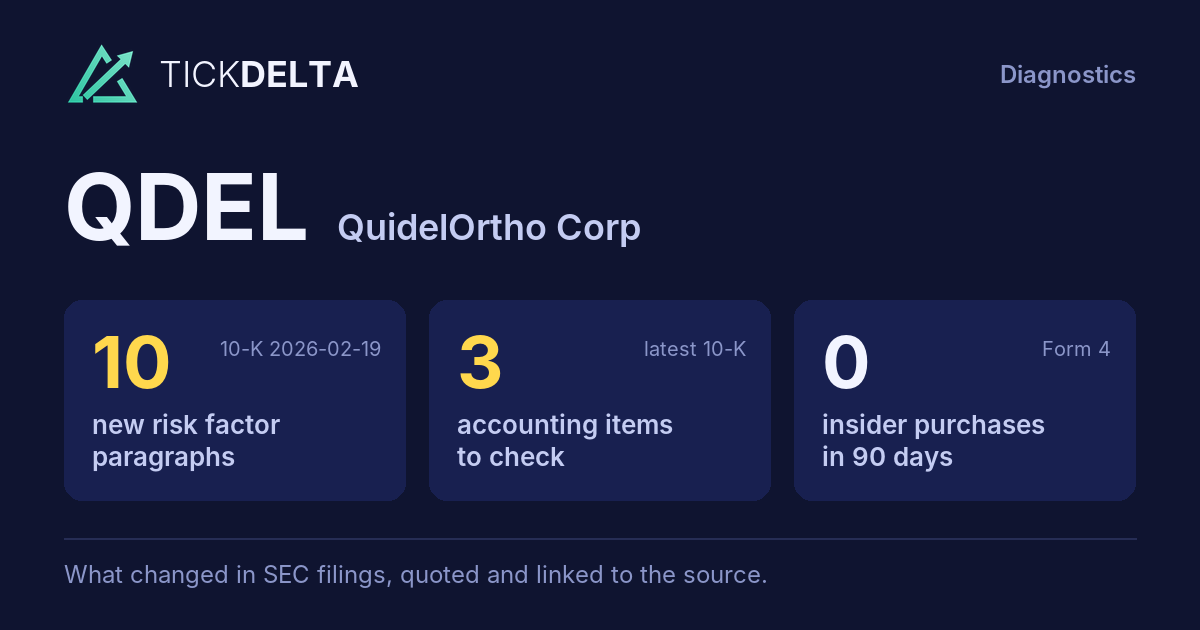
of the text changed · 21,162 words now · 10 new paragraphs, 24 gone
MD&A
31.8%
of the text changed · 7,940 words now · 16 new paragraphs, 11 gone
Legal Proceedings
10.6%
of the text changed · 1,027 words now
Accounting Policies
25.0%
of the text changed · 4,719 words now
10-K 0001906324-26-000008 (Feb 19, 2026) vs 10-K 0001906324-25-000035 (Feb 27, 2025)
Every paragraph, and how much of it changed
One bar per paragraph, in the order of the 10-K. Height and colour show the share of its words not in the closest paragraph a year earlier; the tallest bars are new paragraphs.
Risk Factors
250 paragraphs · 10 new · 113 reworded · 24 gone · 10-K Feb 19, 2026 against Feb 27, 2025
New paragraph
Reworded (5% of its words or more)
Same or nearly
Paragraph 17 · 48% changed
Every version of it
•failure to comply with applicable regulations by the FDA and other federal, state and foreign regulatory agencies, which may result in significant costs, the suspension or withdrawal of previously obtained regulatory approvals, product recalls, seizure of products or injunctions against the distribution of our products, operating restrictions and criminal prosecution; agencies;
Paragraph 125 · 48% changed
Every version of it
Paragraph 166 · 46% changed
Every version of it
Paragraph 175 · 46% changed
Every version of it
Doing business on a worldwide basis requires us to comply with the laws and regulations of the U.S. government federal and state governments and those of various international and sub-national jurisdictions, and our failure to successfully comply with these rules and regulations may expose us to liabilities. These laws and regulations apply to companies and individual directors, officers, employees employees, agents, partners and agents, other intermediaries working on our behalf, and may restrict our operations, trade practices, investment decisions and partnering activities. In particular, our international operations are subject to U.S. and foreign anti-corruption laws and regulations, such as the FCPA, the Bribery Act and the Brazilian Anti-Bribery Act, among others, and economic and trade sanctions, including those administered by the United Nations, the EU, China, the Office of Foreign Assets Control of the U.S. Department of the Treasury (“OFAC”) and the U.S. Department of State. The FCPA prohibits providing anything of value to foreign officials for the purposes of obtaining or retaining business or securing any improper business advantage. We may deal with state-owned business enterprises, the employees and representatives of which may be considered foreign officials for purposes of the FCPA. We are subject to the jurisdiction of various governments and regulatory agencies outside of the U.S., which may bring our personnel into contact with foreign officials responsible for issuing or renewing permits, licenses or approvals or for enforcing other governmental regulations. The FCPA also contains accounting provisions requiring issuers of securities listed in the U.S. to make and keep books and records that accurately and fairly reflect the transactions and dispositions of the assets of the company, and to devise and maintain an adequate system of internal accounting controls. The provisions of the Bribery Act extend beyond bribery of foreign public officials and are more onerous than the FCPA in a number of other respects, including jurisdiction, non-exemption of facilitation payments and penalties. Under China’s Anti-Unfair Competition Law and Criminal Law regime, China has launched an intensified nationwide anti-corruption campaign in the healthcare sector, with strengthened enforcement actions and stricter regulations on both healthcare professionals and enterprises, which has delayed and could continue to delay the processing of public tenders or installations of certain of our instruments, which may have a negative impact on our commercial activities. Economic and trade sanctions restrict our transactions or dealings with certain sanctioned countries, territories and designated persons, absent authorizations or exemptions under applicable law, such as OFAC’s licenses permitting certain humanitarian trade.
Paragraph 91 · 45% changed
Every version of it
We have and are continuing to incorporate AI, including machine learning and independent algorithms, in certain of our internal operations and may incorporate AI into our products and services, which may enhance their operation and effectiveness internally and for our customers, suppliers, suppliers and consumers. There patients. AI development and deployment practices could subject us to competitive harm, reputational harm, increased cybersecurity risks, regulatory enforcement and legal liability. We also may face challenges relating to data provenance and consent, model bias and drift monitoring, governance over updates to adaptive algorithms, and transparency and post‑market monitoring expectations. Use of third‑party data or models could give rise to intellectual property or privacy claims. Emerging frameworks (including predetermined change control plans for AI or machine learning) may increase costs or delay adoption. If we fail to incorporate AI that meets our internal and customer needs, we may fail to recoup our investments, and our competitive position and reputation may be adversely impacted. Furthermore, there can be no assurance that we or our customers will realize the expected benefits from such our implementation of AI. AI innovation presents risks and challenges that could impact our business. Our, or our vendors’, AI algorithms may be flawed. Our datasets or AI training algorithms may be insufficient or contain biased information. Additionally, many countries and regions, including the EU, have proposed new and evolving regulations related to the use of AI and machine learning technologies. The regulations may impose onerous obligations and may require us to unexpectedly rework or reevaluate improvements to be compliant, which may result in the development of products that are subsequently unacceptable under new or revised regulatory frameworks. Use of AI technologies may expose us to an increased risk of regulatory enforcement and litigation. Moreover, some AI features involve the processing of personal data and may be subject to laws, policies, legal obligations, and codes of conduct related to privacy and data protection. AI development and deployment practices could subject us to competitive harm, regulatory enforcement, increased cybersecurity risks, reputational harm, and legal liability.
Paragraph 39 · 44% changed
Every version of it
Competitive and regulatory conditions in many markets in which we operate restrict our ability to fully recover through price increases, higher costs of acquired goods and services resulting from inflation, and other drivers of cost increases. In addition, there has been a trend toward industry consolidation in our markets over the last few years. We may not be able to compete successfully in an increasingly consolidated industry. We expect this trend toward industry consolidation to continue as companies attempt to strengthen or hold their market positions in an evolving industry. If we are unable to compete successfully in this highly competitive industry, it could have a material effect on our business, financial condition and results of operations.
Paragraph 234 · 44% changed
Every version of it
Paragraph 150 · 50% changed
Every version of it
10-K Feb 27, 2025The FDA and corresponding foreign regulatory agencies may require post-market testing and surveillance to monitor the performance of cleared or approved products or may place conditions on any product clearances or approvals that could restrict the commercial applications of those products. The discovery of problems with a product may result in restrictions on the product, including withdrawal of the product from the market. In addition, in some cases, we may sell products or provide services that are reliant on the use or commercial availability of third-party products, including medical devices or equipment, and regulatory restrictions placed upon any such third-party products could have a material adverse impact on the sales or commercial viability of our related products or services.
10-K Feb 19, 2026
and regulatory restrictions placed upon any such third-party products could have a material adverse impact on the sales or commercial viability of our related products or services.
Paragraph 17 · 48% changed
Every version of it
10-K Feb 27, 2025
•failure to comply with applicable regulations by the FDA and other federal, state and foreign regulatory agencies, which may result in significant costs, the suspension or withdrawal of previously obtained regulatory approvals, product recalls, seizure of products or injunctions against the distribution of our products, operating restrictions and criminal prosecution;
10-K Feb 19, 2026
•failure to comply with applicable regulations by the FDA and other federal, state and foreign regulatory agencies;
Paragraph 125 · 48% changed
Every version of it
10-K Feb 27, 2025Furthermore, in recent years, the U.S. Supreme Court has ruled on several patent cases and several laws have been enacted that, in certain situations, potentially narrow the scope of patent protection available and weaken the rights of patent owners. As a result, companies may pursue an “efficient infringement” strategy, having concluded that it is cheaper to infringe third-party intellectual property rights than to acquire, license or otherwise respect them. There can be no assurance that we will be successful in securing additional patents on commercially desirable improvements, that such additional patents will adequately protect our innovations or offset the effect of expiring patents, or that competitors will not be able to design around our patents.
10-K Feb 19, 2026
successful in securing additional patents on commercially desirable improvements, that such additional patents will adequately protect our innovations or offset the effect of expiring patents, or that competitors will not be able to design around our patents.
Paragraph 166 · 46% changed
Every version of it
10-K Feb 27, 2025To enforce compliance with the healthcare regulatory laws, certain enforcement bodies have recently increased their scrutiny of interactions between healthcare companies and healthcare providers, which has led to a number of investigations, prosecutions, convictions and settlements in the healthcare industry. For example, the medical device industry’s relationship with physicians has been under increasing scrutiny by the U.S. Department of Health and Human Services Office of Inspector General (“OIG”), the U.S. Department of Justice (“DOJ”), the state attorney generals and other foreign and domestic government agencies. Responding to investigations can be time- and resource-consuming and can divert management’s attention from the business. We may be subject to private qui tam actions brought by individual whistleblowers on behalf of federal or state governments, with potential liability under the FCA, including mandatory treble damages and significant per-claim penalties. Additionally, as a result of these investigations and qui tam actions, we may need to agree to additional compliance and reporting requirements as part of a consent decree, corporate integrity agreement or other type of government resolution. Any such investigation, or failure to comply with such investigation, including those led by the OIG or the DOJ, or settlement could increase our costs or otherwise have an adverse effect on our business, financial condition and results of operations. Even an unsuccessful challenge or investigation into our practices could cause adverse publicity and be costly to respond to.
10-K Feb 19, 2026
as part of a consent decree, corporate integrity agreement or other type of government resolution. Any such investigation, or failure to comply with such investigation, including those led by the OIG or the DOJ, or settlement could increase our costs or otherwise have an adverse effect on our business, financial condition and results of operations. Even an unsuccessful challenge or investigation into our practices could cause adverse publicity, reputational damage and be costly to respond to.
Paragraph 175 · 46% changed
Every version of it
10-K Feb 27, 2025
Doing business on a worldwide basis requires us to comply with the laws and regulations of the U.S. government and those of various international and sub-national jurisdictions, and our failure to successfully comply with these rules and regulations may expose us to liabilities. These laws and regulations apply to companies and individual directors, officers, employees and agents, and may restrict our operations, trade practices, investment decisions and partnering activities. In particular, our international operations are subject to U.S. and foreign anti-corruption laws and regulations, such as the FCPA, the Bribery Act and the Brazilian Anti-Bribery Act, among others, and economic and trade sanctions, including those administered by the United Nations, the EU, China, the Office of Foreign Assets Control of the U.S. Department of the Treasury (“OFAC”) and the U.S. Department of State. The FCPA prohibits providing anything of value to foreign officials for the purposes of obtaining or retaining business or securing any improper business advantage. We may deal with state-owned business enterprises, the employees and representatives of which may be considered foreign officials for purposes of the FCPA. We are subject to the jurisdiction of various governments and regulatory agencies outside of the U.S., which may bring our personnel into contact with foreign officials responsible for issuing or renewing permits, licenses or approvals or for enforcing other governmental regulations. The FCPA also contains accounting provisions requiring issuers of securities listed in the U.S. to make and keep books and records that accurately and fairly reflect the transactions and dispositions of the assets of the company, and to devise and maintain an adequate system of internal accounting controls. The provisions of the Bribery Act extend beyond bribery of foreign public officials and are more onerous than the FCPA in a number of other respects, including jurisdiction, non-exemption of facilitation payments and penalties. Under China’s Anti-Unfair Competition Law and Criminal Law regime, China has launched an intensified nationwide anti-corruption campaign in the healthcare sector, with strengthened enforcement actions and stricter regulations on both healthcare professionals and enterprises, which has delayed and could continue to delay the processing of public tenders or installations of certain of our instruments, which may have a negative impact on our commercial activities. Economic and trade sanctions restrict our transactions or dealings with certain sanctioned countries, territories and designated persons, absent authorizations or exemptions under applicable law, such as OFAC’s licenses permitting certain humanitarian trade.
10-K Feb 19, 2026
Doing business on a worldwide basis requires us to comply with the laws and regulations of the U.S. federal and state governments and those of various international and sub-national jurisdictions, and our failure to successfully comply with these rules and regulations may expose us to liabilities. These laws and regulations apply to companies and individual directors, officers, employees, agents, partners and other intermediaries working on our behalf, and may restrict our operations, trade practices, investment decisions and partnering activities. In particular, our international operations are subject to U.S. and foreign anti-corruption laws and regulations, such as the FCPA, the Bribery Act and the Brazilian Anti-Bribery Act, among others, and economic and trade sanctions, including those administered by the United Nations, the EU, China, the Office of Foreign Assets Control of the U.S. Department of the Treasury (“OFAC”) and the U.S. Department of State. The FCPA
Paragraph 91 · 45% changed
Every version of it
10-K Feb 27, 2025
We have and are continuing to incorporate AI, including machine learning and independent algorithms, in certain of our internal operations and may incorporate AI into our products and services, which may enhance their operation and effectiveness internally and for our customers, suppliers, and consumers. There can be no assurance that we or our customers will realize the expected benefits from such implementation of AI. AI innovation presents risks and challenges that could impact our business. Our, or our vendors’, AI algorithms may be flawed. Our datasets or AI training algorithms may be insufficient or contain biased information. Additionally, many countries and regions, including the EU, have proposed new and evolving regulations related to the use of AI and machine learning technologies. The regulations may impose onerous obligations and may require us to unexpectedly rework or reevaluate improvements to be compliant, which may result in the development of products that are subsequently unacceptable under new or revised regulatory frameworks. Use of AI technologies may expose us to an increased risk of regulatory enforcement and litigation. Moreover, some AI features involve the processing of personal data and may be subject to laws, policies, legal obligations, and codes of conduct related to privacy and data protection. AI development and deployment practices could subject us to competitive harm, regulatory enforcement, increased cybersecurity risks, reputational harm, and legal liability.
10-K Feb 19, 2026
We have and are continuing to incorporate AI, including machine learning and independent algorithms, in certain of our internal operations and may incorporate AI into our products and services, which may enhance their operation and effectiveness internally and for our customers, suppliers and patients. AI development and deployment practices could subject us to competitive harm, reputational harm, increased cybersecurity risks, regulatory enforcement and legal liability. We also may face challenges relating to data provenance and consent, model bias and drift monitoring, governance over updates to adaptive algorithms, and transparency and post‑market monitoring expectations. Use of third‑party data or models could give rise to intellectual property or privacy claims. Emerging frameworks (including predetermined change control plans for AI or machine learning) may increase costs or delay adoption. If we fail to incorporate AI that meets our internal and customer needs, we may fail to recoup our investments, and our competitive position and reputation may be adversely impacted. Furthermore, there can be no assurance that we or our customers will realize the expected benefits from our implementation of AI. AI innovation
Paragraph 39 · 44% changed
Every version of it
10-K Feb 27, 2025
Competitive and regulatory conditions in many markets in which we operate restrict our ability to fully recover through price increases, higher costs of acquired goods and services resulting from inflation, and other drivers of cost increases. In addition, there has been a trend toward industry consolidation in our markets over the last few years. We may not be able to compete successfully in an increasingly consolidated industry. We expect this trend toward industry consolidation to continue as companies attempt to strengthen or hold their market positions in an evolving industry. If we are unable to compete successfully in this highly competitive industry, it could have a material effect on our business, financial condition and results of operations.
10-K Feb 19, 2026
Competitive and regulatory conditions in many markets in which we operate restrict our ability to fully recover through price increases, higher costs of acquired goods and services resulting from inflation, and other drivers of cost increases. In addition,
Paragraph 234 · 44% changed
Every version of it
10-K Feb 27, 2025Provisions of our Charter could make it more difficult for a third party to acquire control of our business, even if such change in control would be beneficial to our stockholders. Our Charter allows our Board to issue up to five million shares of preferred stock and to fix the rights and preferences of such shares without stockholder approval. Any such issuance could make it more difficult for a third party to acquire our business and may adversely affect the rights of our stockholders. Our Bylaws include advance notice requirements for stockholder proposals that require stockholders to give written notice of any proposal or director nomination to us within a specified period of time prior to any stockholder meeting and do not permit stockholders to call a special meeting of the stockholders, unless such stockholders hold at least 50% of our stock entitled to vote at the meeting. These provisions may delay, deter or prevent a change in control of us, adversely affecting the market price of our common stock.
10-K Feb 19, 2026
call a special meeting of the stockholders, unless such stockholders hold at least 50% of our stock entitled to vote at the meeting. These provisions may delay, deter or prevent a change in control of us, adversely affecting the market price of our common stock.
MD&A
123 paragraphs · 16 new · 67 reworded · 11 gone · 10-K Feb 19, 2026 against Feb 27, 2025
New paragraph
Reworded (5% of its words or more)
Same or nearly
Paragraph 116 · 49% changed
Paragraph 14 · 46% changed
Refer to Part II, Item 8, “Financial Statements and Supplementary Data—Note 9. Goodwill 17. Restructuring, Integration and Intangible Assets, Net” Other Charges” for more information on the goodwill impairment recognized in 2024. further details regarding these actions.
Paragraph 48 · 44% changed
We operate under three five geographically-based reportable segments: North America, EMEA EMEA, China, JPAC and China. Our operations Latin America. Beginning in Latin America and JPAC (Japan and Asia Pacific) are immaterial operating segments that are not considered reportable segments and are included in “Other.” In the fourth quarter of 2024, 2025, we revised determined that the internal allocation JPAC segment, previously included in “Other,” meets the quantitative thresholds for separate reporting under ASC 280. This determination was based on JPAC’s segment revenue exceeding 10% of certain global costs primarily between the North combined reported segment revenue. As Latin America is the only remaining immaterial operating segment, results are reported separately. This change in segment and Corporate to better align costs that reporting did not have an impact us as a whole. on our previously reported Consolidated Financial Statements. Prior periods have been revised to align with the current period presentation.
Paragraph 39 · 41% changed
Paragraph 78 · 39% changed
Paragraph 121 · 34% changed
Paragraph 53 · 32% changed
Adjusted EBITDA was $133.5 $807.0 million for fiscal year ended 2024, 2025, compared to $115.3 $892.1 million for fiscal year ended 2023. 2024. The increase decrease was primarily driven by decreases in sales of QUICKVUE and SOFIA SARS Antigen assays and the wind-down of the U.S. donor screening business, partially offset by an increase in Labs revenue revenues and a decrease in lower operating expenses, partially offset by a decrease in Point of Care revenue. expenses due to cost-savings initiatives.
Paragraph 43 · 31% changed
Paragraph 116 · 49% changed
10-K Feb 27, 2025proceeded directly to the quantitative goodwill impairment test for all reporting units. This quantitative analysis required us to make estimates and assumptions in order to calculate the fair value of our reporting units. We utilized the values separately derived from both income and market approach valuation techniques to develop an overall estimate of reporting unit fair values. Under the income approach, we calculated the fair value of our reporting units based on estimated future discounted cash flows which required significant assumptions surrounding projected revenue growth rates, projected EBITDA margins and discount rates. Under the market approach, we estimated the fair value based on market multiples of our revenue and EBITDA. We concluded that the China and JPAC reporting units’ carrying values exceeded their respective estimated fair values. As a result, we recorded non-cash goodwill impairment charges of $17.3 million and $61.4 million in the fourth quarter of 2024 for the China and JPAC reporting units, respectively.
10-K Feb 19, 2026
During the third quarter of 2025, the sustained decline in our stock price and market capitalization was a triggering event requiring an interim goodwill impairment assessment for all reporting units. Based on our interim goodwill impairment assessment in the third quarter of 2025, we concluded that the EMEA, China and Latin America reporting units’ carrying values exceeded their respective fair values. As a result, we recorded a non-cash goodwill impairment charge of $614.8 million, $68.1 million and $17.8 million in the third quarter of 2025 for the EMEA, China and Latin America reporting units, respectively, which represented a full impairment of the goodwill allocated to these reporting units.
Paragraph 14 · 46% changed
10-K Feb 27, 2025
Refer to Part II, Item 8, “Financial Statements and Supplementary Data—Note 9. Goodwill and Intangible Assets, Net” for more information on the goodwill impairment recognized in 2024.
10-K Feb 19, 2026
Refer to Part II, Item 8, “Financial Statements and Supplementary Data—Note 17. Restructuring, Integration and Other Charges” for further details regarding these actions.
Paragraph 48 · 44% changed
10-K Feb 27, 2025
We operate under three geographically-based reportable segments: North America, EMEA and China. Our operations in Latin America and JPAC (Japan and Asia Pacific) are immaterial operating segments that are not considered reportable segments and are included in “Other.” In the fourth quarter of 2024, we revised the internal allocation of certain global costs primarily between the North America segment and Corporate to better align costs that impact us as a whole. Prior periods have been revised to align with the current period presentation.
10-K Feb 19, 2026
We operate under five geographically-based reportable segments: North America, EMEA, China, JPAC and Latin America. Beginning in the fourth quarter of 2025, we determined that the JPAC segment, previously included in “Other,” meets the quantitative thresholds for separate reporting under ASC 280. This determination was based on JPAC’s segment revenue exceeding 10% of the combined reported segment revenue. As Latin America is the only remaining immaterial operating segment, results are reported separately. This change in segment reporting did not have an impact on our previously reported Consolidated Financial Statements. Prior periods have been revised to align with the current period presentation.
Paragraph 39 · 41% changed
10-K Feb 27, 2025During fiscal year ended 2024, we recognized an impairment charge of $56.9 million related to the long-lived assets classified as assets held for sale. Refer to Part II, Item 8, “Financial Statements and Supplementary Data—Note 8. Assets Held for Sale” for more information. Asset impairment charges were $4.5 million and $2.8 million for fiscal years ended 2023 and 2022, respectively.
10-K Feb 19, 2026
Supplementary Data—Note 7. Assets Held for Sale” for more information. Asset impairment charge was $4.5 million for fiscal year ended 2023.
Paragraph 78 · 39% changed
10-K Feb 27, 2025On April 25, 2024, we entered into Amendment No. 2 to the Credit Agreement, by and among us, the lenders party thereto, and Bank of America, N.A., as administrative agent. The amendment sets a maximum Consolidated Leverage Ratio (as defined in the Credit Agreement) for the applicable measurement period as of the last day of each fiscal quarter of (a) 4.50 to 1.00 on or prior to June 30, 2023, (b) 4.00 to 1.00 after June 30, 2023 and on or prior to June 30, 2024, (c) 4.25 to 1.00 after June 30, 2024 and on or prior to December 31, 2024, (d) 4.00 to 1.00 after December 31, 2024 and on or prior to June 30, 2025 and (e) 3.75 to 1.00 each fiscal quarter after June 30, 2025. The Credit Agreement contains a minimum Consolidated Interest Coverage Ratio (as defined in the Credit Agreement) of 3.00 to 1.00 as of the end of any fiscal quarter for the most recently completed four fiscal quarters. We were in compliance with the financial covenants as of December 29, 2024.
10-K Feb 19, 2026
The Credit Agreement contains affirmative and negative covenants that are customary for credit agreements of this nature. The negative covenants include, among other matters, limitations on asset sales, mergers, indebtedness, liens, investments and transactions with affiliates. The Credit Agreement contains two financial covenants: (i) a maximum Consolidated Leverage Ratio (as defined in the Credit Agreement) as of the last day of each fiscal quarter of (a) 4.50 to 1.00 for each fiscal quarter in the first three years following the Closing Date and (b) 4.25 to 1.00 for each fiscal quarter thereafter; and (ii) a minimum Consolidated Interest Coverage Ratio (as defined in the Credit Agreement) of 3.00 to 1.00 as of the end of any fiscal quarter for the most recently completed four fiscal quarters. We were in compliance with the financial covenants as of December 28, 2025.
Paragraph 121 · 34% changed
10-K Feb 27, 2025Significant judgment is required in determining our provision for income taxes, current tax assets and liabilities, deferred tax assets and liabilities, and our future taxable income, both as a whole and in various tax jurisdictions, for purposes of assessing our ability to realize future benefit from our deferred tax assets. A valuation allowance may be established to reduce our deferred tax assets to the amount that is considered more likely than not to be realized through the generation of future taxable income and other tax planning opportunities. As of December 29, 2024, we had a valuation allowance of $142.4 million, which represents the portion of our deferred tax assets that management believes is not more likely than not to be realized. We will continue to assess the need for a valuation allowance on our deferred tax assets by evaluating both positive and negative evidence that may exist.
10-K Feb 19, 2026
represents the portion of our deferred tax assets that management believes is not more likely than not to be realized. We will continue to assess the need for a valuation allowance on our deferred tax assets by evaluating both positive and negative evidence that may exist.
Paragraph 53 · 32% changed
10-K Feb 27, 2025
Adjusted EBITDA was $133.5 million for fiscal year ended 2024, compared to $115.3 million for fiscal year ended 2023. The increase was primarily driven by an increase in Labs revenue and a decrease in operating expenses, partially offset by a decrease in Point of Care revenue.
10-K Feb 19, 2026
Adjusted EBITDA was $807.0 million for fiscal year ended 2025, compared to $892.1 million for fiscal year ended 2024. The decrease was primarily driven by decreases in sales of QUICKVUE and SOFIA SARS Antigen assays and the wind-down of the U.S. donor screening business, partially offset by an increase in Labs revenues and lower operating expenses due to cost-savings initiatives.
Paragraph 43 · 31% changed
10-K Feb 27, 2025Interest expense, net was $163.5 million, $147.6 million and $75.7 million for fiscal years ended 2024, 2023 and 2022, respectively. Refer to Part II, Item 8, “Financial Statements and Supplementary Data—Note 10. Borrowings” for more information.
10-K Feb 19, 2026
Loss on extinguishment of debt was $5.1 million for fiscal year ended 2025, and was related to the termination of the Prior Credit Agreement. Refer to Part II, Item 8, “Financial Statements and Supplementary Data—Note 9. Borrowings” for more information.
A paragraph is matched with the one last year that shares the most of its words; under half in common makes it new. The paragraphs shown are the 8 reworded the most in each section.
The paragraph that changed most in each section
The redline
Marked against last year's 10-K: cut words struck through, new words highlighted.
Risk Factors280 words changed in this paragraph; it is 48% similar to last year's version.
Doing business on a worldwide basis requires us to comply with the laws and regulations of the U.S. government federal and state governments and those of various international and sub-national jurisdictions, and our failure to successfully comply with these rules and regulations may expose us to liabilities. These laws and regulations apply to companies and individual directors, officers, employees employees, agents, partners and agents, other intermediaries working on our behalf, and may restrict our operations, trade practices, investment decisions and partnering activities. In particular, our international operations are subject to U.S. and foreign anti-corruption laws and regulations, such as the FCPA, the Bribery Act and the Brazilian Anti-Bribery Act, among others, and economic and trade sanctions, including those administered by the United Nations, the EU, China, the Office of Foreign Assets Control of the U.S. Department of the Treasury (“OFAC”) and the U.S. Department of State. The FCPA prohibits providing anything of value to foreign officials for the purposes of obtaining or retaining business or securing any improper business advantage. We may deal with state-owned business enterprises, the employees and representatives of which may be considered foreign officials for purposes of the FCPA. We are subject to the jurisdiction of various governments and regulatory agencies outside of the U.S., which may bring our personnel into contact with foreign officials responsible for issuing or renewing permits, licenses or approvals or for enforcing other governmental regulations. The FCPA also contains accounting provisions requiring issuers of securities listed in the U.S. to make and keep books and records that accurately and fairly reflect the transactions and dispositions of the assets of the company, and to devise and maintain an adequate system of internal accounting controls. The provisions of the Bribery Act extend beyond bribery of foreign public officials and are more onerous than the FCPA in a number of other respects, including jurisdiction, non-exemption of facilitation payments and penalties. Under China’s Anti-Unfair Competition Law and Criminal Law regime, China has launched an intensified nationwide anti-corruption campaign in the healthcare sector, with strengthened enforcement actions and stricter regulations on both healthcare professionals and enterprises, which has delayed and could continue to delay the processing of public tenders or installations of certain of our instruments, which may have a negative impact on our commercial activities. Economic and trade sanctions restrict our transactions or dealings with certain sanctioned countries, territories and designated persons, absent authorizations or exemptions under applicable law, such as OFAC’s licenses permitting certain humanitarian trade.
Source: Item 1A, 10-K 0001906324-26-000008 vs Item 1A, 10-K 0001906324-25-000035
Accounting Policies164 words changed in this paragraph; it is 53% similar to last year's version.
The Company generates a portion of its revenue from sales of the QuickVue QUICKVUE At-Home OTC COVID-19 tests to retail customers. The Company estimates the transaction price for revenue from sales to retail customers based on historical experience and current trends to evaluate when uncertainties related to right of return provisions are resolved. In fiscal year ended 2022, due to a lack of history on which to base an estimate of products to be returned from the retailers, the Company established a reserve based on an estimate of total inventory remaining at our retailers which was subject to return. During fiscal year ended 2023, the Company concluded that it had developed sufficient historical experience regarding the pattern in customer returns to be able to estimate the amount of consideration to which the Company expects to be entitled, excluding consideration for the products expected to be returned. Amounts received or receivable that are expected to be returned are recognized as a refund liability, which is included in Other current liabilities. The refund liability is estimated utilizing historical sale and return rates over the period during which customers have a right of return, taking into account available information on competitive products and contract changes. The refund liability is remeasured at each reporting period to reflect changes in assumptions about expected returns. Revenues from sales to retail customers amounted to approximately 3% of Total revenues for fiscal year ended 2023. The impact from this change in estimate was approximately $0.3 million and is not material to the Company’s Consolidated Financial Statements.
Source: Item 8, Note 1 – Basis of Presentation and Summary of Significant Accounting Policies, 10-K 0001906324-26-000008 vs Item 8, Note 1 – Basis of Presentation and Summary of Significant Accounting Policies, 10-K 0001906324-25-000035
MD&A162 words changed in this paragraph; it is 39% similar to last year's version.
Source: Item 7, 10-K 0001906324-26-000008 vs Item 7, 10-K 0001906324-25-000035
Legal Proceedings24 words changed in this paragraph; it is 83% similar to last year's version.
The Company had $277.3 $236.9 million of purchase obligations as of December 29, 2024, 28, 2025, the majority of which is expected to be purchased in the next year. These purchase obligations include agreements to purchase goods or services that are enforceable and legally binding and that specify all significant terms, including (i) fixed or minimum quantities to be purchased, (ii) fixed, minimum or variable price provisions and (iii) the approximate timing of the transaction, as well as amounts for planned inventory purchases under contractual arrangements.
Source: Item 3, via Note 13 – Commitments and Contingencies, 10-K 0001906324-26-000008 vs Item 3, via Note 14 – Commitments and Contingencies, 10-K 0001906324-25-000035
Sentences and paragraphs added, removed or reworded
Every change, by type
Sentences and paragraphs of QDEL's Risk Factors and MD&A, 10-K Feb 19, 2026 against 10-K Feb 27, 2025. Each links to the text at sec.gov.
Quiet changes are sentences kept from last year with one to four words changed, at least one of them a hedge, a modal or a qualifier (may, could, will, not, significant, material…). A year or date rolling forward is not counted.
The full word list
adverse, adversely, all, although, anticipate, anticipates, any, approximately, believe, believes, can, cannot, certain, could, expect, expects, generally, however, if, intend, intends, largely, likely, many, material, materially, may, might, most, must, never, no, not, possible, primarily, probable, should, significant, significantly, some, substantial, substantially, unlikely, will, would
AddedRisk Factors
•our inability to generate cash flow sufficient to service our debt obligations;
Read it in 10-K Feb 19, 2026 at sec.gov
AddedRisk Factors
Our collaboration arrangements may not operate according to our business strategy and if we are unable to maintain our collaboration arrangements, or if these collaboration arrangements are not successful, our results of operations could be materially adversely affected.
Read it in 10-K Feb 19, 2026 at sec.gov
AddedRisk Factors
We may engage in strategic transactions, including acquisitions, investments, joint ventures, licensing arrangements and other strategic relationships, undertake strategic restructurings or divest, spin-off or discontinue certain business operations, and may not successfully identify or consummate these strategic transactions; therefore, we may not realize the anticipated benefits of these transactions, if any.
Read it in 10-K Feb 19, 2026 at sec.gov
AddedRisk Factors
We may also undertake initiatives to restructure or streamline our operations in order to achieve cost savings and improve operational efficiency. For example, in the second quarter of 2025, we launched the Optimization Plan that aims to (i) realign our costs with our long-term revenue expectations, (ii) drive operational efficiencies in manufacturing and distribution cost bases and (iii) support and align with our strategy to invest in key priorities. The cumulative pre-tax charges to be incurred by us to implement the Optimization Plan are expected to be approximately $100 million through 2027, and the Optimization Plan is expected to deliver net cost savings of approximately $50 million to be achieved through 2027. However, the timing, magnitude and nature of costs associated with implementing a restructuring initiative and the resulting cost savings are uncertain. We may incur costs beyond the amount contemplated when we first developed the initiative, and these increased costs may be substantial, which could adversely impact our results of operations for the periods in which those adjustments are made. Additionally, there can be no assurance we will realize the intended benefits of a strategic restructuring on the expected timeline, or at all. Failure to successfully execute the Optimization Plan or any other strategic restructuring on a timely basis, or the failure to realize the expected benefits of such strategic restructuring or mitigate associated risks and disruptions, may have a material adverse effect on our business, financial condition and results of operations.
Read it in 10-K Feb 19, 2026 at sec.gov
AddedRisk Factors
incur increased costs from insurance premiums and remediation measures and subject us to potential liability, litigation and regulatory or other government action. If any of the foregoing were to occur, our business strategy, results of operations or financial condition could be materially and adversely affected.
Read it in 10-K Feb 19, 2026 at sec.gov
AddedRisk Factors
Outside the U.S., commercialization is subject to diverse and evolving regulatory regimes, including, for example, the EU IVDR, Health Canada licensing and the NMPA in China. These regulatory regimes may require local clinical evidence, language- and country-specific labeling, post-market surveillance and vigilance reporting, and periodic renewals or new registrations for variations. Timelines, standards of review, and enforcement approaches differ by jurisdiction and are subject to change; authorities may suspend, revoke or impose conditions on existing authorizations, require product modifications or prohibit marketing.
Read it in 10-K Feb 19, 2026 at sec.gov
AddedRisk Factors
criminal and civil penalties, termination of contracts and suspension or debarment from government contract work. These requirements complicate our business and increase our compliance burden. The failure to meet key deliverables, milestones or compliance requirements could harm our reputation and may have a materially adverse impact on our business operations and our financial position or results of operations.
Read it in 10-K Feb 19, 2026 at sec.gov
AddedRisk Factors
we had total indebtedness of $2.65 billion, and we had availability under our Revolving Credit Facility of $596.6 million (net of $23.4 million of outstanding letters of credit and $80.0 million borrowings outstanding).
Read it in 10-K Feb 19, 2026 at sec.gov
Show the other 73
AddedRisk Factors
If we fail to develop or maintain an effective system of internal controls, we may not be able to accurately report our financial results or prevent fraud. As a result, stockholders could lose confidence in our financial reporting, which would harm our business and the trading price of our common stock.
Read it in 10-K Feb 19, 2026 at sec.gov
AddedRisk Factors
Effective internal controls are necessary for us to provide reliable financial reports, prevent fraud and operate successfully as a public company. If we cannot provide reliable financial reports or prevent fraud, our reputation and operating results would be harmed. We cannot be certain that our efforts to develop and maintain an effective system of internal controls will be successful, that we will be able to maintain adequate controls over our financial processes and reporting in the future, or that we will be able to comply with our obligations under Section 404 of the Sarbanes-Oxley Act of 2002. Any failure to develop or maintain effective internal controls, or difficulties encountered in implementing or improving internal controls, could harm our operating results or cause us to fail to meet our reporting obligations. Ineffective internal controls could also cause investors to lose confidence in our reported financial information, which would likely have a negative effect on the trading price of our common stock.
Read it in 10-K Feb 19, 2026 at sec.gov
RemovedRisk Factors
RemovedRisk Factors
RemovedRisk Factors
RemovedRisk Factors
RemovedRisk Factors
RemovedRisk Factors
RemovedRisk Factors
RemovedRisk Factors
RemovedRisk Factors
RemovedRisk Factors
RemovedRisk Factors
RemovedRisk Factors
RewordedRisk Factors
While we endeavor to have a strong culture of compliance and an adequate system of internal controls, including procedures to minimize and detect fraud in a timely manner, as well as processes for complying with OFAC authorizations or exemptions, there can be no assurance that our policies and procedures will may not be followed at all times or will effectively detect and prevent violations of applicable laws by one or more of our employees, consultants, agents or partners or other intermediaries working on our behalf and, as a result, we could be subject to penalties criminal, civil and administrative penalties, including prohibitions on the conduct of our business in certain jurisdictions, debarment or exclusion from federal healthcare or global tender programs, and other material adverse consequences on our business, financial condition or results of operations.
Read it in 10-K Feb 19, 2026 at sec.gov
RewordedRisk Factors
Like any large corporation, from time to time the information systems on which we rely, including those controlled controlled, developed and managed by third parties, are subject to computer viruses, malicious software, attacks by hackers hackers, ransomware, supply-chain compromises, credential theft and attacks targeting our enterprise and manufacturing environments, product vulnerabilities, security breaches and other forms of cyber intrusions or unauthorized access, any of which can create system disruptions, shutdowns or unauthorized disclosure of personal or confidential information, all of which can take time and be timely and costly to remediate. remediate, affect our ability to sell the affected product or service, and expose us to damages.
Read it in 10-K Feb 19, 2026 at sec.gov
RewordedRisk Factors
Our international operations are subject to inherent macroeconomic, geopolitical and regulatory risks, risks and a range of diverse regulatory requirements, the occurrence of which, including those over which we have no control, or failure to comply with these regulatory requirements, could adversely impact our financial performance, cause interruptions in our or suspensions of applicable international business operations, impede our international growth and operations, cause reputational harm, and subject us to civil or criminal fines and penalties, other remedial measures and legal expenses.
Read it in 10-K Feb 19, 2026 at sec.gov
RewordedRisk Factors
RewordedRisk Factors
RewordedRisk Factors
Our Credit Agreement governs our senior secured credit facilities, which consist of (i) a $1.15 billion Term Loan in an original amount of $2,750.0 A, (ii) a $100.0 million DDTL Term Loan A, (iii) a $1.45 billion Term Loan B and (ii) an $800.0 (iv) a $700.0 million Revolving Credit Facility.
Read it in 10-K Feb 19, 2026 at sec.gov
RewordedRisk Factors
RewordedRisk Factors
While we proactively work with our suppliers, manufacturers, distributors, industry partners and government agencies to address these challenges in our efforts to meet the needs of our customers, such disruptions and challenges have materially affected and could further materially affect our ability to timely manufacture and distribute our products and have unfavorably impacted and could further unfavorably impact our results of operations.
Read it in 10-K Feb 19, 2026 at sec.gov
RewordedRisk Factors
In addition, in some cases, we may sell products or provide services that are reliant on the use or commercial availability of third-party products, including medical devices or equipment, and regulatory restrictions placed upon any such third-party products could have a material adverse impact on the sales or commercial viability of our related products or services.
Read it in 10-K Feb 19, 2026 at sec.gov
RewordedRisk Factors
The Credit Agreement contains a number of restrictive covenants that impose significant operating and financial restrictions on us and may limit our ability to engage in acts that may be in our long-term best interest, including restrictions including, among other matters, limitations on our ability, asset sales, mergers, indebtedness, liens, investments and the ability of our subsidiaries, to: transactions with affiliates.
Read it in 10-K Feb 19, 2026 at sec.gov
RewordedRisk Factors
We are highly dependent on IT networks and systems, including our office networks, operational environment, special purpose networks, systems and software used in or to provide our products and services, including operating our instruments instruments, automation systems and other devices, whether internally developed or by third parties and collaboration partners, and those networks and systems managed by vendors or third parties, including cloud/SaaS platforms supporting connected instruments, to securely collect, process, transmit, disclose, share, use and store electronic information (including sensitive personal information and proprietary or confidential information) (collectively, “information systems”).
Read it in 10-K Feb 19, 2026 at sec.gov
RewordedRisk Factors
Disruptions at the FDA and other government agencies, including disruptions caused by funding shortages or statutory, regulatory or policy changes, could hinder their ability to hire, retain or deploy key leadership and other personnel, prevent them from performing normal business functions on which the operation of our business may rely, or otherwise prevent new or modified products from being developed, cleared, approved or commercialized in a timely manner or at all, which could negatively impact our business.
Read it in 10-K Feb 19, 2026 at sec.gov
Quiet changesRisk Factors
Quiet changesRisk Factors
In addition, due to regulatory requirements relating to the qualification of suppliers, we may not be able to establish additional or replacement sources on a timely basis or without excessive substantial cost.
Read it in 10-K Feb 19, 2026 at sec.gov
Quiet changesRisk Factors
For example, stringent requirements of the FDA and other regulatory authorities regarding the manufacture of certain of our products may prevent us from quickly establishing additional or replacement sources for the raw materials, products, components or manufacturing services that we use, or from doing so without excessive substantial cost.
Read it in 10-K Feb 19, 2026 at sec.gov
Quiet changesRisk Factors
Since we may do not exercise exclusive control over our current or future collaboration arrangements, we may not be able to require our collaboration arrangement partners to take actions that we believe are necessary to implement our business strategy.
Read it in 10-K Feb 19, 2026 at sec.gov
Quiet changesRisk Factors
The revised reimbursement methodology under PAMA generally results in relatively lower reimbursement under Medicare for clinical diagnostic lab tests than has been historically available.
Read it in 10-K Feb 19, 2026 at sec.gov
Quiet changesRisk Factors
We also maintain insurance coverage for cybersecurity incidents, which although it may not be adequate or cover all incidents.
Read it in 10-K Feb 19, 2026 at sec.gov
Quiet changesRisk Factors
As the UPC is a new court system, there is no limited precedent for the court, increasing the uncertainty of any litigation.
Read it in 10-K Feb 19, 2026 at sec.gov
Quiet changesRisk Factors
If we cannot retain these agreements or arrangements, we may not be able to sell, develop or commercialize certain of our products.
Read it in 10-K Feb 19, 2026 at sec.gov
Quiet changesRisk Factors
We may encounter challenges entering into contracts with government entities due to government-sponsored tendering requirements, and any contracts that we have entered into or will enter into with government entities may involve future funding, compliance and possible sanctions penalties risks.
Read it in 10-K Feb 19, 2026 at sec.gov
Quiet changesRisk Factors
We will be are exposed to significant risks in relation to compliance with anti-bribery and anti-corruption laws and regulations and economic sanctions programs.
Read it in 10-K Feb 19, 2026 at sec.gov
Quiet changesRisk Factors
As a result of our indebtedness, a portion of our cash flows will be are required to pay interest and principal on our outstanding indebtedness, and we may not generate sufficient cash flows from operations, or have future borrowings available under the Revolving Credit Facility, to enable us to repay our indebtedness or to fund our other liquidity needs.
Read it in 10-K Feb 19, 2026 at sec.gov
Quiet changesRisk Factors
Our success will depend depends in part upon our ability to attract, motivate and retain executives and sales, marketing, manufacturing, technical, scientific, technology and other key personnel.
Read it in 10-K Feb 19, 2026 at sec.gov
AddedMD&A
In the second quarter of 2025, we launched multi-year, enterprise-wide cost-reduction, strategic productivity and margin improvement initiatives (the “Optimization Plan”) that aim to (i) realign our costs with our long-term revenue expectations, (ii) drive operational efficiencies in manufacturing and distribution cost bases and (iii) support and align with our strategy to invest in key priorities. The cumulative pre-tax charges to be incurred by us to implement the Optimization Plan are expected to be approximately $100 million through 2027. The Optimization Plan is expected to deliver net cost savings of approximately $50 million to be achieved through 2027. The key initiatives of the Optimization Plan are:
Read it in 10-K Feb 19, 2026 at sec.gov
AddedMD&A
•Rationalization and consolidation of facilities to reduce operational costs, improve processes, and optimize resource allocation;
Read it in 10-K Feb 19, 2026 at sec.gov
AddedMD&A
•A structured approach to procurement to drive identified sourcing cost savings; and
Read it in 10-K Feb 19, 2026 at sec.gov
AddedMD&A
•A distribution rationalization plan, mainly in EMEA, to streamline a complex corporate structure to reduce costs and improve efficiency.
Read it in 10-K Feb 19, 2026 at sec.gov
AddedMD&A
We continue to monitor our operations for cost-reduction, strategic productivity and margin improvement opportunities to streamline our operations globally and identify additional cost savings. We may expand our cost-reduction, strategic productivity and margin improvement initiatives in the future, the costs of which could be material.
Read it in 10-K Feb 19, 2026 at sec.gov
AddedMD&A
Additionally, in the second quarter of 2025, we announced a strategic refocusing of our Molecular Diagnostics business, including our plan to discontinue the development of the SAVANNA platform, which exit we expect to be substantially complete by the first half of 2027, and our intent to acquire LEX Diagnostics.
Read it in 10-K Feb 19, 2026 at sec.gov
AddedMD&A
In April 2025, the U.S. announced tariffs on imports from most countries, including significant tariffs on imports from the U.K., Canada, Mexico and China, leading to increasing trade and political tensions. In response to tariffs, other countries have implemented retaliatory tariffs on U.S. goods. In addition, the U.S. has announced potential new tariffs and related tariff actions affecting companies in the pharmaceutical and biotechnology industries, including a Section 232 national security investigation of imports of personal protective equipment, medical consumables, and medical equipment, including devices. These actions and the related rising political tensions could negatively impact global macroeconomic conditions and the stability of global financial markets. Currently, as a result of recently effected tariffs, we are incurring incremental costs of parts and materials that we use to produce products, as well as incremental costs to ship finished goods to customers. Although the Company plans to, and we have thus far, substantially offset such incremental costs through operating measures, including supply chain adjustments, current and future tariffs could have a material adverse effect on our business, financial condition and results of operations, including through increased supply chain costs. While trade negotiations are ongoing and certain bilateral trade deals have been announced, there remains substantial uncertainty about the duration of existing tariffs, tariff levels, implementation of announced tariffs or imposition of additional tariffs, the potential implications of the Section 232 investigations, litigation challenging tariffs and whether additional tariffs or retaliatory actions may be imposed, modified or suspended. We continue to closely monitor these events as they unfold and assess their potential impact on our operations to inform our response strategy.
Read it in 10-K Feb 19, 2026 at sec.gov
AddedMD&A
A recent research report was issued regarding the potential for the adoption of a dry chemistry VBP program in the Jiangxi province of China. At this time, we have no indication that such a program will be implemented or if our products would be included in such a program. Should this occur, we would seek to implement remediation efforts to offset potential costs. Based on current information, we believe that any potential business impact would likely be insignificant to our total annualized revenue.
Read it in 10-K Feb 19, 2026 at sec.gov
AddedMD&A
(1) Certain reclassifications have been made to prior period amounts to conform to the current period presentation.
Read it in 10-K Feb 19, 2026 at sec.gov
AddedMD&A
On July 4, 2025, the OBBBA was enacted in the U.S. The OBBBA includes significant provisions, such as the permanent extension of certain expiring provisions of the Tax Cuts and Jobs Act, modifications to the international tax framework and the restoration of favorable tax treatment for certain business provisions. The legislation has multiple effective dates, with certain provisions effective in 2025 and others implemented through 2027. Our results for the fiscal year ended 2025 include the impacts of OBBBA on our Consolidated Financial Statements.
Read it in 10-K Feb 19, 2026 at sec.gov
AddedMD&A
On August 21, 2025, we entered into the Credit Agreement by and among us, as borrower, Bank of America, and the other lenders and L/C issuers party thereto. Pursuant to the Credit Agreement, the Lenders provided us with (i) a $1.15 billion Term Loan A, (ii) a $100.0 million DDTL Term Loan A, (iii) a $1.45 billion Term Loan B and (iv) a $700.0 million Revolving Credit Facility. The Financing is guaranteed by certain of our material domestic subsidiaries and is secured by liens on substantially all of our assets and the Guarantors’ assets, excluding real property and certain other types of excluded assets. Loans under the Credit Agreement will bear interest at a rate equal to the Term SOFR, plus the Applicable Rate, or Base Rate, plus the Applicable Rate (each as defined in the Credit Agreement). On the Closing Date, we borrowed the entire amount of the Term Loan A and the Term Loan B, and the effective interest rates as of December 28, 2025 were 6.87% and 8.43%, respectively.
Read it in 10-K Feb 19, 2026 at sec.gov
AddedMD&A
We used the proceeds of the Term Loan A and the Term Loan B, along with its cash on hand, to (i) repay the remaining $2.21 billion and $490.0 million owed under the previous term loan and previous revolving credit facility, respectively, under the Prior Credit Agreement, which was terminated upon such repayment, including principal, accrued interest and outstanding fees and (ii) pay the fees and expenses incurred in connection with the Financing.
Read it in 10-K Feb 19, 2026 at sec.gov
RemovedMD&A
RemovedMD&A
RemovedMD&A
RemovedMD&A
RemovedMD&A
RemovedMD&A
RemovedMD&A
RemovedMD&A
RemovedMD&A
RemovedMD&A
RemovedMD&A
RewordedMD&A
RewordedMD&A
The decrease in Other expense, net in fiscal year ended 2024 2025 compared to fiscal year ended 2023 2024 was primarily related to (i) a prior year release of tax reserves upon the settlement of certain U.S. federal tax matters, with an offsetting benefit recorded to income tax expense, and (ii) Prior Credit Agreement amendment fees, fees in the prior year, partially offset by loss on investments in the prior year period. net foreign currency losses.
Read it in 10-K Feb 19, 2026 at sec.gov
RewordedMD&A
Cash provided by operating activities was $83.0 $105.2 million for fiscal year ended 2024, 2025, and reflected a net loss of $2,052.0 $1,131.8 million and non-cash adjustments of $2,293.7 $1,362.8 million, primarily associated with a goodwill impairment charge and change in deferred tax assets and liabilities, as well as charge, depreciation and amortization, asset impairment charge write off related to restructuring, integration and other charges, and stock-based compensation expense. expense, partially offset by $148.3 million and $117.5 million in cash outflows for inventories and accounts receivable, respectively.
Read it in 10-K Feb 19, 2026 at sec.gov
RewordedMD&A
Fiscal Year Ended (Dollars in millions) 2025 % of 2024 % of 2023 % of 2022 % of Total Revenues Total Revenues Total Revenues Selling, marketing and administrative $ 746.3 27.3% $ 766.8 27.6% $ 763.2 25.5% $ 621.0 19.0% Research and development 186.2 6.8% 218.7 7.9% 245.0 8.2% 187.9 5.8% Amortization of intangible assets 189.2 6.9% 203.4 7.3% 204.8 6.8% 132.5 4.1% Acquisition Restructuring, integration and integration costs other charges 263.6 9.7% 127.2 4.6% 113.4 3.8% 136.0 4.2% Goodwill impairment charge 700.7 N/M 1,822.6 N/M — N/M — N/M Asset impairment charge 9.7 N/M 56.9 N/M 4.5 N/M 2.8 N/M Other operating expenses 97.7 3.6% 51.8 1.9% 27.1 0.9% 12.3 0.4%
Read it in 10-K Feb 19, 2026 at sec.gov
RewordedMD&A
For fiscal years ended 2024 2025 and 2023, 2024, we recognized income tax benefits expense of $24.1 million in relation to loss before taxes of $1,107.7 million and an income tax benefit of $79.5 million in relation to loss before taxes of $2,131.5 million and $19.0 million in relation to loss before taxes of $29.1 million, resulting in effective tax rates of 3.7% (2.2)% and 65.3%, 3.7%, respectively.
Read it in 10-K Feb 19, 2026 at sec.gov
RewordedMD&A
(Dollars in millions) December 28, December 29, December 31, 2025 2024 2023 Cash and cash equivalents $169.8 $98.3 $118.9 Marketable securities, current — 48.4 Marketable securities, non-current — 7.4 Total cash, cash equivalents and marketable securities $98.3 $174.7 Amount available to borrow under the Revolving Credit Facility $596.6 $589.0 $787.1 Working capital including cash and cash equivalents and marketable securities, equivalents, current $481.2 $220.1 $476.7
Read it in 10-K Feb 19, 2026 at sec.gov
RewordedMD&A
The decrease was primarily driven by lower demand for QuickVue decreases in sales of QUICKVUE and Sofia SOFIA SARS Antigen assays, assays and the wind-down of the U.S. donor screening business, partially offset by incremental revenues of $433.8 million from the Combinations. an increase in Labs revenues.
Read it in 10-K Feb 19, 2026 at sec.gov
RewordedMD&A
Selling, marketing and administrative expenses for fiscal year ended 2024 increased 2025 decreased by $3.6 $20.5 million, or 0.5%, 2.7%, to $766.8 $746.3 million from $763.2 $766.8 million for the prior year, primarily due to higher incentive-based employee compensation costs, partially offset by lower costs of outside services and lower compensation costs related to cost-savings initiatives and lower advertising costs. actioned in 2024.
Read it in 10-K Feb 19, 2026 at sec.gov
RewordedMD&A
Cash provided by financing activities was $48.8 $155.8 million for fiscal year ended 2024, 2025, and was primarily related to net proceeds from the Revolving Credit Facility long-term borrowings, net of $198.0 discount and debt issuance costs of $2,559.3 million, partially offset by payments on long-term borrowings of $143.0 $2,289.2 million and net payments from the Revolving Credit Facility of $118.0 million.
Read it in 10-K Feb 19, 2026 at sec.gov
RewordedMD&A
As a result, we recorded a non-cash goodwill impairment charges charge of $17.3 $614.8 million, $68.1 million and $61.4 $17.8 million in the fourth third quarter of 2024 2025 for the EMEA, China and JPAC Latin America reporting units, respectively. respectively, which represented a full impairment of the goodwill allocated to these reporting units.
Read it in 10-K Feb 19, 2026 at sec.gov
RewordedMD&A
Cost of sales, excluding amortization of intangible assets, was $1,456.0 million, or 53.3% of Total revenues, for fiscal year ended 2025, compared to $1,496.4 million, or 53.8% of Total revenues, for fiscal year ended 2024, compared to $1,500.7 million, or 50.1% of Total revenues, for fiscal year ended 2023. 2024.
Read it in 10-K Feb 19, 2026 at sec.gov
RewordedMD&A
The increase decrease in cost of sales, excluding amortization of intangible assets as a percentage of revenue, was driven primarily by product mix, partially offset by a prior year period COVID-19 government award, along with the corresponding inventory reserve release of $39 million. procurement-related cost-savings initiatives actioned in 2024.
Read it in 10-K Feb 19, 2026 at sec.gov
Sources
The two latest 10-Ks on EDGAR, section by section. Each change links to the text at sec.gov.
Also
New risk factors: paragraphs with nothing like them last year, quoted in full.
Work with it
Excel workbook · CSV. Google Sheet that stays up to date: paste =IMPORTDATA("https://tickdelta.com/company/QDEL/export.csv") into a cell.