Screener / SEC EDGAR /CIK 0001107843 /10-K filed Feb 20, 2026, compared with Feb 21, 2025 /Numbers from the XBRL of the 10-Ks
Nasdaq Technology · Software

Qualys, Inc. QLYS

Compare with peers Embed
The 10-K against last year's

53 changes: 5 added, 5 removed, 41 reworded, 2 quiet changes

10-K Feb 20, 2026 vs Feb 21, 2025

10-K 0001107843-26-000008 (Feb 20, 2026) vs 10-K 0001107843-25-000009 (Feb 21, 2025)

Every paragraph, and how much of it changed

One bar per paragraph, in the order of the 10-K. Height and colour show the share of its words not in the closest paragraph a year earlier; the tallest bars are new paragraphs.

Risk Factors

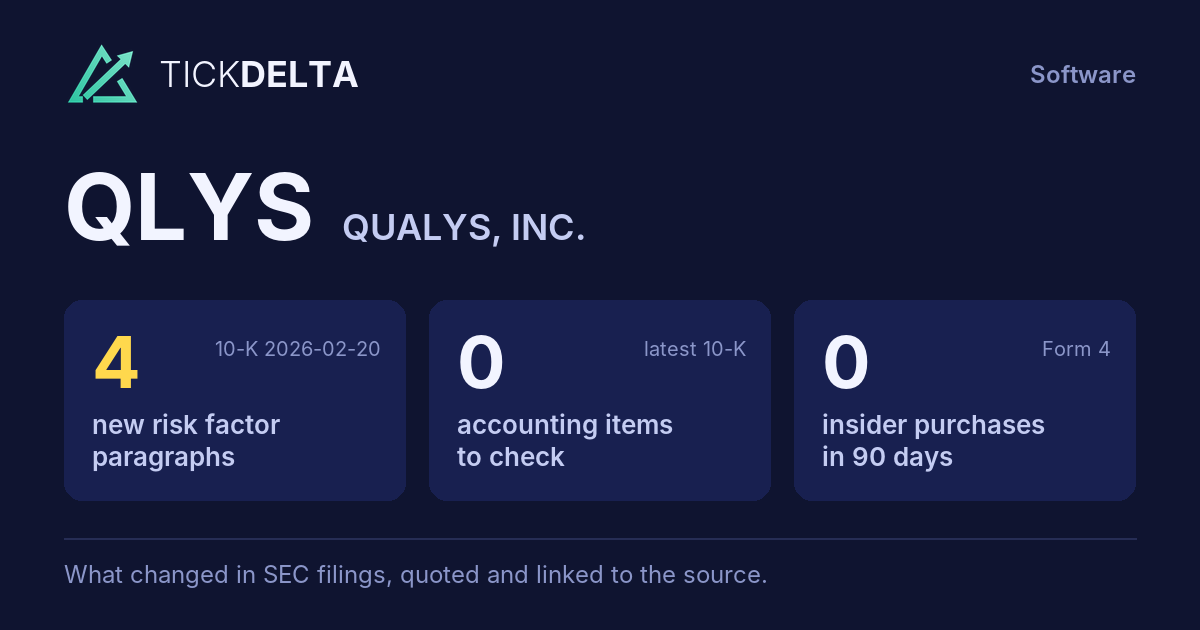
199 paragraphs · 4 new · 36 reworded · 4 gone · 10-K Feb 20, 2026 against Feb 21, 2025
New paragraph Reworded (5% of its words or more) Same or nearly
Paragraph 134 · 48% changed Every version of it
Although we monitor our use of open source software in an effort both to comply with the terms of the applicable open source licenses and to avoid subjecting our solutions to conditions we do not intend, the terms of many open source licenses have not been interpreted by U.S. courts, and there is a risk that these licenses could be construed in a way that could impose unanticipated conditions or restrictions on our ability to commercialize our solutions. In this event, we could be required to seek licenses from third parties to continue offering our solutions, to make our proprietary code generally available in source code form, to re-engineer our solutions or to discontinue the sale of our solutions if re-engineering could not be accomplished on a timely basis, any of which could adversely affect our business, operating results and financial condition.
Paragraph 91 · 48% changed Every version of it
We have continued to grow over the last several years, with revenues increasing from $489.7 $554.5 million in 2022 2023 to $607.6 $669.1 million in 2024, 2025, and headcount increasing from 1,823 2,143 employees at the beginning of 2022 2023 to 2,400 2,625 employees as of December 31, 2024. We rely on information technology systems to help manage critical functions such as order processing, revenue recognition and financial forecasts. To manage any future growth effectively we must continue to improve and expand our IT systems, financial infrastructure, and operating and administrative systems and controls, and continue to manage headcount, capital and processes in an efficient manner. We may not be able to successfully implement improvements to these systems and processes in a timely or efficient manner.
Paragraph 100 · 42% changed Every version of it
Government entities have historically been particularly concerned about adopting cloud-based solutions for their operations, including security solutions, and increasing sales of subscriptions for our solutions to government entities may be more challenging than selling to commercial organizations. Selling to government entities can be highly competitive, expensive and time-consuming, often requiring significant upfront time and expense without any assurance that we will win a sale. We Furthermore, government certification requirements applicable to our platform, including FedRAMP, may change and, in doing so, restrict our ability to sell into the governmental sector until we have invested in attained the creation of a cloud offering certified under the Federal Information Security Management Act for government usage but we cannot be sure that we will continue to sustain full or renew this certification, that the government will continue to mandate such certification or that other government agencies or entities will use this cloud offering. Government demand and payment for our solutions may be impacted by public sector budgetary cycles and funding authorizations, with funding reductions or delays adversely affecting public sector demand for our solutions. Government revised certification. Governmental entities may also have statutory, contractual or other legal rights to terminate contracts with us or our channel partners for convenience or due to a default, and any such termination may adversely impact our future results of operations. Governments routinely investigate and audit government contractors’ administrative processes, and any unfavorable audit could result in the government refusing to continue buying our solutions, a reduction of revenues or fines or civil or criminal liability if the audit uncovers improper or illegal activities. Any such penalties could adversely impact our results of operations in a material way. for other reasons.
Paragraph 127 · 30% changed Every version of it
The privacy, data protection, and cybersecurity laws and regulations we must comply with also are subject to change. For example, the United Kingdom has enacted a Data Protection Act, and has implemented legislation referred to as the “UK GDPR,” which substantially implement the GDPR in the United Kingdom following Kingdom. This legislation, which was modified in the United Kingdom’s exit from the European Union. This legislation Data (Use and Access) Bill, which received Royal Assent on June 19, 2025, provides for substantial penalties for noncompliance of up to the greater of £17.5 million or four percent of the previous year’s annual revenues. While the European Union has deemed the United Kingdom an “adequate country” "adequate country" to which personal data could be exported from the European Economic Area (“EEA”), this decision is required subject to be renewed after four years of being in effect renewal and may be modified, revoked, or challenged in the interim, challenged, creating uncertainty regarding transfers of personal data to the United Kingdom from the EEA. It remains unclear how United Kingdom data protection laws or regulations will develop in the medium to longer term and how data transfers to and from the United Kingdom will be regulated. Additionally, we have self-certified under the EU-U.S. Data Privacy Framework, the Swiss-U.S. Data Privacy Framework, and the United Kingdom extension to the EU-U.S. Data Privacy Framework, and have adopted certain standard contractual clauses approved by the European Commission (“SCCs”) as part of our data processing agreements with regard to certain transfers of personal data from the EEA to the U.S. Both the EU-U.S. Data Privacy Framework and SCCs have, however, been subject to legal challenge. In its July 16, 2020 opinion, the CJEU imposed additional obligations on companies when relying on SCCs to transfer personal data. The European Commission has published revised SCCs addressing the CJEU concerns on June 4, 2021, that are required to be implemented. The United Kingdom has adopted new standard contractual clauses (“UK SCCs”), that became effective as of March 21, 2022, and which also are required to be implemented. The EU-U.S. Data Privacy Framework, Swiss-U.S. Data Privacy Framework, United Kingdom extension to the EU-U.S. Data Privacy Framework, revised SCCs and UK SCCs, guidance and opinions of regulators, and other developments relating to cross-border data transfer may require us to implement additional contractual and technical safeguards for any personal data transferred out of Europe, which may increase compliance costs, lead to increased regulatory scrutiny or liability, and which may adversely impact our business, financial condition and operating results. We may be unsuccessful in maintaining legitimate means for our transfer and receipt of personal data from the EEA, United Kingdom, Switzerland, or other jurisdictions. We may experience reluctance or refusal by current or prospective customers in these or other jurisdictions to use our products, and we and our customers may face a risk of regulatory enforcement actions or other proceedings relating to personal data transfers to us and by us from the EEA, United Kingdom, and Switzerland. Any such proceedings could result in substantial costs and diversion of resources, distract management and technical personnel and negatively affect our business, operating results and financial condition. Some countries also are considering or have passed legislation requiring local storage and processing of data, or similar requirements, which could increase the cost and complexity of delivering our services. Further, the European Union’s Data Act (the “Data Act”) became applicable on September 12, 2025. Compliance with the Data Act may require us to adjust contract terms with customers and develop technical measures for data portability. These changes may impact the duration of customer relationships and result in additional compliance and operational costs, which may affect our business.
Paragraph 103 · 28% changed Every version of it
Government entities have historically been particularly concerned about adopting cloud-based solutions for their operations, including security solutions, and increasing sales of subscriptions for our solutions to government entities may be more challenging than selling to commercial organizations. Selling to government entities can be highly competitive, expensive and time-consuming, often requiring significant upfront time and expense without any assurance that we will win a sale. We have invested in the creation of a cloud offering certified under the Federal Information Security Management Act for government usage but we cannot be sure that we will continue to sustain or renew this certification, that the government will continue to mandate such certification or that other government agencies or entities will use this cloud offering. Government demand and payment for our solutions may be impacted by public sector budgetary cycles and funding authorizations, with funding reductions or delays adversely affecting public sector demand for our solutions. Government entities may have contractual or other legal rights to terminate contracts with our channel partners for convenience or due to a default, and any such termination may adversely impact our future results of operations. Governments routinely investigate and audit government contractors’ administrative processes, and any unfavorable audit could result in the government refusing to continue buying our solutions, a reduction of revenues or fines or civil or criminal liability if the audit uncovers improper or illegal activities. Any such penalties could adversely impact our results of operations in a material way.
Paragraph 62 · 26% changed Every version of it
Furthermore, our current and potential competitors may establish cooperative relationships among themselves or with third parties that may further enhance their resources and product and services offerings in the markets we address. In addition, current or potential competitors may be acquired by third parties with greater available resources. As a result of such relationships and acquisitions, our current or potential competitors might be able to adapt more quickly to new technologies and customer needs, devote greater resources to the promotion or sale of their products and services, initiate or withstand substantial price competition, take advantage of other opportunities more readily or develop and expand their product and service offerings more quickly than we do. For all of these reasons, we may not be able to compete successfully against our current or future competitors.
Paragraph 176 · 26% changed Every version of it
In addition, as of December 31, 2024, 2025, there were approximately 1.3 1.2 million options and 1.1 million restricted stock units outstanding. If such options are exercised and restricted stock units are released, these additional shares will become available for sale. As of December 31, 2024, 2025, we had an aggregate of 2.3 1.7 million shares of our common stock reserved for future issuance under our Restated 2012 Equity Incentive Plan and 0.4 million shares reserved for future purchase under our 2021 Employee Stock Purchase Plan, which can be freely sold in the public market upon issuance. If a large number of these shares are sold in the public market, the sales could reduce the trading price of our common stock.
Paragraph 61 · 22% changed Every version of it
Furthermore, our current and potential competitors may establish cooperative relationships among themselves or with third parties that may further enhance their resources and product and services offerings in the markets we address. In addition, current or potential competitors may be acquired by third parties with greater available resources. As a result of such relationships and acquisitions, our current or potential competitors might be able to adapt more quickly to new technologies and customer needs, devote greater resources to the promotion or sale of their products and services, initiate or withstand substantial price competition, take advantage of other opportunities more readily or develop and expand their product and service offerings more quickly than we do. For all of these reasons, we may not be able to compete successfully against our current or future competitors.

MD&A

64 paragraphs · 1 new · 19 reworded · 1 gone · 10-K Feb 20, 2026 against Feb 21, 2025
New paragraph Reworded (5% of its words or more) Same or nearly
Paragraph 32 · 42% changed
Income tax provision increased by $9.1 $12.4 million in 2024 2025 compared to 2023, 2024, primarily due to the tax effect of an increase a decrease in pretax income, increase in foreign withholding taxes, the benefit from FDII deduction as a result of the enactment of the OBBBA, along with a decrease in excess tax benefit benefits from stock-based compensation and a decrease in tax benefits from other discrete adjustments compared to the prior year, and decrease in other discrete tax adjustments. The increase in tax expense was partially offset by an increase in foreign derived intangible income benefit, an increase in research and development tax credits, and the recognition of an income tax benefit related to uncertain tax positions due to statute lapse. year.
Paragraph 52 · 37% changed
In 2024, we used $59.1 million of cash for purchases of marketable securities net of sales and maturities, and used $12.3 million of cash in capital expenditures mainly related to computer equipment to support our growth and development and leasehold improvement for expansion of our office spaces and shared cloud platform facilities, as compared to the use of $64.4 million of cash for purchases of marketable securities net of sales and maturities, and the use of $8.8 million of cash facilities in capital expenditures mainly related to computer equipment to support our growth and development in 2023. 2024.
Paragraph 30 · 33% changed
Total other income, net increased by $7.0 $2.3 million in 2024 2025 compared to 2023, 2024, primarily due to an increase favorable changes in foreign currency of $2.8 million, partially offset by a decrease in interest income of $8.9 million driven by an increase in our average daily cash and investment balance, a non-recurring unrealized loss of $0.5 million on a non-marketable equity security recognized during 2023, partially offset by an increase in foreign currency loss of $2.4 million.
Paragraph 24 · 31% changed
Cost of revenues Research and development expenses increased by $4.0 $5.4 million in 2024 2025 compared to 2023, 2024, primarily due to an increase in shared cloud platform cost personnel costs of $6.0 million, an increase in personnel costs, including stock-based compensation, of $4.6 $4.4 million, driven by additional employees hired to support the growth of our business, business and an increase in license expenses incentive compensation, an increase in overhead allocations of $1.8 million, and professional service expenses an increase in shared cloud platform costs of $1.2 $1.0 million, partially offset by a decrease in depreciation stock-based compensation of $1.1 million driven by lower average grant-date fair value and amortization geographic mix, and a decrease in professional service expense of $7.8 million resulting from certain of our assets becoming fully depreciated or amortized. $0.7 million.
Paragraph 28 · 29% changed
Research General and development administrative expenses increased by $1.4 $2.9 million in 2024 2025 compared to 2023, 2024, primarily due to an increase in personnel costs, including stock-based compensation, of $2.8 $4.1 million, driven by increased headcount, an increase in headcount and higher incentive compensation due to higher achievement rates compared to 2024, and an increase in license expenses of $0.9 million, partially offset by a decrease in depreciation and amortization expense in property and equipment of $0.8 million, and a decrease an increase in overhead allocation allocations to other expense categories of $0.6 $2.1 million.
Paragraph 26 · 29% changed
Sales and marketing expenses increased by $16.6 $15.2 million in 2024 2025 compared to 2023, 2024, primarily due to an increase in personnel costs, including stock-based compensation, costs of $12.9 $8.8 million, driven by increased headcount, an increase in travel headcount and entertainment cost of $1.8 million, higher sales commissions and incentive compensation, an increase in marketing expenses of $4.2 million, primarily related to trade shows of $0.7 million, digital advertising, sales event and sponsorship, an increase in overhead allocation travel expenses of $0.7 $1.5 million, and an increase in subscribed license and software costs overhead allocations of $0.5 $0.7 million.
Paragraph 62 · 28% changed
Significant assumptions, judgments and estimates are involved in determining our provision for (benefit from) income taxes, our deferred tax assets and liabilities, and any valuation allowance to be recorded against our deferred tax assets. Our judgments, assumptions and estimates relating to the current provision for income taxes include the geographic mix and amount of income (loss), expectations of future income, our interpretation of current tax laws, our business, and possible outcomes of current and future audits conducted by foreign and domestic tax authorities. Our judgments also include anticipating the tax positions we will record in the financial statements before preparing and filing the tax returns. Our estimates and assumptions may differ from the actual results as reflected in our income tax returns and we record the required adjustments when they are identified or resolved. Changes in our business and tax laws or our interpretation of those, and developments in current and future tax audits, could significantly impact the amounts provided for income taxes in our results of operations, financial position, or cash flows.
Paragraph 61 · 25% changed
Significant assumptions, judgments and estimates are involved in determining our provision for (benefit from) income taxes, our deferred tax assets and liabilities, and any valuation allowance to be recorded against our deferred tax assets. Our judgments, assumptions and estimates relating to the current provision for income taxes include the geographic mix and amount of income (loss), expectations of future income, our interpretation of current tax laws, our business, and possible outcomes of current and future audits conducted by foreign and domestic tax authorities. Our judgments also include anticipating the tax positions we will record in the financial statements before preparing and filing the tax returns. Our estimates and assumptions may differ from the actual results as reflected in our income tax returns and we record the required adjustments when they are identified or resolved. Changes in our business and tax laws or our interpretation of those, and developments in current and future tax audits, could significantly impact the amounts provided for income taxes in our results of operations, financial position, or cash flows.

A paragraph is matched with the one last year that shares the most of its words; under half in common makes it new. The paragraphs shown are the 8 reworded the most in each section.

The paragraph that changed most in each section

The redline

Marked against last year's 10-K: cut words struck through, new words highlighted.

Risk Factors315 words changed in this paragraph; it is 66% similar to last year's version.
The privacy, data protection, and cybersecurity laws and regulations we must comply with also are subject to change. For example, the United Kingdom has enacted a Data Protection Act, and has implemented legislation referred to as the “UK GDPR,” which substantially implement the GDPR in the United Kingdom following Kingdom. This legislation, which was modified in the United Kingdom’s exit from the European Union. This legislation Data (Use and Access) Bill, which received Royal Assent on June 19, 2025, provides for substantial penalties for noncompliance of up to the greater of £17.5 million or four percent of the previous year’s annual revenues. While the European Union has deemed the United Kingdom an “adequate country” "adequate country" to which personal data could be exported from the European Economic Area (“EEA”), this decision is required subject to be renewed after four years of being in effect renewal and may be modified, revoked, or challenged in the interim, challenged, creating uncertainty regarding transfers of personal data to the United Kingdom from the EEA. It remains unclear how United Kingdom data protection laws or regulations will develop in the medium to longer term and how data transfers to and from the United Kingdom will be regulated. Additionally, we have self-certified under the EU-U.S. Data Privacy Framework, the Swiss-U.S. Data Privacy Framework, and the United Kingdom extension to the EU-U.S. Data Privacy Framework, and have adopted certain standard contractual clauses approved by the European Commission (“SCCs”) as part of our data processing agreements with regard to certain transfers of personal data from the EEA to the U.S. Both the EU-U.S. Data Privacy Framework and SCCs have, however, been subject to legal challenge. In its July 16, 2020 opinion, the CJEU imposed additional obligations on companies when relying on SCCs to transfer personal data. The European Commission has published revised SCCs addressing the CJEU concerns on June 4, 2021, that are required to be implemented. The United Kingdom has adopted new standard contractual clauses (“UK SCCs”), that became effective as of March 21, 2022, and which also are required to be implemented. The EU-U.S. Data Privacy Framework, Swiss-U.S. Data Privacy Framework, United Kingdom extension to the EU-U.S. Data Privacy Framework, revised SCCs and UK SCCs, guidance and opinions of regulators, and other developments relating to cross-border data transfer may require us to implement additional contractual and technical safeguards for any personal data transferred out of Europe, which may increase compliance costs, lead to increased regulatory scrutiny or liability, and which may adversely impact our business, financial condition and operating results. We may be unsuccessful in maintaining legitimate means for our transfer and receipt of personal data from the EEA, United Kingdom, Switzerland, or other jurisdictions. We may experience reluctance or refusal by current or prospective customers in these or other jurisdictions to use our products, and we and our customers may face a risk of regulatory enforcement actions or other proceedings relating to personal data transfers to us and by us from the EEA, United Kingdom, and Switzerland. Any such proceedings could result in substantial costs and diversion of resources, distract management and technical personnel and negatively affect our business, operating results and financial condition. Some countries also are considering or have passed legislation requiring local storage and processing of data, or similar requirements, which could increase the cost and complexity of delivering our services. Further, the European Union’s Data Act (the “Data Act”) became applicable on September 12, 2025. Compliance with the Data Act may require us to adjust contract terms with customers and develop technical measures for data portability. These changes may impact the duration of customer relationships and result in additional compliance and operational costs, which may affect our business.

Source: Item 1A, 10-K 0001107843-26-000008 vs Item 1A, 10-K 0001107843-25-000009

MD&A146 words changed in this paragraph; it is 56% similar to last year's version.
In 2025, we generated $296.0 million of cash from our net income, as adjusted for non-cash items mainly related to stock-based compensation expense, depreciation and amortization expense and deferred taxes, as compared to $243.9 million in 2024. In addition, we also generated $13.4 million of cash from working capital change in 2025, of which $14.0 million was related to the net favorable change in accounts receivable and deferred revenue due to the growth in billings and collections, partially offset by an $0.6 million net unfavorable change in prepaid expenses and payables and accrued liabilities due to the timing of payments. In 2024, we generated $243.9 million of cash from our net income, as adjusted for non-cash items mainly related to stock-based compensation expense, depreciation and amortization expense and deferred taxes. In addition, we also generated $0.2 million of cash from working capital change in 2024, of which $11.7 million was related to the increases in accounts receivable and deferred revenue due to the timing of collections and growth in billings, a $3.2 million increase in payables and accrued liabilities driven by the timing of payment, partially offset by a $14.7 million increase in prepaid expenses. In 2023, we generated $226.4 million of cash from our net income, as adjusted for non-cash items mainly related to stock-based compensation expense, depreciation and amortization expense and deferred taxes. In addition, we also generated $18.2 million of cash from working capital change in 2023, of which $22.7 million was related to the net increase in deferred revenue and accounts receivable due to the growth in billing and the timing of collections, partially offset by a $1.1 million decrease in payables and accrued liabilities and a $3.4 million increase in prepaid expenses primarily driven by the timing of payments.

Source: Item 7, 10-K 0001107843-26-000008 vs Item 7, 10-K 0001107843-25-000009

Accounting Policies107 words changed in this paragraph; it is 72% similar to last year's version.
The Company provides for the effect of income taxes in its consolidated financial statements using the asset and liability method which requires the recognition of deferred tax assets and liabilities for the expected future tax consequences of events that have been included in the consolidated financial statements. Under this method, deferred tax assets and liabilities are recognized for the future tax consequences attributable to differences between the financial statement carrying amounts of existing assets and liabilities and their respective tax bases, net operating loss carryovers, and tax credit carry forwards. The Company regularly reviews its deferred tax assets for recoverability and establishes a valuation allowance if it is more likely than not that some portion or all of the deferred tax assets will not be realized. To make this assessment, the Company takes into account predictions of the amount and category of taxable income from various sources and all available positive and negative evidence about these possible sources of taxable income. The weight given to the potential effect of negative and positive evidence is commensurate with the extent to which the strength of the evidence can be objectively verified. Deferred tax assets and liabilities are measured using enacted tax rates expected to apply to taxable income in the years in which those temporary differences are expected to be recovered or settled. The effect on deferred tax assets and liabilities of a change in tax rates is recognized in the period that includes the enactment date.

Source: Item 8, Note 1 – The Company and Summary of Significant Accounting Policies, 10-K 0001107843-26-000008 vs Item 8, Note 1 – The Company and Summary of Significant Accounting Policies, 10-K 0001107843-25-000009

Legal Proceedings25 words changed in this paragraph; it is 89% similar to last year's version.
From time to time the Company may become involved in legal proceedings or be subject to claims arising in the ordinary course of the Company's business. The Company records a provision for a liability when it is both probable that a liability has been incurred and the amount can be reasonably estimated. Legal expenses related to such matters are expensed as incurred. The Company provides disclosure if it is reasonably possible that a loss has been incurred and a range of loss or possible loss can be reasonably estimated. Significant judgment is required to determine both probability and the estimated amount. The Company reviews these provisions at least quarterly and adjust these provisions to reflect the impact of negotiations, settlements, rulings, advice of legal counsel, and updated information.

Source: Item 3, via Note 8 – Commitment and Contingencies, 10-K 0001107843-26-000008 vs Item 3, via Note 9 – Commitment and Contingencies, 10-K 0001107843-25-000009

Sentences and paragraphs added, removed or reworded

Every change, by type

Sentences and paragraphs of QLYS's Risk Factors and MD&A, 10-K Feb 20, 2026 against 10-K Feb 21, 2025. Each links to the text at sec.gov.

Quiet changes are sentences kept from last year with one to four words changed, at least one of them a hedge, a modal or a qualifier (may, could, will, not, significant, material…). A year or date rolling forward is not counted.

The full word list

adverse, adversely, all, although, anticipate, anticipates, any, approximately, believe, believes, can, cannot, certain, could, expect, expects, generally, however, if, intend, intends, largely, likely, many, material, materially, may, might, most, must, never, no, not, possible, primarily, probable, should, significant, significantly, some, substantial, substantially, unlikely, will, would

AddedRisk Factors
productive sales personnel, sales of our solutions and the growth of our business may be harmed. Additionally, if our efforts do not result in increased revenues, our operating results could be negatively impacted due to the upfront operating expenses associated with expanding our sales force.
Read it in 10-K Feb 20, 2026 at sec.gov
AddedRisk Factors
We have invested in the creation of a cloud offering certified under the Federal Information Security Management Act for government usage but we cannot be sure that we will continue to sustain or renew this certification, that the government will continue to mandate such certification or that other government agencies or entities will use this cloud offering. We have obtained authorization under FedRAMP, which facilitates our entry into the U.S. federal government market. Such certification is subject to rigorous compliance and if we lose our certification, it could inhibit or preclude our ability to contract with certain U.S. federal government customers. In addition, some customers may rely on our authorization under FedRAMP to help satisfy their own legal and regulatory compliance requirements and our failure to maintain FedRAMP authorization might result in a breach under public
Read it in 10-K Feb 20, 2026 at sec.gov
AddedRisk Factors
sector contracts obtained on the basis of such authorization. This could subject us to liability, result in reputational harm, and adversely impact our financial condition or operating results.
Read it in 10-K Feb 20, 2026 at sec.gov
RemovedRisk Factors
We offer our cloud platform and integrated suite of solutions pursuant to a software-as-a-service model, and our customers purchase subscriptions from us that are generally one year in length. Our customers have no obligation to renew their subscriptions
Read it in 10-K Feb 21, 2025 at sec.gov
RemovedRisk Factors
A breach in or incident impacting our data security, an attack against our service availability, or any breach, incident, or attack impacting our third-party service providers, or a technical error or outage, could impact our networks or networks secured by our solutions, creating system disruptions or slowdowns and exploiting security vulnerabilities of our solutions, and the information stored on our networks or those of our third-party service providers could be accessed, used, disclosed publicly or to
Read it in 10-K Feb 21, 2025 at sec.gov
RemovedRisk Factors
onerous for businesses. Governments may also adopt new laws or regulations, or make changes to existing laws or regulations, which could impact the demand for or value of our solutions.
Read it in 10-K Feb 21, 2025 at sec.gov
RemovedRisk Factors
Our solutions are subject to U.S. export controls, specifically, the Export Administration Regulations and economic sanctions enforced by the Office of Foreign Assets Control. We incorporate encryption technology into certain of our solutions. These encryption solutions and the underlying technology may be exported only with the required export authorizations, including by
Read it in 10-K Feb 21, 2025 at sec.gov
Show the other 28
RewordedRisk Factors
As a result of such relationships and acquisitions, our current or potential competitors might be able to adapt more quickly to new technologies and customer needs, devote greater resources to the promotion or sale of their products and services, initiate or withstand substantial price competition, take advantage of other opportunities more readily or develop and expand their product and service offerings more quickly than we do.
Read it in 10-K Feb 20, 2026 at sec.gov
RewordedRisk Factors
As of December 31, 2024, 2025, we had an aggregate of 2.3 1.7 million shares of our common stock reserved for future issuance under our Restated 2012 Equity Incentive Plan and 0.4 million shares reserved for future purchase under our 2021 Employee Stock Purchase Plan, which can be freely sold in the public market upon issuance.
Read it in 10-K Feb 20, 2026 at sec.gov
RewordedRisk Factors
Although we monitor our use of open source software in an effort both to comply with the terms of the applicable open source licenses and to avoid subjecting our solutions to conditions we do not intend, the terms of many open source licenses have not been interpreted by U.S. courts, and there is a risk that these licenses could be construed in a way that could impose unanticipated conditions or restrictions on our ability to commercialize our solutions.
Read it in 10-K Feb 20, 2026 at sec.gov
RewordedRisk Factors
Government Governmental entities may also have statutory, contractual or other legal rights to terminate contracts with us or our channel partners for convenience or due to a default, and any such termination may adversely impact our future results of operations. for other reasons.
Read it in 10-K Feb 20, 2026 at sec.gov
RewordedRisk Factors
If an actual or perceived disruption in the availability of our solutions or the breach or other compromise of our security measures or those of our service providers occurs, it could adversely affect the market perception of our solutions, result in a loss of competitive advantage, have a negative impact on our reputation, or result in the loss of customers, channel partners and sales, and it may expose us to the loss, unavailability or alteration of information, claims, demands and litigation, regulatory investigations, actions and other proceedings proceedings, possible liability, and possible liability. the potential loss of our authorization under the Federal Risk and Authorization Management Program (“FedRAMP”).
Read it in 10-K Feb 20, 2026 at sec.gov
RewordedRisk Factors
While the European Union has deemed the United Kingdom an “adequate country” "adequate country" to which personal data could be exported from the European Economic Area (“EEA”), this decision is required subject to be renewed after four years of being in effect renewal and may be modified, revoked, or challenged in the interim, challenged, creating uncertainty regarding transfers of personal data to the United Kingdom from the EEA.
Read it in 10-K Feb 20, 2026 at sec.gov
RewordedRisk Factors
This legislation legislation, which was modified in the Data (Use and Access) Bill, which received Royal Assent on June 19, 2025, provides for substantial penalties for noncompliance of up to the greater of £17.5 million or four percent of the previous year’s annual revenues.
Read it in 10-K Feb 20, 2026 at sec.gov
RewordedRisk Factors
Finally, our net share repurchases in 2023 and 2024 were are subject to the 1% excise tax introduced in the Inflation Reduction Act. Act, which could increase the cost to us of share repurchases.
Read it in 10-K Feb 20, 2026 at sec.gov
RewordedRisk Factors
We have continued to grow over the last several years, with revenues increasing from $489.7 $554.5 million in 2022 2023 to $607.6 $669.1 million in 2024, 2025, and headcount increasing from 1,823 2,143 employees at the beginning of 2022 2023 to 2,400 2,625 employees as of December 31, 2024.
Read it in 10-K Feb 20, 2026 at sec.gov
RewordedRisk Factors
Although we maintain insurance coverage that may be applicable to certain liabilities in the event of a security breach or other security incident, connection with these matters, we cannot be certain that our insurance coverage will be adequate for liabilities that actually are incurred, that insurance will continue to be available to us on economically reasonable terms, or at all, or that any insurer will not deny coverage as to any future claim.
Read it in 10-K Feb 20, 2026 at sec.gov
RewordedRisk Factors
Any inability to adequately address concerns relating to privacy, data protection, or cybersecurity, even if unfounded, or any actual or perceived inability to comply with applicable privacy laws, regulations, standards, or data protection laws, regulations and privacy standards other obligations relating to these matters, could result in cost and liability to us, damage our reputation, inhibit sales of subscriptions and harm our business.
Read it in 10-K Feb 20, 2026 at sec.gov
Quiet changesRisk Factors
Our success significantly depends to a significant extent on establishing and maintaining relationships with a variety of channel partners and we anticipate that we will continue to depend on these partners in order to grow our business.
Read it in 10-K Feb 20, 2026 at sec.gov
Quiet changesRisk Factors
Many countries have enacted legislation to apply the Pillar Two directive for tax years beginning in January 2024, which generally provides for a minimum effective tax rate of 15% on the income arising in each jurisdiction certain jurisdictions where the Company operates.
Read it in 10-K Feb 20, 2026 at sec.gov
AddedMD&A
On July 4, 2025, the One Big Beautiful Bill Act (OBBBA) was signed into law. The OBBBA permanently extends and modifies certain domestic and international provisions from the 2017 TCJA and phases out certain provisions from the 2022 Inflation Reduction Act. Beginning in 2025, the OBBBA provides an elective deduction for domestic research and development expenses and a reinstatement of elective 100% first-year bonus depreciation. Some international provisions of the OBBBA will not be effective until 2026 and forward. We have recognized the effects of the OBBBA provisions in our financial results to the extent they are applicable to the year ended December 31, 2025. We will continue to monitor the impact of the OBBBA and the range of potential outcomes, which will depend on facts in each year and anticipated guidance from the U.S. Department of the Treasury.
Read it in 10-K Feb 20, 2026 at sec.gov
RemovedMD&A
For the year ended December 31, 2024, our income tax provision included a benefit of $2.5 million related to an increase in foreign derived intangible income benefit and research and development tax credits associated with our U.S. income tax return filed during the year.
Read it in 10-K Feb 21, 2025 at sec.gov
RewordedMD&A
In 2024, 2025, we used $183.4 million of cash for share repurchases and $25.0 million of cash in payment of employee withholding taxes upon vesting of restricted stock units, partially offset by $16.3 million of proceeds from employee exercise of stock options and $6.8 million of proceeds from issuance of common stock through our employee stock purchase plan (ESPP), as compared to $139.9 million of cash for share repurchases repurchase and $28.4 million of cash in payment of employee withholding taxes upon vesting of restricted stock units and $1.5 million payment of cash held in escrow as part of the Blue Hexagon acquisition on October 4, 2022, partially offset by $17.3 million of proceeds from employee exercise of stock options and $6.9 million of proceeds from issuance of common stock through our employee stock purchase plan ("ESPP"), as compared to $170.8 million of cash for share repurchase and $22.3 million of cash in payment of employee withholding taxes upon vesting of restricted stock units, partially offset by $45.6 million of proceeds from employee exercise of stock options and $6.1 million of proceeds from issuance of common stock through our ESPP in 2023. 2024.
Read it in 10-K Feb 20, 2026 at sec.gov
RewordedMD&A
Cost of revenues Research and development expenses increased by $4.0 $5.4 million in 2024 2025 compared to 2023, 2024, primarily due to an increase in shared cloud platform cost personnel costs of $6.0 million, an increase in personnel costs, including stock-based compensation, of $4.6 $4.4 million, driven by additional employees hired to support the growth of our business, business and an increase in license expenses incentive compensation, an increase in overhead allocations of $1.8 million, and professional service expenses an increase in shared cloud platform costs of $1.2 $1.0 million, partially offset by a decrease in depreciation stock-based compensation of $1.1 million driven by lower average grant-date fair value and amortization geographic mix, and a decrease in professional service expense of $7.8 million resulting from certain of our assets becoming fully depreciated or amortized. $0.7 million.
Read it in 10-K Feb 20, 2026 at sec.gov
RewordedMD&A
Sales and marketing expenses increased by $16.6 $15.2 million in 2024 2025 compared to 2023, 2024, primarily due to an increase in personnel costs, including stock-based compensation, costs of $12.9 $8.8 million, driven by increased headcount, an increase in travel headcount and entertainment cost of $1.8 million, higher sales commissions and incentive compensation, an increase in marketing expenses of $4.2 million, primarily related to trade shows of $0.7 million, digital advertising, sales event and sponsorship, an increase in overhead allocation travel expenses of $0.7 $1.5 million, and an increase in subscribed license and software costs overhead allocations of $0.5 $0.7 million.
Read it in 10-K Feb 20, 2026 at sec.gov
RewordedMD&A
Income tax provision increased by $9.1 $12.4 million in 2024 2025 compared to 2023, 2024, primarily due to the tax effect of an increase a decrease in pretax income, increase in foreign withholding taxes, the benefit from FDII deduction as a result of the enactment of the OBBBA, along with a decrease in excess tax benefit benefits from stock-based compensation and a decrease in tax benefits from other discrete adjustments compared to the prior year, and decrease in other discrete tax adjustments. year.
Read it in 10-K Feb 20, 2026 at sec.gov
RewordedMD&A
In addition, we also generated $18.2 $13.4 million of cash from working capital change in 2023, 2025, of which $22.7 $14.0 million was related to the net increase favorable change in accounts receivable and deferred revenue and accounts receivable due to the growth in billing billings and the timing of collections, partially offset by a $1.1 an $0.6 million decrease net unfavorable change in prepaid expenses and payables and accrued liabilities and a $3.4 million increase in prepaid expenses primarily driven by due to the timing of payments.
Read it in 10-K Feb 20, 2026 at sec.gov
RewordedMD&A
Cost of revenues increased by $4.0 $3.3 million in 2024 2025 compared to 2023, 2024, primarily due to an increase in shared cloud platform cost personnel costs of $6.0 million, an increase in personnel costs, including stock-based compensation, of $4.6 $4.7 million, driven by additional employees hired to support the growth of our business, business and an increase in incentive compensation, an increase in license expenses and professional service expenses of $1.2 $1.9 million, partially offset by a decrease in depreciation and amortization expense of $7.8 $3.3 million resulting from certain of our assets becoming fully depreciated or amortized.
Read it in 10-K Feb 20, 2026 at sec.gov
RewordedMD&A
In 2024, 2025, we used $59.1 $100.9 million of cash for purchases of marketable securities net of sales and maturities, and used $12.3 $5.0 million of cash in capital expenditures mainly related to computer equipment to support our growth and development and leasehold improvement for expansion of our office spaces and shared cloud platform facilities, spaces, as compared to the use of $64.4 $59.1 million of cash for purchases of marketable securities net of sales and maturities, and the use of $8.8 $12.3 million of cash in capital expenditures mainly related to computer equipment to support our growth and development in 2023.
Read it in 10-K Feb 20, 2026 at sec.gov
RewordedMD&A
In 2023, 2025, we generated $226.4 $296.0 million of cash from our net income, as adjusted for non-cash items mainly related to stock-based compensation expense, depreciation and amortization expense and deferred taxes. taxes, as compared to $243.9 million in 2024.
Read it in 10-K Feb 20, 2026 at sec.gov
RewordedMD&A
The uncertainty surrounding macroeconomic factors in the U.S. and globally characterized by inflationary pressure, high interest rates, significant volatility of global markets, reduced spending and extended sales cycles, tariff and non-tariff trade barriers, economic and regulatory uncertainty, and geopolitical conflicts could have a material adverse effect on our long-term business and could lead to further economic disruption and expose us to greater risk as our current and potential customers may reduce or eliminate their overall spending on IT security.
Read it in 10-K Feb 20, 2026 at sec.gov
RewordedMD&A
As of December 31, 2024, 2025, our principal source of liquidity was cash, cash equivalents and marketable securities of $575.3 $696.8 million, including $119.9 $155.3 million of cash held outside of the United States.
Read it in 10-K Feb 20, 2026 at sec.gov

Sources

The two latest 10-Ks on EDGAR, section by section. Each change links to the text at sec.gov.

Also

New risk factors: paragraphs with nothing like them last year, quoted in full.

Work with it

Excel workbook · CSV. Google Sheet that stays up to date: paste =IMPORTDATA("https://tickdelta.com/company/QLYS/export.csv") into a cell.

Next:Related parties
Esc

Type a ticker such as AAPL, a name, an investor such as Buffett, or a topic such as tariffs. ↑ ↓ to move, Enter to open.