Screener / SEC EDGAR /CIK 0001811414 /10-K filed Feb 25, 2026, compared with Feb 26, 2025 /Numbers from the XBRL of the 10-Ks
Nasdaq Technology · Miscellaneous Electrical Machinery, Equipment & Supplies

QuantumScape Corp QS

Compare with peers Embed
The 10-K against last year's

133 changes: 13 added, 5 removed, 114 reworded, 1 quiet changes

10-K Feb 25, 2026 vs Feb 26, 2025

10-K 0001193125-26-071556 (Feb 25, 2026) vs 10-K 0000950170-25-027308 (Feb 26, 2025)

Every paragraph, and how much of it changed

One bar per paragraph, in the order of the 10-K. Height and colour show the share of its words not in the closest paragraph a year earlier; the tallest bars are new paragraphs.

Risk Factors

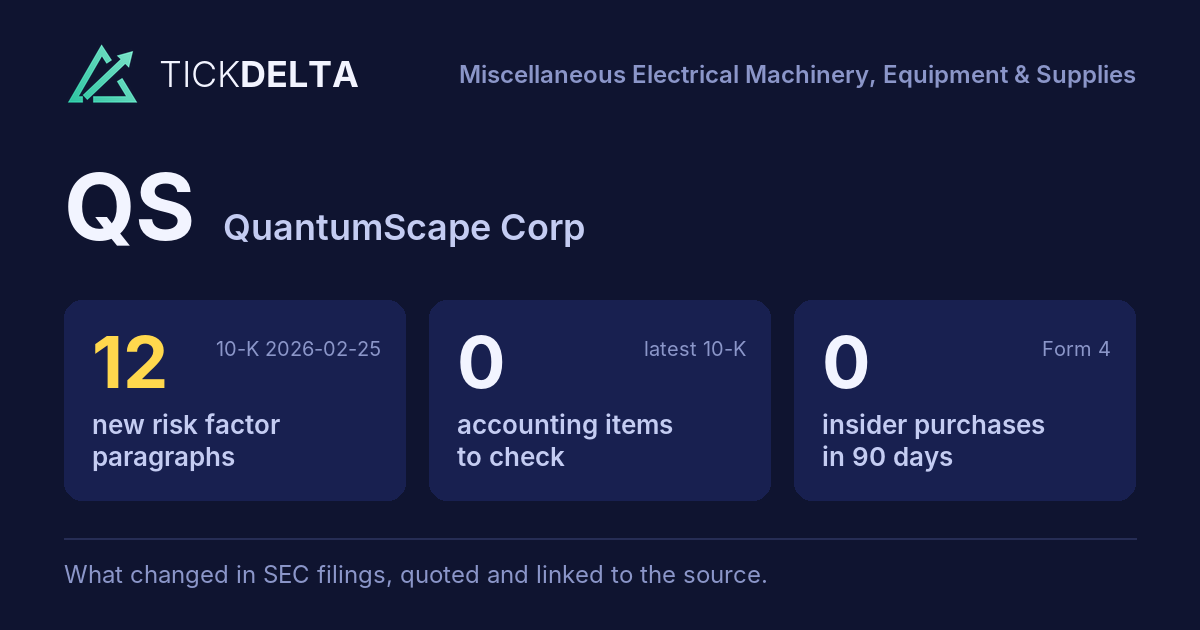
246 paragraphs · 12 new · 91 reworded · 2 gone · 10-K Feb 25, 2026 against Feb 26, 2025
New paragraph Reworded (5% of its words or more) Same or nearly
Paragraph 38 · 49% changed Every version of it
Furthermore, we and our partners must also adapt these production processes to meet customer requirements and specifications. We will need to overcome production challenges to produce sufficient volumes of our separators and prototype battery cells to complete development of our first commercial product and for customer evaluation and product qualification purposes, as well as subsequent cell designs that may require different capacity, layer counts counts, or dimensions. We have not yet validated a manufacturing process or acquired the equipment necessary to produce higher volumes of As we advance our separator, cathode electrode or related cell assembly components that meet customer requirements. We licensing business model, our partners will similarly face significant production, scaling, and adaptation risks and will need to produce these cells at improved yields without compromising performance, achieve the same or additional advancements in production processes as they take our pilot line and simultaneously solve related packaging adapt them to their own facilities for higher volume production, otherwise our partnerships and reliability challenges in a way that is scalable and low-cost. There are significant engineering and mechanical challenges that we must overcome to advance the scale up of our battery cells. In addition, we have been designing and procuring certain equipment to continue developing the manufacturing processes necessary to make these battery cells at higher volumes. If we are not able to overcome these developmental hurdles in building our cells, our business is likely to fail. will be adversely affected.
Paragraph 73 · 48% changed Every version of it
If the milestones under the PowerCo Collaboration Agreement are met and the PowerCo IP License Agreement is entered into, As we develop our business ecosystem, we will increasingly become reliant on PowerCo partners and customers to scale up and commercialize our technology, preserve the value of our license, technology and will be exposed to risks related to PowerCo’s financial our partners and business conditions. customers.
Paragraph 220 · 46% changed Every version of it
In addition, the The Inflation Reduction Act of 2022 (the “IRA”) includes included numerous incentives and tax credits aimed at reducing the effects of climate change, such as the extension and expansion of EV charging infrastructure tax credits under Section 30C of the Internal Revenue Code of 1986 (the “Code”), the expansion of tax credits for EVs under Section 30D of the Code, the expansion of advanced manufacturing facility tax credits under Section 48C of the Code, and enactment of advanced manufacturing production credits for eligible component production in the United States under Section 45X of the Code. Such tax credits may potentially benefit incumbents more than new entrants, and consequently have adverse competitive effects for new entrants. However, several of these provisions were modified by the full impact of the IRA cannot be known, and many of the IRA’s provisions are not self-executing and require further guidance from the Internal Revenue Service (the “IRS”) and Treasury Department (the “Treasury”), which we expect to be issued in the coming months and years. On May 6, 2024, the Treasury and the IRS, in conjunction with the Department of Energy, released final regulations that contain guidance regarding the “battery component” and “critical mineral” sourcing requirements that must be met to be eligible to claim the Section 30D credit, including that at least 50% (for EVs placed in service in 2024) of the value of certain critical minerals in an EV’s battery are extracted and processed in the U.S. or a trade partner country, increasing by 10% per year through 2027 to 80% for EVs placed in service in 2027 and later years, and at least 60% of the value of the battery components in an EV’s battery are manufactured or assembled in North America, increasing by 10% per year through 2027 and to 100% for EVs placed in service in 2028 and later years. OBBBA. The final regulations also provide that an EV is not eligible for the Section 30D credit if any of its battery components or applicable critical minerals are supplied by a “foreign entity of concern,” such as Russia or China, regardless of its overall value percentage. terminated on September 30, 2025, and the Section 30C credit will terminate on July 30, 2026.
Paragraph 76 · 43% changed Every version of it
It is difficult to predict our future revenues and appropriately budget for our expenses, and we may have limited insight into trends that may emerge and affect our business. or our partners’ businesses. We anticipate being required to provide demand forecasts of our demand or adoption projections to our current and future suppliers prior prospective licensees to the scheduled delivery of products to potential customers. support their production planning and supply chain coordination. Currently, there is no historical basis for making judgments on the demand for batteries utilizing our batteries technology or for assessing our ability to develop, manufacture, successfully license, support, and deliver batteries, or scale our profitability technology through third-party manufacturing partners. Our future revenue will also depend on the timing and prioritization of commercialization and industrialization activities by our customers, which are subject to their internal strategies, resource allocation, and market conditions. As these decisions are entirely within our customers’ control and may shift over time, they introduce additional uncertainty into our revenue forecasting and further contribute to the difficulty in predicting the future. pace and magnitude of our commercial growth. If we overestimate potential demand our requirements, licensees may invest in excess manufacturing capacity or materials, indirectly increasing costs or lowering margins for them, which could negatively impact our suppliers may have excess inventory, which indirectly would increase our costs. long-term commercial relationships and revenue. If we underestimate our requirements, our suppliers licensees may have inadequate inventory, face inventory shortages or production delays, which could interrupt manufacturing impact their ability to meet end-customer expectations, delay milestone or royalty payments to us, and damage the perceived reliability of our products and result in delays in shipments and revenues. technology. In addition, lead times for materials and components that our partners and suppliers order may vary significantly and depend on factors such as the specific supplier, contract terms terms, geopolitical conditions, and macroeconomic demand for each component at a given time. If we fail our partners are unable to order sufficient quantities of product source critical components in a timely manner, or if they choose to delay their commercialization efforts for any reason, the delivery of batteries to commercialization timeline for our potential customers technology could be delayed, which would harm our business, financial condition and operating results.
Paragraph 37 · 41% changed Every version of it
We will need In addition, we must continue to advance our current production processes to include more automation, such as automated film handling, and use higher volume equipment and processes, such as higher throughput equipment. There are significant engineering and mechanical challenges that we must overcome production challenges to produce sufficient volumes advance the scale up of our battery cells, including shortening cycle time, improving process control and equipment reliability, and reducing consumables (including energy usage), with the target end goal of increasing the quality, consistency, reliability and throughput of our separators and prototype battery cells to complete development of our first commercial product without compromising performance (e.g. energy density, power, cycle life, and for customer evaluation and product qualification purposes, as well as subsequent cell designs that may require different capacity, layer counts or dimensions. safety). We have not yet validated a manufacturing production process or acquired the equipment necessary to produce higher volumes of our separator, cathode electrode or related cell assembly components that meet customer requirements. We will need If we are unable to produce solve these cells at improved yields without compromising performance, and simultaneously solve related packaging and reliability challenges in a way that is scalable and low-cost. There are significant engineering and mechanical challenges that we must overcome to advance the scale up of our battery cells. In addition, we have been designing and procuring certain equipment to continue developing the manufacturing processes necessary to make these battery cells at higher volumes. If we are not able to overcome these developmental hurdles in building our cells, scalable, low-cost way, our business is likely to fail.
Paragraph 219 · 34% changed Every version of it
As we expand the scale of our business activities, any changes in the U.S. or foreign taxation of such activities may increase our worldwide effective tax rate and harm our business, results of operations, and financial condition. For example, the Organisation for Economic Co-operation and Development ("OECD") has proposed implementing changes to existing tax laws, including a proposed 15% global minimum tax. tax (“Pillar Two”). Numerous countries have enacted or are enacting tax legislation to adopt this global minimum tax. The OECD and participating jurisdictions have recently agreed to a side-by-side system that would allow U.S.-parented multinational corporations to operate under existing U.S. minimum tax rules and be exempt from certain provisions of Pillar Two for fiscal years beginning in 2024. on or after January 1, 2026. Further, beginning in 2022, under the Tax Cuts and Jobs One Big Beautiful Bill Act of 2017 eliminated the option (the “OBBBA”), we are no longer required to deduct capitalize domestic research and development experimental expenditures, but we are still required to amortize foreign research and experimental expenditures currently over 15 years. We do not believe the provisions under the OBBBA had a material impact on our financial statements. However, these changes, and requires taxpayers to capitalize and amortize them over five others in the OBBBA or fifteen years. This requirement other new legislation may impact our effective tax rate and our cash tax liability in future years.
Paragraph 191 · 30% changed Every version of it
All stock-based awards are required to be recognized based on their estimated grant date fair values. The amount recognized could vary depending on a number of assumptions or changes that may occur. We have granted stock-based awards to certain members of our management team pursuant to the EPA Program. EPA Program awards have a vesting schedule based on the attainment of both performance (e.g., business milestones) and market conditions (e.g., stock price target).
Paragraph 163 · 29% changed Every version of it
•announcements by us us, Volkswagen, or Volkswagen other partners regarding developments in our relationship with Volkswagen, or respective relationships, including changes in Volkswagen’s investment in us;

MD&A

65 paragraphs · 1 new · 28 reworded · 3 gone · 10-K Feb 25, 2026 against Feb 26, 2025
New paragraph Reworded (5% of its words or more) Same or nearly
Paragraph 34 · 45% changed
Other income (expense) for the year years ended December 31, 2025 and 2024 primarily consisted of other miscellaneous income. Other income and expense for the year ended December 31, 2023 primarily consisted of foreign currency exchange loss. that were not material individually or in aggregate.
Paragraph 59 · 42% changed
The fair values of options granted with performance (e.g., business milestone) and market conditions (e.g., stock price target) are estimated at the grant date using a Monte Carlo simulation model. The model determined the grant date fair value of each vesting tranche and the future time when the market condition for such tranche is expected to be achieved. The Monte Carlo valuation requires the Company to make assumptions and judgements about the variables used in the calculation including the expected term, volatility of our common stock, an assumed risk-free interest rate, and cost of equity.
Paragraph 32 · 37% changed
The increase decrease in general and administrative expenses in the year ended December 31, 2024 2025 compared to the year ended December 31, 2023 2024 primarily resulted from the due to a net $24.5 million litigation settlement for charged in the Securities Class Action Litigation described in Note 7, Commitments and Contingencies, to year December 31, 2024 associated with the consolidated financial statements included elsewhere in this Report, an increase class action lawsuits that were filed beginning January 2021, a decrease of $10.3 $18.6 million in charges related to other legal matters, professional fees, outside services and office administration, and an increase of $1.6 million in personnel costs offset by a decrease of $25.3 $2.3 million in non-cash stock-based compensation expense primarily due to the net effect of forfeiture of EPA awards full amortization, forfeitures, lower headcount, and restricted stock units with changes in the estimated milestones for performance conditions offset by new restricted stock units granted subsequent to December 31, 2023. based awards.
Paragraph 31 · 33% changed
The increase decrease in research and development expense in the year ended December 31, 2024 2025 compared to the year ended December 31, 2023 2024 primarily resulted from an increase a decrease of $16.2 million in personnel cost to support our battery technology development, an increase of $15.3 million related to depreciation and amortization, an increase of $3.7 $14.8 million in non-cash stock-based compensation expense primarily due to the net effect of new restricted stock units granted offset by full amortization of awards subsequent awards, forfeitures, lower headcount, and changes in the estimated milestones for performance based awards, a decrease of $14.4 million in personnel cost primarily due to December 31, 2023 lower headcount, and forfeiture a decrease of restricted stock units with performance conditions, an increase of $3.5 $3.3 million in material supplies, offset primarily by an increase of $13.2 million in write-off of fixed assets no longer in use, including the leasehold improvements associated with the lease termination, an increase of $7.9 million related to depreciation and amortization, and an increase of $3.0 $4.1 million in facility expenses offset primarily by a decrease of $8.2 million in write-off of property and expensed equipment.
Paragraph 19 · 32% changed
Based on our current business plan, we believe that our cash resources will last into the second half of 2028. In July 2022, we filed a shelf registration statement on Form S-3 with the SEC (File No. 333-266419) (the “Form S-3”), which the SEC declared effective in August 2022, for the offer and sale of Class A Common Stock, preferred stock, depositary shares, debt securities, warrants, subscription rights, purchase contracts and units in one or more offerings and in any combination for an aggregate offering price of up to $1 billion. In February 2023, we filed a prospectus supplement to the a shelf registration statement on Form S-3 (the “Form S-3”) for the issuance and sale of our Class A Common Stock from time to time for an aggregate offering price of up to $400 million (the “ATM offering”). During the year ended December 31, 2024, 24.9 million shares of our Class A Common Stock were sold pursuant to the ATM offering for aggregate proceeds of approximately $128.5 million, net of issuance costs paid paid. During the year ended December 31, 2025, 29.5 million shares of Class A Common Stock were sold pursuant to the ATM offering for aggregate proceeds of approximately $264.2 million, net of issuance costs including the commission fees to the sales agents of approximately $2.0 million. In August 2023, we completed an underwritten public offering of 37.5 million shares of $4.0 million, completing our Class A Common Stock for an aggregate purchase price of $288.2 million, net of issuance costs of $11.8 million (the “August 2023 Public Offering”). ATM offering.
Paragraph 9 · 31% changed
We are focused on the throughput and capability of our pilot line in San Jose, California. As part of the continued expansion of our throughput we are automating our manufacturing production process and purchasing larger-scale higher throughput battery-cell manufacturing production equipment. We will need to substantially improve our battery cell manufacturing processes to increase throughput required for higher numbers of battery cells and to achieve the cost, performance and volume levels required for commercial shipments.
Paragraph 14 · 29% changed
On In July 5, 2024, we entered into the PowerCo Collaboration Agreement with the goal of PowerCo industrializing the solid-state lithium-metal battery QS technology we intend to use in our first planned product—the QSE-5 Technology. based on QSE-5. PowerCo was formed by Volkswagen in 2022 as a company intended to consolidate Volkswagen’s activities in the development and production of battery cells. In connection with the PowerCo Collaboration Agreement and subject to the completion of certain milestones, we and PowerCo intend to enter into the PowerCo IP License Agreement under which we will grant PowerCo a non-exclusive, limited, royalty-bearing license to use the QS technology based on QSE-5 Technology for the purpose of manufacturing and selling batteries primarily for automotive applications, and PowerCo will pre-pay an initial royalty fee of $130 million, against which any future royalties due will be credited. The initial royalty is subject to a time-based diminishing clawback if the PowerCo IP License Agreement is terminated early by PowerCo under certain conditions. The PowerCo In July 2025, we entered into an amendment and restatement of the Collaboration Agreement supersedes and entered into a statement of work outlining the JVA, which was terminated concurrently. As compared scope and responsibilities of the joint scale-up team working at our battery development pilot line in San Jose, California for the development, validation, demonstration, and initial commercialization of QS battery cell technology based on QSE-5 and toward the transfer of such technology into cell size determined by PowerCo (the “Project”). PowerCo has agreed to a contribute up to $130.7 million for the Project over the next two years, subject to the completion of certain milestones by the joint venture arrangement of similar output volumes, we expect the licensing arrangement to result in less revenue, as well as lower costs and capital requirements. scale-up team.
Paragraph 13 · 28% changed
We have demonstrated capabilities of our solid-state separator and battery technology in single-layer and multilayer solid-state cells in commercially relevant areas (ranging from approximately 60x75mm to 70x85mm). We will work to continue improving quality, consistency, reliability, throughput, and safety and optimize all components of the cell. We will continue to work to further develop and validate the volume manufacturing our production processes to enable higher increasing volumes of prototype shipments and, through successful technology transfer, high volume manufacturing and minimize manufacturing costs. Finally, we intend for the building out of by our pilot line to serve as the basis for continued manufacturing process development for the subsequent scale up of the manufacturing capabilities of our battery cells. licensing partners.

A paragraph is matched with the one last year that shares the most of its words; under half in common makes it new. The paragraphs shown are the 8 reworded the most in each section.

The paragraph that changed most in each section

The redline

Marked against last year's 10-K: cut words struck through, new words highlighted.

Risk Factors255 words changed in this paragraph; it is 48% similar to last year's version.
In addition, the The Inflation Reduction Act of 2022 (the “IRA”) includes included numerous incentives and tax credits aimed at reducing the effects of climate change, such as the extension and expansion of EV charging infrastructure tax credits under Section 30C of the Internal Revenue Code of 1986 (the “Code”), the expansion of tax credits for EVs under Section 30D of the Code, the expansion of advanced manufacturing facility tax credits under Section 48C of the Code, and enactment of advanced manufacturing production credits for eligible component production in the United States under Section 45X of the Code. Such tax credits may potentially benefit incumbents more than new entrants, and consequently have adverse competitive effects for new entrants. However, several of these provisions were modified by the full impact of the IRA cannot be known, and many of the IRA’s provisions are not self-executing and require further guidance from the Internal Revenue Service (the “IRS”) and Treasury Department (the “Treasury”), which we expect to be issued in the coming months and years. On May 6, 2024, the Treasury and the IRS, in conjunction with the Department of Energy, released final regulations that contain guidance regarding the “battery component” and “critical mineral” sourcing requirements that must be met to be eligible to claim the Section 30D credit, including that at least 50% (for EVs placed in service in 2024) of the value of certain critical minerals in an EV’s battery are extracted and processed in the U.S. or a trade partner country, increasing by 10% per year through 2027 to 80% for EVs placed in service in 2027 and later years, and at least 60% of the value of the battery components in an EV’s battery are manufactured or assembled in North America, increasing by 10% per year through 2027 and to 100% for EVs placed in service in 2028 and later years. OBBBA. The final regulations also provide that an EV is not eligible for the Section 30D credit if any of its battery components or applicable critical minerals are supplied by a “foreign entity of concern,” such as Russia or China, regardless of its overall value percentage. terminated on September 30, 2025, and the Section 30C credit will terminate on July 30, 2026.

Source: Item 1A, 10-K 0001193125-26-071556 vs Item 1A, 10-K 0000950170-25-027308

MD&A158 words changed in this paragraph; it is 64% similar to last year's version.
On In July 5, 2024, we entered into the PowerCo Collaboration Agreement with the goal of PowerCo industrializing the solid-state lithium-metal battery QS technology we intend to use in our first planned product—the QSE-5 Technology. based on QSE-5. PowerCo was formed by Volkswagen in 2022 as a company intended to consolidate Volkswagen’s activities in the development and production of battery cells. In connection with the PowerCo Collaboration Agreement and subject to the completion of certain milestones, we and PowerCo intend to enter into the PowerCo IP License Agreement under which we will grant PowerCo a non-exclusive, limited, royalty-bearing license to use the QS technology based on QSE-5 Technology for the purpose of manufacturing and selling batteries primarily for automotive applications, and PowerCo will pre-pay an initial royalty fee of $130 million, against which any future royalties due will be credited. The initial royalty is subject to a time-based diminishing clawback if the PowerCo IP License Agreement is terminated early by PowerCo under certain conditions. The PowerCo In July 2025, we entered into an amendment and restatement of the Collaboration Agreement supersedes and entered into a statement of work outlining the JVA, which was terminated concurrently. As compared scope and responsibilities of the joint scale-up team working at our battery development pilot line in San Jose, California for the development, validation, demonstration, and initial commercialization of QS battery cell technology based on QSE-5 and toward the transfer of such technology into cell size determined by PowerCo (the “Project”). PowerCo has agreed to a contribute up to $130.7 million for the Project over the next two years, subject to the completion of certain milestones by the joint venture arrangement of similar output volumes, we expect the licensing arrangement to result in less revenue, as well as lower costs and capital requirements. scale-up team.

Source: Item 7, 10-K 0001193125-26-071556 vs Item 7, 10-K 0000950170-25-027308

Accounting Policies107 words changed in this paragraph; it is 74% similar to last year's version.
The Company has determined that it operates in one operating segment and one reportable segment, as the CODM reviews financial information presented on a consolidated basis. The operating segment has not derived revenue from its business activities as of December 31, 2024. 2025. The CODM uses net loss for purposes of making operating decisions, allocating resources, and evaluating financial performance. Significant expenses for the years ended December 31, 2025, 2024, and 2023, respectively, include non-cash stock-based compensation, compensation of $127.5 million, $144.7 million, and $166.3 million, depreciation and amortization, amortization of $65.6 million, $57.8 million, and $42.0 million, write-off of property and equipment, equipment of $26.6 million, $13.3 million, and $21.5 million, which are reflected in the Consolidated Statement of Cash Flows Flows. Significant expenses for the years ended December 31, 2025, 2024, and 2023, and 2022. Significant expenses respectively, also include personnel costs of $140.0 million, $153.1 million, and $135.3 million, and $131.2 million, respectively, for the years ended December 31, 2024, 2023, and 2022; and professional services and legal contingency of $14.2 million, $58.6 million, $27.2 million and $27.0 million, respectively, for the years ended December 31, 2024, 2023, and 2022. $27.2 million. Other expenses include materials, facilities, other research, development, and administrative expenses, which are recorded within operating expenses. Other segment items included in consolidated net loss are interest income, interest expense, and other income (loss), (expense), which are reflected in the Consolidated Statements of Operations and Comprehensive Income (Loss) for the years ended December 31, 2024, 2023 2025, 2024 and 2022. 2023.

Source: Item 8, Note 2 – Summary of Significant Accounting Policies, 10-K 0001193125-26-071556 vs Item 8, Note 2 – Summary of Significant Accounting Policies, 10-K 0000950170-25-027308

Legal Proceedings54 words changed in this paragraph; it is 84% similar to last year's version.
Two shareholder derivative suits were filed in February 2021 in the United States District Court for the Northern District of California against 11 officers and directors of the Company and have been consolidated into one action, with the first-filed complaint being designated the operative one. The Company is the nominal defendant. The complaint alleges that the individual defendants breached various duties to the Company and contains additional similar allegations based on to the same general allegations in the settled and dismissed securities class action described immediately above. brought against the Company and three of its executives in January 2021, in which it was alleged that materially false and misleading statements were made concerning the Company’s business, operations, and prospects, including information regarding its battery technology. VGA is also named as a defendant in the derivative litigation. The action is currently stayed. A shareholder derivative suit was filed in October 2024 in the United States District Court for the Northern District of California against current and former officers and directors of the Company and VGA alleging breaches of duties to the Company. The Company is the nominal defendant. The action was deemed related to the consolidated action and is currently stayed.

Source: Item 3, via Note 7 – Commitments and Contingencies, 10-K 0001193125-26-071556 vs Item 3, via Note 7 – Commitments and Contingencies, 10-K 0000950170-25-027308

Sentences and paragraphs added, removed or reworded

Every change, by type

Sentences and paragraphs of QS's Risk Factors and MD&A, 10-K Feb 25, 2026 against 10-K Feb 26, 2025. Each links to the text at sec.gov.

Quiet changes are sentences kept from last year with one to four words changed, at least one of them a hedge, a modal or a qualifier (may, could, will, not, significant, material…). A year or date rolling forward is not counted.

The full word list

adverse, adversely, all, although, anticipate, anticipates, any, approximately, believe, believes, can, cannot, certain, could, expect, expects, generally, however, if, intend, intends, largely, likely, many, material, materially, may, might, most, must, never, no, not, possible, primarily, probable, should, significant, significantly, some, substantial, substantially, unlikely, will, would

AddedRisk Factors
On July 17, 2025, we entered into the PowerCo Amendment and a statement of work outlining the scope and responsibilities of the joint scale-up team. PowerCo has agreed that it will contribute up to $130.7 million for the Project over the next two years, subject to the completion of certain technical milestones and other Project goals by the joint scale-up team. As part of the PowerCo Amendment, the terms of the PowerCo IP License Agreement have been amended to provide PowerCo the right to produce up to an additional 5 GWh of QS battery cell technology based on QSE-5 annually, including for customers outside the Volkswagen Group, bringing the potential maximum production by PowerCo under the PowerCo IP License Agreement to 85 GWh annually.
Read it in 10-K Feb 25, 2026 at sec.gov
AddedRisk Factors
Our licensing model requires building a global ecosystem of partners, including but not limited to our customers, suppliers and vendors, around our technology platform. As we advance our licensing model by collaborating with existing and potential partners, we will become more reliant on our partners to scale up and commercialize our technology, preserve the value of our license, and will also limit our ability to retain direct control over decisions around manufacturing and commercializing our technology. As our partners and customers continue to execute their respective business plans alongside us, there are inherent risks associated with their ability to meet manufacturing timelines, manage labor relations, and sustain supplier and customer relationships that will increasingly be outside of our control. Furthermore, we might not be able to obtain strict exclusivity with our partners and customers, which could enable them to work directly with other partners, customers and third parties, limiting our ability to continue or extend existing collaborations and potentially reducing our anticipated revenue from royalty payments or other similar financial arrangements. These factors could result in a material adverse effect on our business and financial results.
Read it in 10-K Feb 25, 2026 at sec.gov
AddedRisk Factors
Our ability to successfully pursue new markets and applications is uncertain, and failure to do so could adversely affect our business, financial condition and results of operations.
Read it in 10-K Feb 25, 2026 at sec.gov
AddedRisk Factors
Our long‑term growth strategy depends in part on our ability to expand beyond our initial target markets and successfully commercialize our solid‑state battery technology across additional vehicle platforms, customers, and end markets. These efforts require us to identify attractive new markets and applications, demonstrate the performance, reliability and cost competitiveness of our technology for such use cases, and convert potential customers into meaningful commercial relationships and orders. There can be no assurance that our technology will be successful in these new markets or that we will be able to penetrate such new markets at all.
Read it in 10-K Feb 25, 2026 at sec.gov
AddedRisk Factors
Pursuing new markets involves significant challenges and risks, including the need to adapt our technology to different performance requirements, qualification standards, regulatory regimes, and customer expectations, as well as the potential need for additional investment in development, manufacturing capabilities, and commercial infrastructure. We may also face increased customer testing and validation requirements, and greater competitive pressures in markets where we have limited operating history or brand recognition. If we are unable to successfully address these challenges, we may not be able to achieve our expected growth objectives.
Read it in 10-K Feb 25, 2026 at sec.gov
AddedRisk Factors
Our success in expanding into new markets also depends on our ability to establish and maintain commercial relationships, which may include new and existing strategic partners, licensees, or other collaborators. There can be no assurance that we will be able to identify and establish relationships and arrangements with partners in such new markets. In addition, these new and existing relationships may require significant management attention and resources and may expose us to operational, financial, or reputational risks.
Read it in 10-K Feb 25, 2026 at sec.gov
Show the other 35
AddedRisk Factors
If we fail to successfully pursue and penetrate new markets, or if our efforts to do so result in higher costs, delays, or lower‑than‑expected returns, our business, financial condition, results of operations, and prospects could be materially and adversely affected.
Read it in 10-K Feb 25, 2026 at sec.gov
AddedRisk Factors
Our business involves complex financial transactions, including but not limited to stock-based compensation, lease accounting, and income tax provisions. The accounting rules and regulations governing these areas are frequently changing and require significant judgment in their application. As our operations grow in scale and complexity, the risk of material errors or omissions in our financial statements increases. For example, in July 2025, we amended the Collaboration Agreement with the goal of funding certain part of the research and development under the PowerCo Collaboration Agreement. The arrangement involved complex accounting judgments under U.S. GAAP, including classification of payments received from PowerCo with no contractually stated repayment terms as a liability, as well as derecognition of the liability to shareholders’ equity upon extinguishment, driven by the significant related party relationship with Volkswagen Group, which creates a presumption of a repayment obligation.
Read it in 10-K Feb 25, 2026 at sec.gov
AddedRisk Factors
Failure to properly interpret or apply accounting standards could result in restatements of prior financial statements, regulatory scrutiny, loss of investor confidence, or reputational harm. Additionally, maintaining compliance with these complex accounting requirements requires significant internal resources, including skilled personnel and robust systems. Any failure in our internal controls over financial reporting could adversely impact our ability to produce accurate and timely financial statements.
Read it in 10-K Feb 25, 2026 at sec.gov
RemovedRisk Factors
Some of our executive officers have limited experience in the management of a publicly traded company. As a public company, we are subject to significant regulatory oversight and reporting obligations under federal securities laws, and certain executives’ limited experience in dealing with the increasingly complex laws pertaining to public companies could be a significant disadvantage in that it is likely that an increasing amount of their time may be devoted to these activities which will result in less time being devoted to the management and growth of our Company. Additionally, we may not have adequate personnel with the appropriate level of knowledge, experience, and training in the accounting policies, practices or internal controls over financial reporting required of public companies in the United States.
Read it in 10-K Feb 26, 2025 at sec.gov
RewordedRisk Factors
While we have signed customer sampling sampling, technology evaluation and joint development agreements with a number of OEMs, we are still in the process of development and manufacturing scale-up of our solid-state battery cells San Jose pilot line and there is no assurance or guarantee that we can sufficiently develop our solid-state battery technology or that any of our customers or potential customers will be able to successfully complete their testing and validation processes and, therefore, enter into definitive volume production or license agreements with us, or conversely, that we can sufficiently scale up the manufacturing of our solid-state battery cells in the time frames required by such customers and potential customers. us.
Read it in 10-K Feb 25, 2026 at sec.gov
RewordedRisk Factors
As a result, even In the event that it is determined that we have in the past experienced an ownership change, or if we earn net taxable income experience one or more ownership changes in the future, our ability to use our these pre-change NOLs and other pre-change tax attributes to offset such future U.S. federal taxable income or tax liability may be subject to limitations, further limited, which could potentially result in increased future income tax liability to us.
Read it in 10-K Feb 25, 2026 at sec.gov
RewordedRisk Factors
Despite our efforts to protect our proprietary rights, insiders and third parties, including our business partners, partners and customers, may attempt to copy or otherwise obtain, use or practice our intellectual property without our consent, use proprietary information shared by us in furtherance of an agreed upon collaboration to make developments on top of our intellectual property, including to compete with or inhibit our ability to exercise our intellectual property rights, and we may have been, and may continue to be, subject to intentional or inadvertent systems disruptions and physical or virtual security incidents, including theft or unauthorized use of our confidential information, trade secrets and proprietary technology, including with respect to our batteries and cells.
Read it in 10-K Feb 25, 2026 at sec.gov
RewordedRisk Factors
If batteries based on our batteries technology fail to perform as expected, we could lose design wins and customers may delay deliveries, terminate further orders or initiate product recalls, each of which this could adversely affect our sales and brand and could adversely affect our sales, brand, business, prospects and results of operations.
Read it in 10-K Feb 25, 2026 at sec.gov
RewordedRisk Factors
If we fail our partners are unable to order sufficient quantities of product source critical components in a timely manner, or if they choose to delay their commercialization efforts for any reason, the delivery of batteries to commercialization timeline for our potential customers technology could be delayed, which would harm our business, financial condition and operating results.
Read it in 10-K Feb 25, 2026 at sec.gov
RewordedRisk Factors
We completed an underwritten public offerings offering in March 2021 and 2021, an underwritten public offering in August 2023 and made sales pursuant to the ATM offering during the year ended December 31, 2024. (as defined below) which we completed in August 2025.
Read it in 10-K Feb 25, 2026 at sec.gov
RewordedRisk Factors
In particular, tariffs—whether tariffs and trade barriers, whether imposed as part of trade disputes, protective measures, or broader geopolitical strategies—could strategies, could substantially drive up increase the cost or negatively affect the availability of components and materials critical to our operations, disrupting operations or putting significant pressure on our overall cost structure. structure or that of our partners.
Read it in 10-K Feb 25, 2026 at sec.gov
RewordedRisk Factors
On In July 5, 2024, we entered into the PowerCo Collaboration Agreement with the goal of PowerCo industrializing the solid-state lithium metal battery QS technology we intend to use in our first planned product—the QSE-5 Technology. based on QSE-5.
Read it in 10-K Feb 25, 2026 at sec.gov
RewordedRisk Factors
In addition, patents issued to us may be infringed or designed around by others and others may obtain patents that we need to license or design around, and our patent rights may expire, which could limit our ability to leverage our patents to their full advantage and adversely affect our competitive position, either of which would increase costs and may adversely affect our business, prospects, financial condition and operating results.
Read it in 10-K Feb 25, 2026 at sec.gov
RewordedRisk Factors
Currently, there is no historical basis for making judgments on the demand for batteries utilizing our batteries technology or for assessing our ability to develop, manufacture, successfully license, support, and deliver batteries, or scale our profitability in the future. technology through third-party manufacturing partners.
Read it in 10-K Feb 25, 2026 at sec.gov
RewordedRisk Factors
For example, we have previously experienced minor disruptions to the supply of process gas due to the shortage of truck drivers related to the COVID-19 pandemic and due to an incident at our main supplier’s facilities, and have also experienced and could continue to experience disruption to the supply of petroleum-derived products as a result of certain weather and geopolitical events and conflicts and any related political or economic responses and counter-responses or otherwise by various global actors.
Read it in 10-K Feb 25, 2026 at sec.gov
RewordedRisk Factors
In addition, While we are continuing to improve the performance characteristics and other specifications of our batteries, our battery cells must simultaneously satisfy all the commercial and safety requirements of our customers. customers and partners.
Read it in 10-K Feb 25, 2026 at sec.gov
Quiet changesRisk Factors
While we have policies and procedures designed to ensure compliance with these laws and regulations, we cannot guarantee that none of our directors, officers, employees, representatives, consultants, agents, and business partners will not engage in improper conduct for which we may be held responsible.
Read it in 10-K Feb 25, 2026 at sec.gov
RemovedMD&A
Our team of scientists, engineers, technicians, and other staff is highly motivated and committed to solving these challenges ahead. However, any delays in the completion of these tasks will require additional cash use and delay market entry.
Read it in 10-K Feb 26, 2025 at sec.gov
RemovedMD&A
In July 2022, we filed the Form S-3, which the SEC declared effective in August 2022, for the offer and sale of Class A Common Stock, preferred stock, depositary shares, debt securities, warrants, subscription rights, purchase contracts and units in one or more offerings and in any combination for an aggregate offering price of up to $1 billion, or $700 million subsequent to our August 2023 Public Offering. Such securities may be offered pursuant to the base prospectus contained in the shelf registration statement and a prospectus supplement that would be prepared and filed at the time of any offering.
Read it in 10-K Feb 26, 2025 at sec.gov
RemovedMD&A
Year Ended December 31, 2024 2023 2022 Net cash used in operating activities $ (274,555) $ (240,025) $ (218,024) Net cash provided by (used in) investing activities 128,869 (152,532) 124,119 Net cash provided by financing activities 144,028 300,213 8,598
Read it in 10-K Feb 26, 2025 at sec.gov
RewordedMD&A
The increase decrease in general and administrative expenses in the year ended December 31, 2024 2025 compared to the year ended December 31, 2023 2024 primarily resulted from the due to a net $24.5 million litigation settlement for charged in the Securities Class Action Litigation described in Note 7, Commitments and Contingencies, to year December 31, 2024 associated with the consolidated financial statements included elsewhere in this Report, an increase class action lawsuits that were filed beginning January 2021, a decrease of $10.3 $18.6 million in charges related to other legal matters, professional fees, outside services and office administration, and an increase of $1.6 million in personnel costs offset by a decrease of $25.3 $2.3 million in non-cash stock-based compensation expense primarily due to the net effect of forfeiture of EPA awards full amortization, forfeitures, lower headcount, and restricted stock units with changes in the estimated milestones for performance conditions offset by new restricted stock units granted subsequent to December 31, 2023. based awards.
Read it in 10-K Feb 25, 2026 at sec.gov
RewordedMD&A
For stock-based compensation awards with performance and market conditions, such as the awards granted under our Extraordinary Performance Award Program (the “EPA Program”) in December 2022 and 2021, and for stock-based compensation awards with performance conditions, such as the restricted stock units with performance conditions (“PSUs”) granted in 2023 and 2024, (“PSUs”), the non-cash expense recognized is based on a probability assessment of the performance conditions, and as such, research and development expenses may fluctuate in the future as the performance conditions are re-assessed at each reporting period.
Read it in 10-K Feb 25, 2026 at sec.gov
RewordedMD&A
Cash used in the operating activities was further driven by $29.3 $19.0 million related to amortization of premiums and accretion of discounts on marketable securities and securities, a decrease of $5.1 million in operating lease liabilities, and offset by an increase of $15.0 $6.8 million in accounts payable, accrued liabilities and accrued compensation and benefits. benefits, and a decrease of $4.8 million in operating lease liabilities.
Read it in 10-K Feb 25, 2026 at sec.gov
RewordedMD&A
Cash provided by financing activities during the year ended December 31, 2024 2025 is primarily due to approximately $128.5 $264.2 million in net proceeds from the ATM offering and $20.1 offering, $32.3 million received from the exercise of stock options and our employee stock purchase plan. plan, and $19.5 million capital contribution received under the PowerCo Collaboration Agreement with no shares issued.
Read it in 10-K Feb 25, 2026 at sec.gov
RewordedMD&A
On In July 5, 2024, we entered into the PowerCo Collaboration Agreement with the goal of PowerCo industrializing the solid-state lithium-metal battery QS technology we intend to use in our first planned product—the QSE-5 Technology. based on QSE-5.
Read it in 10-K Feb 25, 2026 at sec.gov
RewordedMD&A
However, Our future capital requirements are influenced by any changes to our technology development, operating costs and scale-up, including our ability to meet the milestones to enable customer payments or the entry into the PowerCo IP License Agreement and related receipt of the initial royalty fee from PowerCo, could materially impact us and the availability of our capital resources. PowerCo.
Read it in 10-K Feb 25, 2026 at sec.gov
RewordedMD&A
As of December 31, 2024 2025 and December 31, 2023, our principal sources of liquidity were 2024, our cash and cash equivalents and marketable securities in the amount of were approximately $910.8 $970.8 million and $1.1 billion, $910.8 million, respectively.
Read it in 10-K Feb 25, 2026 at sec.gov
RewordedMD&A
Cash used in investing activities for the year ended December 31, 2023 primarily consists of $1.1 These were offset by $1.3 billion used for the purchase of marketable securities and $84.5 $62.1 million used for the purchase of various property and equipment, primarily to support our research and development activities.
Read it in 10-K Feb 25, 2026 at sec.gov
RewordedMD&A
Changes to our technology development, operating costs and scale-up, including our ability to meet the milestones to enable the for entry into the PowerCo IP License Agreement and related Agreement, receipt of the related initial royalty fee from PowerCo, and achievement of the Project milestones for receipt of Project contributions from PowerCo, could materially impact us and the availability of our capital resources.
Read it in 10-K Feb 25, 2026 at sec.gov
RewordedMD&A
These were offset by Cash used in investing activities for the year ended December 31, 2024 primarily consists of proceeds from the maturity and sale of marketable securities of $1.0 $1.5 billion and $1.5 $1.2 million, respectively.
Read it in 10-K Feb 25, 2026 at sec.gov
RewordedMD&A
These were offset Cash provided by $1.3 investing activities for the year ended December 31, 2023 primarily consists of $1.1 billion used for the purchase of marketable securities and $62.1 $84.5 million used for the purchase of various property and equipment, primarily to support our research and development activities.
Read it in 10-K Feb 25, 2026 at sec.gov
RewordedMD&A
Cash provided These were offset by investing activities for the year ended December 31, 2024 primarily consists of proceeds from the maturity and sale of marketable securities of $1.5 $1.0 billion and $1.2 $1.5 million, respectively.
Read it in 10-K Feb 25, 2026 at sec.gov

Sources

The two latest 10-Ks on EDGAR, section by section. Each change links to the text at sec.gov.

Also

New risk factors: paragraphs with nothing like them last year, quoted in full.

Work with it

Excel workbook · CSV. Google Sheet that stays up to date: paste =IMPORTDATA("https://tickdelta.com/company/QS/export.csv") into a cell.

Next:Related parties
Esc

Type a ticker such as AAPL, a name, an investor such as Buffett, or a topic such as tariffs. ↑ ↓ to move, Enter to open.