Screener / SEC EDGAR /CIK 0001315098 /10-K filed Feb 11, 2026, compared with Feb 18, 2025 /Numbers from the XBRL of the 10-Ks
NYSE Technology · Software

Roblox Corp RBLX

Compare with peers Embed
New in the 10-K 61 paragraphs with nothing like them in the 10-K filed Feb 18, 2025 New in the 10-Q 2 paragraphs not in the 10-Q filed Jul 30, 2026 10-Q against the 10-K 141 risk factor paragraphs and sentences added or reworded

New risk paragraphs, branching off last year

Each branch is a paragraph in Risk Factors with nothing like it in the 10-K filed Feb 18, 2025. A box jumps to the paragraph as filed, below.

61 new

Paragraphs with nothing like them in last year's 10-K

Quoted exactly

61 paragraphs in Risk Factors of the 10-K filed Feb 11, 2026 with nothing like them in the 10-K filed Feb 18, 2025. Quoted exactly. Paragraphs that were only edited are under 10-K change.

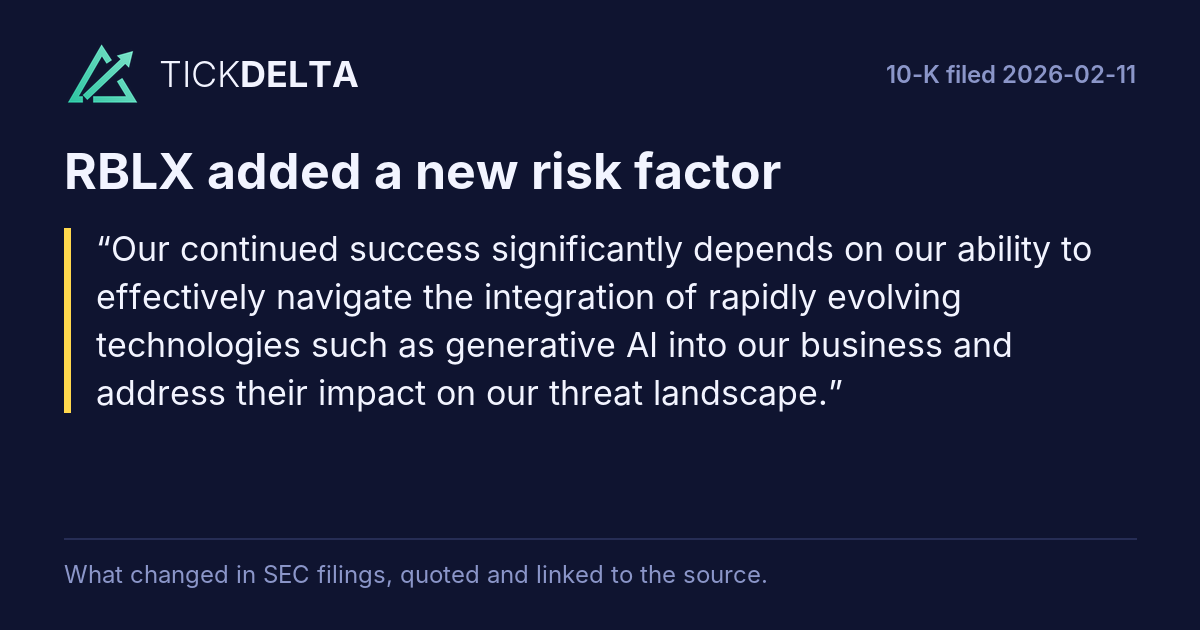
•Our continued success significantly depends on our ability to effectively navigate the integration of rapidly evolving technologies such as generative AI into our business and address their impact on our threat landscape.

Read in the 10-K

There are also evolving laws and regulations relating to social media. For example, Australia has implemented a ban on social media for children under 16 pursuant to its Social Media Minimum Age Act, requiring certain social media platforms to block underage accounts or face significant fines. There are similar discussions and legislative efforts ongoing in several jurisdictions, including the U.S and EU related to restricting minors’ access to social media platforms, with a particular emphasis on restricting access to features that may be considered addictive or harmful to minors, with certain legislation and regulation addressing these matters having been enacted. Depending on the scope of covered services, laws and regulations such as these may affect how we configure and present our Platform or our ability to offer our Platform to certain demographics entirely, which may in turn have an adverse impact on our bookings and revenue.

In the U.S. and abroad there are ongoing discussions and legislative and executive efforts to remove or restrict the protections from liability for third-party content found under Section 230 of the Communications Decency Act (“CDA”) and similar international regulations. For example, in June 2025, the Brazilian Supreme Court ruled that Article 19 of Brazil’s Internet Act is partially unconstitutional, creating platform liability for third-party content in certain instances. The resulting legal framework is in flux, but as it stands, platforms that host third party content like Roblox will be subject to presumptive civil liability for certain categories of content, as well as new regulatory requirements around localization, content moderation, transparency, risk assessment and management, and customer support.

Read in the 10-K

We invest significant technical and human resources to proactively identify inappropriate content and activity on our Platform, including leveraging text-filtering, voice moderation, content moderation, and other automated systems powered by AI such as Roblox Sentinel. We provide our users with the ability to report activity that they find objectionable, and also provide customizable controls for parents and caregivers to restrict children’s access to experiences and communication features, such as our Content Maturity Labels that are designed for users to make informed decisions about the content they interact with. We work closely with regulators, authorities, and safety groups in many countries to promptly report illegal content, and also partner with leading global organizations and members of our community for continued input on the safety features of our Platform.

Notwithstanding our efforts and significant investment, bad actors have and may continue to circumvent our moderation and safety systems by engaging in activities including, but not limited to, uploading or generating inappropriate experiences or content, creating inappropriate environments or content in otherwise non-violative experiences by engaging in offensive behavior, or directing users off-Platform to less moderated third-party platforms to engage in inappropriate behavior. The occurrence of these activities can and has led to reputational harm, legal actions, and regulatory scrutiny on certain occasions, which could adversely affect our business and financial results. Such activities have and may continue to evolve in their complexity as bad actors become more sophisticated, which will require us to continue investing significant technical and human resources.

Some activities and content on our Platform has and may continue to be considered objectionable by certain users, parents, or members of our community, even if it does not violate our Community Standards or terms of use and may not be considered objectionable by certain demographics. Although permitting such content to remain on our Platform is consistent with our policies, this has resulted in and could in the future result in negative publicity or user backlash, which may damage our brand and reputation, lead to a decline in user engagement and growth, and negatively impact our business, financial condition, and operating results. Additionally, violative content that has been removed from our Platform, at times, continues to be shared on social media, resulting in negative publicity and damage to our brand and reputation.

Read in the 10-K

We view DAUs as a critical measure of our user engagement, and adding, maintaining, and engaging users has been and will continue to be necessary to our continued growth. Accordingly, we have made and continue to make investments to enable our creators to design and build compelling content and deliver it to our users on our Platform in order to grow and maintain their userbase. Our DAU growth rate has fluctuated in the past and may slow in the future due to various factors including:

•the introduction of new or updated experiences or virtual content on our Platform;

•the modification and/or removal of popular experiences or other content on our Platform due to factors that may or may not be within our control;

•the availability of our Platform across markets and user demographics, which may be impacted by regulatory or legal requirements, including the use of parental consent and age-check technologies and policies;

•changes to the default settings, features, and/or tools on our Platform overall, or for specific user groups;

•changes to our terms of use, advertising policies, and generative AI policies; and

•higher market penetration rates and competition from a variety of sources for our users and their time.

Read in the 10-K

Our business plan assumes that the demand for interactive entertainment offerings will increase for the foreseeable future. However, if this market shrinks or grows more slowly than anticipated or if demand for our Platform does not grow as quickly as we anticipate, whether as a result of competition, product obsolescence, budgetary constraints of our creators and users, technological changes, unfavorable economic conditions, uncertain geopolitical or regulatory environments, or other factors, we may not be able to increase our revenue and bookings sufficiently to ever achieve profitability and our stock price would decline. We compete to attract and retain our users’ attention and their hours engaged with other global technology leaders such as Amazon, Apple, Meta Platforms, Google, Microsoft, and Tencent, global entertainment companies such as Comcast, Disney, Paramount Global, and Warner Bros Discovery, global gaming companies such as Activision Blizzard (now owned by Microsoft), Electronic Arts, Take-Two, Epic Games, Krafton, NetEase, and Valve, online content platforms such as Netflix, Spotify, and YouTube, as well as platforms such as Facebook, TikTok, Instagram, WhatsApp, Pinterest, X, Reddit, Discord, and Snap. We expect competition to continue to increase in the future. Many of our existing competitors have, and some of our potential competitors could have, substantial competitive advantages, such as larger sales and marketing budgets and resources; broader and more established relationships with our target demographics; greater resources to make acquisitions and enter into strategic partnerships; lower labor and research and development costs; larger and more mature intellectual property portfolios; and substantially greater financial, technical, and other resources. Moreover, a large number of our users are under the age of 13. This demographic may be less brand loyal and more likely to follow trends, including viral trends, than other demographics. These and other factors may lead users to switch to another entertainment option rapidly, which can interfere with our ability to forecast usage or DAUs and would negatively affect our user retention, growth, and engagement. We also may not be able to penetrate other demographics in a meaningful manner to compensate for the loss of DAUs in this age group.

Read in the 10-K
Show the other 21

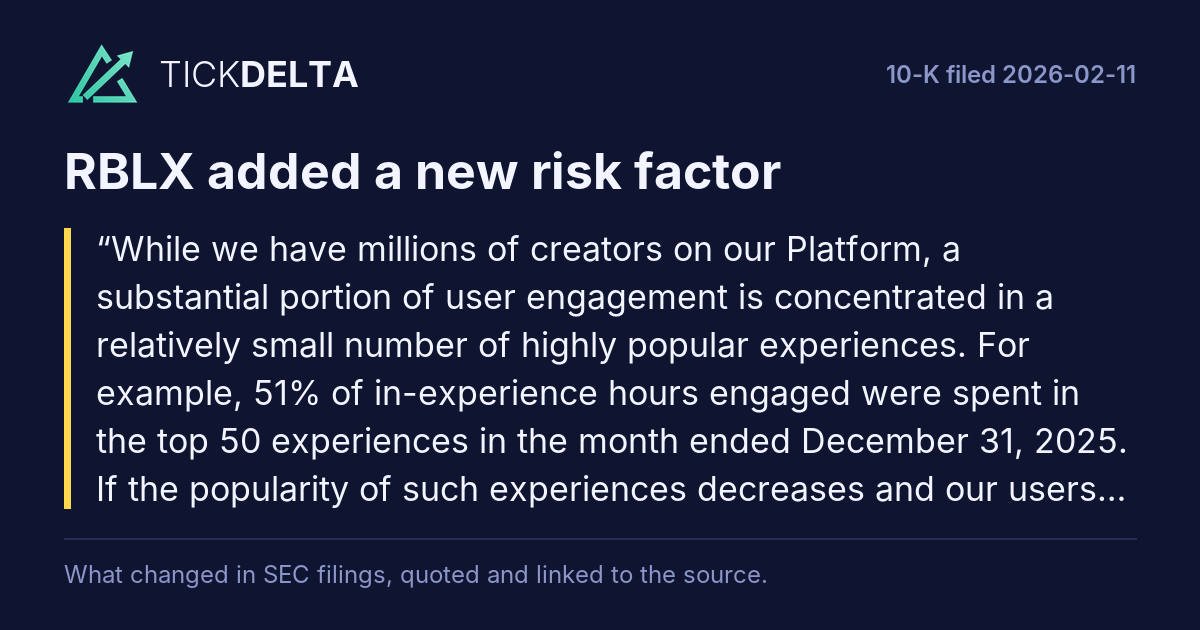
While we have millions of creators on our Platform, a substantial portion of user engagement is concentrated in a relatively small number of highly popular experiences. For example, 51% of in-experience hours engaged were spent in the top 50 experiences in the month ended December 31, 2025. If the popularity of such experiences decreases and our users do not consider other content to be appealing, our DAUs and engagement could decline, which would have a material impact on our business, financial condition, and operations.

Read in the 10-K

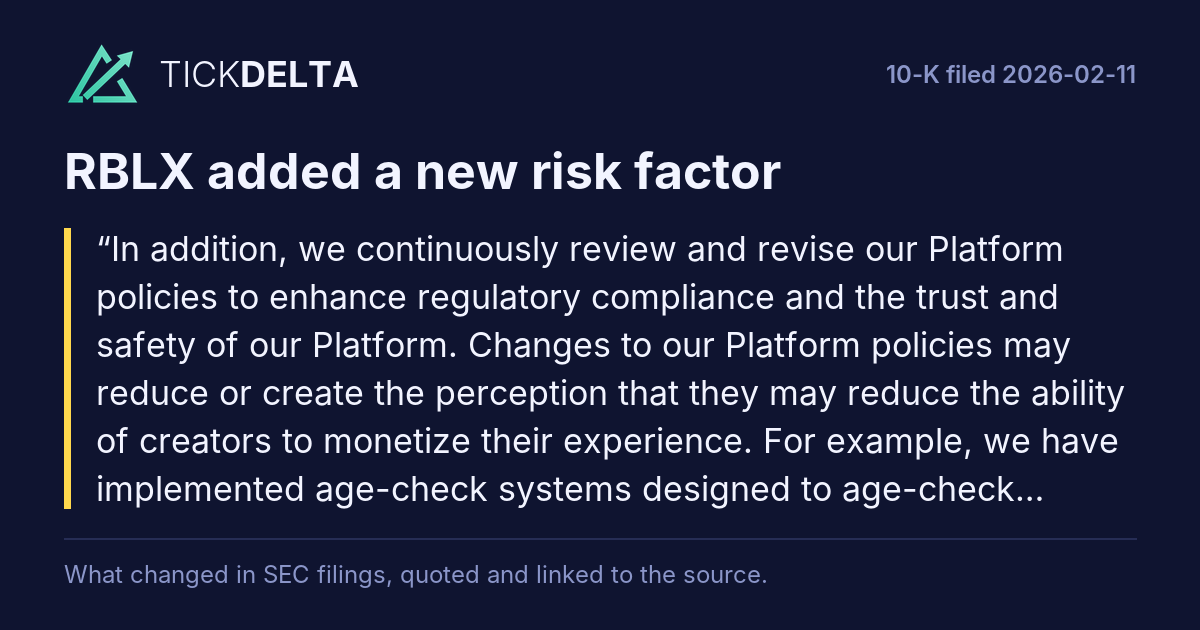
In addition, we continuously review and revise our Platform policies to enhance regulatory compliance and the trust and safety of our Platform. Changes to our Platform policies may reduce or create the perception that they may reduce the ability of creators to monetize their experience. For example, we have implemented age-check systems designed to age-check users prior to accessing chat on Platform. The system is designed to enable chat only between users in similar age groups or Trusted Connections. We have also implemented new eligibility requirements for publishing and updating experiences that are designed to reduce spam and potentially violating content. We have received negative feedback from certain of our creators on these changes because of their perceived impact to monetization and profitability. If our creators believe these changes will materially impact the monetization and profitability of their content, they may stop developing content on our Platform, which could harm our results of operations, and particularly if such creators are responsible for a substantial portion of our user engagement.

Read in the 10-K

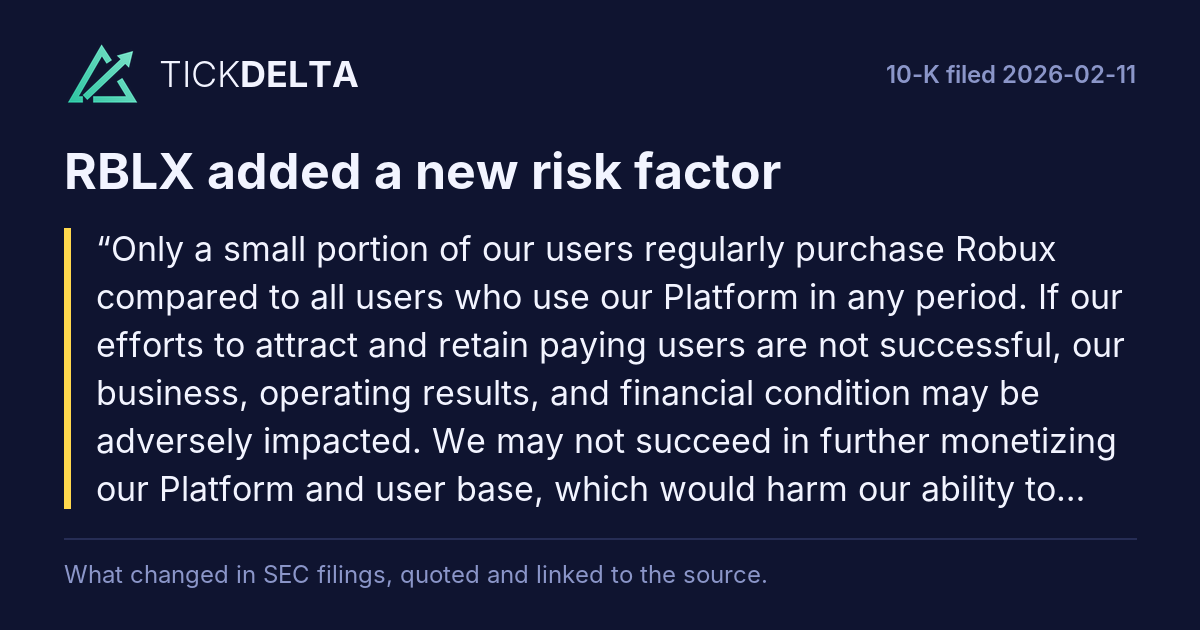
Only a small portion of our users regularly purchase Robux compared to all users who use our Platform in any period. If our efforts to attract and retain paying users are not successful, our business, operating results, and financial condition may be adversely impacted. We may not succeed in further monetizing our Platform and user base, which would harm our ability to grow revenue and our financial performance generally due to various factors including, but not limited to if:

•our user growth outpaces our ability to monetize our users, and particularly as our user growth occurs in markets that are not profitable or less profitable;

•we fail to provide the tools and education to our creators to enable them to monetize their experiences and creators do not create engaging or new experiences for users;

•we fail to continue to incentivize creators on our Platform to develop content that our users consider to be of value;

•we fail to accurately predict which specific Platform features encourage users to become paying users;

•we introduce new or adjust existing features or pricing in a manner that is not favorably received by our users;

•we fail to increase the number of experiences or content that our users are willing to pay for;

•we fail to increase the features of our Platform, allowing it to more broadly serve the entertainment, education, communication, and business markets;

•we fail to increase penetration and engagement across all demographics, including our goal of reaching 10% of the global gaming content market;

•measures intended to make our Platform more attractive to older users create the perception that our Platform is not safe for younger users;

•our paying users stop interacting with our Platform and purchasing Robux as they increase in age; and

•if paying users reduce their spend on our Platform due to reasons such as the need to reduce household expenses or the perception that competitive services provide better value.

Read in the 10-K

•increased cybersecurity, technology and physical security risks to the data, systems, facilities, and people supporting the operation of the Platform;

Read in the 10-K

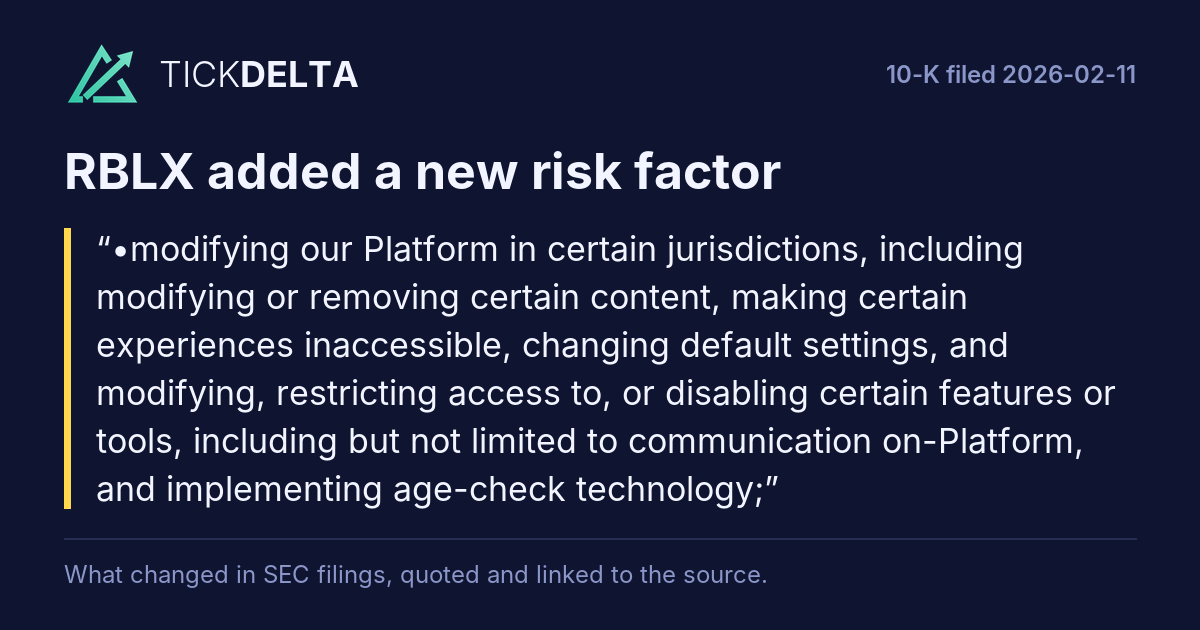
•modifying our Platform in certain jurisdictions, including modifying or removing certain content, making certain experiences inaccessible, changing default settings, and modifying, restricting access to, or disabling certain features or tools, including but not limited to communication on-Platform, and implementing age-check technology;

Read in the 10-K

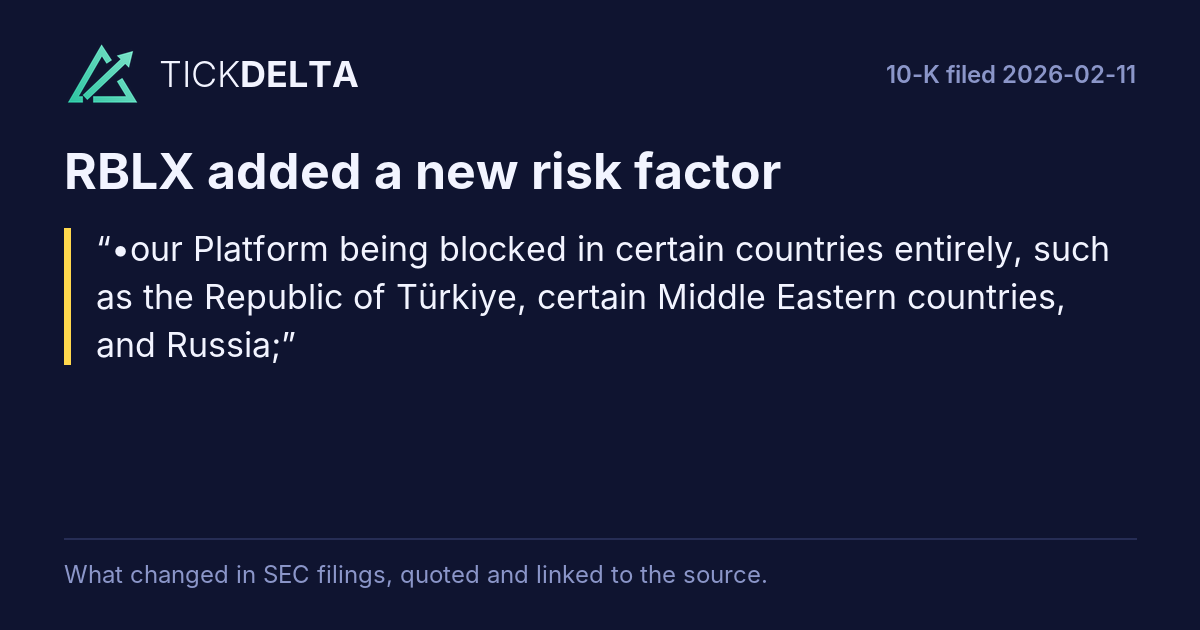
•our Platform being blocked in certain countries entirely, such as the Republic of Türkiye, certain Middle Eastern countries, and Russia;

Read in the 10-K

Our continued success significantly depends on our ability to effectively navigate the integration of rapidly evolving technologies such as generative AI into our business and address their impact on our threat landscape.

Read in the 10-K

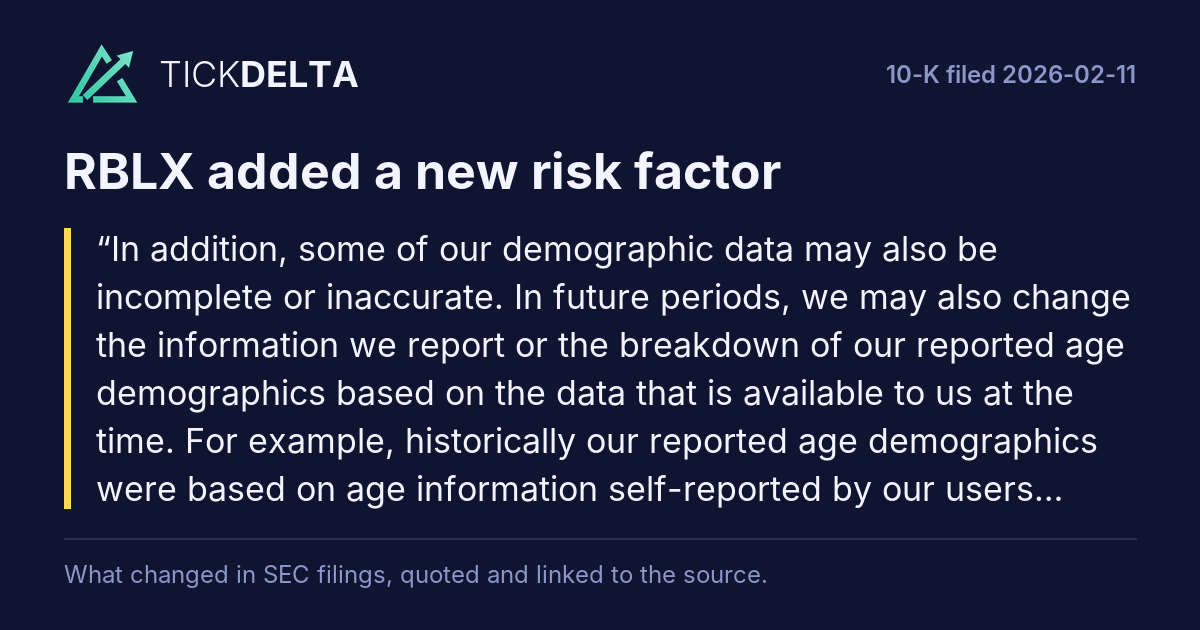
In addition, some of our demographic data may also be incomplete or inaccurate. In future periods, we may also change the information we report or the breakdown of our reported age demographics based on the data that is available to us at the time. For example, historically our reported age demographics were based on age information self-reported by our users. We are currently developing, testing, and implementing new systems designed to check the ages of our users, which we refer to as “age-checking,” and currently we incorporate facial age estimation technology, identity verification, and parent or caregiver provided age data. Age-checked metrics will not be comparable to historical periods that relied on self-reported data. In addition, since our age-check systems are only mandatory for users seeking to access chat features on our Platform, our future reported age-demographic data will not include all of our users, including those who engage on our Platform but do not use our chat features or users in geographies in which chat is not enabled. Therefore, there is no guarantee that the population of users who access chat is representative of our entire user base. As the number of users that choose to undergo age-check processes, the features or tools that require age-check, and our methodologies for age-checking continue to develop, prior period demographics may not be comparable to future ones. Our age demographic data could differ from users’ actual ages due to the functionality of our age-check systems, policies and technology. Users seeking to evade our age estimation systems and tools may also be more likely to create alternate or multiple accounts which would inflate our user activity.

Read in the 10-K

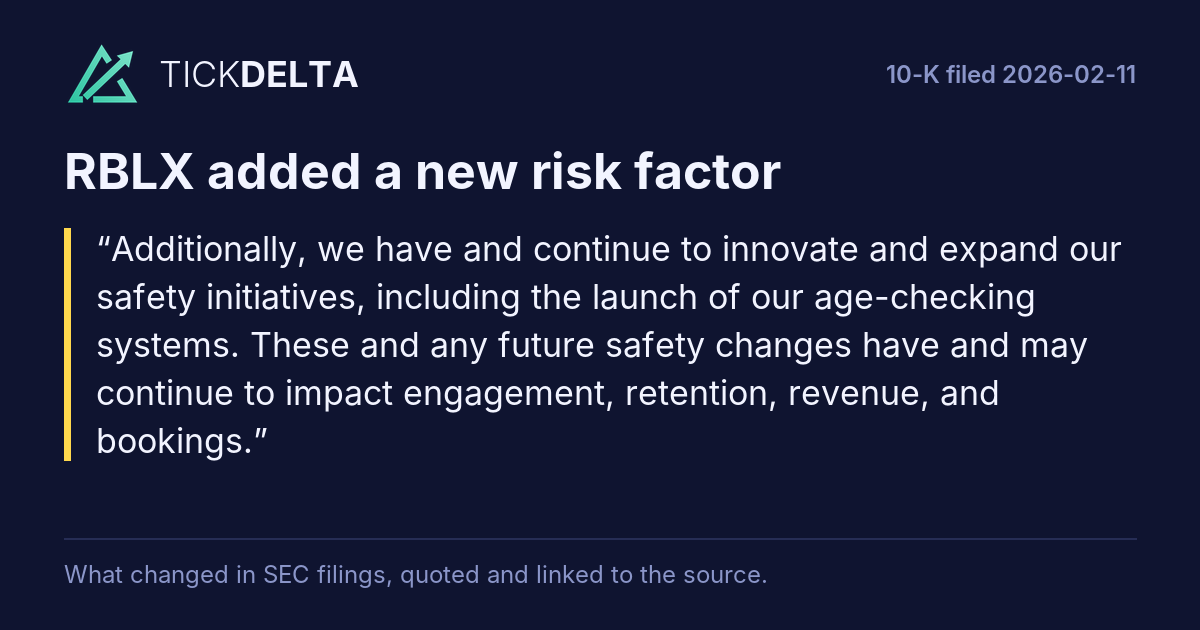
Additionally, we have and continue to innovate and expand our safety initiatives, including the launch of our age-checking systems. These and any future safety changes have and may continue to impact engagement, retention, revenue, and bookings.

Read in the 10-K

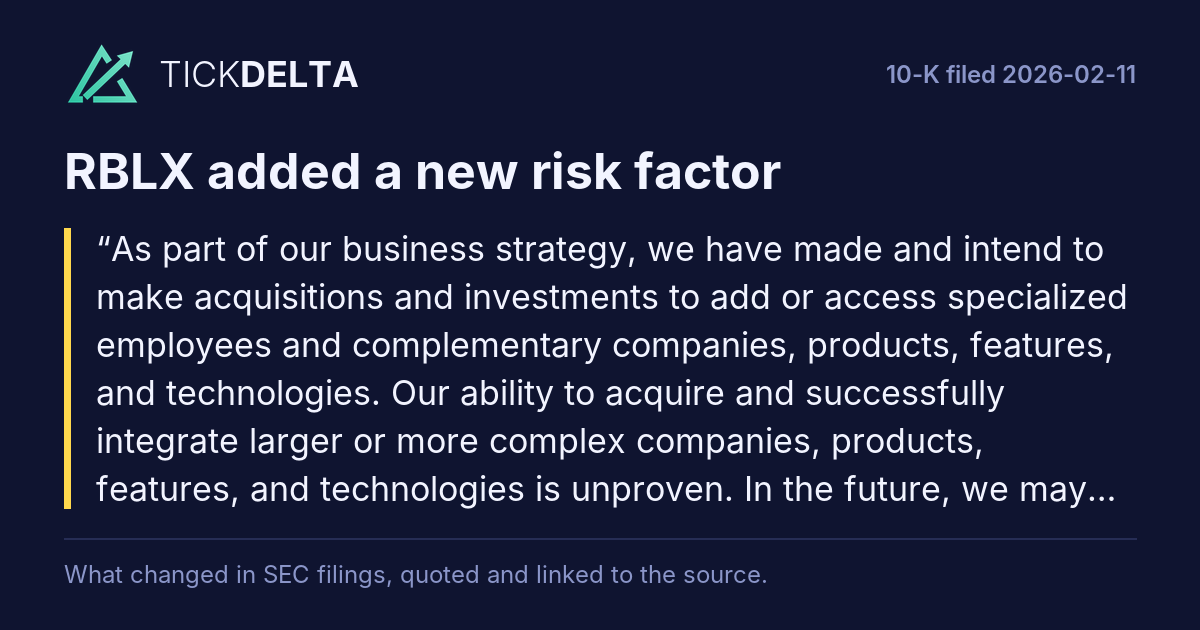
As part of our business strategy, we have made and intend to make acquisitions and investments to add or access specialized employees and complementary companies, products, features, and technologies. Our ability to acquire and successfully integrate larger or more complex companies, products, features, and technologies is unproven. In the future, we may not be able to find other suitable acquisition or investment candidates, and we may not be able to complete acquisitions, investments, or similar strategic transactions on favorable terms, if at all. The risks and challenges associated with acquisitions and investments include:

•The pursuit of potential acquisitions or investments may divert the attention of management and cause us to incur significant expenses related to identifying, investigating, and pursuing suitable targets, whether or not they are consummated.

•Our previous and future acquisitions and investments may not achieve our goals, and any future acquisitions or investments we complete could be viewed negatively by users, creators, partners, or investors.

•If we fail to successfully close transactions or integrate new teams into our corporate culture, or fail to integrate the products, features, and technologies associated with acquisitions or investments in a timely fashion, our business and reputation could be significantly harmed.

•Any integration process may require significant time and resources, and we may not be able to manage the process successfully.

•We may not successfully evaluate or use the acquired products, technology, and personnel, or accurately forecast the financial impact of an acquisition, including accounting charges which could be recognized as a current period expense.

•We may not achieve the anticipated benefits of synergies from the target business, may encounter challenges with incorporating the acquired products, features, and technologies into our Platform while maintaining quality and security standards consistent with our brand, or may fail to identify security vulnerabilities in acquired technology prior to integration with our technology and Platform.

•We may incur unanticipated liabilities that we assume as a result of acquiring companies, including claims related to the acquired company, its offerings, or technologies or potential violations of applicable law or industry rules and regulations arising from prior or ongoing acts or omissions by the acquired business that were not discovered or deemed material during diligence.

•We will pay cash, incur debt, or issue equity securities to pay for any acquisitions or investments, any of which could reduce our ability to make future acquisitions or investments and significantly harm our financial results. In addition, if target companies view our Class A common stock unfavorably, we may be unable to consummate key acquisitions or investments.

•It generally takes several months after the closing of an acquisition to finalize the purchase price allocation. Therefore, it is possible that our valuation of an acquisition may change and result in unanticipated write-offs or charges, impairment of our goodwill, or a material change to the fair value of the assets and liabilities associated with a particular acquisition, any of which could significantly harm our business.

•Selling equity to finance any acquisition or investment would dilute our stockholders, and incurring debt would increase our fixed obligations and could also include covenants or other restrictions that would impede our ability to manage our operations.

Read in the 10-K

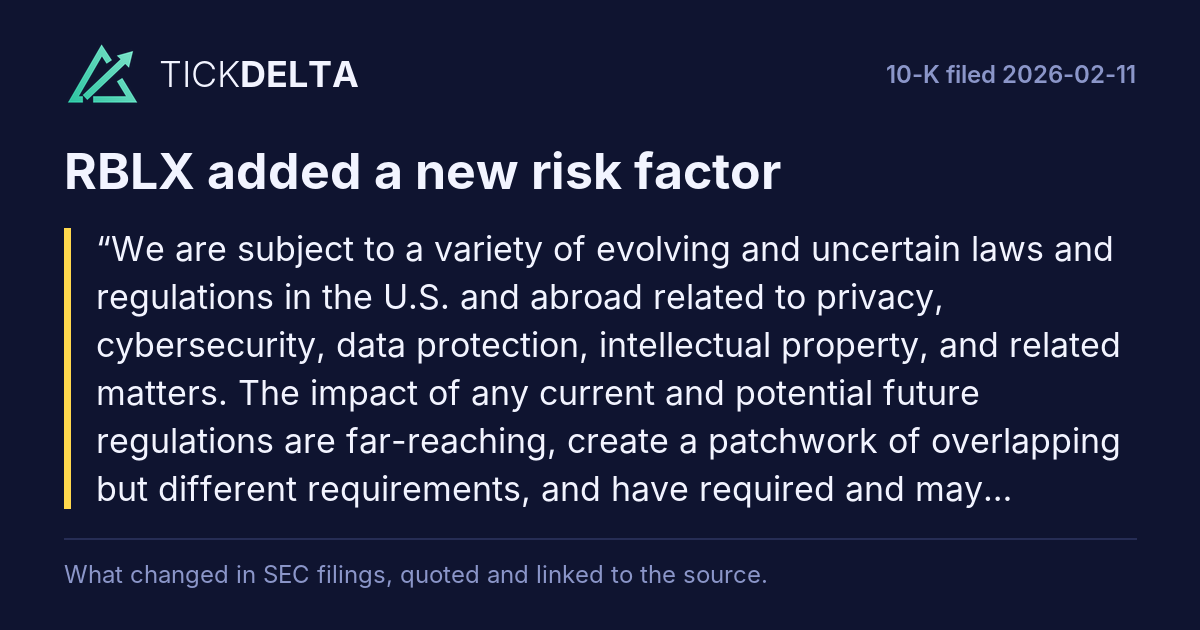
We are subject to a variety of evolving and uncertain laws and regulations in the U.S. and abroad related to privacy, cybersecurity, data protection, intellectual property, and related matters. The impact of any current and potential future regulations are far-reaching, create a patchwork of overlapping but different requirements, and have required and may continue to require us to, modify practices, policies, features and Platform defaults, incur substantial costs and expenses, and at times restrict our operations.

Read in the 10-K

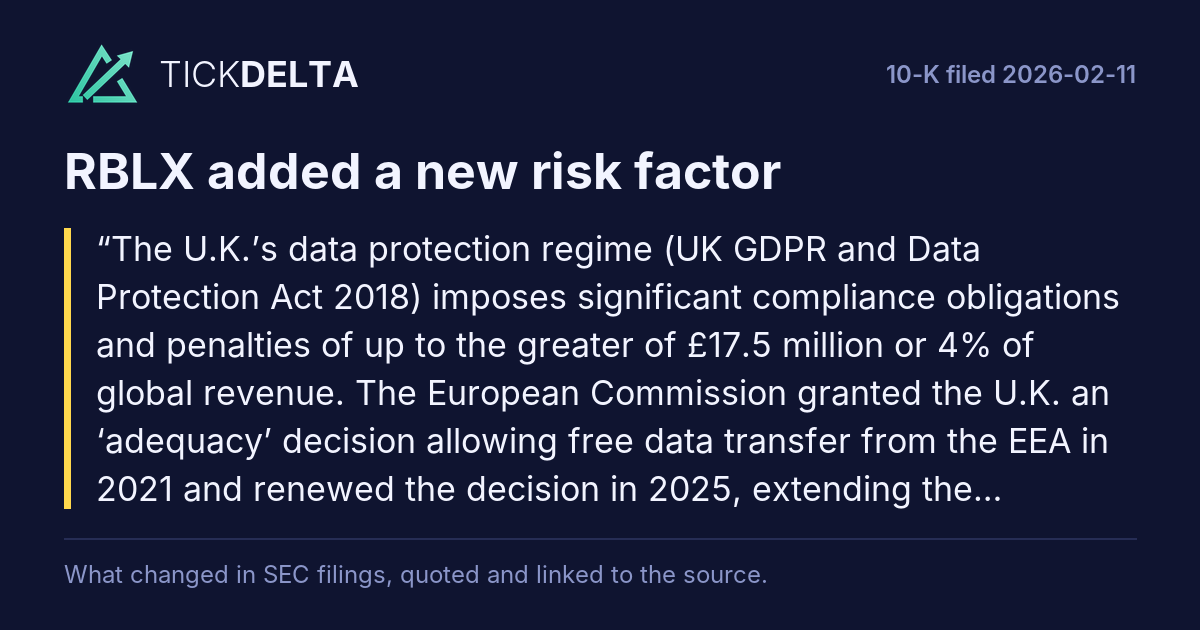
The U.K.’s data protection regime (UK GDPR and Data Protection Act 2018) imposes significant compliance obligations and penalties of up to the greater of £17.5 million or 4% of global revenue. The European Commission granted the U.K. an ‘adequacy’ decision allowing free data transfer from the EEA in 2021 and renewed the decision in 2025, extending the adequacy decision through December 27, 2031, with the possibility to be renewed. Any loss of adequacy or divergence between U.K. and EU laws could disrupt our data flows and increase compliance costs.

Read in the 10-K

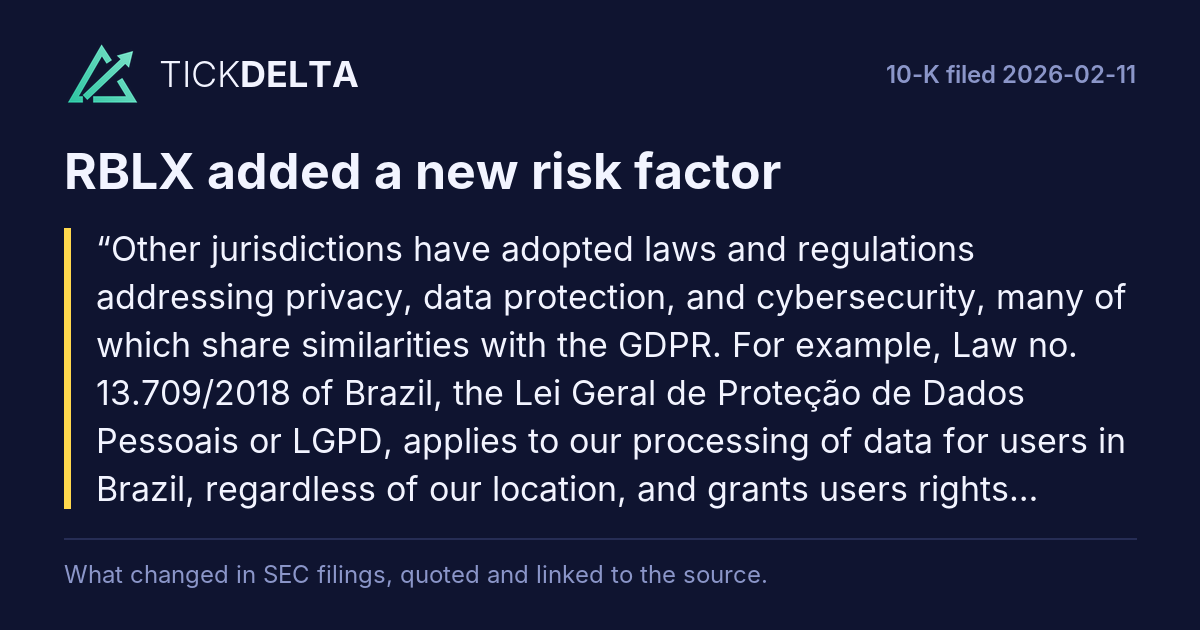
Other jurisdictions have adopted laws and regulations addressing privacy, data protection, and cybersecurity, many of which share similarities with the GDPR. For example, Law no. 13.709/2018 of Brazil, the Lei Geral de Proteção de Dados Pessoais or LGPD, applies to our processing of data for users in Brazil, regardless of our location, and grants users rights similar to the GDPR, including a private right of action. Non-compliance could result in fines of up to 2% of our revenue in Brazil or 50 million reais (approximately $9.5 million) per violation. Similarly, the Personal Information Protection Law, (“PIPL”) of the People’s Republic of China (“PRC”) imposes extraterritorial obligations similar to the GDPR, including strict data localization requirements. Violations can result in corporate fines of up to 50 million RMB or 5% of prior-year revenue. Notably, the PIPL also imposes personal liability on responsible individuals, including fines up to 1 million RMB and potential bans on serving as a director or senior managers.

Read in the 10-K

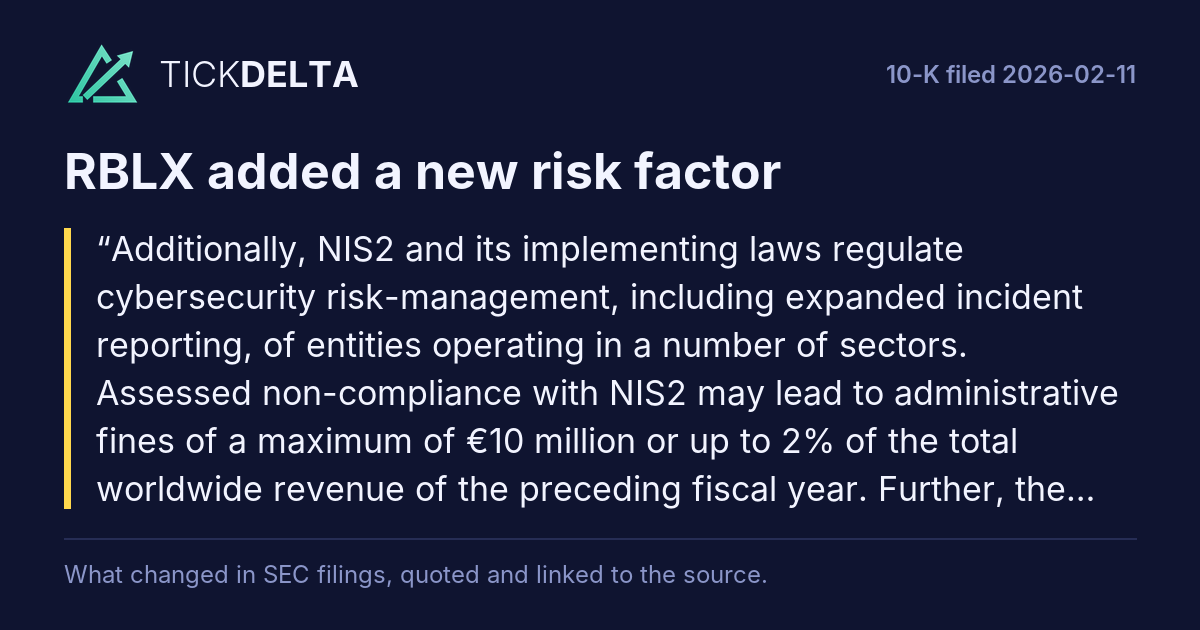
Additionally, NIS2 and its implementing laws regulate cybersecurity risk-management, including expanded incident reporting, of entities operating in a number of sectors. Assessed non-compliance with NIS2 may lead to administrative fines of a maximum of €10 million or up to 2% of the total worldwide revenue of the preceding fiscal year. Further, the EU’s Data Act (the “Data Act”) became applicable on September 12, 2025. Compliance with the Data Act may require us to adjust contract terms with business partners and enable data sharing in some situations. These changes may result in additional compliance and operational costs, which may affect our business.

In addition, the CCPA as modified and supplemented by the California Privacy Rights Act (“CPRA”), established a new privacy framework for covered businesses in California, such as ours, requires us to modify our data processing practices and policies, incur compliance related costs and expenses, and gives California residents the ability to opt-out of the selling and sharing of personal information and limit the use of their sensitive personal information. The CCPA provides for civil penalties for violations, as well as a private right of action for data breaches, which may increase the likelihood and cost of data breach litigation. The CCPA has prompted similar legislative developments in other states in the U.S., including laws enacted in Virginia, Colorado, Utah, Connecticut, Florida, Iowa, Indiana, Montana, Tennessee, Oregon, Delaware, Texas, New Hampshire, New Jersey, Kentucky, Maryland, Nebraska, Rhode Island, and Minnesota.

Read in the 10-K

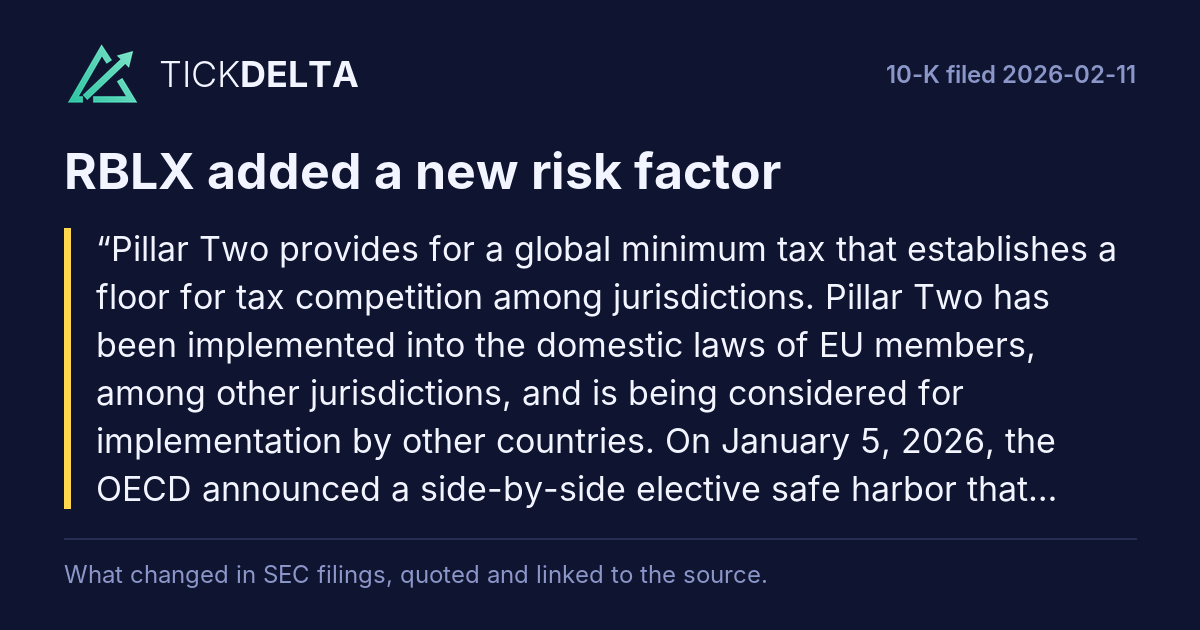
Pillar Two provides for a global minimum tax that establishes a floor for tax competition among jurisdictions. Pillar Two has been implemented into the domestic laws of EU members, among other jurisdictions, and is being considered for implementation by other countries. On January 5, 2026, the OECD announced a side-by-side elective safe harbor that exempts U.S.-parented multinational businesses from certain provisions of Pillar Two for fiscal years beginning on or after January 1, 2026. We currently operate in countries that have digital service taxes and that have enacted all or portions of the Pillar Two framework. Any developments or changes in federal, state, or international tax laws or tax rulings, with respect to the foregoing or otherwise, could adversely affect our compliance costs, effective tax rate, and our operating results.

Read in the 10-K

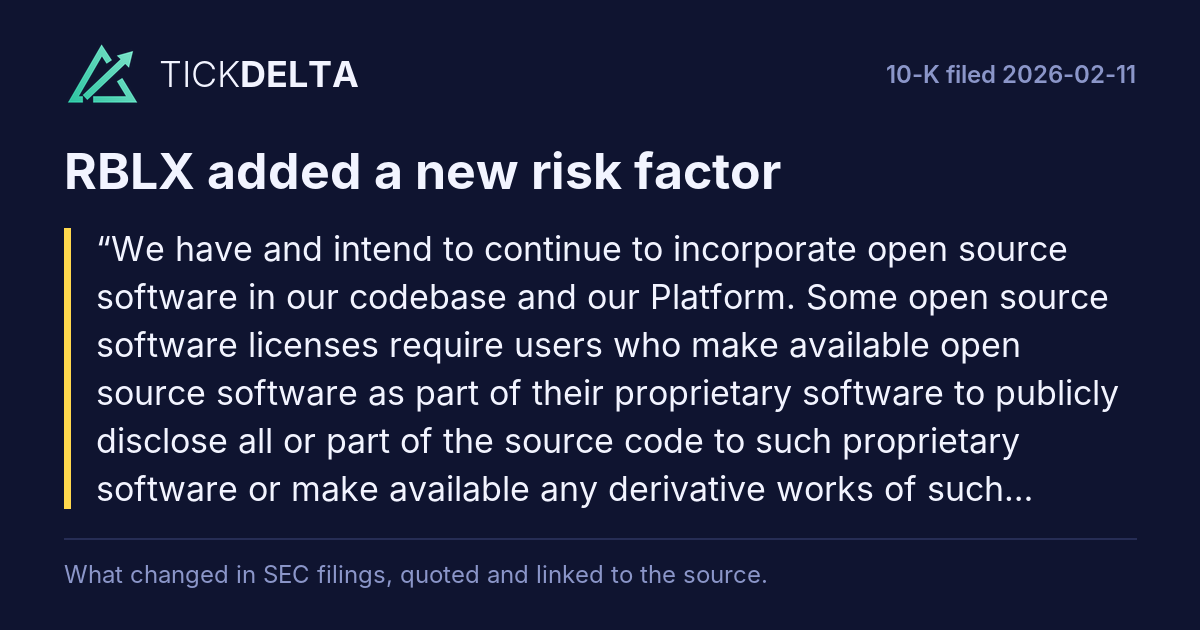
We have and intend to continue to incorporate open source software in our codebase and our Platform. Some open source software licenses require users who make available open source software as part of their proprietary software to publicly disclose all or part of the source code to such proprietary software or make available any derivative works of such software free of charge, under open source licensing terms which would make it difficult to monetize such software and to protect and enforce our related intellectual property rights. Licensors of open source software included in our products may, from time to time, modify the terms of their license agreements in such a manner that those license terms may become incompatible with our business model and thus could, among other consequences, prevent us from incorporating the software subject to the modified license. Certain open source projects also include other open source software and there is a risk that those dependent open source libraries may be subject to incompatible licensing terms. In addition, some open source software may include output from generative AI software or other software that incorporates or relies on generative AI or other AI technologies. Software produced by generative AI may infringe the rights of others. In addition, the use of such open source software may expose us to risks as the intellectual property ownership and use rights of software produced by generative AI have not been fully interpreted by U.S. or international courts or been fully addressed by federal or state regulation or those of other international legal jurisdictions in which we do business. This could create further uncertainties as to the governing terms for the open source software we incorporate.

Read in the 10-K

In May 2025, we completed our reincorporation from a Delaware corporation to a Nevada corporation governed by Chapter 78 and the other applicable provisions of the Nevada Revised Statutes (“NRS”). Nevada’s “combinations with interested stockholders” statutes (NRS 78.411 through 78.444, inclusive) prohibit specified types of business “combinations” between certain Nevada corporations and any person deemed to be an “interested stockholder” for two years after such person first becomes an “interested stockholder” unless the corporation’s board of directors approves, in advance, either the combination or the transaction by which such person becomes an “interested stockholder,” or unless the combination is approved by the board of directors and sixty percent of the corporation’s voting power not beneficially owned by the interested stockholder, its affiliates, and associates. Further, in the absence of prior approval, certain restrictions may apply even after such two-year period. However, these statutes do not apply to any combination of a corporation and an interested stockholder after the expiration of four years after the person first became an interested stockholder. For purposes of these statutes, an “interested stockholder” is any person who is (1) the beneficial owner, directly or indirectly, of ten percent or more of the voting power of the outstanding voting shares of the corporation, or (2) an affiliate or associate of the corporation and at any time within the two previous years was the beneficial owner, directly or indirectly, of ten percent or more of the voting power of the then outstanding shares of the corporation. The definition of the term “combination” is sufficiently broad to cover most significant transactions between a corporation and an “interested stockholder.” These statutes generally apply to Nevada corporations with 200 or more stockholders of record. However, a Nevada corporation may elect in its articles of incorporation not to be governed by these particular laws, but if such election is not made in the corporation’s original articles of incorporation or in an amendment effective prior to the company having 200 or more stockholders of record, then the amendment (1) must be approved by the affirmative vote of the holders of stock representing a majority of the outstanding voting power of the corporation not beneficially owned by interested stockholders or their affiliates and associates, and (2) is not effective until 18 months after the vote approving the amendment and does not apply to any combination with a person who first became an interested stockholder on or before the effective date of the amendment. We have expressly elected not to be governed by these provisions in our articles of incorporation, so they do not apply to us.

In addition, our articles of incorporation and bylaws contain provisions that may make the acquisition of our company more difficult, including the following:

Read in the 10-K

•certain litigation against us can only be brought in courts of our state of incorporation;

Read in the 10-K

•asserting a claim for breach of a fiduciary duty or other duty owed by any current or former director, stockholder, officer, or other employee or fiduciary of our company to us or our stockholders;

Read in the 10-K

•to interpret, apply, enforce, or determine the validity of our articles of incorporation or our bylaws; and

This provision would not apply to suits prior to completion of our reincorporation from a Delaware corporation to a Nevada corporation, which will continue to be subject to the Court of Chancery of the State of Delaware. It would also not apply to suits brought to enforce any direct claim asserted under the Securities Exchange Act of 1934, as amended (the “Exchange Act”). In the event that the Eighth Judicial District Court of Clark County, Nevada does not have jurisdiction over any such action, suit, or proceeding, then any other state district court located in the State of Nevada shall be the sole and exclusive forum therefor.

Read in the 10-K

Our articles of incorporation include a jury trial waiver that could limit the ability of our stockholders to bring or demand a jury trial for internal actions.

Our articles of incorporation provide that, to the fullest extent permitted by the NRS and not inconsistent with any applicable laws of the U.S., any and all internal actions (as defined in NRS 78.046) to be tried in any court of the State of Nevada must be tried before the presiding judge as the trier of fact, and not before a jury. Our articles of incorporation further provide that this requirement operates as a waiver of the right of trial by jury by each party to any internal action to which such requirement applies. However, this requirement does not limit or otherwise affect our stockholders’ right to a jury trial in any action, suit or proceeding that is not an internal action. This waiver is expressly authorized by statute in an amendment to NRS 78.046 enacted in May 2025 pursuant to Assembly Bill No. 239 adopted by the Nevada legislature, but the enforceability of this waiver has not yet been adjudicated in a court of competent jurisdiction.

We do not expect to pay dividends or other distributions in the foreseeable future.
Read in the 10-K

Paragraphs in the 10-Q filed Oct 29, 2026 that were not in the one before

New in the latest 10-Q

2 paragraphs in the 10-Q filed Oct 29, 2026 with nothing like them in the 10-Q filed Jul 30, 2026 (at least half the words must differ; new numbers alone do not count). Quoted exactly, grouped by the item heading above them. This is text that changed, not a judgement of how serious it is.

Financial statements and notes

The Company anticipates filing or has filed motions to dismiss that are currently pending in the remainder of these cases. In addition, in October 2026, the Federal Trade Commission (“FTC”) and the states of Pennsylvania and Utah notified the Company that as part of an ongoing investigation they are considering filing claims based on alleged violations of the Federal Trade Commission Act, the Children’s Online Privacy Protection Act (“COPPA”), and certain state consumer protection laws seeking monetary damages and declaratory and injunctive relief. At this time, the Company is unable to reasonably estimate the loss or range of loss, if any, arising from any of the above-referenced matters.

Read in the 10-Q

As of September 30, 2026, $ 2.4 billion remained available under the program authorization.

Read in the 10-Q

The 10-Q's risk factors against the 10-K

Item 1A of the 10-Q filed Oct 29, 2026 against Item 1A of the 10-K filed Feb 11, 2026. A 10-Q repeats only the risks that changed, so a 10-K paragraph that is missing from it is not counted as removed. Added is a paragraph with nothing like it in the 10-K, Reworded a sentence that is in both with several words changed, Quiet changes a sentence in both where one to four words changed and one is a hedge or a modal (cut words struck through, new words highlighted). Text on the page, not a score; each links to the filing at sec.gov.

Added10-Q Oct 29, 2026 vs 10-K Feb 11, 2026
The use of AI in our products and business practices may increase or create additional cybersecurity and privacy risks, including risks of unauthorized disclosure or exposure of data, breaches, and other security incidents. In particular, the deployment of agentic AI introduces new attack surfaces and risk profiles for us to address. Prompt injection attacks, in which malicious instructions cause an AI agent to take unintended or unauthorized actions, are an emerging threat vector for which established defenses are still developing. As AI use expands across our products and operations, we expect the scale, frequency, and sophistication of AI-targeted attacks to increase. Beyond external threats, agentic AI systems operating with limited human oversight at each step may also inadvertently expose proprietary or confidential information by autonomously executing tasks across data boundaries without explicit human authorization.

Read it in the 10-Q at sec.gov

Added10-Q Oct 29, 2026 vs 10-K Feb 11, 2026
Our Platform and services operate in conjunction with, and we are dependent upon, third-party products, services, and components. Our reliance on third-party service providers, including cloud infrastructure providers, payment processors, analytics tools, distribution channels, and customer support providers and platforms, introduces significant and evolving risks related to cybersecurity and data privacy. These risks extend to the third-party AI models, tools, and services that we and our service providers increasingly incorporate into our operations. AI components sourced from third parties may contain vulnerabilities, behave in unintended ways, or be compromised before or after integration with our systems. As AI systems become more autonomous and interconnected, a security failure in a third-party AI component could have cascading effects across our Platform. We do not have complete visibility into or control over the development, training, and security practices of all third-party AI providers in our supply chain, and our contractual protections, vendor assessments, and monitoring capabilities may not be sufficient to prevent or promptly identify such issues in all cases.

Read it in the 10-Q at sec.gov

Added10-Q Oct 29, 2026 vs 10-K Feb 11, 2026
In addition, global laws and regulations relating to cybersecurity continue to evolve in their scope and complexity. For example, the EU’s Network and Information Systems Directive 2 (“NIS2”) and its implementing laws impose mandatory cybersecurity risk-management and incident reporting obligations on entities operating in a number of sectors, including social networking service platforms. Noncompliance may result in fines of up to the greater of €10 million or 2% of total worldwide annual turnover. NIS2 also introduces personal liability for management personnel, who may face temporary prohibition from exercising managerial functions for serious noncompliance. The EU’s Cyber Resilience Act also imposes mandatory cybersecurity requirements on products with digital elements placed on the EU market, including actively exploited vulnerability reporting, incident reporting, and core product obligations. Noncompliance may result in fines of up to the greater of €15 million or 2.5% of total worldwide annual turnover, and market surveillance authorities may order product withdrawal from the EU market. Our efforts to comply with evolving laws and regulations such as these have and could continue to lead to increased operational costs and we could be exposed to fines, product withdrawal orders, reputational harm, and other adverse impacts to our business if we are, or are alleged to be, unable to comply.

Read it in the 10-Q at sec.gov

Added10-Q Oct 29, 2026 vs 10-K Feb 11, 2026
We may not realize the anticipated value of our share repurchase program, and any failure to repurchase our Class A common stock after we have announced our intention to do so may negatively impact our stock price.

Read it in the 10-Q at sec.gov

Show the other 22
Added10-Q Oct 29, 2026 vs 10-K Feb 11, 2026
In May 2026, our Board of Directors authorized the repurchase of up to $3.0 billion of our Class A common stock from time to time through a share repurchase program. Under our program, we may make repurchases of stock from time to time through open market transactions, privately negotiated transactions, and other means in compliance with applicable securities laws, including through Rule 10b5-1 plans. As of September 30, 2026, $2.4 billion remained available for purchase under the program. Our program does not have a fixed expiration date, does not obligate us to repurchase any specific number of shares, and may be suspended or discontinued at any time at our discretion and without prior notice. The timing, manner, price, and amount of any repurchases, if any, will be determined by us at our discretion and will depend on a variety of factors, including legal requirements, price, and economic market conditions. Any failure to repurchase stock after we have announced our intention to do so may negatively impact our reputation and investor confidence in us and may negatively impact our stock price.

Read it in the 10-Q at sec.gov

Added10-Q Oct 29, 2026 vs 10-K Feb 11, 2026
The existence of our program could cause our stock price to be higher than it otherwise would be and could potentially reduce the market liquidity for our stock. Although our program is intended to partially offset dilution from employee equity grants while preserving flexibility to invest in future growth opportunities, there is no assurance that it will do so because the market price of our Class A common stock may decline below the levels at which we repurchase shares, and short-term stock price fluctuations could reduce the effectiveness of the program.

Read it in the 10-Q at sec.gov

Added10-Q Oct 29, 2026 vs 10-K Feb 11, 2026
Repurchasing our Class A common stock reduces the amount of cash we have available to fund working capital, capital expenditures, strategic acquisitions or business opportunities, and other general corporate purposes, and we may fail to realize the anticipated long-term stockholder value of any share repurchase program.

Read it in the 10-Q at sec.gov

Reworded10-Q Oct 29, 2026 vs 10-K Feb 11, 2026
We provide our users with the ability to report activity that they find objectionable, objectionable or which they believe violates our terms of use or Community Standards, and also provide customizable controls for parents and caregivers to restrict children’s access to experiences games and communication features, such as our Content Maturity Labels that are designed for users to make informed decisions about the content they interact with. features.

Read it in the 10-Q at sec.govThe 10-K sentence

Reworded10-Q Oct 29, 2026 vs 10-K Feb 11, 2026
We are and may continue to be subject to legal proceedings asserting claims arising from allegations that we have facilitated gambling by users of our Platform Platform, including by minors, that our Platform is unsafe, that we have misrepresented the safety of our Platform, that we have failed to warn of or misrepresented the risk of encountering bad actors on our Platform, that we provide inadequate safety controls on our Platform, that our Platform is addictive, that our terms of use are not enforceable against minors, that we unlawfully or unfairly benefit from child labor, that we are in violation of child privacy laws and have misrepresented our compliance with such laws, that we have failed to comply with consumer protection laws, that we have misrepresented information about our user base, that we have engaged in copyright infringement, infringement and/or other violations of intellectual property laws, that we have engaged in unlawful employment practices, and suits related to our refund policies.

Read it in the 10-Q at sec.govThe 10-K sentence

Reworded10-Q Oct 29, 2026 vs 10-K Feb 11, 2026
Additional unfavorable publicity has covered, and may in the future cover, our privacy, cybersecurity or data protection practices, terms of service, use, including our advertising policies, product changes, product quality, litigation or regulatory activity, actions we take to address content on our Platform, trust and safety efforts, accusations that certain of our trust and safety efforts favor certain viewpoints or suppress freedom of expression, our use of and policies regarding generative AI, the actions of our users, our use of age-checking technology, and the actions of our creators whose products are integrated with our Platform. users and creators.

Read it in the 10-Q at sec.govThe 10-K sentence

Reworded10-Q Oct 29, 2026 vs 10-K Feb 11, 2026
If any of these providers fail to process or ensure the security of users’ payments for any reason, our reputation may be damaged and we may lose our paying users, creators may lose interest in our Developer Exchange Program, Program or other creator payment programs we may introduce in the future, such as Roblox Wallet, creators may be discouraged from creating on our Platform, and users may be discouraged from making purchases on our Platform, which, in turn, would materially and adversely affect our business, financial condition, and prospects. Platform.

Read it in the 10-Q at sec.govThe 10-K sentence

Reworded10-Q Oct 29, 2026 vs 10-K Feb 11, 2026
Various Numerous regulators, including state Attorneys General attorneys general and the FTC, have commenced investigations, filed claims claims, or announced the intent to commence investigations or file claims against us based on various state state, federal, or local laws and causes of action primarily relating to youth-related consumer protection protection, digital safety, and online safety privacy matters.

Read it in the 10-Q at sec.govThe 10-K sentence

Reworded10-Q Oct 29, 2026 vs 10-K Feb 11, 2026
Certain of its obligations entered into effect on in February 2, 2025, and the majority many of its applicable provisions are currently due to become became effective by in August 2, 2026, although the EU’s legislature may vary this date for certain obligations. 2026.

Read it in the 10-Q at sec.govThe 10-K sentence

Reworded10-Q Oct 29, 2026 vs 10-K Feb 11, 2026
Utilization of our net operating loss carryforwards and other tax attributes may be subject to limitations on utilization or benefit due to the ownership change limitations provided by Sections 382 and 383 of the Internal Revenue Code of 1986, as amended (the “Code”), and other similar provisions. $3,242 million of our federal net operating losses are carried forward indefinitely but the deductibility of these losses is generally limited to 80% of current year taxable income.

Read it in the 10-Q at sec.govThe 10-K sentence

Reworded10-Q Oct 29, 2026 vs 10-K Feb 11, 2026
No assurances can be given that our compliance efforts will be sufficient to avoid allegations of liability for alleged COPPA violations, and any non-compliance noncompliance or allegations of non-compliance noncompliance could expose us to significant liability, penalties penalties, and loss of revenue, significantly harm our reputation, and could be costly and time consuming to address or defend. defend, which could materially adversely affect our business, including our financial condition, operating results, and reputation.

Read it in the 10-Q at sec.govThe 10-K sentence

Reworded10-Q Oct 29, 2026 vs 10-K Feb 11, 2026
In addition, the CCPA as modified and supplemented by the California Privacy Rights Act (“CPRA”), established a new privacy framework for covered businesses in California, such as ours, requires us companies like Roblox to modify our their data processing practices and policies, incur compliance related compliance-related costs and expenses, and gives California residents the ability to opt-out opt out of the selling and sharing of personal information and limit the use of their sensitive personal information.

Read it in the 10-Q at sec.govThe 10-K sentence

Reworded10-Q Oct 29, 2026 vs 10-K Feb 11, 2026
Information on related to those purchases or under our Developer Exchange Program and payments (e.g., debit and credit card numbers and expiration dates, personal information, including tax identification number, bank account information, and billing addresses) is disclosed to the third-party online platform platforms and service providers (such as Stripe, Xsolla, and Tipalti). providers.

Read it in the 10-Q at sec.govThe 10-K sentence

Reworded10-Q Oct 29, 2026 vs 10-K Feb 11, 2026
We have been and may continue to be subject to legal proceedings asserting claims on behalf of shareholders stockholders related to allegations that discussions of our growth prospects have been misleading and unsustainable due to concerns related to safety and safety, our implementation of parental controls on our Platform, controls, age-check systems, other trust and safety efforts, and the impact of viral content, as well as claims that our leadership has engaged in insider trading.

Read it in the 10-Q at sec.govThe 10-K sentence

Reworded10-Q Oct 29, 2026 vs 10-K Feb 11, 2026
If we are unable to react quickly to new technology trends compared to our competitors —such - such as the continued growth of generative AI solutions which affect the ways creators create experiences or games, the way users consume virtual content—it content, or the degree to which we can safely integrate AI systems - it may harm our business and results of operation. operations.

Read it in the 10-Q at sec.govThe 10-K sentence

Quiet changes10-Q Oct 29, 2026 vs 10-K Feb 11, 2026
Provisions of the AI Act could require us to alter design or restrict our use of AI both in features or products available to our users and in our systems that interact with our users, depending on respective levels of risk-categorization, types of systems, and manner of use, as set forth in the AI Act.

Read it in the 10-Q at sec.govThe 10-K sentence

Quiet changes10-Q Oct 29, 2026 vs 10-K Feb 11, 2026
We have been and may in the future become subject to intellectual property disputes, as well as costs and awards of damages and/or injunctive relief as a result of these disputes, and we are may be subject to liability for our intellectual property that we license to third parties.

Read it in the 10-Q at sec.govThe 10-K sentence

Quiet changes10-Q Oct 29, 2026 vs 10-K Feb 11, 2026
Any content Content used to create, or created by using, generative AI tools and products may not be subject to copyright protection, the determination of which may adversely affect our intellectual property rights in, or ability to deploy, commercialize or use, such tools and products or the underlying content.

Read it in the 10-Q at sec.govThe 10-K sentence

The first 27 of 141 are shown (at most 12 of each type).

Phrases used for the first time

Two-word phrases in Risk Factors of the 10-K filed Feb 11, 2026 that are in none of the 1 earlier 10-Ks stored, back to Feb 18, 2025

nevada corporation ×5increased activity ×4age-check systems ×4geopolitical conflicts ×4products features ×4pillar two ×4numerous legal ×3viral experiences ×3platform due ×3age-checking technology ×3csea content ×3proceedings claims ×3claims investigations ×3engagement retention ×3currency based ×3reported age ×3
Where each one is used
  • nevada corporation: Our Class B common stock has 20 votes per share, and our Class A common stock has one vote per share. Our Founder, President, CEO, Chair of our Board of Directors, and largest stockholder, David Baszucki, and his affiliates, beneficially own 100% of our outstanding Class B common stock, together as a single class,...
  • increased activity: We have experienced rapid growth in prior periods relative to our quarterly forecast and historic trends, which may not be indicative of our financial and operating results in future periods. For example, historically we experienced periods of increased activity levels due in part to the COVID-19 lockdowns, prepaid...
  • age-check systems: Beginning in January 2026, we implemented mandatory age-check systems in all chat-enabled regions designed to check a user’s age prior to accessing chat on our Platform. Notwithstanding our efforts, from time to time users have been able to evade our systems and our age-check methodology has misclassified a user’s...
  • geopolitical conflicts: •uncertainty regarding the imposition of and changes in the U.S.’ and other governments’ trade regulations, trade wars, tariffs or other restrictions, and responsive retaliatory actions as a result thereof or other geopolitical events, including, without limitation, the evolving relations between the U.S. and...
  • products features: As part of our business strategy, we have made and intend to make acquisitions and investments to add or access specialized employees and complementary companies, products, features, and technologies. Our ability to acquire and successfully integrate larger or more complex companies, products, features, and...
  • pillar two: Pillar Two provides for a global minimum tax that establishes a floor for tax competition among jurisdictions. Pillar Two has been implemented into the domestic laws of EU members, among other jurisdictions, and is being considered for implementation by other countries. On January 5, 2026, the OECD announced a...
  • numerous legal: •We are subject to numerous legal proceedings that are costly and time-consuming to defend and could harm our business, financial condition, or results of operations.
  • viral experiences: We have experienced rapid growth in prior periods relative to our quarterly forecast and historic trends, which may not be indicative of our financial and operating results in future periods. For example, historically we experienced periods of increased activity levels due in part to the COVID-19 lockdowns, prepaid...

The 10-K at sec.gov

Used at least twice, small words left out. Counted, not picked: a phrase can be new because the company renamed something.

What was taken out

30 paragraphs of last year's Risk Factors with nothing like them now. The longest are quoted.

Across all companies
As part of our business strategy, we have made and intend to make acquisitions and investments to add or access specialized employees and complementary companies, features, and technologies. Our ability to acquire and successfully integrate larger or more complex companies, features, and technologies is unproven. In the future, we may not be able to find other suitable acquisition or investment candidates, and we may not be able to complete acquisitions, investments or similar strategic transactions on favorable terms, if at all. The pursuit of potential acquisitions or investments may...
In the 10-K filed Feb 18, 2025
We also rely on developers and creators to create the content that leads to and maintains user engagement (including maintaining the quality of experiences). We compete to attract and retain developers and engineering talent with gaming and metaverse platforms such as Epic Games, Unity, Meta Platforms, and Valve Corporation, which also give developers the ability to create or distribute interactive content. We do not have any agreements with our developers that require them to continue to use our Platform for any time period. Some of our developers have developed attractive businesses in...
In the 10-K filed Feb 18, 2025
Accordingly, our quarterly results of operations have fluctuated in the past and will fluctuate in the future, both based on the seasonality of our business as well as external factors impacting the global economy, our industry and our company. Our results of operations and financial condition in any given quarter can be influenced by numerous factors, many of which we are unable to predict or are outside of our control, including, but not limited to: our ability to maintain and grow our user base, user engagement, developer base and developer engagement; the level of demand for our...
In the 10-K filed Feb 18, 2025
Additionally, we may not succeed in further monetizing our Platform and user base. As a result, our user growth, user engagement, financial performance and ability to grow revenue could be significantly harmed if we fail to increase or maintain DAUs; our user growth outpaces our ability to monetize our users, including if our user growth occurs in markets that are not profitable; we fail to provide the tools and education to our developers and creators to enable them to monetize their experiences and developers do not create engaging or new experiences for users; we fail to increase the...
In the 10-K filed Feb 18, 2025

Sources

Item 1A of each 10-K and 10-Q on EDGAR, quoted exactly. Each paragraph links to the filing at sec.gov.

Also

10-K change: what was reworded or cut, section by section.

Work with it

Excel workbook · CSV. Google Sheet that stays up to date: paste =IMPORTDATA("https://tickdelta.com/company/RBLX/export.csv") into a cell.

Next:10-K change
Esc

Type a ticker such as AAPL, a name, an investor such as Buffett, or a topic such as tariffs. ↑ ↓ to move, Enter to open.