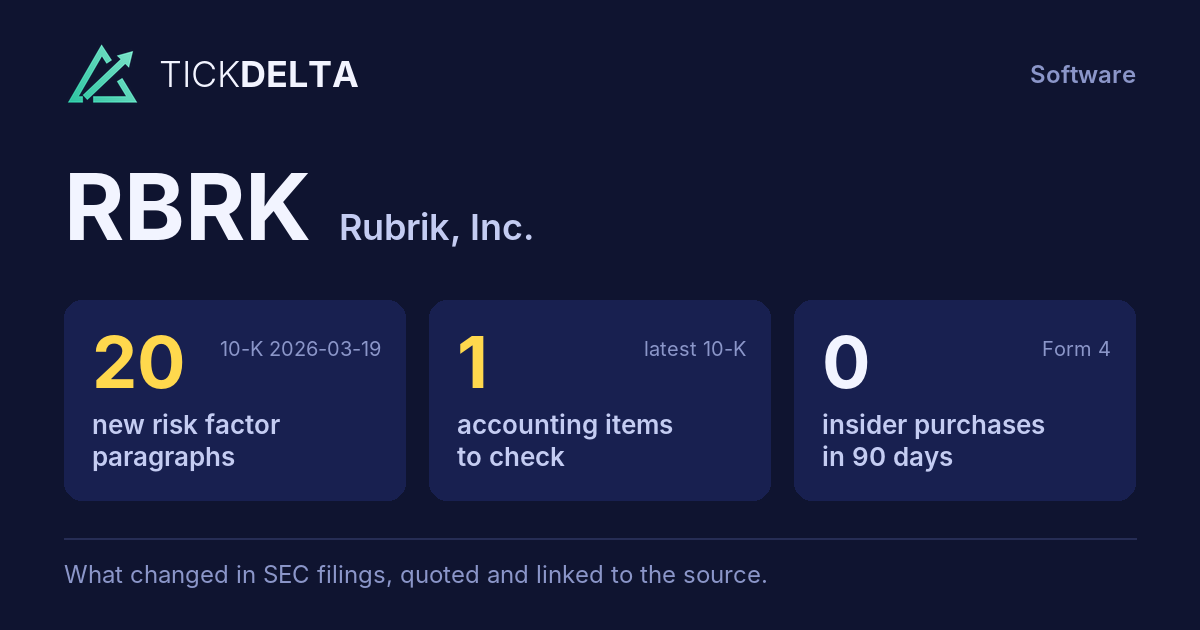
Screener / SEC EDGAR /CIK 0001943896 /10-K filed Mar 19, 2026, compared with Mar 20, 2025 /Numbers from the XBRL of the 10-Ks
NYSE Technology · Software

Rubrik, Inc. RBRK

Compare with peers Embed
The 10-K against last year's

216 changes: 27 added, 22 removed, 161 reworded, 6 quiet changes

10-K Mar 19, 2026 vs Mar 20, 2025

10-K 0001943896-26-000013 (Mar 19, 2026) vs 10-K 0001943896-25-000012 (Mar 20, 2025)

Every paragraph, and how much of it changed

One bar per paragraph, in the order of the 10-K. Height and colour show the share of its words not in the closest paragraph a year earlier; the tallest bars are new paragraphs.

Risk Factors

342 paragraphs · 20 new · 129 reworded · 13 gone · 10-K Mar 19, 2026 against Mar 20, 2025
New paragraph Reworded (5% of its words or more) Same or nearly
Paragraph 21 · 47% changed Every version of it
Although we were founded in December 2013, we only began offering our products and services in the fiscal year ended January 31, 2016, and we began offering RSC as a cloud native SaaS solution in fiscal 2023. 2023, and introduced the RAC suite in fiscal 2026. As a result of our limited operating history, our ability to accurately forecast our future results of operations is limited and subject to a number of uncertainties, including our ability to plan for and forecast future growth. Our historical revenue growth should not be considered indicative of our future performance. Further, in future periods, we expect our revenue growth to fluctuate, slow, and possibly decline for a number of reasons, including mix shifts in our platform and data security products, as well as the impact on products. In future periods, our revenue recognition resulting growth may fluctuate, slow or decline due to a number of factors, including changes in product mix. While we have largely completed both the transition of sales of Rubrik-branded Appliances from us to our contract manufacturers in fiscal 2025 and the transition from selling our products primarily on the basis of subscription term-based licenses to SaaS subscriptions. The timing for this transition new and related implications on our revenue recognition and trends will depend on our ability to transition existing customers to sales of RSC in a timely manner. We are implementing certain initiatives to accelerate fiscal 2026, we expect our existing customers’ migration to RSC as part of our business transition to SaaS, which include enforcement of migration deadlines. These initiatives may be perceived negatively by our customers. For example, these initiatives may require customers to prioritize preparation for their migration over other organizational needs, potentially resulting in diversion of resources. For certain existing customers, the perceived benefits from undertaking the migration may be outweighed by the anticipated time and effort required to prepare for and execute the migration, resulting in potential delays in customers’ transition to RSC. We expect these customers may consume our platform and products through a mix of RSC and a transitional license for Cloud Data Management ("RCDM-T"), for an extended period of time, resulting in the continued recognition of a portion of the associated revenue for some of these customers upfront at the time we transfer control of the license to the customer. Conversely, if some or all of these customers complete their transition to RSC sooner than we expect, less revenue would be recognized upfront during this period, which could cause our subscription revenue to be lower than continue to benefit from customers exercising or forfeiting their Subscription Credits (which are customer options that are accounted for as material rights) through fiscal 2027, although we expect the benefits to significantly reduce sequentially. These business transitions cause fluctuations to our estimates or forecasts or even result in a decrease in our revenue growth rates. Any of these factors could result in continued fluctuations in our total revenue growth and adversely impact limit the comparability of our ability to accurately predict our future revenue. revenue with past performance.
Paragraph 22 · 46% changed Every version of it
In addition, we operate in a new market for data security and AI solutions, and as such we have encountered, and will continue to encounter, risks and uncertainties frequently experienced by growing companies in new and rapidly changing markets, such as the risks and uncertainties described throughout this section. Further, our business and growth strategies are also dependent on continued development, and implementation and integration of our AI offerings and initiatives, including RAC, which is designed to accelerate enterprise AI agent deployments. While we have invested significantly in our AI offerings and initiatives and intend to continue doing so in the future, AI technology is expected to continue to rapidly advance. We may not be successful in obtaining and maintaining market acceptance of our AI offerings and initiatives, including RAC, particularly as competitive technologies and solutions are introduced. Any of these outcomes could harm our business, results of operations, and financial condition.
Paragraph 311 · 40% changed Every version of it
Our stock The capped call transactions may affect the market price may be volatile, of the Notes and the value of our Class A common stock may decline. stock.
Paragraph 291 · 40% changed Every version of it
Furthermore, we may incur significant additional indebtedness in the future. Although the financing documents that govern substantially all of our indebtedness contain restrictions on the incurrence of additional indebtedness and entering into certain types of other transactions, these restrictions are subject to a number of qualifications and exceptions. Additional indebtedness incurred in compliance with these restrictions the future could be substantial. To the extent we incur additional indebtedness, the significant leverage risks described above would be exacerbated.
Paragraph 58 · 39% changed Every version of it
We use generative AI tools in our business, and we expect to use generative AI tools in the future, including to generate code and other materials incorporated into our products, proprietary software, and systems, and for other internal and external uses. Generative AI refers to deep-learning models that can generate new data, such as text, images, and other content, by analyzing and emulating existing data. Advanced generative AI tools, which may produce content indistinguishable from that generated by humans, are a relatively novel development, with benefits, risks, and liabilities still unknown. Recent decisions of governmental entities and courts (such as the U.S. Copyright Office, U.S. Patent and Trademark Office, and U.S. Court of Appeals for the Federal Circuit) interpret U.S. copyright and patent law as limited to protecting works and inventions created by human authors and inventors, respectively. We are therefore unlikely to be able to obtain U.S. copyright or patent protection for works or inventions wholly created by a generative AI tool, and our ability to obtain U.S. copyright and patent protection for source code, text, images, inventions, or other materials, which are developed with some use of generative AI tools, may be limited, if available at all. Likewise, the availability of such IP protections in other countries is unclear. In addition, we may have little or no insight into and no control over the content and materials used by vendors to train these generative AI tools. There is ongoing litigation over whether the use of copyrighted materials to train the AI models used in these tools is lawful, and the impact of decisions in such litigation on our use of generative AI tools is unknown. Additionally, our use of third-party generative AI tools to develop source code, text, images, inventions, or other materials may expose us to greater risks than utilizing contracted human developers, as third-party generative AI vendors typically do not provide warranties or indemnities with respect to the output generated by such generative AI tools, and generative AI tools may also hallucinate, providing output that appears correct but is erroneous. Furthermore, some generative AI tools may be offered under terms that do not protect the confidentiality of the prompts or inputs that users submit to such tools and may use prompts or inputs to train shared AI models, potentially resulting in third-party users receiving outputs containing information from prompts or inputs (including confidential, competitive, proprietary, or personal data) that we submitted to the tool. The disclosure and use of personal data in AI technologies is also subject to various privacy laws and other privacy obligations. Prior to implementing a generative AI tool, our AI governance committee (including leaders from our Engineering, Product, Legal, and Information Security teams) performs an analysis and review of the tool, including evaluation of potential legal, security, and business risks and steps that can be taken to mitigate any such risks. The selection criteria and analysis include consideration of how use of the generative AI tool could raise issues relating to confidential information, personal data and privacy, customer data and contractual obligations, open source software, copyright and other intellectual property rights, transparency, output accuracy and reliability, and security. Additionally, while we employ practices designed to evaluate, track, and mitigate risk around our use of third-party generative AI tools, our practices may not be error free, and our use of such tools may inadvertently violate a third party’s rights, be non-compliant with the applicable terms of use or our other legal obligations, or result in a security or privacy risk or data leakage. Our use of this AI technology could result in additional compliance costs, regulatory investigations and actions, and lawsuits. For example, we may face new or enhanced governmental scrutiny, or claims from third parties claiming infringement of their intellectual property rights or mandatory compliance with open-source software or other license terms with respect to software or other materials or content we believed to be available for use and not subject to license terms or other third-party proprietary rights. Any of these claims could result in legal proceedings and investigations or proceedings. Furthermore, if we are found to be in violation of third party rights based on our use of AI tools, we could require us be required to purchase costly licenses, comply with the requirements of third-party licenses, or limit or cease using the implicated software or other materials or content, unless and until we can re-engineer such software, materials, or content to avoid infringement or change the use of, or remove, the implicated third-party materials, which could reduce or eliminate the value of our technologies and services. Our use of generative and agentic AI tools to generate code may also present additional security risks because the generated source code may contain security vulnerabilities. Additionally, the vendors of these generative AI tools may fail to comply with their contractual obligations to us regarding the confidentiality or security of any data or other inputs provided to such vendor or outputs generated by their generative AI tools. Our sensitive information or that of our customers could be leaked, disclosed, or revealed as a result of or in connection with our employees’, personnel’s, or vendors’ use of third-party generative AI technologies.
Paragraph 28 · 38% changed Every version of it
Furthermore, we have historically sold our products to customers as perpetual licenses with associated maintenance contracts or as subscription term-based licenses with associated support, and with respect to the latter, we recognized a portion of the revenue upfront at the time we transferred control of the subscription term-based license to the customer and deferred the remainder. Moving forward, we expect that We have substantially all completed our transition to offering our platform primarily through SaaS subscriptions, and a significant majority of our new and existing customers will continue to adopt have adopted RSC primarily on a SaaS subscription basis. As of the end of fiscal 2024, RSC 2026, SaaS subscriptions represented a majority of our total revenue. In addition, we We have historically sold Rubrik-branded Appliances to help our customers secure their enterprise data. In also largely completed the third quarter transition of fiscal 2023, we began transitioning the sale sales of Rubrik-branded Appliances from us to our contract manufacturers, manufacturers in fiscal 2025. We expect our subscription revenue to continue to benefit from customers exercising or forfeiting their Subscription Credits (which are customer options that are accounted for as material rights) through fiscal 2027, although we expect the benefits to significantly reduce sequentially. These business transitions may continue to cause fluctuations to our total revenue growth and as a result, limit the amount comparability of our revenue we recognize from sales of Rubrik-branded Appliances with past performance. In addition, the stock-based compensation expense related to our RSUs has resulted in and will continue to decline over time. We expect these transitions result in significant increases in our expenses in future periods, which may negatively impact our ability to adversely affect our revenue as well as our profitability through the fiscal year ending January 31, 2027. However, this timing will depend in part on when a substantial portion of our existing customers complete their transition to RSC. achieve profitability.
Paragraph 3 · 38% changed Every version of it
Our revenue was $1.32 billion, $886.5 million, $627.9 million and $599.8 $627.9 million for the fiscal years ended January 31, 2025, 2024 2026, 2025 and 2023, 2024, respectively. You should not rely on the revenue growth of any prior quarterly or annual period as an indication of our future performance. Even if our revenue continues to increase, we expect that our revenue growth rate will fluctuate in the future as a result of a variety of factors, including factors. While we have largely completed both the sales of Rubrik-branded Appliances transitioning from us to our contract manufacturers in fiscal 2025 and the transition for new and existing customers to sales of Rubrik Security Cloud ("RSC"), RSC in fiscal 2026, we expect our subscription revenue to continue to benefit from customers exercising or forfeiting their Subscription Credits (which are customer options that are accounted for which an increasing amount as material rights) through fiscal 2027, although we expect the benefits to significantly reduce sequentially. These business transitions cause fluctuations to our total revenue growth and limit the comparability of our software revenue will be recognized ratably. with past performance.
Paragraph 65 · 35% changed Every version of it
We expect our Our revenue mix to may vary over time due to a number of factors, including the timing of when customers adopt RSC and the mix of our subscriptions for different data security products. products and the timing of remaining customer migrations to RSC or other SaaS offerings. Our subscription revenue includes revenue from sales of subscription term-based licenses, a portion of which is recognized upfront when we transfer control of the subscription term-based license to the customer, and revenue from sales of SaaS subscriptions and support, which is recognized ratably over the contract period. Due to the proportion of As we have substantially completed our contracts trending transition from subscription term-based licenses to SaaS subscriptions, the timing of the migration subscriptions and migrated a significant majority of our existing customers from Cloud Data Management to RSC, the proportion of revenue recognized upfront versus ratably over time has evolved. However, the timing of remaining customer migrations, as well as the estimates and assumptions used to account for certain customers’ customer arrangements, including Subscription Credits (as defined below) (which are customer options that are accounted for as material rights) related to their Refresh Rights (as defined below), Rights, may continue to affect the amount and timing of revenue recognized. In addition, future changes in our product offerings, pricing models, contract structures, customer purchasing patterns, or other business initiatives may further affect our revenue may fluctuate mix and period-to-period the timing of revenue comparisons may not be meaningful, and our past results may not be indicative of future performance. We cannot be certain how long these factors may persist. For example, as our existing customers prepare to migrate to RSC, we expect certain of them to consume our solutions through a mix of RSC and RCDM-T during which time we will continue recognizing a portion of the associated revenue upfront. recognized. These factors make it challenging to forecast our revenue as the mix of solutions and services, the timing of our customers’ RSC transition, as well as the size of contracts, are difficult to predict.

MD&A

103 paragraphs · 7 new · 63 reworded · 9 gone · 10-K Mar 19, 2026 against Mar 20, 2025
New paragraph Reworded (5% of its words or more) Same or nearly
Paragraph 74 · 50% changed
Interest expense Loss on debt extinguishment increased for the fiscal year ended January 31, 2025 primarily 2026 due to the write-off of unamortized debt discount and issuance costs and prepayment premium paid upon the full repayment of borrowings under our Prior Credit Facility and Amended Credit Facility (each as defined below). Facility.
Paragraph 59 · 50% changed
Growth in subscription revenue for the fiscal year ended January 31, 2026 was driven by growth in Subscription ARR and modest some benefits as customers exercised or forfeited their Subscription Credits but also benefited from Credits. For the fiscal 2024 year ended January 31, 2026, non-recurring revenue headwind related to material rights associated with Subscription Credits accounted for approximately $70.2 million. We expect our subscription revenue to continue to benefit from customers exercising or forfeiting their Subscription Credits through fiscal 2027, although we expect the transition benefits to RSC and higher than expected upfront and non-recurring revenue. The higher than expected upfront and non-recurring revenue is also due to higher new sales and renewals of RSC-Private from regulated and government verticals in fiscal 2025 as well as the extension of RCDM-T to some of our customers, as they progress through their adoption of RSC. significantly reduce sequentially.
Paragraph 77 · 46% changed
Interest Our income tax expense increased for the fiscal year ended January 31, 2025 2026 due to higher cash, cash equivalents, and investment balances. increased profits in our foreign subsidiaries, mainly due to non-deductible stock-based compensation.
Paragraph 68 · 43% changed
Sales Research and marketing development expenses increased decreased for the fiscal year ended January 31, 2025. Employee compensation and related expenses increased 2026 primarily driven by $366.5 a decrease of $194.3 million due to $329.1 million of in stock-based compensation expense we recognized after and as a result of higher RSU expense in the completion prior periods related to the recognition of cumulative stock-based compensation expense upon our IPO in April 2024. The decrease was partially offset by an increase of $22.8 million in employee related costs driven by an increase in headcount, an increase of $5.6 million in hosting and increases software expense and $5.4 million in headcount. consulting services expense to support the Company’s growth.
Paragraph 11 · 40% changed
We expect new New and existing customers to continue to adopt have largely adopted RSC. Our new customers We have generally been rapidly adopting the RSC platform. We are actively migrating largely migrated our existing customers from our legacy CDM capabilities to RSC. As part of During this migration, we expect certain existing customers to consume consumed our platform and products through a mix of RSC and a transitional CDM license ("RCDM-T"), during which time we expect to continue recognizing recognized a portion of the associated revenue from these customers upfront at the time we transfer transferred control of the license to the customer. We cannot predict how long these customers will use customer, and we have largely completed this mix before they complete their transition. transition in fiscal 2026. In addition, we expect our subscription revenue will fluctuate when qualified to continue to benefit from customers choose to exercise exercising or forfeit forfeiting their Subscription Credits (which are customer options that are accounted for as material rights) upon their associated expiration date. through fiscal 2027, although we expect the benefits to significantly reduce sequentially.
Paragraph 81 · 40% changed
In June 2022, August 2023, we entered into a $195.0 million credit facility amended and restated the Prior Credit Facility (the "Prior "Amended Credit Facility"), to increase the total borrowing capacity thereunder to $330.0 million, consisting of initial term loans in an aggregate principal amount of $175.0 approximately $289.5 million and delayed draw term loan commitments in an aggregate principal amount of $20.0 approximately $40.5 million. The Prior Credit Facility was scheduled to mature in June 2027. We borrowed the full amount of the initial term loans in June 2022, the proceeds of which were used for general corporate purposes, and subsequently drew approximately $14.5 million of delayed draw term loans to pay accrued quarterly interest payments under the Prior Credit Facility.
Paragraph 28 · 40% changed
Free cash flow was $237.8 million, $21.6 million, $(24.5) million and $(15.0) $(24.5) million for the fiscal year years ended January 31, 2025, 2024 2026, 2025 and 2023, 2024, respectively. Free cash flow for the fiscal year ended January 31, 2025 includes a cash outlay of $22.8 million for employer payroll taxes due to the vesting of certain equity awards in conjunction with the initial public offering. The improvement in free cash flow was primarily due to higher sales that were offset by higher expenses sales, including expenses from Laminar operations, which was acquired in August 2023, a decrease in contract term due to the growth timing of renewals, improved operating leverage and optimizing our Cloud and SaaS products, and an increasing mix of annual and consumption payments from customers. capital structure. This trend when combined with changes in new business growth, may result in free cash flow volatility across periods.
Paragraph 63 · 37% changed
Cost of other revenue increased decreased for the fiscal year ended January 31, 2025 2026 primarily due to $14.5 driven by a $15.0 million decrease in stock-based compensation expense we recognized after and expense, as a result of higher RSU expense in the completion prior period related to the recognition of cumulative stock-based compensation expense upon our IPO, partially offset by a IPO. The remaining decrease in is due to lower costs associated with decreased sales of Rubrik-branded Appliances costs Appliances, as the transition of $10.9 million as we are transitioning the sale sales of Rubrik-branded Appliances from us to our contract manufacturers. manufacturers was largely completed in fiscal 2025.

A paragraph is matched with the one last year that shares the most of its words; under half in common makes it new. The paragraphs shown are the 8 reworded the most in each section.

The paragraph that changed most in each section

The redline

Marked against last year's 10-K: cut words struck through, new words highlighted.

Risk Factors468 words changed in this paragraph; it is 67% similar to last year's version.
We use generative AI tools in our business, including generative AI and agentic AI, and we expect to use generative AI tools in the future, including to generate code and other materials incorporated into our products, proprietary software, and systems, and for other internal and external uses. Generative uses, and we are making investments to expand our generative and agentic AI refers to deep-learning models that can generate new data, capabilities, including recent and future product offerings such as text, images, and other content, by analyzing and emulating existing data. Rubrik Agent Cloud, which is designed to accelerate enterprise AI agent deployments. Advanced generative AI tools, which may produce content indistinguishable from that generated by humans, are a relatively novel development, with benefits, risks, and liabilities still unknown. Recent decisions of governmental entities and courts (such as the U.S. Copyright Office, U.S. Patent and Trademark Office, and U.S. Court of Appeals for the Federal Circuit) interpret U.S. copyright and patent law as limited to protecting works and inventions created by human authors and inventors, respectively. We are therefore unlikely to be able to obtain U.S. copyright or patent protection for works or inventions wholly created by a generative AI tool, and our ability to obtain U.S. copyright and patent protection for source code, text, images, inventions, or other materials, which are developed with some use of generative AI tools, may be limited, if available at all. Likewise, the availability of such IP protections in other countries is unclear. In addition, we may have little or no insight into and no control over the content and materials used by vendors and model providers to train these generative AI tools. tools, or that otherwise use or incorporate these generative AI tools into their own offerings. There is ongoing litigation over whether the use of copyrighted materials to train the AI models used in these tools is lawful, and the impact of decisions in such litigation on our use of generative AI tools is unknown. Furthermore, our vendors who use generative and agentic AI tools in their own offerings may not meet existing or rapidly evolving regulatory or industry standards, including with respect to the rights of others, privacy and data security. Additionally, our use of open-source and other third-party generative and agentic AI tools tools, including to develop source code, text, images, inventions, or other materials materials, may expose us to greater risks than utilizing contracted human developers, as third-party generative such AI vendors tools typically do not provide come with warranties or indemnities with respect to the output generated by such generative AI tools, and generative and agentic AI tools may also hallucinate, providing erroneous output that appears correct but is erroneous. or making erroneous decisions. Furthermore, some generative AI tools may be offered under terms that do not protect the confidentiality of the prompts or inputs that users submit to such tools and may use prompts or inputs to train shared AI models, potentially resulting in third-party users receiving outputs containing information from prompts or inputs (including confidential, competitive, proprietary, or personal data) that we submitted to the tool. The disclosure and use of personal data in AI technologies is also subject to various privacy laws and other privacy obligations. Prior to implementing a an AI tool (including generative AI tool, tools), our AI governance committee (including leaders from our Engineering, Product, Legal, and Information Security teams) performs an analysis and review of the tool, each AI tool for which pre-approval is required according to our policies, including evaluation of potential legal, security, and business risks and steps that can be taken to mitigate any such risks. The selection criteria and analysis include consideration of how use of the generative AI tool could raise issues relating to confidential information, personal data and privacy, customer data and contractual obligations, open source software, copyright and other intellectual property rights, transparency, output accuracy and reliability, and security. Additionally, while we employ practices designed to evaluate, track, and mitigate risk around our use of third-party generative AI tools, our use of such tools may inadvertently violate a third party’s rights, be non-compliant with the applicable terms of use or our other legal obligations, or result in a security or privacy risk or data leakage. Our use of this technology could result in additional compliance costs, regulatory investigations and actions, and lawsuits. For example, we may face claims from third parties claiming infringement of their intellectual property rights or mandatory compliance with open-source software or other license terms with respect to software or other materials or content we believed to be available for use and not subject to license terms or other third-party proprietary rights. Any of these claims could result in legal proceedings and could require us to purchase costly licenses, comply with the requirements of third-party licenses, or limit or cease using the implicated software or other materials or content, unless and until we can re-engineer such software, materials, or content to avoid infringement or change the use of, or remove, the implicated third-party materials, which could reduce or eliminate the value of our technologies and services. Our use of generative AI tools to generate code may also present additional security risks because the generated source code may contain security vulnerabilities. Additionally, the vendors of these generative AI tools may fail to comply with their contractual obligations to us regarding the confidentiality or security of any data or other inputs provided to such vendor or outputs generated by their generative AI tools. Our sensitive information or that of our customers could be leaked, disclosed, or revealed as a result of or in connection with our employees’, personnel’s, or vendors’ use of third-party generative AI technologies.

Source: Item 1A, 10-K 0001943896-26-000013 vs Item 1A, 10-K 0001943896-25-000012

Accounting Policies126 words changed in this paragraph; it is 32% similar to last year's version.
In November 2023, September 2025, the Financial Accounting Standards Board ("FASB") FASB issued Accounting Standards Update (“ASU”) 2023-07, ASU 2025-06, Intangibles - Goodwill and Other - Internal-Use Software: Targeted Improvements to Reportable Segment Disclosures, the Accounting for Internal-Use Software, which updates reportable segment disclosure requirements primarily through enhanced disclosures about significant segment expenses. The modernizes the accounting for internal-use software costs by increasing the operability of the recognition guidance considering different methods of software development. ASU 2025-06 is effective for the Company's annual report for its fiscal year periods beginning February 1, 2024 after December 15, 2027 and interim periods within its fiscal year beginning February 1, 2025, on those annual reporting periods and can be applied prospectively, retrospectively, or with a retrospective basis. Early modified transition approach, with early adoption is permitted. The Company adopted ASU 2023-07 in is assessing the fourth quarter impact of the fiscal year ended January 31, 2025. See Note 14 Segment Reporting. adopting this standard.

Source: Item 8, Note 2 – Basis of Presentation and Summary of Significant Accounting Policies, 10-K 0001943896-26-000013 vs Item 8, Note 2 – Basis of Presentation and Summary of Significant Accounting Policies, 10-K 0001943896-25-000012

MD&A122 words changed in this paragraph; it is 46% similar to last year's version.
Our revenue will fluctuate based on While we have largely completed both the timing sales of Rubrik-branded Appliances transitioning from us to our contract manufacturers in fiscal 2025 and the transition for transitioning our new and existing customers to RSC, including the RCDM-T licenses offered to existing customers, sales of RSC-Private, and when qualified RSC in fiscal 2026, we expect our subscription revenue to continue to benefit from customers choose to exercise exercising or forfeit forfeiting their Subscription Credits, the Credits (which are customer options that are accounted for as material rights. rights) through fiscal 2027, although we expect the benefits to significantly reduce sequentially. These expected trends, when combined with the transition of the sale of Rubrik-branded Appliances from us to our contract manufacturers, will limit and business transitions cause fluctuations to our total revenue growth through fiscal 2027. and limit the comparability of our revenue with past performance. We primarily measure our business on the basis of Subscription ARR, as we believe it best reflects our actual growth and our growth prospects.

Source: Item 7, 10-K 0001943896-26-000013 vs Item 7, 10-K 0001943896-25-000012

Legal Proceedings62 words changed in this paragraph; it is 42% similar to last year's version.
In December 2024, June 2025, the Company entered into three-year contracts amended an existing hosting service contract with certain third-parties for hosting services. a third party. The Company is required amendment extended the original contract term by approximately two years to spend a April 2029, and increased the minimum spending amount by $375.0 million from the original spending commitment of $200.0 million over the term of the contracts. $220.0 million. As of January 31, 2025, 2026, the Company had $178.7 $290.4 million remaining on these commitments. this commitment.

Source: Item 3, via Note 9 – Commitments and Contingencies, 10-K 0001943896-26-000013 vs Item 3, via Note 9 – Commitments and Contingencies, 10-K 0001943896-25-000012

Sentences and paragraphs added, removed or reworded

Every change, by type

Sentences and paragraphs of RBRK's Risk Factors and MD&A, 10-K Mar 19, 2026 against 10-K Mar 20, 2025. Each links to the text at sec.gov.

Quiet changes are sentences kept from last year with one to four words changed, at least one of them a hedge, a modal or a qualifier (may, could, will, not, significant, material…). A year or date rolling forward is not counted.

The full word list

adverse, adversely, all, although, anticipate, anticipates, any, approximately, believe, believes, can, cannot, certain, could, expect, expects, generally, however, if, intend, intends, largely, likely, many, material, materially, may, might, most, must, never, no, not, possible, primarily, probable, should, significant, significantly, some, substantial, substantially, unlikely, will, would

AddedRisk Factors
Tariffs and other restrictive trade policies, such as those regarding hardware and technology infrastructure from China, have had and may continue to have an indirect impact on the total price customers pay for our products and may also impact production and supply of our Rubrik-branded Appliances and the commodity servers compatible with our solutions. These impacts could negatively affect customer experience, demand, and the attractiveness of our solutions relative to alternatives.
Read it in 10-K Mar 19, 2026 at sec.gov
AddedRisk Factors
Our AI Products may also rely on certain third party providers of AI technology. Our success in deploying AI features and tools for our AI Products is reliant on these third parties and their platforms. We cannot control the quality, availability or pricing of such third-party platforms, especially in a highly competitive environment. If any such third-party platforms become incompatible with our offerings or unavailable for use or have degradations in performance, or if the providers of such models unfavorably change the terms on which their AI platforms are offered or terminate their relationship with us, our solutions may become less appealing to our customers. In addition, for any third party providers of AI platforms that host platforms on our behalf any disruption, outage, or loss of information, data breaches, cybersecurity threats or other data loss through such hosted services could disrupt our operations or solutions, damage our reputation, cause a loss of confidence in our solutions, or result in legal claims or proceedings, for which we may be unable to recover damages from the affected provider.
Read it in 10-K Mar 19, 2026 at sec.gov
AddedRisk Factors
Also, the rapid evolution of AI technologies may require the expenditure of significant resources to design, develop, test and maintain our products and services to help ensure that our AI features and tools are implemented in accordance with applicable law and regulation and in a socially responsible manner and to minimize any real or perceived unintended harmful impacts. We also may need to expend further resources to adjust our business practices, as these laws and regulations evolve, especially where requirements across jurisdictions are inconsistent.
Read it in 10-K Mar 19, 2026 at sec.gov
AddedRisk Factors
•timing of our customers exercising or forfeiting their Subscription Credits (which are customer options that are accounted for as material rights), including the impact on our revenue recognition and causing fluctuations to our total revenue growth and limit the comparability of our revenue with past performance;
Read it in 10-K Mar 19, 2026 at sec.gov
AddedRisk Factors
Our ability to make scheduled payments of the principal of, to pay special interest, if any, on or to refinance the Notes, depends on our future performance, which is subject to economic, financial, competitive and other factors beyond our control. Our business may not continue to generate sufficient cash flow from operations to service our debt and make necessary capital expenditures. If we are unable to generate such cash flow, we may be required to adopt one or more alternatives, such as selling assets, restructuring debt, or obtaining additional equity capital on terms that may be onerous or highly dilutive. Our ability to refinance the Notes will depend on the capital markets and our financial condition at such time. We may not be able to engage in any of these activities or engage in these activities on desirable terms, which could result in a default on our debt obligations. In addition, any of our future debt agreements may contain restrictive covenants that may prohibit us from adopting any of these alternatives. Our failure to comply with these covenants could result in an event of default which, if not cured or waived, could result in the acceleration of our debt repayment.
Read it in 10-K Mar 19, 2026 at sec.gov
Show the other 62
AddedRisk Factors
Holders of the Notes will have the right, subject to certain conditions and limited exceptions, to require us to repurchase all or any portion of their Notes upon the occurrence of a fundamental change (as defined and described in the Indenture). In addition, upon any conversion of the Notes, unless we elect to deliver solely shares of our Class A common stock to settle such conversion, we will be required to make cash payments in respect of the Notes being converted. However, we may not have enough available cash or be able to obtain financing at the time we are required to make repurchases of Notes surrendered therefor or pay cash with respect to Notes being converted. Our failure to repurchase the Notes at a time when the repurchase is required by the Indenture or to pay any cash payable on future conversions of the Notes as required by the Indenture would constitute a default under the Indenture. If the repayment of the related indebtedness were to be accelerated, we may not have sufficient funds to repay the indebtedness and repurchase the Notes or make cash payments upon conversions of the Notes.
Read it in 10-K Mar 19, 2026 at sec.gov
AddedRisk Factors
•uncertainty with respect to legal standards regarding the existence, validity and enforceability of proprietary rights in outputs from AI platforms (including those that we may use for coding our products and tools).
Read it in 10-K Mar 19, 2026 at sec.gov
AddedRisk Factors
We may also become subject to new laws that regulate non-personal information. For example, the European Union’s Data Act imposes certain data and cloud service interoperability and switching obligations to enable users to switch between cloud service providers without undue delay or cost, as well as certain requirements concerning cross-border international transfers of, and governmental access to, non-personal information outside the European Economic Area. Depending on how this Act and any similar laws are implemented and interpreted, we may have to adapt our business practices, contractual arrangements, and services to comply with such obligations, which could impact our revenue and results of operations, if such changes impact our customers’ subscription terms.
Read it in 10-K Mar 19, 2026 at sec.gov
AddedRisk Factors
Additionally, the U.S. Department of Justice issued a rule entitled the Preventing Access to U.S. Sensitive Personal Data and Government-Related Data by Countries of Concern or Covered Persons, which places additional restriction on certain data transactions involving countries of concern (e.g., China, Russia, Iran) and covered persons that may impact certain business activities such as vendor engagements, sale or sharing of data, employment of certain individuals, and investor agreements. Violations of the rule could lead to significant civil and criminal fines and penalties.
Read it in 10-K Mar 19, 2026 at sec.gov
RemovedRisk Factors
In addition, following the completion of our IPO, the stock-based compensation expense related to our RSUs has resulted in and will continue to result in significant increases in our expenses in future periods, which may negatively impact our ability to achieve profitability.
Read it in 10-K Mar 20, 2025 at sec.gov
RemovedRisk Factors
The terms of the financing documents governing our term loan and credit facilities restrict our current and future operations, particularly our ability to respond to changes or to take certain actions.
Read it in 10-K Mar 20, 2025 at sec.gov
RemovedRisk Factors
The financing documents governing our credit facilities impose significant operating and financial restrictions on us and may limit our ability to engage in acts that may be in our long-term best interests, including restrictions on our ability to:
Read it in 10-K Mar 20, 2025 at sec.gov
RemovedRisk Factors
As a result of the restrictions described above, we will be limited as to how we conduct our business, and we may be unable to raise additional debt or equity financing to compete effectively or to take advantage of new business opportunities. The terms of any future indebtedness we may incur could include more restrictive covenants. We cannot assure you that we will be able to maintain compliance with these covenants in the future and, if we fail to do so, that we will be able to obtain waivers from the lenders or amend the covenants.
Read it in 10-K Mar 20, 2025 at sec.gov
RemovedRisk Factors
Our failure to comply with the restrictive covenants described above as well as other terms of our indebtedness or the terms of any future indebtedness we may incur from time to time could result in an event of default, which, if not cured or waived, could result in our being required to repay these borrowings before their due date. If we are forced to refinance these borrowings on less favorable terms or are unable to refinance these borrowings, our business, financial condition, and results of operations could be adversely affected.
Read it in 10-K Mar 20, 2025 at sec.gov
RemovedRisk Factors
We are an “emerging growth company,” and we cannot be certain if the reduced reporting and disclosure requirements applicable to emerging growth companies will make our Class A common stock less attractive to investors.
Read it in 10-K Mar 20, 2025 at sec.gov
RemovedRisk Factors
We are an “emerging growth company,” as defined in the JOBS Act, and we may take advantage of certain exemptions from various reporting requirements that are applicable to other public companies that are not “emerging growth companies,” including the auditor attestation requirements of Section 404, reduced disclosure obligations regarding executive compensation in our periodic reports and proxy statements, and exemptions from the requirements of holding a nonbinding advisory vote on executive compensation and stockholder approval of any golden parachute payments not previously approved. Pursuant to Section 107 of the JOBS Act, as an emerging growth company, we have elected to use the extended transition period for complying with new or revised accounting standards until those standards would otherwise apply to private companies. As a result, our consolidated financial statements may not be comparable to the financial statements of issuers who are required to comply with the effective dates for new or revised accounting standards that are applicable to public companies, which may make our Class A common stock less attractive to investors. In addition, if we cease to be an emerging growth company, we will no longer be able to use the extended transition period for complying with new or revised accounting standards.
Read it in 10-K Mar 20, 2025 at sec.gov
RemovedRisk Factors
We will remain an emerging growth company until the first to occur of: (1) the last day of the year following the fifth anniversary of our IPO; (2) the last day of the first year in which our annual gross revenue is $1.235 billion or more; (3) the date on which we have, during the previous rolling three-year period, issued more than $1.0 billion in non-convertible debt securities; and (4) the date we qualify as a “large accelerated filer,” with at least $700 million of equity securities held by non-affiliates.
Read it in 10-K Mar 20, 2025 at sec.gov
RewordedRisk Factors
There are a The limited number of contract manufacturers and original equipment manufacturers of that produce commodity servers that are compatible with our data security solutions, solutions are susceptible to supply chain disruptions and failure have recently experienced shortages of key components for their servers, which may adversely affect our ability to accurately forecast demand for these commodity servers or successfully manage the relationship with such manufacturers manufacturers, and could negatively impact the ability to sell demand for our offerings. offerings, and adversely affect our business and financial results.
Read it in 10-K Mar 19, 2026 at sec.gov
RewordedRisk Factors
If we are unable to manage our relationship with Supermicro effectively, or if Supermicro suffers continues to suffer delays or disruptions for any reason, including due to recent reports of challenges at Supermicro, experiences the global chip shortage that the broader industry is currently experiencing, any other component allocation constraints, increased manufacturing lead-times, capacity constraints, quality control problems in its manufacturing operations, potential delays or increased costs from international trade disputes, tariffs or other protectionist measures, or fails to meet our requirements for timely delivery, or if Supermicro no longer produces the servers for our Rubrik-branded Appliances, our indirect costs may increase and our end-customer’s ability to procure Rubrik-branded Appliances in a timely manner would be impaired. impaired to the extent that any alternative commodity servers are available at all.
Read it in 10-K Mar 19, 2026 at sec.gov
RewordedRisk Factors
We use generative AI tools in our business, including generative AI and agentic AI, and we expect to use generative AI tools in the future, including to generate code and other materials incorporated into our products, proprietary software, and systems, and for other internal and external uses. uses, and we are making investments to expand our generative and agentic AI capabilities, including recent and future product offerings such as Rubrik Agent Cloud, which is designed to accelerate enterprise AI agent deployments.
Read it in 10-K Mar 19, 2026 at sec.gov
RewordedRisk Factors
We have recently commenced the costly and challenging The process of compiling the system and processing process documentation necessary to perform the evaluation needed to comply with required under Section 404 of the Sarbanes-Oxley Act ("Section 404"), but we may not be able to complete our evaluation, testing, 404") is costly and any required remediation in a timely fashion once initiated. challenging.
Read it in 10-K Mar 19, 2026 at sec.gov
RewordedRisk Factors
If Any debt we incur additional debt, could give the debt holders would have rights senior to holders of common stock our stockholders to make claims on our assets, assets and the terms of any debt could restrict our operations, including involve covenants which may limit our ability to obtain additional capital, pursue business opportunities and strategic transactions and pay dividends on our Class A common stock.
Read it in 10-K Mar 19, 2026 at sec.gov
RewordedRisk Factors
Any Furthermore, if we are found to be in violation of these claims third party rights based on our use of AI tools, we could result in legal proceedings and could require us be required to purchase costly licenses, comply with the requirements of third-party licenses, or limit or cease using the implicated software or other materials or content, unless and until we can re-engineer such software, materials, or content to avoid infringement or change the use of, or remove, the implicated third-party materials, which could reduce or eliminate the value of our technologies and services.
Read it in 10-K Mar 19, 2026 at sec.gov
RewordedRisk Factors
Additionally, our use of open-source and other third-party generative and agentic AI tools tools, including to develop source code, text, images, inventions, or other materials materials, may expose us to greater risks than utilizing contracted human developers, as third-party generative such AI vendors tools typically do not provide come with warranties or indemnities with respect to the output generated by such generative AI tools, and generative and agentic AI tools may also hallucinate, providing erroneous output that appears correct but is erroneous. or making erroneous decisions.
Read it in 10-K Mar 19, 2026 at sec.gov
RewordedRisk Factors
Even if our revenue continues to increase, we expect that our revenue growth rate will fluctuate in the future as a result of a variety of factors, including our transition for new and existing customers to sales of Rubrik Security Cloud ("RSC"), for which an increasing amount of our software revenue will be recognized ratably. factors.
Read it in 10-K Mar 19, 2026 at sec.gov
RewordedRisk Factors
Further, in future periods, we expect our revenue growth to fluctuate, slow, and possibly decline for a number of reasons, including mix shifts in our platform and data security products, as well as the impact on our revenue recognition resulting from our transition from selling our products primarily on the basis of subscription term-based licenses to SaaS subscriptions. products.
Read it in 10-K Mar 19, 2026 at sec.gov
RewordedRisk Factors
Moving forward, we expect that We have substantially all completed our transition to offering our platform primarily through SaaS subscriptions, and a significant majority of our new and existing customers will continue to adopt have adopted RSC primarily on a SaaS subscription basis.
Read it in 10-K Mar 19, 2026 at sec.gov
RewordedRisk Factors
Although we currently have an internal audit group, we will have in the past, and may in the future, need to hire additional accounting and financial staff with appropriate public company experience and compile the system and process documentation necessary to perform the evaluation needed to comply with Section 404. experience.
Read it in 10-K Mar 19, 2026 at sec.gov
RewordedRisk Factors
We expect our Our revenue mix to may vary over time due to a number of factors, including the timing of when customers adopt RSC and the mix of our subscriptions for different data security products. products and the timing of remaining customer migrations to RSC or other SaaS offerings.
Read it in 10-K Mar 19, 2026 at sec.gov
Quiet changesRisk Factors
Anti-corruption and anti-bribery laws are interpreted broadly to generally prohibit companies, their officers and employees, and their third-party intermediaries from authorizing, offering, or providing, or in some cases receiving, directly or indirectly, improper payments or benefits to or from recipients persons in the public or private sector.
Read it in 10-K Mar 19, 2026 at sec.gov
Quiet changesRisk Factors
However, given historical challenges to similarly positioned frameworks, it is possible that the Data Privacy Framework is may be invalidated in the future, and we will need to rely on other established transfer mechanisms for cross border transfers.
Read it in 10-K Mar 19, 2026 at sec.gov
Quiet changesRisk Factors
State, local, or foreign governments may interpret existing laws, or have adopted or may adopt new laws, requiring us to calculate, collect and remit taxes on sales in their jurisdictions.
Read it in 10-K Mar 19, 2026 at sec.gov
AddedMD&A
In fiscal 2026, we launched RAC, our AI agent operations suite, to accelerate enterprise AI transformation without introducing added risk. RAC is designed to monitor and audit agentic actions, enforce real-time guardrails for agentic changes, fine-tune agents for accuracy and, finally, undo agent mistakes. Built on our unique architecture that understands data, identity and application contexts, RAC is designed to give customers security, accuracy, and efficiency as they transform their organizations into AI enterprises. As RAC only became commercially available in February of 2026, we expect the RSC suite to continue to be the majority of our revenue in fiscal 2027 and the main driver for ARR growth.
Read it in 10-K Mar 19, 2026 at sec.gov
AddedMD&A
Our overall performance depends in part on worldwide economic and geopolitical conditions and their impact on customer behavior. Macroeconomic conditions, including inflation, fluctuations in interest rates, foreign currency fluctuations, tariffs or other trade restrictions, geopolitical issues, changes in government policy or spending, and other changes in economic conditions, may adversely affect the buying patterns of our customers and prospective customers. For example, in light of current macroeconomic conditions, such as higher cost-consciousness around information technology budgets, as well as constraints affecting the availability or pricing of compatible commodity servers needed to deploy our solutions, we have observed a lengthening of our sales cycles. Additionally, key components of the commodity servers that are compatible with our solutions have been, and continue to be, adversely affected by global chip shortages and allocation constraints, in part due to elevated industry demand, which in certain cases have resulted in extended lead times and increased server prices. While we have largely completed the sales of Rubrik-branded Appliances transitioning from us to our contract manufacturers in fiscal 2025, such delays, constraints and increased costs may adversely affect our customers’ purchasing decisions and deployment timelines. In response, we may in the future provide commercial accommodations, which could reduce our margins or adversely affect our revenue and operating results if such practices become widespread or prolonged. Due to our subscription-focused business model, any impact of the current macroeconomic environment and supply chain constraints on our business may not be fully reflected in our results of operations until future periods. As we continue to monitor the direct and indirect impacts of the current environment, the broader implications of macroeconomic conditions and supply chain constraints on our business, results of operations and financial condition, particularly in the long term, remain uncertain.
Read it in 10-K Mar 19, 2026 at sec.gov
AddedMD&A
Certain prior period amounts reported in the consolidated financial statements and notes have been reclassified to conform to the current year presentation. For the years ended January 31, 2026, 2025 and 2024, the Company combined maintenance revenue and other revenue into “Other” on the consolidated statements of operations. The presentation of cost of revenue has been conformed to reflect the changes related to the presentation of revenues. Such reclassifications related to the presentation of revenue and cost of revenue did not impact total revenue, loss from operations or net loss.
Read it in 10-K Mar 19, 2026 at sec.gov
AddedMD&A
Other income (expense), net includes foreign exchange gains and losses and fluctuations are driven by the strengthening or weakening of the US dollar against foreign currencies on our foreign-denominated intercompany payables.
Read it in 10-K Mar 19, 2026 at sec.gov
AddedMD&A
In June 2025, we completed a private offering to qualified institutional buyers of $1.15 billion aggregate principal amount of 0.00% convertible senior notes due 2030 (the “Convertible Notes" or "Notes"). The Convertible Notes are general unsecured obligations of the Company and will mature on June 15, 2030, unless earlier converted, redeemed or repurchased. Net proceeds from the issuance of the Convertible Notes were approximately $1.13 billion. The outstanding principal of the Convertible Notes was $1.15 billion as of January 31, 2026.
Read it in 10-K Mar 19, 2026 at sec.gov
AddedMD&A
In connection with the Convertible Notes, we entered into privately negotiated capped call transactions with certain affiliates of certain initial purchasers of the Convertible Notes and other financial institutions (the “Capped Calls”) for a cost of $88.6 million. The Capped Calls are expected generally to reduce the potential dilution to our Class A common stock upon any conversion of the Convertible Notes and/or offset any cash payments we are required to make in excess of the principal amount of converted Convertible Notes, as the case may be, with such reduction and/or offset subject to a cap based on the cap price initially equal to $175.10 per share. We used a portion of the net proceeds from the Convertible Notes to pay the $88.6 million cost of the Capped Calls and repay the outstanding balance of $327.9 million under the Amended Credit Facility. We expect to use the remaining net proceeds from the Convertible Notes for general corporate purposes, which may include acquisitions or strategic investments in complementary businesses or technologies, working capital, operating expenses and capital expenditures.
Read it in 10-K Mar 19, 2026 at sec.gov
RemovedMD&A
In August 2023, we amended and restated the Prior Credit Facility (the "Amended Credit Facility"), to increase the total borrowing capacity thereunder to $330.0 million, consisting of initial term loans in an aggregate principal amount of approximately $289.5 million and delayed draw term loan commitments in an aggregate principal amount of approximately $40.5 million. The Amended Credit Facility will mature in August 2028. We borrowed the full amount of the initial term loans and approximately $4.1 million of delayed draw term loans under the Amended Credit Facility on the closing date of the Amended Credit Facility in order to (i) refinance and replace in full the outstanding term loans under the Prior Credit Facility, (ii) finance the consideration for the acquisition of Laminar, and (iii) pay the accrued quarterly interest under the Prior Credit Facility then due. Borrowings under the Amended Credit Facility will bear interest, at our option, at a rate per annum equal to (i) (x) a base rate equal to the highest of (A) the prime rate as published by The Wall Street Journal, (B) the federal funds rate plus 0.5%, and (C) an adjusted SOFR rate for a one-month interest period plus 1.0% plus (y) a margin of 6.0%, or (ii) an adjusted SOFR rate for a selected interest period plus a margin of 7.0%. We have the option to elect to fund up to 100.0% of the interest payments under the Amended Credit Facility with the incurrence of additional delayed draw term loans, subject to a temporary increase of 0.5% in the annual interest rate due on outstanding term loans for a period of 90 to 180 days from the latest date of incurrence of such additional delayed draw term loans. The annual interest rate on outstanding term loans under the Amended Credit Facility can also decrease by 0.5% if we achieve certain financial targets. In connection with each of the Prior Credit Facility and the Amended Credit Facility, we were also required to pay customary fees for a credit facility of this size and type, including an upfront fee. We have the option to prepay the loans under the Amended Credit Facility at any time subject to a prepayment premium of (i) 1.5% in the first year following the closing of the Amended Credit Facility, (ii) 0.5% in the second year following the closing of the Amended Credit Facility, and (iii) 0.0% thereafter.
Read it in 10-K Mar 20, 2025 at sec.gov
RemovedMD&A
Prior to the IPO, the fair value of the common stock underlying our stock-based awards has historically been determined by our board of directors, with input from management and reference to contemporaneous unrelated independent third-party valuations. We believe that our board of directors has the relevant experience and expertise to determine the fair value of our common stock. Given the absence of a public trading market of our common stock, and in accordance with the American Institute of Certified Public Accountants Practice Aid, Valuation of Privately-Held-Company Equity Securities Issued as Compensation, our board of directors exercised reasonable judgment and considered numerous objective and subjective factors to determine the best estimate of the fair value of our common stock. These factors include:
Read it in 10-K Mar 20, 2025 at sec.gov
RemovedMD&A
The determination of the fair value of our common stock involves the use of estimates, judgments, and assumptions that are highly complex and subjective, such as those regarding our expected future revenue, expenses, future cash flows, discount rates, market multiples, the selection of comparable public companies, and the probability of and timing associated with possible future events.
Read it in 10-K Mar 20, 2025 at sec.gov
RemovedMD&A
In June 2022, our board of directors approved a stock option grant to our CEO, Mr. Sinha to purchase up to 8,000,000 shares of Class B common stock. The CEO Performance Award was granted upon our IPO and vests upon the satisfaction of a service-based condition and the achievement of certain stock price goals. We estimated the grant date fair value of the award using the Monte Carlo simulation method which incorporates multiple stock price paths as well as the possibility that the stock price goals may not be satisfied. One of the judgmental assumptions in the Monte Carlo simulation method is the expected volatility of our common stock price. Since we do not have sufficient trading history of our common stock, we estimated the expected volatility at the grant date by using the historical volatility of a group of comparable publicly traded companies over a period equal to the time to expiration of the options.
Read it in 10-K Mar 20, 2025 at sec.gov
RemovedMD&A
We are an emerging growth company, as defined in the JOBS Act. The JOBS Act provides that an emerging growth company can take advantage of an extended transition period for complying with new or revised accounting standards. This provision allows an emerging growth company to delay the adoption of some accounting standards until those standards would otherwise apply to private companies. We have elected to use the extended transition period under the JOBS Act for the adoption of certain accounting standards until the earlier of the date we (i) are no longer an emerging growth company or (ii) affirmatively and irrevocably opt out of the extended transition period provided in the JOBS Act. As a result, our financial statements may not be comparable to companies that comply with new or revised accounting pronouncements as of public company effective dates.
Read it in 10-K Mar 20, 2025 at sec.gov
RewordedMD&A
Year Ended January 31, 2026 2025 2024 2023 Revenue Subscription 96 % 93 % 86 % 64% Maintenance 3 6 13 86% Other 4 8 23 7 14 Total revenue 100 100 100 Cost of revenue Subscription 18 24 16 10 Maintenance 1 1 3 Other 5 2 6 17 7 Total cost of revenue 20 30 23 30 Gross profit 80 70 77 70 Operating expenses Research and development 28 60 33 29 Sales and marketing 58 98 77 71 General and administrative 20 40 16 14 Total operating expenses 106 198 126 114 Loss from operations (26) (128) (49) (44) Interest income 4 3 2 1 Interest expense (1) (5) (5) (2) Loss on debt extinguishment (1) — — Other income (expense), net — (1) — — Loss before income taxes (25) (130) (52) (45) Income tax expense 2 — 4 1 Net loss (27) % (130) % (56) % (46)% (56)%
Read it in 10-K Mar 19, 2026 at sec.gov
RewordedMD&A
For the fiscal year ended January 31, 2025, 2026, net cash provided by financing activities of $398.0 $736.5 million resulted primarily from $815.2 $800.2 million in proceeds from our IPO and underwriters' exercise issuance of over-allotment option, the Convertible Notes, net of underwriting discounts and commissions, $11.1 full repayment of our Amended Credit Facility, $29.0 million in proceeds from issuance of common stock under employee stock purchase plan, and $8.5 $4.1 million from the exercise of stock options, partially offset by $432.5 $88.6 million paid to purchase Capped Calls and $6.3 million in taxes paid related to the net share settlement of equity awards that vested since our IPO, and $3.5 million for payment of deferred offering costs. awards.
Read it in 10-K Mar 19, 2026 at sec.gov
RewordedMD&A
A discussion regarding our financial condition and results of operations for the fiscal year ended January 31, 2023 2025 compared to the fiscal year ended January 31, 2024 can be found in “Management’s Discussion and Analysis of Financial Condition and Results of Operations” in the final prospectus Annual Report on Form 10-K for our initial public offering (“IPO”) dated as of April 24, 2024 and the fiscal year ended January 31, 2025 filed with the Securities and Exchange Commission (“SEC”) pursuant to Rule 424(b)(4) SEC on April 26, 2024. March 20, 2025.
Read it in 10-K Mar 19, 2026 at sec.gov
RewordedMD&A
Subscription gross margin decreased increased for the fiscal year ended January 31, 2025 due to the stock-based compensation expense we recognized after and 2026 as a result of higher RSU expense in the completion prior periods related to the recognition of cumulative stock-based compensation expense upon our IPO and IPO, partially offset by an increase in hosting costs associated with our development and launch of more SaaS products.
Read it in 10-K Mar 19, 2026 at sec.gov
RewordedMD&A
In June 2022, August 2023, we entered into a $195.0 million credit facility amended and restated the Prior Credit Facility (the "Prior "Amended Credit Facility"), to increase the total borrowing capacity thereunder to $330.0 million, consisting of initial term loans in an aggregate principal amount of $175.0 approximately $289.5 million and delayed draw term loan commitments in an aggregate principal amount of $20.0 approximately $40.5 million.
Read it in 10-K Mar 19, 2026 at sec.gov
RewordedMD&A
Growth in subscription revenue for the fiscal year ended January 31, 2026 was driven by growth in Subscription ARR and modest some benefits as customers exercised or forfeited their Subscription Credits but also benefited from the fiscal 2024 revenue headwind related to the transition to RSC and higher than expected upfront and non-recurring revenue. Credits.
Read it in 10-K Mar 19, 2026 at sec.gov
RewordedMD&A
Other gross margin decreased increased for the fiscal year ended January 31, 2025 due to the stock-based compensation expense we recognized after and 2026 as a result of higher RSU expense in the completion prior periods related to the recognition of cumulative stock-based compensation expense upon our IPO.
Read it in 10-K Mar 19, 2026 at sec.gov
RewordedMD&A
For the fiscal year ended January 31, 2025, 2026, net cash provided by operating activities of $48.2 $282.9 million resulted primarily from a net loss of $1,154.8 $348.8 million, partially offset by $913.9 $329.4 million of stock-based compensation, $90.3 $110.0 million of amortization of deferred commissions, $34.3 million for non-cash interest related to debt, $28.9 $37.1 million for depreciation and amortization, $6.7 million of loss on debt extinguishment, and $141.7 $148.2 million of net cash inflow from changes in operating assets and liabilities.
Read it in 10-K Mar 19, 2026 at sec.gov
RewordedMD&A
As part of During this migration, we expect certain existing customers to consume consumed our platform and products through a mix of RSC and a transitional CDM license ("RCDM-T"), during which time we expect to continue recognizing recognized a portion of the associated revenue from these customers upfront at the time we transfer transferred control of the license to the customer. customer, and we have largely completed this transition in fiscal 2026.
Read it in 10-K Mar 19, 2026 at sec.gov
RewordedMD&A
The combination of both of these factors will may continue to limit and cause fluctuations in our subscription revenue growth through during fiscal 2027, depending in part on the timing of our existing customers’ transition to RSC. RSC and exercises or forfeitures of Subscription Credits (which are customer options that are accounted for as material rights).
Read it in 10-K Mar 19, 2026 at sec.gov
RewordedMD&A
Our primary uses of cash from in operating activities are for employee compensation and related expenses, sales commissions, fees for third-party professional services, colocation and hosting costs, marketing programs, and discretionary cash payments of our debt interest expense pursuant to the terms of our Amended Credit Facility and prepayments of other spend. spend, including hosting prepayments.
Read it in 10-K Mar 19, 2026 at sec.gov
RewordedMD&A
As of January 31, 2025, the The aggregate principal amount of our $322.3 million $1.15 billion debt obligation under the Convertible Notes as of January 31, 2026 is due in fiscal 2029. June 2030.
Read it in 10-K Mar 19, 2026 at sec.gov

Sources

The two latest 10-Ks on EDGAR, section by section. Each change links to the text at sec.gov.

Also

New risk factors: paragraphs with nothing like them last year, quoted in full.

Work with it

Excel workbook · CSV. Google Sheet that stays up to date: paste =IMPORTDATA("https://tickdelta.com/company/RBRK/export.csv") into a cell.

Next:Related parties
Esc

Type a ticker such as AAPL, a name, an investor such as Buffett, or a topic such as tariffs. ↑ ↓ to move, Enter to open.