Form 10-K for the Fiscal Year Ended December 31, 2020
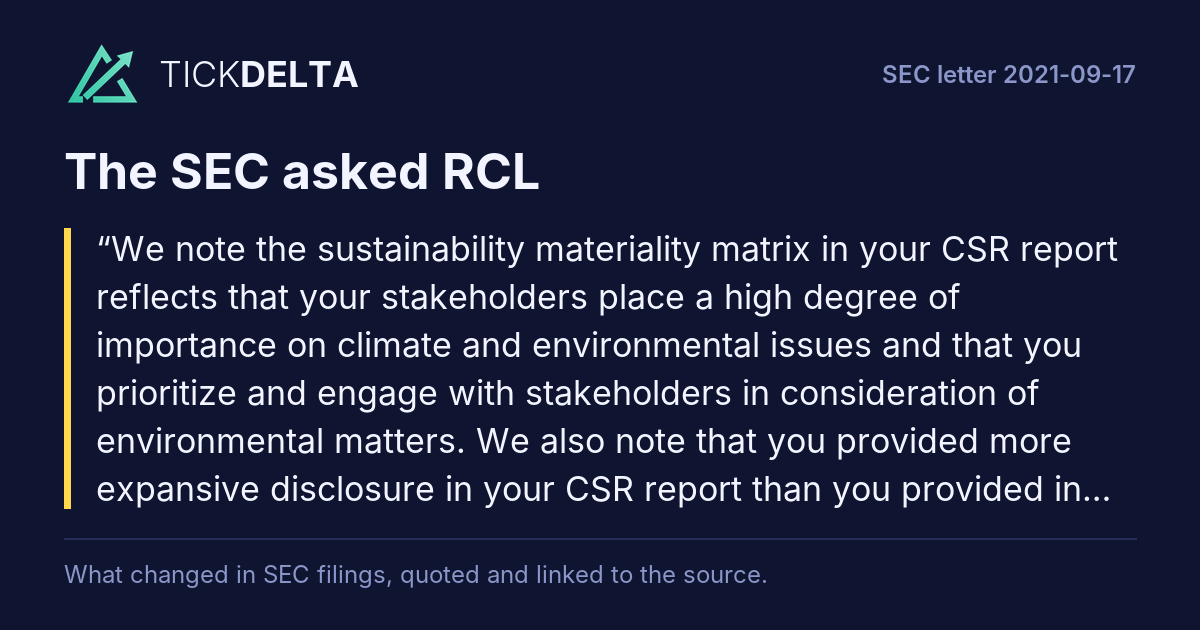
We note the sustainability materiality matrix in your CSR report reflects that your stakeholders place a high degree of importance on climate and environmental issues and that you prioritize and engage with stakeholders in consideration of environmental matters. We also note that you provided more expansive disclosure in your CSR report than you provided in your SEC filings.Rest of the question
Please advise us what consideration you gave to providing the same type of climate-related disclosure in your SEC filings as you provided in your CSR report.
The sustainability materiality matrix in our Seastainability Report reflects the economic, environmental, and social issues on which our company may have an impact or by which our company may be impacted. In that context, as we state in our Seastainability Report, the “matrix serves as the foundation from which the report’s content has been developed and provides a structure from which we can continue to expand upon our commitments to sustainability and sound stewardship.” Accordingly, the disclosures included in our Seastainability Report are designed to address an array of issues of varyingRead in the reply ↗Rest of the answer
degrees of importance to a broad set of stakeholders. In comparison, the disclosures included in our Form 10-K are guided primarily by compliance with the requirements of SEC forms, rules and regulations applicable to our company and are informed by the principle of materiality to investors. As you know, information is deemed material to investors when there is a substantial likelihood that a reasonable investor would attach importance to the information when making an investment or voting decision. Although it may be appropriate in some instances to include in our SEC filings information from our Seastainability Report, the extent to which we do so depends on the applicable disclosure requirements and our assessment of whether the information is material to investors.
In preparing our Form 10-K, we carefully considered the SEC’s guidance on climate-related disclosure contained in SEC Release No. 34-61469.
These considerations included, among other things, the impact of legislation and regulations regarding climate-related matters. In addition, we considered whether developments relating to climate change and other climate-related matters may create new material opportunities or risks that may have indirect consequences on our company, including, among other things, a potential change in consumer demand based on our use of carbon-based energy sources and climate-related concerns and reputational impacts relating to those concerns. We also assessed any material risk and consequences to our company related to the physical impact of climate change.
In our Environmental Regulations disclosures in Item 1 of our Form 10-K, as in our Seastainability Report, we disclosed our compliance efforts and related financial impact of environmental matters, including climate-related matters, that we deemed material to investors. These matters included compliance with the International Maritime Organization’s regulations under the International Convention for the Prevention of
Pollution from Ships (the ‘‘MARPOL Regulations’’) and the International Convention for the Control and Management of Ships Ballast Water and Sediments (Ballast Water Management Convention), in addition to other regional and national regulations, such as EU Directives and the US Vessel General Permit, which include requirements designed to minimize pollution by oil, sewage, garbage, air emissions and the transfer of non-native/non-indigenous species. In our evaluation of incorporating additional climate-related disclosures from our Seastainability Report in our Form
10-K, we considered (a) whether the climate-related matter was a significant factor that could make an investment in our common stock risky or otherwise negatively impact our financial condition or business (as required by Item 105 of Regulation S-K), and (b) whether the climate-related matter was a known trend, event or other uncertainty that could have a material effect on our financial condition and, therefore, should be discussed in Management’s Discussion and Analysis (as required by Item 303 of Regulation S-K).
We believe the disclosures included in our Form 10-K are appropriate and complete in light of the applicable disclosure requirements and materiality to investors. In addition, within the Protect the Environment section of Item 1 in our Form 10-K, we disclose that we publish our Seastainability Report, and although not incorporated by reference to our Form 10-K, we guide the reader to the accessibility of our Seastainability Report within our corporate website. We will continue to evaluate the risks and financial impacts of climate-related matters and will expand our climate-related disclosures in future filings if those matters become or are reasonably expected to become material to our investors.
Your filing and your CSR report as well as the sustainability portion of your website describe initiatives you have undertaken as a part of your environmental stewardship strategy to reduce your emissions of greenhouse gases and other air pollutants. Please revise your disclosure to identify any material past and/or future capital expenditures for climate-related projects.Rest of the question
If material, please quantify these expenditures.
Our environmental regulation disclosures in our Form 10-K, which include disclosures on the fleet-wide implementation efforts of our “advanced emissions purification” system strategy, identify the climate-related projects that support our environmental stewardship strategy and compliance with environmental protection regulations that are most significant to our company.
We disclose that the cost to execute these projects and related compliance efforts has not had a material impact to our results of operation largely due to a number of fleet-wide mitigating steps we have taken over the lastRead in the reply ↗Rest of the answer
several years relating to our environmental protection efforts. We believe that the disclosure in our Form 10-K is appropriate as the incurred and projected capital expenditures related specifically to climate-related projects have not been material to the periods reported therein or future periods. Our largest projected capital expenditures are attributable to our new vessels on order which, as disclosed in our environmental regulation disclosures, are equipped with the aforementioned advanced emissions purification systems and other environmental protection technologies. The expected capital expenditures related to our new vessels on order can be found in the Future Capital Commitments disclosures in Item 1 of our Form 10-K. We will continue to evaluate the financial impacts of our climate-related projects and will expand our disclosure in future filings if such capital expenditures become or are reasonably expected to become material.
If applicable, quantify any material weather-related damages to your property or operations.
Our fleet of vessels continues to represent the largest component of our portfolio of assets, which we generally have the ability to mobilize as weather-related threats such as hurricanes and typhoons arise. Other than the hurricane-related impacts discussed in our MD&A section with respect to our 2019 results, we have not incurred any material weather-related damages to our property or operations for the periods reported within our Form 10-K. We do discuss the risks associated with weather and other climate related events on our property and operations in Item 1A of our Form 10-K.Read in the reply ↗Rest of the answer
To the extent we experience material weather-related damages to our property or operations, we will quantify such impacts in our future filings.
We note your disclosure relating to insurance. If material, disclose any weather-related impacts on the cost or availability of insurance.
In the maritime insurance industry, increases and decreases in insurance premiums tend to be cyclical in nature. These cycles are impacted both by our own loss experience and by losses incurred in direct and reinsurance markets. We historically have been able to obtain insurance coverage in amounts and at premiums we have deemed to be commercially acceptable, and we did not experience any weather-related impacts on the cost or availability of insurance that were material for the periods presented in our Form 10-K.Read in the reply ↗Rest of the answer
To the extent we experience weather-related impacts on the cost or availability of required or desired insurance coverage, we will disclose such impacts in our future filings if material.
Disclose any material litigation risks related to climate change and the potential impact to the company.
We have not experienced, nor do we have any ongoing, climate change related litigation that has resulted or is expected to result in a material impact to our company for the periods reported in our Form 10-K. We do discuss the risks and potential impacts to our company associated with the increasing regulatory focus on climate change in the U.S. and internationally in
Item 1A of our Form 10-K. To the extent material litigation risks related to climate change arise in future periods, we will disclose such risks and potential impacts in our future filings. Read in the reply ↗
We note your environmental regulations disclosure, including your disclosure that compliance with each enumerated environmental regulation did not materially impact your operations, costs and/or results. Please revise your disclosure to quantify any material increased compliance costs related to climate change, including compliance costs associated with these regulations in the aggregate.
In our environmental regulations disclosure, we disclose that the cost to comply with the environmental regulations applicable to our company has not had a material impact to our results of operation largely due to a number of mitigating steps we have taken over the last several years relating to our environmental protection efforts.Read in the reply ↗Rest of the answer
We also disclose that changes and planned amendments in legislation applicable to our company contemplate further obligations and restrictions, which could ultimately result in additional costs that may be material to our operations.
In determining the laws and regulations relating to environmental protection that are most significant to our company, we did consider the SEC’s guidance on climate change disclosure contained in SEC Release No. 34-61469. In consideration of this guidance, we determined that the effects of compliance with current regulations specific to climate change on the operations of our company, and any costs to adhere to such regulations individually or in the aggregate, were not material to the periods reported in our Form 10-K. In addition, Item 1A of our Form 10-K discusses the risks and potential impacts to our company associated with the increasing regulatory focus on climate change in the U.S. and internationally.
In future filings, we will quantify, to the extent applicable, any material increased compliance costs related to climate change, including compliance costs associated with relevant environmental regulations that are material in the aggregate.
Please provide us with additional detail supporting the statement made in response to comment 2 that the incurred and projected capital expenditures related specifically to climate-related projects have not been material to the periods reported therein or future periods, including quantitative information.Rest of the question
As part of your response, include detail regarding climate-related projects other than those related to your advanced emissions purification systems for which you incurred or will incur material capital expenditures.
We reduce our carbon footprint primarily through energy and carbon efficiencies included in the design of our new vessels, our ongoing fleet energy management program and the development of new technologies.
In responding to comment 2 in our letter dated
October 14, 2021, we considered our advanced emissions purifications systems (“AEP”) as well as other projects that address climate-related matters and carbon reduction opportunities.Read in the reply ↗Rest of the answer
Below is the capital cost, consisting of equipment and installation costs, of climate-related projects related to our existing fleet that we considered and concluded to be immaterial for disclosure for each of the periods presented in our Form 10-K for the year ended December 31, 2020:
(In thousands)
2018
2019
2020
Advanced emissions purification systems - retrofits
$ 53,851
$ 62,739
$ 33,178
Other climate-related projects
24,880
34,386
8,507
Climate-related projects capital expenditures
$ 78,731
$ 97,125
$ 41,685
Percentage of Purchases of property and equipment
2.2 %
3.2 %
2.1 %
Our other climate-related projects noted above are categorized into the following five disciplines. Capital expenditures for each discipline for the periods presented in our Form 10-K for the year ended December 31, 2020 are as follows:
HVAC
$ 13,965
$ 19,149
$ 3,839
Machinery
5,651
12,952
3,931
Hydrodynamics
1,990
764
166
Operational Excellence
1,327
730
520
Electrical
1,947
791
$ 24,880
$ 34,386
$ 8,507
Each discipline is defined as follows:
· HVAC - Equipment related to heating, ventilation and air conditioning needs for galleys, accommodation, public spaces, and provisioning rooms refrigeration. Includes upgrades of AC chillers, compressors and fan coils.
· Machinery - Related to main and auxiliary heavy marine equipment. Includes upgrades of engine, steam turbine generator, reverse osmosis, pumps, boilers and other heat exchangers.
· Hydrodynamics - Entails improving propulsion performance and reducing the resistance through the water with more efficient design of air lubrication system, propeller blades, Azipod fins, bow thruster grids and underwater hull coatings.
· Operational Excellence - Entails data management improvements and the development of real time and predictive digital tools to benchmark speed, route, engine, trim and hotel energy performance.
· Electrical – Includes variable frequency drives for machinery and HVAC equipment and lighting upgrades in technical and public space areas including LED bulbs, smart dimmers and sensors.
AEP and other climate-related projects have become standard features of our new vessels and are part of each new vessel’s aggregate cost. While our costs for these features are not generally disaggregated by the builder from each new vessel’s contractual cost, we are able to arrive at a reasonable estimate of disaggregated AEP costs based on our experience installing the equipment on our existing vessels. The estimate of our disaggregated AEP costs in our new vessels is approximately a third of our cost of installing AEP on our existing vessels as no incremental retrofit expenses are required for the new vessels. The estimated disaggregated AEP cost for new vessels delivered in 2018, 2019 and 2020 represented 0.7%,
0.6% and 1.3%, respectively, of the total capital expenditures reported in the same periods, which we concluded to be immaterial for disclosure in our Form 10-K for the year ended December 31, 2020. Whereas the AEP project involves the installation of incremental equipment to our new vessels, our other climate-related projects generally involve equipment that has always been required to operate our vessels but have evolved to address climate-related matters. This makes the determination of a reasonable estimate of the incremental climate-related cost, if any, of such equipment not feasible. However, similar to the installation cost of AEP, the cost of other climate-related projects for our new vessels is further reduced as no retrofit expenses are required on new vessels as compared to our existing vessels. As a result, we believe the incremental cost, if any, of the other climate-related projects on our new vessels is significantly less than those costs listed above for the retrofitting of our existing vessels. Therefore, we determined the costs of AEP and other climate-related projects related to our new vessels to be immaterial for the periods presented in our Form 10-K for the year ended 2020.
At the time of filing our Form 10-K, the ratio of our projected capital expenditures for remaining AEP retrofits and other climate related projects for our existing vessels to projected total capital expenditures was consistent with the historical ratio ranges noted above. Additionally, the ratio of estimated disaggregated costs for AEP for our vessels on order to expected total capital expenditures for new vessels on order were 0.3%. We concluded that these amounts were immaterial for disclosure in our Form 10-K for the year ended December 31, 2020. As noted in our response letter dated October
14, 2021, the expected capital expenditures related to our new vessels on order can be found in the Future Capital Commitments disclosures in Item 1 of our Form 10-K. We will continue to monitor these projected expenditures and enhance our disclosure in future filings to the extent appropriate.
We note from your response to comment 4 that you did not experience any weatherrelated impacts on the cost or availability of insurance that were material for the periods presented. Provide us with additional detail to support this statement, including quantification.
Our property insurance policy coverage period is June 1 to May 31, and the associated premiums for each of the last three policy years ended May 31, 2021 were less than $10 million and less than 1% of our marketing, selling and general expenses (where the insurance premium amortization expenses are recorded) and net income (loss) for the periods presented in our Form 10-K for the year ended December 31, 2020.Read in the reply ↗Rest of the answer
For these coverage periods, we did experience increases in property insurance premiums, and insurance carriers cited a number of reasons for the increases including a rise in natural disasters and other weather-related events. For the same coverage periods, we did not experience any difficulty, weather-related or not, in obtaining our property insurance. We believe the property insurance policy premiums of less than $10 million for each coverage period, as well as any weather-related impacts on the cost or availability of our property insurance, to be immaterial to the periods presented in our Form 10-K for the year ended December 31, 2020. We will continue to monitor and revise future filings as appropriate to the extent such costs become material.
In response to prior comment 5, you state that you have not experienced, nor do you have any ongoing, climate change related litigation that has resulted or is expected to result in a material impact to you. Please provide us with additional support for this statement and tell us how you considered providing disclosure addressing the risks associated with the possibility of climate change related litigation and itsRest of the question
potential impact.
We did not experience any litigation that we reasonably would consider related to climate change during the periods reported in our Form 10-K for the year ended December 31, 2020. Primarily for this reason, we have not viewed the possibility of such litigation and its potential impact on our business as representing a significant or material factor that could cause an investment in our securities to be speculative or risky.Read in the reply ↗Rest of the answer
Thus, although our Form 10-K and subsequent
Forms 10-Q include disclosure concerning litigation risks in general and in relation to specific types of matters, we have not provided disclosure specifically addressing risks associated with the possibility of climate change related litigation and its potential impact.
We will continue to monitor developments in this area, however, and enhance our risk factors disclosure in future filings to the extent appropriate.
Your response to prior comment 6 indicates the cost to comply with applicable environmental regulations has not had a material impact on your results of operation. Tell us about the compliance costs you have incurred and explain how you concluded the related amounts were not material.
Our environmental regulations disclosure indicated that compliance with the following regulations did not materially impact our operations, costs and/or results:
·
MARPOL global ship sulfur emission limitation to 0.5%;
MARPOL Emission Control Areas (“ECA”) ship sulfur emission limitations to 0.1%;
North American and U.S.Read in the reply ↗Rest of the answer
Caribbean Sea ECA nitrogen oxide emission limits;
International Maritime Organization’s (“IMO”) Ballast Water Management Convention discharge standards; and
European Union and IMO requirements to monitor and report ship annual carbon dioxide emissions.
MARPOL global ship sulfur emission limitation to 0.5% and ECA sulfur emission limitations to 0.1%
We incurred an increase in fuel expense for the portion of our fleet that had not been equipped with AEP when complying with MARPOL regulations that imposed special ECAs restricting ship sulfur emissions to 0.1% and, as of January 1, 2020, restricted global sulfur emissions to 0.5%. The higher fuel expense resulted from the incremental cost of compliant fuel. We concluded that the compliance cost was not material based on its incremental impact to our total cruise operating expenses or net income (loss) for the periods presented in our Form 10-K for the year ended December 31, 2020.
Below is the incremental fuel expense as a percentage of total cruise operating expenses and of net income (loss) for each of the periods presented in our Form 10-K for the year ended December 31, 2020:
Incremental Fuel expense
$ 50,396
$ 62,016
$ 67,257
Percentage of Total cruise operating expenses
1.0 %
2.4 % *
Percentage of Net income (loss)
2.8 %
3.3 %
1.2 %
* The increase in the 2020 ratio of
Incremental Fuel expense to Total cruise operating expenses is primarily attributed to a shorter sailing period in 2020 due to
COVID-19 where the itineraries requiring the use of compliant fuel were proportionally more significant to Total cruise operating expenses than they would have been in a full operating year. Additionally, the reduced global IMO limitation of sulfur to 0.5% as of
January 1, 2020 broadly increased our full year 2020 fuel cost for the portion of our fleet that had not been equipped with advanced emissions purification systems.
North American and U.S. Caribbean Sea ECA nitrogen oxide emission limits
In certain ECAs, more stringent nitrogen oxide emission limits were imposed on all new vessels that began construction on or after January 1, 2016. The regulation did not require compliance for vessels that began construction prior to January 1, 2016, resulting in no compliance costs for those vessels. Our compliance with the regulation led to the installation of additional engine equipment for all new vessels starting with Celebrity
Edge which was delivered in 2018. The additional equipment has become a standard feature of our new vessels and is part of each new vessel’s aggregate cost. Our cost for this equipment is not generally disaggregated by the builders from each new vessel’s aggregate contractual cost; however, we are able to arrive at a reasonable estimate of the itemized cost. The estimated disaggregated costs for the additional equipment addressing nitrogen oxide emission regulations for new vessels delivered in 2018, 2019 and 2020 represented 0.2%, 0.2% and 0.5%, respectively, of the total capital expenditures reported in the same periods. Estimated disaggregated costs for additional equipment addressing nitrogen oxide emission regulations to expected total capital expenditures for new vessels on order were 0.3%. We concluded that these amounts were immaterial for disclosure in our Form
10-K for the year ended December 31, 2020. As noted in our response letter dated October 14, 2021, the expected capital expenditures related to our new vessels on order can be found in the Future Capital Commitments disclosures in Item 1 of our Form 10-K.
The cost of consumable fluids used in the additional engine equipment during the three periods presented in our Form 10-K for the year ended December 31, 2020 was approximately $350,000 in the aggregate. We do not expect the projected cost of the consumable fluids to be material to our results of operations in future years.
IMO Ballast Water Management Convention discharge standards
Our compliance with ballast water regulations also resulted in the installation of related equipment to our fleet. The equipment was included in all new vessels starting with Quantum of the Seas which was delivered in 2014. The additional equipment has become a standard feature of our new vessels and is part of each new vessel’s aggregate cost. Our cost for this equipment is not generally disaggregated by the builders from each new vessel’s contractual cost; however, we are able to arrive at a reasonable estimate of the itemized cost based on our experience installing the equipment on our existing ships. The estimate of our new vessel cost for the equipment is approximately 40% of our cost of installing the equipment on our existing ships as no incremental retrofit expenses are required for the new vessels. Our remaining fleet has been retrofitted to include ballast water equipment for compliance, and the related installed equipment cost, approximately $530,000 per ship, was not material individually or in the aggregate to our capital expenditures for the periods presented in our Form 10-K for the year ended 2020. Below is the cost to retrofit our vessels as a percentage of total capital expenditures for each of the periods presented in our Form 10-K for the year ended December 31, 2020:
Ballast water retrofit capital expenditures
$ 1,371
$ 3,853
$ 872
0.04 %
0.13 %
The estimated disaggregated costs for the additional equipment addressing ballast water regulations for new vessels delivered in 2018, 2019 and 2020 represented 0.03%, 0.01% and 0.02%, respectively, of the total capital expenditures reported in the same periods. Estimated disaggregated costs for additional equipment addressing ballast water regulations to total expected total capital expenditures for new vessels on order were
0.02%. We concluded that these amounts were not immaterial for disclosure in our Form 10-K for the year ended December 31, 2020. As noted in our response letter dated October 14, 2021, the expected capital expenditures related to our new vessels on order can be found in the Future Capital Commitments disclosures in Item 1 of our Form 10-K.
European Union and IMO requirements to monitor and report ship annual carbon dioxide emissions
Compliance with EU and IMO carbon dioxide emission monitoring and reporting regulations resulted in the development of a fuel reporting database for the fleet. The cost to develop the database was approximately $75,000 in 2017. Additionally, we incur approximately $5,000 of annual reporting approval and verification costs per vessel. We concluded that these costs were not material for the periods presented in our Form 10-K for the year ended December 31, 2020.
We will continue to monitor and revise future filings as appropriate to the extent that our costs to comply with applicable environmental regulations become material.
Also in this review: request for more time, 2021-10-01, request for more time, 2021-11-08, closing letter, 2022-01-31